


If you've bought crypto assets (also known as virtual currencies), you may simply be leaving them in your exchange account. Another option is to manage them yourself using a wallet app such as MetaMask or a hardware wallet.
Understanding this distinction comes down to two key concepts: "custodial wallets" and "non-custodial wallets." The difference lies in who holds the private key (signature key) needed to move your crypto assets — the service provider or you, the user, yourself.
This article explains the difference between custodial and non-custodial wallets by comparing exchange-managed custody with self-custody. We'll also cover the pros and cons of each, along with cases where it makes sense to use one over the other.
The Difference Between Custodial and Non-Custodial Wallets
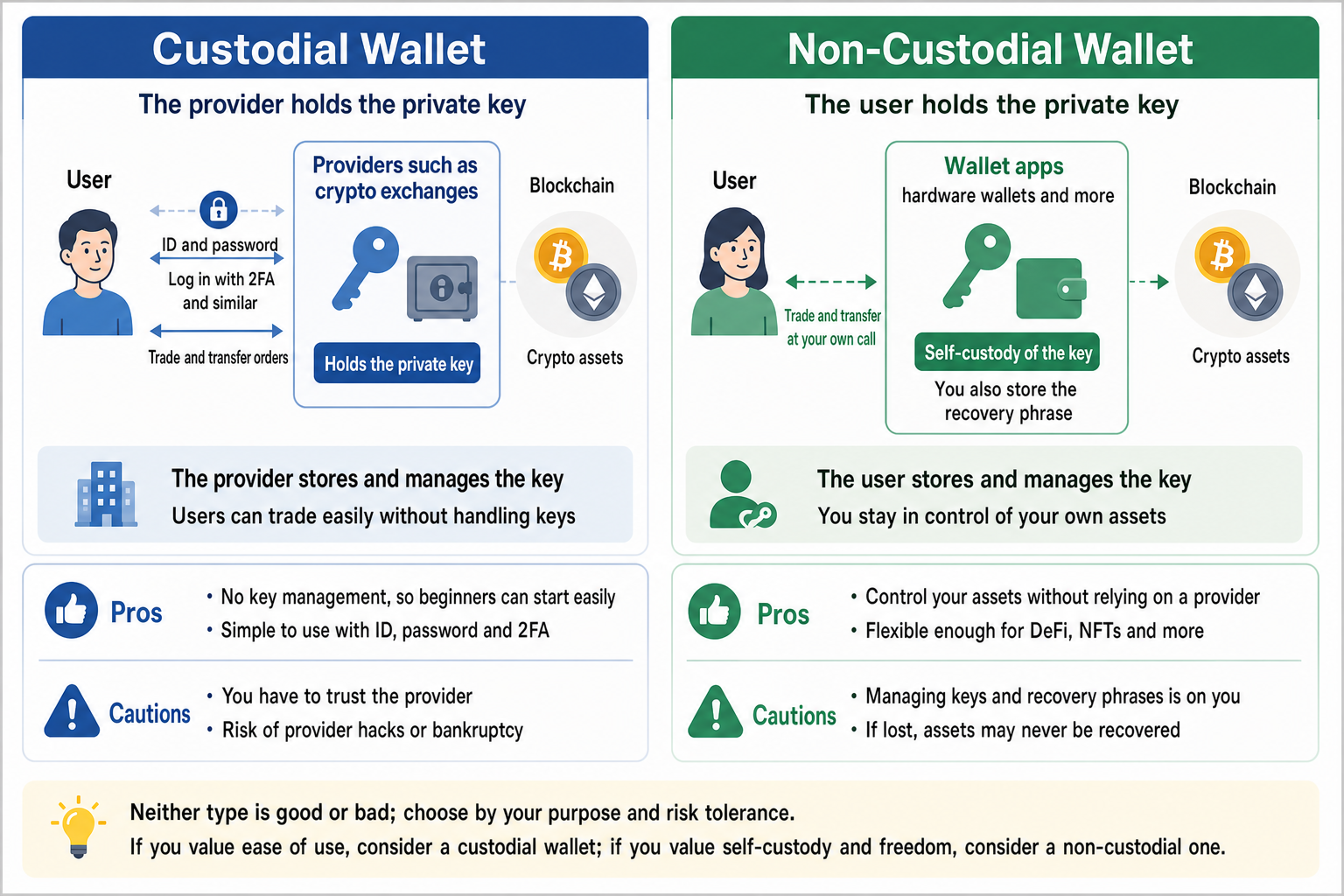
Wallets for managing crypto assets broadly fall into two categories: "custodial wallets" and "non-custodial wallets."
What separates the two is who manages the private key — the essential piece of information required to move crypto assets recorded on a blockchain. Because crypto assets are recorded on a blockchain, moving them requires using a private key to authorize the transaction.
This difference in who manages the key also affects how convenient a wallet is day to day, as well as what you need to watch out for to protect your assets. To choose the wallet that's right for you, let's take a detailed look at how each type works, along with its features, benefits, and points of caution.
Custodial Wallets: The Provider Manages the Private Key
A custodial wallet is a type of wallet where a service provider, such as a Crypto Asset Exchange Service Provider, manages the private key on the user's behalf. "Custody" means safekeeping or management, and true to the name, the provider holds onto the key needed to move your assets.
For example, if you hold crypto assets in an account with a Crypto Asset Exchange Service Provider — Japan-registered exchanges such as bitbank, bitFlyer, or Coincheck — this generally falls under custodial-style management.
Users log in to the exchange using an ID, password, and two-factor authentication, and instruct trades or transfers through the platform's interface. Meanwhile, the private key itself — the key needed to move the crypto assets — is essentially managed by the provider. As a result, users don't need to store or manage the private key themselves.
Because custodial wallets let you leave private key management to the provider, they make it easy to start trading crypto assets even without specialized knowledge. On the other hand, since asset management is entrusted to the provider, how much you can trust that provider becomes an important consideration.
Non-Custodial Wallets: The User Manages the Private Key
A non-custodial wallet is a type of wallet where users manage their own private key and recovery phrase. Because the private key is never entrusted to a provider and stays in the user's own hands, this is also known as a "self-custody wallet."
Well-known examples include the wallet apps below, as well as hardware wallets such as Ledger and Trezor. When using these, the private key and recovery phrase needed to move crypto assets are managed by the user themselves, not by any provider.
- MetaMask
- Trust Wallet
- Phantom
Because non-custodial wallets don't entrust asset management to a provider, they offer a high degree of freedom, letting users control their own crypto assets directly. At the same time, full responsibility for managing the private key and recovery phrase falls on the user, and losing them can mean losing access to the assets for good. This wallet type tends to suit people who prioritize the scope of what they can manage themselves over sheer convenience.
Pros and Cons of Custodial Wallets
Custodial wallets, exemplified by exchanges, serve as the entry point into crypto assets for many users. While they're easy to start using, this same structure comes with points you should be aware of.
What matters is understanding both the benefits and drawbacks accurately, and judging whether they fit how you plan to use them. Choosing a wallet simply because it's "convenient" can leave you thinking, "this isn't what I expected," later on.
Let's look at the specific pros and cons of custodial wallets one by one.
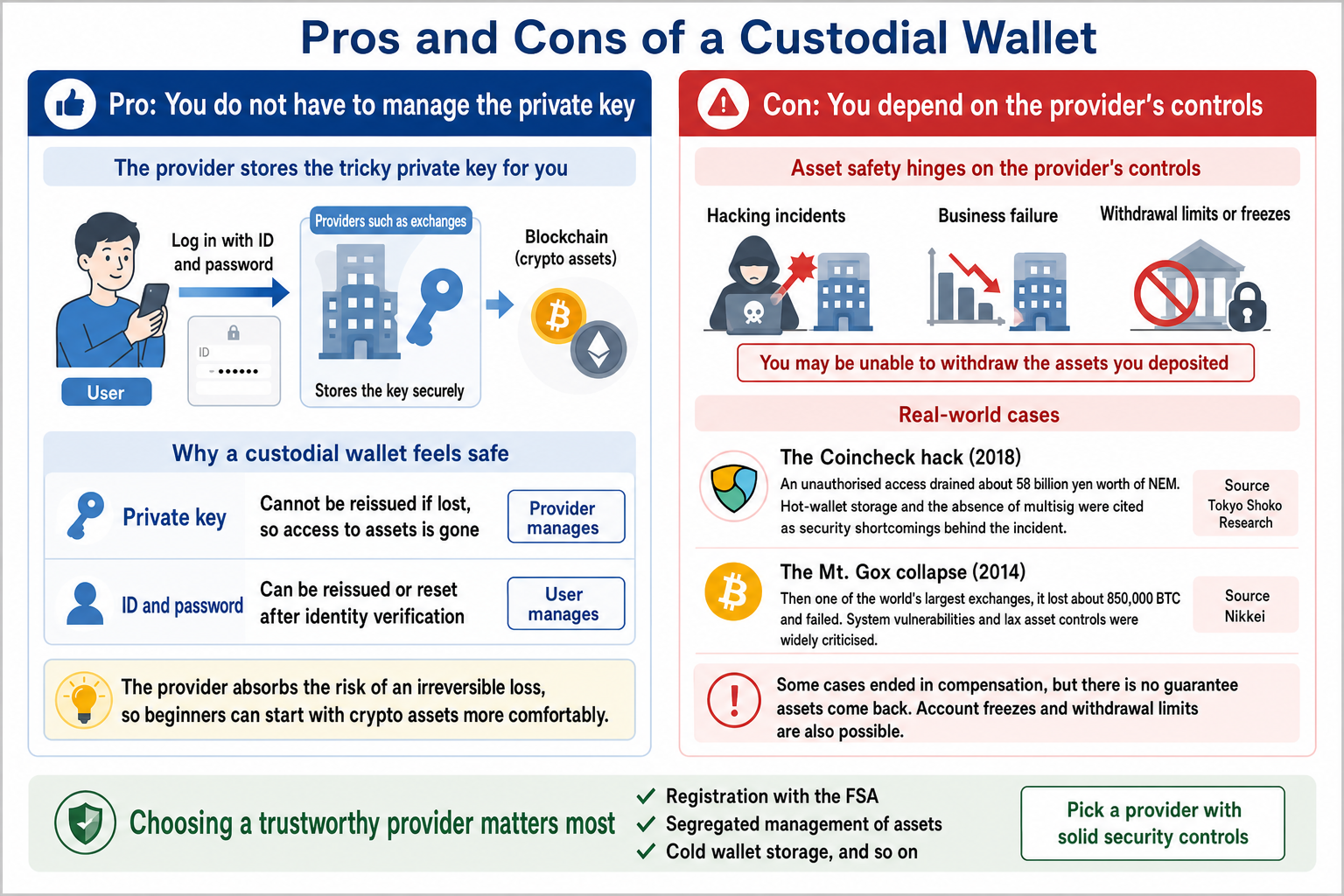
Pro: You Don't Have to Manage the Private Key Yourself
A private key is a "key held only by you" needed to move crypto assets, represented as a string of dozens of letters and numbers. It's comparable to a bank PIN, but the crucial difference is that once you lose it, no one can reissue it for you.
Because crypto assets have no central administrator like a bank, losing or having your private key stolen means permanently losing access to those assets. There's no reissuing it, even if you reach out for help — losing the key means losing the assets.
This is where custodial wallets come in: the provider manages this hard-to-handle private key on your behalf. All the user needs to remember is the ID and password used to log in to the provider.
What's significant here is that even if you forget your ID or password, they can be reissued or reset. Unlike a private key, the provider can verify your identity and handle a reset, so you can avoid the scenario of "accidentally forgetting something and losing all your assets."
In other words:
- Private key: if lost, cannot be reissued, and you lose access to the assets
- ID/password: can be reissued or reset through identity verification, even if forgotten
This difference is exactly what gives custodial wallets their sense of security. For those new to crypto assets, or anyone uneasy about managing keys, having a provider shoulder the risk of unrecoverable loss is arguably a major benefit.
Con: You Depend on the Provider's Management Practices
On the other hand, the drawback of custodial wallets is that the safety of your assets depends heavily on the provider's management practices.
Entrusting your private key to a provider means, conversely, that you're handing over the "key" to access your assets to someone else. As a result, if the provider you've entrusted your assets to suffers a hack or goes bankrupt, the risk of not being able to withdraw the assets you deposited is not zero.
This isn't a purely hypothetical risk — there have been actual cases where inadequate management practices at a provider led to the loss of large amounts of crypto assets.
- The Coincheck incident (2018): Unauthorized access resulted in the outflow of roughly ¥58 billion (approximately US$530 million at the time) worth of the crypto asset NEM. Security shortcomings were cited as contributing factors, including managing the assets in a "hot wallet" that was constantly connected to the internet, and not implementing "multisig," which requires multiple keys for approval (source: Tokyo Shoko Research).
- The Mt. Gox incident (2014): What was then the world's largest Bitcoin exchange lost around 850,000 BTC and collapsed into bankruptcy. Alongside system vulnerabilities, the case highlighted the provider's lax asset management practices (source: Nikkei).
While some cases, like Coincheck's, did include compensation, there's no guarantee that deposited assets will always be returned. Depending on the provider's bankruptcy proceedings, a large portion of assets can remain unreturned as procedures drag on for a long time.
It's also worth noting that, beyond hacks or bankruptcies, a provider could restrict withdrawals or freeze accounts at its own discretion. It's important to keep in mind that "even though the assets are yours, they aren't entirely under your sole control."
To reduce these risks, it's essential to choose a trustworthy provider with solid security practices in place — such as being registered with Japan's Financial Services Agency (FSA), the country's financial regulator, segregating user assets from company assets, and storing assets in cold wallets.
Pros and Cons of Non-Custodial Wallets
A non-custodial wallet is a method of managing your crypto assets yourself. Being able to handle assets freely without relying on a third party is a major appeal, but that same freedom comes with its own pitfalls.
Here, we'll cover the pros and cons of non-custodial wallets.
Pro: You Can Manage Your Crypto Assets Yourself
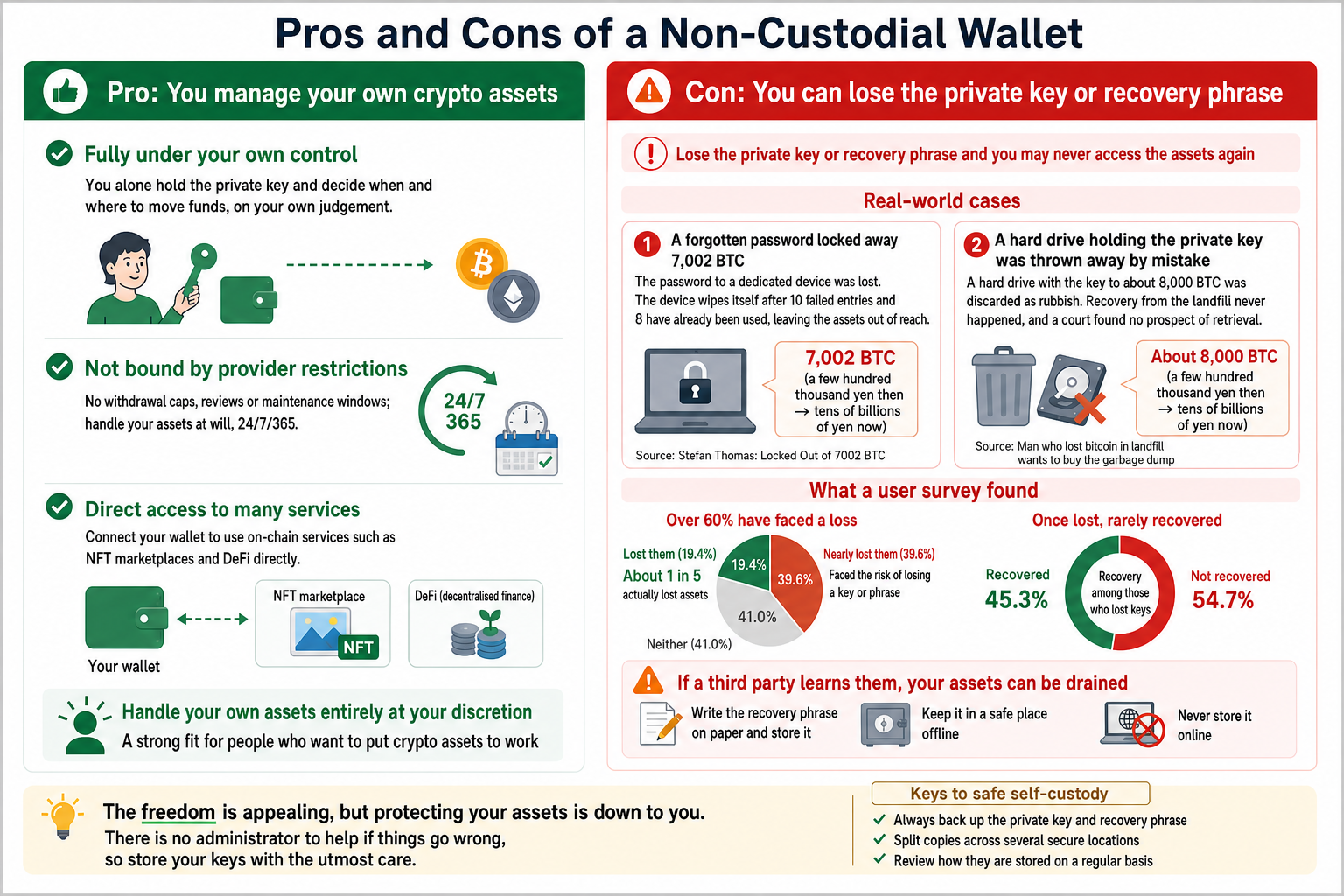
The benefit of a non-custodial wallet is having complete control over your crypto assets. Because only you hold the private key, you alone decide when, how much, and where to move your assets — without needing anyone's permission.
With exchanges, withdrawal limits, account reviews, and maintenance-related suspensions can sometimes prevent you from moving your assets right away. With a non-custodial wallet, you're not subject to such provider-side constraints, and can handle your assets on your own terms, 24 hours a day, 365 days a year.
Non-custodial wallets are also notable for connecting directly to services offered on the blockchain. For example, marketplaces for trading NFTs (assets representing ownership of digital data) and DeFi (decentralized finance) services, which let you exchange and use crypto assets without going through a provider like an exchange, are generally accessed by connecting a wallet. A non-custodial wallet lets you access these kinds of services directly — services that are hard to use if your assets remain parked at an exchange.
In this way, the major appeal of non-custodial wallets lies in being able to handle your own assets entirely at your own discretion. For those who want to take direct, hands-on control of their crypto assets, this can be a powerful option.
Con: Risk of Losing Your Private Key or Recovery Phrase
The flip side of managing everything yourself freely is that you also bear all of the responsibility. The biggest drawback of non-custodial wallets is that losing your private key or recovery phrase can mean permanently losing access to your assets.
With an exchange, even if you forget your login credentials, you can typically have them reset after identity verification. Non-custodial wallets, however, have no such rescue mechanism through an administrator. If you lose or forget your private key or recovery phrase, the assets remain locked away, inaccessible to anyone.
This isn't an exaggeration — it's a serious problem that has actually occurred around the world.
- The case of losing access to 7,002 BTC after forgetting a password
- Programmer Stefan Thomas stored roughly 7,002 BTC he received as payment in 2011 on a dedicated security device. He subsequently lost the piece of paper on which he had written the device's password. The device is designed to wipe its contents after ten failed password attempts, and he had already used eight, leaving him unable to access the remaining assets (source: Stefan Thomas: Locked Out of 7002 BTC).
- The case of accidentally throwing away a hard drive containing a private key
- In the UK, James Howells accidentally discarded a hard drive containing the private key to roughly 8,000 BTC as trash in 2013. Despite years of attempts to recover it from the landfill where it was disposed of, recovery never materialized, and courts have ruled that recovery is not feasible (source: Man who lost bitcoin in landfill wants to buy the garbage dump).
In both cases, the amounts involved were modest at the time, but as Bitcoin's price subsequently surged, the lost assets at one point ballooned to hundreds of millions of dollars (tens of billions of yen) in value. Losing just one key or string of characters can permanently lock away assets of this scale.
These extreme cases might seem like outliers, but the loss of a key or phrase isn't a problem limited to large holders — it's a common trouble that ordinary users run into as well.
In a survey Clabo conducted among crypto asset users, 19.4% (roughly one in five) reported having actually lost assets due to losing a private key or recovery phrase. Including those who came close to losing one, more than 60% of users have experienced either a loss or a near-loss.
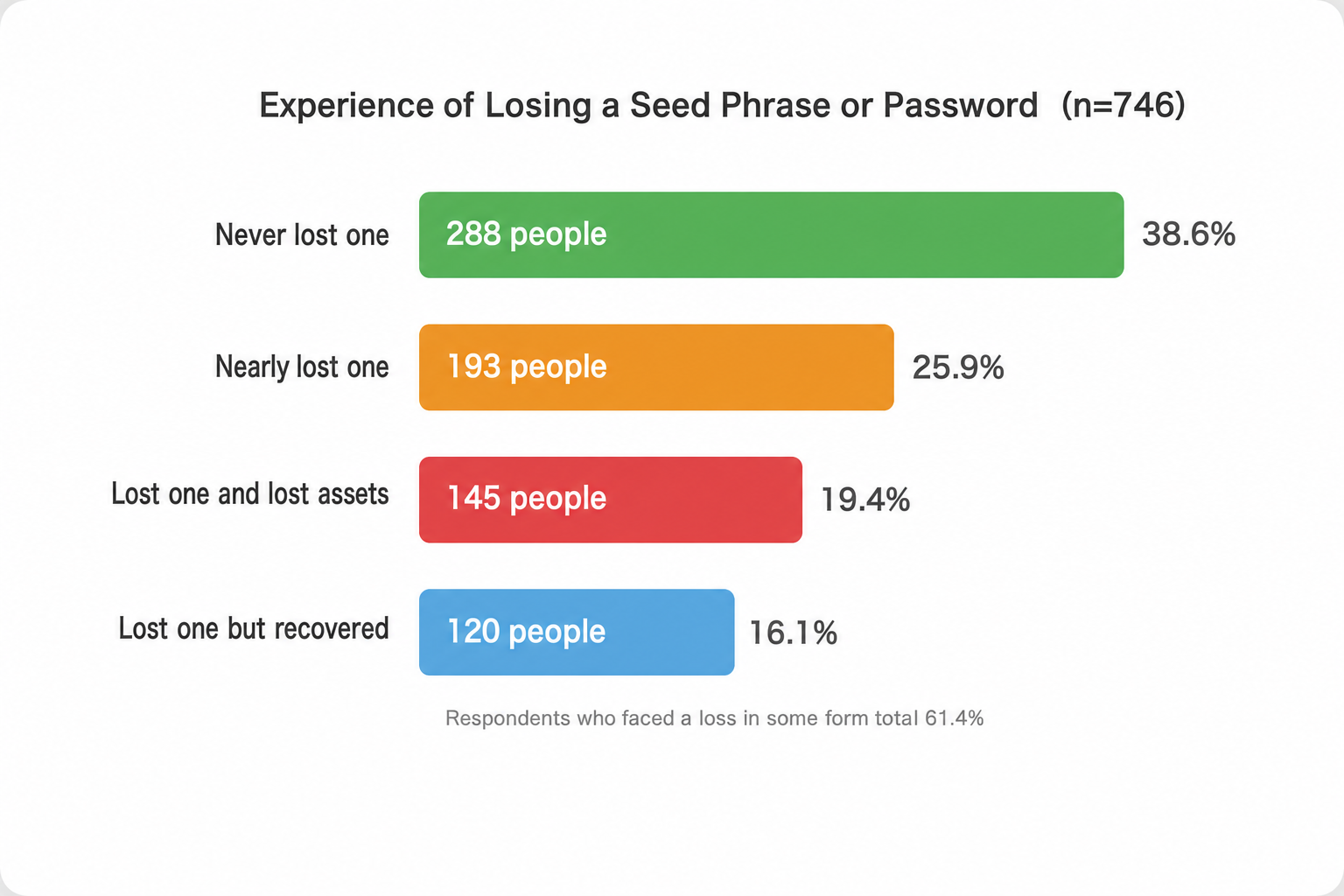
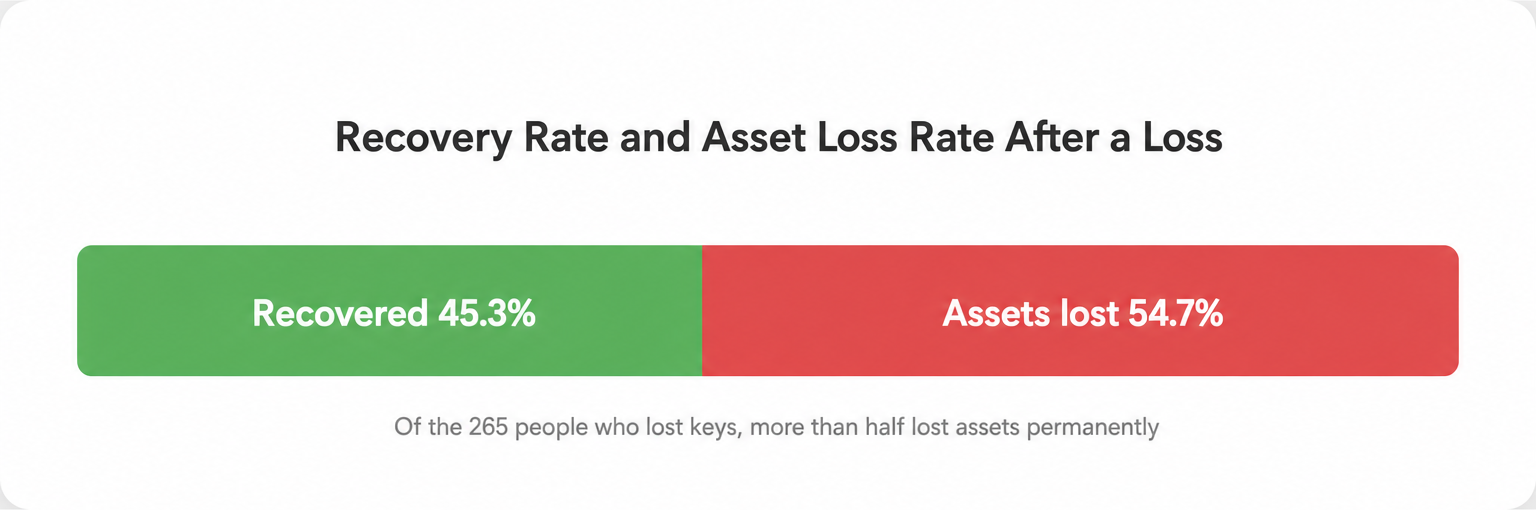
More concerning still, once a key or phrase is lost, recovery is often impossible. Tracking those who actually experienced a loss in the same survey, only 45.3% successfully recovered their assets, while the remaining 54.7% lost their assets permanently. Because there's no administrator to step in and help after identity verification, as there is with a custodial exchange, a single loss can directly translate into a permanent loss of assets.
Beyond the risk of loss, if your private key or recovery phrase falls into someone else's hands, there's also a danger of your assets being withdrawn without your consent. That's why thorough self-management is essential — writing your recovery phrase on paper and storing it offline in a secure location, rather than saving it carelessly online.
In short, non-custodial wallets offer a high degree of freedom, but whether you can protect your assets comes down to your own management. When using one, it's important to fully understand that "there's no administrator to bail you out if something goes wrong," and to take great care in how you store your keys.
How This Differs From Hot Wallets and Cold Wallets
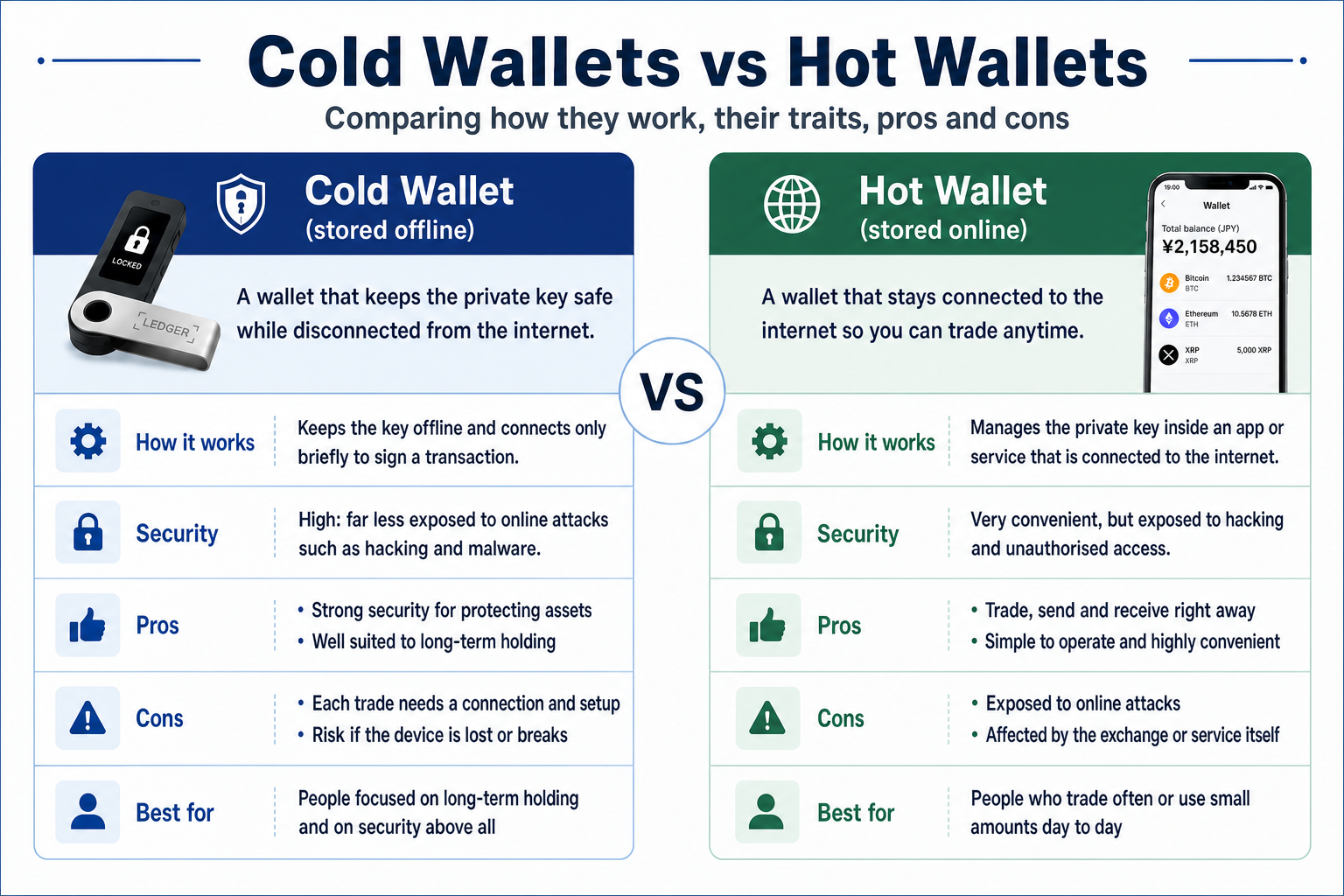
Beyond the "custodial" and "non-custodial" distinction covered so far, wallets are also categorized as "hot wallets" and "cold wallets." Both are terms describing how crypto assets are managed, so they're easy to confuse, but these are two entirely separate classifications.
To put it simply: custodial vs. non-custodial is about "who manages the private key," while hot vs. cold is about "whether it's connected to the internet" — they're not even measuring the same thing. Because it's easy to get confused when choosing a wallet without sorting this out, let's walk through what each term means and how the two relate.
What Are Hot Wallets and Cold Wallets?
Hot wallets and cold wallets are a classification based on "whether or not the wallet is connected to the internet."
A hot wallet is a wallet used while connected to the internet. Smartphone apps, browser extensions, and exchange wallets all fall into this category. They're convenient because you can send and trade instantly at any time, but being constantly connected to the internet also means a higher risk of hacking or unauthorized access. Think of it as an everyday wallet — well suited to keeping a small amount on hand for frequent use.
A cold wallet stores the private key offline, disconnected from the internet. Representative examples include hardware wallets (dedicated small devices) and paper wallets (keys printed on paper). Because it's not connected to the internet, it's resistant to external attacks and offers high security, though it takes extra effort to connect each time you use it. Think of it as a bank vault — well suited to storing a substantial amount of assets for the long term.
In short, hot wallets prioritize convenience, and cold wallets prioritize security. Neither is inherently superior; it comes down to matching the wallet to its purpose, with the basic approach being "hot for everyday use, cold for long-term storage."
"Who Manages It" and "Connection Status" Are Different Axes
The reason "custodial vs. non-custodial" and "hot vs. cold" get confused so often is that people don't realize these classifications are based on entirely different axes. The two divide wallets by completely separate criteria, as shown below.
Classification | Basis for division | What it distinguishes |
Custodial | Who manages the private key (management subject) | Managed by the provider / managed by yourself |
Hot wallet | Whether connected to the internet (connection status) | Always online / stored offline |
As the comparison table above shows, custodial vs. non-custodial describes "who owns the key," while hot vs. cold describes "how the key is protected." These aren't opposing concepts — they're independent axes that should be considered separately.
Management Subject and Connection Status Combine to Define a Wallet
Because who manages the key and whether it's connected to the internet are independent axes, any actual wallet is defined by a combination of the two. Combining them yields four possible patterns, as shown below.
Hot (online) | Cold (offline) | |
|---|---|---|
Custodial | Exchange wallet | Cold storage where the exchange holds customer assets |
Non-custodial | Wallet app / browser extension wallet | Hardware wallet |
As this table shows, it's not simply the case that "non-custodial = cold" and "custodial = hot."
For example, exchanges (custodial) generally keep the bulk of deposited assets in cold storage as a hacking countermeasure. Conversely, plenty of non-custodial wallets — where you manage your own key — are hot, app-based wallets built for everyday convenience.
When choosing a wallet, it's important to weigh both axes together: whether you'd rather entrust asset management to a provider or hold it yourself (management subject), and whether you prioritize transaction convenience or long-term storage security (connection status). Considering both perspectives makes it easier to find the wallet that best fits how you use crypto assets.
When to Use Custodial vs. Non-Custodial Wallets
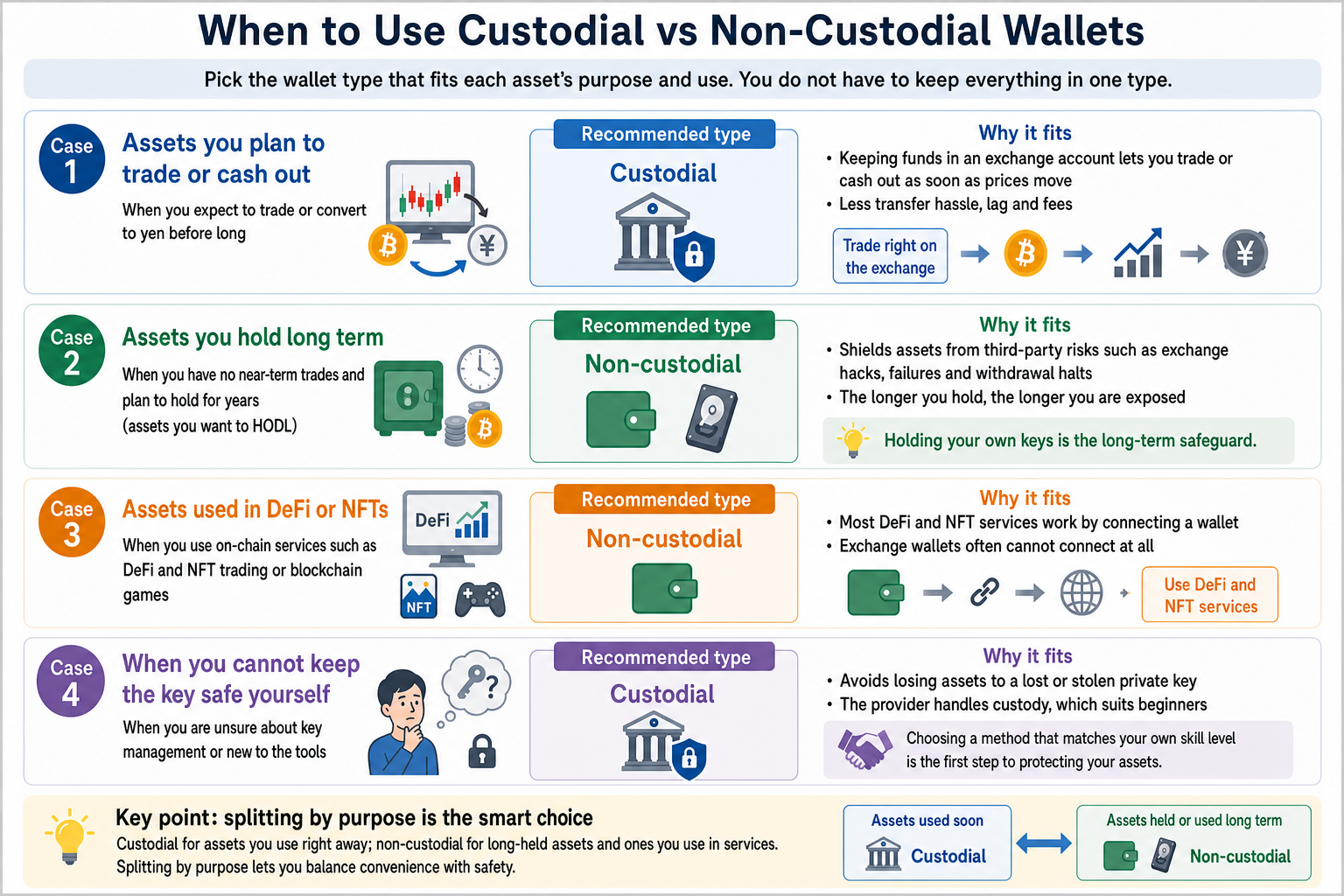
As we've seen, custodial and non-custodial wallets each come with distinct pros and cons. Rather than deciding uniformly which one is "better," the right type depends on what you're using an asset for and how you plan to use it.
What matters is that you don't need to keep all of your assets in a single type of wallet. Splitting management by the purpose of each asset makes it easier to balance convenience and security.
Below, we'll look at four specific cases to help determine which type suits which situation. Chances are one of these will resemble how you use your own assets, so use these cases as a reference for choosing the management method that's right for you.
Assets You Plan to Trade or Cash Out Are Easier to Manage With a Custodial Wallet
Assets you plan to trade or convert to Japanese yen in the near future are easier to manage using a custodial wallet provided by an exchange. Keeping assets in your exchange account lets you trade immediately when the price moves, and the process of cashing out goes smoothly.
If you're managing assets in a non-custodial wallet, you'll need to send them to an exchange each time you want to trade, which takes time, and the market can move while you wait for the transfer to be reflected. Keeping assets at the exchange from the start avoids this kind of lag and associated fees.
The more likely you are to move an asset soon, the greater the benefit of keeping it consolidated at the exchange, which serves as the starting point for trading.
Assets Held for the Long Term Are Also Worth Considering for Non-Custodial Wallets
For assets you don't plan to trade any time soon and intend to hold for years (so-called "HODLing"), a non-custodial wallet is also worth considering.
With a custodial wallet, if the exchange you've deposited assets with runs into trouble — such as a hack, bankruptcy, or a withdrawal freeze — your assets could be affected. The longer you keep assets deposited, the longer you're exposed to these kinds of third-party risks. A non-custodial wallet, on the other hand, lets you hold assets without being affected by the exchange's circumstances, since you manage the private key yourself.
In practice, though, the tendency is that the longer someone holds an asset, the more likely they are to leave it parked at an exchange. In a survey Clabo conducted among 746 people with crypto asset investment experience, 59.3% of long-term holders had left their assets "parked at an exchange" — the highest rate among all investment styles surveyed. The survey also found that 45.1% of HODLers had never once carried out a wallet migration (related: [Original Survey] Crypto HODLers and the Reality of Wallet Neglect).
Given that adoption of cold wallets, such as hardware wallets, sits at just 8.8%, this points to a real pattern: assets people intend to hold the longest are often the ones where security measures get pushed off the longest.
As the saying goes, "Not your keys, not your coins" (if you don't hold the keys, you don't truly own the assets) — the longer you plan to hold an asset, the more meaningful it becomes to manage it yourself. If you have assets you don't plan to move any time soon, moving even a portion of them to a non-custodial wallet helps reduce your dependence on any single exchange.
Assets Used for DeFi or NFTs May Require a Non-Custodial Wallet
If you plan to use services such as DeFi (decentralized finance) or NFT trading and gaming, a non-custodial wallet is often required.
Many of these services are built to connect to non-custodial wallets like MetaMask. Custodial wallets provided by exchanges generally can't connect directly to these services, so if you want to make use of DeFi or NFTs, you'll need a non-custodial wallet that you can operate yourself.
If you're planning not just to "hold" an asset but to "use it within a service," it's worth assuming a non-custodial wallet will be a prerequisite.
A Custodial Wallet Is a Practical Choice If You Can't Manage Your Private Key Safely
We've covered the benefits of non-custodial wallets above, but they all rest on the premise that you can safely manage your private key or recovery phrase yourself.
With a non-custodial wallet, if you lose or have your private key or recovery phrase stolen, there's generally no way to recover your assets. With no third party to support you, all of the responsibility falls on you.
If you're not confident you can keep something safely stored long-term, or you're still getting used to how these tools work, a custodial wallet — where the provider manages the key on your behalf — can end up being the safer, more practical choice, rather than forcing yourself into a non-custodial setup. Choosing a method that matches your own level of comfort with managing assets is the first step toward protecting them.
Summary
The difference between custodial and non-custodial wallets comes down to who manages the private key needed to move crypto assets — the provider, or you, the user, yourself.
Custodial wallets, where you entrust your key to a provider, make it easy to get started even without specialized knowledge, but the safety of your assets depends on the provider's management practices. Non-custodial wallets, where you hold the key yourself, let you manage your assets entirely at your own discretion, but you bear the full risk of loss or theft.
Separately from this, there's another axis: whether a wallet is connected to the internet, which gives us "hot wallets" and "cold wallets." "Who manages the key (management subject)" and "where the key is stored (connection status)" are independent axes, and any actual wallet is defined by combining the two.
Avoiding confusion between these two axes, and evaluating each on its own terms, is the first step toward choosing the wallet that's right for you. Beyond that, it's important not to assume that one approach is simply "better" than the other.
Assets you plan to trade or cash out soon are easier to manage by keeping them at an exchange (custodial), while assets you intend to hold long-term or use for DeFi and NFTs are better suited to a non-custodial wallet. You don't need to consolidate all of your assets into a single type — dividing management by purpose makes it easier to strike the right balance between convenience and security.
When managing your crypto assets, choose a management method that matches your knowledge level and how you plan to use your assets, so you can keep them safe.
This article is for informational purposes only and does not constitute financial or investment advice. Please consult a qualified professional before making investment decisions.


