


Getting started with crypto investing, the first big wall most people hit is taxes.
Our survey found that roughly 7 in 10 users have run into some kind of tax-related setback, and most of them felt the difficulty within their first year.
The complexity of "calculating gains and losses" in particular leaves many investors stumped — more than 30% told us they had put off dealing with it because they couldn't find a solution, a sobering finding in its own right.
Drawing on responses from 338 investors, this article walks through a timeline of when, and for what reasons, investors tend to run into tax pitfalls.
We unpack what experienced investors say they "wish they'd known beforehand," and offer concrete lessons that can help beginners avoid the same trouble.
About 7 in 10 investors say they've stumbled over crypto taxes
1 in 4 say they "clearly" ran into trouble — a tough reality
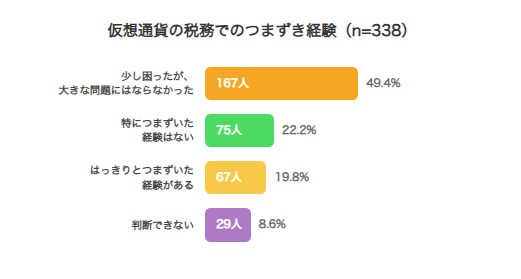
Response | Respondents | Share (%) |
|---|---|---|
Clearly ran into trouble | 67 people | 19.82% |
Had some trouble, but nothing major | 167 people | 49.41% |
No real trouble at all | 75 people | 22.19% |
Can't say | 29 people | 8.58% |
We surveyed 338 people with experience using crypto assets (also known as virtual currencies) about the difficulties they've faced with taxes and annual tax filing.
19.82% said they had "clearly" run into a wall — meaning roughly 1 in 5 investors has faced a serious hurdle.
Add in those who said they had "some trouble," and about 69% of all respondents have dealt with some kind of tax-related challenge — a struggle that's essentially universal among crypto investors.
The crypto market runs 24/7, 365 days a year, and trading takes many different forms, which makes it inherently hard just to track how much you've actually gained.
As convenience has improved, tax calculation rules and the surrounding legal framework have struggled to keep pace with what individual investors can reasonably be expected to understand.
For investors who want to keep going long term, managing the "exit strategy" of taxes is just as important a skill as generating returns in the first place.
Only around 20% say "no trouble" — tax knowledge is unavoidable
Response | Respondents | Share (%) |
|---|---|---|
Clearly ran into trouble | 67 people | 19.82% |
Had some trouble, but nothing major | 167 people | 49.41% |
No real trouble at all | 75 people | 22.19% |
Can't say | 29 people | 8.58% |
Only 22.19% of respondents flatly said they had "no real trouble" with taxes.
That figure makes clear just how hard it is to keep investing in crypto long term without ever running into a tax-related snag.
Because the market's volatility makes "unexpected gains" more likely than with many other asset classes, investors here tend to face a tax-filing obligation more often than they might with other assets.
Even people who assume "this doesn't apply to me" can end up owing tax due to a jump in the value of their holdings or an exchange promotion, among other triggers.
Even seasoned investors are regularly forced to revisit their tax assumptions — that's simply a feature of the crypto industry.
Building a systematic understanding early on, and preparing accordingly, functions as a defense that protects your long-term wealth-building plans.
A potential risk pool? About 8% say they "can't judge" their own situation
Response | Respondents | Share (%) |
|---|---|---|
Clearly ran into trouble | 67 people | 19.82% |
Had some trouble, but nothing major | 167 people | 49.41% |
No real trouble at all | 75 people | 22.19% |
Can't say | 29 people | 8.58% |
Another notable finding: 8.58% of investors said they simply "can't judge" their own tax situation.
This group doesn't even know whether their own trades are taxable, or whether they could be booked as a loss — in other words, they're carrying an "unrecognized risk" they aren't even aware of.
This data point symbolizes the kind of "latent risk of unfiled taxes" where investors only realize there's a problem once the tax office flags it.
Crypto taxes are fundamentally a self-assessment system, and it's difficult to make the right call without proactively seeking out information.
The easy assumption that "I'm not having any particular trouble right now, so I'm fine" can come back years later as a hefty burden in the form of late-payment penalties and the like.
To get a clear picture of where you actually stand, the first step is to organize your transaction history and check your situation against objective data.
The "tax wall" tends to arrive within the first year — about 55% stumble early
6 months to under a year is the single largest group, at 38%
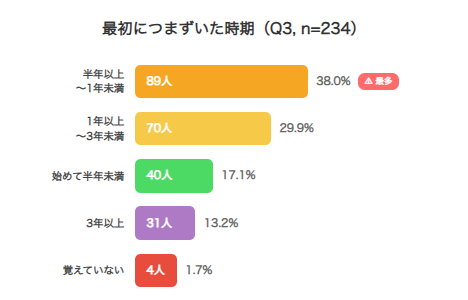
Response | Respondents | Share (%) |
|---|---|---|
Less than 6 months after starting | 40 people | 17.09% |
6 months to under 1 year | 89 people | 38.03% |
1 year to under 3 years | 70 people | 29.91% |
3 years or more | 31 people | 13.25% |
Don't remember | 4 people | 1.71% |
Asked when they first ran into trouble with crypto taxes, the largest group of respondents — 38.03% — said "6 months to under a year."
Add the 17.09% who said "less than 6 months," and over 55% of all respondents faced some kind of difficulty within their first year of investing.
That timing lines up closely with the point at which early gains, made shortly after first buying something like Bitcoin, come due for their first tax-filing season.
In the early days of investing, attention naturally gravitates toward watching your assets grow and the excitement of trading itself — but the very real challenge of "paying tax" arrives regardless.
The first year in particular is when many investors, who haven't yet developed the habit of keeping transaction records or grasped the concept of gain/loss calculation, find themselves at a loss once they actually try to prepare their filing.
This data shows that how well an investor navigates this "dangerous first year" is a key turning point that shapes whether they keep investing afterward.
13% still stumble even after 3+ years
Response | Respondents | Share (%) |
|---|---|---|
Less than 6 months after starting | 40 people | 17.09% |
6 months to under 1 year | 89 people | 38.03% |
1 year to under 3 years | 70 people | 29.91% |
3 years or more | 31 people | 13.25% |
Don't remember | 4 people | 1.71% |
Notably, even among veteran investors with "3 years or more" of experience, 13.25% reported a new tax-related setback.
You might assume that years of experience would make someone comfortable with taxes, but the crypto world keeps introducing new mechanisms — DeFi, NFTs, staking, and more.
The tax treatment of these new technologies is often extremely complex, and it's increasingly common for past knowledge alone to fall short.
Experienced investors can also get tripped up when they need to go back and recalculate years-old transaction records, or when a tax reform changes how something is interpreted.
Overconfidence — thinking "I'm already used to this, so I'll be fine" — is a trap; staying current with the latest tax information is essential regardless of experience level.
No matter how many years you've been investing, the constant tension between crypto investing and tax risk is something that feeds directly into protecting your wealth over the long run.
Investors in their 20s: watch out for stumbling early, within 6 months
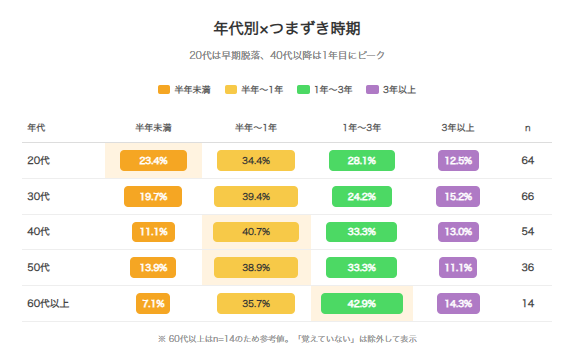
Age group | Less than 6 months | 6 months–under 1 year | 1 year–under 3 years | 3 years or more | Don't remember | n |
|---|---|---|---|---|---|---|
20s | 15 people (23.44%) | 22 people (34.38%) | 18 people (28.13%) | 8 people (12.50%) | 1 person (1.56%) | 64 |
30s | 13 people (19.70%) | 26 people (39.39%) | 16 people (24.24%) | 10 people (15.15%) | 1 person (1.52%) | 66 |
40s | 6 people (11.11%) | 22 people (40.74%) | 18 people (33.33%) | 7 people (12.96%) | 1 person (1.85%) | 54 |
50s | 5 people (13.89%) | 14 people (38.89%) | 12 people (33.33%) | 4 people (11.11%) | 1 person (2.78%) | 36 |
60s and above | 1 person (7.14%) | 5 people (35.71%) | 6 people (42.86%) | 2 people (14.29%) | 0 people (0.00%) | 14 |
Breaking the data down by age, respondents in their 20s show a higher tendency to stumble "less than 6 months" in — 23.44%, higher than any other age bracket.
Younger investors are quick to act, often starting to invest right after seeing something on social media, but that same speed means their tax preparation can lag behind, leaving them more exposed to trouble.
Conversely, the rate of stumbling within 6 months declines with age, and from the 40s onward the peak shifts to the "6 months to under 1 year" bracket.
This suggests that while older investors tend to start more cautiously, they're more likely to notice how cumbersome the calculations get once a full year of trading has accumulated.
Whatever your age, the first year after starting to invest brings a major hurdle — but investors in their 20s especially should sharpen their tax awareness right from the start.
Making a habit of "how do I keep records" a priority — before "let's just make money" — is the single most effective way to avoid stumbling early.
The maze of gain/loss calculation: what's behind the "impossible to calculate" feeling reported by ~36%
The top difficulty: how gain/loss calculation even works
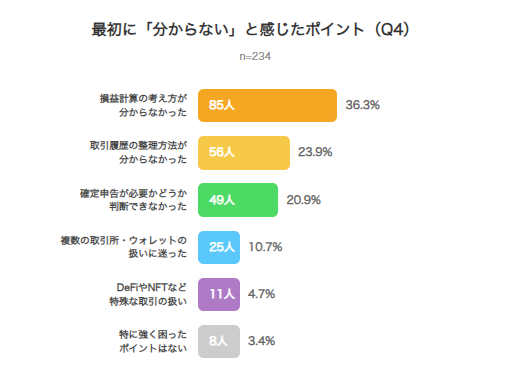
Response | Respondents | Share (%) |
|---|---|---|
Didn't understand the basic approach to calculating gains/losses | 85 people | 36.32% |
Didn't know how to organize transaction history | 56 people | 23.93% |
Couldn't determine whether a tax return was required | 49 people | 20.94% |
Was confused about handling multiple exchanges/wallets | 25 people | 10.68% |
Didn't understand how to handle special transactions like DeFi or NFTs | 11 people | 4.70% |
No particular difficulty | 8 people | 3.42% |
Asked what point they first found confusing about crypto taxes, "the basic approach to calculating gains and losses" topped the list at 36.32%.
Crypto gain/loss calculation requires specialized concepts like the total average method or the moving average method, and there's no standard equivalent of a specified brokerage account that calculates everything automatically the way there often is for stock investing.
As a result, many investors who try to work out the calculation themselves find themselves overwhelmed the moment they hit that complexity.
It's not simply a matter of "bought at X, sold at Y" — swapping into other coins, using crypto for payments, and other events can each trigger a taxable moment, and that variety adds to the confusion.
When gains are spread across multiple coins in particular, figuring out which trades are taxable and which acquisition cost basis applies is an extremely high bar for beginners.
This result suggests that while the barrier to entering the market has come down, building better support for the "exit" — the calculation itself — is now an urgent challenge.
"No records" is the single biggest calculation risk
Response | Respondents | Share (%) |
|---|---|---|
Didn't understand the basic approach to calculating gains/losses | 85 people | 36.32% |
Didn't know how to organize transaction history | 56 people | 23.93% |
Couldn't determine whether a tax return was required | 49 people | 20.94% |
Was confused about handling multiple exchanges/wallets | 25 people | 10.68% |
Didn't understand how to handle special transactions like DeFi or NFTs | 11 people | 4.70% |
No particular difficulty | 8 people | 3.42% |
The second most common issue was "how to organize transaction history," which tripped up 23.93% of investors.
Calculating crypto gains and losses requires every past transaction record, but the format of exported CSV data differs from exchange to exchange, which makes consistent management difficult.
Many investors, once they actually sit down to calculate, discover they forgot to download old data in time, or that an exchange they used has since shut down — either of which can make an accurate calculation impossible.
Transfer records between wallets, and private transactions that don't go through an exchange, are especially easy to lose track of and hard to reconstruct after the fact.
Having "no records" is a major weak point from a tax standpoint, and in the worst case can force investors into an unfavorable outcome such as an estimated tax assessment.
Building a habit of organizing and saving data every time you trade is the one map that can lead you out of this calculation maze.
Investors past their first year struggle more with multiple exchanges
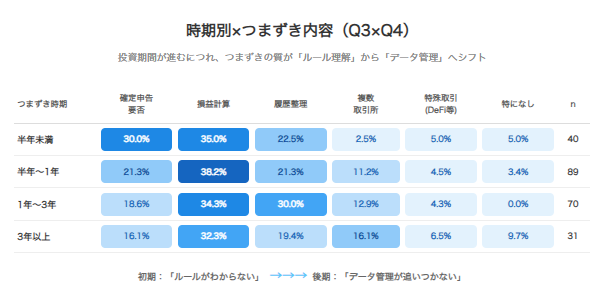
Timing of setback | Whether a return was required | Gain/loss calculation | Organizing history | Multiple exchanges | Special transactions | None in particular | n |
|---|---|---|---|---|---|---|---|
Less than 6 months | 12 (30.0%) | 14 (35.0%) | 9 (22.5%) | 1 (2.5%) | 2 (5.0%) | 2 (5.0%) | 40 |
6 months–1 year | 19 (21.3%) | 34 (38.2%) | 19 (21.3%) | 10 (11.2%) | 4 (4.5%) | 3 (3.4%) | 89 |
1–3 years | 13 (18.6%) | 24 (34.3%) | 21 (30.0%) | 9 (12.9%) | 3 (4.3%) | 0 (0.0%) | 70 |
3 years or more | 5 (16.1%) | 10 (32.3%) | 6 (19.4%) | 5 (16.1%) | 2 (6.5%) | 3 (9.7%) | 31 |
Cross-tabulating the timing and content of setbacks shows that the longer someone has invested, the more likely they are to struggle with "handling multiple exchanges and wallets."
Among those who stumbled in "less than 6 months," only 2.5% cited this issue, but that rises to 12.9% among those with a year or more of experience, and to 16.1% for those with 3+ years.
That's because, as an investor's approach matures, they tend to spread across more platforms for diversification or to secure specific coins, physically increasing the complexity of managing everything.
Once someone starts using overseas exchanges or a personal wallet alongside their main account, keeping track of asset movements consistently becomes dramatically harder.
On the other hand, 30% of those in the early stage struggle with "determining whether a tax return is required," reflecting a focus on grasping the basic rules first.
As one moves further along the investing journey, the data clearly shows a shift in the nature of the difficulty — from "understanding the rules" to the more hands-on task of "reconciling data."
A flood of information and the struggle to apply it to "my own case" — 32% get stuck unable to organize it
Information overload leads to a kind of decision paralysis
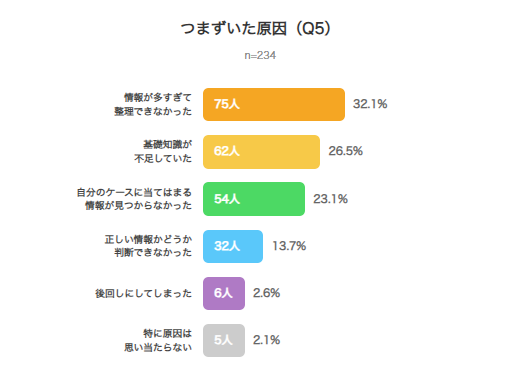
Response | Respondents | Share (%) |
|---|---|---|
Too much information to organize | 75 people | 32.05% |
Lacked basic knowledge | 62 people | 26.50% |
Couldn't find information that applied to their own case | 54 people | 23.08% |
Couldn't tell whether the information was accurate | 32 people | 13.68% |
Put it off | 6 people | 2.56% |
Can't think of a particular cause | 5 people | 2.14% |
Asked about the underlying cause of their tax troubles, "too much information to organize" was the most common answer, at 32.05%.
There's no shortage of articles and social-media posts online about crypto taxes, but because none of it is well organized into a coherent system, it ends up confusing investors more than helping them.
The more investors try to piece together fragments of knowledge, the harder it becomes to see the whole picture — leading to a kind of "paralysis by information overload," where they can no longer judge what to prioritize.
Because this is still a relatively immature regulatory area, it's not unusual for different sources to interpret the rules differently, or for outdated information to circulate alongside current guidance.
Many investors work hard to figure out the right answer on their own, only to be stopped by the high bar of filtering good information from bad.
Being able to pick out only the information that's actually relevant to you, out of everything that's out there, has become an essential skill for navigating crypto taxes today.
About 23% feel isolated by problems unique to their own situation
Response | Respondents | Share (%) |
|---|---|---|
Too much information to organize | 75 people | 32.05% |
Lacked basic knowledge | 62 people | 26.50% |
Couldn't find information that applied to their own case | 54 people | 23.08% |
Couldn't tell whether the information was accurate | 32 people | 13.68% |
Put it off | 6 people | 2.56% |
Can't think of a particular cause | 5 people | 2.14% |
The next most common cause was "couldn't find information that applied to their own case," at 23.08%.
Crypto trading involves a huge range of individual combinations — which exchanges you use, which coins, how often you trade, whether you've done staking or received airdrops — and every investor's situation looks a little different.
The "unusual trading patterns" that generic explainer articles don't fully cover can, in fact, happen to almost anyone; that's part of what makes this asset class so difficult.
Investors often have textbook knowledge but don't know how to apply it to their own complicated transaction history, and end up stuck.
Especially for those using multiple services at once, the low "generalizability" of the information available becomes a direct cause of getting tripped up.
The anxiety of not being able to find "the answer for my specific situation" is what pushes many investors toward tax trouble in the first place.
The less experience an investor has, the more they struggle with "the basics"
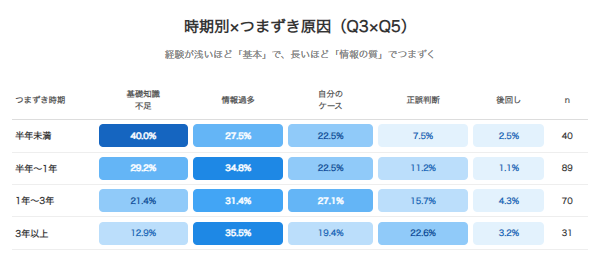
Timing of setback | Lack of basic knowledge | Too much information | Own case | Judging accuracy | Put it off |
|---|---|---|---|---|---|
Less than 6 months (n=40) | 16 (40.0%) | 11 (27.5%) | 9 (22.5%) | 3 (7.5%) | 1 (2.5%) |
6 months–1 year (n=89) | 26 (29.2%) | 31 (34.8%) | 20 (22.5%) | 10 (11.2%) | 1 (1.1%) |
1–3 years (n=70) | 15 (21.4%) | 22 (31.4%) | 19 (27.1%) | 11 (15.7%) | 3 (4.3%) |
3 years or more (n=31) | 4 (12.9%) | 11 (35.5%) | 6 (19.4%) | 7 (22.6%) | 1 (3.2%) |
Cross-tabulating timing and cause reveals that the shorter someone's investing history, the more likely they are to cite "lacking basic knowledge."
For "less than 6 months," that figure reaches 40.0%, and it steadily declines with experience, down to 12.9% among those with "3 years or more."
Conversely, more experienced investors are more likely to struggle with "judging whether information is accurate" or "too much information" — the more knowledge someone accumulates, the more sensitive they seem to become to questions of accuracy.
In the early stage, simply learning the basic rules of "what needs to be done" can prevent a lot of trouble on its own.
But for mid-to-long-term investors whose trading has grown more complex, the challenge shifts to something that basic knowledge alone can't fix: filtering the quality of information.
Understanding how the cause of setbacks changes over time — beginners should focus on the basics, and experienced investors on the reliability of their sources — calls for a staged approach.
Self-help is the norm, but about 30% put it off — under 40% turn to a professional
Over 40% handled it by teaching themselves
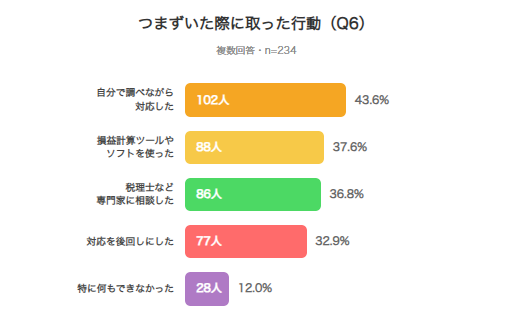
Response | Respondents | Share (%) |
|---|---|---|
Researched and dealt with it themselves | 102 people | 43.59% |
Used a gain/loss calculation tool or software | 88 people | 37.61% |
Consulted a professional such as a tax accountant | 86 people | 36.75% |
Put off dealing with it | 77 people | 32.91% |
Couldn't do anything in particular | 28 people | 11.97% |
Never experienced a setback | 3 people | 1.28% |
Looking at what investors actually did when they hit a tax problem, "researched and dealt with it themselves" was the most common response, at 43.59%.
Close behind, "used a gain/loss calculation tool or software" came in at 37.61%, and "consulted a professional such as a tax accountant" at 36.75% — the two are nearly tied.
It appears that investors who feel they've hit the limits of what they can research on their own split roughly evenly between automating the process with technology and turning to expert human advice.
The fact that nearly 40% turned to a professional speaks to just how difficult crypto tax issues can be.
For a typical income-tax filing, most people manage on their own — the fact that so many investors here felt they needed professional help points to the specific complexity of crypto taxes.
Self-directed research, using a tool, and consulting a professional appear to be settling in as the three main routes investors take to resolve their tax troubles.
Concerns about heavy additional-tax penalties from letting problems sit
Response | Respondents | Share (%) |
|---|---|---|
Researched and dealt with it themselves | 102 people | 43.59% |
Used a gain/loss calculation tool or software | 88 people | 37.61% |
Consulted a professional such as a tax accountant | 86 people | 36.75% |
Put off dealing with it | 77 people | 32.91% |
Couldn't do anything in particular | 28 people | 11.97% |
Never experienced a setback | 3 people | 1.28% |
One particularly sobering statistic: 32.91% of investors said they "put off dealing with it."
Add the 11.97% who "couldn't do anything in particular," and nearly 45% may be leaving the problem unresolved without finding an appropriate solution.
Crypto taxes don't just go away because you don't understand them — leaving the issue unresolved actually raises the risk of penalties like late-payment tax and additional tax growing larger over time.
The sheer size of this "left unresolved" group is a clear sign of just how heavy a psychological burden crypto taxes have become for investors.
The confusion of "not knowing where to even start" tends to end in simply giving up on taking action — a negative spiral that shows up clearly in this data.
To nip trouble in the bud, the most important thing is not to carry the burden alone, and to take that first step — even if it's just organizing your records.
Reliance on professionals rises after the first year
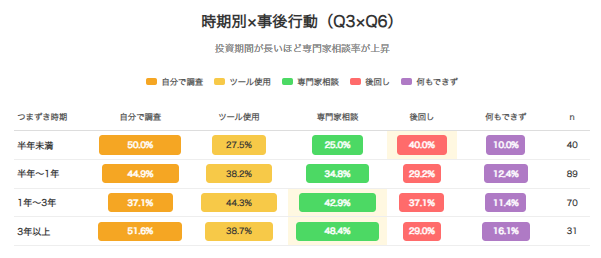
Timing of setback | Self-research | Used a tool | Consulted a professional | Put it off | Couldn't do anything |
|---|---|---|---|---|---|
Less than 6 months (n=40) | 20 (50.0%) | 11 (27.5%) | 10 (25.0%) | 16 (40.0%) | 4 (10.0%) |
6 months–1 year (n=89) | 40 (44.9%) | 34 (38.2%) | 31 (34.8%) | 26 (29.2%) | 11 (12.4%) |
1–3 years (n=70) | 26 (37.1%) | 31 (44.3%) | 30 (42.9%) | 26 (37.1%) | 8 (11.4%) |
3 years or more (n=31) | 16 (51.6%) | 12 (38.7%) | 15 (48.4%) | 9 (29.0%) | 5 (16.1%) |
Cross-tabulating the timing of a setback against the action taken shows a clear shift over time in "who investors turn to."
Among those who stumbled "less than 6 months" in, 50.0% tried to research the issue on their own, while only 25.0% consulted a professional — a strong tendency to try to solve things independently first.
But once an investor's tenure passes "1 year," the share consulting a professional exceeds 40%, and among those with "3 years or more," it reaches 48.4% — nearly half turning to expert help.
This likely reflects a process in which trading grows more complex the more experience an investor accumulates, until they recognize the limits of solving it alone.
Tool usage is also highest — 44.3% — among the "1–3 years" group, showing that mid-to-long-term investors are more proactive about adopting efficient calculation methods.
At the same time, roughly 30% of respondents put the problem off no matter how long they'd been investing, showing that "putting off tax matters" is a shared challenge regardless of experience level.
Understanding gain/loss calculation is the best defense — lessons from experienced investors on preparing in advance
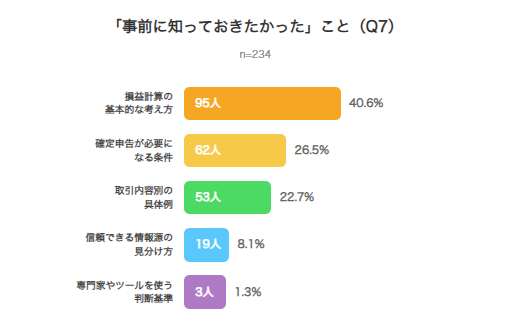
40% wish they'd understood calculation earlier
Response | Respondents | Share (%) |
|---|---|---|
The basic approach to calculating gains and losses | 95 people | 40.60% |
The conditions that make a tax return necessary | 62 people | 26.50% |
Concrete examples by transaction type | 53 people | 22.65% |
How to identify reliable sources of information | 19 people | 8.12% |
Criteria for deciding whether to use a professional or a tool | 3 people | 1.28% |
Nothing in particular | 2 people | 0.85% |
We asked investors who had experienced real tax trouble what they "wish they'd known beforehand," and "the basic approach to calculating gains and losses" won by a wide margin, at 40.60%.
Given that this same calculation issue was also the number-one cause of stumbling in the first place, this reconfirms that understanding the calculation logic is the single best defense.
Many investors jump into the market without knowing the rules for the "exit" — how gains actually get locked in for tax purposes — and end up paying the price for that later.
Concretely, this covers not just straightforward trading gains, but crypto-specific rules like when swapping between coins or earning staking rewards becomes taxable.
Understanding these in advance makes it possible to act strategically — for example, holding off on unnecessary frequent trading, or setting aside funds for taxes ahead of time.
"Understanding gain/loss calculation" isn't just administrative housework — it's an essential skill for maximizing the actual return on your investment.
Beginners in particular want to know "the exit rules"
Response | Respondents | Share (%) |
|---|---|---|
The basic approach to calculating gains and losses | 95 people | 40.60% |
The conditions that make a tax return necessary | 62 people | 26.50% |
Concrete examples by transaction type | 53 people | 22.65% |
How to identify reliable sources of information | 19 people | 8.12% |
Criteria for deciding whether to use a professional or a tool | 3 people | 1.28% |
Nothing in particular | 2 people | 0.85% |
The second most common lesson was "the conditions that make a tax return necessary," which 26.50% of investors said they wish they'd understood in advance.
For salaried employees in particular, simply knowing a basic rule of thumb — such as the fact that gains of ¥200,000 or less generally don't require a filing — can meaningfully ease their anxiety.
At the same time, because the criteria for whether that rule actually applies to a given person can be ambiguous, no shortage of investors end up panicking once filing season arrives.
This data suggests that information available to crypto investors skews heavily toward the "entry" question of how to make money, while information about the "exit" — when a filing is actually required — remains scarce.
It's worth running a simulation, before you even start investing, of roughly how much profit would trigger a filing obligation given your own investing style.
As the saying goes, "what you understand, you don't have to fear" — grasping the full picture of the system is the best antidote to the invisible fear of tax trouble.
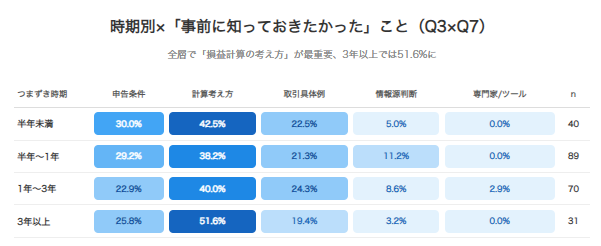
Across every group, over 20% value concrete case studies
Timing of setback | Filing conditions | Calculation approach | Transaction examples | Judging sources | Professional/tool |
|---|---|---|---|---|---|
Less than 6 months (n=40) | 12 (30.0%) | 17 (42.5%) | 9 (22.5%) | 2 (5.0%) | 0 (0.0%) |
6 months–1 year (n=89) | 26 (29.2%) | 34 (38.2%) | 19 (21.3%) | 10 (11.2%) | 0 (0.0%) |
1–3 years (n=70) | 16 (22.9%) | 28 (40.0%) | 17 (24.3%) | 6 (8.6%) | 2 (2.9%) |
3 years or more (n=31) | 8 (25.8%) | 16 (51.6%) | 6 (19.4%) | 1 (3.2%) | 0 (0.0%) |
Conclusion
The survey found that about 69% of investors have stumbled over crypto taxes at some point, and more than half of them ran into that wall within their first year.
Trouble is especially concentrated around the "6 months to under a year" mark, the point where filing an annual tax return starts to become a real concern.
At the heart of the problem is "complex gain/loss calculation," which trips up 36.32% of investors, along with the sheer difficulty of managing transaction history.
It's worth taking seriously that, unable to find the right answer amid a flood of information, more than 30% of investors end up putting off any countermeasure at all.
The lesson from experienced investors is clear: understanding "how the calculation works" and "when a filing is required" matters most before you've actually made a profit.
Investing without knowing the exit rules carries real risk, and preparing in advance is your best defense for protecting your wealth.
Crypto taxes don't resolve themselves if you leave them alone — the risk of penalties only grows over time.
Using this survey's timeline as a guide, taking proactive steps at key milestones — organizing your records, consulting a professional — is key to a healthy, sustainable approach to investing.
Editor's note on Japan's crypto tax framework (as of July 2026): Under current Japanese law, gains from selling crypto assets are treated as miscellaneous income and taxed under the aggregate (progressive) taxation system, not the separate self-assessment rate used for stocks. On July 15, 2026, an amendment to the Financial Instruments and Exchange Act was passed by the House of Councillors, which will move crypto assets under that Act's framework; a flat 20% separate self-assessment tax rate is expected to take effect from the fiscal year following the amendment's enforcement (expected around January 2028). Importantly, losses from crypto trading can currently only be offset against other miscellaneous income — they cannot be offset against employment income or other income categories.
This article is for informational purposes only and does not constitute financial or investment advice. Please consult a qualified professional before making investment decisions.
Survey overview
Survey date: February 24, 2026
Survey method: Internet survey
Survey population: Men and women residing in Japan (people currently investing in crypto assets, or who have invested in the past)
Valid responses: 338
Conducted by: Clabo, Inc.
Survey questions
- Have you ever used crypto (crypto assets)?
- How long after you started investing in crypto did you first run into a setback?
- Which of the following comes closest to the point you first found confusing about crypto taxes?
- Looking back, which of the following comes closest to the root cause of your tax-related setback?
- When you ran into trouble or felt anxious about crypto taxes, which of the following actions did you actually take?
- Looking back on your crypto tax troubles, which of the following comes closest to something you wish you'd known beforehand?


