


A paper wallet is a method of recording the private key or recovery phrase used to access crypto assets (also known as virtual currencies) on paper and storing it offline. It doesn't mean storing the crypto assets themselves on paper — rather, it means keeping on paper the critical information needed to move assets on the blockchain.
The process itself is simple: you just copy your private key or recovery phrase onto paper by hand. However, if you record the wrong information or store it incorrectly, you risk losing access to your crypto assets entirely — so even though it's just copying text, it needs to be done carefully.
This article explains what to check before creating a paper wallet, how to actually make one, and the precautions and storage methods to keep in mind.
What to Check Before Creating a Paper Wallet
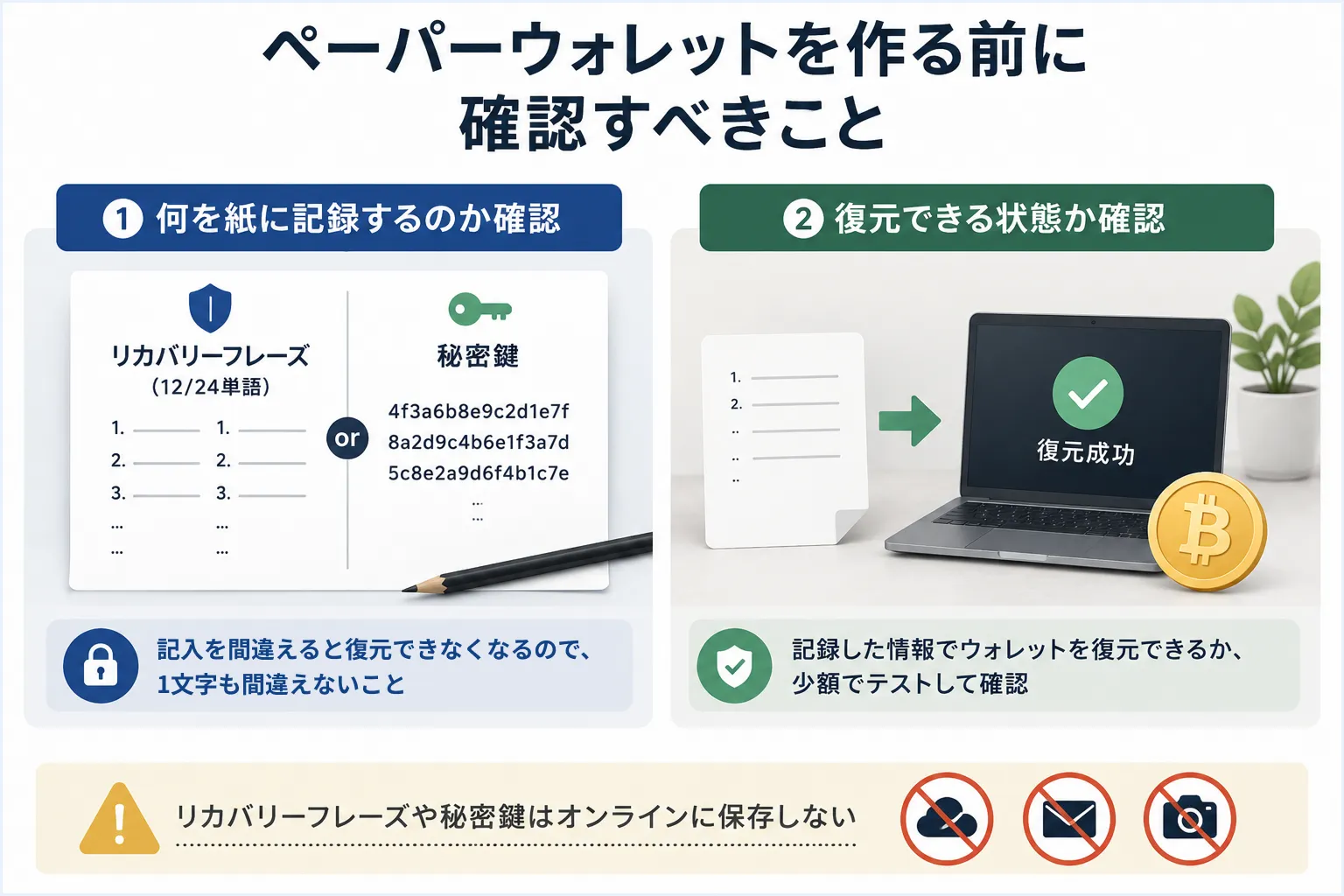
Before creating a paper wallet, the first thing to check is "what exactly will be recorded on paper." If you write down the wrong information, you may later be unable to restore the wallet or access your assets.
The recovery phrase and the private key are especially easy to confuse. Both are important for managing crypto assets, but they play different roles and are used differently, so it's important to understand the difference before you begin (related: What's the Difference Between a Recovery Phrase and a Private Key? (in Japanese)).
Check What Information You're Recording
What you record on a paper wallet is mainly either your recovery phrase or your private key. A recovery phrase is a set of 12 or 24 words used to restore a wallet.
A private key, on the other hand, is the key that lets you move the crypto assets held at a specific address. If a third party learns your private key, there's a risk that the assets at that address could be sent out fraudulently.
With most wallets today, it's common to record and store the recovery phrase on paper. That said, some older or certain wallets require you to store the private key itself.
For this reason, before copying anything onto paper, check whether the information displayed is a recovery phrase or a private key. Either way, this is sensitive information that must never be shown to a third party.
Check That You Can Actually Restore the Wallet
Creating a paper wallet doesn't end once you've written the information down. It's important to make sure that, when the time comes, you can actually use the recorded information to restore the wallet.
For example, even if you've written down your recovery phrase, you won't be able to restore the wallet if you get the word order wrong. Likewise, if you enter a recorded private key into a wallet that doesn't support it, your assets may not appear.
If possible, it's reassuring to run a restoration test using a small amount of crypto assets. A test lets you confirm that the recorded information is correct and that the wallet you're using can actually restore it.
However, even when running a restoration test, never save your recovery phrase or private key online. If the information leaks during the verification process, the entire point of keeping a paper wallet is lost.
How to Create a Paper Wallet
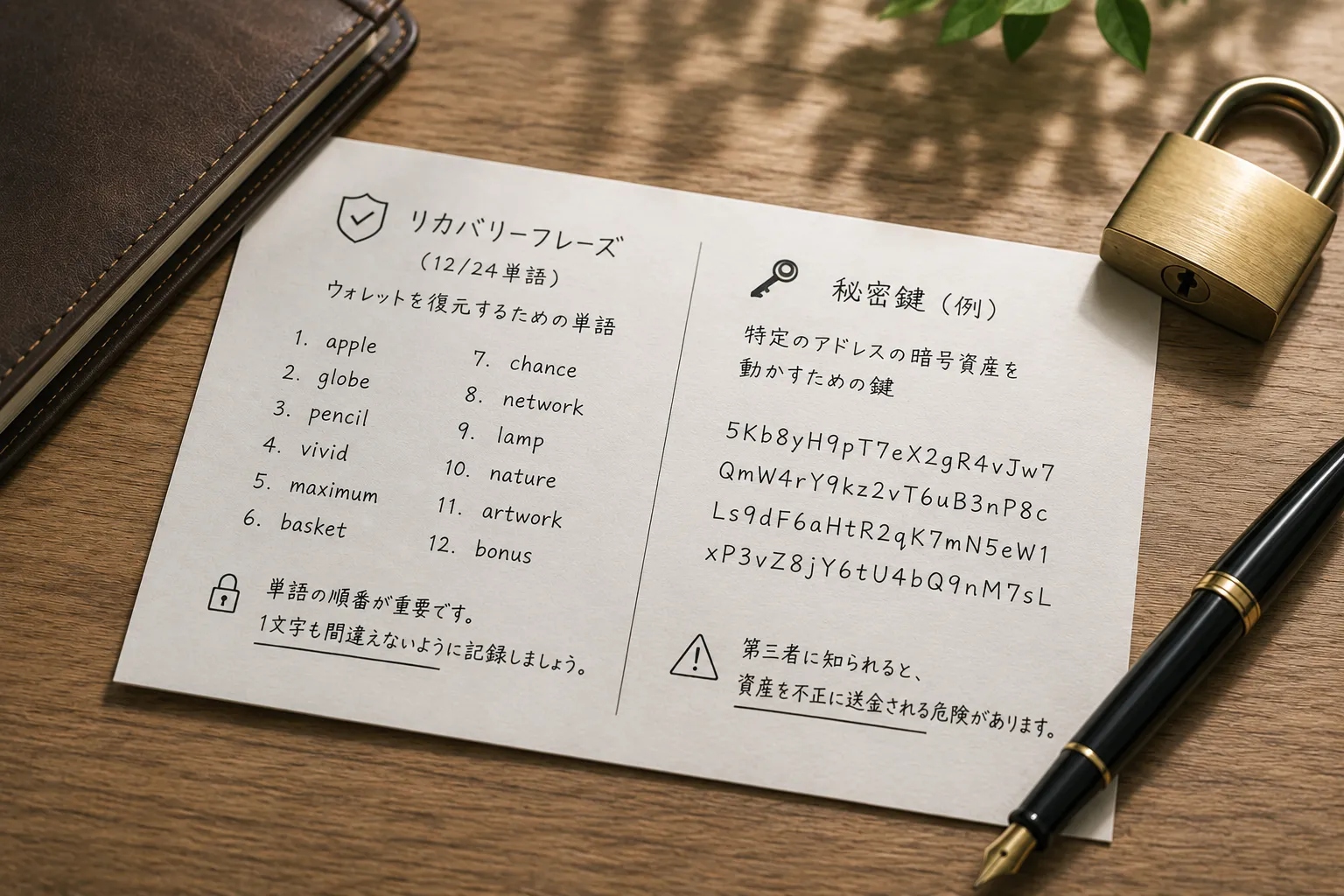
Making a paper wallet is, in principle, simple: you just check the private key or recovery phrase displayed by your wallet and copy it accurately onto paper.
That said, the fact that the task is easy doesn't mean it's automatically safe. With a paper wallet, what matters is the accuracy of the information you copy down and making sure no one else can see it while you work.
Copy the Private Key or Recovery Phrase onto Paper
First, display your recovery phrase or private key from within the wallet you're using. How you display it varies by wallet, but in most cases you can find it from the settings screen or the backup screen.
Copy the displayed information onto paper exactly, character by character. For a recovery phrase, word order matters — numbering each word from 1 to 12 (or up to 24) as you write it down helps prevent mistakes. For a private key, you need to accurately record uppercase and lowercase letters and symbols.
Even a single mistaken character can make the information unreadable, so it's also important to use a writing implement that won't fade. Pencils or erasable pens can become hard to read over time or from friction.
Check the Recorded Information for Errors
After copying the information onto paper, always review it. With a paper wallet, a recording mistake can directly lead to a failed restoration.
For a recovery phrase, check the spelling of each word, the word order, and whether the numbering is off. English words in particular are easy to mistype with similarly spelled words, so check carefully.
For a private key, uppercase and lowercase letters, and characters like the digit 0 versus the letter O, or the digit 1 versus the lowercase letter l, are easy to misread. Write clearly enough that you can tell the difference when you read it back later.
Once you've finished checking, do not photograph the paper with your phone or make copies of it on a copy machine. Leaving behind a digital copy creates the risk of an online leak.
Precautions When Creating a Paper Wallet

The single most important precaution with a paper wallet is making sure your private key or recovery phrase doesn't leak while you're creating it. The whole point of storing this information on paper is to keep critical information disconnected from the internet.
However, if you take a screenshot or save it to the cloud while creating it, the point of offline storage is largely lost at that moment. Copying information onto paper is simple, but you still need to pay close attention to the environment you work in.
Don't Save It Online
Never save your private key or recovery phrase online. Storing it in a notes app on your phone, cloud storage, email, or a chat app creates the risk that it could leak through unauthorized access or a hijacked device.
You should also avoid saving it via screenshot. Image data doesn't just remain on the device — it can also end up automatically backed up to the cloud.
When creating a paper wallet, make copying the information directly onto paper by hand your basic approach. By not leaving behind any digital copy, you reduce the risk of an online leak.
Printing also requires caution. Because print data can remain on the printer or computer, handwriting is the safer option for beginners who can't judge the security of their environment.
Work in an Environment Where No One Else Can See You
When creating a paper wallet, work in an environment where no third party can see you. Your private key or recovery phrase can lead to lost assets simply by being seen.
Leaks can happen from surprisingly small slip-ups. For example, when Korea's National Tax Service published information about crypto asset wallets it had seized, the press materials inadvertently included the mnemonic — a secret phrase needed to recover the wallet — and roughly 6.9 billion KRW worth of crypto assets were reportedly leaked as a result.
In fact, the National Tax Service announced in February that it had seized four cold wallets (USB devices) containing crypto assets belonging to a delinquent taxpayer, but it inadvertently disclosed the mnemonic code — the recovery passphrase — in the process. As a result, it has emerged that assets worth roughly 6.9 billion KRW (approximately ¥760 million) may have leaked.
Source: Yahoo! News (Japan)
As this case shows, a recovery phrase or private key can leak even without being typed in anywhere — simply appearing in a photo or a document is enough. For that reason, you should avoid working in places with people around, such as cafes, workplaces, or shared spaces. Even in front of family or acquaintances who aren't involved in managing your crypto assets, it's not advisable to work where the information is visible.
Also be careful not to show your screen during a video call or screen share while you're working. Even when receiving support, you shouldn't show your private key or recovery phrase directly to another person.
When it comes to managing crypto assets, thinking "it's fine to show this because I trust them" is dangerous. As a rule, your private key and recovery phrase should be managed so that no one but you ever sees them.
Avoid Fake Websites and Suspicious Wallet-Generation Tools
When creating a paper wallet, be careful of fake websites and suspicious generation tools.
A site that appears in search results or in a social media ad isn't necessarily safe. Be especially cautious of any site that asks you to enter your private key or recovery phrase. Even if you intend to enter it just to check an existing wallet, the site may actually be a phishing site designed to steal that information.
When creating a paper wallet, it's important to check the official information for the wallet you're using and display your backup information through the legitimate process. Avoid using tools of unknown origin to generate or enter a private key.
If you're unsure about how to proceed, it's also worth consulting a specialist experienced in crypto wallet management rather than deciding on your own.
How to Store a Paper Wallet
A paper wallet tends to be thought of as "just write it down and store it," but it's actually the process of leaving behind critical information needed to restore your crypto assets. If the recovery phrase or private key you recorded on paper survives, you may be able to regain access to your assets even if you're locked out of your wallet app.
In fact, in a case one of our clients consulted us about, a 12-word recovery phrase had been kept on paper, which made it possible to restore the wallet and recover access to roughly 30 ETH (related: How Roughly 30 ETH Was Recovered: A Case Study (in Japanese)).
As this shows, paper storage might look primitive at first glance. But if your wallet app stops working or you forget your login information, the information you kept on paper can become the clue that brings your assets back.
That said, being on paper also means that if you store it incorrectly, it can become useless. To make sure you can check it reliably when the time comes, here we'll introduce how to properly store a paper wallet.
Store It Somewhere It Won't Be Lost or Deteriorate
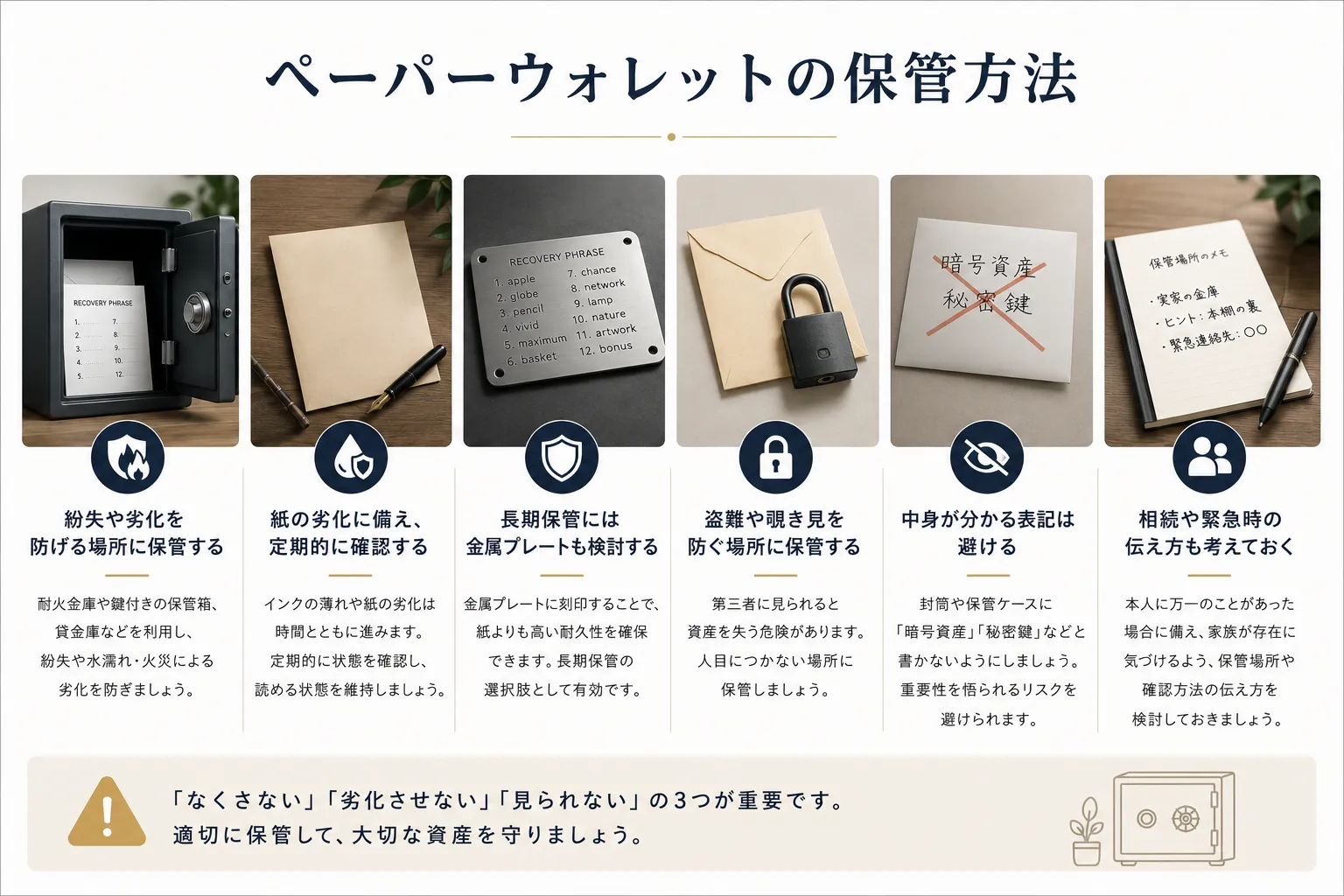
Keep the paper on which you've written your recovery phrase or private key somewhere it won't be lost and won't deteriorate. If you leave it carelessly in a desk drawer or on a bookshelf, there's a risk it could get thrown away during a cleanup or a move.
A fireproof safe or a lockable storage box are good candidates for where to keep it. If the value of your crypto assets is large, some people also consider using a bank safe deposit box — that's worth considering as well.
Also, ink on paper can fade over time. If you're planning to store it long-term, it's important to periodically check that it's still readable.
If you're concerned about water damage or fire, engraving the information onto a metal plate is another option. It's more physically durable than paper, making it a good choice for long-term storage.
Also Watch Out for Theft or Accidental Disposal
A paper wallet can lead to lost assets if seen by a third party. So it's important not just to avoid losing it, but also to prevent theft or prying eyes.
Avoid storage locations that family members or visitors could easily stumble upon. Even if you keep it in an envelope, writing something like "crypto assets" or "private key" on the outside gives away that it's important information.
On the other hand, if you hide it too well, your family may not realize it exists in the event of your death or a sudden medical emergency. If you're thinking about inheritance or emergencies, it's also worth considering how to communicate the storage location and how to check it (related: Inheritance and Taxes When a Crypto Asset Owner Passes Away (in Japanese)).
Splitting the information across multiple copies is another option, but the more locations you store it in, the greater the risk that it will be seen. Storing multiple copies with the intention of improving security can actually increase risk if the management rules aren't clear.
Summary
Creating a paper wallet means accurately copying your private key or recovery phrase onto paper and storing it somewhere safe. The process itself isn't difficult, but recording or storage mistakes can leave you unable to access your crypto assets, so caution is essential.
Before you begin, you need to check whether the information you're recording on paper is a recovery phrase or a private key. It's also important to keep in mind whether the information you've recorded can actually restore the wallet.
While creating it, avoid screenshots, cloud storage, and notes apps, and work in an environment where no third party can see you. A paper wallet only has value because it's managed offline, so it's essential not to leave any information online.
After creating it, store it with care to avoid loss, deterioration, water damage, fire, theft, and accidental disposal. Rather than being done once it's written down, the most important part of using a paper wallet is maintaining a state where you can reliably restore it whenever you need to.
This article is for informational purposes only and does not constitute financial or investment advice. Please consult a qualified professional before making investment decisions.


