


As your crypto assets (also known as virtual currencies) grow, you may start looking into how to store them safely. Along the way, you may come across advice suggesting that "storing assets in a cold wallet is safer than leaving them on an exchange."
A cold wallet is a way of managing the private key needed to move crypto assets by keeping it disconnected from the internet. Because the private key is never placed in an online environment, this approach makes it easier to reduce the risk of loss from unauthorized access or phishing scams.
Cold wallets are one of the security measures used by crypto exchanges as well — for example, GMO Coin, a Japanese exchange, employs this approach.
All crypto assets (virtual currencies) entrusted to us by customers are stored in "cold wallets" that are isolated from the internet.
Source: GMO Coin
That said, the term "cold wallet" may not be familiar to everyone, and it can be hard to grasp exactly what benefits it offers or how its safety differs from leaving assets on an exchange.
This article explains what a cold wallet is, its basic mechanics, its main types, and the precautions to keep in mind when using one. If you are considering holding crypto assets over the long term, we hope you find this useful.
What Is a Cold Wallet
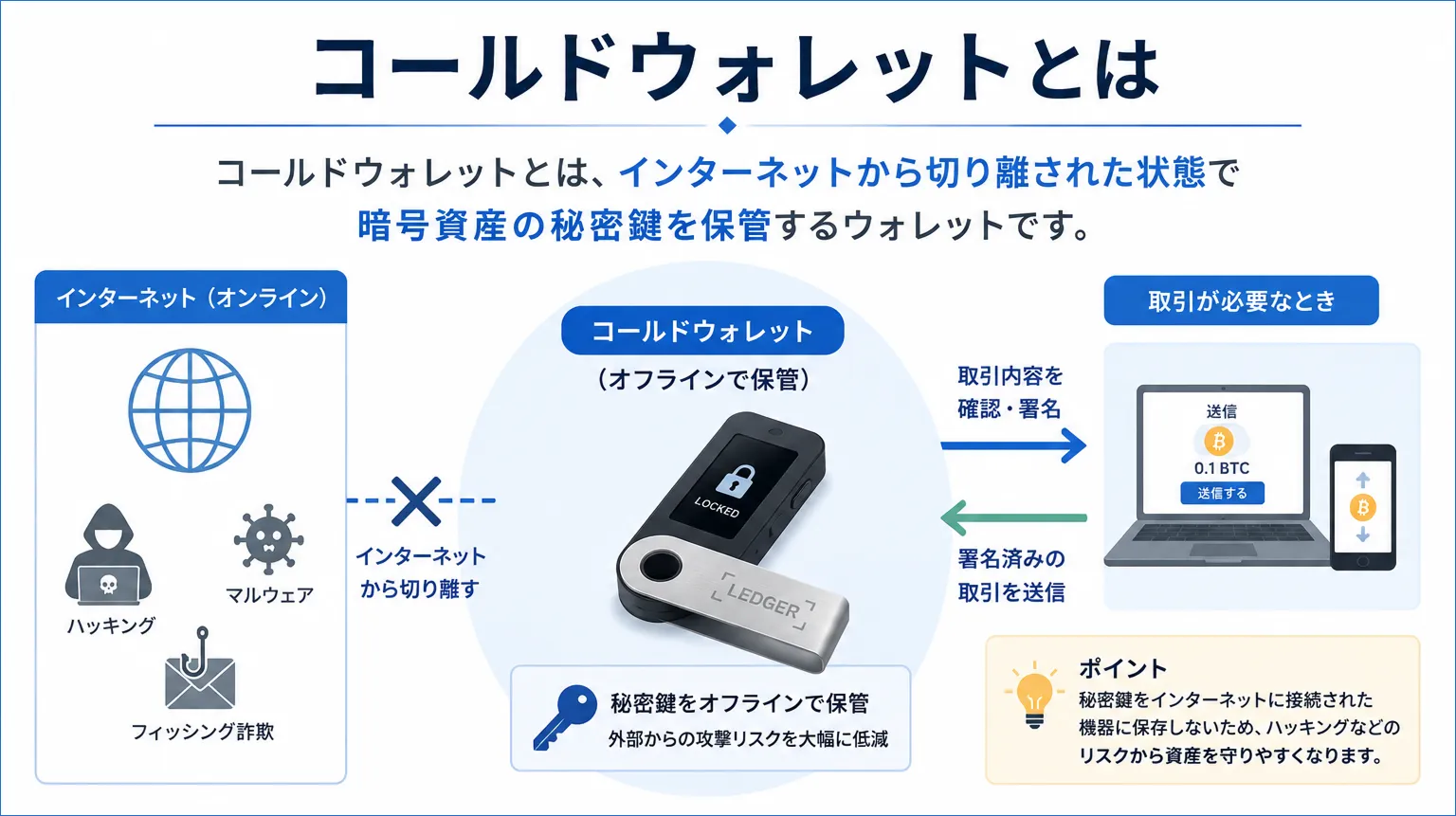
To put it simply, a cold wallet is a method of storing the private key needed to manage crypto assets "away from an online environment." Here, the private key refers to the critical piece of information used to send crypto assets recorded on a blockchain.
Crypto assets are not stored directly inside a wallet device or app. Balances and transaction records are recorded on the blockchain, and a wallet is simply a tool that manages "the key used to move those assets." By keeping this private key disconnected from an environment that is constantly connected to the internet, it becomes easier to reduce the risk of loss through unauthorized access or phishing scams.
That said, using a cold wallet does not automatically make your assets safe under all circumstances. If you lose your private key or recovery phrase, you may become unable to access your own crypto assets. In addition, if a third party gains access to this information, your crypto assets could be moved without your consent.
In fact, there have been cases where crypto assets were reportedly lost due to mismanagement of private keys or recovery-related information. For example, it was reported that South Korea's national tax authority accidentally exposed wallet-recovery information in photos it published, resulting in the loss of approximately 6.9 billion Korean won worth of seized crypto assets.
While publicizing the results of seized crypto assets (virtual currencies), South Korea's National Tax Service reportedly exposed information corresponding to a wallet-recovery password by mistake, resulting in the loss of approximately 6.9 billion Korean won (roughly 690 million yen) worth of assets.
Source: Assets leaked from a seized wallet belonging to a South Korean tax delinquent | Yahoo! News
For this reason, when using a cold wallet, it is important to think carefully not only about "which device to use" but also about "how to store your private key and recovery phrase."
Is It a Bad Idea to Leave Crypto Assets on an Exchange?
Leaving crypto assets on an exchange (order-matching marketplace) is not necessarily a bad idea in itself. It makes buying, selling, and sending funds quick and easy, and it is also a relatively manageable option for beginners.
On the other hand, crypto assets held on an exchange are not under your own private-key management. Because you are relying on the exchange's own management systems, if something like unauthorized access or a service outage occurs, you may find yourself unable to move your assets based on your own judgment alone.
In fact, in 2018 an incident occurred in which roughly 58 billion yen worth of NEM was stolen from Coincheck through unauthorized access. Reports at the time indicated that the stolen NEM was being managed not in a cold wallet, but in a hot wallet connected to the internet.
Coincheck said the NEM coins were stored in a "hot wallet" instead of a "cold wallet". Company President Koichiro Wada cited technical difficulties and a shortage of staff.
Source: The Coincheck hack and the issue with crypto assets on centralized exchanges | Reuters
In response to this kind of incident, Crypto Asset Exchange Service Providers in Japan today are, in principle, required to manage customers' crypto assets using highly reliable methods such as cold wallets (source: Financial Services Agency (FSA)).
The massive outflow of assets at Coincheck led to tighter regulation of exchange operators. Under a 2019 legal revision, the government required exchanges to manage customers' virtual currencies using highly reliable methods, such as "cold wallets" that are cut off from the network.
Source: Nikkei
That said, there are situations where exchanges use hot wallets within the scope necessary for their operations, and in such cases they are required to separately hold reserve assets of the same type and amount as compensation funds. This means that leaving crypto assets on an exchange is not, in itself, immediately dangerous.
On the other hand, as long as your assets remain on an exchange, you as the user are not the one managing the private key — you are relying on the exchange's management systems and continued operation. This is why, for crypto assets you plan to hold long term, it can be worth considering a self-managed cold wallet.
A Cold Wallet Does Not "Store" Your Crypto Assets by Moving Them
When people first learn about cold wallets, some assume it works like copying files from a computer onto a USB drive — that is, moving your crypto assets into a dedicated device or app for storage. In reality, however, the crypto assets themselves are not placed inside the device or app.
Balances and transaction records for crypto assets are recorded on the blockchain. What a wallet manages is the private key required to move those crypto assets. In other words, a cold wallet is not a box that holds crypto assets — it is a mechanism for keeping the key that accesses assets on the blockchain disconnected from the internet.
Understanding this distinction makes it clear that what truly matters with a cold wallet is not the device or app itself, but the management of the private key and recovery phrase. Even if the wallet you are using becomes unusable, you may be able to restore access as long as these remain intact. On the other hand, if you lose your recovery phrase or private key, you may become unable to access your assets (related: How to Recover When You Can't Log In to MyEtherWallet: A Case Study of Recovering 15 ETH (in Japanese)).
The Difference Between Cold Wallets and Hot Wallets
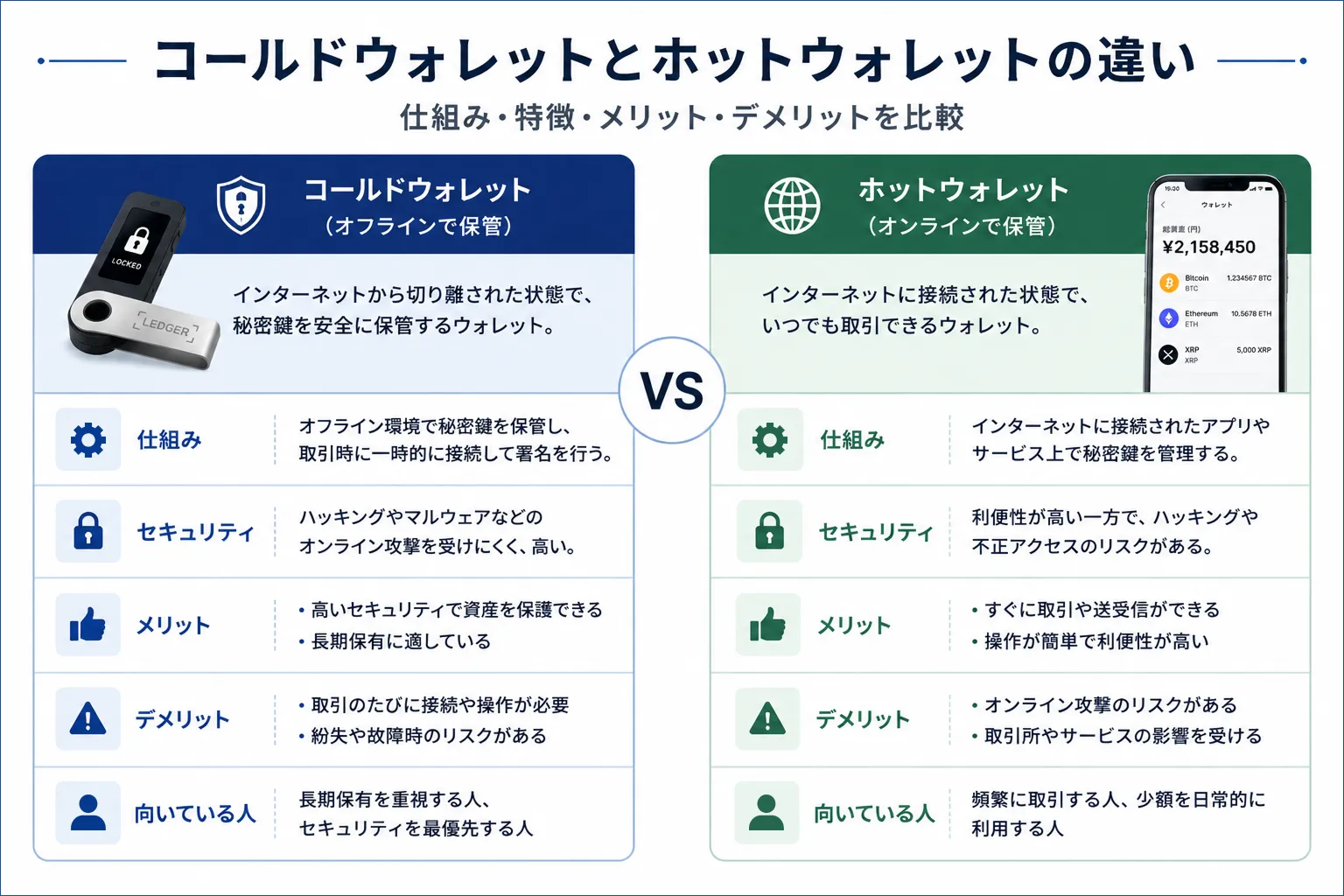
Crypto asset wallets can broadly be divided into two categories: "hot wallets" and "cold wallets." The key difference between the two lies in whether the private key is managed in an environment connected to the internet.
Hot wallets prioritize convenience, while cold wallets prioritize security while assets are held in storage. Neither is unconditionally better than the other — what matters is choosing the right one for your purpose.
Hot Wallets Suit Everyday Transfers and Trading
A hot wallet is a wallet used while connected to the internet. This includes smartphone app-based wallets and wallets provided by exchanges.
The defining feature of a hot wallet is how easily it lets you send or trade crypto assets. For example, when you want to buy or sell crypto assets on an exchange, or make transfers on a day-to-day basis, an online hot wallet is more convenient.
On the other hand, because it is connected to the internet, there are risks such as unauthorized access and phishing scams. In particular, if you enter your recovery phrase on a fake website, you risk losing your assets — something to be especially careful about.
For this reason, hot wallets are best suited for managing the portion of crypto assets you use on a daily basis. Rather than managing all of your assets through a hot wallet alone, it is important to separate your management approach according to how you intend to use the assets.
Cold Wallets Suit Long-Term Storage
Cold wallets are well suited for holding crypto assets over the long term without trading them right away. Because the private key is managed offline, it is less exposed to online attacks.
For example, if you plan to hold crypto assets for several months to several years without trading them frequently, managing them in a cold wallet is a reasonable option. In stock investing terms, this is similar to the idea of separating funds for short-term trading from assets held for the long term.
That said, cold wallets require extra steps every time you send or trade — you need to connect a hardware wallet and go through a signing process, for example — which makes them less suited to frequent trading.
A cold wallet is a management method that prioritizes security in storage over convenience. It is easiest to understand as follows: use a hot wallet for assets you use daily, and a cold wallet for assets you hold long term, choosing based on your purpose.
Main Types of Cold Wallets
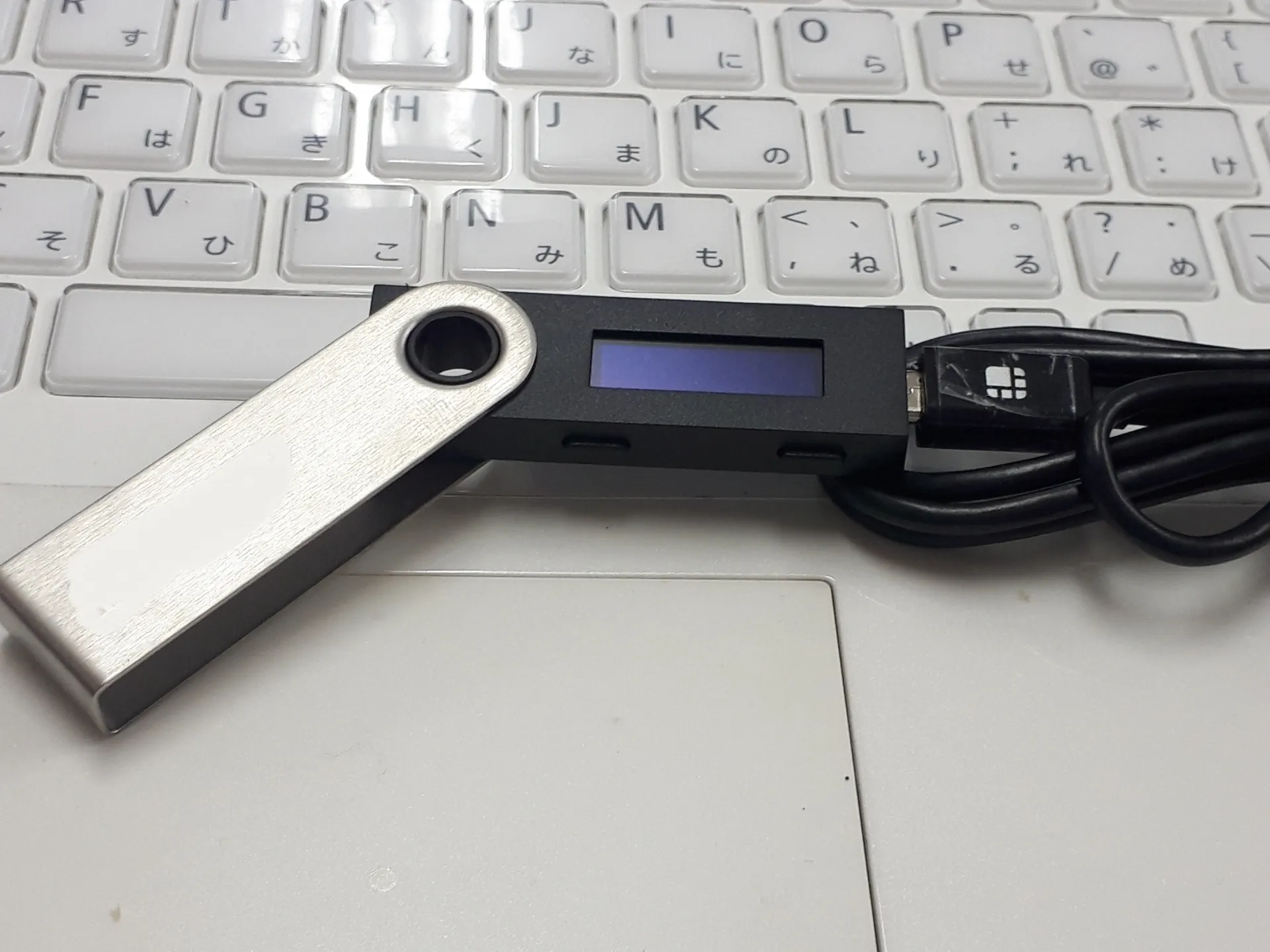
There are several types of cold wallets. The most common are hardware wallets, which use a dedicated device, and paper wallets, which record the private key and other information on paper.
Currently, hardware wallets are the most practical option for individual users. Paper wallets are also a type of cold wallet, but they require careful handling for management and recovery, which can make them difficult for beginners.
Hardware Wallets
A hardware wallet is a type of cold wallet that manages the private key within a dedicated device. Well-known examples include Ledger and Trezor.
With a hardware wallet, you can sign transactions without ever exposing the private key directly to the internet. When sending funds, you connect the device to a computer or smartphone to operate it, but the private key itself remains managed inside the device.
Thanks to this design, even if your computer or smartphone is infected with a virus, it is easier to reduce the risk of the private key leaking to the outside. That said, if you are tricked by a fake app or fake website into entering your recovery phrase, you risk losing your assets.
When using a hardware wallet, it is important to manage not just the device itself, but also the recovery phrase displayed during initial setup. Even if the device breaks, you may be able to restore your wallet as long as the recovery phrase has been correctly preserved.
Paper Wallets
A paper wallet is a method of storing a crypto asset's private key, address, and other information by writing or printing it on paper. Since it does not require any special dedicated device and can simply be written on paper by hand, the concept itself is relatively simple.
As you might expect, because paper itself is not connected to the internet, it is less exposed to online unauthorized access. For example, if you write your private key on paper and store it in a safe, it becomes less affected by a broken smartphone or computer, a virus infection, or an account takeover.
On the other hand, because a paper wallet is managed on paper, it is vulnerable to "loss, damage, fire, water damage, and fading of the text." Also, if you print the information using a printer connected to a network or a shared printer, the printed data may remain on the device or network. For this reason, when printing a private key, you should work in an environment that is as disconnected from external networks as possible, and make sure no printed data is left behind afterward.
In addition, if the website or device used to generate a paper wallet has security problems, the private key could leak to a third party during the creation process itself. Storing information on paper does not automatically make it safe — if the private key was already exposed at the point of creation, no amount of careful paper storage afterward will restore that safety.
For this reason, while a paper wallet is technically a type of cold wallet, beginners should be cautious about using one casually. Given considerations around usability and ease of recovery, a hardware wallet tends to be the more practical choice today. If you do use a paper wallet, it is important to generate the private key safely and store it in a way that keeps it hidden from third parties.
Precautions When Using a Cold Wallet

A cold wallet is one effective option for holding crypto assets over the long term. However, if used incorrectly, it can actually leave you unable to access your own assets.
What matters most is the management of your recovery phrase and private key. Because a cold wallet involves a greater degree of self-management, it is important to understand that the risks differ from those of leaving your assets on an exchange.
Store Your Recovery Phrase and Private Key So They Are Not Lost
When using a cold wallet, the most important thing is to store your recovery phrase and private key so that they are never lost. A recovery phrase is a set of multiple words used to restore a wallet.
Even if your hardware wallet device breaks or is lost, you may be able to restore it as long as the recovery phrase has been correctly preserved. Conversely, even if the device itself is on hand, mismanaging the recovery phrase or private key can make recovery difficult.
Storage methods include writing it on paper and keeping it in a safe, storing it in a fireproof location, or using a metal plate. In every case, it is important to keep the information somewhere a third party cannot see it.
In addition, if family members are unaware that the assets exist at the time of inheritance, the crypto assets may effectively be lost. If you plan to hold assets long term, it is also worth thinking about how to communicate their existence and storage location to others (related: Inheritance and Taxes When a Crypto Asset Holder Passes Away (in Japanese)).
Do Not Store Your Recovery Phrase Online
As a rule, you should not store your recovery phrase online. Saving it as a smartphone photo, in cloud storage, in email, in a notes app, or in a chat tool all carry a risk of the information leaking.
One case to be particularly careful about is saving a recovery phrase as a photo. If your smartphone's photos are automatically backed up to the cloud, you may end up storing it online without realizing it.
There have also been cases of people entering their recovery phrase into fake websites or apps posing as legitimate wallet-recovery tools. Even with a genuine wallet, you should carefully verify any situation where you are asked to enter your recovery phrase.
Your recovery phrase is the single most critical piece of information for moving your crypto assets. If it becomes known to a third party, you may not be able to stop the resulting damage as easily as you could by simply changing a password. This is why it is important to make a firm rule from the start never to store it online.
Purchase a Genuine Wallet
If you are using a hardware wallet, it is important to purchase a genuine device. There is no way to rule out the possibility that a used device, or one purchased through unofficial channels, has been tampered with before initial setup.
For example, be cautious of any device that already comes with a recovery phrase enclosed, or one whose packaging has already been opened. Normally, the recovery phrase should be generated by you, the user, during initial setup, and recorded by you alone.
It is safer to purchase from the manufacturer's official website or an authorized retailer; well-known products include Ledger and Trezor. Once the device arrives, check that the seal and packaging are intact, and complete initial setup by following the provided instructions.
Used correctly, a cold wallet can be valuable for the long-term storage of crypto assets. However, mistakes in how you purchase the device or complete its initial setup can end up creating new risks. Simply buying a device is not enough for peace of mind — setting it up and storing it correctly is what matters.
Summary
A cold wallet is one management method worth considering when holding crypto assets over the long term. Because it allows you to manage your private key disconnected from the internet, it makes it easier to reduce the risk of loss from online unauthorized access or phishing scams.
At the same time, using a cold wallet does not automatically make your assets safe. If you lose your recovery phrase or private key, you may become unable to access your own assets. And if this information becomes known to a third party, your crypto assets could be moved without your consent.
For this reason, when using a cold wallet, it is important to decide on a management approach only after understanding how it works. A practical approach is to manage crypto assets you plan to trade soon on an exchange or in a hot wallet, and manage crypto assets you plan to hold long term in a cold wallet — choosing based on your purpose.
If you have concerns about managing your crypto assets, or are unsure how to use or recover a wallet, consulting a professional before acting on your own judgment is also worth considering. In particular, proceed carefully in any situation where you are asked to enter your recovery phrase or private key.
This article is for informational purposes only and does not constitute financial or investment advice. Please consult a qualified professional before making investment decisions.


