


A "hot wallet" is one of the storage methods used for crypto assets (also known as virtual currencies). It is a crypto wallet that stays connected to the internet, accessible through smartphone apps or browser extensions, and it stands out for making it easy to send and receive crypto assets and connect to other services.
While hot wallets offer high convenience, they also come with risks such as phishing, fake apps, and unauthorized access. In particular, mismanaging a recovery phrase or private key can result in the loss of your crypto assets.
This article explains the basics of hot wallets, including how they work, how they differ from cold wallets, and key points for using them safely.
A Hot Wallet Is an Internet-Connected Crypto Asset Wallet
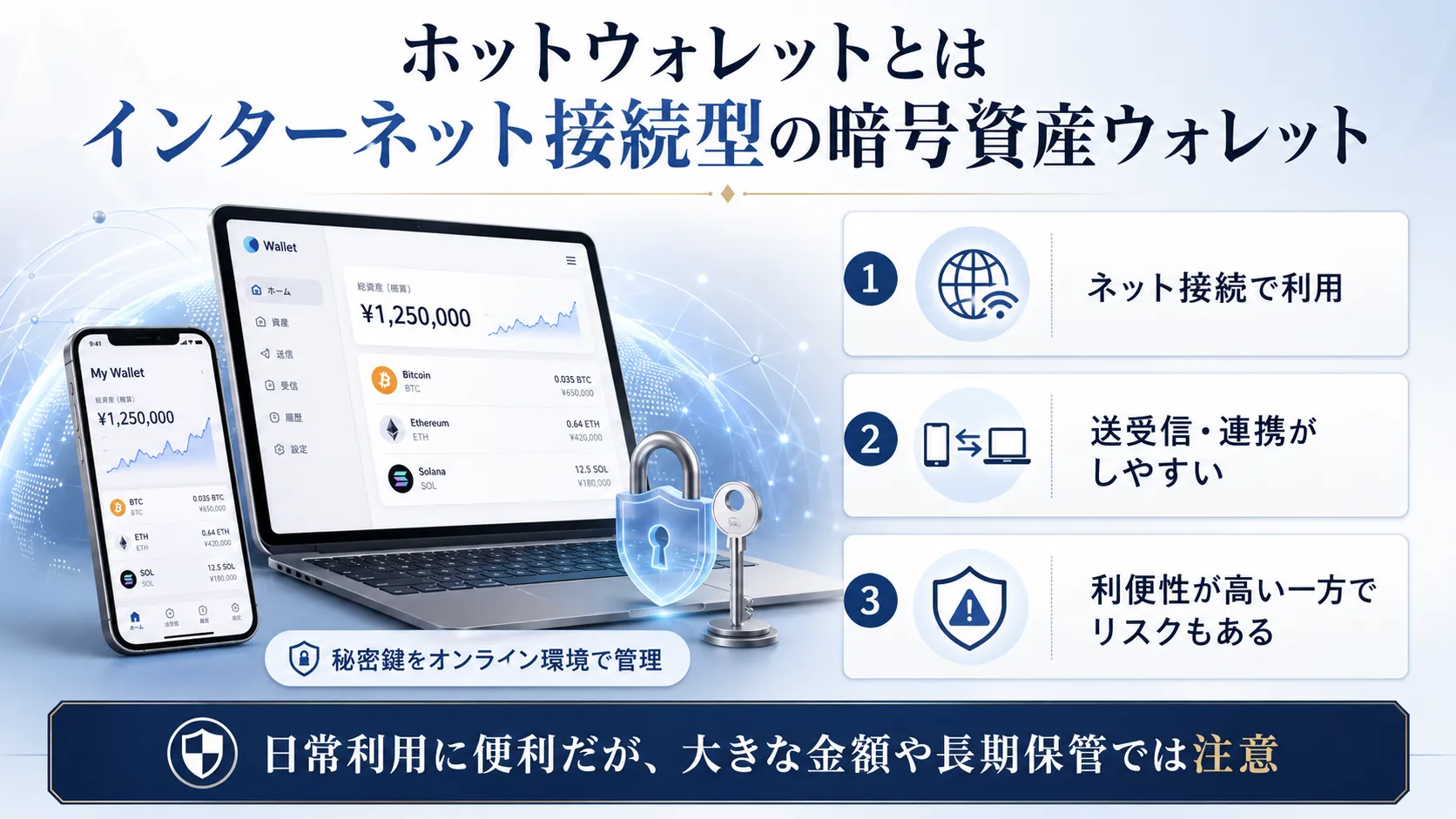
A hot wallet is a management tool for crypto assets that stays connected to the internet. It can be used on devices that are online in everyday life, such as smartphones and computers, and it stands out for letting you send and receive crypto assets and connect to various services right away.
The word "wallet" tends to conjure an image of "something like a purse that holds the crypto assets themselves," but in reality a hot wallet does not store the crypto assets themselves. Instead, it is a mechanism for managing the "private key," the critical piece of information needed to move crypto assets.
A private key is the information used to authorize the sending of crypto assets and to approve transactions. In banking terms, it plays a role similar to the authentication information required when making a transfer. Because a crypto asset transaction generally cannot be reversed once sent, how you manage this private key becomes extremely important.
Because a hot wallet handles this private key in an internet-connected environment, it offers high convenience but also carries risks from phishing scams and fraudulent sites. It is therefore well suited to everyday use, but caution is needed when managing assets you intend to hold long term or in large amounts.
What Is the Difference Between a Hot Wallet and a Cold Wallet?
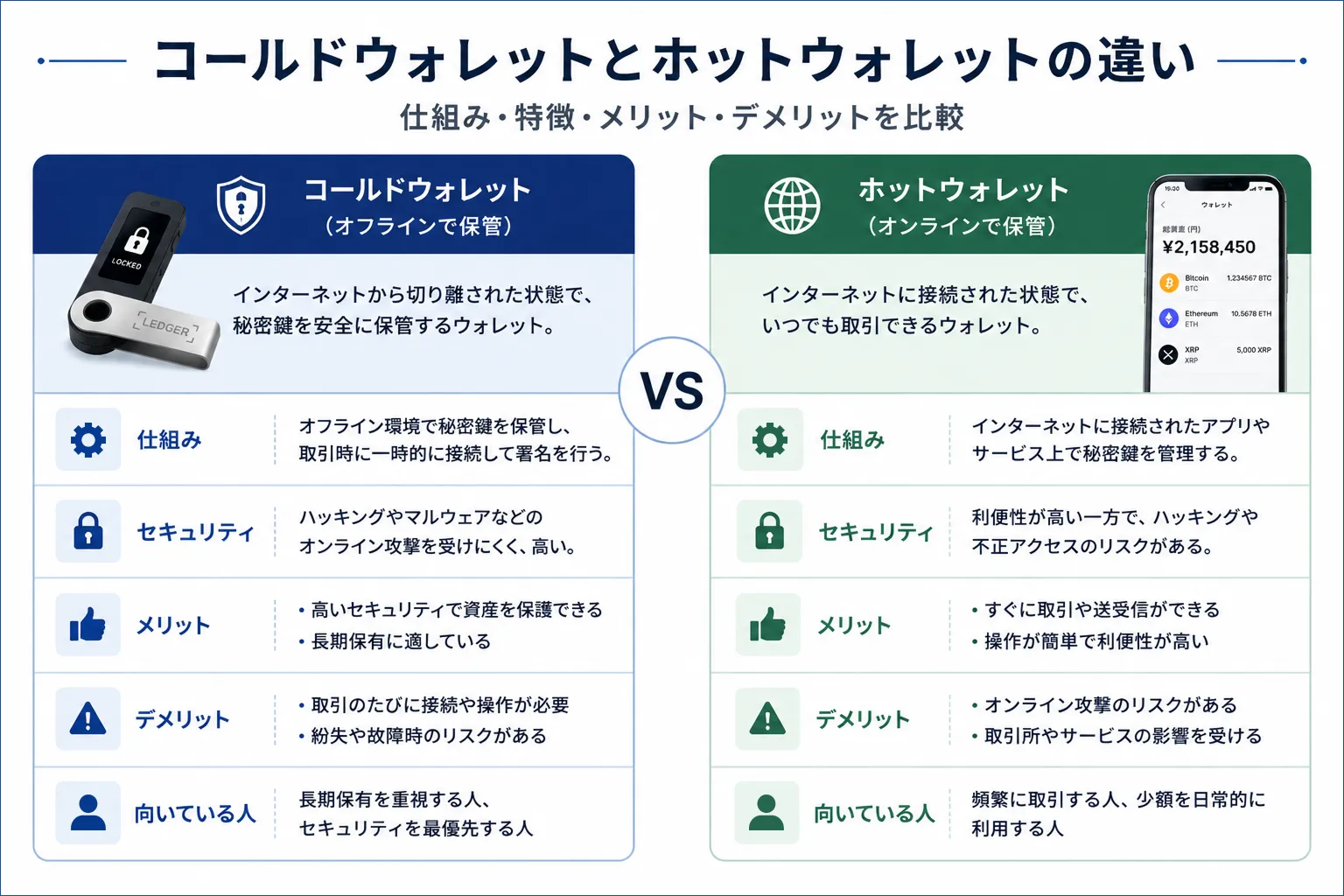
To understand hot wallets, it also helps to know about another storage method called a "cold wallet." Whereas a hot wallet is used while connected to the internet, a cold wallet is a wallet in which the private key is managed in a state disconnected from the internet.
Because a hot wallet stays connected to the internet, it makes sending and receiving crypto assets and connecting to external services quick and easy. For example, when receiving crypto assets from an exchange or connecting to an NFT marketplace, a hot wallet is an easy method to work with.
A cold wallet, on the other hand, manages the private key in a state disconnected from the internet, making it less susceptible to online attacks. Representative examples include hardware wallets and methods that record a recovery phrase on paper for safekeeping (related: What Is a Cold Wallet? (in Japanese)).
In this way, hot wallets and cold wallets differ in their characteristics depending on their internet connection status. Neither is inherently superior to the other; it is important to use them according to purpose — for example, using a hot wallet for crypto assets you move around day to day and a cold wallet for assets you intend to hold long term.
Main Types of Hot Wallets
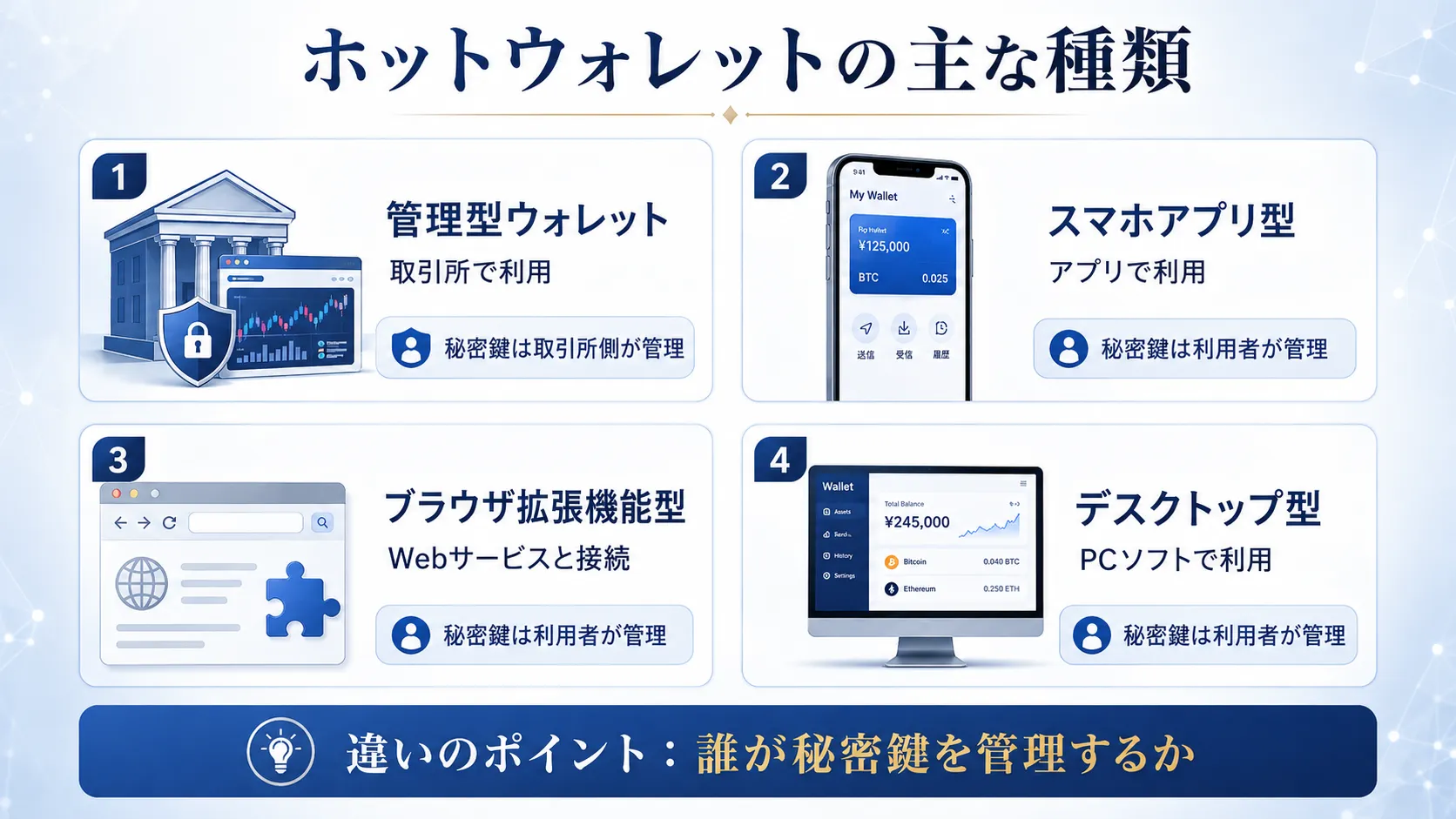
There are several types of hot wallets. The main categories are the following four:
- Custodial wallets used at exchanges
- Smartphone app wallets
- Browser extension wallets
- Desktop wallets
Understanding the differences between them makes it easier to grasp the characteristics and precautions of the wallet you are using. In particular, the question of "who manages the private key" is important.
Custodial Wallets Used at Exchanges
When you hold crypto assets in an account at a Crypto Asset Exchange Service Provider, it is generally the exchange, not the user, that manages the private key. The user logs into the account using the exchange's ID, password, and two-factor authentication. Because there is no need to manage the private key directly, this approach is easy to use for people who are not yet familiar with crypto assets.
On the other hand, because your assets are held in a way that depends on the exchange's system and operational policies, if the exchange experiences a system outage or maintenance, you may not be able to move your crypto assets at any time you choose. In addition, withdrawals can be temporarily restricted due to regulatory responses or the exchange's internal decisions, and account operations may also be restricted for asset-protection reasons if unauthorized logins or security issues are detected.
Incidentally, when a domestic (Japan-based) Crypto Asset Exchange Service Provider manages a user's crypto assets, the information needed to move those crypto assets, such as the private key, must in principle be managed in an environment not connected to the internet. This is generally understood to mean management via a cold wallet or similar method. In other words, while users can operate the exchange's interface online, the exchange itself does not leave the bulk of users' assets sitting online (reference: Cabinet Office Order on Crypto Asset Exchange Service Providers).
Smartphone App Wallets
A smartphone app wallet is a hot wallet used by installing a dedicated app on a smartphone. Because it lets you check balances and send or receive crypto assets instantly on your smartphone, it is well suited to everyday payments and managing small amounts of assets.
Representative examples include the following. The crypto assets and blockchains supported, as well as the available features, differ from wallet to wallet, so it is important to check the official site for compatibility before use.
With this type of wallet, the user manages the private key needed to move crypto assets, as well as the recovery phrase used to restore it. A recovery phrase is a critical piece of information, typically made up of a combination of 12 or 24 words, used to back up and restore a wallet (related: What Is a Recovery Phrase? (in Japanese)).
Thanks to this mechanism, even if you lose your smartphone, as long as the recovery phrase has been safely stored, you may be able to restore the same wallet on a different device and regain access to your assets.
A smartphone is a convenient, always-carried device, but its security risks should not be forgotten. Specifically, these include loss or theft of the device, malware infection, access to phishing sites, and installation of fake apps disguised as the genuine ones.
For this reason, it is important to take multiple precautions when using such a wallet, such as downloading apps only from official stores, keeping the OS and apps up to date, and storing the recovery phrase safely offline.
Browser Extension Wallets
A browser extension wallet is a type of hot wallet added to a browser such as Google Chrome. A typical use case is connecting to services such as DeFi, NFT marketplaces, and blockchain games.
DeFi refers to a mechanism for conducting financial transactions on a blockchain without going through a central intermediary such as a bank or securities firm. An NFT, meanwhile, refers to a unique digital asset issued on a blockchain.
With this type of wallet, you perform a "connect wallet" action on a website to execute transactions and signatures. Browser extension wallets are convenient, but checking the destination you are connecting to is especially important. Connecting to a fake site or signing a suspicious transaction can result in the loss of the crypto assets in your wallet.
For this reason, when using a browser extension wallet, be sure to install it from the official site, verify the URL of the destination you are connecting to, and avoid casually approving signatures whose content you do not understand.
Desktop Wallets
A desktop wallet is a type of hot wallet used by installing software on a computer. Because it can be operated on a larger screen than a smartphone, it is easier to check balances and transaction history.
On the other hand, as long as the computer is connected to the internet, there are risks from malware, unauthorized software, and fake sites. Security management is especially important on devices where you routinely install a variety of software.
Some desktop wallets also take time to synchronize blockchain data. When you open a wallet you have not used in a while, synchronization may not progress smoothly, or a change in the software's specifications may make it harder to figure out how to operate it.
When using a desktop wallet as well, managing your backup information is important. Even if the software becomes unusable, if you still have your recovery phrase or private key, you may be able to restore your assets with a different compatible wallet.
Benefits of Using a Hot Wallet
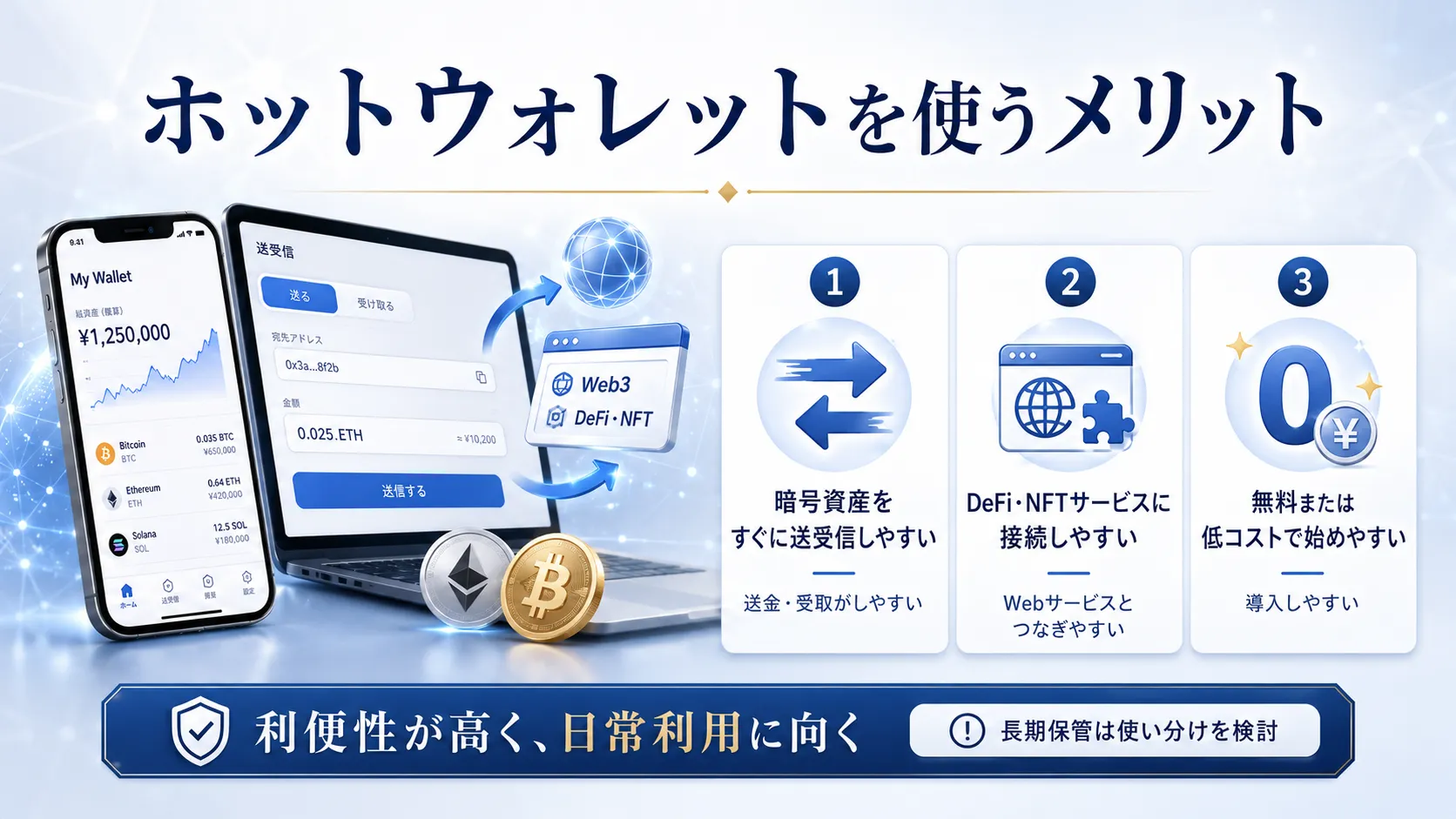
The benefit of a hot wallet is that it makes moving crypto assets quick and easy. It is well suited to everyday operations such as receiving crypto assets purchased on an exchange, sending them to another wallet, or connecting to DeFi or NFT-related services.
That said, the benefit lies purely in convenience. If safety is your top priority, or if your goal is long-term storage, you need to consider using a cold wallet as well, depending on the purpose.
Makes Sending and Receiving Crypto Assets Quick and Easy
Because a hot wallet is used while connected to the internet, it lets you send and receive crypto assets right away. For example, it is convenient for situations such as moving crypto assets from an exchange to your own wallet or sending them to another service.
Sending crypto assets requires correctly entering the destination address, network, and amount. Because a hot wallet lets you perform these operations within an app or browser, it can be handled smoothly by those who are used to it.
However, the fact that sending is easy does not mean the risk of sending to the wrong destination is small. If you get the destination address or network wrong, you may not be able to recover the assets, so always check carefully before sending.
Easy to Connect to Services Such as DeFi and NFTs
Another characteristic of hot wallets is that they are easy to connect to services such as DeFi and NFTs. For example, with a browser extension wallet, you can connect your wallet on a website and carry out transactions and signatures.
However, when connecting to an external service, the assets in your wallet may be exposed to risk. In particular, always verify whether the service you are connecting to is trustworthy, whether you understand the content of what you are signing, and whether you are being asked to approve anything suspicious.
When using DeFi or NFTs, it can also help to separate the wallet that holds your main assets from the wallet you use to connect to services. This limits the scope of damage if something does go wrong.
Easy to Get Started for Free or at Low Cost
Many hot wallets are easy to start using for free or at low cost. If the wallet is provided as a smartphone app or browser extension, you can start using it simply by installing it on your device and completing the initial setup.
Since there is no need to purchase a dedicated device as with a hardware wallet, this makes hot wallets an easy method to use when managing a small amount of crypto assets or when you first want to understand how a wallet works.
That said, even if the wallet app itself is free, sending crypto assets may incur a network fee. A network fee is the fee paid to have a transaction processed on the blockchain. On networks such as Ethereum, this fee can rise depending on network congestion.
For this reason, while a hot wallet keeps the cost of getting started low, you also need to factor in the fees involved in sending assets and using services.
Risks of Using a Hot Wallet
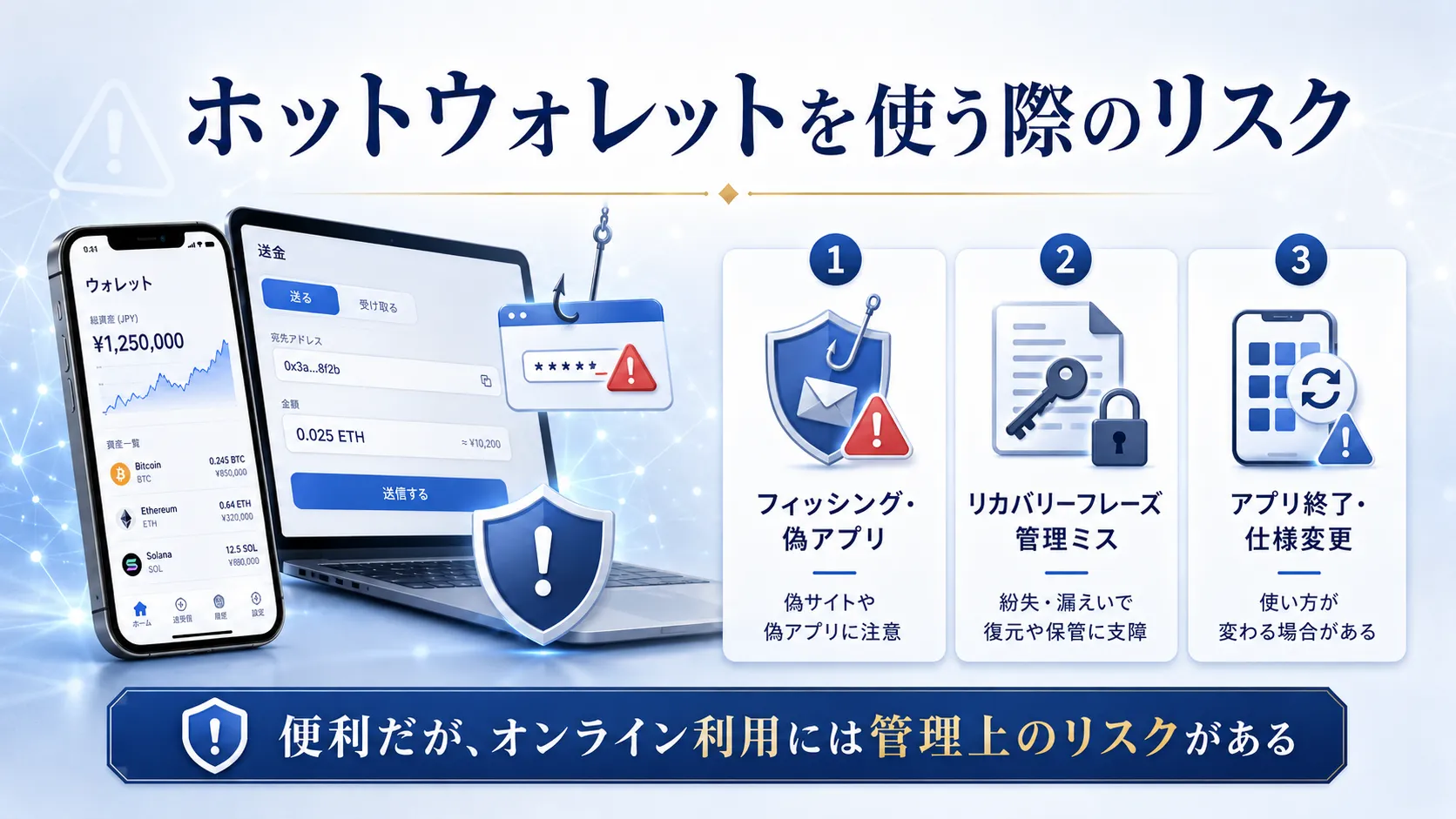
When using a hot wallet, it is important to understand the risks that come from being connected to the internet. Particular points of caution include phishing, fake apps, mismanagement of your recovery phrase, and app shutdowns or specification changes.
A hot wallet is not something you should avoid using simply because it is "dangerous." What matters is choosing an appropriate management method based on the amount you are storing and your purpose for using it.
Risk of Damage from Phishing or Fake Apps
With a hot wallet, you need to be careful of damage from phishing and fake apps. Phishing is a technique that lures users to a fake site posing as an official site or official support channel and induces them to enter their recovery phrase or private key (related: Countermeasures Against Crypto Asset Phishing Scams (in Japanese)).
There are also cases in which users are led to fake sites via search results or social media ads. Even a design that looks official may have a different URL, so do not simply take search results at face value — always verify that the URL is correct.
Even if a suspicious site displays messages such as "restore your wallet," "fix an error," or "receive assets," never enter your recovery phrase. Even if the other party claims to be official support, caution is warranted the moment you are asked for your recovery phrase or private key.
Mismanaging Your Recovery Phrase or Private Key Can Make Recovery Impossible
The recovery phrase is the single most important piece of information for restoring a wallet. Even if your smartphone or computer breaks, as long as you have the recovery phrase, you may be able to restore your wallet on a different device. On the other hand, if you lose it, you risk losing access to your assets, so the recovery phrase and private key must be managed carefully.
You should avoid storing them in a smartphone notes app, cloud storage, email, or chat apps. If stored online, they could be seen by a third party in the event of an account takeover or data leak.
As a basic rule, record your recovery phrase on paper or a metal plate and store it somewhere it is unlikely to be seen by others or lost. If you make the storage location known only to yourself, this can create problems in the event of inheritance or an emergency, so consider a management method appropriate to your circumstances.
App Shutdowns or Specification Changes Can Make Usage Unclear
With hot wallets, app shutdowns or specification changes can sometimes make it unclear how to use the wallet. In particular, if you open a wallet you have not used in several years, you may find that the app has been discontinued or that the login method has changed.
That said, even if a wallet app becomes unusable, this does not mean your crypto assets are lost. In fact, there are cases in which a previously used wallet app could no longer be opened, but the assets were still restored to a different wallet using the recovery phrase or private key (related: A Case Study: Recovering About 6.5 ETH After the Service Shut Down (in Japanese)).
Cases like this show that what matters is not the app itself, but whether you have correctly stored the information needed for recovery. For this reason, keep your recovery phrase and private key stored strictly in a way that prevents leakage to third parties.
Points for Using a Hot Wallet Safely
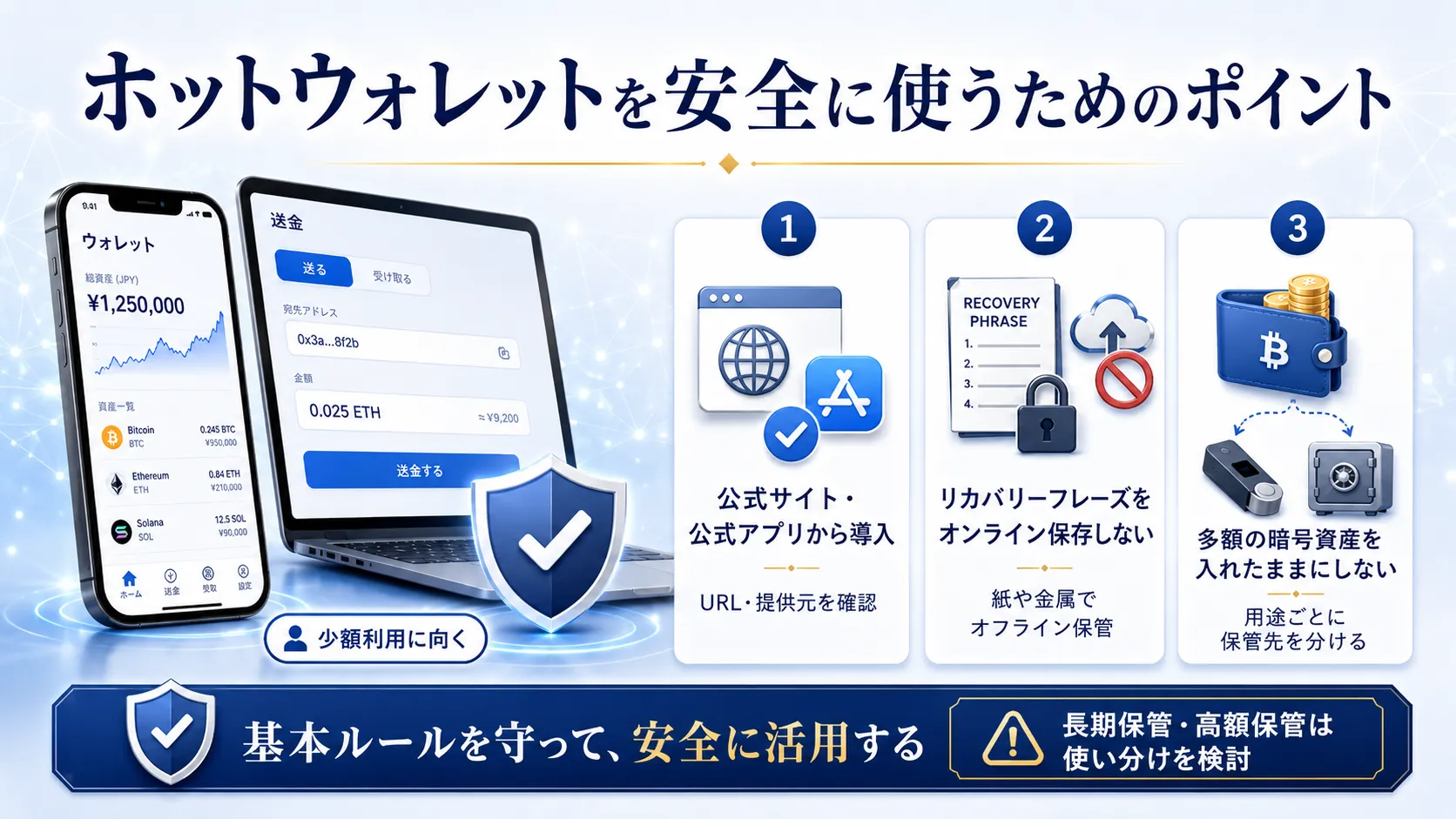
To use a hot wallet safely, it is important to follow basic management rules. While it offers convenience for everyday use, misusing it can also lead to risk.
Here, we cover the mindset and precautions worth keeping in mind to use a hot wallet with confidence.
Install It from the Official Site or Official App Store
When using a hot wallet, check the legitimacy of the source you're installing from. Specifically, you should install it from a link listed on the wallet's official site, or from an official app store such as the Apple App Store or Google Play.
Links that appear in search engine results or social media ads may look official but could be fake sites created by a third party, so avoid accessing them without caution. Before installing, verify that the URL you are accessing matches the official domain, that the app's provider is the legitimate developer, and that there is nothing unnatural about the reviews.
It is also important not to casually open a link sent by someone claiming to be a support representative. Legitimate support will, as a rule, never individually send you a link and ask you to enter your recovery phrase or private key.
Tactics that prompt you to enter such information under the pretext of "restoring your wallet" or "resolving an error" are a classic scam technique. Do not respond to such requests — instead, verify directly through the support contact listed on the official site.
Do Not Store Your Recovery Phrase Online
As a basic rule, do not store your recovery phrase online. Storing it in a smartphone's notes app, cloud storage, email, chat apps, or as a screenshot risks exposure if your device or account is compromised.
Writing it on paper for storage is a common method (in Japanese). However, paper is vulnerable to water damage, fire, deterioration, and loss, so care is needed in choosing where to store it. For long-term storage, you may also want to consider a fireproof safe or a metal plate (in Japanese).
Also, keeping your recovery phrase somewhere too easy to find risks it being seen by family members or others. Conversely, hiding it somewhere too obscure risks you forgetting it yourself. Balance safety and recoverability, and store it in a way that ensures you yourself can reliably retrieve it when needed.
Do Not Leave Large Amounts of Crypto Assets in a Hot Wallet
It is important not to leave large amounts of crypto assets in a hot wallet. Because it is used while connected to the internet, risks such as phishing, unauthorized signatures, and device compromise can never be completely eliminated.
A hot wallet is well suited to managing the portion of crypto assets you use day to day — for example, funds used for sending and receiving, funds connected to DeFi or NFT services, or funds you plan to move in the short term.
On the other hand, if you leave crypto assets you intend to hold long term, or large amounts, sitting in a hot wallet, any damage that occurs will result in a larger loss. Just as with brokerage or bank accounts, where funds are separated by purpose, the same approach of separating storage locations applies to crypto assets.
The larger your holdings, the more worth considering the use of a cold wallet or hardware wallet as well (related: How to Set Up a Cold Wallet (in Japanese)).
Frequently Asked Questions About Hot Wallets
Here we go through frequently asked questions about hot wallets. A hot wallet is a convenient management method, but using it without understanding how it differs from an exchange account or a cold wallet can lead to misunderstandings.
Is a Hot Wallet the Same as an Exchange Account?
You should not think of a hot wallet and an exchange account as the same thing. With an exchange account, the user logs in with an ID and password and buys, sells, and holds crypto assets on the exchange's platform. In this case, the private key is generally managed by the exchange.
With a self-custodial hot wallet, on the other hand, users manage their own recovery phrase and private key. A key characteristic is that you can send and receive crypto assets or connect to external services without going through an exchange.
In other words, an exchange account is a form in which management is entrusted to a service provider, while a self-custodial hot wallet is a form in which you manage it yourself. Both can be used online, but who manages the private key differs significantly between the two.
Can a Hot Wallet Be Used for Free?
Many hot wallets can be installed as an app or browser extension for free. This makes them easier to get started with compared to a hardware wallet, which requires purchasing a dedicated device.
That said, even if using the wallet itself is free, sending crypto assets may incur a network fee. The network fee varies depending on the blockchain being used and the level of network congestion.
In addition, service-side fees may apply when exchanging crypto assets or staking within the wallet. Being free to start and having every operation be free are two different things.
If I Lose My Smartphone, Will I Also Lose My Crypto Assets?
Losing your smartphone alone does not necessarily mean you will lose your crypto assets. With a self-custodial wallet, as long as your recovery phrase has been properly stored, you may be able to restore your wallet on a different device.
However, if you have not stored your recovery phrase, or have not recorded it accurately, recovery can become difficult. Also, if your smartphone's lock screen is weak or your wallet app is accessed without authorization, a third party may be able to move your assets.
If you lose your smartphone, you should promptly consider steps such as remotely locking the device, changing passwords for related accounts, restoring your wallet, and moving assets as needed. Storing your recovery phrase safely in advance is the single most important countermeasure (related: What Happens to Your Crypto Assets If You Lose Your Phone? (in Japanese)).
Is It OK to Store Crypto Assets Using Only a Hot Wallet?
If your purpose is sending and receiving a small amount of crypto assets day to day, a hot wallet is a convenient management method. On the other hand, managing crypto assets you intend to hold long term, or large amounts, using only a hot wallet warrants careful consideration.
Because a hot wallet is used while connected to the internet, it carries risks such as phishing, fake apps, unauthorized signatures, and device compromise. If you are affected, crypto asset transfers are difficult to reverse, so the resulting loss can be significant.
For this reason, a practical approach is to separate storage by purpose — using a hot wallet for funds used day to day and a cold wallet for funds held long term. If your crypto holdings are substantial, it is also worth considering the use of a hardware wallet.
Summary
A hot wallet is a crypto asset wallet used while connected to the internet. It comes in forms such as smartphone apps, browser extensions, and desktop wallets, and it is well suited to sending and receiving crypto assets and using services such as DeFi and NFTs.
On the other hand, because a hot wallet is used in an online environment, caution is needed regarding phishing, fake apps, malicious connection destinations, and the loss or breakdown of your device. In particular, with self-custodial wallets, mismanaging your recovery phrase or private key can result in losing access to your assets.
While convenient, a hot wallet is less suited to long-term storage or holding large amounts. It is important to separate your storage methods by purpose — for example, managing assets you use day to day with a hot wallet and assets you hold long term with a cold wallet.
To manage your crypto assets safely, it is important to understand not only the type of wallet you are using but also who manages the private key and recovery phrase, and under what circumstances they will be used.
This article is for informational purposes only and does not constitute financial or investment advice. Please consult a qualified professional before making investment decisions.


