


Investors who self-identify as "primarily long-term holders" are, paradoxically, more likely to leave their assets sitting on an exchange.
That is the counterintuitive finding to emerge from a survey of 746 respondents.
Of all respondents, 226 identified their investment style as "HODL" (long-term holding), making it the largest group at 30.3% of the total.
Yet when asked where they keep their long-term holdings, 59.3% of this HODL group answered "left on an exchange" — the highest figure of any investment style surveyed.
What makes this more striking is a dual structure: the HODL group's rate of having two-factor authentication (2FA) enabled on all services is 45.1% — the highest of any style — yet its rate of never having migrated to a self-custody wallet also sits at 45.1%.
This points to a serious gap between security awareness and actual behavior: locking the door, so to speak, while leaving the safe itself in someone else's hands.
This article examines the contradictions within the HODL investor profile from multiple angles and uses the survey data to identify the conditions under which a long-term holding strategy actually works.
The Largest Group of Investors — 226 "HODLers," 60% of Whom Leave Assets on an Exchange
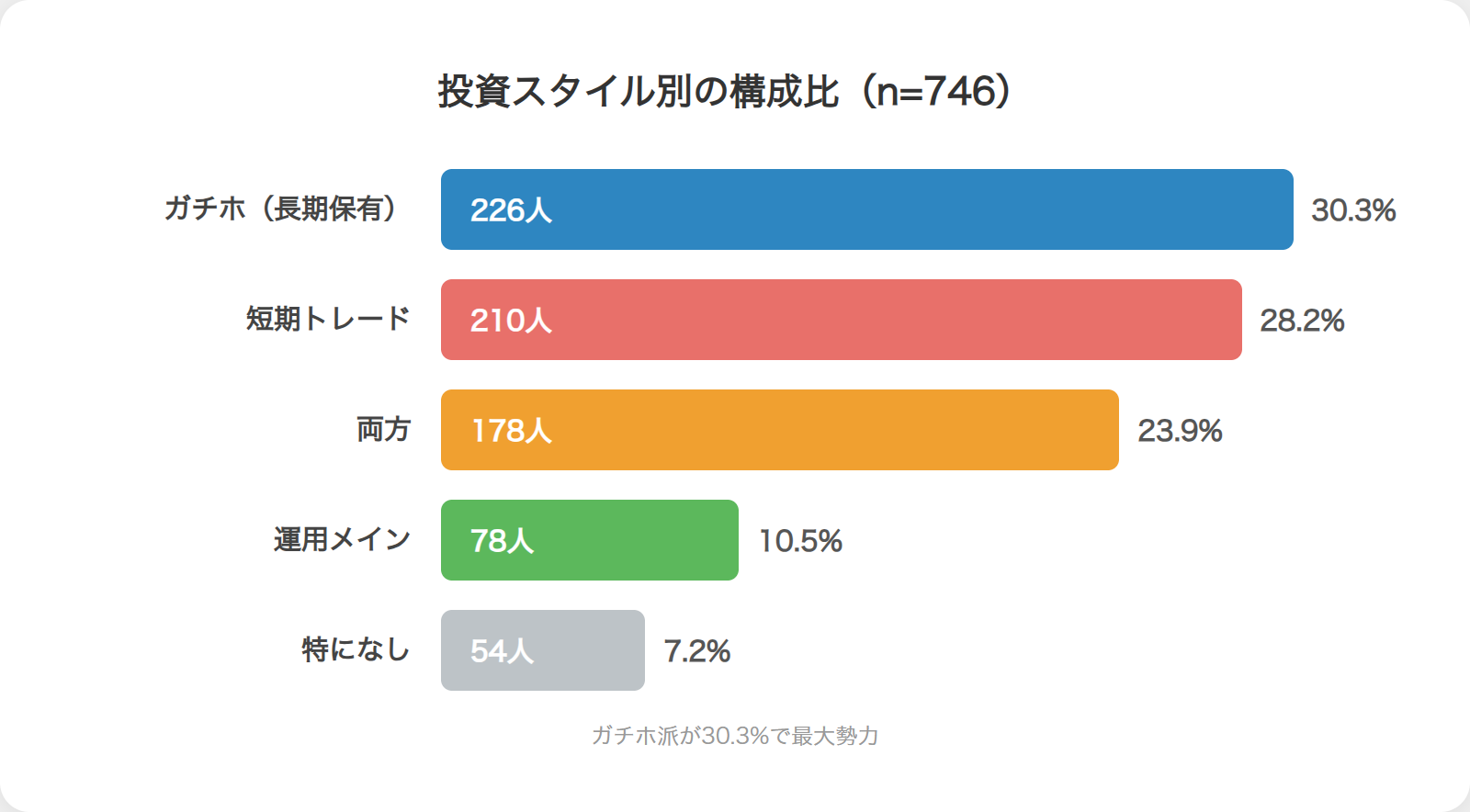
Investment Style | Respondents | Share |
|---|---|---|
HODL (long-term holding) | 226 | 30.3% |
Short-term trading | 210 | 28.2% |
Both | 178 | 23.9% |
Yield-focused (staking, etc.) | 78 | 10.5% |
None in particular | 54 | 7.2% |
The Largest Group at 30.3% — Self-Reported "Long-Term Holders"
When asked about their investment style, the largest group of respondents — 226 people, or 30.3% of the total — identified as "HODL" (long-term holding).
That works out to roughly one in three investors, confirming long-term holding as the dominant strategy in the crypto assets (also known as virtual currencies) market.
Long-term holding refers to a strategy of holding assets for years at a time without reacting to short-term price swings.
For investors expecting major assets such as Bitcoin and Ethereum to appreciate over the long run, it is considered the simplest and most repeatable approach.
For a "long-term holding" strategy to actually work, however, the underlying premise is that the assets are held securely.
The longer the holding period, the more security risk can accumulate over that time.
59.3% of HODLers "Leave Assets on an Exchange" — Worst of Any Style
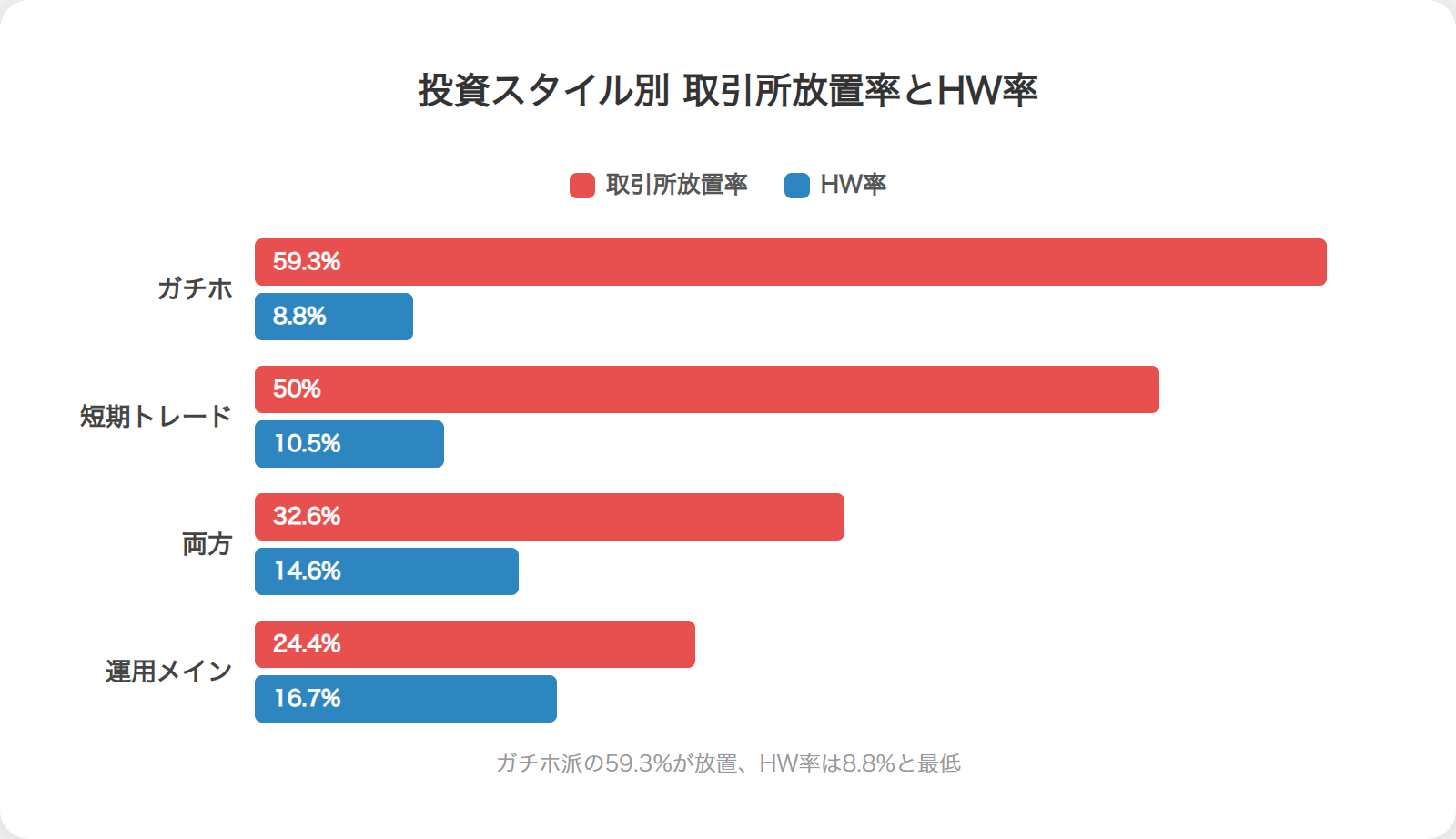
Investment Style | n | Left on Exchange | Hardware Wallet Usage Rate |
|---|---|---|---|
HODL (long-term holding) | 226 | 59.3% | 8.8% |
Short-term trading | 210 | 50.0% | 10.5% |
Both | 178 | 32.6% | 14.6% |
Yield-focused | 78 | 24.4% | 16.7% |
None in particular | 54 | 63.0% | 5.6% |
Cross-tabulating where long-term holdings are kept by investment style reveals a striking figure.
59.3% of the HODL group reported leaving their assets "on an exchange," the highest figure of any investment style except the "none in particular" group.
One would expect long-term holdings, of all assets, to be the ones under strict cold-wallet management — yet the reality is the exact opposite.
Also worth noting is the hardware wallet (HW) adoption rate.
At just 8.8%, the HODL group's hardware-wallet usage rate is lower than both the "both" and "yield-focused" groups, indicating it is the group with the weakest self-custody awareness.
The data makes clear that a strategy of "not moving assets" has, in practice, become "not bothering to move assets."
45.1% "Have Never Migrated to a Wallet" — HODLers Move Assets Off Exchanges the Least
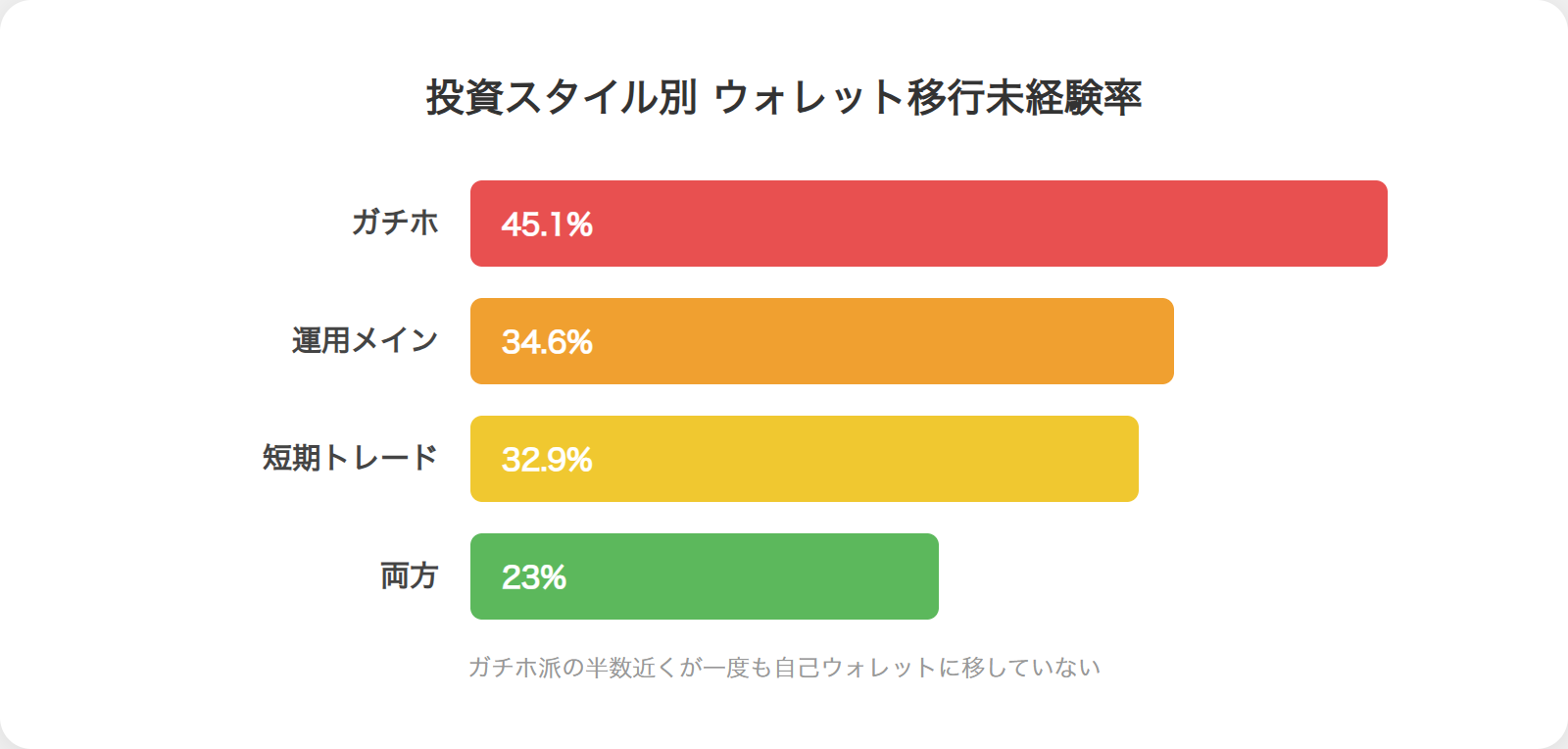
Investment Style | n | Never Migrated to a Wallet |
|---|---|---|
HODL (long-term holding) | 226 | 45.1% |
Short-term trading | 210 | 32.9% |
Both | 178 | 23.0% |
Yield-focused | 78 | 34.6% |
Nearly Half of HODLers Have Never Used a Self-Custody Wallet
Asked whether they had ever migrated assets from an exchange to a wallet, 45.1% of the HODL group answered "never."
That means 102 of the 226 HODL respondents have never moved their crypto assets to a self-custody wallet since purchasing them.
The group that, by definition, should be moving assets the least has ended up in a behavioral pattern of "never moving assets off the exchange at all."
But "holding for the long term" and "never carrying out a migration" are, in principle, entirely separate concepts.
Yet nearly half of HODLers appear to conflate the two, revealing a significant gap between strategy and execution.
Migration Hurdles May Be Reinforcing the "HODL" Habit
Why does the HODL group migrate wallets the least?
One likely factor is the psychological and technical hurdles involved in the migration process itself.
Managing a seed phrase, choosing the correct network, and sending a test transaction are far from simple for beginners.
Not a few investors likely put migration off with an "I'll get to it eventually" attitude, and as the holding period stretches out, they end up self-identifying as "HODLers."
But the longer migration is postponed, the longer those holdings remain exposed to exchange risk.
Exchange bankruptcies, hacks, and withdrawal suspensions are, based on past cases, far from rare events.
For investors serious about long-term holding, investing a few dozen minutes upfront to build a self-custody setup is a necessary condition, not an optional extra.
A Surprising Finding — HODLers Have the Highest Rate of Full 2FA Adoption, at 45.1%
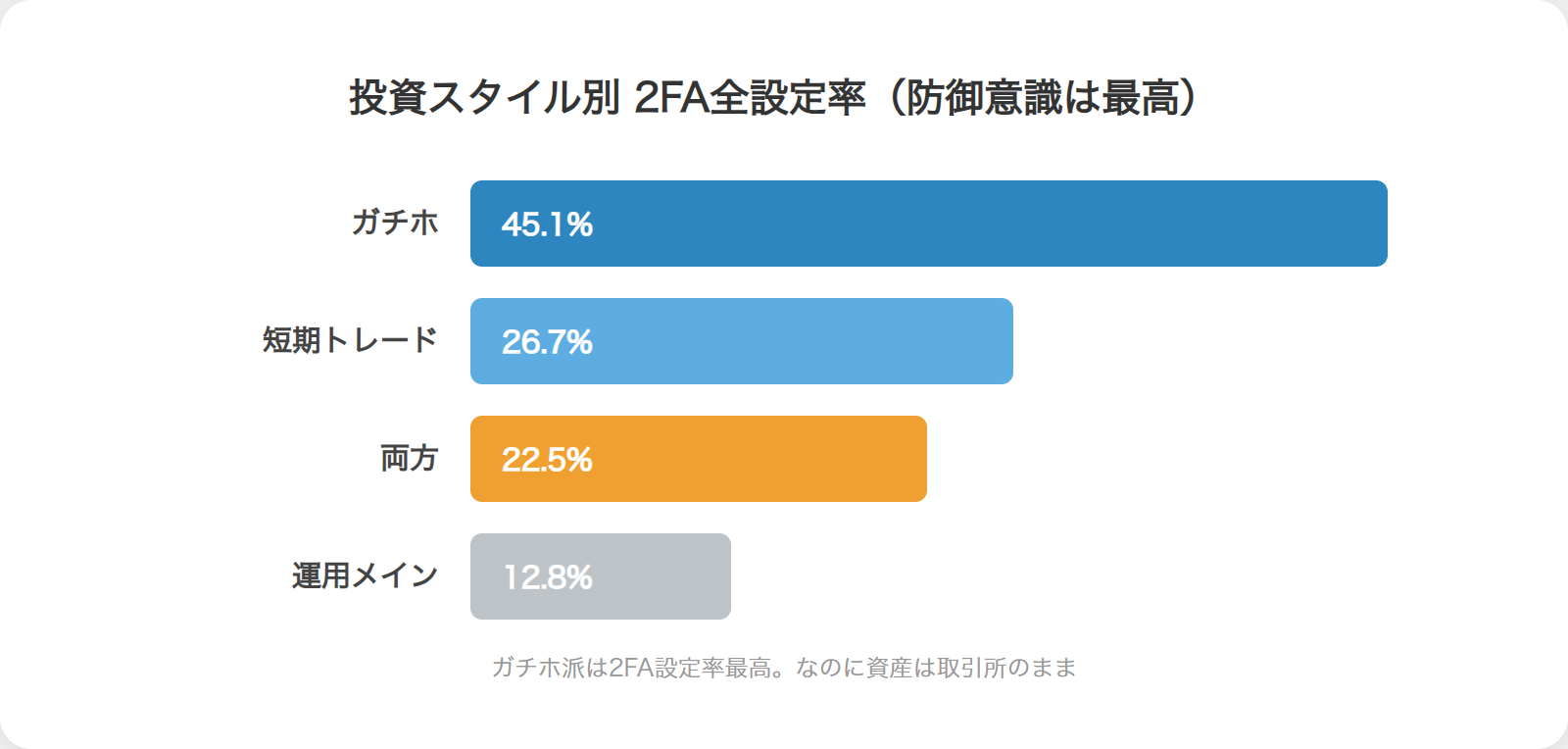
Investment Style | n | All Services Enabled | Not Enabled or Unsure |
|---|---|---|---|
HODL (long-term holding) | 226 | 45.1% | 19.5% |
Short-term trading | 210 | 26.7% | 21.9% |
Both | 178 | 22.5% | 20.8% |
Yield-focused | 78 | 12.8% | 35.9% |
Security Awareness Is Highest — Yet Assets Remain on the Exchange
One unexpected side of the HODL group to emerge from the survey is a high rate of two-factor authentication (2FA) adoption across all services.
45.1% of the HODL group reported having 2FA "enabled on every service," the highest figure among all investment styles.
Ironically, it is the HODL group that appears to grasp the importance of security most strongly.
Yet that same group leaves 59.3% of its long-term holdings sitting on an exchange.
What emerges is a strange dual structure of defense: locking the door, while leaving the safe itself in someone else's hands.
The Gap Between Security Awareness and Behavior — What Is Holding Investors Back?
The HODL group's hardware wallet ownership rate is 46.9%, and its full 2FA adoption rate is 45.1% — both on par with, or better than, other investment styles.
So how can we explain the contradiction that, despite this, 59.3% of long-term holdings are left sitting on an exchange?
One plausible hypothesis is that investors have the security knowledge but simply place a low priority on the migration task itself.
Enabling 2FA takes only a few minutes, whereas migrating to a wallet — from managing a seed phrase to confirming a transfer — can take anywhere from tens of minutes to several hours.
The result of continually postponing this "hassle" may be that the long-term holding period has simply become an equally long period of neglect.
Another hypothesis is trust in exchanges themselves.
A belief that "as long as 2FA is enabled, an exchange is safe enough" may be shared, with a degree of internal logic, among HODL investors.
Identifying the "Most Unguarded" Segment Within the HODL Group
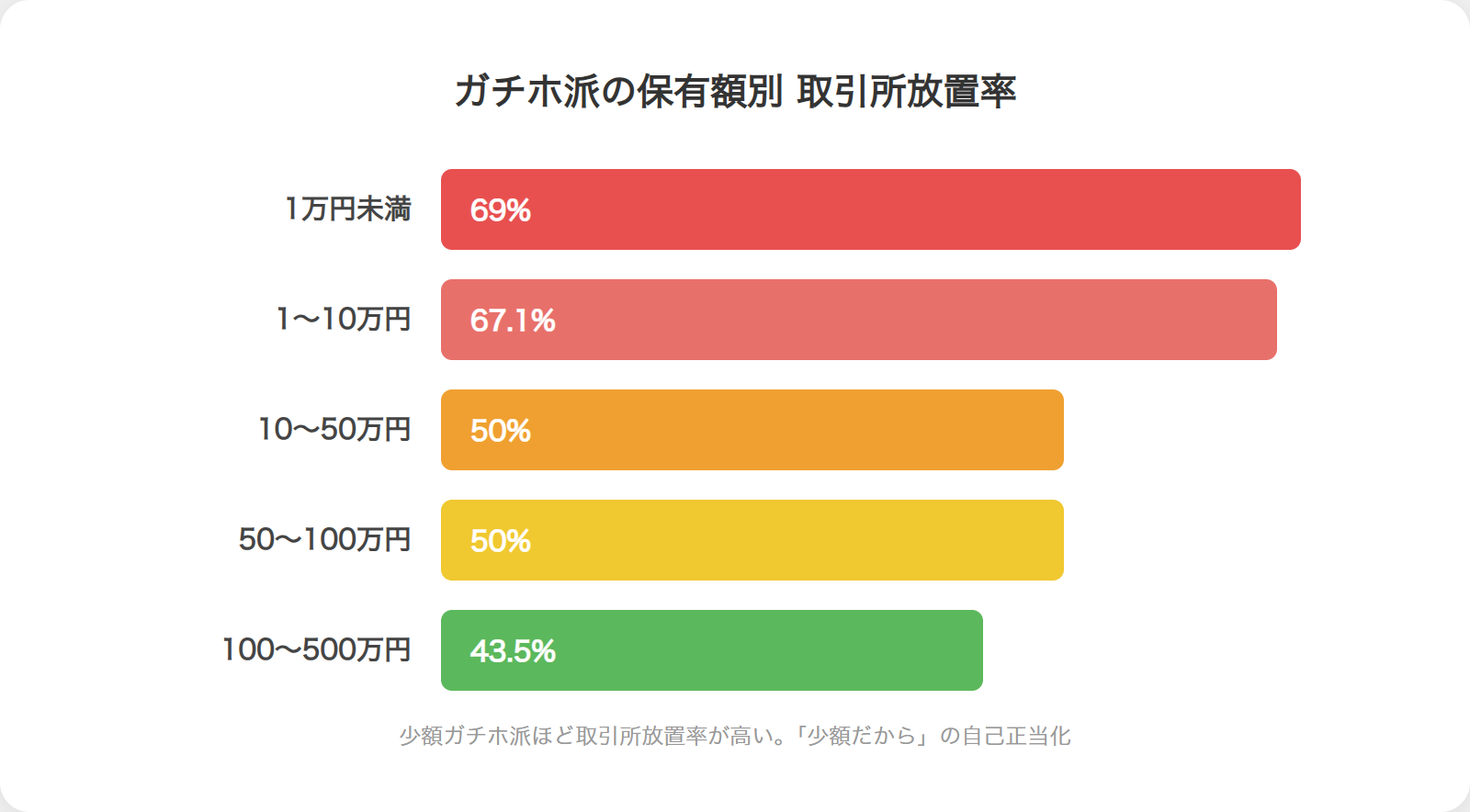
Holdings Value | n | Left on Exchange |
|---|---|---|
Under ¥10,000 (≈$65) | 42 | 69.0% |
¥10,000–under ¥100,000 (≈$65–$650) | 70 | 67.1% |
¥100,000–under ¥500,000 (≈$650–$3,200) | 44 | 50.0% |
¥500,000–under ¥1,000,000 (≈$3,200–$6,500) | 32 | 50.0% |
¥1,000,000–under ¥5,000,000 (≈$6,500–$32,000) | 23 | 43.5% |
69.0% of HODLers Holding Under ¥10,000 Leave Assets on an Exchange — Justified by "It's Only a Small Amount"
Within the HODL group, the segment with the highest rate of leaving assets on an exchange was the under-¥10,000 holdings bracket, at 69.0%.
The data clearly shows that the smaller a HODLer's holdings, the more likely they are to leave long-term assets sitting on an exchange.
Reasoning such as "it's such a small amount, losing it wouldn't hurt much" or "it's not worth the effort of migrating a wallet" appears to function as an economic justification for leaving assets in place.
But whether a self-custody setup is already in place by the time holdings grow tenfold or a hundredfold is an extremely important consideration for a long-term investor.
Going through the migration process while holdings are still small means investors won't be scrambling once their holdings grow substantial.
As practice runs, migrating to a wallet early — while amounts are still small — is a behavior that should be strongly encouraged.
67.4% of HODLers With Under a Year of Experience — New Investors Let Their Guard Down
Years of Investing Experience | n | Left on Exchange |
|---|---|---|
Under 1 year | 43 | 67.4% |
1–under 2 years | 63 | 65.1% |
2–under 3 years | 53 | 54.7% |
3–under 5 years | 35 | 45.7% |
5+ years | 32 | 59.4% |
Broken down by years of experience, HODLers with under one year of investing experience have a notably high exchange-retention rate of 67.4%.
The tendency to leave assets on an exchange is most pronounced among those who have only recently entered the market.
For new entrants, getting comfortable with buying and selling on an exchange is likely the top priority, leaving little bandwidth for wallet migration.
However, the first one to two years of crypto assets investing are also when operational mistakes, scam victimization, and loss incidents tend to concentrate.
This is precisely the phase in which defenses should be at their strongest.
For new entrants choosing to HODL, it's important to build wallet migration into the process as a step that immediately follows purchase, rather than as something to defer.
Even Veterans With 5+ Years' Experience Sit at 59.4% — Familiarity Is Not the Same as Diligence
Surprisingly, even veteran HODLers with five or more years of investing experience maintain a high exchange-retention rate of 59.4%.
What stands out is that the rate, having dropped to 45.7% for the three-to-under-five-year bracket, rises again for the five-plus-year bracket.
Rather than reflecting simple neglect, the veteran group's high retention rate can be read as a judgment grounded in rule-of-thumb experience — "nothing has gone wrong so far."
Five-plus years of keeping assets on an exchange without incident may well be reinforcing a status-quo bias.
But the absence of trouble in the past is no guarantee against trouble in the future.
The more experienced an investor is, the more important it is to periodically update one's security setup rather than coasting on familiarity.
The Harm HODLers Actually Face — 9.7% Have Lost Funds
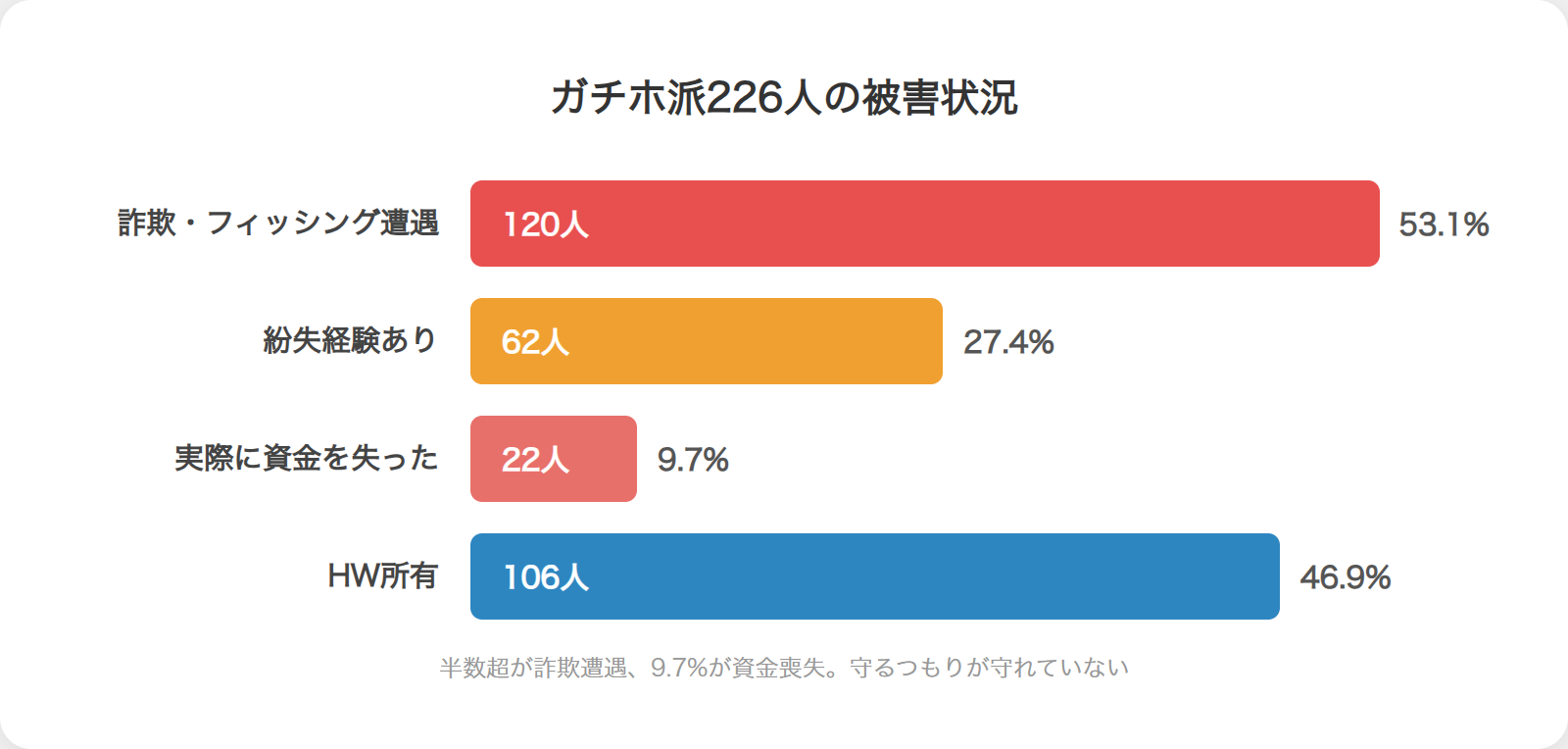
Item | Count | Share |
|---|---|---|
Encountered a scam or phishing attempt | 120 | 53.1% |
Actually lost funds | 22 | 9.7% |
Experienced a loss (recovered + funds lost, combined) | 62 | 27.4% |
Owns a hardware wallet | 106 | 46.9% |
53.1% Have Encountered Scams or Phishing — Leaving Assets on an Exchange Amplifies the Risk
Of the 226 HODL respondents, 53.1% — 120 people — reported having encountered some form of scam or phishing attempt.
This confirms that more than half of HODLers have come into direct contact with the threat of fraud.
Investors who leave assets on an exchange are particularly likely to be targeted by fake sites and fraudulent direct messages impersonating exchanges.
Compared with those who have migrated to a wallet, exchange-custody users also carry the added risk of relying on ID-and-password authentication, a comparatively weaker safeguard.
Even with 2FA enabled, users cannot avoid harm if the exchange itself is hacked.
27.4% Have Experienced Loss of Assets — Intending to Protect, Yet Failing To
Combining successful recoveries and outright losses, 62 HODLers (27.4%) reported having experienced the loss of assets.
Including near-miss incidents as well, that figure rises to 107 people (47.3%) who have had at least a close call in defending their assets.
The fact that HODLers — who presumably chose long-term holding with protection in mind — have experienced defensive failures in such numbers vividly illustrates the mismatch between strategy and execution.
The choice to leave assets on an exchange ends up putting at risk the very assets investors meant to protect.
"Owning security tools without using them" and "enabling settings but postponing migration" — this inability to take the final step is arguably the biggest challenge facing HODL investors.
Summary
This survey revealed that 59.3% of the 226 respondents in the largest group, HODLers, leave their long-term holdings on an exchange.
What is particularly contradictory is that while the HODL group's rate of full 2FA adoption is 45.1% — the highest of any investment style — its rate of never having migrated to a wallet also reaches 45.1%.
Security awareness is highest, yet the assets themselves remain on the exchange — a dual structure of defense in which the door is locked but the safe's location is left to someone else — and it stands as the HODL group's biggest challenge.
As a result, 53.1% of HODLers have encountered a scam and 9.7% have actually lost funds.
The most important shift for HODL investors is to start pairing "long-term holding" with "self-custody" as a single mindset.
Here are three steps you can start today.
First, choose and set up a software or hardware wallet.
Second, practice the migration process with a small test transfer.
Third, store your seed phrase in a secure physical location.
A long-term holding strategy of "not moving assets" is fundamentally different from the lapse of "failing to move assets when the moment calls for it."
Survey Overview
Survey date: April 10, 2026
Method: Internet survey
Target respondents: Men and women residing in Japan who currently invest, or have previously invested, in crypto assets
Valid responses: 746
Conducted by: Clabo Inc.
Survey Questions
- Do you have investing experience with crypto assets?
- How many years have you been investing in crypto assets?
- What is the total value of the crypto assets you currently hold?
- Which best describes your investment style?
- Have you ever migrated assets from an exchange to a wallet?
- Where do you keep the crypto assets you hold long-term?
- Do you own a hardware wallet?
- Do you have two-factor authentication (2FA) enabled?
This article is for informational purposes only and does not constitute financial or investment advice. Please consult a qualified professional before making investment decisions.


