


Simply put, a "public key" is a key that's fine to share with others, while a "private key" is one you must keep to yourself and protect at all costs. These two always work as a pair: the public key is used to "receive and verify," and the private key is used to "move funds and sign."
As long as you're trading crypto assets (also known as virtual currencies) on an exchange, the exchange manages the keys on your behalf, so most people never really think about public and private keys. However, the moment you try to manage your assets yourself in a wallet — especially a cold wallet — you have to confront these two keys directly. And in the world of crypto assets, a single mistake in handling your private key can cost you everything.
Although the names sound similar, the roles of the public key and the private key are exact opposites. There are clear reasons why one is "fine to make public" and the other is "something you must always hide," so let's go through them in detail.
What you'll learn in this article |
|---|
|
What Are Public and Private Keys? Key Differences at a Glance
A public key is "a key you may share with others," while a private key is "a key only you hold, and must never hand over to anyone else." These two are always created as a pair, and in crypto assets, they divide roles between "receiving assets" and "moving assets."
Public Key | Private Key |
|---|---|
A key you may share with others. In crypto assets, it forms the basis of the "wallet address" used to receive funds. | A key only you manage. In crypto assets, only the person holding this key can move the assets. If it leaks, you lose your assets, so it must be guarded rigorously. |
The key point is that these two always work as a pair. Anyone can "lock" (encrypt) something with the public key, but only the person holding the paired private key can "unlock" (decrypt) it. Here's a comparison table summarizing the differences:
Public Key | Private Key | |
|---|---|---|
Role | Used for encryption and receiving | Used for decryption and signing (proof of identity) |
OK to make public? | ◯ Yes, fine to share | ✕ Never share |
Crypto asset analogy | An "account number" for receiving funds | The "personal seal or password" that moves assets |
Impact if leaked | No real problem | You could lose your assets |
Think of a bank account: sharing your account number with someone won't let them withdraw your money. But if your registered seal (a hanko — the personal stamp that stands in for a handwritten signature in Japan) or PIN leaks, the funds in your account can be withdrawn without your consent. This same intuition applies directly to the relationship between public and private keys.
Why Is It OK to Share a Public Key But Not a Private Key?
When you hear the word "key," you might think of a house key — something dangerous to show to others. But as explained above, a public key is fine even if others learn what it is. That's because the two keys handle entirely different jobs, and having the public key alone doesn't let anyone open the contents. A padlock is a helpful analogy here.
Imagine you can duplicate an unlocked padlock as many times as you like and hand copies out to anyone on the street. This is the public key. Anyone who receives one can put a letter in a box, snap the padlock shut, and send it to you. "Locking" it is something anyone can do.
Meanwhile, suppose only you hold the one physical key that can open that padlock. This is the private key. No matter how many padlocks are scattered around, the key to open them exists only in your hands — so you're the only one who can read what's inside the box that was sent to you.
In other words, because the "locking role" and the "unlocking role" are separated, the tool for locking (the public key) remains safe no matter how widely it's shared.
- Public key (unlocked padlock) = fine to hand out — a tool for others to lock things for you
- Private key (the key that unlocks it) = never hand over — only you can open it
Another reassuring fact is that no matter how closely you examine a public key, you cannot derive the private key from it. The two keys are created mathematically as a pair, but the relationship only goes one way.
Trying to compute the private key from the public key runs into a wall of calculations that are, for all practical purposes, impossible to finish in any realistic amount of time, even with today's computers. This difficulty of reverse calculation is exactly what allows the public key to be shared openly and confidently.
That's why the priority for what to protect is simple. There's no need to panic if your public key is seen — what you truly need to protect is your private key, and only your private key. Keep this intuition in mind, and the discussion of crypto wallet management that follows will be much easier to understand.
How Public and Private Keys Work: From Encryption to Decryption
Public and private keys are always created as a pair. Combining the two makes it possible to send information so that, even if it passes through a route where it could be intercepted, only the intended recipient can read the contents. This is made possible by two operations: "encryption" (locking) and "decryption" (unlocking).
A public-private key pair has the following two properties:
- Information locked with a public key can only be unlocked with the paired private key.
- No matter how closely you examine a public key, you cannot derive the paired private key from it (this is protected by a calculation that is, for all practical purposes, impossible).
What matters is that the "role of locking" and the "role of unlocking" are kept strictly separate. The public key locks; the private key unlocks. These roles never swap. That's precisely why the public key used for locking is safe no matter who sees it or who it's handed to — it can't be used to unlock anything, nor can the private key be derived from it.
With this property in mind, let's trace through how person A sends a message to person B that only B can read.
First, B — the message recipient — hands their public key to A. Since this key is "fine to hand out," it doesn't matter if it's sent by email or chat, or seen by someone along the way. Meanwhile, the paired private key is kept by B alone and is never handed to anyone.
A uses B's public key, which they received, to lock the message. This is encryption. The encrypted message turns into a meaningless string of characters, and no one can read its contents as it is.
Here's where the earlier property — "a public key is only for locking" — comes into play. Even if a third party intercepts the message in transit, all they can do is "look at something that's already locked." Since they don't have the key to unlock it, they can't read the contents.
Only B, who holds the paired private key, can unlock this message. B removes the lock with their private key and reads the original message. This is decryption. B is the only one who holds the private key, and as a result, the original goal — "only the intended recipient can read it" — is achieved.
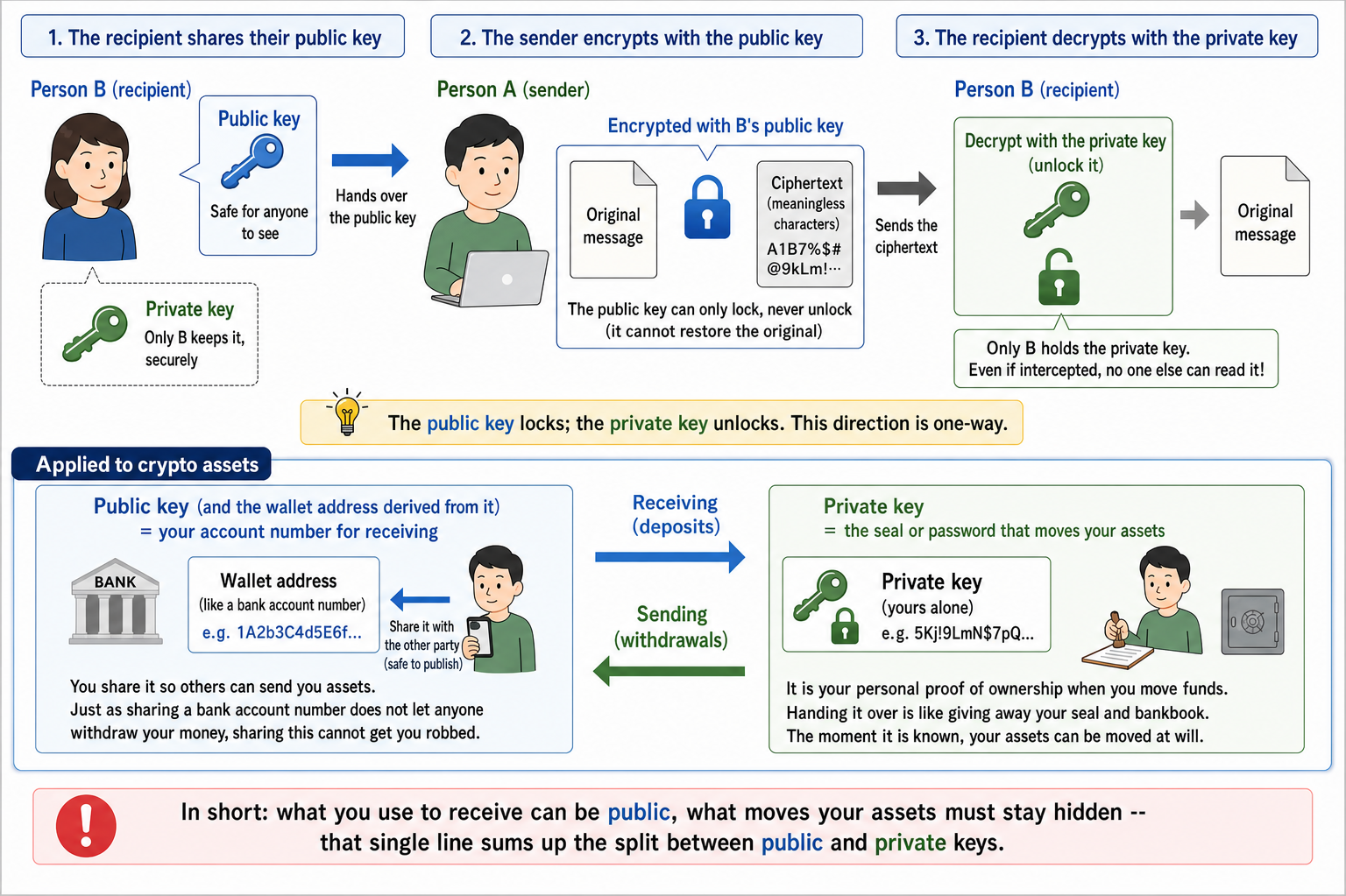
This division of roles — "the public key can be shared, the private key must always be hidden" — applies directly to crypto assets as well. Note that when it comes to crypto asset "transfers," this mechanism is used in the opposite direction from the encryption we just saw. The private key is used to prove that "this transfer was indeed instructed by the rightful owner." That's the digital signature, explained next.
What Is a Digital Signature? Why a Private Key Proves Identity
A digital signature is a mechanism that uses a private key to prove that "this data was indeed created by this person." If encryption, as seen in the previous section, is a way to "hide something so others can't read it," a digital signature is, in a sense, the reverse use. It's easier to understand if you think of it as the roles of the keys being swapped.
Who uses which key | Purpose | |
|---|---|---|
Encryption | Sender encrypts with the "recipient's public key" → recipient decrypts with "their own private key" | Hide the contents (only the intended person can read it) |
Digital Signature | Sender signs with "their own private key" → recipient verifies with the "sender's public key" | Prove who created it (anyone can verify) |
The key point is that only the person holding the private key can create a signature, while anyone with the public key can verify whether that signature is valid. There are two reasons why this constitutes "proof of identity":
- Only the private key holder can create the signature
- A signature made with a given private key can be verified with the paired public key as "definitely this person's signature." Conversely, someone who doesn't know the private key cannot, in practice, impersonate the owner and produce the same signature. It's similar to a handwritten signature or a registered seal, but far harder to copy or forge.
- If the content is altered even slightly, the signature no longer matches
- A digital signature is tied to the "content of the data" that was signed. So if the content is altered by even a single character afterward, verification fails, revealing that "this data was tampered with along the way." This means the signature simultaneously guarantees both "who created it" and "that the content hasn't been tampered with."
This mechanism is used exactly as-is at the moment a crypto asset transaction is made.
Sending crypto assets means attaching a digital signature — made with your own private key — to transaction data specifying "who to send how much to," and broadcasting it to the network. Participants on the network who receive it use the sender's public key to verify that "this transaction was indeed signed by the actual asset owner." If the signature is valid, the transaction is approved; if not, it's rejected.
That's exactly why "the person holding the private key = the person who can move the asset." Conversely, if a private key falls into someone else's hands, that person can impersonate you, sign in your place, and send your assets away.
The Role of Public and Private Keys in Crypto Assets
As long as you're buying crypto assets on an exchange and leaving them deposited there, you'll rarely need to think about public or private keys. However, once you start using a self-custody wallet, not knowing about public and private keys could, in the worst case, cost you your assets.
This is exactly where most people first get confused. What is that long string of characters displayed in the wallet? What's the difference between a "private key" and a "recovery phrase"? And where should assets even be stored in the first place?
In the world of crypto assets, public and private keys aren't just cryptography jargon — they're directly tied to your everyday actions of "receiving assets," "moving assets," and "protecting assets." From here, let's look at their concrete roles through three lenses.
The Relationship Between a Wallet Address and a Public Key
When sending crypto assets, what you communicate to the other party is a string of characters called a "wallet address." Meanwhile, in the cryptographic explanations so far, the term "public key" has come up. These two play similar roles, but they aren't the same thing.
Roughly speaking, a wallet address is a "receive-only window created from a public key." Think of it as the public key information processed into something shorter, easier to handle, and safer — which is the address we usually copy and paste.
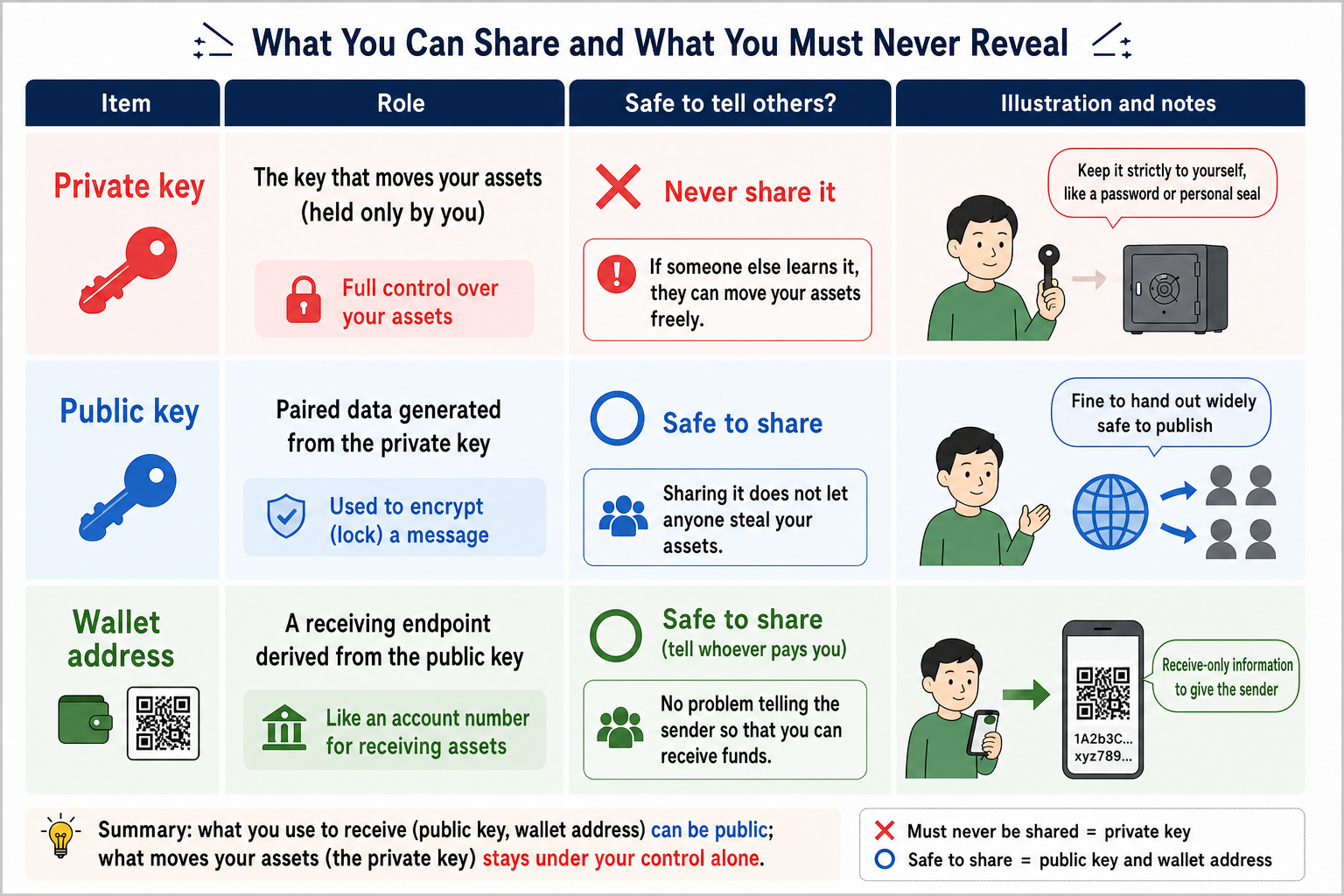
What matters here is that the relationship "private key → public key → address" flows in one direction only. While you can generate a public key or address from a private key, the reverse — deriving a private key from a publicly known address — is protected by a calculation that is, for all practical purposes, impossible.
That's why you can hand out an address like a business card, to anyone. There's no need to worry that "sharing my address might get my assets stolen" — just keep in mind that an address is fundamentally information for receiving funds.
The Difference Between a Private Key and a Recovery Phrase
Once you start using a self-custody wallet, alongside the private key you'll encounter the term "recovery phrase (seed phrase)." When first setting up a wallet, you may have been shown a sequence of 12 or 24 English words — drawn from the standardized BIP-39 wordlist that most wallets share — with a warning to "never lose this," and jotted it down on paper.
Both of these are "important information for managing your assets," but they sit at different levels in the hierarchy of roles.
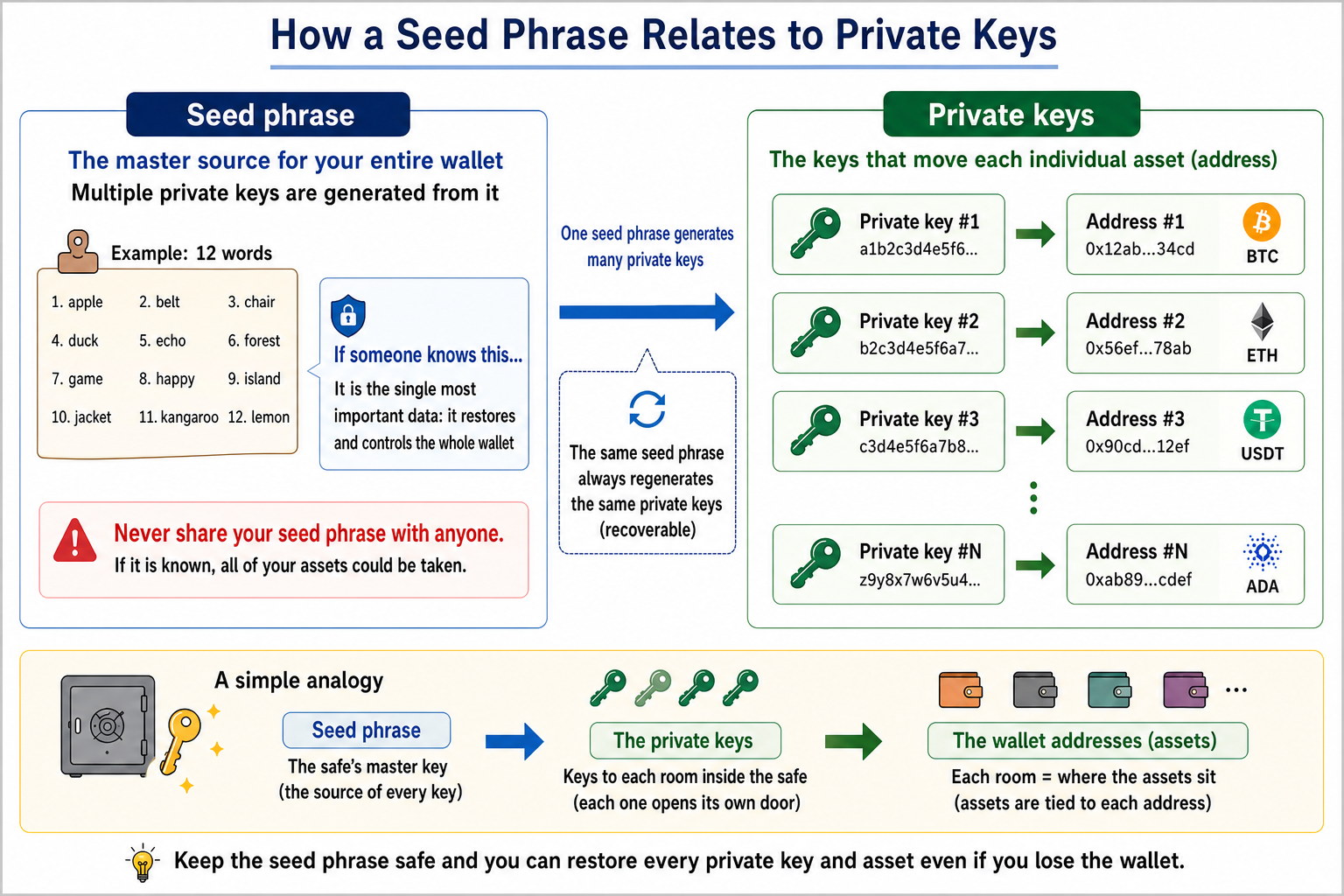
Think of it this way: the recovery phrase is "the master source data used to generate a master key," while the private key is "the key to each individual room" generated from it. A single recovery phrase can be used to derive many private keys (i.e., many addresses).
This relationship matters a great deal in practice, because backup and restoration happen at the level of the recovery phrase. Even if you lose your phone or your wallet app breaks, as long as you still have this recovery phrase, you can restore your entire wallet on a different device (related: Alta Wallet Recovery Case Study: The Process of Recovering About 6.5 ETH from an Unreachable Wallet After Service Shutdown).
Conversely, a recovery phrase is even more powerful information than a private key. Keep in mind that if a recovery phrase falls into someone else's hands, it's equivalent to handing over every private key — that is, every asset in the wallet.
How to Properly Manage a Private Key | What You Must Never Do
In crypto assets, the private key is "the only key that can move your assets." Conversely, the moment someone else learns your private key (or recovery phrase), they can freely move your assets as they please.
The crypto asset world has no bank-like "administrator" who verifies your identity and can freeze or reverse transactions. Even a fraudulent transfer, once recorded on the blockchain, cannot be undone. That's exactly why managing your keys is entirely your own responsibility.
- Leaking your private key (or recovery phrase) = losing your assets
- Losing your private key (or recovery phrase) = permanently locking your assets.
What You Must Never Do When Managing a Private Key
First, let's go over the risky habits many people fall into simply because they seem "convenient."
Common mistake | Why it's dangerous |
Saving it as a screenshot | Images are often automatically synced to the cloud (e.g., photo app backups), so if your device or account is compromised, they get stolen along with everything else. |
Storing it in cloud storage, email, or a notes app | Online storage such as Google Drive, iCloud, Gmail, or the Keep Memo feature in LINE (a messaging app widely used in Japan) is constantly exposed to the risk of account takeover or data leaks. |
Telling someone else, or handing it over when asked to enter it | A legitimate service will never ask for your private key or seed phrase — not even when the person contacting you claims to be support staff or the service operator. The moment someone asks, it's a scam. |
Entering it on a fake site or fake app (phishing) | Scammers commonly lure victims to wallet screens or campaign sites that look identical to the real thing and trick them into entering their seed phrase. Always double-check the URL and use official links. |
Relying on an online tool to generate or manage it | Key-generation sites of unknown origin may be sending the keys they generate straight to a third party. |
The key point comes down to a single rule: never place your private key or recovery phrase anywhere "connected to the internet." The more conveniently you try to handle it as digital data, the higher the risk of theft becomes.
Recommended Ways to Store a Private Key
So how should you protect it? The basics are to keep it "offline" and "with backups spread across multiple locations."
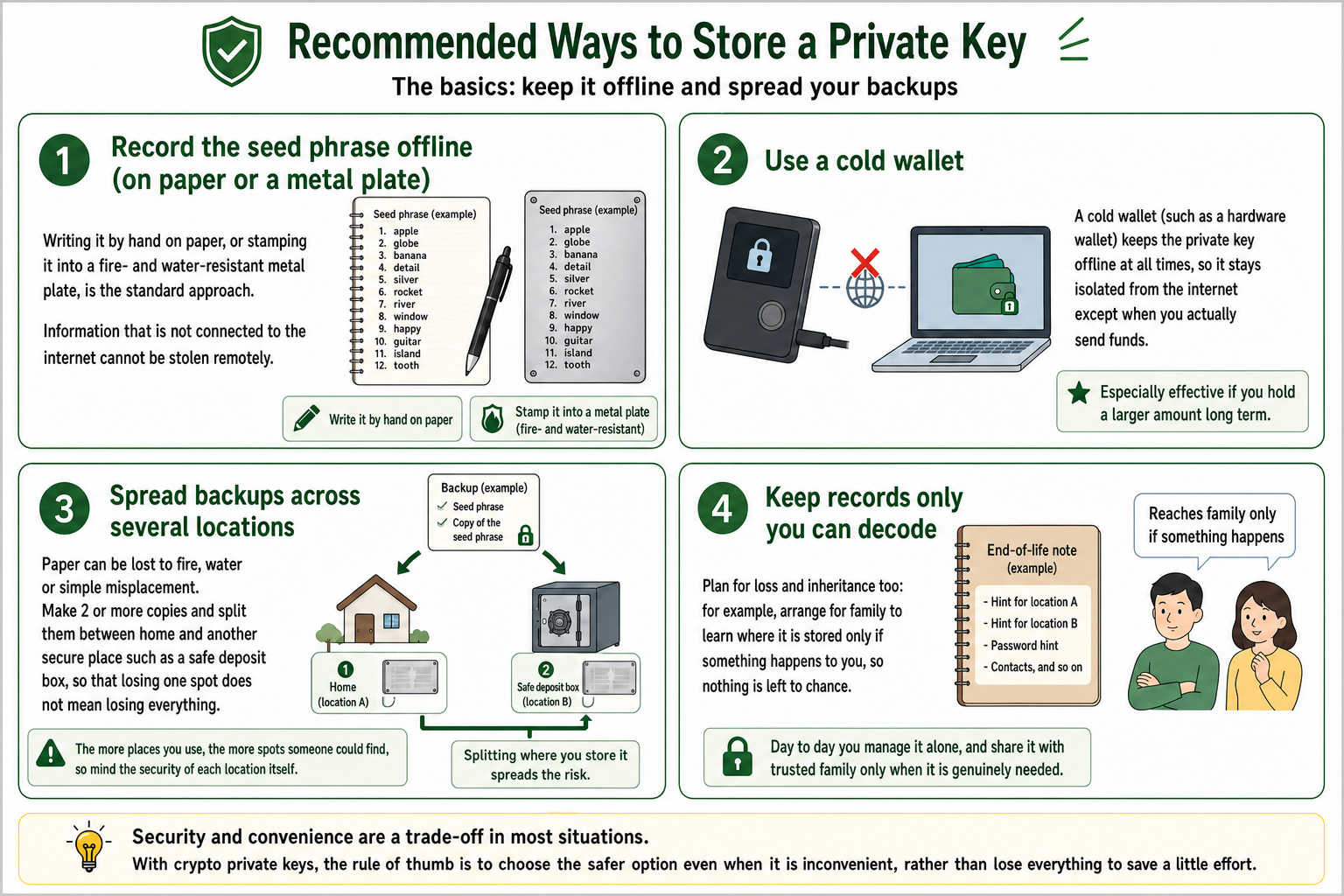
- Write it down offline (on paper or a metal plate)
- The standard approach is to write your seed phrase down by hand on paper, or stamp it onto a fire- and water-resistant metal plate. Information that's never connected to the internet cannot be stolen remotely (related: How to Back Up a Recovery Phrase on a Metal Plate).
- Use a cold wallet
- Using a "cold wallet" (such as a hardware wallet) that keeps the private key offline at all times lets you stay isolated from the network except when actually sending funds. This is especially effective for holding a significant amount long-term (related: How to Manage Crypto Assets with a Cold Wallet).
- Spread backups across multiple locations
- Paper can be lost to fire, water damage, or misplacement. Making two or more copies and storing them in separate, secure locations — your home and, say, a safe deposit box elsewhere — creates a setup where "losing one location doesn't mean losing everything." That said, the more locations you spread backups across, the more places there are for someone else to find them, so pay attention to the security of each storage location itself (related: How to Create a Crypto Asset Paper Wallet).
- Manage it in a way only you understand
- It's also worth preparing for loss or inheritance — for example, arranging so that a family member learns where it's stored only "in case of emergency" (related: Crypto Asset Inheritance).
Security and convenience are often at odds. Still, when it comes to managing a private key in crypto assets, the rule of thumb is to always choose the safer option, even if it's a bit of a hassle — rather than risk losing everything for the sake of saving a little effort.
Frequently Asked Questions About Public and Private Keys
Public and private keys are a topic that tends to leave small questions unanswered. Here, we cover the points that trip up people handling a wallet for the first time, in Q&A format.
Can a private key be derived from a public key?
With current technology, this is, for all practical purposes, impossible. A public key and private key are created as a pair, but they're designed so that while a public key can be easily computed from a private key, the reverse — deriving a private key from a public key — cannot.
This reverse calculation requires an astronomical amount of computation — one that couldn't be solved in any realistic amount of time even using every computer in the world combined. That's exactly why a public key can be safely shared with others.
There's no need to worry that "sharing my public key might reveal my private key." But conversely, if the private key itself ever leaks, this safety collapses instantly. What you need to protect is the private key, and only the private key.
Are a public key and a wallet address the same thing?
Strictly speaking, no — it's easiest to think of a wallet address as a "shortened version" created from a public key. For most crypto assets, the public key is transformed using a hash function or similar process into a shorter, easier-to-handle string, which becomes the wallet address.
In practice, what you communicate to someone else when sending or receiving is the wallet address. Both the public key and the address are information that's fine to share with others, so you can treat them with the same mindset as a "receiving account number." The private key, on the other hand, is fundamentally different in nature from both, and must never be handed to anyone.
If I keep my assets on an exchange, do I not need to think about the private key?
While your assets are deposited on an exchange, the exchange manages the private key, so as a user you'll rarely need to think about the key itself. It feels similar to logging in with an account number and password to trade — this is called "custodial" management (related: What Is a Custodial Wallet?).
However, in this case, the private key is held not by you but by the exchange. That means risks like system outages, hacks, or withdrawal suspensions at the exchange are entirely outside your control. This is where the idea that "you can only fully control your assets by holding your own private key" comes from — and it's the starting point for considering a self-custody wallet (usually called a "non-custodial" wallet in English-language services). Which to choose comes down to balancing convenience against self-responsibility.
What happens to my assets if I lose or forget my private key?
If you completely lose a private key, you may permanently lose access to those assets. There's no such thing as "reissuing" a private key or "resetting a password" for it. Because there's no administrator anywhere in the system, loss is entirely your own responsibility.
That said, with most wallets, as long as you've properly stored the recovery phrase that underlies the private key, you can restore the private key or wallet. This is why reinstalling an app after a device breaks can bring everything back. Conversely, if you lose both the private key and the seed phrase, there's no way to recover. That's exactly why it's critical to reliably store your seed phrase offline (related: What Happens to Your Crypto Assets If You Lose Your Phone?).
What's the difference between a private key and a login password?
The biggest difference is whether it's recoverable. A password can be reset if forgotten, but a private key cannot be reissued — losing it can mean losing the assets themselves. Even though both are "secret strings of characters," the weight of the risk they carry is completely different.
Also, a password is normally verified on the service provider's server, whereas a private key isn't something you hand to anyone else for verification — it's the final key that only you hold. This "no administrator to rely on" nature is exactly why private key management is emphasized again and again in the world of crypto assets. Treat it with more care than a password, and always keep it offline.
Summary: What You Must Protect Is the "Private Key"
Public and private keys sound similar in name, but their roles are exact opposites. Let's recap the key points of this article.
- The public key is "a key you may share with others"
- It's used for encryption and receiving, and the wallet address derived from it can be shared with anyone, just like an account number.
- The private key is "a key only you hold"
- Used for decryption and digital signatures (proof of identity), only the holder of this key can move the assets. It's the equivalent of a bank's registered seal or PIN — information you must absolutely protect.
- The two always work as a pair
- The public key "locks," the private key "unlocks." Because the roles are separated, the public key can be shared openly, and the private key can never be derived from it.
- In crypto assets, "the holder of the private key = the person who can move the assets"
- Transfers are carried out via digital signature, so if a private key falls into someone else's hands, they can impersonate you and send your assets away.
- A recovery phrase is even more powerful than a private key
- Because a single phrase can derive multiple private keys, if it leaks, it's equivalent to losing every asset in the wallet.
The crypto asset world has no administrator, like a bank, who can freeze accounts or reverse transactions. That's exactly why managing your keys is entirely your own responsibility. Still, what you need to do is simple.
It's fine if your public key is seen; what you must hide is your private key and recovery phrase. And rather than storing them anywhere "connected to the internet," such as in a screenshot or the cloud, keep them offline — on paper, a metal plate, or in a cold wallet.
As long as you keep this principle in mind, you can protect your assets safely with your own hands. Choosing "the safer option, even if it's inconvenient" is the surest path to protecting your valuable assets for the long term.
This article is for informational purposes only and does not constitute financial or investment advice. Please consult a qualified professional before making investment decisions.


