


Once you start holding crypto assets (also known as virtual currencies), you inevitably run into the question of where you should actually keep them. Is it fine to leave everything on the exchange, or should you move it to a wallet? Even if you look into it, unfamiliar terms like "hot wallet," "cold wallet," "hardware," and "MetaMask" keep popping up one after another, and you may end up not knowing which one is right for you.
In fact, a survey we conducted of 746 crypto asset investors found that even among "long-term holders" who carefully grow their assets over time, 59.3% leave their assets sitting in the exchange where they purchased them.
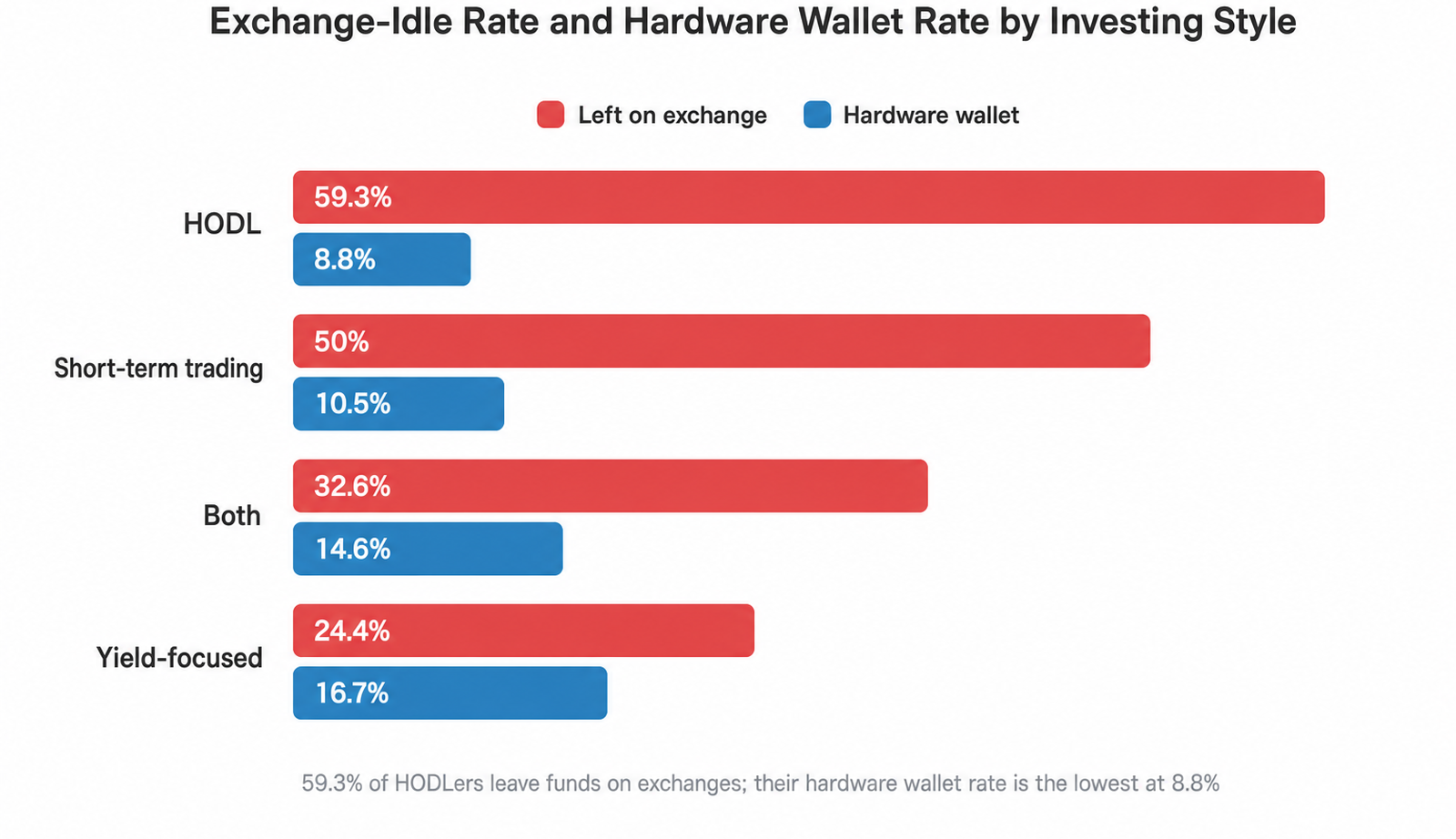
This is the reality even among the group that, in theory, should be the most careful about how they store their assets. While keeping funds on an exchange is convenient, it also comes with the risk of losing valuable assets to hacking or an exchange collapse.
That said, choosing a wallet based on security alone can leave you stressed every time you make a transaction because it's inconvenient to use. What matters is finding the right balance between "security" and "usability" for your own way of using crypto.
This article organizes the different types of crypto asset wallets so you can naturally find the one that best fits your needs.
Types of Crypto Asset Wallets
There are many different types of wallets for holding and managing crypto assets. While they are all called "wallets," their mechanisms, ease of use, and safety vary widely by type. Deciding where and how to keep your assets is an unavoidable and important choice when dealing with crypto assets.
To organize the many wallets out there, there are two major axes worth keeping in mind first. One is whether the wallet is "connected to the internet," and the other is "what form it is provided in." Mapping the overall picture along these two axes gives us the following:
Form | Hot Wallet | Cold Wallet |
|---|---|---|
Web | Web wallet | ― |
App (smartphone) | Mobile wallet | ― |
Software (PC) | Desktop wallet | ― |
Dedicated device | ― | Hardware wallet |
Paper / physical | ― | Paper wallet |
Wallets are divided into two groups—hot wallets and cold wallets—based on whether or not they are connected to the internet, and each group then branches further by the form in which it is provided. Each type has its own suitable use cases and points to watch out for, so let's look at the characteristics of each group in turn.
Hot Wallets (Connected to the Internet, Prioritizing Convenience)
A hot wallet is a general term for a type of wallet that manages crypto assets while connected to the internet. The name "hot" is easiest to understand if you picture it as always being connected to the network and "actively running."
Its biggest appeal is, above all, its high level of convenience. It lets you quickly send and receive funds, trade on exchanges, and connect with services like DeFi and NFTs, making it well suited for people who want to use crypto assets on a daily basis. On the other hand, because it is always connected to the internet, you need to understand that the risk of hacking or unauthorized access is higher than with cold wallets, discussed later.
Hot wallets can be further divided into three types depending on the form in which they are provided. Since each is suited to different situations and levels of convenience, let's go through them one by one below.
Web Wallets
A web wallet is a type of wallet used through a browser (on a website or via a browser extension). It does not require installing a dedicated app or software, and its ease of use—being accessible from any device just by logging in with an ID and password—is a key feature.
Many of the wallets provided by crypto asset exchanges fall into this category, and being able to start using one as soon as you open an account is a major advantage for beginners. However, this format often involves a custodial model, in which the service provider holds custody of your private keys, so you should keep in mind the risk that the exchange itself could be hacked or that the service could be suspended.
Mobile Wallets
A mobile wallet is a type of wallet used by installing an app on your smartphone. Because you can manage your assets right on the phone you always carry with you, it makes sending funds while out, paying in stores, and receiving funds via QR code smooth and convenient.
Compared with web wallets, mobile wallets are more often non-custodial, meaning private keys are managed on your own device, giving you the appeal of being able to control your assets yourself. On the flip side, there is a risk from losing or having your phone stolen, or from installing malicious or fake apps, so managing the security of the device itself is essential. For people who use crypto assets frequently in daily life, this is likely to be the most familiar option.
Desktop Wallets
A desktop wallet is a type of wallet used by installing dedicated software on a computer. Because you can check your balance and transaction history in detail on a large screen, it is well suited for people who want to manage a sizable amount of assets carefully and deliberately.
Because the private key is stored on your own computer, you can control your assets more easily yourself compared with a web wallet, but if that computer becomes infected with a virus or malware, there is a risk of losing your assets. It is also important to always keep backups (such as storing your recovery phrase safely) in case the computer you use breaks down.
Cold Wallets (No Internet Connection, Prioritizing Security)
A cold wallet is a general term for a type of wallet that manages the private keys for crypto assets in an environment disconnected from the internet (offline). As the name "cold" suggests, assets are normally stored in a state isolated from the network.
Its greatest strength is its high level of security. Because the private key is never exposed online, it greatly reduces the risk of losing assets to hacking or unauthorized access. It is very well suited for "protecting" assets intended for long-term holding or a significant amount of crypto assets. On the other hand, it takes more effort every time you send funds, so it falls somewhat short of hot wallets in terms of everyday convenience.
There are two representative forms of cold wallets as well. Their mechanisms and how they are managed differ significantly, so let's look at each in detail below.
Hardware Wallets
A hardware wallet is a type of wallet that stores the private key inside a dedicated physical device (something like a USB drive). It only needs to be connected to a computer or smartphone when performing an operation such as sending funds, and it can be returned to an offline state once the approval is complete, giving it an excellent balance between "security" and "usability."
Because it is designed so the private key never leaves the device, it makes it easier to protect your assets even if the computer it is connected to is infected with a virus, and it is chosen by many users as the most practical option among cold wallets.
In fact, in an independent survey we conducted of 286 people with experience investing in crypto assets, 48.6% were currently using a hardware wallet, and when including those who had used one in the past, about 80% had experience adopting one.
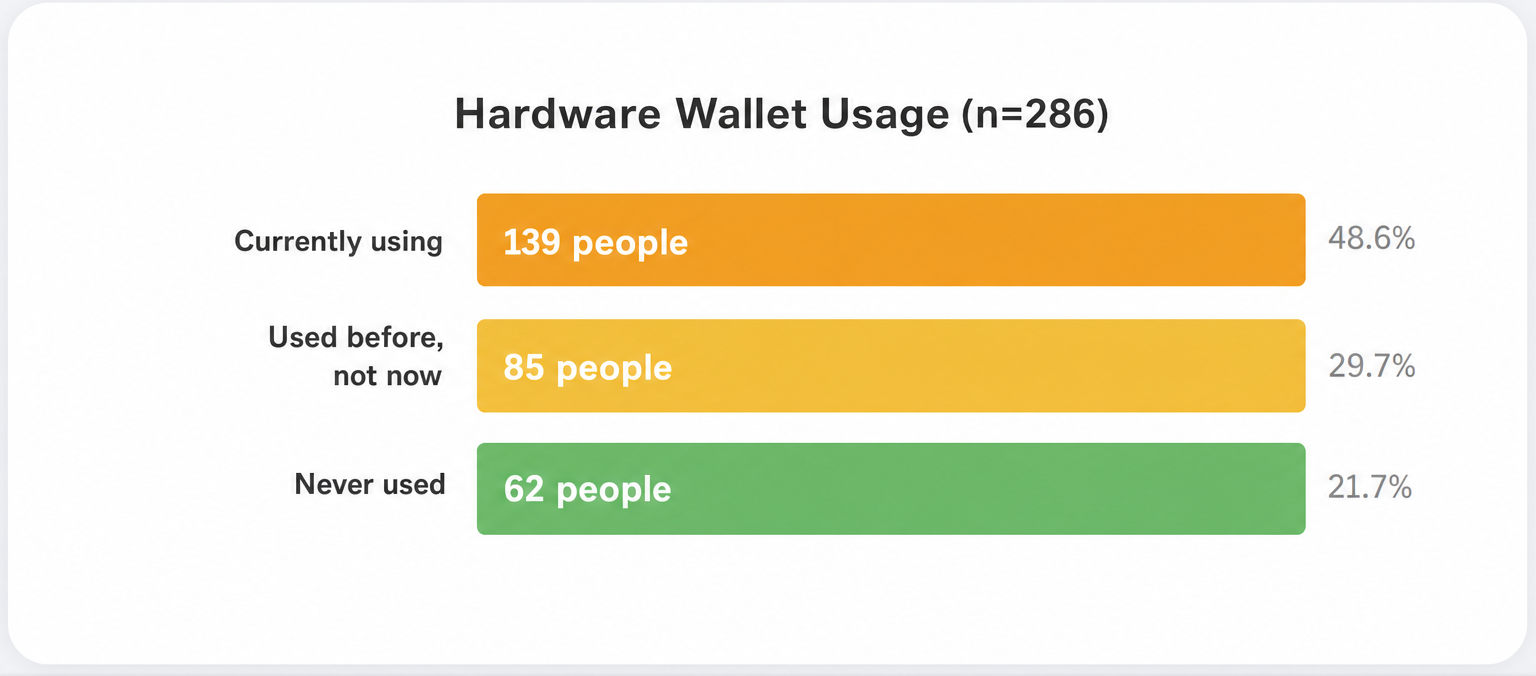
Adoption is particularly high among people in their 20s at 62.0%, and once an investment amount reaches ¥100,000 (roughly US$650 at recent exchange rates) or more, adoption jumps to 68.3% or higher, suggesting that hardware wallets are "chosen more often as there is more to protect." Satisfaction among users is also high, with around 60% saying they are "satisfied."
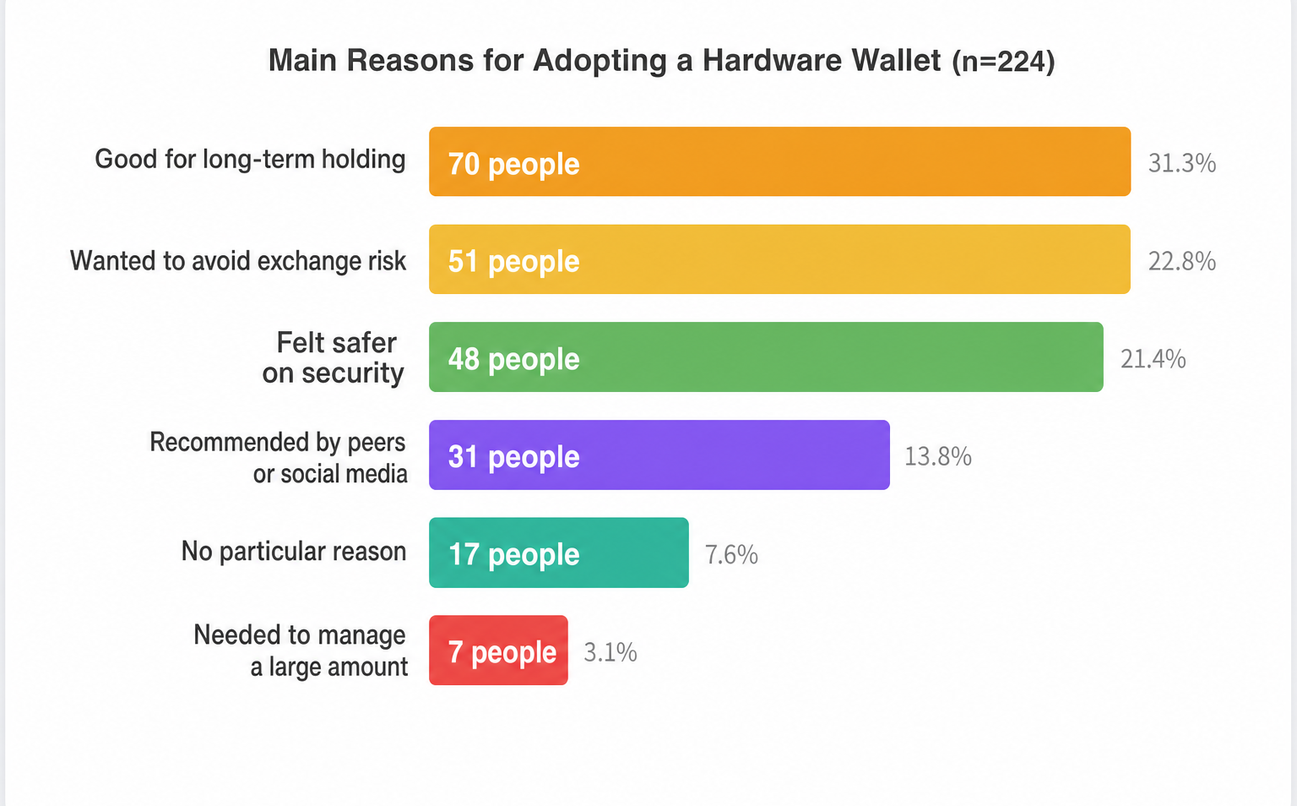
On the other hand, in addition to the fact that purchasing one requires a certain amount of money, the same survey found that the top complaints among users were "found managing it troublesome (51.3%)," "some services or currencies are not supported (35.7%)," and "risk of loss or malfunction (33.5%)."
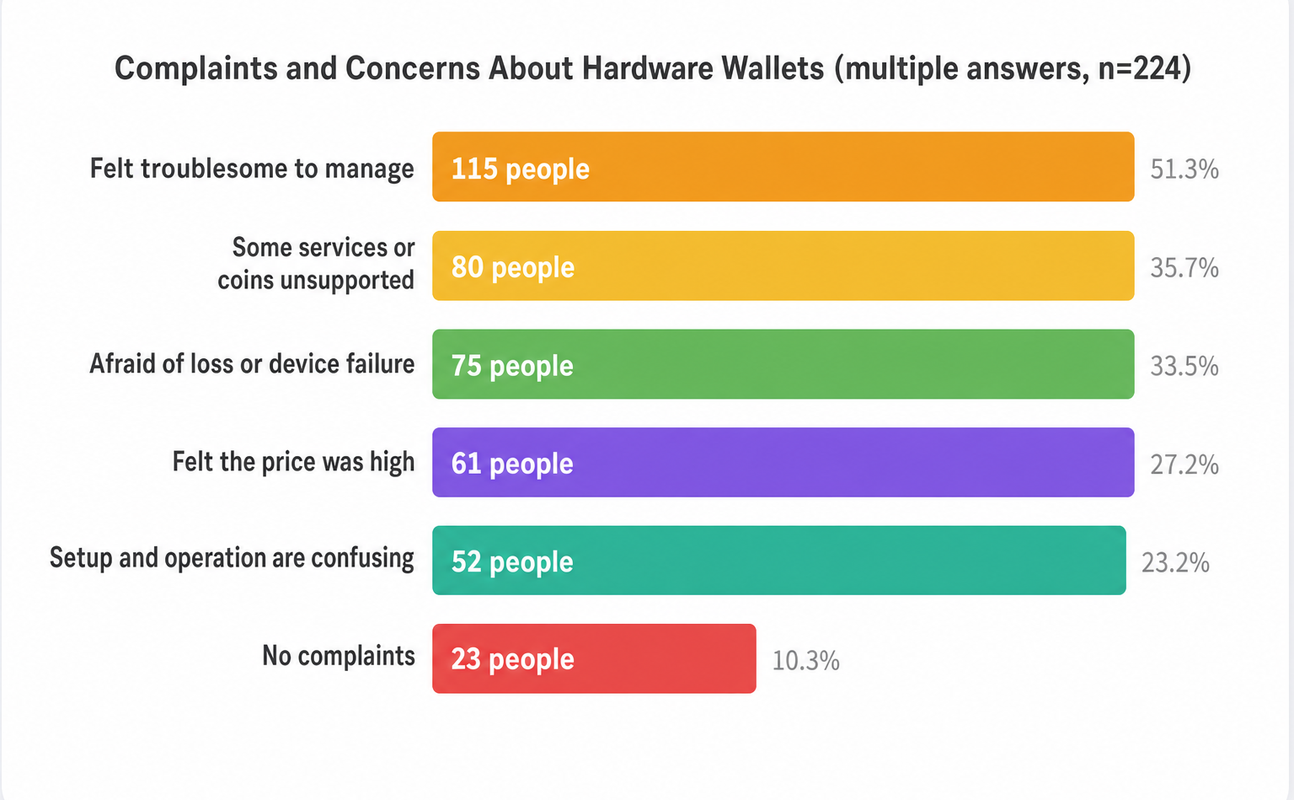
Among non-users hesitant to adopt one, "I don't really understand how it works (38.7%)" was the most common reason as well, highlighting the reality that hardware wallets are seen as safe but somewhat of a hurdle to get into. When setting one up, it is essential to write down your recovery phrase (the words used to restore your wallet) on paper and store it securely in preparation for losing or damaging the device itself.
Paper Wallets
A paper wallet is an extremely simple type of wallet in which the private key and public key are written down and kept on paper. Because it leaves no data whatsoever online or on any device, its biggest feature is that it is completely immune to the risk of hacking.
You might wonder whether it's really safe to store valuable assets on paper, but this is by no means an outdated or unusual method. The idea of "storing the private key disconnected from the internet" in the first place is considered the safest way to store crypto assets, and even domestic crypto asset exchanges registered with Japan's Financial Services Agency (FSA), the country's financial regulator, are required to keep most of the assets they hold in custody offline.
A paper wallet is the simplest form of this robust concept of offline storage, achieved with a single sheet of paper and no special equipment required. That is exactly why, if made correctly, it can be considered a legitimate storage method. For the actual creation steps and precautions, see "How to Create a Crypto Asset Paper Wallet" for a detailed explanation.
That said, while it offers the ultimate offline storage that does not rely on digital devices, it also carries all the weaknesses inherent to paper itself. If the paper is lost due to a physical incident such as fire, water damage, tearing, or fading, you will never be able to access your assets again.
One method drawing attention as a way to make up for this weakness of paper is engraving the private key or recovery phrase onto a highly fire-resistant, water-resistant metal plate for storage. Because it can withstand fire and water damage, it is far better suited to long-term storage than paper (related: Should You Store Your Recovery Phrase on a Metal Plate? Benefits, How to Choose, and Recording Steps Explained).
In addition, creating and storing one safely also requires specialized knowledge. For that reason, if you prioritize reliability over cost, it is recommended to consider using a hardware wallet instead, since it offers the same offline storage while being safer to handle.
The Difference Between Custodial and Non-Custodial Wallets
There is another important perspective for classifying wallets, alongside "whether or not it is connected to the internet." That is the difference in "who manages the private key." From this perspective, wallets can be broadly divided into two types: custodial and non-custodial.
A custodial wallet is a type in which management of the private key is entrusted to a service provider such as an exchange. "Custody" means "safekeeping" or "management," and because users can handle their assets simply by logging in with an ID and password, they don't need to worry about key management. Holding assets in an account at a crypto asset exchange is a representative example. While convenient and beginner-friendly, you need to be aware that ultimate control over the assets rests with the service provider, not with you.
A non-custodial wallet, on the other hand, is a type in which the user manages the private key themselves. Its greatest appeal is that you can have complete control over your own assets without entrusting them to anyone. There is a well-known saying in the crypto world—"Not your keys, not your coins"—which captures the philosophy behind non-custodial wallets exactly. However, all responsibility for managing the private key and recovery phrase also falls on you, and if you lose them, there is no way to recover your assets.
It is not simply a question of which is superior; it comes down to a choice based on your goals and style—whether you prioritize "convenience and support" or "the freedom and security of self-custody." For more on the pros and cons of each and how to choose a specific wallet, see "What Is a Custodial Wallet? A Detailed Comparison with Non-Custodial Wallets" for a deeper dive.
How to Choose a Crypto Asset Wallet by Purpose
With so many types of crypto asset wallets available, you may end up wondering, "which one should I actually use?" To cut to the conclusion: there is no single "best wallet for everyone." That's because every wallet has its own strengths and weaknesses—"level of security," "ease of use," "range of supported services"—and which of these matters most depends entirely on "how you use it."
For example, someone who wants to steadily trade small amounts and someone who wants to keep the bulk of their assets locked away for the long term will have completely different priorities. That's exactly why choosing based on how you plan to handle your crypto assets is the surest way to avoid making a mistake in your wallet choice.
So first, try the flowchart below to find the wallet that matches you. Just answer the questions, and you'll be able to see at a glance which type best fits your style.
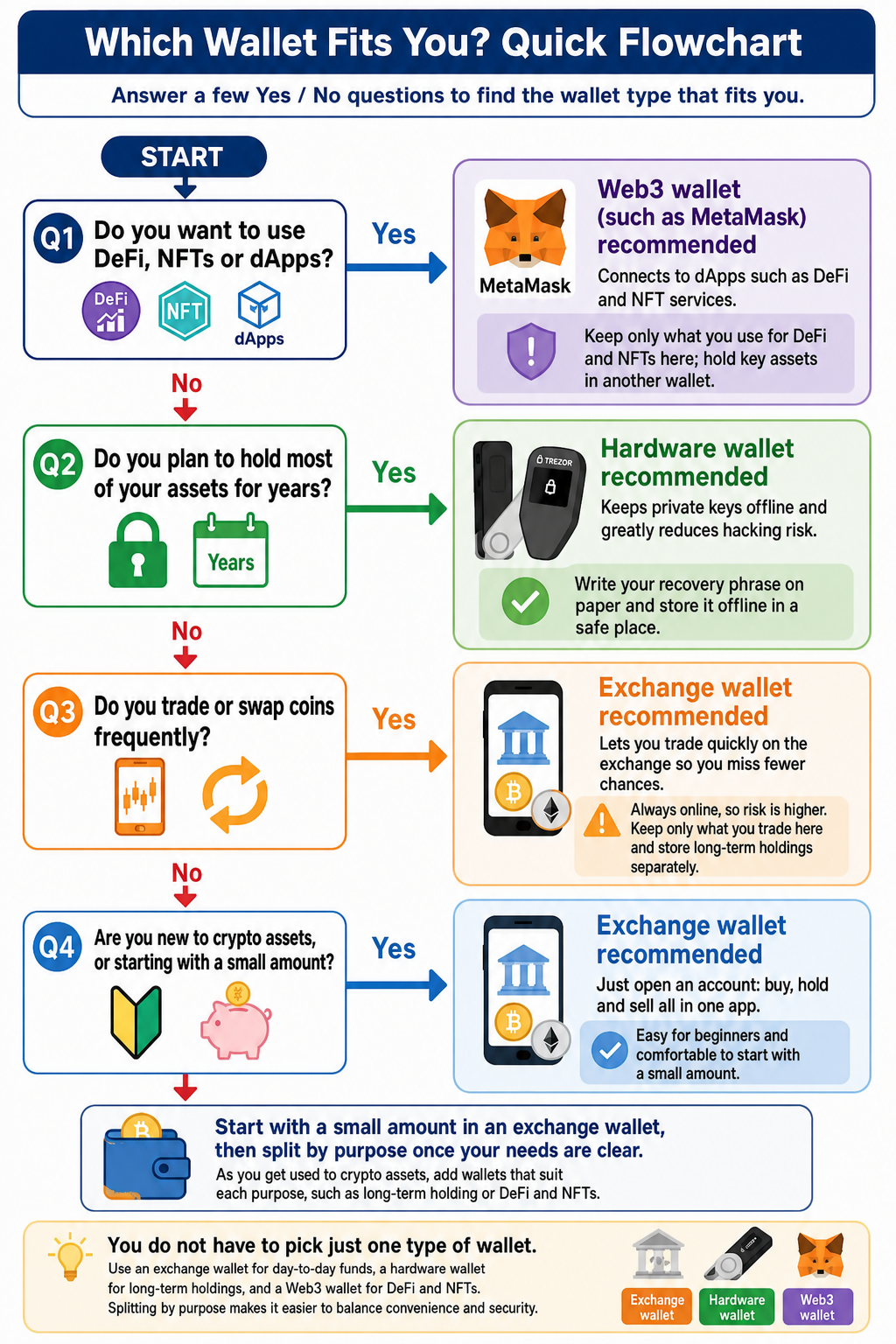
Once you get a general sense of direction from the flowchart, let's go through the following four type-by-type explanations to confirm the reasoning and specific options. It's a good idea to read through not only the section that applies to you but also the ones that don't, since they can serve as useful reference for the future ("if I ever use crypto this way, this is the wallet for it"), sharpening the precision of your choice.
For Beginners or Small Investments
If you are about to start with crypto assets, or want to try starting with a modest, manageable amount, it's a good idea to start with a wallet that requires no difficult setup or management and that you can begin using right away. Specifically, "wallets provided by crypto asset exchanges (exchange wallets)" such as Coincheck or bitFlyer are the first candidates.
Once you open an account with an exchange, you can use it automatically, with no need to prepare a separate app or go through a complicated initial setup. Its biggest advantage is the convenience of being able to complete buying, storing, and selling all within a single app. If you're unsure which exchange to choose, it's safer to consider one from among the exchange service providers registered with the FSA (list in Japanese), such as the following:
Note that the providers listed above are registered as crypto asset exchange service providers in Japan, and their sites and support are provided mainly in Japanese, so opening an account may require residency in Japan or meeting other conditions. Also, because an exchange wallet has its private key managed by the exchange, it also helps you avoid a common beginner mistake—losing your own key and losing your assets as a result—which offers additional peace of mind.
However, because an exchange wallet entrusts asset management to the exchange, keep in mind that it can be affected by trouble at the exchange itself (such as hacking or bankruptcy). It's a natural progression to start with a small amount, get used to handling crypto assets, and then gradually move to a self-managed wallet, as introduced next, once you're more comfortable.
For Long-Term Holding ("HODLing")
If you're planning to hold your purchased crypto assets for years without trading them—what's commonly called "HODLing"—you should prioritize security over convenience when choosing a wallet. A hardware wallet is the strongest candidate here.
This is a dedicated physical device, similar to a USB drive, represented by products like Ledger and Trezor, which lets you store your private key completely disconnected from the internet. Because it isn't connected to the internet, it can keep the risk of unauthorized transfers from hacking extremely low, which is the main reason it's well suited to long-term holding.
With long-term holding, since you won't be moving your assets frequently, what matters is "how safely can you keep storing them in the meantime." Even accounting for some upfront cost (the price of the device) and the slight extra effort required when sending funds, it's well worth introducing one as a vault to protect a substantial amount of assets.
Note that when using a hardware wallet, it's essential to write down the recovery phrase (the string of words for restoring your wallet) shown during initial setup and store it securely offline, such as on paper. Even if you lose or break the device, you can restore your assets as long as you have this phrase—but conversely, if you lose the phrase, you will never be able to recover your assets again. This is worth remembering above all else.
For Frequent Trading
If you're someone who trades frequently over short periods while watching market movements, or who wants to rotate between multiple coins often, you should choose a wallet that prioritizes the convenience of fast, smooth trading.
This style is well suited to a "hot wallet"—one that's constantly connected to the internet—and among hot wallets, an exchange wallet in particular.
With an exchange wallet, since the place where your assets are stored and the place where you trade are the same, you avoid the time lag and hassle of "sending funds from your wallet to the exchange before selling," making it less likely you'll miss a price opportunity. The ability to place an order instantly, anytime, from a smartphone app is a major advantage for people who trade frequently.
On the other hand, in exchange for that convenience, a hot wallet connected to the internet at all times carries relatively higher risks, such as hacking, compared with offline storage types. For that reason, it's effective for reducing risk to keep only the amount you actively move for trading in a hot wallet, while storing crypto assets you have no plans to use for the time being separately, in a safer place (such as a hardware wallet).
For Using DeFi or NFTs
If you want to do more than just buy and sell on an exchange—such as using DeFi (decentralized finance) for lending or swapping, or buying and holding NFTs—a wallet that can connect to a wide range of dApps (decentralized applications) becomes essential.
The standard choice for this purpose is a Web3-compatible wallet, represented by MetaMask. These are non-custodial hot wallets in which you manage your own private key, and they let you connect directly to DeFi services and NFT marketplaces from a browser extension or smartphone app to sign and execute transactions.
Since exchange wallets often don't support connecting to these external services, having this type of wallet is basically a prerequisite if you want to step into the world of DeFi and NFTs.
That said, this high degree of freedom comes hand in hand with "everything being your own responsibility." If you accidentally connect to a malicious site, or enter your recovery phrase on a fake site, your assets can be drained in an instant. Make sure to always verify the legitimacy of any site you connect to, never respond to signature requests you don't recognize, and here too, it's recommended to keep only what you need for DeFi and NFTs in this wallet while managing your important assets separately in another wallet.
Frequently Asked Questions About Crypto Asset Wallets
We've covered the types of crypto asset wallets and how to choose one, but once you actually start using them, all kinds of detailed questions tend to come up one after another, like "how does this work?"
So here, we've picked out some of the most common questions about crypto asset wallets and answered each of them concisely.
Are there any recommended wallets besides MetaMask?
MetaMask is a hugely popular wallet used around the world, but it's by no means the only option. Depending on your needs, other wallets may be more comfortable to use in certain situations.
For example, if you prioritize a wide range of supported blockchains, "Trust Wallet" is worth considering, and if you want to prioritize security and store your assets offline, hardware wallets like "Ledger" are candidates. If you want to use a wallet tied to a specific exchange, that exchange's official wallet is also an option.
What matters isn't "because it's famous," but whether it fits your purpose (whether you plan to use DeFi, focus on long-term storage, etc.). Try picking the one that best matches you, referring back to the characteristics of each type covered earlier in this article.
Is it safe to use a wallet made overseas?
To cut to the conclusion, wallets developed overseas are widely used by many users as long as their track record and reliability can be confirmed. MetaMask, mentioned earlier, and many other widely used wallets were in fact developed overseas.
That said, there are a few points to watch out for. First, the app's interface or official support is often not available in Japanese, meaning you may need to resolve any issues on your own if trouble arises. Also, unlike exchanges registered with the FSA, keep in mind that the wallet itself sits outside the scope of Japanese financial regulation.
To use one safely, it's essential to follow the basics: only download from the official site, and check its track record, such as user numbers and how long it has been operating, beforehand. Regardless of whether a wallet is domestic or overseas, the key attitude is to carefully judge whether the provider can be trusted.
What is a multisig wallet?
A multisig wallet is a type of wallet that requires signatures (approvals) from multiple private keys for a single transaction to go through.
For example, by setting it up so that "two out of three keys" must sign before a transfer can be made, even if one key is stolen, your assets can't be moved by that alone. Compared with a standard wallet where a single key is enough to send funds, this dramatically increases security against theft and unauthorized transfers.
For this reason, it's used for asset management at companies, joint management by multiple people, and long-term storage of large amounts of crypto assets, among other cases. On the other hand, setup and operation are somewhat more complex, so it's better thought of as an option for once you're more experienced with asset management, rather than something a beginner would start with.
For more on how multisig works and its benefits and drawbacks, see "What Is Crypto Asset Multisig?" for further explanation.
What happens to your assets if the exchange goes bankrupt?
If the exchange where you keep your crypto assets goes bankrupt, there's no guarantee that you'll get everything back—this is the reality. This is one of the risks you absolutely need to understand when holding crypto assets.
In Japan, exchanges registered with the FSA are required to keep users' assets segregated from the company's own assets ("segregated management") and to hold crypto assets in trust for safekeeping, among other measures, and user protection mechanisms have been strengthening year by year. However, these are different in nature from a system like deposit insurance, in which the government guarantees a fixed amount as with bank deposits, so keep in mind that full protection is not necessarily guaranteed. These requirements are part of Japan's own regulatory framework and apply to exchanges registered in Japan; there is no deposit insurance-style scheme that covers crypto assets the way it covers bank deposits.
That's exactly why it's important to move any assets you plan to hold long-term or have no plans to use for the time being out of the exchange and into a wallet where you manage the private key yourself, rather than leaving them there. Keep in mind the division of roles: "the exchange is for trading, and your own wallet is for storage."
For real past cases of exchange bankruptcies and concrete steps you can take now, see the related article "What Happens to Your Assets If a Crypto Exchange Goes Bankrupt? Real Cases and Steps You Can Take Now."
Should you use multiple wallets?
Using multiple wallets depending on the purpose is an effective way to achieve both security and convenience. If you keep all your assets in a single wallet, you risk losing everything if that one wallet is compromised.
A common approach is to separate a small "hot wallet" used for everyday trading and DeFi from an offline "cold wallet (hardware wallet)" that holds important assets for long-term storage. Think of it like separating your "everyday wallet" from your "safe."
That said, the more wallets and private keys you manage, the more effort is required to keep track of and manage them. Rather than needlessly increasing the number, it's recommended to start with just two—one for "everyday use" and one for "storage"—and use as many as you can comfortably manage.
Summary
Crypto asset wallets come in many types, but the overall picture can be organized along two axes: "whether or not it's connected to the internet (hot/cold)" and "who manages the private key (custodial/non-custodial)." And which wallet is right for you isn't determined by its specifications, but by "how you want to handle your crypto assets."
As mentioned at the outset, our survey found that 59.3% of long-term holders leave their assets sitting in the exchange. While it's an understandable choice given the convenience, we shouldn't forget that it comes with risks such as hacking or exchange bankruptcy. That's exactly why the mindset of "the exchange is for trading, and your own wallet is for storage" is the first step toward protecting your valuable assets.
Let's go over the purpose-based approach once more:
- For beginners or small investments: an exchange wallet
- For long-term holding ("HODLing"): a hardware wallet
- For frequent trading: an exchange wallet
- For using DeFi or NFTs: a Web3-compatible wallet such as MetaMask
And what's also important to remember is that these aren't things you have to choose just one of—like separating an "everyday wallet" from a "safe" for your valuable assets, you can use them side by side. Simply putting the assets you move frequently in a hot wallet and the assets you don't plan to touch for a while in a cold wallet lets you cut risk significantly while keeping your convenience.
There's no single right answer when it comes to balancing "security" and "usability"—it's different for everyone. Use the flowchart and the type-by-type explanations as a guide to first choose the one that fits your style, and gradually work your way toward your ideal management approach as you get more comfortable.
This article is for informational purposes only and does not constitute financial or investment advice. Please consult a qualified professional before making investment decisions.


