


Multi-signature (multisig) is a mechanism that requires approval from multiple keys before a crypto asset transfer can be executed. Compared with a standard wallet, where a single private key is enough to send funds, multisig is characterized by not relying on any one key alone.
That said, multisig is not a mechanism every user needs. While it can make asset management more secure, it also raises the difficulty of setup and ongoing management. For this reason, it is important to understand how the mechanism works and judge whether it fits your asset size and management setup.
This article explains the basic mechanics of multisig, its advantages and disadvantages, who it is suited for, and the general process for using it.
What Is Multisig? A Mechanism for Approving Transfers with Multiple Keys
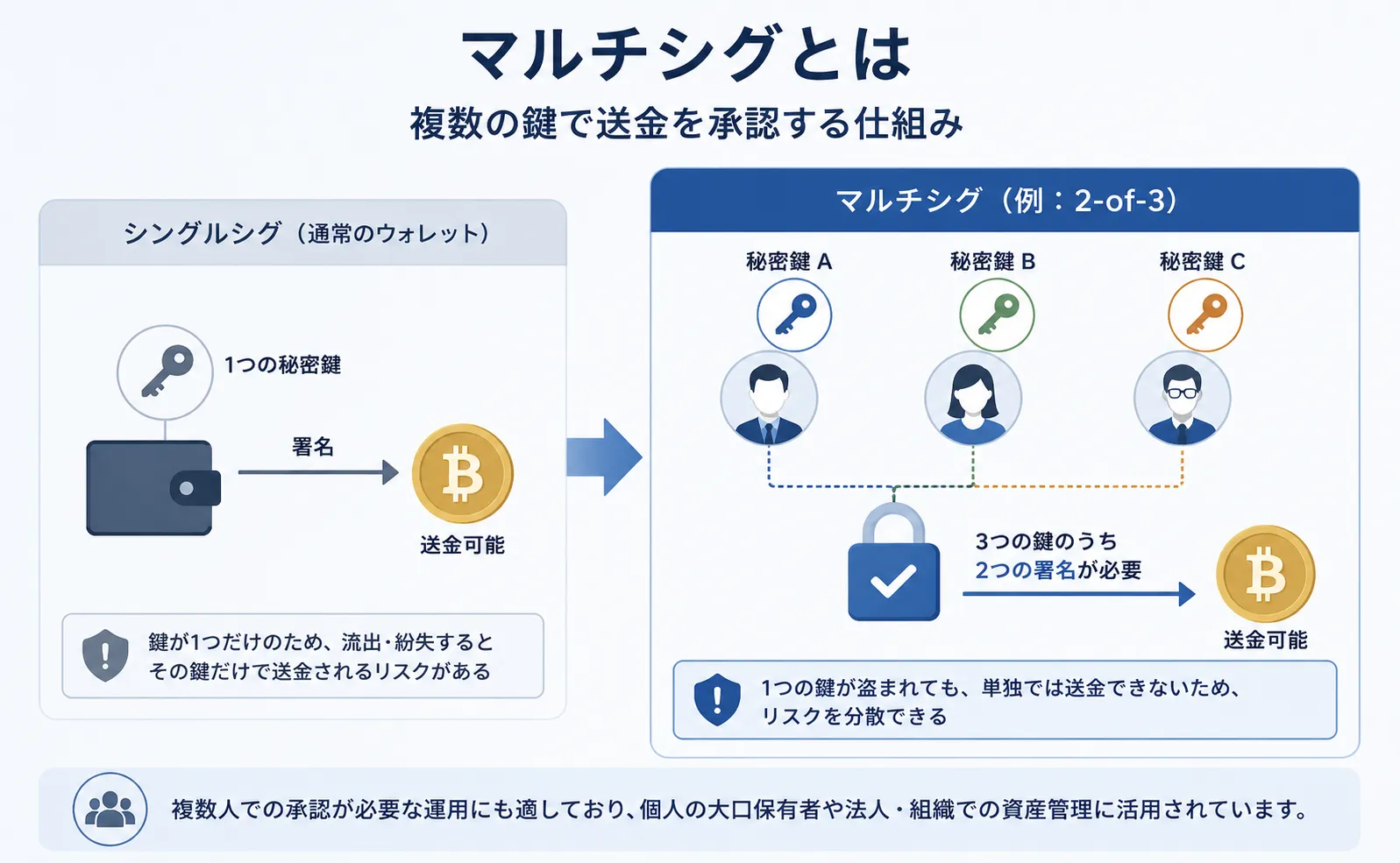
Multisig is a mechanism that requires signatures from multiple private keys to send a crypto asset transaction. Formally called "multi-signature," it is sometimes described in Japanese as requiring "multiple signatures."
With a standard wallet, a single private key is sufficient to send crypto assets. This kind of setup is sometimes called "single-signature" (single-sig) to distinguish it from multisig. Single-sig is relatively simple to manage, but if the private key is leaked, that key alone can be used to move the funds.
Multisig, by contrast, sets up multiple keys, and a transfer cannot be executed unless a required number of them sign. For example, a "2-of-3" multisig setup requires signatures from 2 of 3 keys. Because no single key alone is enough to send funds, this is a management method that is less dependent on any one private key.
This structure makes it easier to spread out the risk of a single key being stolen or lost. It also enables an operating model in which multiple people must approve a transaction when several parties are managing the assets together.
For these reasons, multisig is used not only by individual holders of large amounts of crypto assets but also by corporations and organizations that manage assets jointly. It is one of the representative mechanisms for reducing reliance on a single key when managing crypto assets.
Advantages of Using Multisig
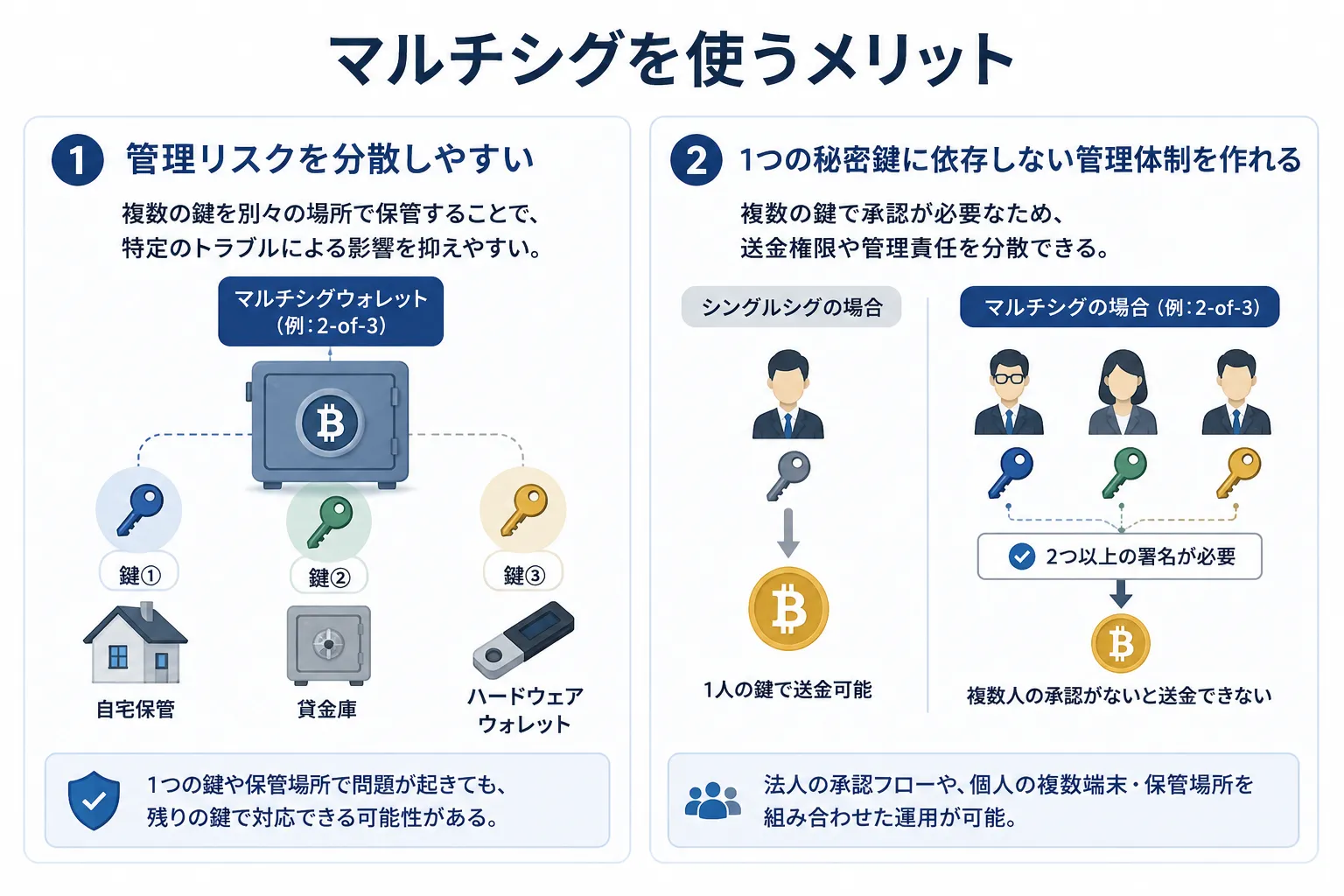
Multisig is sometimes used as a way to strengthen security when managing crypto assets. However, it is important to understand what makes it advantageous by comparing it with a standard wallet.
Here, we look in turn at the specific advantages behind why multisig attracts attention.
Easier to Spread Out Management Risk
Because multisig uses multiple keys to approve a transfer, it makes it easier to spread out management risk. A standard wallet depends on a single private key, whereas multisig can be designed around multiple keys from the outset.
For example, if you prepare three keys and store them in separate locations, a problem at one location may still leave the remaining keys available to respond. This makes it easier to limit the impact of an issue at any one storage location, such as a fire, theft, or a device failure.
You can also combine different management methods for each key. By combining a hardware wallet, home storage, and a safe deposit box, for example, you can build a setup that does not depend on a single management method.
In this way, multisig is a mechanism that makes it easier to spread out the management of private keys. It is worth considering when you do not want to depend on a single key or a single storage location. That said, please be aware that setting the required number of signatures too strictly, or forgetting a storage location, can end up making it impossible to send funds at all.
You Can Build a Management Setup That Does Not Depend on a Single Private Key
With multisig, transfer approval authority can be distributed across multiple keys. This makes it easier to build a management setup in which no single person can move the assets alone.
For example, when a company manages crypto assets, allowing the accounting staff alone to send funds carries the risk of operational mistakes or internal fraud. With multisig, you can require approval from multiple staff members before a transfer is executed.
Even for individual use, keys can be distributed across multiple devices or storage locations. By combining a key stored at home with one kept in a safe deposit box, for example, you can design a setup that is less likely to be disrupted by a problem at a single location.
In this way, multisig is not simply a matter of adding more keys — its advantage lies in making it easier to distribute transfer authority and management responsibility. It is worth considering when you do not want management concentrated in a single person or location.
Disadvantages of Using Multisig
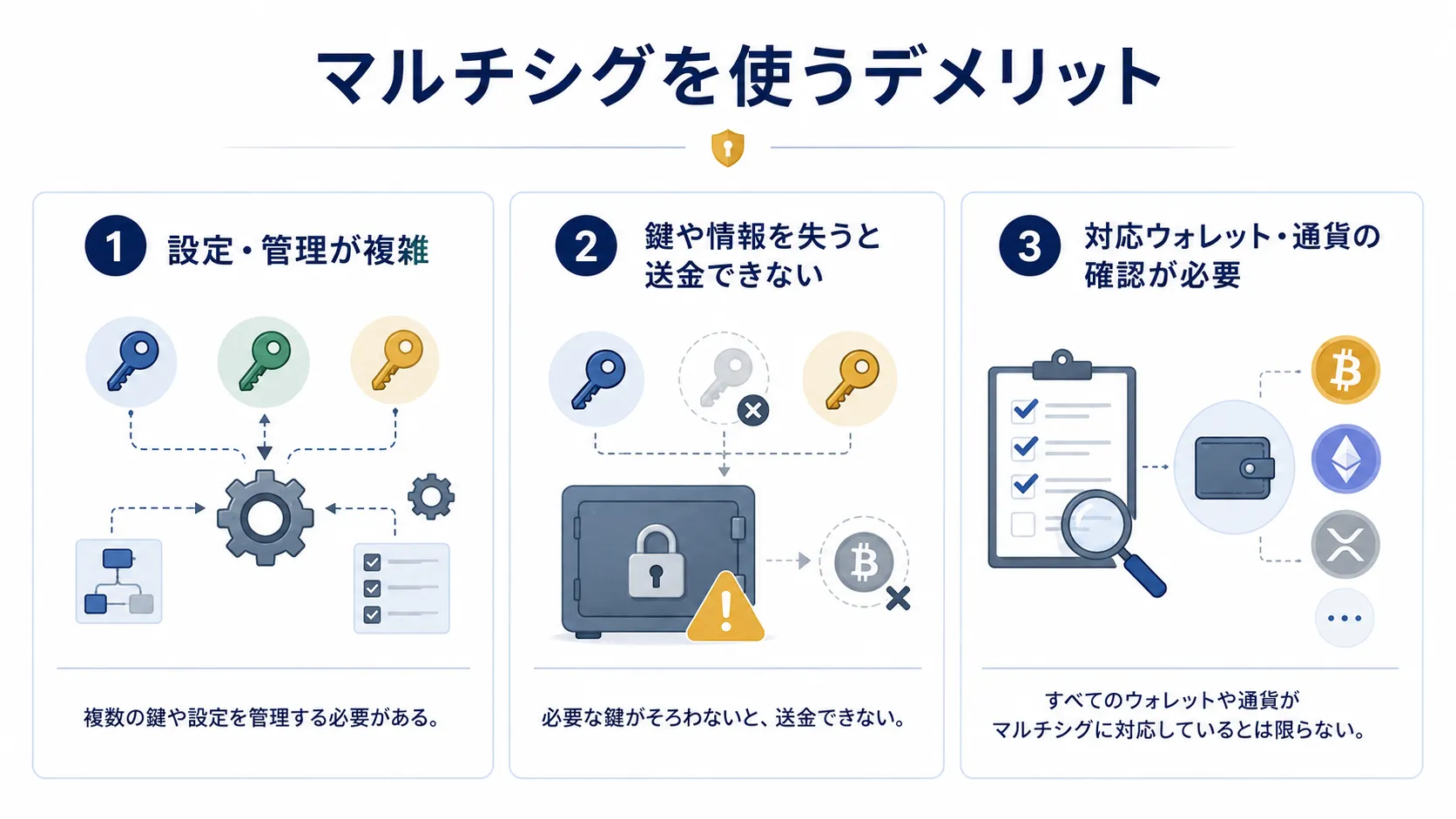
While multisig can make asset management more secure, there are also points worth understanding before adopting it. Because it is a mechanism built around multiple keys, it has characteristics that differ from a standard wallet.
When managing crypto assets, not only security but also everyday usability and how you handle worst-case scenarios matter. Below are the main disadvantages and points of caution to keep in mind when considering multisig.
Setup and Management Are More Complex Than a Standard Wallet
With multisig, it is not enough to simply store a single recovery phrase, as you would with a standard wallet. You need to decide in advance on the number of keys, the required number of signatures, where the keys will be stored, and which wallets are compatible.
For example, when managing under a "2-of-3" setup, you prepare three keys and configure the wallet so that a transfer can be sent with signatures from 2 of the 3. You then need to track where each of the three keys is stored, who manages each one, and which combinations can authorize a transfer.
Sending funds also requires multiple signatures. Compared with a standard management method where a transfer can be completed from a single wallet, the number of steps increases.
For this reason, it can be difficult for someone unfamiliar with managing crypto assets to adopt multisig right away. It is more practical to first understand standard wallet management and recovery phrase storage, and consider multisig only if and when it becomes necessary.
Losing the Required Keys or Setup Information Can Make Funds Unrecoverable
With multisig, not only the multiple keys but also the setup information needs to be carefully managed. If you lose track of which keys are combined, how many signatures are required, or which wallet was used to create the setup, sending or recovering funds can become difficult.
For example, if the setup requires 2 of 3 keys and you lose two or more of them, you will no longer be able to send funds. Even if the keys themselves remain, recovery can take time if you do not know which configuration was used to create the wallet.
Managing recovery phrases and private keys carefully matters for a standard wallet too. With multisig, the amount of information to manage increases, so storage rules need to be made even clearer.
Even if multisig is adopted to improve security, it defeats the purpose if you end up unable to recover your own funds. If you use multisig, it is important to record where the keys are stored and how to recover them, and to set up a system where the necessary people can check this information.
You Need to Check Which Crypto Assets and Wallets Are Supported
Multisig is not available in the same way for every crypto asset or wallet. The setup and usage methods differ depending on the supported currency, chain, and wallet.
For example, with Bitcoin, there are methods for combining multiple keys using wallets that support multisig (see: Multi-signature | Bitcoin Wiki). With Ethereum and similar networks, on the other hand, smart accounts are sometimes used, where the conditions for executing a transaction are defined by smart contract code (see: Safe Docs).
In this way, even under the same term "multisig," the mechanism and operating procedures vary depending on the type of crypto asset. Because wallet specifications can change or services can be discontinued, it is important to check the supported status before adopting multisig.
When choosing a compatible wallet, it is also worth checking factors such as the number of users, the state of ongoing development, and how thorough the official documentation is. Using multisig without fully understanding how it works can lead to trouble when sending or recovering funds.
Who Is Multisig Suited For?
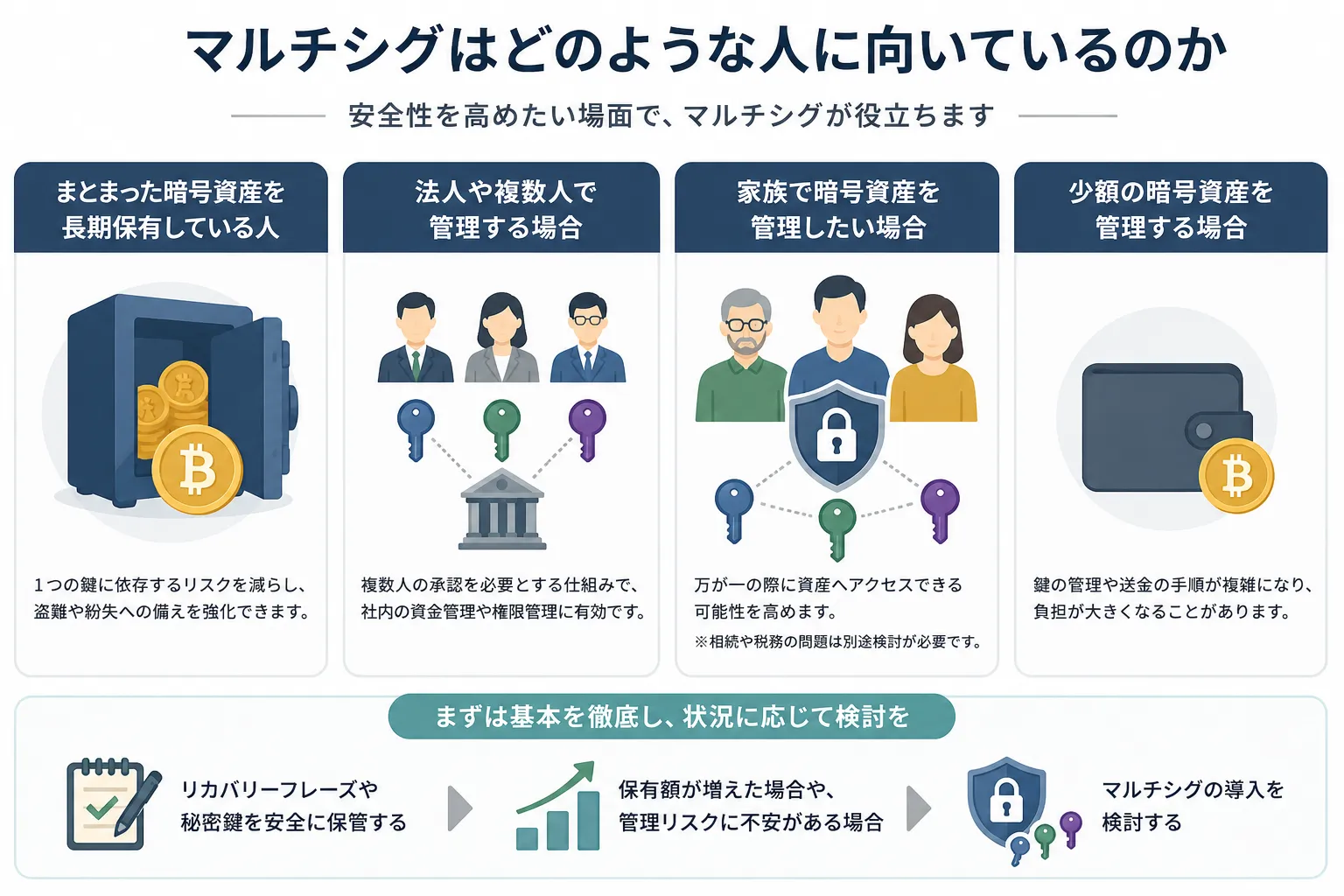
Multisig is not a mechanism that every user needs. While it can make asset management more secure, it also increases the effort involved in management and the amount of information you need to understand.
Multisig tends to suit people holding a substantial amount of crypto assets over the long term. The larger your holdings, the greater the risk of depending on a single private key. Distributing keys and designing a setup where no single key alone can send funds makes it easier to strengthen your defenses against theft or loss.
It is also suited to cases where a company or multiple people manage crypto assets together. If you want to avoid a situation where a single person alone can send funds, multisig lets you build a mechanism that requires approval from multiple people. This is a concept close to internal fund management and authority controls within a company.
Multisig is also sometimes considered for managing crypto assets as a family. If only one person knows the private key, family members may be unable to access the assets in an emergency. That said, inheritance and tax issues need to be considered separately, since multisig alone does not complete inheritance planning (related: Inheritance and Taxation When a Crypto Asset Holder Passes Away (in Japanese)).
On the other hand, for individuals managing a small amount of crypto assets, a standard wallet remains a viable option. Adopting multisig makes key management and the transfer process more complex, so for small holdings the burden can outweigh the benefit.
The basic starting point is storing your recovery phrase and private key safely. From there, it is worth considering multisig once your holdings grow or if you feel uneasy about relying on a single key.
The General Process for Using Multisig
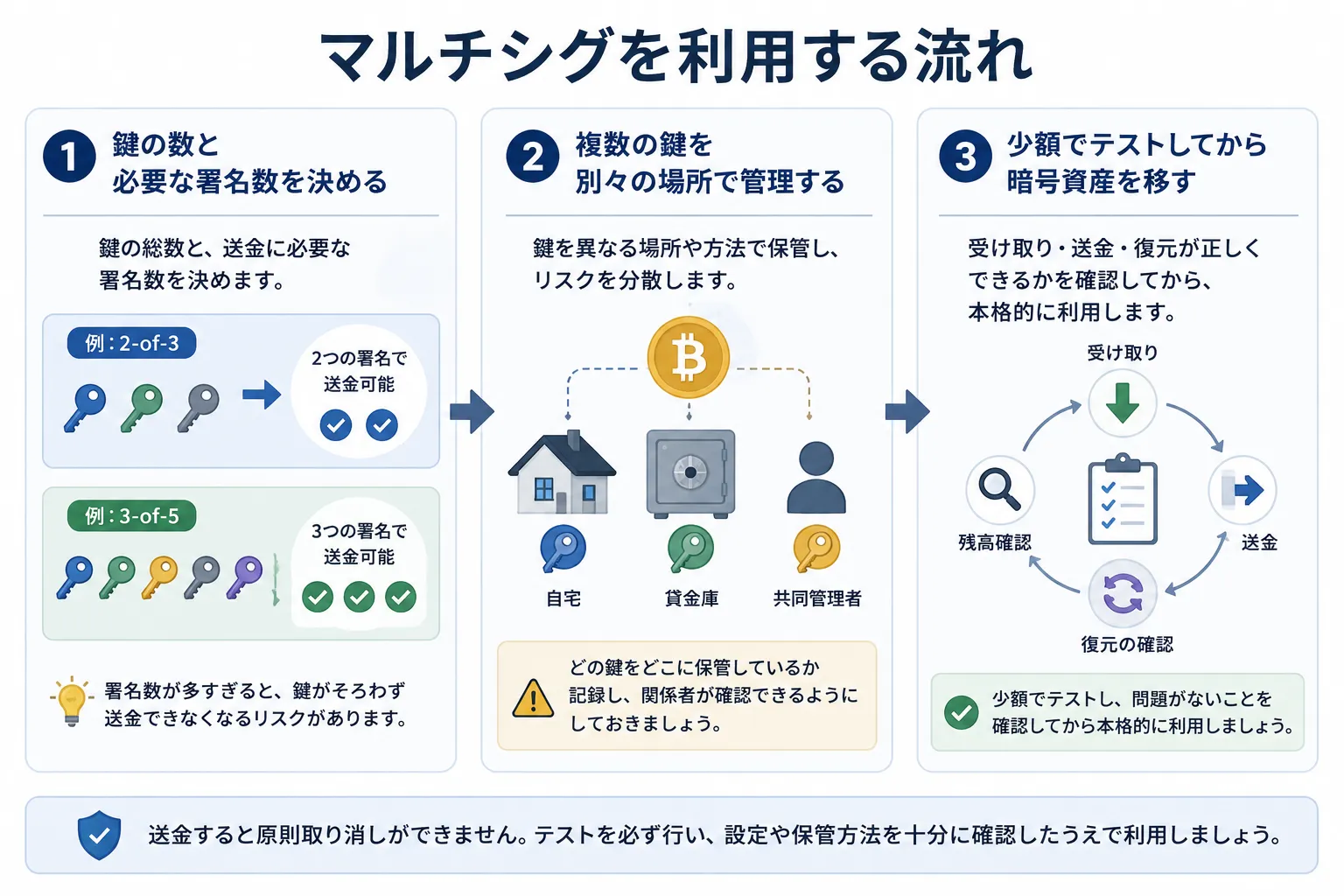
Rather than simply adding a quick setting to a standard wallet, multisig involves creating a new management environment using a wallet that supports it. For this reason, it is important to understand the general process before adopting it.
The actual steps vary depending on the wallet and crypto asset used. Here, we look at the general flow: deciding on the number of keys and the required number of signatures, managing the multiple keys separately, and testing with a small amount before using it in earnest.
Decide on the Number of Keys and the Required Number of Signatures
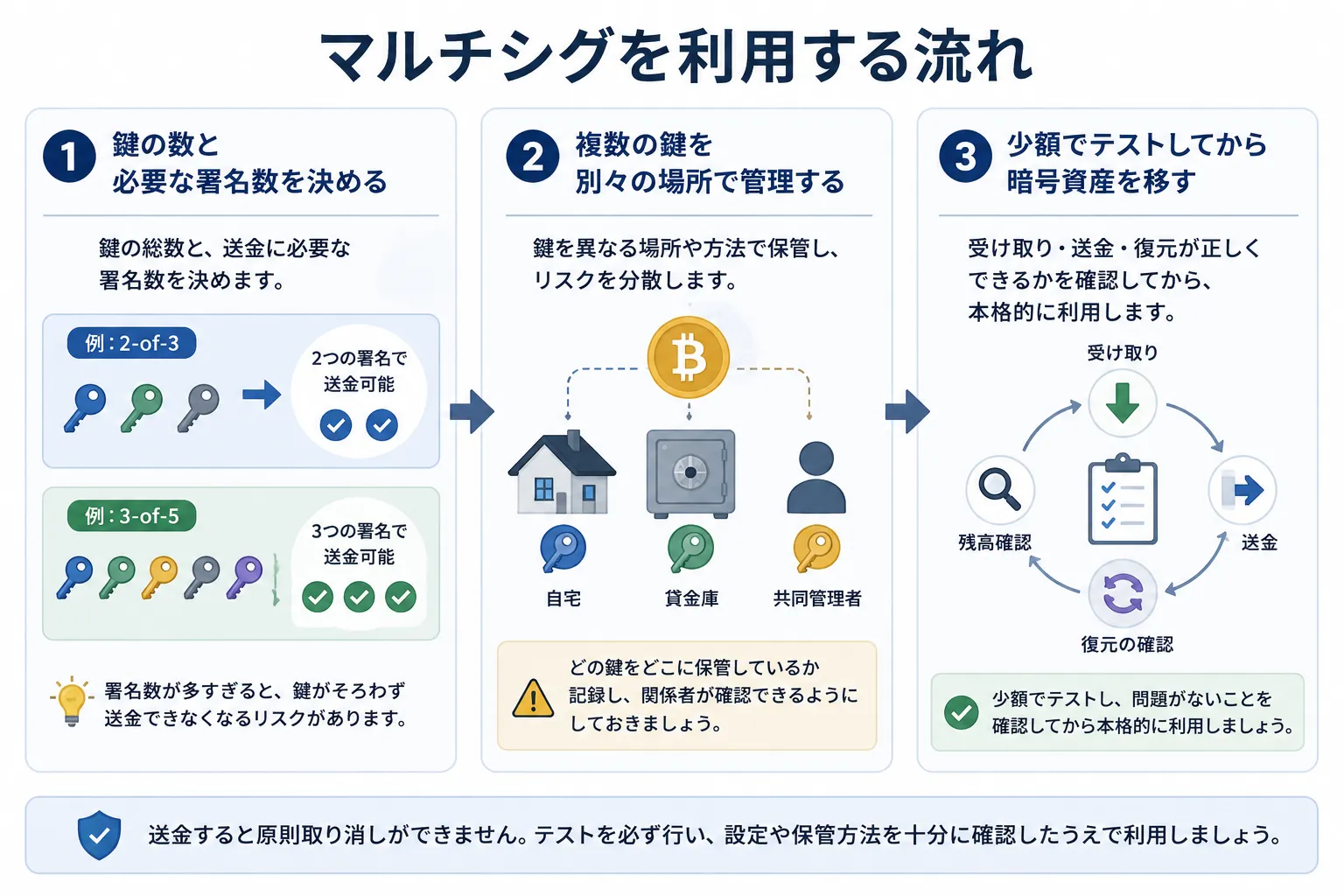
The first step in using multisig is to decide on the total number of keys and the required number of signatures. Common configurations include "2-of-3" and "3-of-5."
"2-of-3" is a setup where a transfer can be sent with signatures from 2 of 3 keys. Even if one key is lost, a transfer may still be possible with the remaining two. At the same time, a transfer is unlikely to go through if only one key is stolen. "3-of-5" requires signatures from 3 of 5 keys. This allows management across more people or storage locations, but operations become correspondingly more complex.
More required signatures is not necessarily better. Raising the required number of signatures tends to increase security, but it also raises the risk that you cannot gather the necessary keys and are unable to send funds. It is important to decide based on the size of your holdings, the number of managers, the storage locations, and how well you can respond during recovery.
Manage the Multiple Keys in Separate Locations
With multisig, it is important to manage the multiple keys in separate locations. If all the keys are kept on the same device or in the same place, you risk losing them all at once in the event of theft or a disaster.
One approach is to split storage across locations such as your home, a safe deposit box, or the storage location of a trusted co-manager. Another approach is to use multiple hardware wallets and manage each one in a different location (related: What Is a Cold Wallet for Crypto Assets? (in Japanese)).
However, splitting up storage locations alone is not enough. You also need to record where each item is stored and which key corresponds to which wallet. It is also worth considering setting things up so that relevant people, not just you, can check this information when needed.
It is also safer to avoid saving key storage information directly online. Storing a private key or recovery phrase in cloud storage or email carries the risk of exposure through unauthorized access, so please be careful.
Test with a Small Amount Before Moving Crypto Assets
Once you have set up multisig, it is important to test with a small amount rather than moving a large sum right away. Confirm the process of receiving funds, checking your balance, sending funds, and recovering the wallet before relying on it in earnest.
What matters most is confirming that you can actually send a transaction with the configured number of signatures. For a "2-of-3" setup, confirm that you can sign and send with 2 of the keys. You should also understand whether you can still operate the wallet when one key is unavailable.
It is also worth checking how the wallet you are using handles recovery. Even if the keys remain, if you do not know the recovery procedure, you may be unable to move your assets when you need to.
Crypto asset transfers generally cannot be reversed once sent. For this reason, even when adopting multisig, it is important to test with a small amount first and confirm there are no issues before moving to full-scale management.
Conclusion
Multisig is a mechanism that requires multiple keys to approve a transfer. Because it does not depend on a single private key, it is a management method that can help strengthen your defenses against theft or loss.
That said, using multisig does not automatically make your assets safe. Because it requires managing multiple keys, the difficulty of setup and storage is higher than with a standard wallet. Keep in mind that losing the required keys or setup information can leave you unable to move your own crypto assets.
For individuals storing a small amount of crypto assets, the basic starting point is properly managing your recovery phrase and private key with a standard wallet. From there, multisig is worth considering when holding substantial assets over the long term, or when a company or family needs to manage assets across multiple people.
When managing crypto assets, balancing security and usability matters. If you adopt multisig, make sure you understand how it works, test it with a small amount, and carefully judge whether it fits your management setup.
This article is for informational purposes only and does not constitute financial or investment advice. Please consult a qualified professional before making investment decisions.


