


Overseas exchanges for crypto assets (also known as virtual currencies) attract many Japanese traders with their wide selection of coins not listed domestically and their high leverage. At the same time, warnings such as "don't recommend overseas exchanges" or "just don't do it" remain common online, yet what actually goes wrong is not widely understood.
Overseas exchanges certainly offer attractions that domestic exchanges don't. Problems such as frozen withdrawals or an exchange's bankruptcy can happen regardless of whether the exchange is based in Japan or abroad. With an overseas exchange, however, you are less likely to be able to rely on Japan's investor protection framework or Japanese-language support when something goes wrong. There is also the added burden, unique to overseas platforms, of managing your own transaction records and handling your final tax return (annual tax filing). Whether these benefits and risks actually apply to you varies a great deal from person to person.
This article organizes the reasons people use overseas exchanges and the benefits involved, helps you check whether you actually need one, and covers the real-world trouble cases, tax practicalities, and the current state of regulation.
Why Japanese Traders Use Overseas Exchanges — and Their Benefits
Overseas crypto asset exchanges offer a number of features and conditions that domestic exchanges don't. That's exactly why a certain number of Japanese traders choose overseas exchanges, and there is a rationality to that choice that shouldn't be dismissed. Before writing it off as "too risky, better avoid it," it's worth honestly understanding why overseas exchanges get chosen in the first place — that's the foundation for calmly judging whether one is actually necessary for you.
The main benefits of overseas exchanges fall into four broad categories.
- The number of coins available
- Leverage ratios
- The range of derivatives products
- Fees and tooling
Note that each exchange's leverage ratio, number of listed coins, and whether it accepts users based in Japan are all things that can change. Treat the figures below as rough guidance only, and check the latest official information when you actually consider using an exchange.
The Wide Range of Listed Coins
The number-one reason overseas exchanges are chosen is the sheer breadth of coins they list. Domestic exchanges generally handle a few dozen coins, with even the largest offering around 60 or so as of now (July 2026). This is partly because, as part of the Financial Services Agency (FSA) registration process, any crypto asset a domestic exchange lists must pass a certain screening.
By contrast, major overseas exchanges list hundreds of coins, and the largest handle more than 1,000. Being able to trade new altcoins not yet available domestically, or tokens that have just started generating buzz, ahead of everyone else is the most obvious appeal for people who look overseas.
That said, this is also the flip side of looser screening, and it means low-value crypto assets get mixed in among the listings. Having many options is appealing in itself, but whether each individual coin is actually something you need is a separate question. Whether this abundance becomes a real benefit depends on what the user is trying to achieve.
High Leverage
Leveraged trading (margin trading), which lets you move a larger amount of money than you actually hold by using margin as collateral, is another reason overseas exchanges are chosen. In Japan, margin trading in crypto assets by individual (retail) investors is subject to a leverage cap of 2x. This is an investor-protection regulation that has been in place since 2020.
Regarding trading in crypto assets, the Financial Services Agency has settled on a policy of capping the leverage ratio for margin trading — which allows large trades on a small amount of capital — at 2x. Until now there had been no clear rule set by the government. The aim is to curb excessive speculation and the risk of losses from sharp price swings. The cap will be set out in a Cabinet Office Ordinance under the revised Financial Instruments and Exchange Act (FIEA), which was to take effect in spring 2020.
Reference: Nikkei
Overseas exchanges, on the other hand, commonly advertise leverage ratios ranging from several dozen times up to 100x or more. Because the same price movement produces gains or losses many times larger, this looks like a strong draw to anyone hoping to make large profits over a short period.
However, the higher the ratio, the greater the danger of losing your entire margin from just a small adverse price move. High leverage means both the possibility of large profits and the constant presence of large losses, so it's important not to simply assume that "higher leverage is always better."
A Wide Range of Derivatives Products
Beyond spot trading, a rich lineup of derivatives products such as perpetual futures and options is another feature unique to overseas exchanges. Derivatives is a general term for products whose value is based on price movement itself; while such products have limited availability domestically, many overseas exchanges offer them as a standard part of their menu.
Using derivatives makes possible a range of strategies not available with spot trading, such as "short selling" to profit when prices fall, or "hedging" to protect against a decline in the value of assets you hold. For experienced traders with a view on the market, this is an area that greatly widens the range of possible strategies.
That said, the mechanics are more complex than spot trading, and misreading price movements can easily lead to unexpected losses. Getting involved without fully understanding how these products work only increases the risk, so this is an area where less experienced traders should proceed with caution.
Lower Fees and More Advanced Tools
Many traders also see an advantage in overseas exchanges when it comes to trading costs and the tools available. Trading fees are sometimes set lower, and volume-based discounts can be more generous.
Additionally, easier integration with APIs and bots (automated trading via programs) for algorithmic trading, along with bonuses offered for account opening and deposits, attract users who prioritize cost and convenience. For frequent traders or those who want to trade using automated systems, these are factors that are hard to ignore.
However, fee structures and bonus conditions are revised frequently, and the actual cost is often hard to gauge from the headline numbers alone. How much of a real benefit any of this provides varies greatly depending on your own trading style.
[Self-Check] Do You Actually Need an Overseas Exchange?
The benefits of overseas exchanges are real, but whether they actually help you depends on the individual. Below is a self-check that lets you get a rough sense of whether you currently need an overseas exchange, just by answering four questions with "yes" or "no." Start with the flowchart below to see which type you fall into.
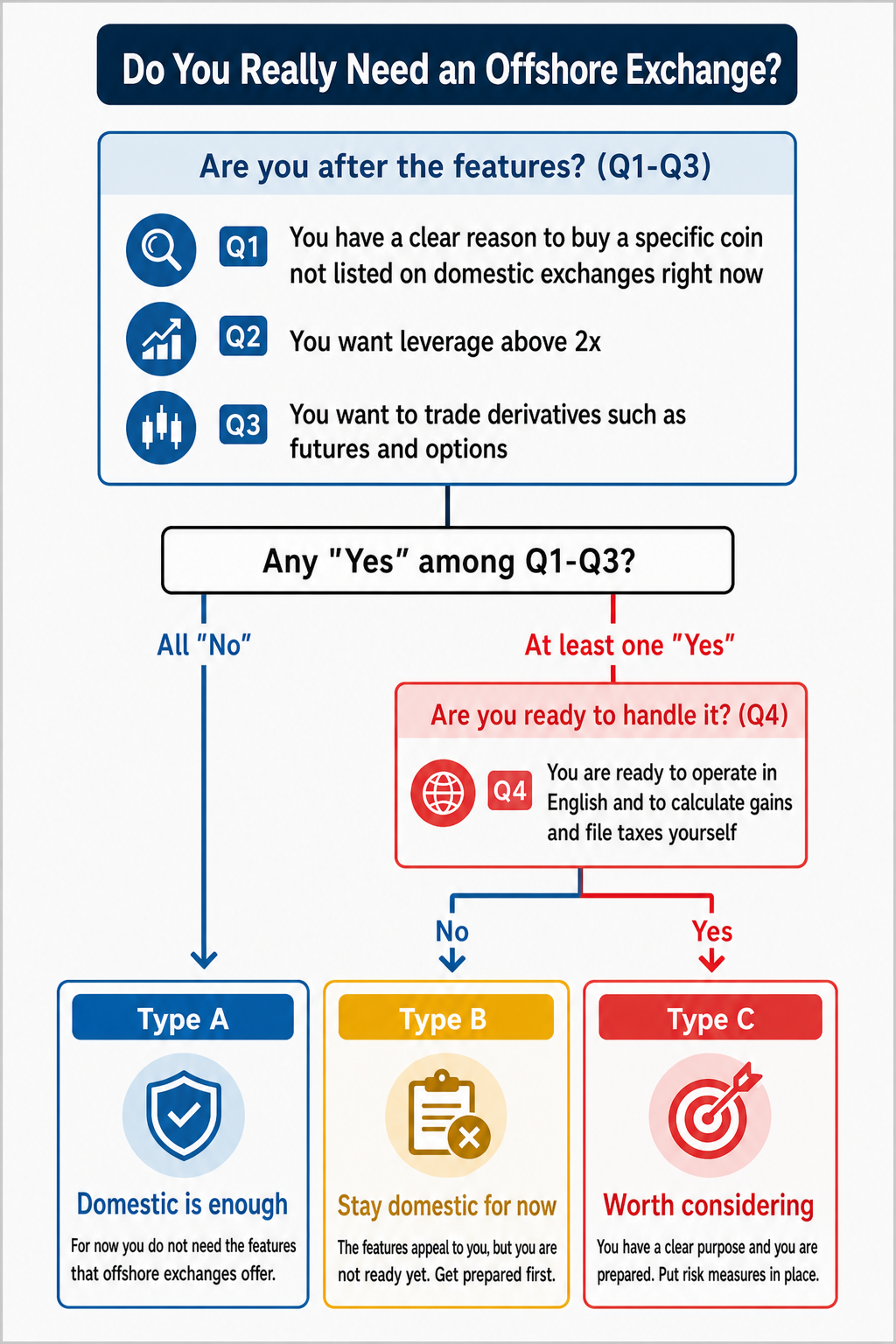
Type A | This means you don't currently need what overseas exchanges offer. Since major crypto assets can be bought and sold without any problem on domestic exchanges, there's no clear reason to take on the extra risk and hassle of using an overseas exchange. |
|---|---|
Type B | You feel drawn to what overseas exchanges offer, but you aren't yet prepared to operate in English or handle the tax paperwork involved. If you start using one without adequate preparation, you're likely to run into unexpected trouble or find the administrative burden weighing on you later. It's probably safer to build experience and knowledge on a domestic exchange first while you get the necessary preparations in place. |
Type C | You have a clear purpose and are prepared to take on the risk and effort yourself. There is room to consider an overseas exchange, but you cannot skip taking precautions against the risks involved. |
Most people who are new to crypto assets or who want to hold major coins long term fall into Type A. Aside from a subset of experienced traders who strongly need a specific feature, the reality is that domestic exchanges rarely fall short.
Trouble That Actually Happens on Overseas Exchanges
Overseas exchanges offer benefits that domestic exchanges don't, but it's also true that after opening an account and starting to actually use one, some people run into problems that rarely occur on domestic exchanges. So if you do use an overseas exchange, it's important to know what kinds of incidents actually happen.
Here we introduce some of the representative trouble that overseas exchange users have actually experienced.
Withdrawals Suddenly Stop Working One Day
One of the problems most frequently reported about overseas exchanges is trouble with withdrawals. There are cases where an account that worked normally until the day before suddenly becomes unable to release funds. The causes fall into a few categories.
One pattern is being asked for additional Know Your Customer (KYC) verification later on. KYC is the process of proving your identity by submitting your name, address, identification documents, and so on. Even if a simplified check was enough when the account was opened, exchanges may require more detailed verification at the withdrawal stage as Anti-Money Laundering (AML) measures are strengthened. If your registered information no longer matches your submitted documents — for example after a move or marriage — the mismatch can get your account locked, and unlocking it can take a long time.
The other pattern is restrictions arising from the exchange's own circumstances. Services for residents of a particular country may be scaled back or suspended in response to regulatory pressure or a change in business policy. In fact, Bybit received warnings from the FSA in 2021, 2023, and 2024 for conducting a crypto asset exchange business targeting Japanese residents without registration. Bybit subsequently announced in January 2026 that it would phase out its products and services for Japanese residents (Reference: Bybit).
In 2025, several overseas exchange apps were also removed from the App Store and Google Play, making new downloads and updates impossible. In such withdrawal-from-market situations, you may need to move your own assets within a limited window, and delaying your response can make it harder to withdraw them.
With a domestic exchange, even in situations like these there is a Japanese-language inquiry desk, and you can expect a certain level of process under FSA oversight. With an overseas exchange, communication will naturally center on English, and it's not unusual for responses to take a long time. You need to understand in advance that, if you find yourself unable to withdraw funds, the people you can turn to for help are limited.
An Exchange's Bankruptcy Can Mean Your Assets Never Come Back
There is also the risk that the exchange itself goes bankrupt and the assets you deposited never come back. The emblematic case is the 2022 collapse of the major overseas exchange FTX.
In November 2022, reports about the finances of an FTX-affiliated company triggered a crisis of confidence, and users rushed to demand withdrawals. FTX was unable to keep up and suspended withdrawals; on November 11 it filed for Chapter 11 bankruptcy protection in the United States, effectively collapsing. Later court proceedings revealed that management had improperly diverted customer assets (Reference: Impress Watch).
What's worth noting here is how Japanese users were treated. FTX Japan, which was registered and operating domestically, kept segregated management and trust-based safeguarding under Japan's legal framework, and had reserves matching the assets it held on deposit, so withdrawals resumed from 2023 (Reference: ITmedia NEWS). By contrast, the assets of some Japanese users who had used the overseas FTX parent entity — for example through its mobile app — fell outside the scope of Japan's segregated management rules, and returning those assets remained difficult.
This contrast illustrates the core risk of using overseas exchanges. Even though it was the same FTX, assets deposited through the entity regulated in Japan were protected, while assets deposited directly with the overseas parent company were not covered by Japan's investor protection. Using an overseas exchange directly generally means placing your assets outside that protection.
It should be noted that asset theft and hacking incidents have also occurred at domestic exchanges in the past, so being domestic does not guarantee absolute safety. Some major overseas exchanges do maintain insurance-like funds. However, when it comes to whether you can receive relief under Japan's legal system or support in Japanese if something goes wrong, there is a large gap between domestic and overseas exchanges (Related: What Happens to Your Assets If a Crypto Exchange Goes Bankrupt?).
Falling Victim to Fake Sites and Scams
Separate from problems with the exchanges themselves, scams that impersonate exchanges continue unabated. Because there is little Japanese-language information about overseas exchanges, it can be hard to tell a legitimate service from a fake one, which makes them fertile ground for scams.
The methods generally fall into the following categories.
Fake exchange | Creating a site with a name and logo resembling a real, well-known exchange, getting the victim to deposit funds, then cutting off contact. |
|---|---|
Phishing | Luring victims to a fake login page that looks identical to the real site, then stealing their ID, password, or two-factor authentication code. |
Social media recruitment | A person met through social media or a dating app steers the victim toward a specific overseas exchange or investment scheme, and ultimately prevents them from withdrawing funds. |
Fake withdrawal-fee demand | Claiming that "a fee or tax must be paid upfront to withdraw your profits," then repeatedly demanding further deposits. |
The scale of this damage also shows up in official statistics. According to Japan's National Police Agency, losses from social-media investment and romance scams in 2024 (Reiwa 6) reached roughly ¥127.2 billion (approx. USD 850 million at ¥150/USD, for reference only), a sharp increase from the previous year. Schemes in which victims are made to send the defrauded funds in crypto assets have also been confirmed (Reference: National Police Agency).
If you use a domestic registered exchange, at least it's clear whether the counterparty is a real, regulated business. If you use an overseas exchange, or a service you've never heard of that was introduced to you via social media, you need to determine for yourself whether it is a legitimate business in the first place. Even if you do fall victim, reaching a complaints desk or getting a refund is not easy when the counterparty is based overseas.
Unexpected Burdens at Tax Filing Time
Trouble arises not just around the assets themselves but also on the tax side. There are cases where people who made a profit on an overseas exchange only realize how heavy the burden is once tax-filing season arrives.
Overseas exchanges don't necessarily provide a document summarizing your annual gains and losses the way domestic exchanges do. As a result, many people find, once they actually try to file, that they don't have the records they need on hand, or that converting everything into yen takes a lot of effort. Even though making a profit is welcome news in itself, stumbling over the subsequent filing work ends up costing extra time and money (Related: Only 3 in 10 Overseas Exchange Users Report Their Profits — A Survey on Unreported Income Driven by Misunderstanding and Calculation Difficulty).
The Tax and Filing Challenges of Overseas Exchanges
When considering whether to use an overseas exchange, taxes are an issue many people tend to overlook. It's easy to push the topic aside as "something to deal with after you've made a profit," but it's actually an important point you should understand before you even open an account.
To begin with, the tax treatment of crypto assets — whether traded on a domestic or overseas exchange — tends to result in a heavier burden than something like stocks. On top of that, an overseas exchange lacks the conveniences you'd take for granted on a domestic exchange, so you have to handle most of the work yourself, from keeping records to converting everything into yen. Rules around remittances can also come into play.
This section looks at the tax and filing challenges unique to overseas exchanges, in the order of the tax-rate structure, the practicalities of record-keeping, remittance rules, and how to guard against unreported income. After outlining the system, we go on to what you should actually do about it. Note that individual tax judgments vary by circumstance, so we recommend consulting a professional such as a tax accountant for any specific calculations or filings.
The Tax and Filing Challenges of Overseas Exchanges
When deciding whether to use an overseas exchange, another thing many people overlook is the tax and filing burden waiting for them after they've finished trading. Whether the exchange is domestic or overseas, if you make a profit trading crypto assets, Japanese residents may incur an obligation to file and pay tax.
If you use a domestic exchange, you can rely to some extent on the exchange's own systems for the documents and profit/loss calculations needed for your final tax return. With an overseas exchange, that assumption breaks down, and the burden changes substantially — from how the tax amount is calculated to how you gather records and handle remittance procedures.
Here we organize the tax-related points where users of overseas exchanges commonly stumble.
Profits Are Miscellaneous Income Subject to Aggregate Taxation
Under National Tax Agency (NTA) treatment, profits from buying and selling crypto assets are, in principle, classified as miscellaneous income and subject to aggregate taxation (comprehensive taxation). Aggregate taxation is a system in which your crypto profits are combined with other income such as salary or business income, and the tax rate is set based on the total amount. Profits earned on an overseas exchange are treated the same way.
Regulatory note (as of July 2026): Under current law, gains from selling crypto assets are treated as miscellaneous income under aggregate taxation. On July 15, 2026, a revised FIEA passed a plenary session of the House of Councillors, reclassifying crypto assets as financial instruments under the FIEA. A 20% separate self-assessment tax rate is expected to apply from the year after the revised law takes effect (expected around January 2028).
Miscellaneous income is subject to a progressive tax rate, where the rate rises as income grows. Income tax rises in stages from 5% to 45%, and roughly 10% in resident tax is added on top of that. As a result, for high earners the combined rate can reach around 55% at the top end. Compared with the roughly flat 20% that applies to stock or FX profits under separate self-assessment taxation, this may make the weight of the burden easier to picture. It's also worth noting that if your crypto trading results in a loss for the year, that loss can only be offset against other miscellaneous income — it cannot be offset against salary or other categories of income.
A particularly important point about progressive taxation is that crypto profits are not taxed on their own; the rate is determined after they are added on top of income such as salary. For example, if someone with ¥5 million (approx. USD 33,000 at ¥150/USD) in taxable salary income earns a ¥3 million (approx. USD 20,000) profit from crypto assets, that profit portion may be taxed in a higher bracket than would apply if the person had only the salary income. Because overseas exchanges list many coins and allow high leverage, profits can balloon quickly, which makes an unexpectedly heavy tax burden more likely.
It should be noted that crypto asset taxation is an area where reform discussions are ongoing. Because tax rates and how income is classified may change, we recommend checking the NTA's latest published FAQ, or consulting a professional such as a tax accountant, before filing (Reference: Tax Treatment of Crypto Assets and Related Worksheets | National Tax Agency).
No Transaction Report — You Manage Your Own Records
If you use a domestic Crypto Asset Exchange Service Provider, many issue an "annual transaction report" summarizing a year's worth of trading. Because you receive your trading history and the information needed for profit/loss calculations already largely organized, preparing for your filing isn't much of a burden (example: bitbank).
Overseas exchanges generally do not issue this kind of report. Even if you can obtain your trading data, it often doesn't follow the Japanese format and is presented in English or in a foreign currency, so it frequently can't be used for filing as-is. As a result, users end up having to gather their own records, convert them into yen, and calculate profit and loss themselves.
In practice, the process generally looks like this.
- Download your trading history as a CSV or similar file from each exchange's dashboard (some exchanges let you pull everything at once via API integration)
- Also keep records of transfers between exchanges, and deposit/withdrawal history for your wallets
- For each transaction, convert the amount into yen using the market rate at the moment the transaction was executed
- Total up the year's profit and loss based on the converted amounts
One thing that's easy to overlook during conversion is that exchanging one crypto asset for another is also a taxable event. For example, if you use Bitcoin to buy a different coin, you need to calculate the gain or loss as if it were realized at that point. Overseas exchanges tend to involve a larger number of trades and coins, so the volume of records grows accordingly. If you scramble to gather everything after the year has already ended, you'll spend a lot of extra effort tracking down historical prices, so saving your records at the time of each trade will reduce the burden later on.
The Travel Rule Makes Remittances More Complicated
When using an overseas exchange, it's also worth understanding that sending funds itself has become more complicated than before. Behind this is the "Travel Rule," which is being adopted internationally as an anti-money-laundering measure. In Japan too, the June 2023 revision of the Act on Prevention of Transfer of Criminal Proceeds (APTCP) made compliance with this rule mandatory for domestic Crypto Asset Exchange Service Providers.
The Travel Rule is a mechanism in which exchanges notify each other of the sender's and recipient's information whenever crypto assets are sent. Its purpose is to make transaction routes traceable, and it adds a step where users must declare information about the recipient when sending funds (Related: What Is the Crypto Travel Rule?).
The effect is most likely to show up in practice when moving funds between a domestic exchange and an overseas one. Depending on how the receiving exchange complies with the Travel Rule, the range of counterparties you can send to may be limited, or you may be asked for additional verification. Compliance varies from exchange to exchange and can change over time, so it's reassuring to check the guidance from both your own exchange and the receiving exchange before sending funds.
The Risk of Unreported Income, and How to Guard Against It
As we've seen, using an overseas exchange often means handling profit/loss calculations and record-keeping yourself, and that difficulty tends to lead directly to unreported income. It's not uncommon for filings to be omitted with no bad intent, for reasons such as "the exchange never sent me a document" or "I didn't know that exchanging one crypto asset for another was taxable."
Unreported income is by no means overlooked. The NTA has been stepping up audits of individuals trading crypto assets, and according to published data, of 615 audits conducted in the FY2022 (Reiwa 4) program year, 548 resulted in findings such as unreported income. Media reports have also described a case in which a salaried employee earning around ¥9 million (approx. USD 60,000 at ¥150/USD) a year was hit with more than ¥200 million (approx. USD 1.33 million at ¥150/USD) in back taxes over unreported crypto income. It's also worth noting that tax audits can look back several years, and penalties such as additional tax and delinquency tax are added on top of the original tax amount.
As a practical way to guard against this risk, there are two realistic options.
Using a profit/loss calculation tool | Consulting a tax accountant |
|---|---|
Using a dedicated tool built for crypto profit/loss calculation lets you import history from multiple exchanges and wallets and handle the yen conversion and totaling all at once. Some tools support the data formats used by overseas exchanges, reducing both manual effort and the risk of calculation errors. | If you have a large number of trades, or trades you're unsure how to treat, the safest approach is to consult a tax accountant experienced in crypto asset filings. Calculations tailored to your individual circumstances, and whether a filing is required, are areas that are difficult to judge without a professional. |
The tax calculation and whether a filing is required vary by individual circumstance. This article only outlines the system in general terms, so for any actual filing, be sure to check the latest information from the NTA and consult a professional such as a tax accountant (Related: How to Choose a Tax Accountant Experienced in Crypto Assets).
Regulation and Legality Surrounding Overseas Exchanges
In Japan, providing crypto asset exchange services as a business requires registration under the Payment Services Act (PSA). This registration system has been strengthened repeatedly in response to lessons learned from incidents involving the unauthorized outflow of assets and from business failures.
Meanwhile, many overseas exchanges are not registered, and some have been named and cautioned directly by the authorities. Which exchange will restrict its services and when is also something that keeps shifting, based on decisions made by regulators and by the companies themselves.
Let's look at where the legal line is drawn, and at the reality that the environment for using these services can change.
The FSA's Registration System and Warnings to Unregistered Operators
Operating a crypto asset exchange service as a business in Japan requires registration with the FSA (or the relevant Local Finance Bureau) under the PSA. Registered operators are called "Crypto Asset Exchange Service Providers" and take on numerous obligations, including segregated management — keeping assets deposited by users separate from the company's own assets — as well as identity verification and system security measures.
The problem is that many overseas-based exchanges are not registered. The FSA issues warning notices and publishes the names of operators that conduct a crypto asset exchange business targeting Japanese residents without registration. Binance, known as the world's largest exchange, was itself once among the companies warned for operating without registration (Reference: Names of Entities Conducting Unregistered Crypto Asset Exchange Business).
It's important to understand that "being an unregistered operator" and "the user being penalized" are two different things. The PSA's registration requirement applies to the business operating the exchange, not to the user. At least under the current PSA, there is no provision that directly penalizes a Japanese resident simply for using, as an ordinary customer, an overseas exchange that isn't registered with the FSA. In other words, the current line is that using an overseas exchange does not by itself make the act illegal.
That said, this does not mean it's "safe to use." Unregistered operators are not under the supervision of Japanese authorities, and user-protection rules such as segregated management do not apply to them. That difference became real in the 2022 FTX collapse. When deciding whether to use an overseas exchange, you need to think not only about whether using it is illegal, but also about whether you would receive protection or relief under Japan's system if something went wrong.
The Possibility That an Overseas Exchange Becomes Unusable
Beyond the regulatory line, there's another thing worth keeping in mind: the environment you're operating in can itself change. Overseas exchanges sometimes scale back or discontinue services for Japanese residents in response to moves by regulators or their own business decisions. It has actually happened that an exchange that worked fine until yesterday suddenly stopped accepting new registrations, or asked existing users to migrate their accounts or withdraw their funds.
Binance symbolizes this. Having been warned for operating without registration, the company subsequently changed its approach to the Japanese market dramatically. In 2022 it announced the acquisition of Sakura Exchange Bitcoin (SEBC), a domestic registered operator, and in August 2023 it began operating as the registered entity "Binance Japan."
As a result, Japanese users who had been using the global platform were forced to either migrate to the domestic entity or withdraw their assets, and the coins and services offered were also narrowed down to comply with Japanese regulation. This is an example of how the entire environment can change based on a single decision by an operator or a regulator, even when the user has done nothing wrong.
Behind this is a broader trend of tightening regulation across countries. Authorities are stepping up their monitoring of unregistered operators from an anti-money-laundering and user-protection standpoint, and operators continue to reassess which regions they serve. These changes are not always announced far in advance, and there are cases where registration or trading was already restricted by the time users noticed.
If a service suddenly becomes unavailable, you may be forced to rush to move or withdraw your assets, and at an exchange with little Japanese-language support, the procedures themselves can be time-consuming. We recommend regularly checking the latest regulatory developments and each exchange's status through information published by the FSA and official announcements from the companies themselves.
Why Domestic Exchanges Are Recommended for Most Beginners
For people buying crypto assets for the first time, or who want to hold major coins such as Bitcoin in spot form, choosing a domestic exchange first — given the user protection and straightforward procedures involved — makes it easier to get started trading without unnecessary strain.
Operators running a crypto asset exchange business domestically are required to register with the FSA. Being a registered operator is no guarantee against bankruptcy or the unauthorized outflow of assets, but compared with an overseas operator whose location and operating entity may be unclear, it's reassuring that responsibility and where to turn for help are easier to identify when something goes wrong.
Domestic registered operators also follow rules for how they manage assets entrusted by customers. Money deposited by users is kept segregated through trusts placed with trust companies and similar entities, while crypto assets are, in principle, kept segregated in cold wallets (offline wallets) disconnected from the internet. Note that this does not mean crypto assets themselves are all principal-guaranteed through trust arrangements. Rather, a management framework is in place to separate the operator's own property from users' property and to limit the impact of an unauthorized outflow of assets or a bankruptcy.
Being able to handle inquiries and identity verification in Japanese is also important for beginners. When problems occur — a hold on deposits or withdrawals, a misdirected transfer, or being unable to log in — an overseas exchange may require you to explain the situation in English and submit the necessary documents. With a domestic exchange, Japanese-language guidance and support are available, making it easier to understand the cause of a problem and what response is needed.
Being able to gather the information needed for tax calculations easily is another benefit of choosing a domestic exchange. Domestic Crypto Asset Exchange Service Providers may provide an annual transaction report and trading history recording your annual purchase and sale amounts. Compared with tallying multiple currencies and prices at the time of each trade yourself, as you would with an overseas exchange, it's easier to organize the profit and loss figures needed for your final tax return.
Of course, if you want to buy a specific coin not available domestically, or want to use futures or options, an overseas exchange can become an option. However, at a stage when you cannot clearly explain what benefit you're getting, there's little need to choose an environment with a heavier burden in terms of user protection and tax administration. If you're starting out by buying or dollar-cost-averaging into major crypto assets, using a domestic exchange registered with the FSA is a sensible starting point.
Frequently Asked Questions
Because the terms of service on the provider side and Japan's domestic system both keep changing, it's risky to make decisions about overseas exchanges based on outdated information alone. Below are some of the most common questions worth checking before you use one. Please check the item that applies to you.
Can overseas crypto asset exchanges be used from Japan?
If a service accepts Japanese residents as users, it may be accessible from Japan. However, being able to access an overseas exchange is a separate matter from that exchange being registered in Japan as a Crypto Asset Exchange Service Provider.
Article 63-2 of the PSA requires operators conducting a crypto asset exchange business to be registered with the Prime Minister. What this provision directly regulates is the operator side, not an obligation imposed on users to register. Meanwhile, the FSA issues warnings to overseas operators conducting a crypto asset exchange business targeting Japanese residents without registration, and urges users to check whether an exchange is registered before using it.
So merely using an overseas exchange does not directly result in the user being penalized, but the asset management and user-protection mechanisms required of Japan's registered operators are not necessarily applied in the same way. Before opening an account, you need to check the FSA's list of registered operators and the exchange's terms of service.
Can an overseas exchange suddenly become unusable?
Yes, it's possible for an overseas exchange to stop accepting new registrations or trading from Japanese residents. This is because the countries it serves and the services it offers get reviewed in response to tightening regulation in various countries, changes to licensing policy, and the exchange's own business decisions. Even when a certain grace period is set between the announcement and the start of restrictions, you may need to move your holdings or close out open positions during that window.
Restrictions like this can occur even without any bankruptcy or wrongdoing at the exchange. If you use an overseas exchange, it's important to check official emails and announcements regularly, so you're not left scrambling to respond only after you've already been notified.
Is identity verification required at overseas crypto asset exchanges?
Whether identity verification is required, and what documents you need to submit, varies by exchange, but it's best not to assume you can keep using every feature indefinitely without it. Even if you were able to create an account, you may still be asked for identity verification, or have your usage limits restricted, at the deposit, trading, or withdrawal stage.
Identity verification typically requires you to submit identification such as a passport, a photo of your face, and documents that verify your current address. Depending on the exchange and the features you use, additional proof of address or source-of-funds checks may also be required.
How are profits from an overseas exchange taxed?
For anyone subject to Japanese income tax filing, profits earned on an overseas exchange are, in principle, also subject to Japanese taxation. The fact that the exchange is based overseas, or that you haven't withdrawn the funds in yen to a domestic bank account, does not exempt you from taxation.
If you use multiple overseas exchanges, or engage in crypto-to-crypto exchanges, futures trading, staking, and the like, your profit/loss calculations become more complex. If you're unsure how to treat something, keep your trading history without deleting it, and consult a tax accountant experienced in crypto asset taxation.
Conclusion: Weigh Your Purpose Against the Risk Before Choosing an Overseas Exchange
Overseas crypto asset exchanges offer benefits that domestic exchanges don't, including a wider range of listed coins, high leverage, and a rich lineup of derivatives products. For experienced traders who have a clear purpose for using coins or trading features not available domestically, an overseas exchange can be a strong option.
At the same time, many overseas exchanges are not registered with Japan's FSA, and the segregated management and user-protection mechanisms required of domestic registered operators are not necessarily applied in the same way. Beyond frozen withdrawals, bankruptcy, and fake-site scams, there is also the possibility that services for Japanese residents could suddenly be restricted due to a change in regulation or business policy.
In many cases you also have to handle saving your trading history, converting it into yen, and calculating profit and loss yourself, so the burden of filing your final tax return is far from light. You need to judge not just whether you can make a profit, but also whether you can handle responding to trouble and managing your own tax obligations.
If you don't need a specific overseas coin or trading feature and simply want to buy or dollar-cost-average into major crypto assets such as Bitcoin, there's little need to deliberately choose an overseas exchange. Start with a domestic exchange registered with the FSA, and if you do use an overseas exchange, it's important to fully confirm the need and the risk first, and keep the assets you deposit there to the necessary minimum.
This article is for informational purposes only and does not constitute financial or investment advice. Please consult a qualified professional before making investment decisions.


