


As the crypto asset market becomes increasingly global, a growing number of holders are turning to overseas exchanges in search of tokens and services not available on domestic platforms. However, significant challenges remain around properly reporting the profits earned through these overseas transactions for tax purposes.
Clabo's original survey found that 75.0% of respondents have used an overseas exchange, yet only 31.6% say they have fully reported their profits in every year they made a gain. Furthermore, roughly one in five respondents who recognize that reporting is required admit they have not filed, highlighting a clear gap between holders' awareness of compliance obligations and their actual behavior.
For context, under Japan's current tax code, gains from crypto asset sales are treated as miscellaneous income and taxed under the aggregate taxation system alongside salary and other income, at progressive rates of 5–45% plus a flat 10% resident tax. Japan's Diet passed a revision to the Financial Instruments and Exchange Act (FIEA) on July 15, 2026 that will bring crypto assets under that law as financial instruments; once the revised law takes effect (expected from January 2028), gains are expected to move to a flat 20% separate self-assessment taxation, similar to how stock gains are currently taxed. Until then, the current miscellaneous-income treatment described in this article applies.
This article draws on survey data from 234 holders who use overseas exchanges to analyze, from a specialist perspective, the details of their reporting status, the causes of non-filing, and the practical barriers holders face.
75% Have Used an Overseas Exchange, With Working-Age Adults Leading the Way
Three in Four Respondents Have Used an Overseas Exchange
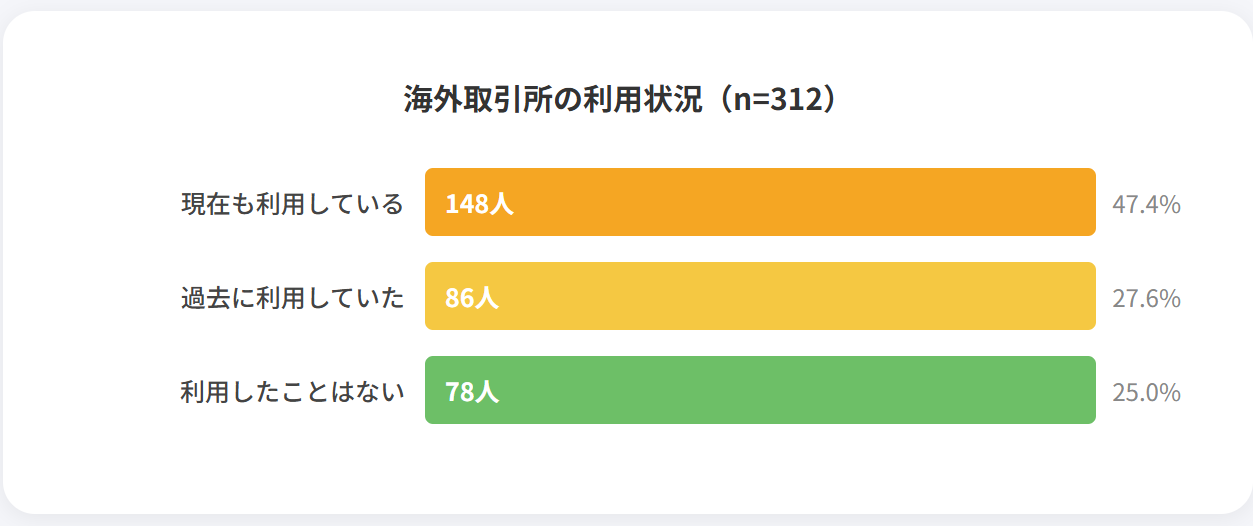
Response | Number of Respondents | Percentage |
|---|---|---|
Currently using | 148 | 47.4% |
Used in the past | 86 | 27.6% |
Never used | 78 | 25.0% |
We surveyed 312 users with crypto trading experience about their use of overseas exchanges. The results showed that 234 respondents, or 75% of the total, said they have used an overseas exchange — an extremely high adoption rate. In particular, 47.4% said they are "currently using" one, painting a picture of holders who rely on overseas platforms as part of their everyday trading routine, not just domestic exchanges.
Meanwhile, only 25.0% said they have never used an overseas exchange — meaning three out of four investors with trading experience have accessed the global market at least once. Overseas exchanges are an attractive option for holders thanks to the wide range of altcoins not listed domestically, advanced charting tools, and flexible leverage settings. Holders with stronger research skills appear more likely to actively favor overseas platforms that sit closer to the original source of information.
Widespread Adoption From Younger Users to the Working-Age Generation
Age Group | Currently Using | Used in the Past | Never Used |
|---|---|---|---|
In their 20s | 33 | 15 | 11 |
In their 30s | 47 | 20 | 24 |
In their 40s | 36 | 24 | 17 |
In their 50s | 22 | 19 | 22 |
In their 60s | 5 | 6 | 3 |
70 and older | 5 | 2 | 1 |
Looking at the data by age group, respondents in their 30s recorded the highest number of "currently using" responses at 47, the largest figure across all age brackets. They were followed by those in their 40s (36) and 20s (33), making it clear that working-age adults in their 20s through 40s are the main players in the overseas exchange market. This generation tends to adapt quickly to digital technology and appears comfortable navigating overseas services whose interfaces are primarily in English.
That said, the share of respondents with usage experience remains far from low even among those aged 50 and above, suggesting a trend of incorporating overseas exchanges into a broader asset-management strategy. An environment where information about overseas trends and specific tokens spreads instantly through social media and video platforms is likely a major factor behind the high usage rate, particularly among younger holders. A shared understanding — regardless of generation — that the speed of information acquisition can determine investment success may also be fueling interest in overseas platforms.
Continued Use Stands Out Among Those Earning ¥4 Million or More
Individual Annual Income | Currently Using | Used in the Past | Never Used |
|---|---|---|---|
Under ¥2 million | 45 | 35 | 22 |
¥2–4 million | 38 | 31 | 23 |
¥4–6 million | 41 | 14 | 22 |
¥6–8 million | 12 | 5 | 6 |
¥8–10 million | 5 | 1 | 4 |
¥10 million or more | 7 | 0 | 1 |
Analyzing usage by individual annual income reveals that a wide range of earners — from under ¥2 million to the ¥4–6 million bracket — are actively trading on overseas exchanges. Notably, the ¥4–6 million bracket shows a particularly high rate of "currently using" responses, confirming ongoing usage within this group. Crypto assets were once strongly associated with wealthy investors, but the data show that individual holders at ordinary income levels are, in fact, at the center of the market today.
Among high earners with an annual income above ¥10 million, sample sizes are small, but the vast majority are actively using overseas exchanges right now. This points to a clear focus on preserving assets and maximizing returns, with high earners strategically leveraging overseas platforms. Because crypto assets allow access to markets worldwide starting from small amounts, holders can pursue a diverse range of investment strategies suited to their individual risk tolerance regardless of income level — a factor that is helping drive broader adoption.
Overseas Exchange Adoption Growing Regardless of Gender
Gender | Currently Using | Used in the Past | Never Used |
|---|---|---|---|
Male | 98 | 52 | 55 |
Female | 50 | 34 | 23 |
A cross-tabulation by gender found that 47.8% of male respondents and 46.7% of female respondents are "currently using" an overseas exchange. This near-even split clearly shows that gender-based barriers to entry or differences in preference have all but disappeared when it comes to overseas exchange usage. Crypto assets were once a field with an overwhelmingly male user base, but as the community has matured and information has become more democratized, adoption among female holders has grown at a remarkable pace.
The share of respondents who have "never used" an overseas exchange is 26.8% for men versus 21.5% for women — if anything, slightly lower among women. This shows that gender has no discernible effect on holders' willingness to choose a global trading environment on their own initiative. The spread of trustworthy specialist media and social media, which now gives everyone equal access to advanced trading environments, is likely behind this usage pattern. As market participants become more diverse, the crypto asset ecosystem stands to gain a wider range of perspectives, which is expected to contribute to healthier market formation going forward.
20% Knowingly Fail to File, Exposing Gaps in Understanding of the Tax System
Only 31.6% Report Every Year They Made a Profit
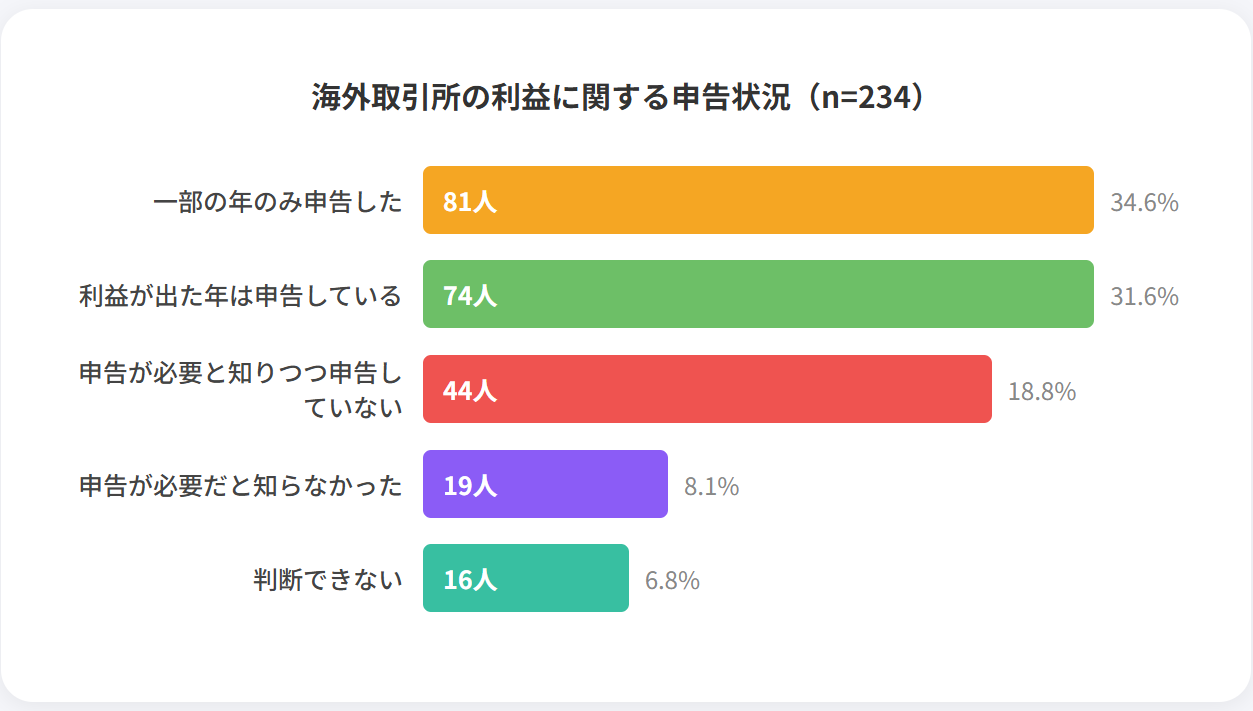
Filing Status | Number of Respondents | Percentage |
|---|---|---|
Filed for some years only | 81 | 34.6% |
Filed every year they had a profit | 74 | 31.6% |
Knew filing was required but did not file | 44 | 18.8% |
Did not know filing was required | 19 | 8.1% |
Unable to determine | 16 | 6.8% |
Among the 234 holders who reported profits from overseas exchanges, only 31.6% said they correctly filed all of their profits. The most common response was "filed for some years only" at 34.6%, highlighting the difficulty of maintaining consistent compliance. Furthermore, 18.8% said they know filing is required but have not filed — revealing the serious reality that roughly one in five holders is knowingly not filing.
Combined with the 8.1% who said they "did not know" filing was required, a large share of users are not fully meeting their tax obligations. Even for profits earned on an overseas exchange, Japanese residents are still liable to pay tax on those gains — a point the National Tax Agency (NTA) has clearly stated in its guidance. As the crypto asset market has expanded, individual awareness of tax compliance and understanding of the system appear not to have kept pace, which seems to be a key factor behind the pool of non-filers.
Over 40% Misunderstood How Overseas Exchanges Differ From Domestic Ones
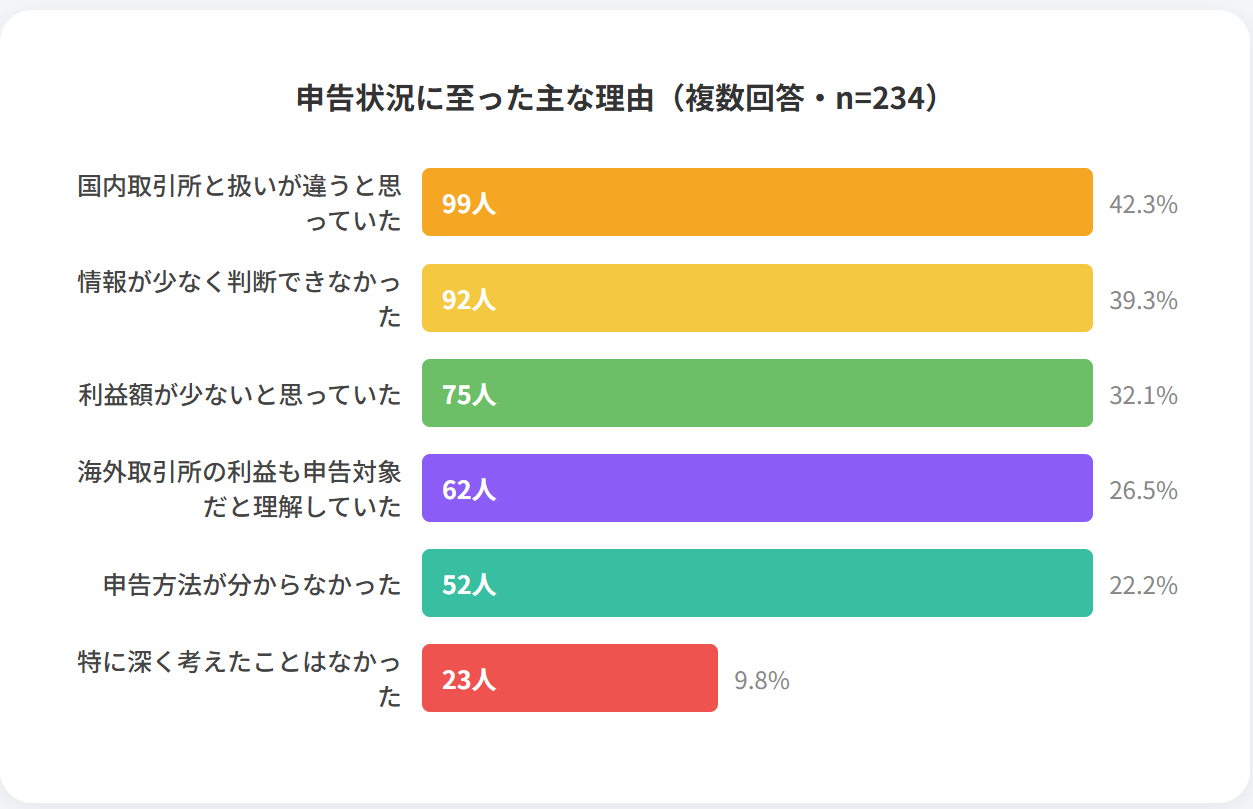
Main Reason for Their Decision (multiple answers allowed) | Number of Respondents | Percentage |
|---|---|---|
Thought the rules were different from domestic exchanges | 99 | 42.3% |
Too little information to judge | 92 | 39.3% |
Thought the profit amount was too small to matter | 75 | 32.1% |
Understood that overseas exchange profits were also subject to filing | 62 | 26.5% |
Did not know how to file | 52 | 22.2% |
Had not given it much thought | 23 | 9.8% |
None of the above apply | 16 | 6.8% |
When asked why they arrived at their reported filing status, the most common answer, at 42.3%, was "I thought the rules were different from domestic exchanges." Domestic Crypto Asset Exchange Service Providers operate under Japanese regulation with standardized transaction-history disclosures, yet a very large share of holders appear to treat overseas platforms as an entirely separate case. In addition, 39.3% of users said they "had too little information to judge," clearly showing confusion over the calculation rules and tax treatment unique to overseas exchanges.
Over 30% of respondents also said they underestimated the size of their profits, suggesting a mistaken belief may be spreading that small amounts do not need to be reported. In reality, for individuals who earn a salary, a final tax return (annual tax filing) is required once supplementary income — including crypto gains — exceeds ¥200,000 (roughly $1,300) in a year. Only 26.5% correctly understood that overseas exchange profits are subject to filing, underscoring the urgent need to spread accurate information.
Non-Filers Concentrated Among Those in Their 30s and 40s
Age Group | Filed Every Year | Filed Some Years Only | Knew but Did Not File | Did Not Know | Unable to Determine |
|---|---|---|---|---|---|
In their 20s | 16 | 24 | 5 | 2 | 1 |
In their 30s | 21 | 22 | 16 | 5 | 3 |
In their 40s | 17 | 17 | 14 | 6 | 6 |
In their 50s | 12 | 14 | 3 | 6 | 6 |
In their 60s | 4 | 2 | 5 | 0 | 0 |
70 and older | 4 | 2 | 1 | 0 | 0 |
A cross-tabulation by age found that respondents in their 30s and 40s who said they "know but have not filed" numbered 16 and 14 respectively, far outpacing every other age group. This working-age group has both a high rate of overseas exchange usage and, as this data shows, the greatest exposure to tax risk. Frequent trading, which tends to make calculations more complex, is also likely a psychological barrier that discourages filing.
By contrast, respondents in their 20s show a higher rate of "filed some years only," suggesting an attitude of attempting to file, even if imperfectly. Among those aged 50 and above, the shares answering "unable to determine" or "did not know" tend to be higher than among younger respondents, suggesting that gaps in knowledge may be directly hindering filing behavior. Given the potential impact on their careers and social standing, working-age holders in particular should avoid the risk of being flagged by tax authorities, making up-to-date, accurate knowledge essential.
Non-Filing Concentrated Among Those Earning Under ¥8 Million
Individual Annual Income | Filed Every Year | Filed Some Years Only | Knew but Did Not File | Did Not Know | Unable to Determine |
|---|---|---|---|---|---|
Under ¥2 million | 24 | 29 | 14 | 5 | 8 |
¥2–4 million | 19 | 26 | 15 | 6 | 3 |
¥4–6 million | 18 | 20 | 11 | 3 | 3 |
¥6–8 million | 7 | 3 | 4 | 2 | 1 |
¥8–10 million | 1 | 2 | 0 | 3 | 0 |
¥10 million or more | 5 | 1 | 0 | 0 | 1 |
Analysis by income also shows that "knew but did not file" responses are concentrated among those earning under ¥8 million a year. Among high earners with an annual income of ¥10 million or more, the majority have completed their filing, pointing to a stronger awareness of asset management. Among low- and middle-income earners, on the other hand, the cost of hiring a professional to handle the calculations may feel disproportionate, or the calculations may simply be too difficult to manage alone — both plausible factors behind non-filing.
In particular, the ¥2–4 million income bracket shows a notable share of partial or non-filing, reflecting real difficulty in maintaining tax compliance. Using an overseas exchange involves a far-from-trivial administrative burden, including converting figures into Japanese yen and offsetting gains and losses against those from domestic exchanges — though it is worth noting that, under Japan's current rules, crypto losses can only be offset against other miscellaneous income and cannot be offset against salary or other income categories. Even so, paying tax is a civic obligation, and proper filing is essential regardless of income level. Making use of simple calculation tools and organizing the necessary information will likely be key to improving the filing rate within this group.
Nearly 30% of Holders Have Struggled With the Question Repeatedly
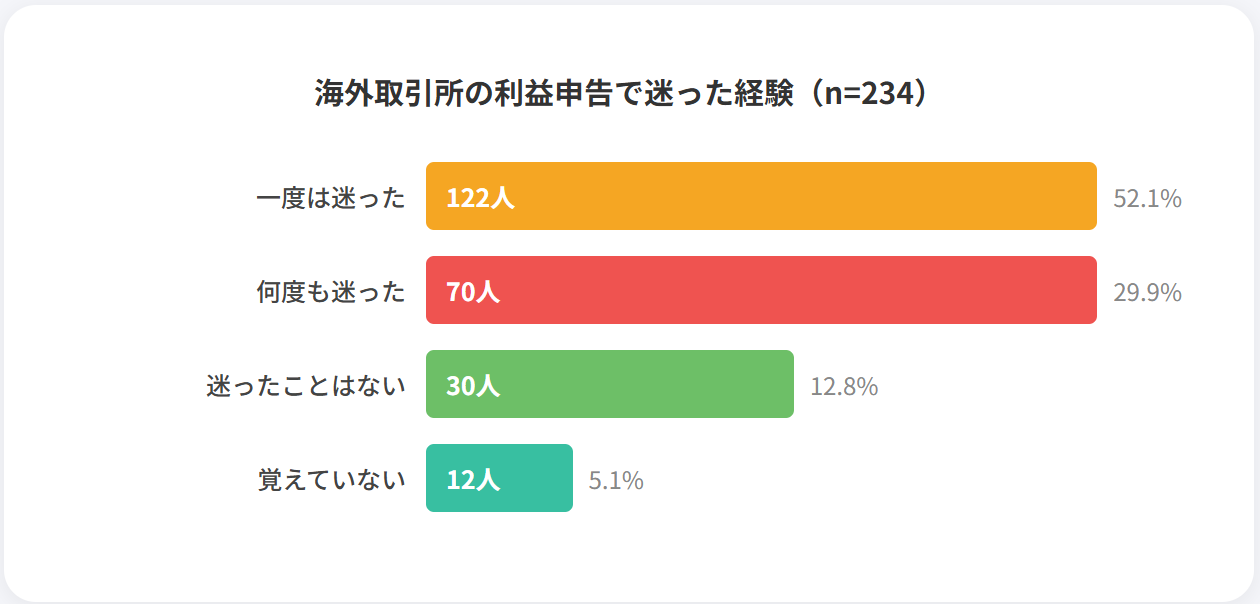
Experience of Uncertainty | Number of Respondents | Percentage |
|---|---|---|
Uncertain at least once | 122 | 52.1% |
Uncertain multiple times | 70 | 29.9% |
Never uncertain | 30 | 12.8% |
Do not remember | 12 | 5.1% |
When we asked users about their experience of uncertainty over reporting overseas exchange profits, a striking 82.0% said they had felt uncertain at some point. "Uncertain at least once" accounted for 52.1% and "uncertain multiple times" for 29.9%, highlighting a situation where doubts go unresolved even as users continue to trade. Only 12.8% said flatly that they have "never" felt uncertain — it is hardly an exaggeration to say that almost every holder who uses an overseas exchange runs into the wall of tax compliance.
The fact that nearly 30% of respondents said they have felt uncertain multiple times symbolizes just how difficult calculating profits and filing on overseas exchanges can be. Annual regulatory changes and the emergence of new forms of trading, such as DeFi and NFTs, are likely one factor that quickly makes existing knowledge outdated. For holders to keep trading with confidence, reliable, concrete guidelines and support systems that can dispel this kind of uncertainty appear essential.
The Reliability of Information and the Complexity of Converting to Japanese Yen
News Sites Are the Top Source of Information
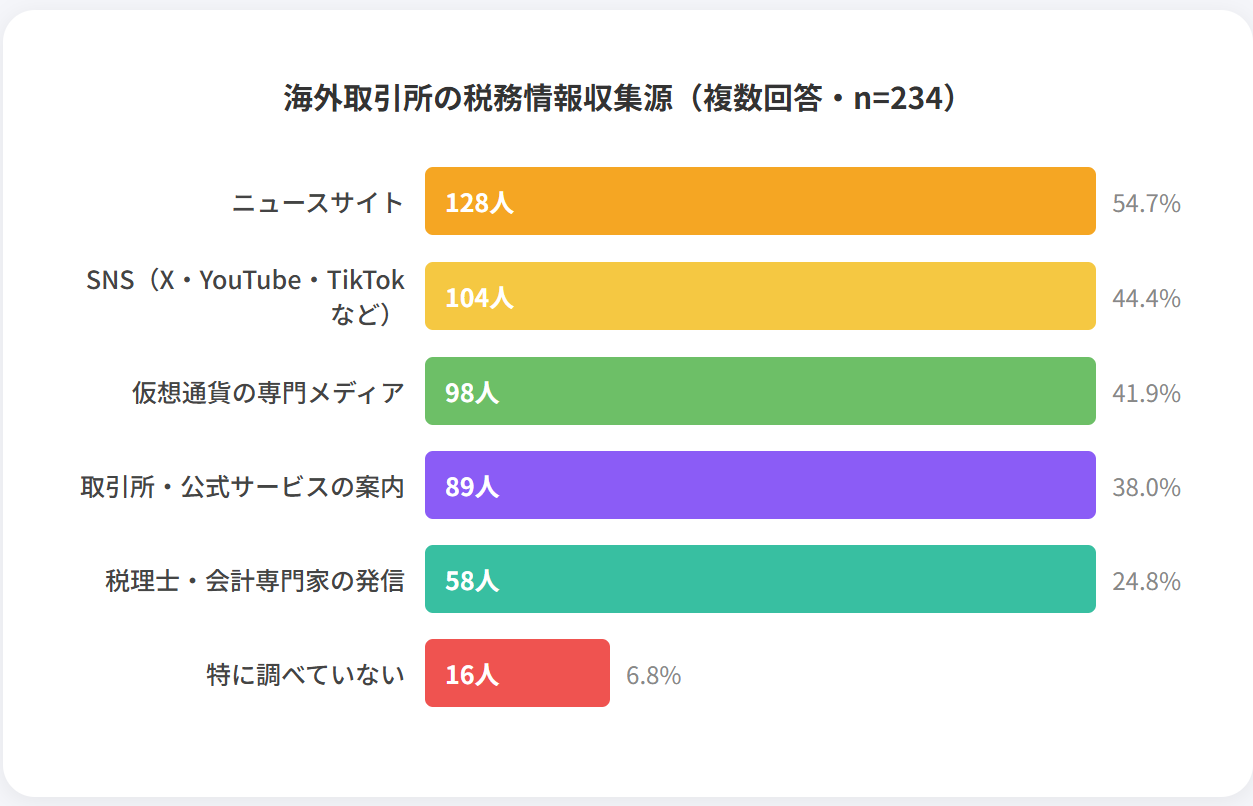
Information Source (multiple answers allowed) | Number of Respondents | Percentage |
|---|---|---|
News sites | 128 | 54.7% |
Social media (X, YouTube, TikTok, etc.) | 104 | 44.4% |
Specialist crypto media | 98 | 41.9% |
Guidance from exchanges or official services | 89 | 38.0% |
Content from tax accountants or accounting professionals | 58 | 24.8% |
Have not looked into it | 16 | 6.8% |
Asked where they get tax information about overseas exchanges, respondents cited "news sites" most often, at 54.7%, followed by social media at 44.4% — a picture of holders piecing together decisions from fragmented sources. Only 24.8% referred to content from tax accountants or accounting professionals, suggesting that convenience is currently being prioritized over the accuracy of information.
Making complex tax judgments specific to overseas exchanges based solely on general news articles or social media posts carries risk. In particular, changes to the law or shifts in regulators' operational approach are often difficult to interpret correctly without specialist knowledge. Improving media literacy — by prioritizing trustworthy specialist outlets and official guidance — ultimately helps holders protect their own assets.
Complex Calculations Discourage Filing
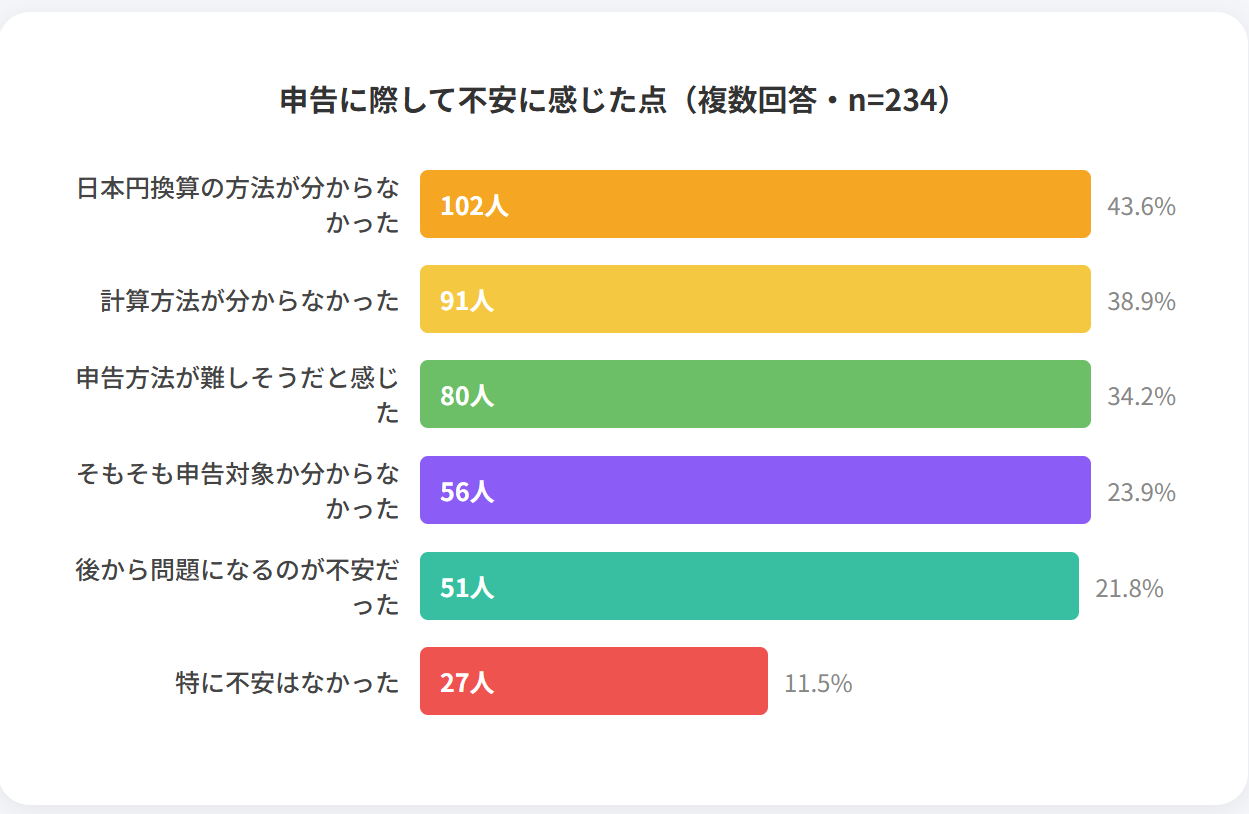
Point of Concern (multiple answers allowed) | Number of Respondents | Percentage |
|---|---|---|
Did not know how to convert to Japanese yen | 102 | 43.6% |
Did not know how to calculate profits | 91 | 38.9% |
Felt the filing process looked difficult | 80 | 34.2% |
Was not sure whether it was subject to filing at all | 56 | 23.9% |
Worried it might cause problems later | 51 | 21.8% |
Had no particular concerns | 27 | 11.5% |
The most common specific concern about filing was "how to convert to Japanese yen," cited by 43.6% of respondents. On overseas exchanges, transactions denominated in stablecoins or Bitcoin are the norm, and converting the market price at each transaction into yen is an extremely laborious process. "Not knowing how to calculate at all" was also cited by 38.9% of respondents, confirming that the sheer difficulty of the practical work is the biggest obstacle to filing.
Over 20% of respondents also said they were "worried it might cause problems later," pointing to the ironic situation of holders hesitating to file precisely because they fear making a mistake. In reality, calculation errors can be corrected, but failing to file at all carries harsher penalties. There is a strong need for organized, practical information — such as how to obtain accurate exchange rates or make use of automated calculation tools — to resolve the real-world challenges holders face.
Filing Awareness Improves Once Investment Size Exceeds ¥100,000
Investment Size | Filed Every Year | Filed Some Years Only | Knew but Did Not File | Did Not Know | Unable to Determine |
|---|---|---|---|---|---|
Under ¥10,000 | 18 | 16 | 7 | 7 | 8 |
¥10,000–under ¥100,000 | 22 | 42 | 17 | 5 | 0 |
¥100,000–under ¥500,000 | 23 | 21 | 13 | 2 | 1 |
¥500,000 or more | 11 | 1 | 5 | 1 | 1 |
Prefer not to answer | 0 | 1 | 2 | 4 | 6 |
Looking at the correlation between investment size at the time and filing status, the share who said they "filed every year" tends to rise once the amount invested exceeds ¥100,000 (roughly $667). Among those with ¥500,000 (roughly $3,300) or more, over half filed properly, suggesting that sensitivity to legal risk grows as the amount invested grows. Among those with under ¥10,000 (roughly $67), by contrast, the shares answering "filed some years only" or "did not know" are higher, suggesting that the small size of the investment breeds complacency, or that the effort of filing feels disproportionate to the amount involved.
Additionally, mid-tenure holders who have been trading crypto assets for one to three years account for 35.4% of the total, making this group the most likely to run into practical obstacles. It is precisely once holders have gained some experience and their trading starts to become more complex that accurate tax knowledge becomes essential. While a larger investment expands the opportunity for returns, it also increases management responsibility — being mindful of this and setting up a filing process early is key to sustaining investment over the long term.
The Path to Correct Tax Filing: Self-Check Tools and Concrete Examples
Demand for a Self-Check Method Tops the List
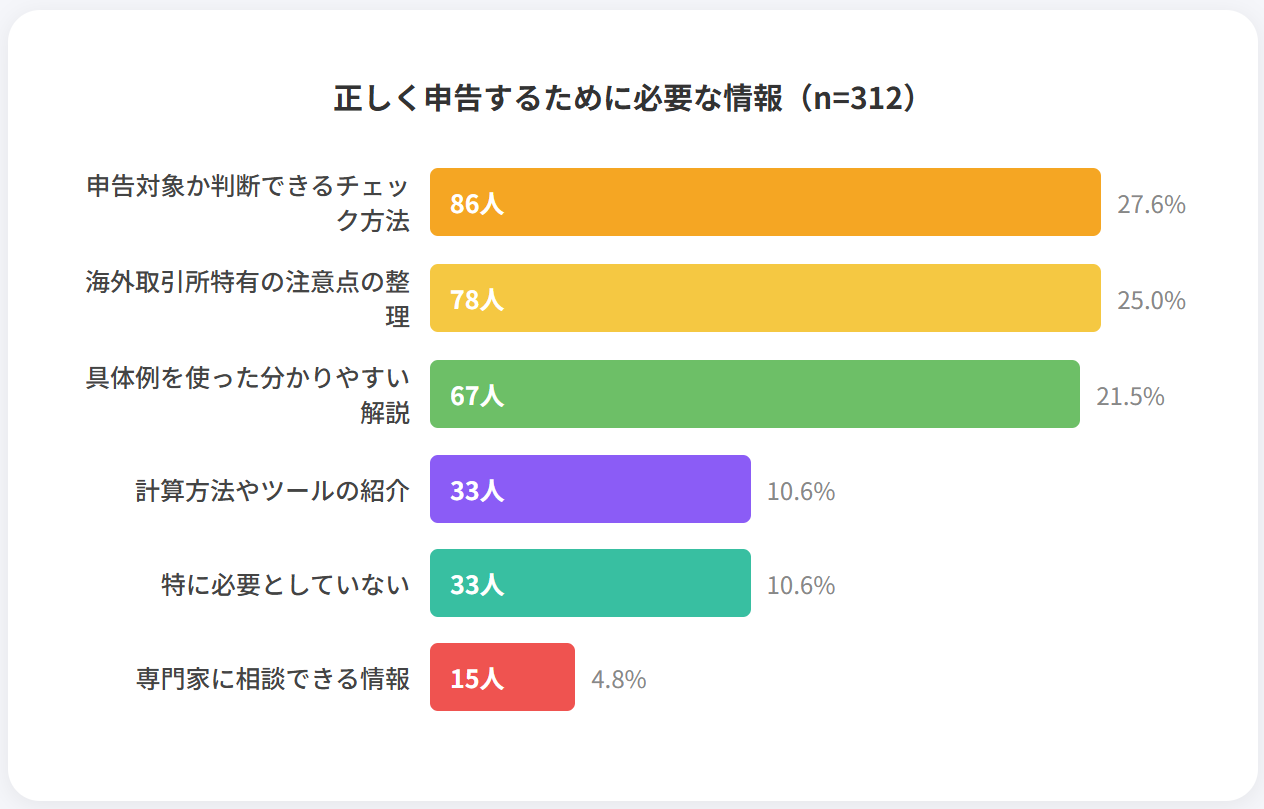
Response | Number of Respondents | Percentage |
|---|---|---|
A check method to determine whether filing is required | 86 | 27.6% |
A summary of points unique to overseas exchanges | 78 | 25.0% |
Easy-to-understand explanations using concrete examples | 67 | 21.5% |
Introduction to calculation methods and tools | 33 | 10.6% |
Do not particularly need anything | 33 | 10.6% |
Information on where to consult a professional | 15 | 4.8% |
We asked 312 holders with crypto trading experience what kind of information would help them file correctly going forward. The most common answer, at 27.6%, was "a check method to determine whether filing is required," highlighting that holders struggle right at the entry point of figuring out whether their trades trigger a tax obligation at all. This was followed by demand for "a summary of points unique to overseas exchanges" at 25.0%, showing very strong demand for clarity on how the rules differ from those for domestic exchanges.
Many holders are willing to pay tax but are looking for a "yardstick" to measure what counts as correct within a complex set of rules. In particular, the tax treatment of events that occur frequently on overseas exchanges — such as staking rewards or token distributions from a hard fork — is extremely difficult for individuals without specialist knowledge to judge. Providing self-check tools or flowcharts that let users objectively determine whether filing is required simply by entering their own situation should be key to improving compliance.
Those in Their 30s and 40s Place the Most Weight on a Summary of Key Points
Age Group | Check Method | Summary of Key Points | Concrete Examples | Calculation Methods/Tools | Professional Consultation | Not Needed |
|---|---|---|---|---|---|---|
In their 20s | 23 | 13 | 7 | 11 | 3 | 2 |
In their 30s | 22 | 29 | 20 | 4 | 5 | 11 |
In their 40s | 19 | 21 | 18 | 10 | 3 | 6 |
In their 50s | 17 | 11 | 14 | 5 | 4 | 12 |
In their 60s | 3 | 3 | 4 | 3 | 0 | 1 |
70 and older | 2 | 1 | 4 | 0 | 0 | 1 |
By age group, respondents in their 30s and 40s — who trade the most actively — showed the highest demand for "a summary of points unique to overseas exchanges." Because this generation engages in a wide variety of transactions in practice, they need in-depth, practical information rather than a surface-level explanation. Among those in their 20s, on the other hand, demand for a "check method" stood out, reflecting a more basic, entry-level need typical of younger users who want to start by understanding their own situation.
Demand for "easy-to-understand explanations using concrete examples" is also present across every age group, centered on those in their 30s and 40s, suggesting that case-study-style information is easier to grasp than abstract explanations of tax law. In a field as complex as taxation, presenting model cases that match a holder's own trading pattern can significantly lower the psychological barrier to filing. Information providers are being asked to go beyond simple rule explanations and produce content that more closely reflects users' actual trading realities.
Men Favor "Check Methods" and "Key Points," Women Favor "Professional Consultation"
Gender | Check Method | Summary of Key Points | Concrete Examples | Calculation Methods/Tools | Professional Consultation | Not Needed |
|---|---|---|---|---|---|---|
Male | 60 | 57 | 39 | 25 | 5 | 19 |
Female | 26 | 21 | 28 | 8 | 10 | 14 |
Analyzing differences in needs by gender, men showed a strong demand for information that helps them solve the problem logically, such as "check methods" and "a summary of key points." Many male holders appear to want to first find a standard they can be satisfied with on their own and then chart their own path to a solution. Women, by contrast, cited "information on where to consult a professional" at roughly twice the rate of men, showing a tendency to seek reliable third-party advice.
Demand among women for "easy-to-understand explanations using concrete examples" is also very high, placing weight on both clarity and accuracy at the same time. What is common across genders is a desire for "concrete, trustworthy information" that can cut through the current uncertainty. Providing information through a range of approaches tailored to different types of holders — from introducing tools that support self-calculation to organizing contact information that bridges holders to professionals — should help contribute to a healthier market overall.
Conclusion
Clabo's survey revealed an extremely high adoption rate: three in four crypto asset holders have used an overseas exchange. Conveniences unavailable on domestic exchanges — a wider range of tokens, leveraged trading, and access to DeFi (decentralized finance) — are driving holders toward overseas platforms.
At the same time, however, only around 30% have fully filed their taxes in every year they made a profit, exposing a serious gap between holders' awareness of compliance and their actual behavior.
Behind this lies a deep-rooted misunderstanding that "the rules are different from domestic exchanges," along with an overwhelming lack of information. More than 40% of holders do not correctly recognize their filing obligations on overseas exchanges, and on the practical side, the complexity of converting figures into Japanese yen remains a major barrier that discourages filing.
In particular, the data show that working-age holders in their 30s and 40s are especially prone to tax risk, making it urgent for them to update their knowledge accurately in order to protect their future social standing.
Proper tax payment is an unavoidable step toward crypto assets gaining broader social legitimacy. Making use of check methods to determine whether one's own trades are subject to filing, and of organized information on points unique to overseas exchanges, will be essential to continuing to invest responsibly and sustainably going forward.
Survey Overview
Survey date: February 24, 2026
Survey method: Internet survey
Survey subjects: Men and women residing in Japan (people who invest, or have invested, in crypto assets)
Valid responses: 312
Conducted by: Clabo Inc.
Survey Questions
- Have you ever used crypto assets (virtual currency)?
- Have you ever traded crypto assets on an overseas exchange?
- Which of the following best describes how you have reported profits earned on an overseas exchange so far?
- What were the main reasons behind that decision? (Select all that apply)
- Have you ever felt uncertain about whether you needed to report profits from an overseas exchange?
- At the time you made that decision about overseas exchange profits, how long had you been trading crypto assets?
- Which best describes the size of your investment at the time you made that decision?
- Where did you primarily get information about overseas exchange profits and taxes?
- What concerns did you have at the time regarding profits from overseas exchanges? (Select all that apply)
- What kind of information would help you feel confident about filing correctly for overseas exchange profits going forward?
This article is for informational purposes only and does not constitute financial or investment advice. Please consult a qualified professional before making investment decisions.


