


Crypto assets (also known as virtual currencies) aren't just for buying and selling — they can also be used through methods such as "lending" and "staking." According to our survey (in Japanese), 55.3% of crypto asset users currently use staking or lending, and when including those who have used them in the past, more than 80% have some experience with these methods.
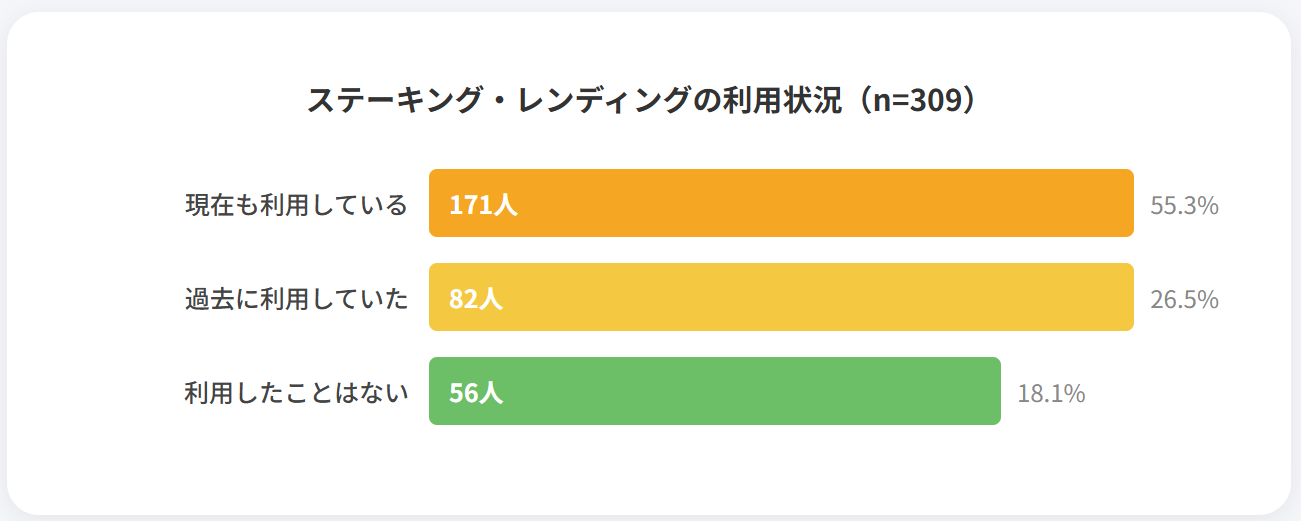
These results suggest that ways of using crypto assets are expanding beyond simply aiming for trading gains, toward earning rewards from assets already held. In particular, for those planning to hold long-term, lending and staking offer an option beyond the binary choice of "sell or keep holding."
However, while lending and staking may look similar, the reasons they generate returns and the risks to watch for differ. Judging only by interest or reward rates can lead you to overlook factors such as periods during which withdrawals aren't possible, price volatility, and counterparty credit risk at the exchange.
This article explains the differences between lending and staking, along with their benefits, risks, and how to choose between them.
Differences Between Lending and Staking
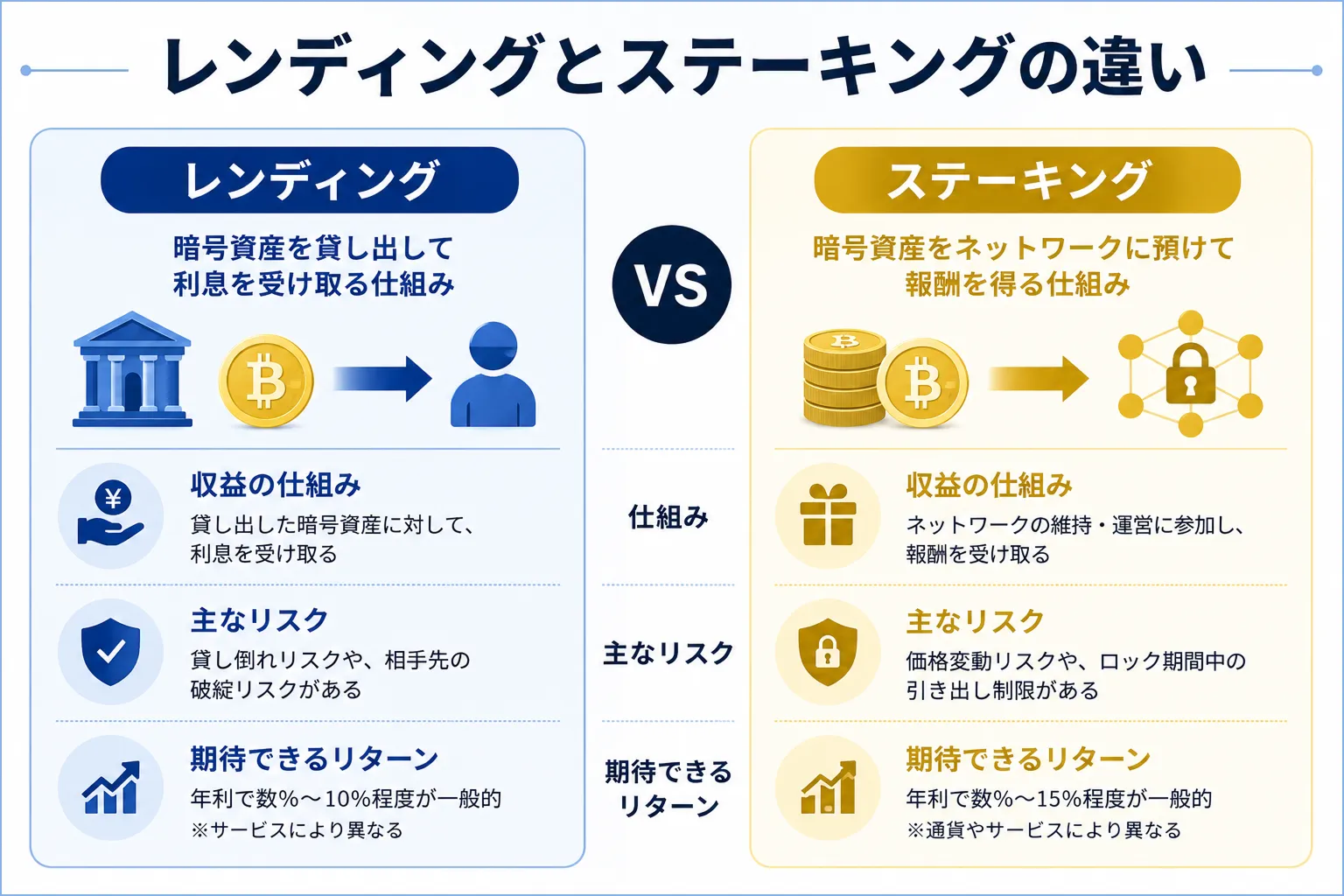
Lending and staking are both mechanisms that offer the possibility of earning rewards while holding crypto assets. However, even though both are sometimes described using the same word — "depositing" — the actual mechanisms differ.
Confusing the two can lead you to judge based solely on how high the interest rate is, only to find the outcome doesn't match your expectations after using the service. Let's first check how lending and staking each work.
Lending: Lending Out Crypto Assets to Earn Interest
Lending is a mechanism in which you lend crypto assets you hold — typically to an exchange (order-matching marketplace) — in exchange for interest payments. In Japanese, this is sometimes referred to as "kashi angoshisan" (crypto asset lending) or "crypto asset lending services," and major exchanges offer such services.
Typically, users lend out crypto assets for a set period, and once the contract term ends, they receive back the principal in crypto assets along with the interest earned. For example, you might lend out Bitcoin for a set period and receive the interest denominated in Bitcoin once the term matures.
However, unlike a bank deposit, the principal is not protected by any institutional guarantee. During the lending period, you may be unable to sell or withdraw the asset, which can make this unsuitable for crypto assets you might need to use in the short term.
Staking: Holding a Target Coin to Earn Rewards
Staking is a mechanism in which holding a target crypto asset contributes to operating and maintaining the stability of its blockchain, and in return you receive rewards. A blockchain is a technology in which transaction records are shared and managed across multiple computers.
Not all crypto assets support staking. Eligible assets are limited to those built on mechanisms that support staking, such as the following:
- Ethereum (ETH)
- Cardano (ADA)
- Polkadot (DOT)
Bitcoin (BTC) uses a mechanism called mining to validate transactions, so it does not support staking in the conventional sense. Even if a service lets you deposit BTC to earn rewards, this is not a mechanism involving participation in the Bitcoin network to earn rewards — it should be understood as closer to a different mechanism, such as lending.
Some exchanges automatically grant staking rewards simply for holding the eligible coin. Others require an application, or involve a lock-up period, so it's important to check the terms of use.
Benefits of Lending and Staking

The benefit of lending and staking lies less in earning rewards for their own sake, and more in giving crypto assets you're holding long-term an additional role. Many crypto asset holders think in terms of either continuing to hold in anticipation of price appreciation, or selling once the price rises. Lending and staking can be considered a third option, distinct from either of these.
For example, if you plan to hold a crypto asset for several years, you don't need to keep trading in response to short-term price movements. Also, simply holding an asset means its status doesn't change until the price moves. Using lending or staking creates the option of earning rewards during the holding period, without significantly changing your overall holding strategy.
This can be an advantage for those who aren't good at short-term trading, or who find it difficult to check the market every day. You don't need to agonize over whether to sell each time the price rises, or decide whether to buy more each time it falls — you can put your holdings to use while maintaining a long-term holding stance.
It's also important that this allows you to avoid selling. If you're anticipating future price appreciation, selling means giving up some of the opportunity to capture those gains. Because lending and staking let you earn rewards without selling, they can be compatible with a long-term holding strategy.
That said, even if the quantity of crypto assets you hold increases through rewards, if the price of the crypto asset itself falls, you may still incur a loss when converted into Japanese yen. So while being able to put held crypto assets to use is a benefit, it should not be assumed that this guarantees stable returns.
Risks of Lending and Staking

While lending and staking let you put held crypto assets to use, each carries different risks. If you use these services based on interest or reward rates alone, you may find yourself unable to move your assets when you want to, or may incur losses due to price declines.
Below, we outline the key risks to check for lending and staking respectively. Understanding what to check before using these services can help you avoid unexpected trouble.
Lending Carries Counterparty and Exchange Credit Risk
With lending, because you are lending your crypto assets to an exchange or similar entity, there is credit risk associated with the borrower or service provider. You need to check how the lent crypto assets will be managed, and how they would be handled if something were to go wrong with the service provider.
In addition, lending may involve a fixed lending term. In this case, even if the price moves significantly while your assets are lent out, you may not be able to sell or withdraw immediately.
Services offering higher annual rates can look more attractive, but judging based on rate alone is risky. You need to check the lending term, whether early cancellation is possible, the conditions for return of assets, and the service provider's management practices before making a decision.
Staking Requires Attention to Reward Rate Fluctuations and Lock-Up Periods
With staking, the reward rate is not necessarily fixed. The actual reward you receive can vary depending on the target coin, network conditions, and the exchange's service terms.
Staking may also involve a lock-up period. A lock-up period is a period during which you cannot move the crypto asset. During this period, selling or withdrawing may be restricted.
Even if you plan to hold the target coin long-term, situations may arise where you suddenly want to sell. Before using staking, it's important to check not just the reward rate, but also the lock-up period, the conditions for release, and the timing of reward payments.
Both Can Result in Losses If the Price Falls
With lending and staking, the quantity of crypto assets you hold may increase through rewards. However, an increase in quantity is a separate matter from an increase in the value of your assets when converted to Japanese yen. If the price of the crypto asset itself falls, the overall valuation of your holdings can decline even while you're receiving rewards.
For example, even if you receive a 5% annual reward, if the price of the target coin falls 20%, you would still incur a loss when converted into Japanese yen. In this case, even though the quantity of crypto assets has increased, the investment as a whole is not in positive territory.
This differs significantly from a yen-denominated time deposit or ordinary interest. Because lending and staking rewards are typically paid in crypto assets whose prices fluctuate, looking at the reward rate alone does not tell you your actual gain or loss.
For this reason, when using lending or staking, you need to first consider not just "how much reward can I earn," but also "do I want to hold this coin through its price fluctuations." Even if the reward rate is high, it's safer to avoid using coins you can't tolerate holding through volatility, or under conditions that prevent you from selling when needed.
Tax Treatment Must Be Confirmed When You Receive Rewards
If you receive rewards through lending or staking, you also need to check the tax treatment. This is because crypto asset rewards may be treated as taxable income not only when you sell and convert them into Japanese yen, but also at the point you receive them as rewards.
Where crypto assets are acquired through mining, staking, lending, or similar means, any profit arising from that acquisition is subject to income tax or corporate tax.
Source: Tax Treatment of Crypto Assets, etc. | National Tax Agency (NTA)
For example, if you receive ETH as a staking reward, you need to calculate your income based on its market value at the time of receipt. Later, if you sell the ETH you received, you also need to check the difference between the price at the time of acquisition and the price at the time of sale. The same applies to lending — if you receive crypto assets as interest, you need to keep similar records.
As of July 2026, under current law, gains from the sale of crypto assets are treated as miscellaneous income subject to aggregate (comprehensive) taxation. On July 15, 2026, an amended Financial Instruments and Exchange Act (FIEA) was passed by the House of Councillors, which will reclassify crypto assets as financial instruments under the FIEA; the resulting 20% separate self-assessment tax rate is expected to apply from the fiscal year after the amended law takes effect (projected January 2028).
Note also that losses arising from crypto asset lending or staking can only be offset against other miscellaneous income (offsetting of gains and losses) — they cannot be offset against employment income or other income categories.
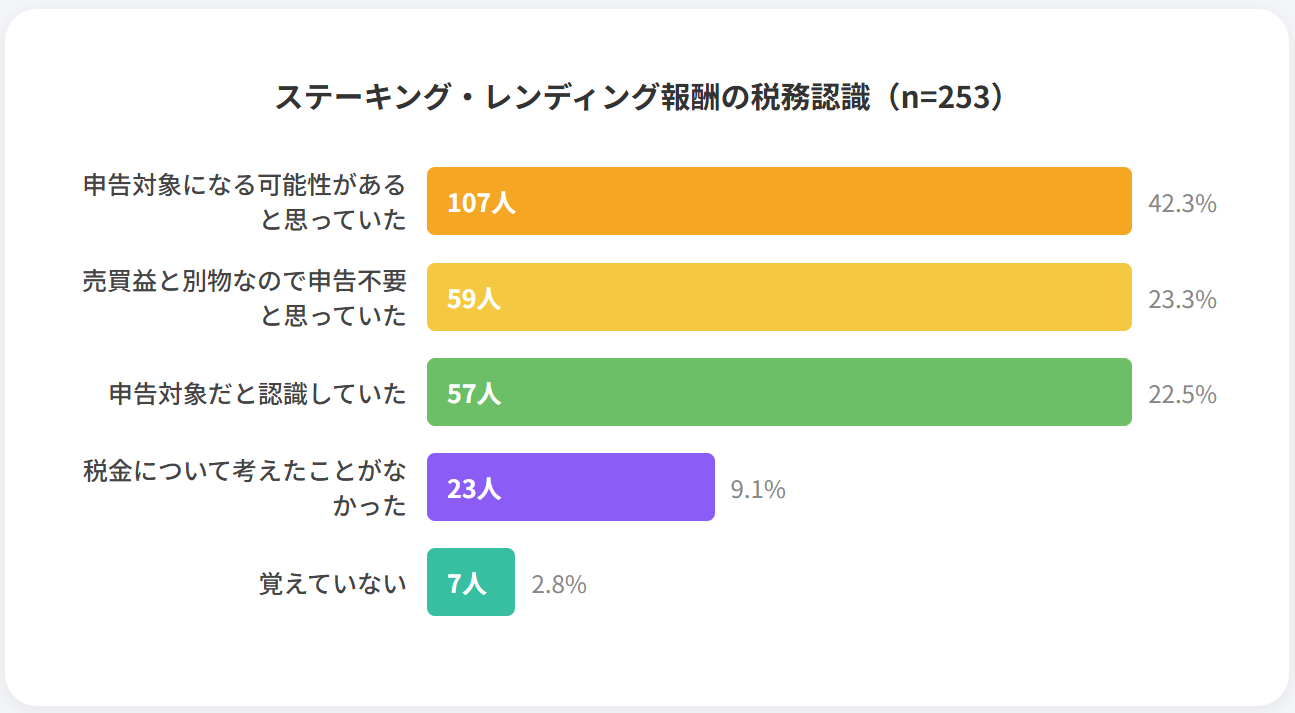
That said, according to our own survey, only 22.5% of respondents answered that they "recognized [staking rewards] as subject to tax filing." Meanwhile, 42.3% said they "thought it was possibly subject to filing," and 23.3% said they "thought it wasn't subject to filing because it's different from trading gains." This suggests that, while many people are vaguely aware that rewards may have tax implications, a significant number do not fully understand the details.
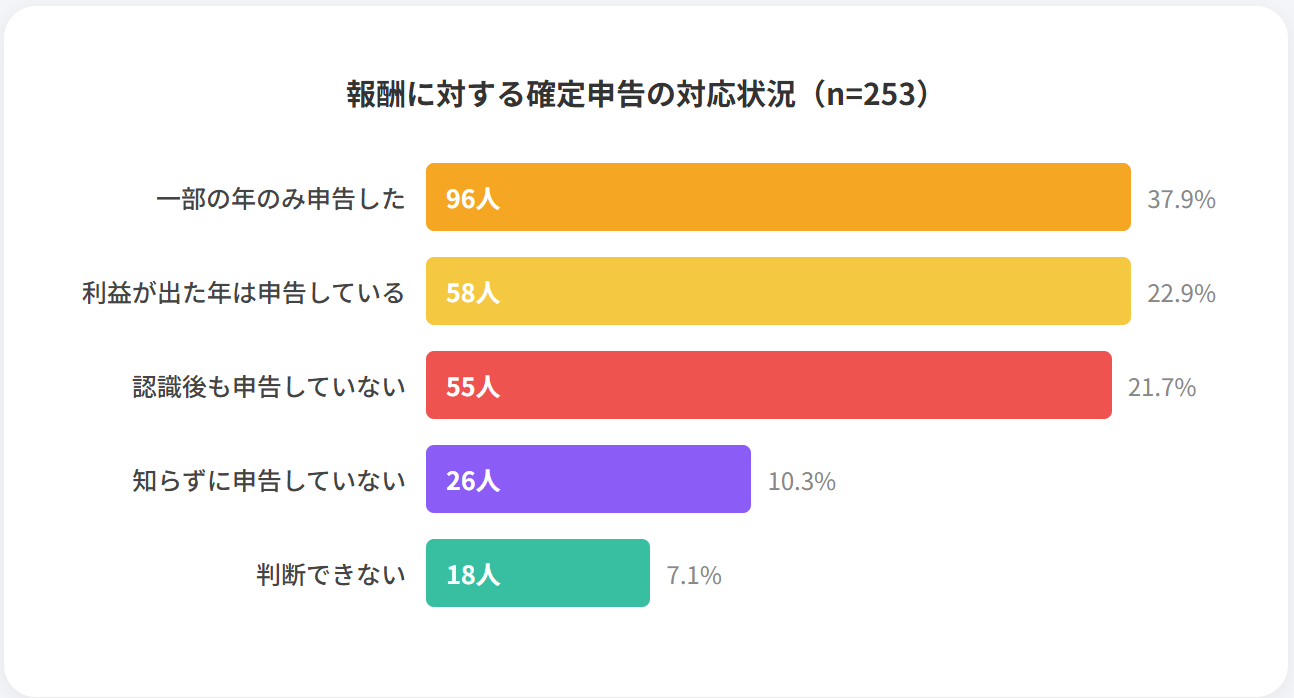
Actual filing behavior also varies. In our survey, 22.9% of respondents said they "file in years when there is a gain," while 37.9% said they "filed only in some years." Additionally, 21.7% said they "have not filed even after recognizing that filing was required." It's possible that in years with smaller reward amounts, or when the income felt different in nature from trading gains, some people made their own judgment to skip filing.
For this reason, when using lending or staking, it's important to keep tax-related records in mind, not just the reward rate. Without tracking the date, quantity, and market value of each reward received, it becomes difficult to calculate your taxable income at tax filing time (final tax return). This is especially important if you use multiple exchanges or wallets, where you'll need to be able to trace your reward history later.
Which Should You Choose: Lending or Staking?

Whether lending or staking suits you better depends on the type of crypto asset you hold and how long you don't plan to use it, so neither option is universally better.
When deciding, you need to look not just at the interest or reward rate, but also at the period during which your assets can't be moved and how the service works. Below, we outline some points to consider when deciding whether to use these services.
Lending Is an Option If You Have Crypto Assets You Won't Need for a While
Lending is a method worth considering when you don't need to move a crypto asset you hold for a certain period. The key question isn't "do I want to hold this coin long-term," but rather "is it fine if I don't move this crypto asset for a certain period."
For example, if you're holding BTC or ETH long-term and have no plans to sell or transfer them in the near future, lending them out for interest is an option. Lending terms vary by service — shorter terms may be 14 or 30 days, while longer terms can be 180 or 365 days. Since you're lending out crypto assets you already hold, there's no need to newly purchase a staking-eligible coin.
On the other hand, be aware that lending tends to reduce your flexibility during the lending period. With services that fix the lending term, you can't sell immediately even if the market moves suddenly. For example, if the price rises sharply and you want to lock in gains, or the price falls and you want to avoid further losses, you may be unable to move your assets while they're on loan.
For this reason, lending suits crypto assets that you don't plan to trade in response to short-term price movements, and that you've decided to keep holding for a set period. Conversely, assets you might sell soon, or want to be able to move immediately in response to the market, are easier to manage if you don't lend them out.
If you use lending, it's more practical to lend out only the portion you don't expect to need for a while, rather than lending your entire holdings. Lending everything just because the rate looks attractive can leave you unable to move assets when you need to, potentially forcing an unfavorable decision.
Staking Is an Option If You Plan to Hold the Target Coin Long-Term
Staking is worth considering when you've already decided to hold a particular coin long-term, and that coin supports staking. The key question isn't "is the reward rate high," but rather "do I want to keep holding this coin even without the reward."
For example, if you already hold a staking-eligible coin such as ETH or ADA and have no plans to sell it in the short term, earning rewards through staking is an option. In this case, you can maintain your original holding strategy while also earning rewards during the holding period.
On the other hand, choosing to stake purely to earn rewards requires careful thought. Even if the reward rate looks attractive, if the price of that coin itself falls significantly, you could incur a loss when converted into Japanese yen. In other words, for staking, what matters more than "the reward rate" is "whether you can keep holding this coin through its price fluctuations."
Staking may also involve lock-up periods or waiting periods for unlocking. Even if you intend to keep holding, situations may arise where you suddenly want to sell, or want to move the asset to a different exchange. Before using staking, you should check not just the reward rate, but also the lock-up period, unlock conditions, and reward payment timing.
Staking suits those who have a clear reason for holding the target coin long-term and can continue holding without being swayed by short-term price movements. Conversely, if you're choosing a coin purely based on reward rate, or might sell it in the near future, it may be easier to avoid staking.
Conclusion
Lending and staking are both mechanisms that let you put crypto assets you're already holding to use. However, lending is a mechanism where you lend out crypto assets to earn interest, while staking is a mechanism where you hold a target coin to earn rewards.
While the two may look similar, the reasons returns are generated and the risks to watch for differ. With lending, you need to be mindful of counterparty and exchange credit risk; with staking, you need to watch for fluctuations in reward rates and lock-up periods.
Also, regardless of which you use, if the price of the crypto asset falls, you may incur a loss when converted into Japanese yen. When considering whether to use these services, don't judge based on interest rate alone — check the target coin, withdrawal restrictions, lock-up period, and your tax record-keeping obligations as well.
This article is for informational purposes only and does not constitute financial or investment advice. Please consult a qualified professional before making investment decisions.


