


Staking and lending — earning rewards by putting crypto assets to work — have become an established way to manage holdings efficiently. However, many holders still struggle to understand the tax treatment of these rewards and to file the appropriate final tax return (kakutei shinkoku).
In a survey we conducted ourselves, roughly 8 in 10 respondents with experience in crypto reported using staking or similar income-generating methods, yet only a limited share were paying taxes correctly. In particular, 40.7% of users said their exchange had provided no explanation of the tax treatment, and this lack of transparent information is compounding the risk of underreporting.
Drawing on an original survey of 309 crypto holders, this article uses the data to take a detailed look at holders' weak awareness of their tax obligations when receiving rewards, and their strong demand for tax explanations built around concrete examples.
Staking and Lending Are Becoming Core Investment Methods
Current usage rate stands at 55.3%
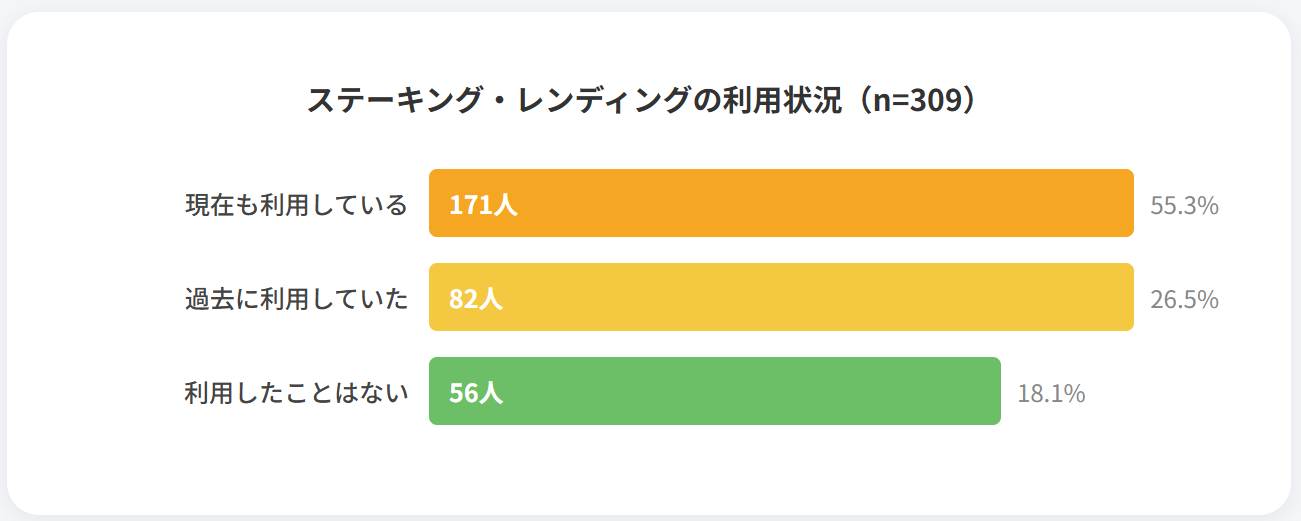
Response | Respondents | Share |
|---|---|---|
Currently using it | 171 | 55.3% |
Used it in the past | 82 | 26.5% |
Never used it | 56 | 18.1% |
In the crypto asset market, the emphasis is shifting clearly from trading purely for capital gains toward generating income from assets already held. Our survey found that more than 80% of crypto users have experience with staking or lending. Of particular note, 55.3% of those with experience said they are "currently using it."
This suggests that most users are not just trying these methods once, but adopting them as an ongoing investment approach. Methods that once required specialized knowledge have become far more accessible in recent years, thanks to expanded services from domestic exchanges. It appears that a strategy of steadily growing one's holdings, regardless of market volatility, is taking hold.
Younger holders place more weight on "income gain"
Age group | Currently using it | Used it in the past | Never used it |
|---|---|---|---|
20s | 42 (70.0%) | 9 (15.0%) | 9 (15.0%) |
30s | 52 (56.5%) | 23 (25.0%) | 17 (18.5%) |
40s | 41 (56.2%) | 21 (28.8%) | 11 (15.1%) |
50s | 25 (40.3%) | 20 (32.3%) | 17 (27.4%) |
60s | 6 (40.0%) | 7 (46.7%) | 2 (13.3%) |
70 and over | 5 (71.4%) | 2 (28.6%) | 0 (0.0%) |
Breaking the results down by age group, respondents in their 20s reported the highest "currently using it" rate of any generation, at 70.0%. This suggests that younger holders place more emphasis on efficiently growing their assets through "management," on top of the traditional goal of capital gains. By contrast, holders in their 50s and 60s are more likely than younger generations to have used these methods in the past but not currently.
This may reflect either more cautious risk management among older holders, or the fact that some have wound down a given holding period and locked in gains. More than half of holders in their 30s and 40s are still using these methods, establishing them as a stable asset-building tool for this working-age group. The findings highlight that generations closer to being digital natives tend to adapt more readily to new financial protocols.
Households earning over ¥10 million show a roughly 70% usage rate
Household income | Currently using it | Used it in the past | Never used it |
|---|---|---|---|
Under ¥2 million | 22 (48.9%) | 9 (20.0%) | 14 (31.1%) |
¥2–4 million | 32 (53.3%) | 23 (38.3%) | 5 (8.3%) |
¥4–6 million | 45 (52.3%) | 22 (25.6%) | 19 (22.1%) |
¥6–8 million | 37 (61.7%) | 11 (18.3%) | 12 (20.0%) |
¥8–10 million | 18 (56.3%) | 11 (34.4%) | 3 (9.4%) |
¥10 million or more | 17 (65.4%) | 6 (23.1%) | 3 (11.5%) |
A cross-tabulation by household income shows that holders with greater financial capacity are more likely to actively use staking and lending. Among households earning more than ¥10 million a year, about 70% are still using these methods. This group tends to treat crypto holdings not as static assets left idle, but as a way to maximize capital efficiency by earning yield.
By contrast, in households earning under ¥2 million a year, 31.1% said they had "never used it" — the highest share of any income bracket. This likely reflects practical barriers such as the capital needed to participate and platform minimum-deposit requirements. For higher-income households, managing crypto assets for yield appears to have already become an essential part of a portfolio that balances offense and defense.
Risk of Underreporting Staking Rewards Comes into Focus
Editor's note: Under Japan's current tax law (as of July 2026), gains from crypto assets — including staking and lending rewards — are classified as miscellaneous income and subject to aggregate (progressive) taxation. Losses on crypto assets can only be offset against other miscellaneous income, and cannot be offset against employment income or other income categories. Separately, on July 15, 2026, Japan's Diet passed an amendment to the Financial Instruments and Exchange Act (FIEA) that will reclassify crypto assets as financial products under the FIEA; under this amendment, a flat 20% separate self-assessment tax rate is expected to apply starting from the fiscal year following the amendment's enforcement (expected around January 2028).
Over 40% suspected reporting "might" be required
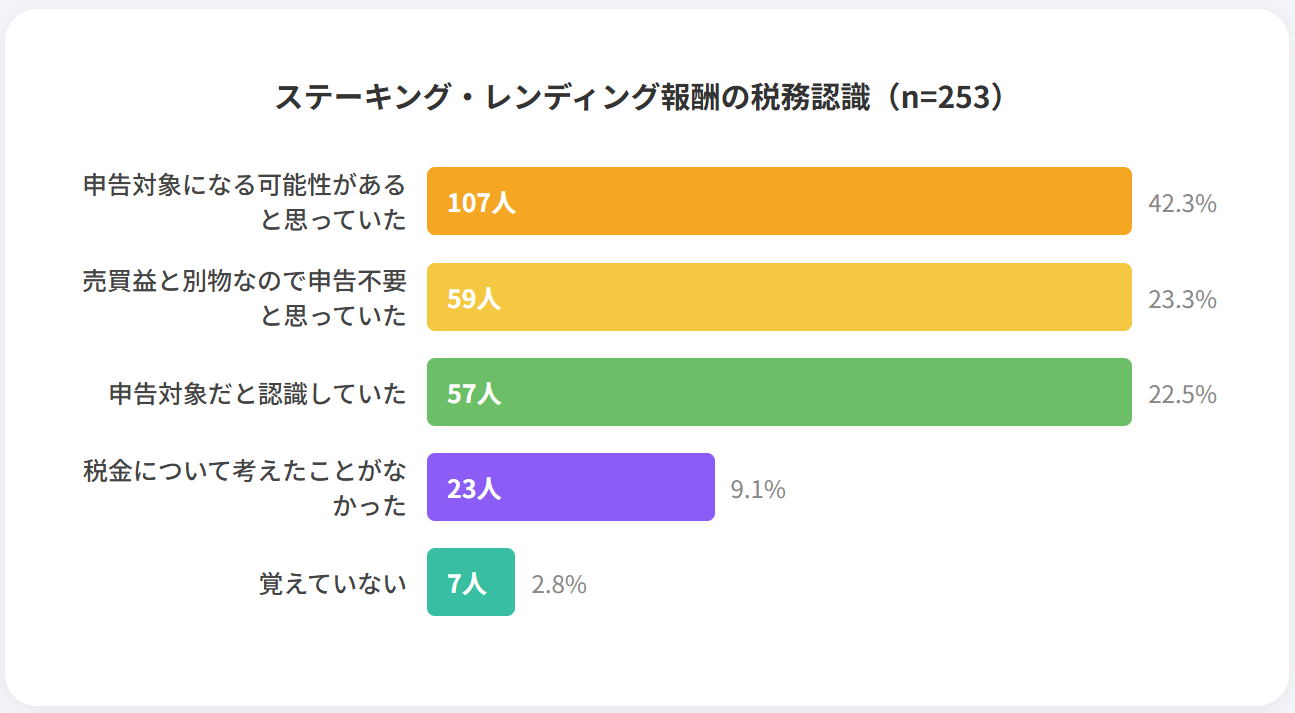
Item | Respondents | Share |
|---|---|---|
Thought it might be subject to reporting | 107 | 42.3% |
Thought it was separate from trading gains, so no reporting was needed | 59 | 23.3% |
Recognized it was subject to reporting | 57 | 22.5% |
Had never thought about the tax implications | 23 | 9.1% |
Don't remember | 7 | 2.8% |
When it comes to rewards earned through crypto asset management, holders' awareness turns out to be little more than a vague expectation. In this survey, 42.3% of users had a general sense that reporting "might" be required, yet only 22.5% clearly recognized it as an obligation. Even more concerning, roughly 1 in 4 mistakenly believed that, because the rewards were separate from trading gains, no reporting was necessary.
Rewards earned through staking or lending must, in principle, be included in taxable income at their market value at the time they are received. However, an understanding of taxation shaped mainly around trading gains appears to be getting in the way of a correct understanding of these newer forms of reward income. The findings make clear that the concept of taxation on an "increase in coin count" has not yet fully taken hold among holders.
About 60% have filing experience
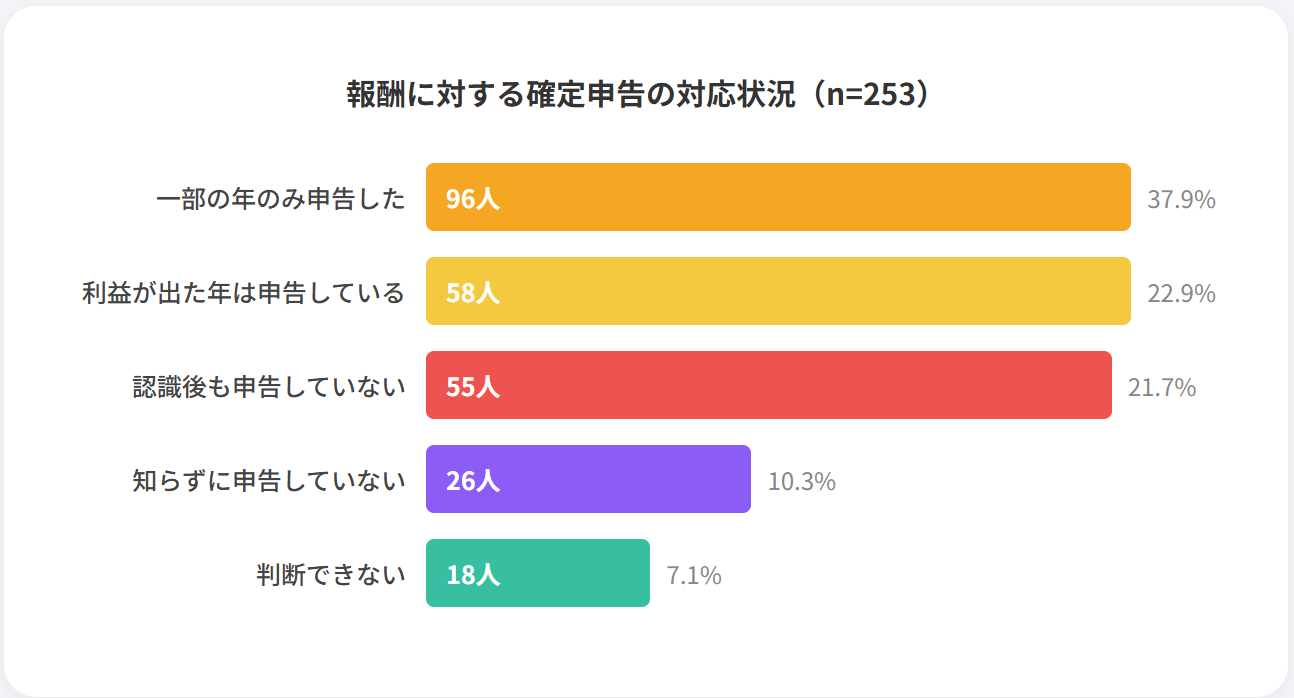
Actual response | Respondents | Share |
|---|---|---|
Filed in some years only | 96 | 37.9% |
Files in years when there was a profit | 58 | 22.9% |
Recognized it was subject to reporting but still has not filed | 55 | 21.7% |
Did not know it was subject to reporting and has not filed | 26 | 10.3% |
Can't say | 18 | 7.1% |
Looking closely at actual filing behavior, it becomes clear that very few holders are consistently meeting their legal obligations correctly. Only 22.9% file every single year without fail, while the most common response, at 37.9%, was filing "in some years only." This suggests that many holders are making their own judgment calls about when reporting is necessary — for example, in years when the reward amount was small, or when they assumed a loss could offset it.
The highest-risk group is the 21.7% who said they recognized the rewards were reportable but still did not file. Deliberate non-filing can expose holders to penalties such as additional heavy tax in the event of a future tax audit. The preconception that "crypto asset taxation is complicated" appears to act as a psychological barrier that discourages proper filing.
40.7% point to "insufficient explanation from exchanges"
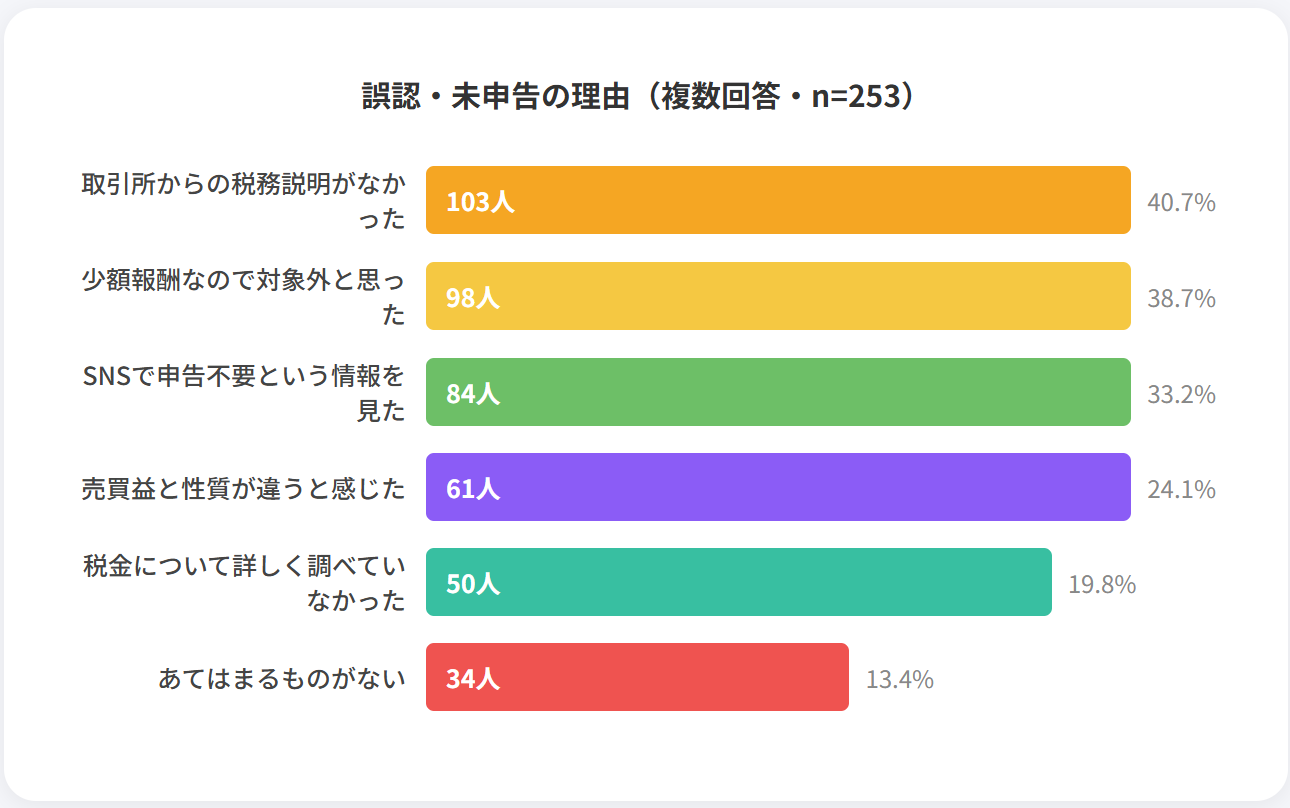
Reasons for misunderstanding or not filing (multiple answers) | Respondents | Share |
|---|---|---|
The exchange gave no explanation about taxes | 103 | 40.7% |
Thought the reward amount was too small to be subject to reporting | 98 | 38.7% |
Saw information from people around them or on social media saying reporting wasn't necessary | 84 | 33.2% |
Felt it was a different kind of income from price-driven trading gains | 61 | 24.1% |
Had not looked into the tax details | 50 | 19.8% |
None of the above applies | 34 | 13.4% |
Why haven't more holders filed correctly? The main causes come down to a lack of information and an underestimation of the amounts involved. According to the survey, 40.7% cited "insufficient explanation from the exchange," expressing clear dissatisfaction with the platforms themselves. Japan's domestic crypto asset exchange service providers arguably bear a responsibility to more proactively inform users about the tax treatment of management rewards.
In addition, 38.7% judged that the amount was too small to be subject to reporting, which stands as a direct cause of underreporting. For salaried employees, miscellaneous income of ¥200,000 or less may not require a final tax return, though a separate resident-tax filing is still required in that case. The findings underscore the danger of being misled by unverified "no reporting needed" claims circulating on social media and skipping tax payments based on one's own self-styled interpretation.
Strong Demand for Calculation Methods and Concrete Examples
News sites are the top information source, cited by about half
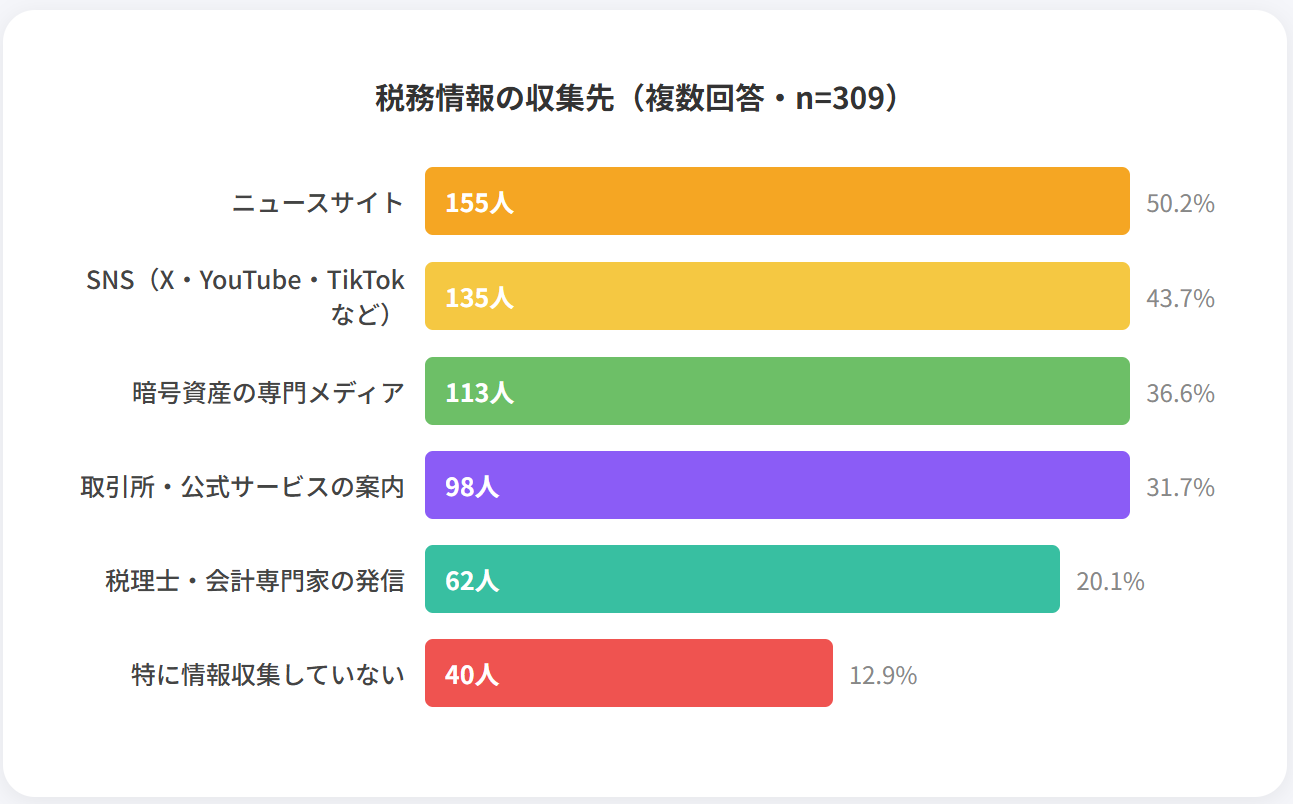
Information source (multiple answers) | Respondents | Share |
|---|---|---|
News sites | 155 | 50.2% |
Social media (X, YouTube, TikTok, etc.) | 135 | 43.7% |
Specialist crypto asset media | 113 | 36.6% |
Guidance from exchanges or official services | 98 | 31.7% |
Tax accountants or other accounting professionals | 62 | 20.1% |
Not gathering information in particular | 40 | 12.9% |
Asked where they get their crypto asset tax information, the most common answer was "news sites," at 50.2%. This suggests that many holders rely on general economic news to keep up with fast-moving developments such as legal amendments and National Tax Agency (NTA) guidance. Social media usage was also high, at 43.7%, reflecting a strong tendency to seek out real-time community activity and concrete personal experiences.
However, only 20.1% get information directly from professionals such as tax accountants, raising the possibility of an imbalance in information quality. Only 31.7% rely on guidance from exchanges, once again highlighting a shortfall in official information. In an area where accuracy is paramount, holders appear to be forced to piece together and filter information across a wide range of channels.
36.9% confused about how to convert rewards into yen
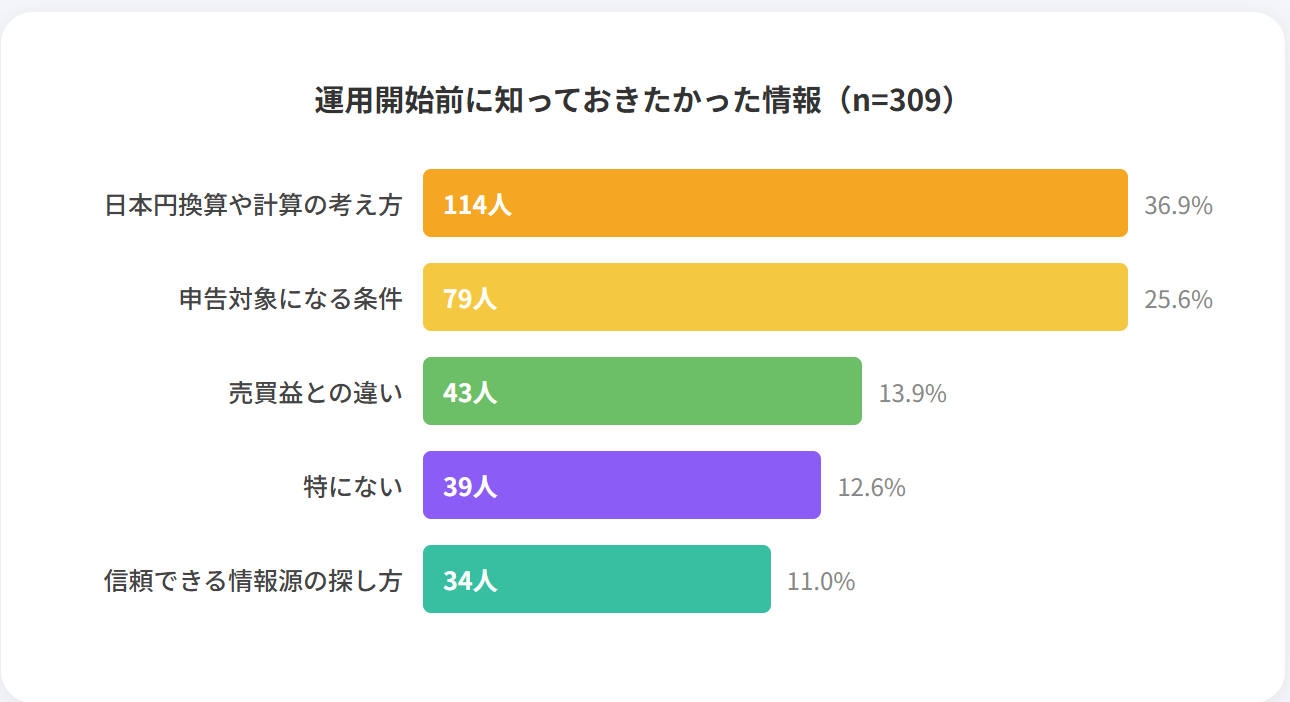
What holders wish they had known beforehand | Respondents | Share |
|---|---|---|
How to convert to yen and calculate income | 114 | 36.9% |
The conditions that make it subject to reporting | 79 | 25.6% |
How it differs from trading gains | 43 | 13.9% |
Nothing in particular | 39 | 12.6% |
How to find a trustworthy source of information | 34 | 11.0% |
Asked what they wish they had known before they started, 36.9% of holders cited "how to convert to yen and calculate income." Staking rewards and similar income must be valued at the market price on the date received and recorded in one's books, and the sheer complexity of this task is the biggest hurdle. Also notable is that 25.6% cited "the conditions that make it subject to reporting," showing that the line between taxable and non-taxable is a further source of confusion.
Unlike trading gains, there is clearly strong demand for concrete guidance on how to manage the ongoing, small-scale rewards these methods generate. This suggests that many holders' challenge is not simply knowing that "taxes apply," but figuring out the practical mechanics of handling them. The results reflect a real tension: holders want to maximize their returns from these methods, while also worrying about the administrative burden that follows.
Younger holders place more weight on practical tools
Age group | A way to check whether reporting is required | Explanations using concrete examples | Case-by-case breakdowns | Tool or procedure guides |
|---|---|---|---|---|
20s | 24 (40.0%) | 15 (25.0%) | 12 (20.0%) | 6 (10.0%) |
30s | 39 (42.4%) | 23 (25.0%) | 16 (17.4%) | 4 (4.3%) |
40s | 24 (32.9%) | 22 (30.1%) | 15 (20.5%) | 7 (9.6%) |
50s | 16 (25.8%) | 15 (24.2%) | 7 (11.3%) | 6 (9.7%) |
Asked what kind of information would improve their understanding going forward, respondents across every age group most commonly named "a way to check whether reporting is required." Broken down by generation, the demand for a practical way to instantly determine whether one is subject to reporting is especially strong among younger holders, particularly those in their 30s (42.4%) and 20s (40.0%). Meanwhile, among holders in their 50s, 29.0% said they "don't particularly need" such information, revealing a gap in needs across generations.
Holders in their 40s and above also show strong demand for "easy-to-understand explanations using concrete examples," indicating they are looking for information grounded in real cases rather than abstract theory. To raise practical transparency in the crypto asset market, it will be essential to develop tools that can apply the complex tax system to individual situations and make the results visible. The underlying source of holders' anxiety about not being able to "understand correctly" appears to be exactly this opacity in the determination process.
Conclusion
This survey's findings make clear that, as staking and lending become common ways to manage crypto assets, the tax obligations that come with them present a major challenge for holders. The fact that many holders prioritize long-term income gain and continue to use these methods at a high rate shows growing confidence in them as a tool for asset building. At the same time, it is impossible to overlook the gap between holders' vague sense that "reporting might be necessary" and their hesitation or misunderstanding when it comes to actually filing.
In particular, a lack of practical information — on how to convert rewards into yen and how they differ in nature from trading gains — stands out as a major factor preventing proper filing. The fact that more than 40% of holders feel exchanges have not explained the rules adequately points to a significant communication gap between service providers and users. There is also an urgent need for vigilance around the risk that self-styled interpretations based on unofficial information from social media and elsewhere may be increasing the potential for underreporting.
For the crypto asset market to develop in a healthier direction going forward, holders' own willingness to learn needs to be matched by practical support — such as eligibility-check tools and shared, concrete examples of how others have filed. An environment in which the complex tax system can be correctly applied and understood on a case-by-case basis will allow holders to build long-term investment strategies with greater peace of mind. The candid "I wish I'd known beforehand" sentiment revealed in this survey should serve as a guide for the information the industry as a whole needs to provide going forward.
Survey Overview
Survey date: February 24, 2026
Survey method: Internet survey
Survey population: Men and women residing in Japan (people currently investing in crypto assets, or who have invested in the past)
Valid responses: 309
Conducted by: Clabo Inc.
Survey Questions
- Have you ever used crypto assets (virtual currencies)?
- Have you ever used staking or lending to manage your crypto assets?
- When you first started, which of the following best described your understanding of the rewards (interest/rewards) earned through staking or lending?
- Which of the following best describes your actual handling of income from staking or lending?
- Which of the following reasons apply to why you understood it that way?
- Which of the following best describes the amount you first invested when you began staking or lending?
- Which of the following best describes your current approach to managing crypto assets?
- Where did you mainly get information about taxes on staking and lending?
- Looking back now, what do you feel you "wish you had known beforehand" about income from staking or lending?
- What kind of information, going forward, would help you "understand correctly" the taxes on staking and lending?
This article is for informational purposes only and does not constitute financial or investment advice. Please consult a qualified professional before making investment decisions.


