


Many people who have lost crypto assets (also known as virtual currencies)—whether through misplacement, theft, or fraud—wonder whether the loss can be treated as a deduction when calculating their taxes. Separate from the question of whether the assets can be recovered, it is worth checking whether the loss qualifies for a deduction or loss treatment on your final tax return.
The short answer: losing crypto assets does not automatically reduce your tax burden in every case. The tax treatment depends on the cause of the loss, and there are broadly two routes for a deduction or loss treatment.
The first is the casualty loss deduction (zasson kōjo), which covers losses from disasters, theft, and embezzlement. The second is to examine whether the loss can be entered as a necessary expense when calculating miscellaneous income, for losses—such as those from fraud—that the casualty loss deduction is less likely to cover.
This article draws on the National Tax Agency (NTA)'s Tax Answer FAQ database, the Income Tax Act, and Diet testimony to organize how crypto assets lost to misplacement, theft, fraud, or an exchange collapse are treated for tax purposes. Note: this reflects the law as of July 2026 (miscellaneous income under aggregate/comprehensive taxation). Under the 2026 amendment to the Financial Instruments and Exchange Act (FIEA), crypto assets have been reclassified as financial instruments; a 20% separate self-assessment tax rate is targeted for 2028 as a distinct policy track, but has not yet taken effect.
How Crypto Asset Losses Are Treated for Tax Purposes

When you lose crypto assets, the first step is to sort out why you lost them. The systems available to you differ depending on the cause.
Cause of loss | Tax classification | Possible route | Default treatment for deduction/loss |
|---|---|---|---|
Stolen via hacking or phishing | May qualify as theft | Casualty loss deduction | If the requirements are met, the casualty loss deduction may be available. That said, whether crypto assets count as an \"asset not ordinarily needed for daily life\" is a key point of contention. |
Not returned due to an exchange collapse | May qualify as embezzlement | Casualty loss deduction | Depending on the facts, this may be treated as embezzlement, making the casualty loss deduction available. If compensation was received, the tax treatment of that compensation needs separate confirmation. |
Private key or device lost in a disaster | May qualify as a disaster | Casualty loss deduction | May be considered as a disaster-related loss. However, proving that the crypto assets themselves have become genuinely inaccessible, and the amount of the loss, is important. |
Sent via investment fraud or a romance scam | Fraud or extortion | Necessary expense deduction | The casualty loss deduction generally cannot be used. However, the loss may be treated as a necessary expense, up to the amount of that year's miscellaneous income. |
Lost private key or recovery phrase | Loss due to your own negligence | Generally not eligible | If it does not fall under disaster, theft, embezzlement, or fraud, a deduction is considered difficult. |
Sent to the wrong address | Transfer error due to your own negligence | Generally not eligible | Treatment varies depending on the destination and circumstances, but a simple sending error is often difficult to deduct. |
The first thing to check when you lose crypto assets is which cause it falls under, under tax law. Even where the outcome—losing an asset—looks similar, the tax treatment differs depending on whether it was theft, fraud, or your own negligence.
One point that deserves particular attention: being unable to log into your wallet is not the same as having lost the crypto assets for tax purposes. Simply being unable to log in does not mean the assets are gone—if the recovery phrase or private key still exists, you may be able to restore access using a different wallet. Before considering any tax treatment, it is worth confirming whether the assets are truly unrecoverable.
Two Routes to a Deduction
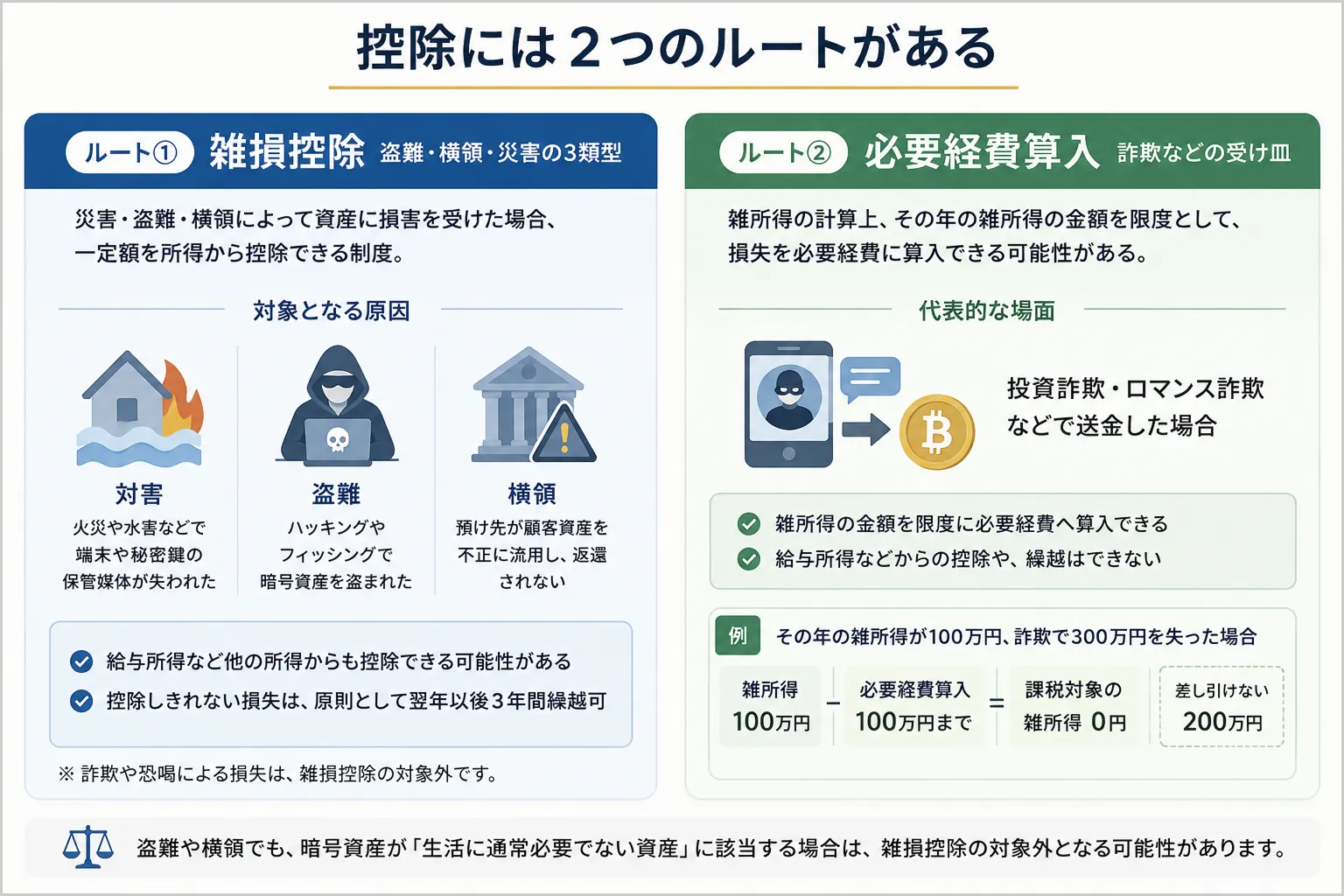
How a loss of crypto assets is treated for tax purposes depends on the circumstances and background of the loss. This means you cannot simply assume that \"a loss automatically means lower taxes.\"
Let's first look at how crypto-related losses are organized for tax purposes, then walk through the treatment for each case.
Route 1: The Casualty Loss Deduction — Three Categories: Theft, Embezzlement, and Disaster
The casualty loss deduction (zasson kōjo) is a system that allows a set amount to be deducted from income when assets are damaged due to a disaster, theft, or embezzlement. It is an income deduction based on Article 72 of the Income Tax Act, and if the requirements are met, it can be deducted from other income, such as employment income.
The causes that qualify for the casualty loss deduction generally fall into the following three categories.
Cause | Example scenario for crypto assets |
|---|---|
Disaster | A device or the storage medium for a private key is lost in a fire, flood, or similar disaster |
Theft | Crypto assets are stolen through hacking or phishing |
Embezzlement | The custodian misappropriates client assets and does not return them |
References: When Assets Are Damaged by a Disaster or Theft | National Tax Agency References: Losses Due to Fraud | National Tax Agency
A key feature of the casualty loss deduction is that it can be deducted not only from miscellaneous income generated by crypto assets, but also from other income such as employment income or business income. In addition, if a loss cannot be fully deducted in the year it occurs, it can generally be carried forward for up to three years.
That said, the casualty loss deduction does not apply to every kind of loss. The NTA excludes losses due to fraud or extortion from the casualty loss deduction.
The casualty loss deduction covers losses arising from \"a disaster, theft, or embezzlement,\" but does not cover losses due to \"fraud.\"
Reference: Losses Due to Fraud | National Tax Agency
For this reason, if you sent crypto assets due to investment fraud or a romance scam, you will need to consider a different route rather than the casualty loss deduction.
Route 2: Necessary Expense Deduction — A Fallback for Fraud and Similar Cases
A necessary expense deduction refers to subtracting certain costs or losses from income when calculating taxable income. For crypto assets, it may be possible to enter a loss as a necessary expense when calculating miscellaneous income, up to the amount of that year's miscellaneous income.
A typical scenario for considering this route is a case where crypto assets were lost to fraud. Losses due to fraud are excluded from the casualty loss deduction, but they may be treated as a necessary expense when calculating miscellaneous income. On this point, at the House of Councillors Committee on Financial Affairs on April 19, 2022, NTA Deputy Commissioner Tetsuro Shigeto testified as follows:
Crypto assets are an asset that gives rise to miscellaneous income. Under Article 51, Paragraph 4 of the Income Tax Act, losses on assets that give rise to miscellaneous income can be entered as a necessary expense up to the amount of miscellaneous income for the year in which the loss occurred, and this includes losses due to fraud.
Reference: National Diet Library Minutes Search System
However, the necessary expense deduction comes with an important limitation. Even though a loss can be entered as a necessary expense under Article 51, Paragraph 4 of the Income Tax Act, the ceiling is \"the amount of miscellaneous income for the year in which the loss occurred.\" Unlike the casualty loss deduction, it cannot be deducted from other income such as employment income, nor can any un-deducted amount be carried forward to later years.
For example, suppose you had 1,000,000 yen (approx. USD 6,700*) in miscellaneous income from selling crypto assets in a given year, and lost crypto assets worth 3,000,000 yen (approx. USD 20,000*) to fraud. In this case, while the fraud loss may be treated as a necessary expense, the amount you can deduct is capped at that year's miscellaneous income of 1,000,000 yen.
Therefore, subtracting the 1,000,000 yen loss from the 1,000,000 yen in miscellaneous income may bring your miscellaneous income down to zero. However, the remaining 2,000,000 yen (approx. USD 13,300) cannot be deducted from other income such as employment income, and in principle cannot be carried forward to later years. (*Yen-to-USD figures above are approximate, calculated at roughly ¥150/USD for illustrative purposes only.)
The necessary expense deduction offers a narrower scope of relief than the casualty loss deduction. Rather than simply assuming \"it was fraud, so my taxes will go down,\" you need to check whether you had miscellaneous income that year and how you can substantiate the amount of the loss.
[Caution] Even Theft or Embezzlement Can Fall Outside the Casualty Loss Deduction
For the casualty loss deduction, one requirement is that the damaged asset does not qualify as \"an asset not ordinarily needed for daily life.\" Assets not ordinarily needed for daily life refer to things held for hobby, entertainment, recreation, or appreciation purposes, as well as high-value precious metals, artwork, antiques, and the like.
The law does not uniformly state that all crypto assets fall under \"assets not ordinarily needed for daily life.\" However, when an individual investor holds crypto assets with the aim of profiting from price appreciation, there is a possibility that the assets will be judged as held for investment or speculative purposes.
This is a point that deserves particular attention for the casualty loss deduction as it applies to crypto assets. Even where hacking or phishing may qualify as theft, whether the casualty loss deduction applies can become an issue depending on the nature of the asset.
For this reason, when considering the casualty loss deduction, you should organize not only the cause of the loss but also the purpose for which you held the crypto assets, your holding status, transaction history, and the scale of your assets.
Tax Treatment by Cause of Loss
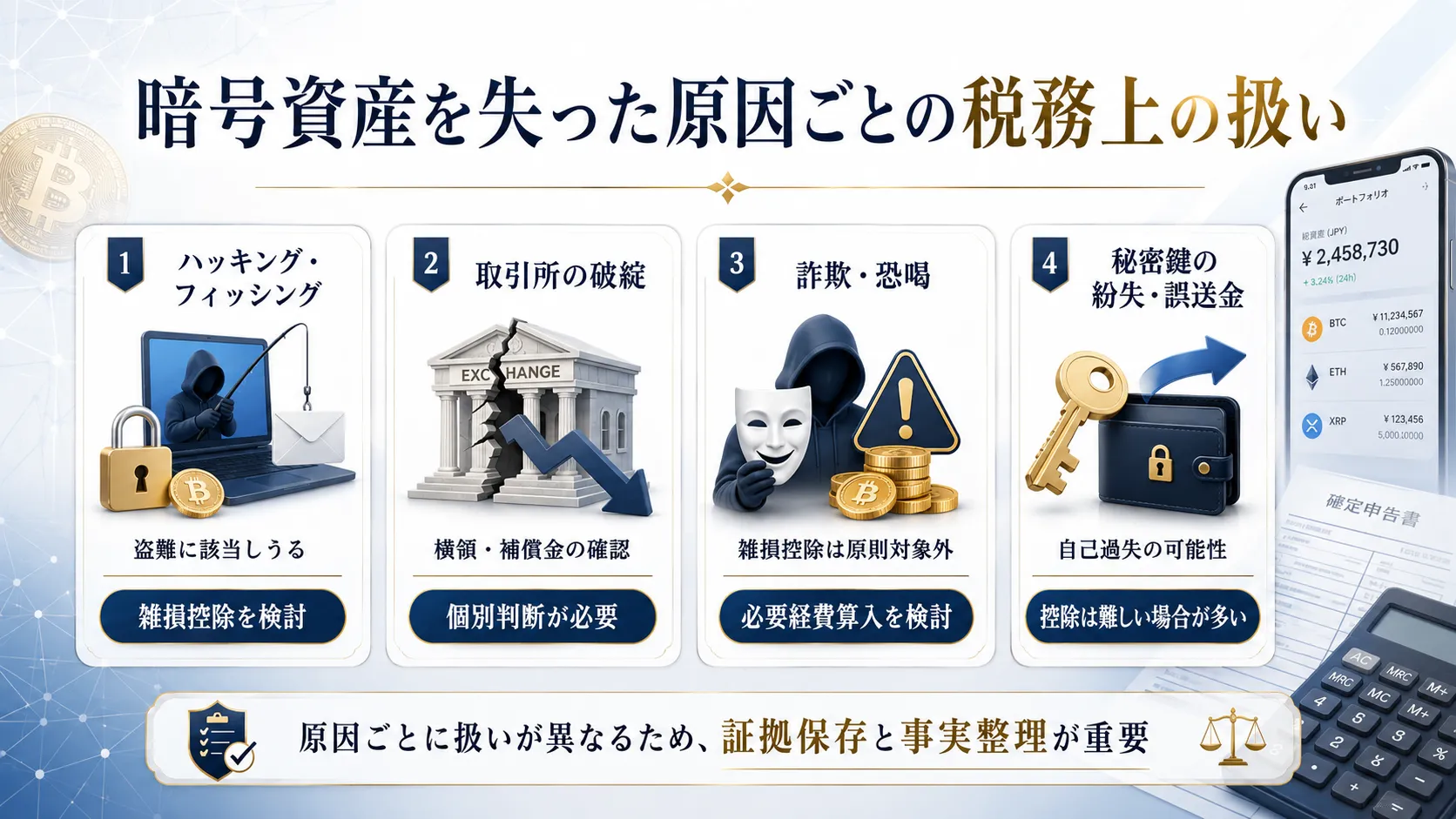
The tax classification and required procedures differ from case to case when crypto assets are lost. Here, we organize the cases that come up most often in consultations.
Hacking and Phishing
If crypto assets are drained through hacking or phishing, this is a case that may qualify as theft for tax purposes. If it qualifies as theft, the casualty loss deduction may be worth considering.
Phishing is a technique that uses fake websites or emails to get you to enter your ID, password, private key, recovery phrase, and similar information. Even if you entered the information yourself, if in substance a third party fraudulently transferred the assets, it may still be organized as theft (related: Countermeasures Against Crypto Asset Phishing Scams (in Japanese)).
What matters most in this scenario is preserving evidence as early as possible. Save your exchange login history, wallet transfer history, transaction IDs, destination addresses, the URL of the fake site, and records of emails or social media messages.
Consulting the police is also important. When considering the casualty loss deduction, documents such as a police report acceptance certificate showing the theft are important supporting materials. For tax filing purposes, simply stating \"it was stolen\" may not be enough—you may be asked to provide objective materials showing the fact of the theft.
In terms of procedure, first organize the facts of the damage and consult the police. Then confirm the acquisition cost of the crypto assets, the market value at the time of the loss, the transfer records, and whether any compensation was received, before determining whether the casualty loss deduction applies on your final tax return.
Exchange Collapse
If crypto assets are not returned due to an exchange's collapse, the treatment depends on the facts. Whether it qualifies as embezzlement is a matter of whether it was simply a business failure, or whether there was misappropriation or improper management of customer assets.
If it qualifies as embezzlement, the casualty loss deduction route may be worth considering. That said, the circumstances of an exchange collapse vary greatly case by case. You will need to confirm details such as the bankruptcy proceedings, the compensation policy, how customer assets were managed, and the outlook for their return.
In addition, if you receive compensation in yen or another currency from the exchange, you will need to separately confirm the tax treatment. According to the NTA's Tax Answer FAQ database, if a crypto asset exchange service provider pays monetary compensation in lieu of crypto assets it cannot return, that compensation is not treated as a non-taxable damages payment, and is instead taxed as miscellaneous income.
Generally, when compensation is paid in lieu of crypto assets that a provider holds on behalf of a customer but cannot return, that compensation is money paid in place of the crypto assets that could not be returned. Because this results in the same outcome as if the customer had sold the crypto assets and received money in the same amount, it is considered to include the portion that represents income that should have accrued, or profit that would otherwise have been obtained.
Accordingly, the compensation in question does not fall under non-taxable damages, and is subject to tax as miscellaneous income.
Furthermore, if the value of the crypto assets used as the basis for calculating the compensation is lower than your original acquisition cost, a loss may arise when calculating your miscellaneous income. In that case, the loss can reportedly be offset against other miscellaneous income (note: this offsetting of gains and losses applies only within miscellaneous income—it cannot be applied against other income categories such as employment income).
In an exchange collapse case, the tax treatment may differ before and after compensation is received. Whether you can treat the loss at the time of the collapse, and how to handle the compensation in the year it is received, require case-by-case judgment.
Fraud and Extortion
If you sent crypto assets due to investment fraud, a romance scam, an SNS investment group scam, or similar schemes, the casualty loss deduction generally cannot be used. This is because the NTA excludes losses due to fraud or extortion from the casualty loss deduction.
The casualty loss deduction covers losses arising from \"a disaster, theft, or embezzlement,\" but does not cover losses due to \"fraud.\"
Reference: Losses Due to Fraud | National Tax Agency
That said, being a fraud case doesn't mean there is nothing you can do. Crypto assets generally qualify as an asset that gives rise to miscellaneous income. So, under Article 51, Paragraph 4 of the Income Tax Act, you may be able to consider entering the fraud-related loss as a necessary expense, up to the amount of your miscellaneous income.
What matters in a fraud case is having materials that demonstrate the fraud. Preserve LINE and email exchanges with the perpetrator, social media records, the investment group's solicitation messages, transfer instructions, bank transfer receipts, records of the crypto asset transfers, and transaction IDs.
It is also important to consult the police, a consumer affairs center, or the Financial Services Agency (FSA)'s consultation desk, and to keep records of those consultations. For tax purposes as well, it matters whether you have objective materials documenting the fraud, rather than relying on your own judgment alone (related: What to Do If You Think Your Crypto Assets Have Been Stolen (in Japanese)).
Lost Private Key or a Wrong-Address Transfer
If you lose your own private key or recovery phrase, a deduction is generally considered difficult, since this does not qualify as a disaster, theft, embezzlement, or fraud.
For example, in the following scenarios, the situation is likely to be organized as inaccessibility due to your own negligence, meaning neither the casualty loss deduction nor the necessary expense deduction is likely to be recognized:
- Threw away a paper copy of your recovery phrase
- Reset the device where it was stored
- Forgot your password
That said, it can be premature to conclude that you have \"lost\" your crypto assets in this scenario. If the recovery phrase or private key survives in some form, you may be able to restore the assets in a different wallet based on it (related: A Case Study on Restoring a Wallet Holding 15 ETH (in Japanese))
The same caution applies to a wrong-address transfer. If you simply sent funds to the wrong address yourself, it is unlikely to qualify as a disaster, theft, embezzlement, or fraud, and a tax deduction is often difficult. However, if you were deceived into making the transfer, it may be possible to treat it as fraud.
For a lost private key or a wrong-address transfer, check the possibility of recovery or return before considering tax treatment. As a general rule, transfers on the blockchain cannot be reversed, but in cases such as a wrong-address transfer to an exchange, the exchange may sometimes be able to return the funds.
Documents and Procedures Needed for Filing

When reporting a crypto asset loss on your tax return, you need materials that can explain the cause, amount, and timing of the loss. This is especially true for theft, fraud, and exchange collapses, where how thoroughly you can organize objective evidence matters.
Documents/Records | Main content | Cases where especially important |
|---|---|---|
Police report acceptance certificate | A document showing that you filed a police report | Theft, hacking, phishing |
Transaction records | Date and time of transfer, destination address, amount, transaction ID | Theft, fraud, wrong-address transfer |
Exchange transaction history | Purchase date, acquisition cost, sale history, deposit/withdrawal history | All cases |
Wallet history | Send/receive history, holdings, address information | Theft, wrong-address transfer, lost private key |
Communications with the perpetrator | LINE, email, social media, investment group posts | Fraud, extortion |
Materials related to the exchange collapse | Bankruptcy proceedings, compensation notices, return policy, official announcements | Exchange collapse |
Compensation-related materials | Compensation amount, basis of calculation, payment date | Exchange compensation, damages |
Acquisition cost materials | Materials showing how much you paid to acquire the crypto assets | Calculating the loss amount in general |
When filing your final tax return, first organize your crypto asset transactions for the year. If you had sales, exchanges, use for payment, or reward receipts, review each transaction and calculate your annual miscellaneous income.
Next, organize the cause of the loss. If it may qualify as theft, embezzlement, or a disaster, check whether it is eligible for the casualty loss deduction. If it qualifies as fraud, examine whether it can be entered as a necessary expense, up to the amount of your miscellaneous income.
Then, prepare the materials that support your filing. If you are using the casualty loss deduction, make sure you can explain the cause and amount of the loss using materials such as a police report acceptance certificate and transaction history. If you are considering the necessary expense deduction, also organize transfer records, communications with the perpetrator, and materials showing your acquisition cost.
Losses involving crypto assets tend to be more complex than an ordinary trading loss, both in classifying the cause and in calculating the loss amount. If the amount is large, or if theft, fraud, or an exchange collapse is involved, we recommend consulting a tax accountant who is familiar with crypto asset taxation.
Frequently Asked Questions (FAQ)

Here, we organize common questions about taxes when crypto assets are lost, stolen, or taken through fraud. Whether a deduction is available depends on the cause of the loss and your income for that year, so check the item closest to your situation.
Can I use the casualty loss deduction even if I didn't sell any crypto assets that year?
If your case qualifies for the casualty loss deduction, you may be able to deduct it from other income, such as employment income, even if you did not sell or exchange any crypto assets that year. For example, even if you were simply holding crypto assets long-term and suffered a hacking incident, you may be able to consider the casualty loss deduction if it qualifies as theft or embezzlement and you meet the asset requirement.
On the other hand, if you are entering a fraud-related loss as a necessary expense, the ceiling is, in principle, that year's miscellaneous income. So if you had no miscellaneous income from crypto asset sales or similar activity that year, you may not be able to deduct the loss.
How far back can I go for past damage?
Whether you can revise a past year's filing depends on whether you have already filed a final tax return for that year. If you already filed and overpaid tax, you would generally consider a request for correction (kōsei no seikyū). The NTA states that a request for correction can generally be made within five years of the statutory filing deadline.
If you did not comply with tax laws, or if there was an error in your calculation, please submit the request within five years of the statutory filing deadline.
On the other hand, if you were required to file but did not, a late filing (kigengo shinkoku) is relevant instead. Whether you can now reflect a past theft or fraud incident in your filing depends on the year in question, whether you already filed, your income situation at the time, and whether you have materials supporting the loss. If you are dealing with damage from several years ago, don't handle it on your own judgment—check with a tax accountant or the tax office.
What should I do if I'm not sure whether it was theft or fraud?
First, organize the timeline of how the crypto assets were transferred. If they were taken through unauthorized access against your will, that is closer to theft. On the other hand, if you sent them yourself after believing a false explanation from the other party, that is closer to fraud.
That said, some cases are genuinely difficult to classify. For example, if you were led to a fake website and entered your private key there, even though you entered it yourself, it may in substance be organized as theft through phishing.
A misclassification changes whether you should consider the casualty loss deduction or the necessary expense deduction. After organizing your police report, consultation records, transfer history, and correspondence, it is important to confirm the classification with a specialist.
Can I treat a lost private key as a loss too?
If you simply lost your own private key or recovery phrase, a tax deduction is generally considered difficult. This is because it is unlikely to fall under theft, embezzlement, disaster, or fraud.
That said, if you lost the storage medium in a disaster, or if it was stolen by a third party, the situation may be organized differently. Also, if part of the private key or recovery phrase still remains, check the possibility of recovery before pursuing any tax treatment.
Summary
Even if you lose crypto assets to misplacement or theft, you cannot simply assume that \"losing them means a deduction.\" This is because the tax treatment depends on the cause of the loss.
Hacking and phishing may be treated as theft, making the casualty loss deduction worth considering. An exchange collapse raises the question of whether it qualifies as embezzlement. Fraud and extortion are excluded from the casualty loss deduction, but you may be able to consider a necessary expense deduction within the scope of your miscellaneous income. A lost private key or a wrong-address transfer, caused by your own negligence, is generally considered difficult to deduct.
Case | What to check first |
|---|---|
Hacking/Phishing | Whether you have evidence supporting classification as theft |
Exchange collapse | Whether it qualifies as embezzlement, whether compensation was paid, the details of the bankruptcy proceedings |
Fraud/Extortion | Whether you have correspondence or transfer records showing the fraud |
Lost private key/Wrong-address transfer | Whether recovery or return is genuinely impossible |
For crypto asset loss treatment, the classification under tax law, the calculation of the loss amount, and the organization of supporting evidence all matter. Especially if the amount is large, or if theft, fraud, or an exchange collapse is involved, consult a specialist such as a tax accountant at an early stage.
This article is based on general information drawn from NTA materials, the Income Tax Act, and Diet testimony. Actual tax determinations vary depending on your purpose in holding the assets, the details of your transactions, the circumstances of the loss, whether compensation was received, and your supporting evidence. When filing, check the latest NTA materials and consult a tax accountant or the tax office as needed.
This article is for informational purposes only and does not constitute financial or investment advice. Please consult a qualified professional before making investment decisions.


