


If you've been leaving your crypto assets (also known as virtual currencies) on an exchange, you may start looking for a safer way to store them. One option that often comes up is cold wallet storage.
A cold wallet is frequently introduced as a security-focused storage method, making it an appealing option for anyone planning to hold crypto long-term. At the same time, using a dedicated hardware device can feel intimidating, which leads some people to wonder, "Can't I just manage this with a smartphone app instead?"
Here's the key point to keep in mind: a typical smartphone app cannot function as a cold wallet. Smartphone apps are usually connected to the internet while in use, which is a fundamentally different setup from a cold wallet, where the private key is kept isolated from the network.
Before choosing a smartphone app, it's important to understand how it differs from a cold wallet. This article explains the difference between app-based wallets and cold wallets, what to watch out for when managing crypto assets on a smartphone, and the points to check when it comes to long-term storage.
A cold wallet keeps the private key isolated from the internet
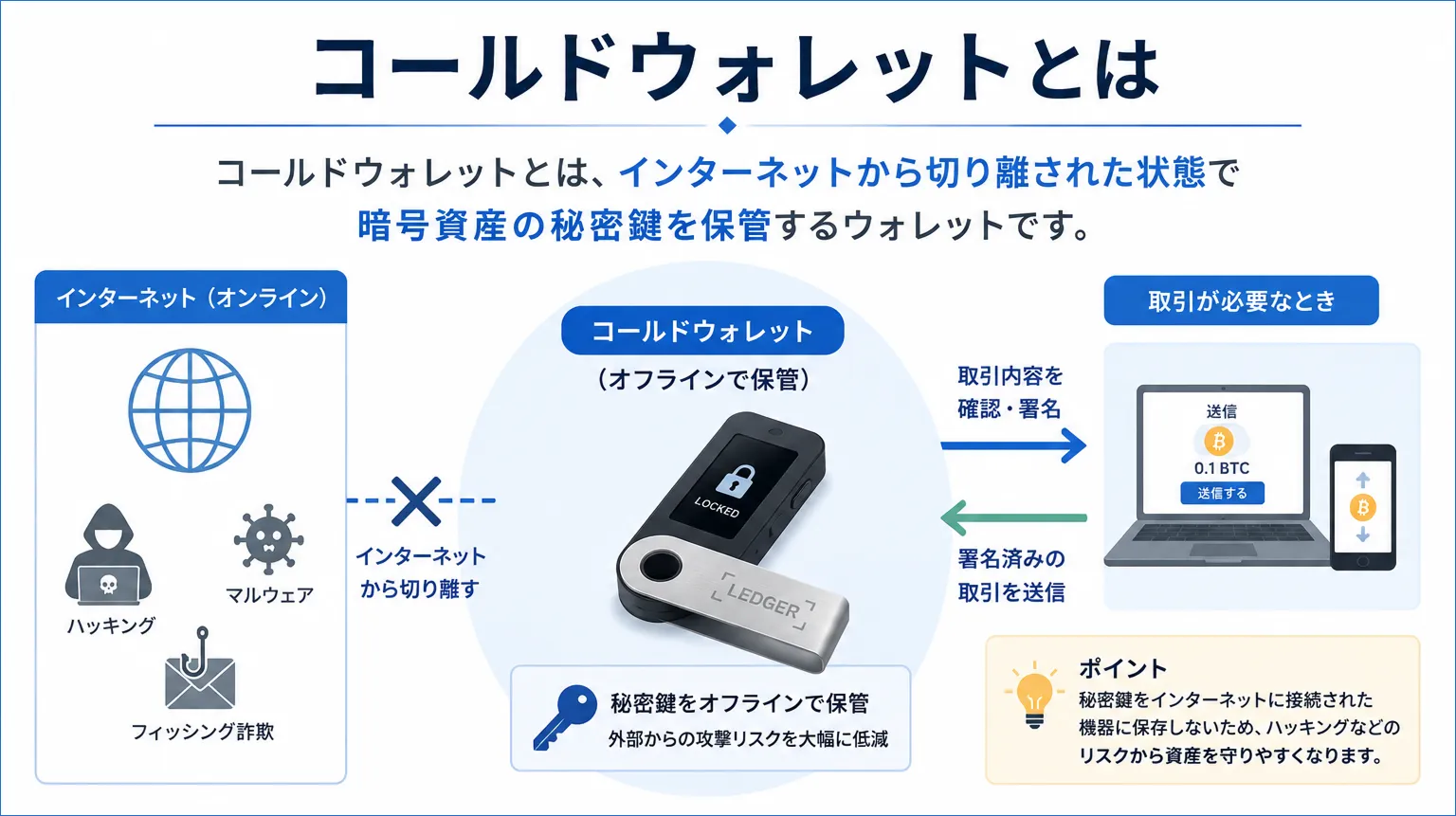
A cold wallet is a method of managing the information needed to move crypto assets by keeping it isolated from the internet.
Sending crypto assets requires information called a private key (also referred to as a signature key). In a bank account, the private key plays a role similar to a PIN or a personal seal — if a third party gets hold of it, your crypto assets could be moved without your consent.
With a cold wallet, this private key is kept in an "offline environment" rather than on a smartphone or computer connected to the internet. Common examples include storing it on a dedicated hardware wallet device, or writing the recovery phrase needed to restore the wallet on paper.
Looked at this way, it becomes clear that a smartphone app-based wallet is a different type of management method from a cold wallet. Wallet apps you use on a smartphone are typically operated on a device connected to the internet, so they can't be described as a method that isolates the private key from the network.
This means that for crypto assets you don't plan to move for a long time, or for a substantial amount of crypto assets, a different approach is needed. Rather than prioritizing convenience, the priority should be keeping the private key and recovery phrase away from any online environment.
Wallet apps serve a different purpose from cold wallets
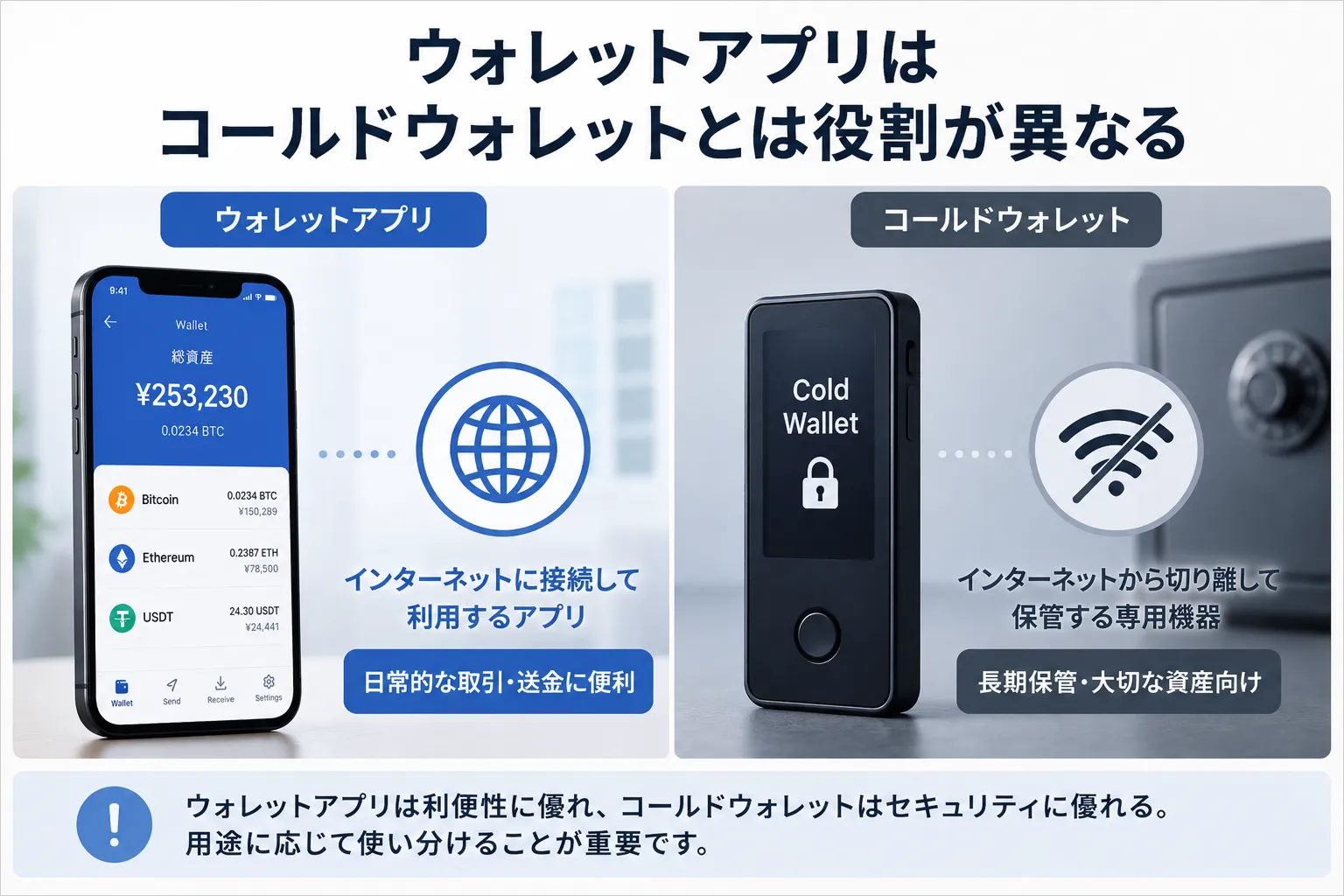
Wallet apps available on smartphones include MetaMask and Trust Wallet. Rather than depositing crypto assets with an exchange, these apps let you manage your own recovery phrase and private key.
This type of app-based wallet, operated from a smartphone, is a different management method from a cold wallet. Wallet apps used on a smartphone are typically operated on a device connected to the internet, so they cannot be considered a cold wallet, which keeps the private key isolated from the network.
That said, this doesn't mean smartphone wallet apps are unnecessary. For managing a small amount of crypto assets yourself, or for sending funds and checking your balance on a daily basis, they're a highly convenient option.
What matters is that for crypto assets you don't plan to move for a long time, or for a substantial amount of crypto assets, a different approach is needed. Rather than prioritizing convenience, the priority should be keeping the private key and recovery phrase away from any online environment.
Who should consider managing crypto assets with a cold wallet

A cold wallet isn't a method everyone needs. Whether it's necessary depends on how much crypto you hold, how often you trade, and how concerned you are about managing your assets.
In particular, if you're primarily engaged in short-term trading, moving all your assets into a cold wallet could be inconvenient. On the other hand, if you're holding long-term, it may be worth considering management that doesn't rely solely on an exchange or a smartphone app.
People holding a substantial amount of crypto assets long-term
People holding a substantial amount of crypto assets for the long term are good candidates for cold wallet management. The larger your holdings, the greater the potential loss if you're affected by unauthorized access or phishing.
If you're using a small amount of crypto for transfers or trying things out, the convenience of a smartphone wallet app can be genuinely useful. On the other hand, if you have no plans to move several million yen worth of crypto assets for a long time, the priority should be safely storing the private key rather than day-to-day convenience.
A cold wallet isn't suited to frequent trading or transfers. However, for crypto assets you don't intend to move for a long time and want to keep out of an online environment, it's a strong option.
People who prioritize storage over frequent trading
People who don't trade frequently and want to prioritize storage are good candidates for cold wallet management. A cold wallet isn't designed for quickly buying and selling crypto assets — it's designed for storing them without moving them for extended periods.
If you have no plans to move crypto assets you've purchased for a while, the need to prioritize day-to-day ease of use is lower. Instead, what matters more is reducing exposure to online risks while your assets are being stored, rather than prioritizing ease of trading.
For example, if you've purchased crypto assets with a long-term holding strategy and have no plans to sell them any time soon, there's no need to keep them in a state where they can always be transferred immediately. Such assets can be kept separate from your everyday wallet or exchange account and managed in a cold wallet instead.
People uneasy about leaving assets on an exchange
People who feel uneasy about leaving crypto assets on an exchange should also consider self-custody with a cold wallet. When assets are held on an exchange, management of the private key is essentially entrusted to the exchange.
Of course, this doesn't mean domestic crypto asset exchange service providers manage customer assets without any safeguards. According to the Financial Services Agency (FSA)'s explanation of the regulatory framework, exchange service providers are required to manage crypto assets entrusted by customers using highly reliable methods such as cold wallets, except for the portion necessary for business operations.
Exchange service providers are required to manage customers' crypto assets using highly reliable methods (such as cold wallets), except for the portion necessary for the smooth conduct of business (capped at 5% of the total crypto assets entrusted by customers).
Source:Regulatory Framework for Crypto Assets (Virtual Currencies) (FSA, in Japanese)
Even so, keeping assets on an exchange doesn't guarantee absolute safety. In fact, it was reported that on May 31, 2024, DMM Bitcoin detected an unauthorized outflow of 4,502.9 BTC — worth roughly ¥48.2 billion (approx. USD 300 million at the time) — from the company's wallet. The company stated it would procure an equivalent amount of Bitcoin and fully guarantee customers' deposited assets, though some of its services were also restricted for a time.
On May 31, Reiwa 6 (2024), crypto assets (BTC) managed by our company were sent externally without authorization, resulting in an outflow of assets entrusted by customers (4,502.9 BTC).
Source:Kanto Local Finance Bureau, Ministry of Finance (in Japanese)
Cases like this show that while keeping crypto on an exchange offers convenience, it also exposes you to the risk of being affected by issues or service restrictions on the exchange's side. Being able to reset your login credentials and rely on customer support is an advantage, but since you aren't managing the private key yourself, you don't have full control over your assets.
In fact, in a survey of 417 hardware wallet owners, the top reason cited for purchasing one was "concern about security," chosen by 38.1% of respondents. This was followed by "decided it was necessary after researching" at 35.0% and "saw news of a hacking incident" at 33.6%. This suggests that unease about leaving assets on an exchange, along with awareness of past leak incidents, is a common trigger for considering self-custody.
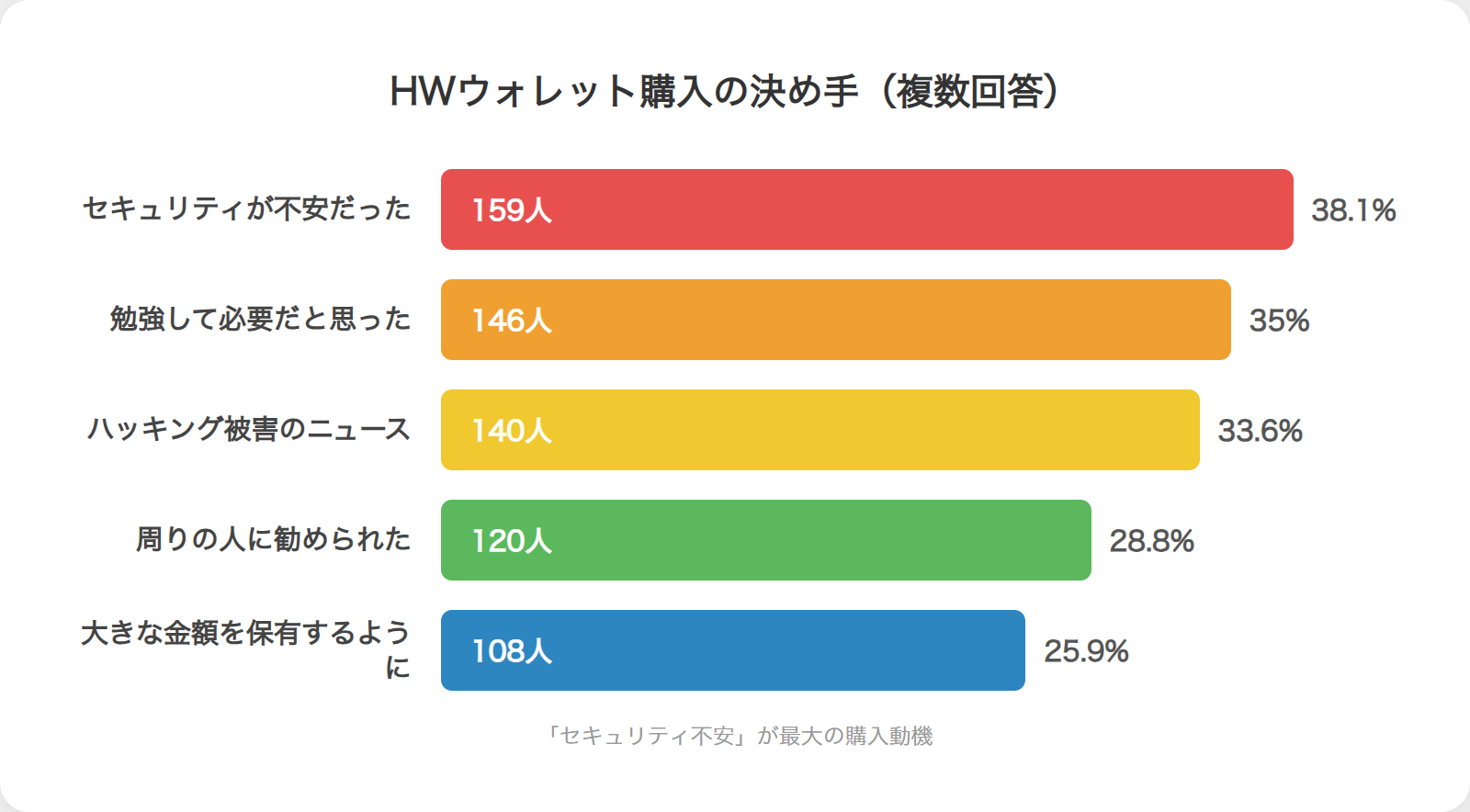
A cold wallet is a method where you manage the private key and recovery phrase yourself, rather than leaving that responsibility to an exchange. The responsibility of self-custody is heavier, but it's a way to avoid leaving long-term holdings on an exchange indefinitely.
How to manage crypto assets with a cold wallet
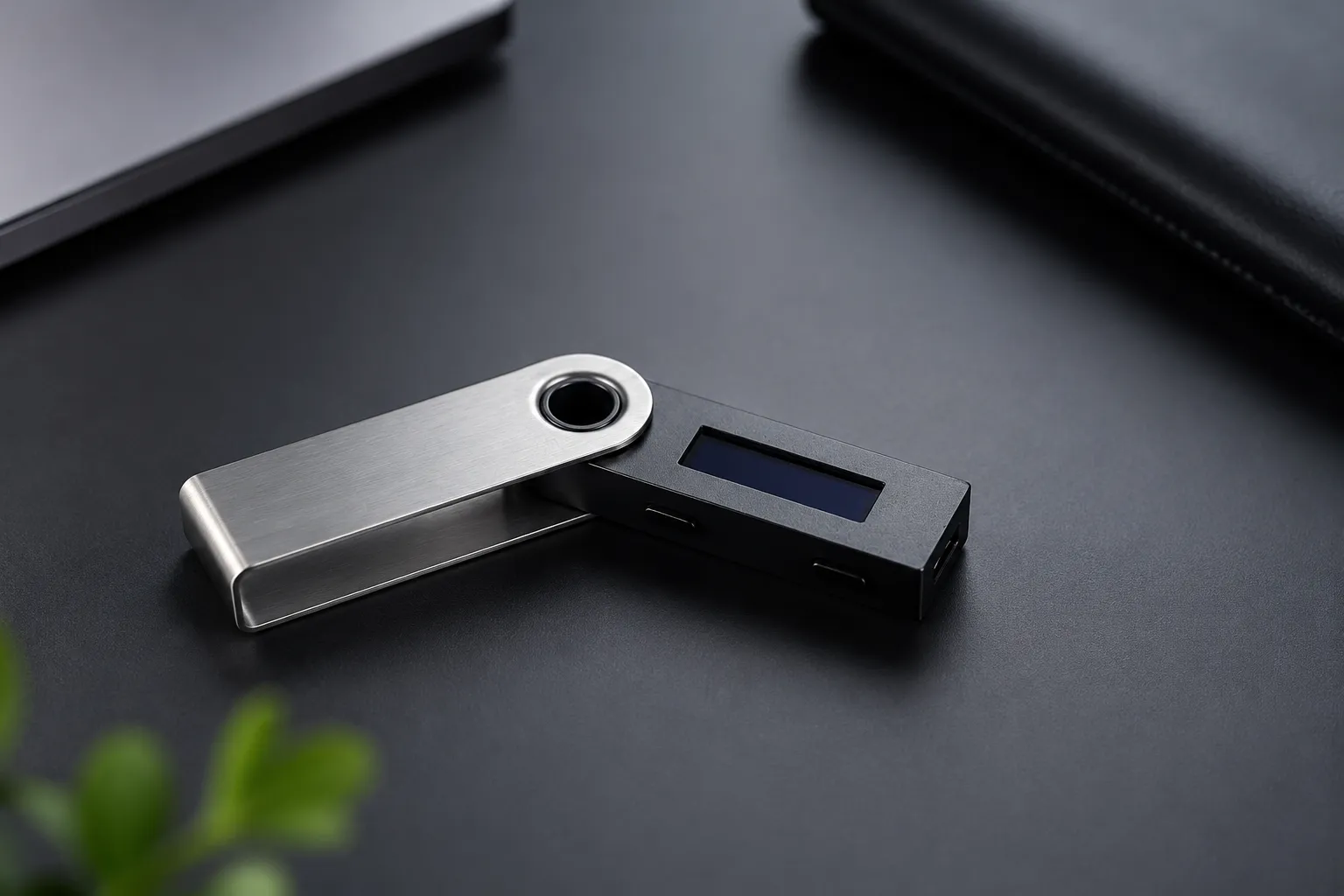
The main ways to manage crypto assets with a cold wallet are hardware wallets and paper wallets. Both methods keep the private key and recovery phrase isolated from any online environment.
That said, some methods are easier for beginners to handle, while others are more prone to management mistakes. You need to consider not just security, but also whether you can realistically keep managing it yourself over time.
Hardware wallets: storing the private key on a dedicated device
A hardware wallet is a method of managing the private key for your crypto assets on a dedicated device. It connects to a computer or smartphone when you send a transaction, but since the private key itself is never placed on an internet-connected device, it's widely used as a method suited to long-term storage.
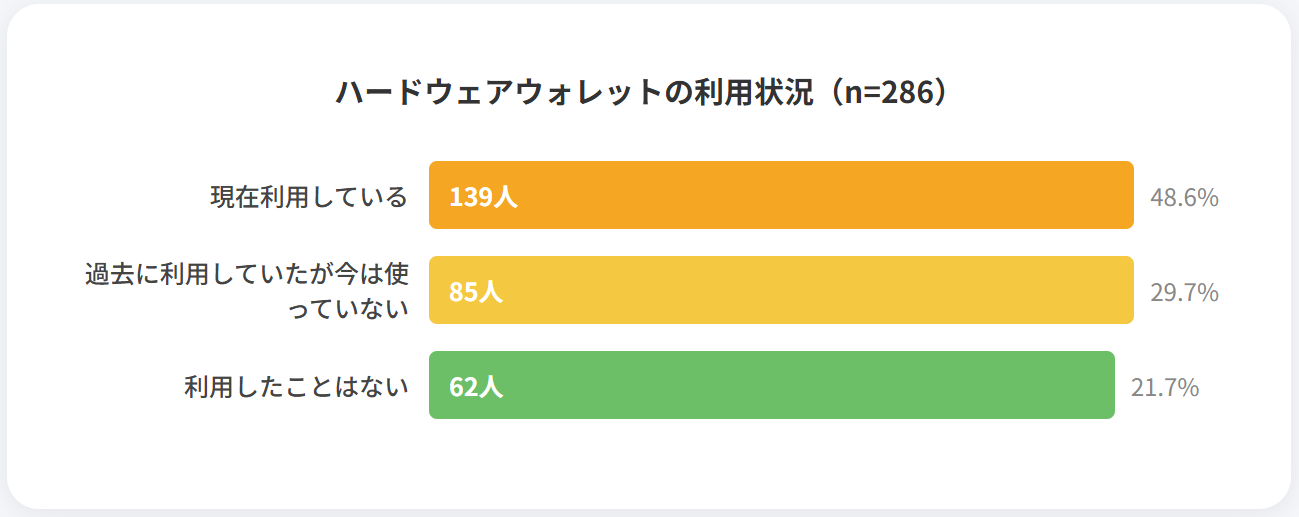
In a survey of 286 crypto holders, 48.6% said they "currently use" a hardware wallet. Another 29.7% said they "used to use one but don't anymore," meaning that including past use, roughly 80% have tried one at some point.
The larger the investment amount, the higher the hardware wallet usage rate tends to be. In the survey, 68.3% of respondents with investments between ¥100,000 and under ¥500,000 said they currently use one, as did 65.4% of those with ¥500,000 or more invested. This suggests that the larger a person's holdings, the more likely they are to feel the need to manage the private key with a dedicated device.
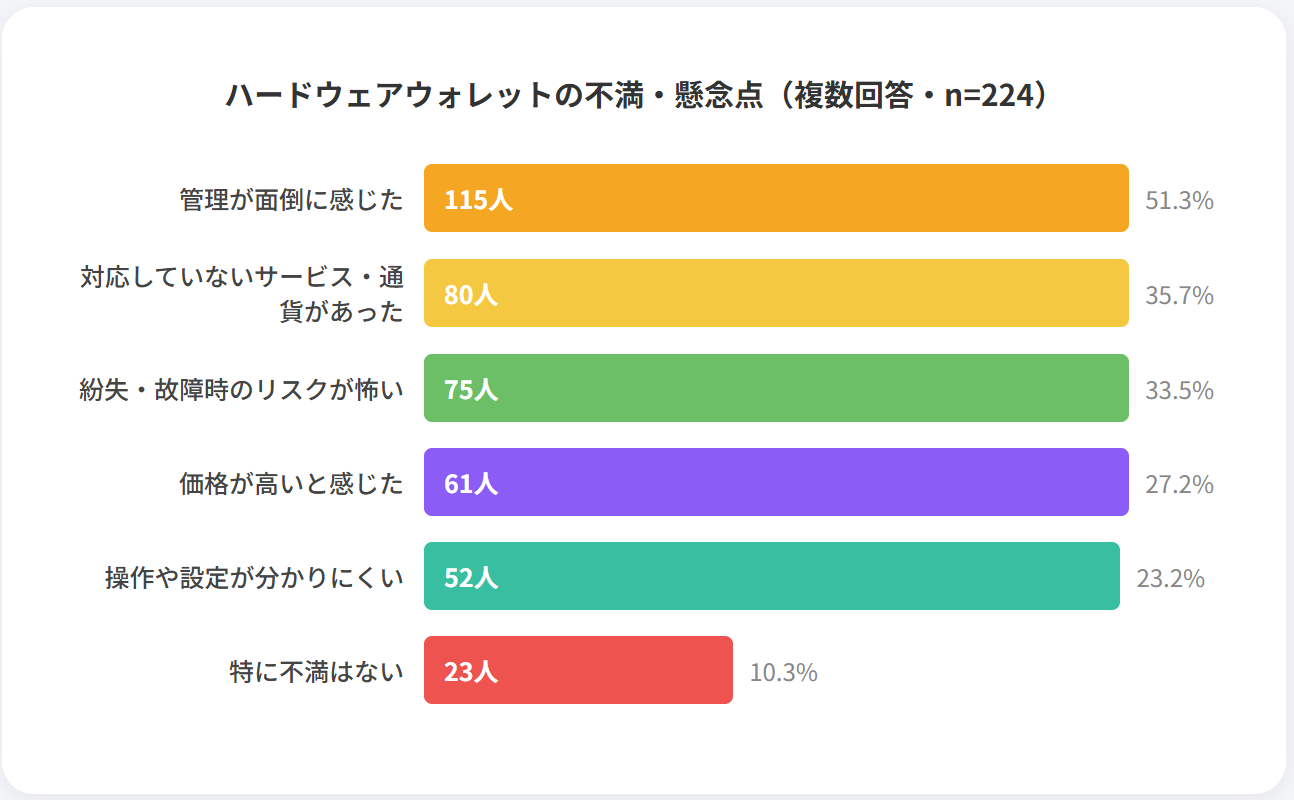
On the other hand, hardware wallets aren't a convenience-first tool. Among those with hands-on experience, the most common complaint was "managing it felt like a hassle," cited by 51.3% of respondents. Other responses included concerns such as "fear of the risk of losing or damaging the device" and "unclear operation or setup," indicating that there's a certain amount of ongoing effort involved once you adopt one.
For this reason, hardware wallets are better suited to people who want to store a substantial amount long-term rather than trade crypto assets frequently. While they make it easier to strengthen security, you'll need to manage the device and the recovery phrase yourself, so it's important to understand how the system works before using one.
Paper wallets: recording the private key or recovery phrase on paper
A paper wallet is a method of recording the private key or recovery phrase on paper. Because it isn't stored in an online environment, if created and stored properly, it can help reduce the risk of leaks over the internet.
On the other hand, paper has a physical weakness. Information can become unreadable due to water damage, fire, tearing, ink fading, or simple loss.
Care is also needed when it comes to how a paper wallet is created. If the private key is generated in an online environment, or if information ends up remaining on a printer or in image data, there's a risk that it could be leaked unintentionally.
For this reason, it's not advisable to create one casually, thinking it's simply a matter of writing something down on paper. When creating a paper wallet, you need to carefully verify both the environment used to create it and how it will be stored.
Points to watch out for when managing crypto assets with a cold wallet

A cold wallet is a management method that makes it easier to reduce the risk of an online leak. However, simply using one doesn't make you automatically safe.
One point that deserves particular attention is that the burden of self-custody becomes greater. Unlike an exchange, where you can typically reset your password, if you lose your recovery phrase or private key, recovery may become difficult.
Losing your recovery phrase can make recovery impossible
A recovery phrase is a set of words used to restore a wallet. Even if your wallet device breaks, your app gets deleted, or you switch to a new smartphone, as long as you still have the recovery phrase, you may be able to restore your wallet on a different device or a compatible wallet app.
In fact, there are past recovery cases where people regained access to their assets using a recovery phrase after their app had stopped working. For example, in the Copay Wallet case (in Japanese), the app disappeared after a phone change and login became impossible, but because the recovery phrase had been kept, the user was able to restore access through Bitpay Wallet and regain access to roughly 3 BTC. Similarly, in the Alta Wallet case (in Japanese), the wallet could no longer be opened after the app's service ended, but the user was able to restore it in MetaMask using their 12-word recovery phrase.
On the other hand, if you've lost your recovery phrase, you may not be able to restore your wallet in the same way. Self-custody wallets for crypto assets generally don't have a mechanism — unlike an exchange or a bank — that lets you re-issue your management information through identity verification.
For this reason, your recovery phrase should be treated not as a simple memo, but as the single most important piece of information for accessing your crypto assets. Decide on a storage location and keep it in a form that a third party can't view.
Don't store your recovery phrase on your smartphone or in the cloud
It's safer not to store your recovery phrase in a notes app, in photos, or in cloud storage on your smartphone. These are convenient, but because they're connected to an online environment, if the information leaks, a third party could use it to restore your wallet.
In particular, you should avoid saving it as a screenshot. Image data can be automatically synced to the cloud, so even if you think you're keeping it offline, it may actually still be sitting online somewhere.
The basic approach is to record your recovery phrase on paper or a metal plate and store it offline. If you store it on paper, be careful about the storage location as well, to protect against water damage, fire, and loss.
Buy hardware wallets from the official site or an authorized retailer
When using a hardware wallet, it's important to purchase it from the official website or an authorized retailer. With a used device or one bought through an unofficial channel, you can't completely rule out the possibility that a third party has already set it up in advance.
One thing to watch for in particular is a device that comes with the recovery phrase already included at the time of purchase. With a genuine hardware wallet, the recovery phrase is generated by the user themselves during initial setup, and they record it on their own. If a device arrives with a piece of paper already showing a recovery phrase, there's a possibility that a third party already knows that phrase.
If you use a device like this, after you deposit crypto assets, a third party could use the same recovery phrase to restore the wallet and move your assets. In fact, hardware wallet maker Ledger has issued a warning (in Japanese) about scams involving pre-configured devices or recovery phrases prepared in advance for users.
For this reason, it's important to purchase hardware wallets only through trusted sales channels and always complete the initial setup yourself. If a device arrives with the recovery phrase already provided, or appears to have already been opened or is in an otherwise unusual condition, it's safer not to use it.
Conclusion
Smartphone app-based wallets are a convenient way to manage crypto assets yourself. They make it easy to check your balance and send funds from your phone, and they suit small holdings and everyday use well.
At the same time, a typical smartphone app-based wallet is not itself a cold wallet. That's because a cold wallet is, by definition, a method that keeps the private key needed to move crypto assets isolated from the internet.
When storing crypto assets long-term, it's important not to base your decision on an app's convenience alone. You also need to think through how you'll protect your recovery phrase and private key, and consider methods such as a hardware wallet where appropriate.
A cold wallet is a strong option for enhancing security. However, if managed incorrectly, you risk losing access to your own assets. Understand both the mechanics and the precautions involved, and choose a management method that fits how much you hold and how you plan to use it.
This article is for informational purposes only and does not constitute financial or investment advice. Please consult a qualified professional before making investment decisions.


