


As more people prepare for retirement through New NISA and index investing, where do crypto assets (also known as virtual currencies) and staking fit into the picture? How far are investors willing to incorporate a highly volatile asset class into their retirement funds? This report summarizes investors' real views based on survey data.
Clabo surveyed 600 people who either hold a New NISA account or invest with retirement funds in mind. This report organizes the findings around the intensity of retirement anxiety and preparedness, the composition of respondents' investment portfolios, and the role of crypto assets and staking.
*The figures in this article are aggregated from respondents' self-reported answers.
1. Retirement Funds: 65% Feel 'Anxious'
Regarding funds for daily living in retirement, 36.0% answered 'somewhat anxious' and 29.2% answered 'very anxious,' for a combined 65.2% who feel anxious.
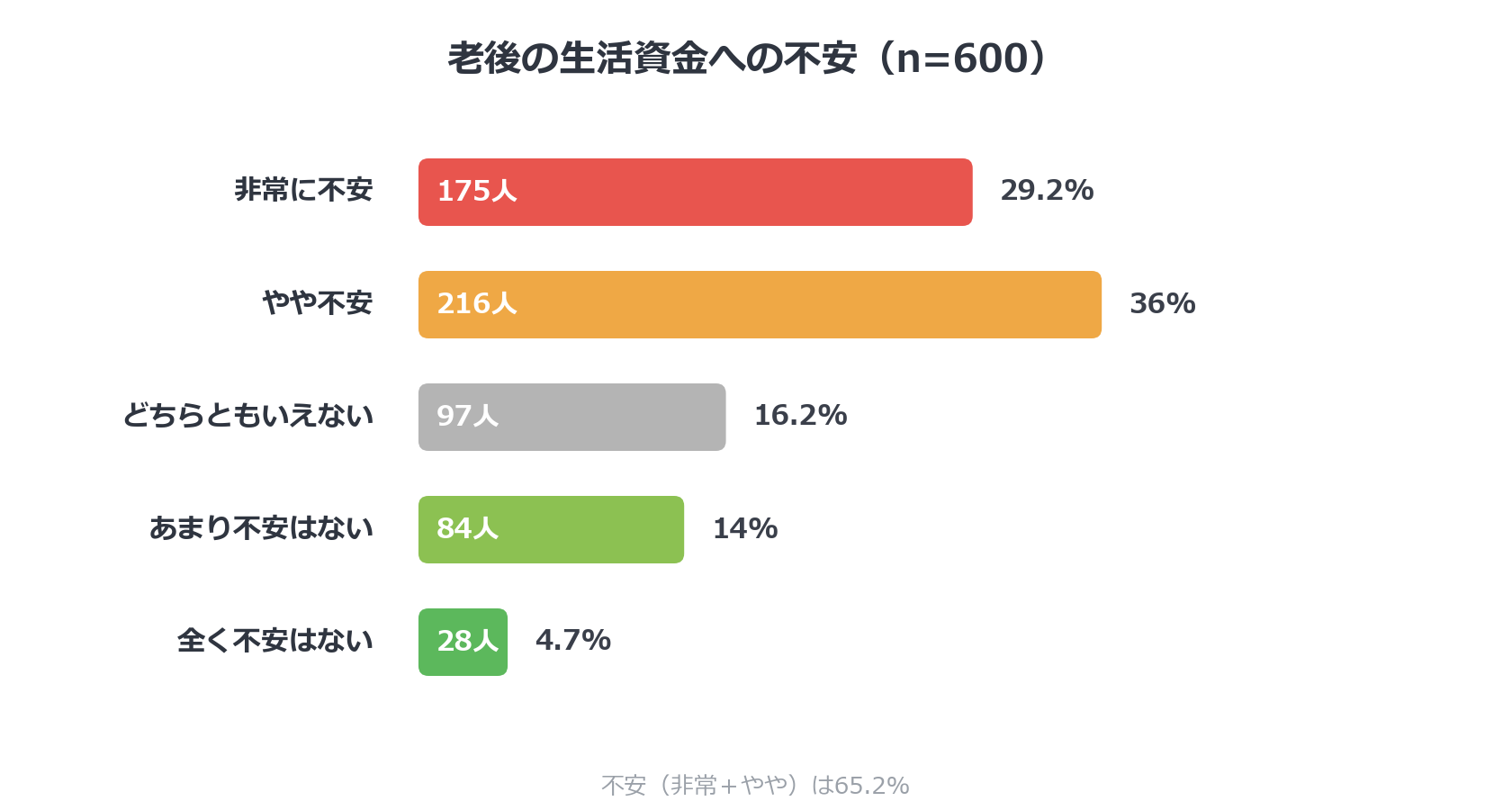
1-1. Distribution of Retirement Anxiety (n=600)
Anxiety Level | Responses | Percentage |
|---|---|---|
Very anxious | 175 | 29.2% |
Somewhat anxious | 216 | 36.0% |
Neither | 97 | 16.2% |
Not very anxious | 84 | 14.0% |
Not anxious at all | 28 | 4.7% |
1-2. Those in Their 40s Are Most Anxious
By age group, 51% of respondents in their 40s answered 'very anxious,' making them the most anxious segment. Among those aged 70 and older, the share answering 'not very anxious' rises to 33%, suggesting anxiety eases with age.
Anxiety Level \ Age Group | 30s | 40s | 50s | 60s | 70s+ |
|---|---|---|---|---|---|
Very anxious | 27% | 51% | 35% | 20% | 20% |
Not very/not at all anxious | 6% | 6% | 12% | 17% | 41% |
2. About Half Cite '¥20–50 Million' as the Amount Needed; 54% Say Preparation Is 'Insufficient' or Worse
As for the amount respondents believe they will need for retirement, 24.7% said ¥20–30 million and 23.7% said ¥30–50 million (approximately US$130,000–330,000 at roughly ¥150/US$1), together accounting for about half of respondents. Another 21.3% cited ¥50 million or more. Meanwhile, preparation levels lagged: 45.2% said their preparation was 'insufficient' and 8.7% said they had 'not yet started,' for a combined 53.9% at 'insufficient or worse.'
2-1. Amount Believed Necessary (n=600)
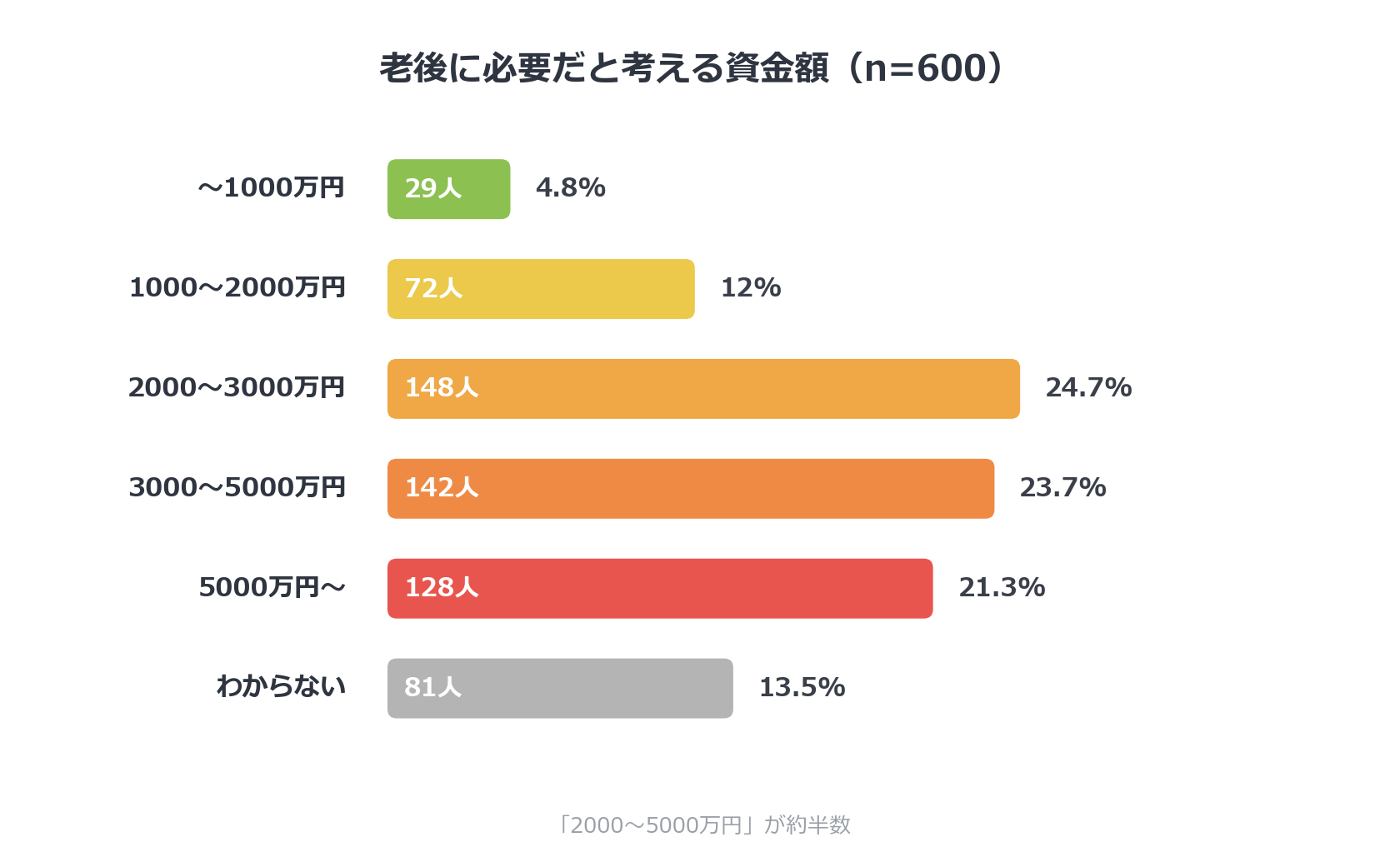
Amount Needed | Responses | Percentage |
|---|---|---|
Up to ¥10 million | 29 | 4.8% |
¥10–20 million | 72 | 12.0% |
¥20–30 million | 148 | 24.7% |
¥30–50 million | 142 | 23.7% |
¥50 million or more | 128 | 21.3% |
Not sure | 81 | 13.5% |
2-2. Preparation Status (n=600)
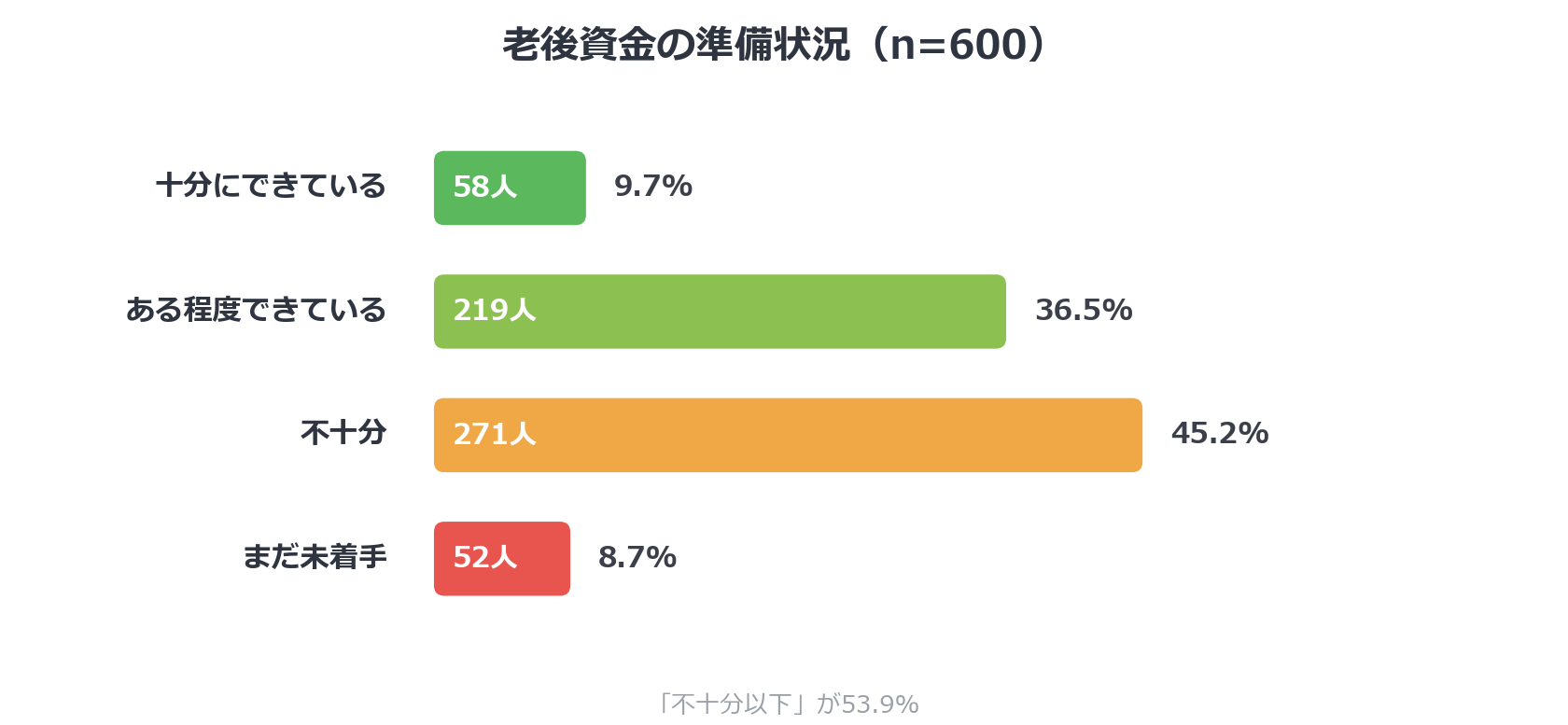
Preparation Status | Responses | Percentage |
|---|---|---|
Fully prepared | 58 | 9.7% |
Somewhat prepared | 219 | 36.5% |
Insufficient | 271 | 45.2% |
Not yet started | 52 | 8.7% |
3. Individual Stocks Lead Portfolios at 59%; Crypto Stays Under 10%
Among current investment activities (multiple answers allowed), 'individual stocks' led at 59.0%, followed by 'index funds' at 32.8%. 'Long-term crypto holding (HODL)' came in at 8.8% and 'staking' at 4.8%, meaning fewer than one in ten respondents incorporate crypto assets into their portfolios.
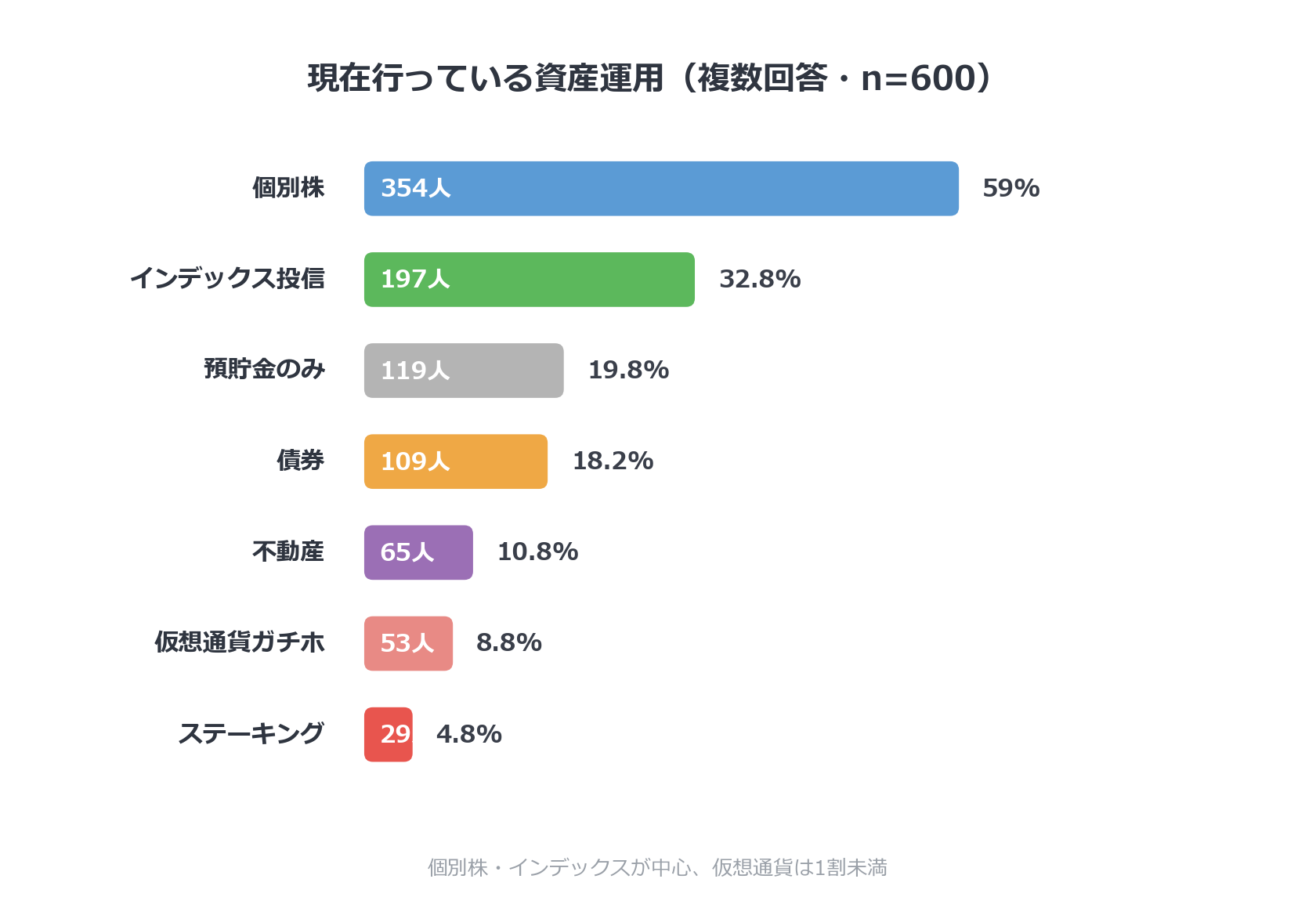
3-1. Current Investment Activities (Multiple Answers, n=600)
Investment Type | Responses | Percentage |
|---|---|---|
Individual stocks | 354 | 59.0% |
Index funds | 197 | 32.8% |
Savings/deposits only | 119 | 19.8% |
Bonds | 109 | 18.2% |
Real estate | 65 | 10.8% |
Long-term crypto holding (HODL) | 53 | 8.8% |
Staking | 29 | 4.8% |
3-2. New NISA Utilization (n=600)
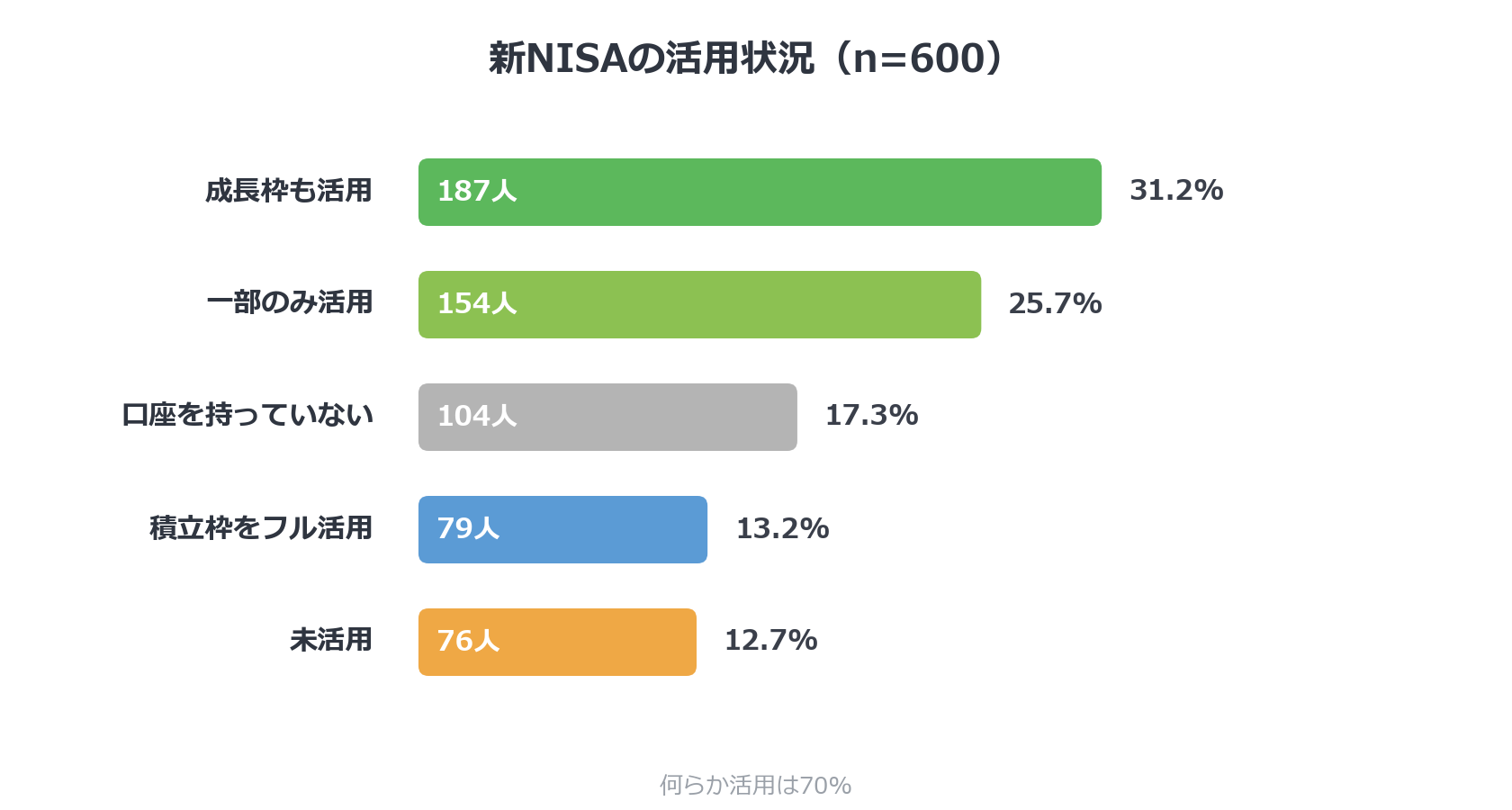
For New NISA, 31.2% said they 'also use the growth investment quota' and 25.7% said they 'use it partially,' meaning roughly seven in ten respondents make some use of the program.
New NISA Utilization | Responses | Percentage |
|---|---|---|
Also uses the growth investment quota | 187 | 31.2% |
Uses it partially | 154 | 25.7% |
Does not have an account | 104 | 17.3% |
Fully uses the tsumitate (regular investment) quota | 79 | 13.2% |
Not used | 76 | 12.7% |
4. Crypto's Share of Total Assets: 75% Say '0%'
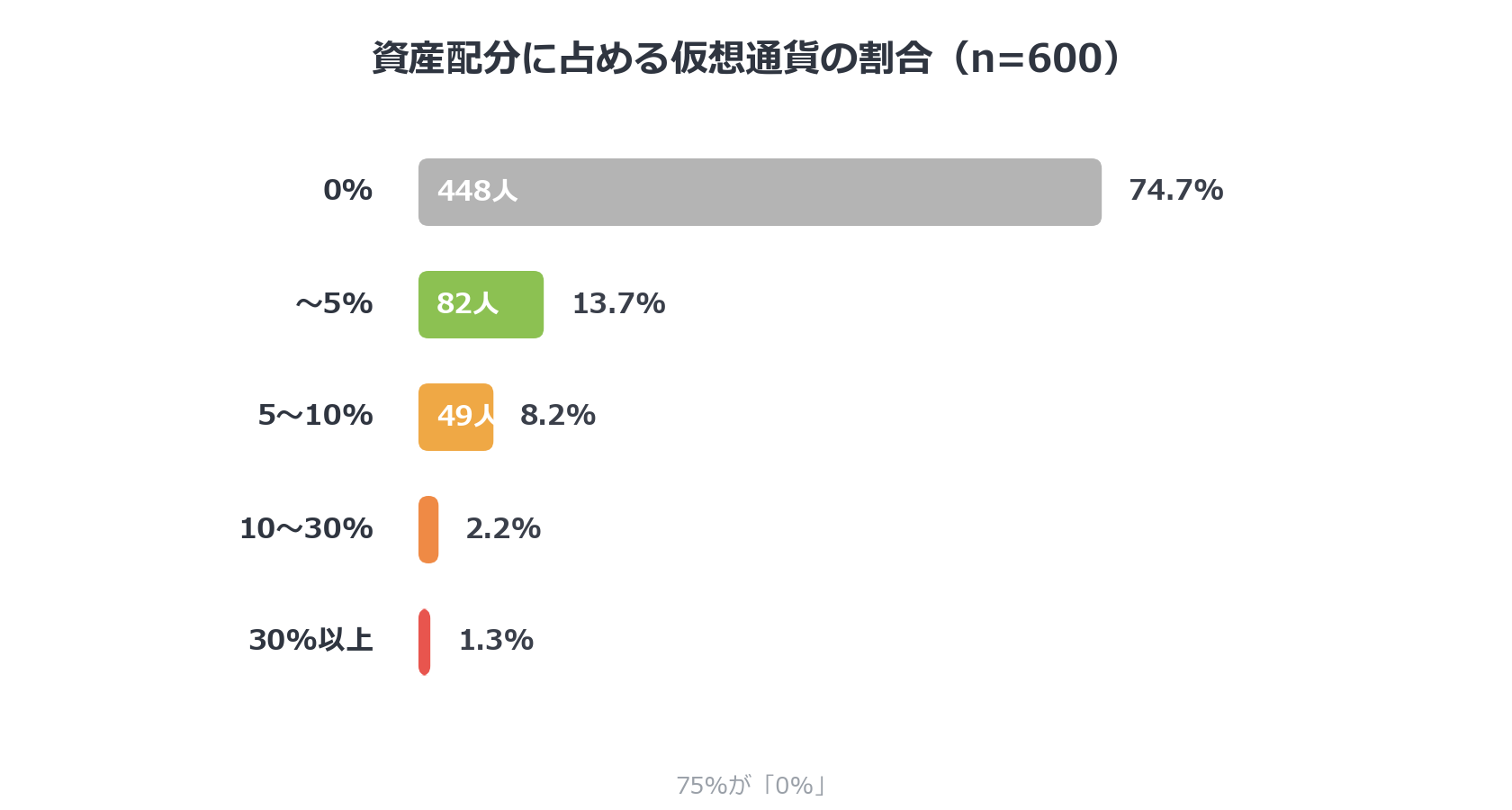
Regarding crypto's share of respondents' overall asset allocation, 74.7% said '0%.' Even among those who do hold crypto assets, most keep the share small: 13.7% said 'up to 5%' and 8.2% said '5–10%.'
Crypto's Share of Assets | Responses | Percentage |
|---|---|---|
0% | 448 | 74.7% |
Up to 5% | 82 | 13.7% |
5–10% | 49 | 8.2% |
10–30% | 13 | 2.2% |
30% or more | 8 | 1.3% |
5. Staking Rewards for Retirement? 65% Say 'Not Considering It'
When asked about using staking rewards as part of their retirement funds, 65.3% said 'not considering it.' Only 17.2% said they 'would like to use some of it' and 11.7% said they 'have concerns but would consider it,' meaning the share of respondents open to the idea remains limited.
.png)
5-1. Willingness to Use Staking Rewards for Retirement (n=600)
Willingness | Responses | Percentage |
|---|---|---|
Would actively use it | 35 | 5.8% |
Would use some of it | 103 | 17.2% |
Have concerns but would consider it | 70 | 11.7% |
Not considering it | 392 | 65.3% |
5-2. Willingness Splits Sharply by Crypto Holding Ratio
Cross-referencing willingness with crypto holding ratio reveals a clear divide. Among respondents with '0%' crypto holdings, 80% said 'not considering it,' while among those holding '5–10%,' seven in ten were positive about using staking rewards (combining 'would actively use it' and 'would use some of it').
Willingness \ Crypto Share | 0% | Up to 5% | 5–10% | 10–30% |
|---|---|---|---|---|
Actively/partially willing | 9% | 61% | 70% | 61% |
Not considering it | 80% | 24% | 12% | 23% |
6. Top Concern About Using Crypto for Retirement: 'Price Volatility'
Among concerns about incorporating crypto assets into retirement funds (multiple answers allowed), 'price volatility' stood out at 68.0%. It was followed by 'hacking' at 41.8%, 'taxes' at 28.0%, and 'regulation' at 20.3%.
.png)
Concern (Multiple Answers, n=600) | Responses | Percentage |
|---|---|---|
Price volatility | 408 | 68.0% |
Hacking | 251 | 41.8% |
Taxes | 168 | 28.0% |
Regulation | 122 | 20.3% |
Inheritance | 75 | 12.5% |
No concerns | 104 | 17.3% |
7. Summary
This survey revealed the following points about asset formation among the New NISA generation and how crypto assets fit into it:
- 65.2% feel anxious about retirement funds, with respondents in their 40s the most anxious (51% 'very anxious').
- About half cite ¥20–50 million as the amount needed; 53.9% rate their preparation as 'insufficient' or worse.
- Individual stocks (59.0%) and index funds (32.8%) dominate investment activity, while crypto assets remain under 10%.
- 74.7% report a 0% crypto allocation within their total assets.
- 65.3% are 'not considering' using staking rewards for retirement, though willingness rises among those with larger crypto holdings.
- The top concern about using crypto for retirement is 'price volatility,' cited by 68.0%.
8. Survey Overview
- Survey title: Survey on Asset-Building Styles and Retirement Anxiety
- Survey conducted by: Clabo Inc.
- Survey method: Internet survey (self-administered questionnaire)
- Survey population: Men and women who hold a New NISA account or invest with retirement funds in mind
- Valid responses: 600
- Survey period: May 2026
- Note: The figures in this article are based on respondents' self-reported answers. For questions allowing multiple answers, totals may exceed 100%.
Charts and figures may be quoted or reproduced provided the source is credited as 'Clabo Inc. survey.'
9. Key Survey Questions
Q1. How anxious do you feel about your living expenses in retirement?
Q2. How much money do you believe you will need for retirement?
Q3. Which best describes your current level of retirement fund preparation?
Q4. Please select all the investment activities you currently engage in.
Q5. Please tell us how you are using New NISA.
Q6. What share of your overall asset allocation is crypto assets?
Q7. Are you considering using staking rewards as part of your retirement funds?
Q8. Please select all the concerns you have about incorporating crypto assets into your retirement funds.
Q9. What is your total investment asset value, including crypto assets?
Q10. Which best describes your position or stance on crypto assets and investing?
Q11. Please share your honest thoughts on incorporating crypto assets into your retirement funds.
This article is for informational purposes only and does not constitute financial or investment advice. Please consult a qualified professional before making investment decisions.


