


Which crypto assets (also known as virtual currencies) are investors watching in 2026?
In our latest independent survey of 992 respondents, Bitcoin came out on top with 15.6% of the vote, once again demonstrating its enduring trust among investors.
Behind that headline number, however, Ethereum, XRP, and rising challenger Solana are locked in a fierce battle for market share.
This survey goes beyond a simple popularity ranking to dig into investor psychology — specifically, why respondents chose the coins they did.
While many investors say they believe in long-term potential, the data also reveals a riskier reality: one in four respondents said social media influenced their choice.
Here is the full picture of real purchase-intent data that could shape crypto investment strategy heading into 2026.
Top 9 Crypto Assets Investors Want to Buy in 2026
Bitcoin Takes the Top Spot at 15.6%, Reasserting Its Dominance
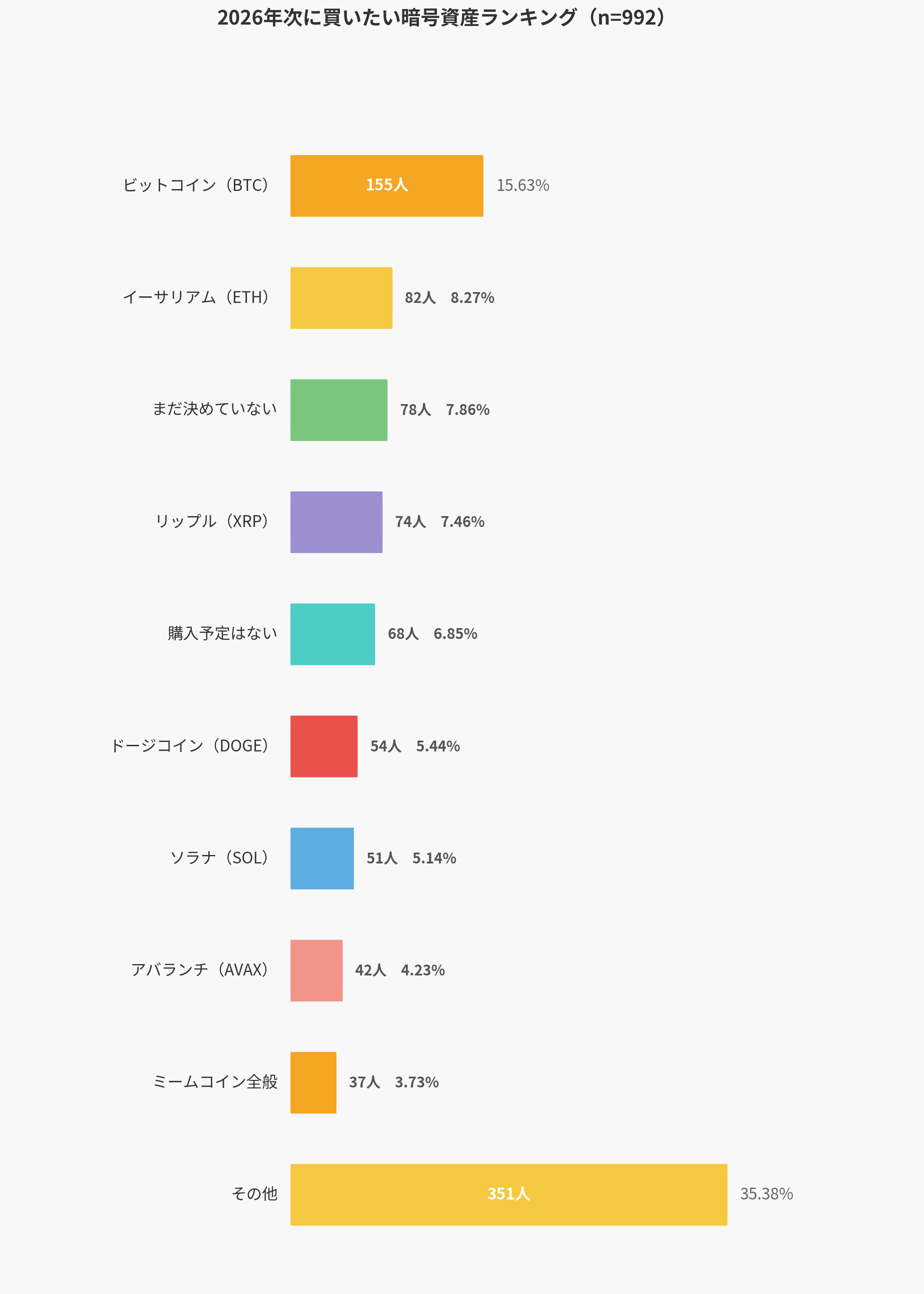
Answer | Responses | Share |
|---|---|---|
Bitcoin (BTC) | 155 | 15.63% |
Ethereum (ETH) | 82 | 8.27% |
Undecided | 78 | 7.86% |
XRP | 74 | 7.46% |
No plans to purchase | 68 | 6.85% |
Dogecoin (DOGE) | 54 | 5.44% |
Solana (SOL) | 51 | 5.14% |
Avalanche (AVAX) | 42 | 4.23% |
Meme coins (general) | 37 | 3.73% |
Other | 351 | 35.38% |
Bitcoin claimed a clear first place among coins investors plan to buy in 2026, garnering 15.63% of responses.
That is roughly double the share of second-place Ethereum, showing that Bitcoin's reputation as “digital gold” remains unshaken even as market uncertainty grows.
The result clearly reflects investor psychology that treats BTC as the core holding of a portfolio, including among those planning additional purchases.
At the same time, “undecided” ranked third with 7.86%, a notable data point for the 2026 market.
A meaningful segment of investors clearly want to invest but are cautiously waiting to see which project becomes the next trend.
With many investors still in the information-gathering stage, where this capital eventually flows could shift significantly depending on future market conditions.
Among altcoins, Ethereum (8.27%) and XRP (7.46%) held steady popularity.
Combined, these “big three” account for about 31% of responses, showing that roughly three in ten investors favor concentrating their capital in established, proven assets.
Interest in emerging tokens is rising too, but the underlying pattern — investors first gravitating toward stable platforms and coins with real payment demand — has not changed.
Rising Challengers: SOL and Meme Coins Approach a Combined 20%
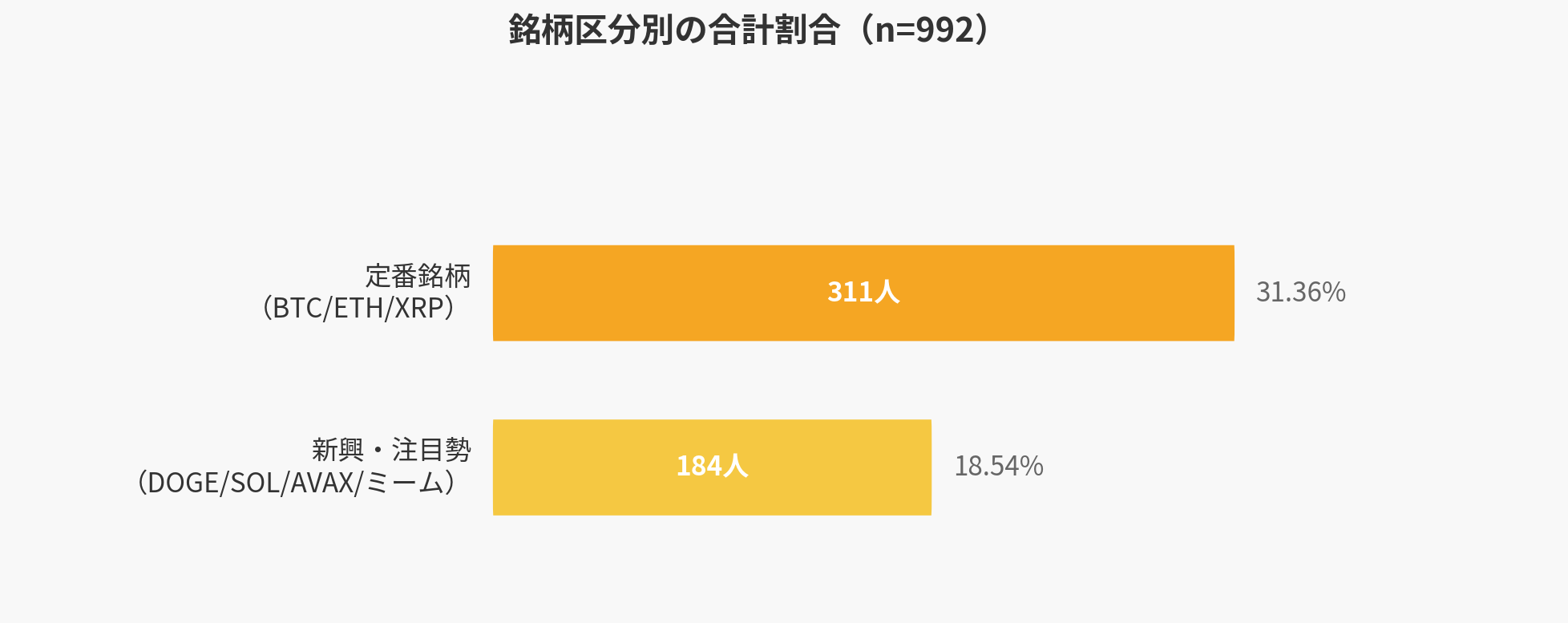
Category | Combined Share |
|---|---|
Established coins (BTC/ETH/XRP) | 31.36% |
Emerging/trending coins (DOGE/SOL/AVAX/memes) | 18.54% |
The survey found that high-speed layer-1 chains such as Solana (5.14%) and Avalanche (4.23%) are steadily gaining support.
These coins are valued for their technical advantages and expanding ecosystems, and investor perception is shifting from viewing them as purely speculative to seeing them as investments with real utility.
The fact that several emerging chains have broken into the top 10 is evidence that investor attention is becoming more diversified.
Also notable: combined interest in “meme coins” — Dogecoin (5.44%) plus meme coins in general (3.73%) — reaches roughly 9%.
Add Solana and other emerging assets, and this challenger group totals about 18%, closing in on the established coins.
A meaningful segment of investors is chasing explosive gains, and community-driven price action looks set to remain a significant part of the market in 2026.
Today's investors are, in reality, balancing technology-driven coins with meme coins that ride on social media buzz.
The data hints at a strategy of anchoring risk with stable assets like Bitcoin while allocating a portion of capital to emerging coins with higher return potential.
As portfolio diversification advances, established and newer coins are expected to keep fighting fiercely for market share.
Bitcoin Support Tops 22% Among Households Earning ¥10 Million or More
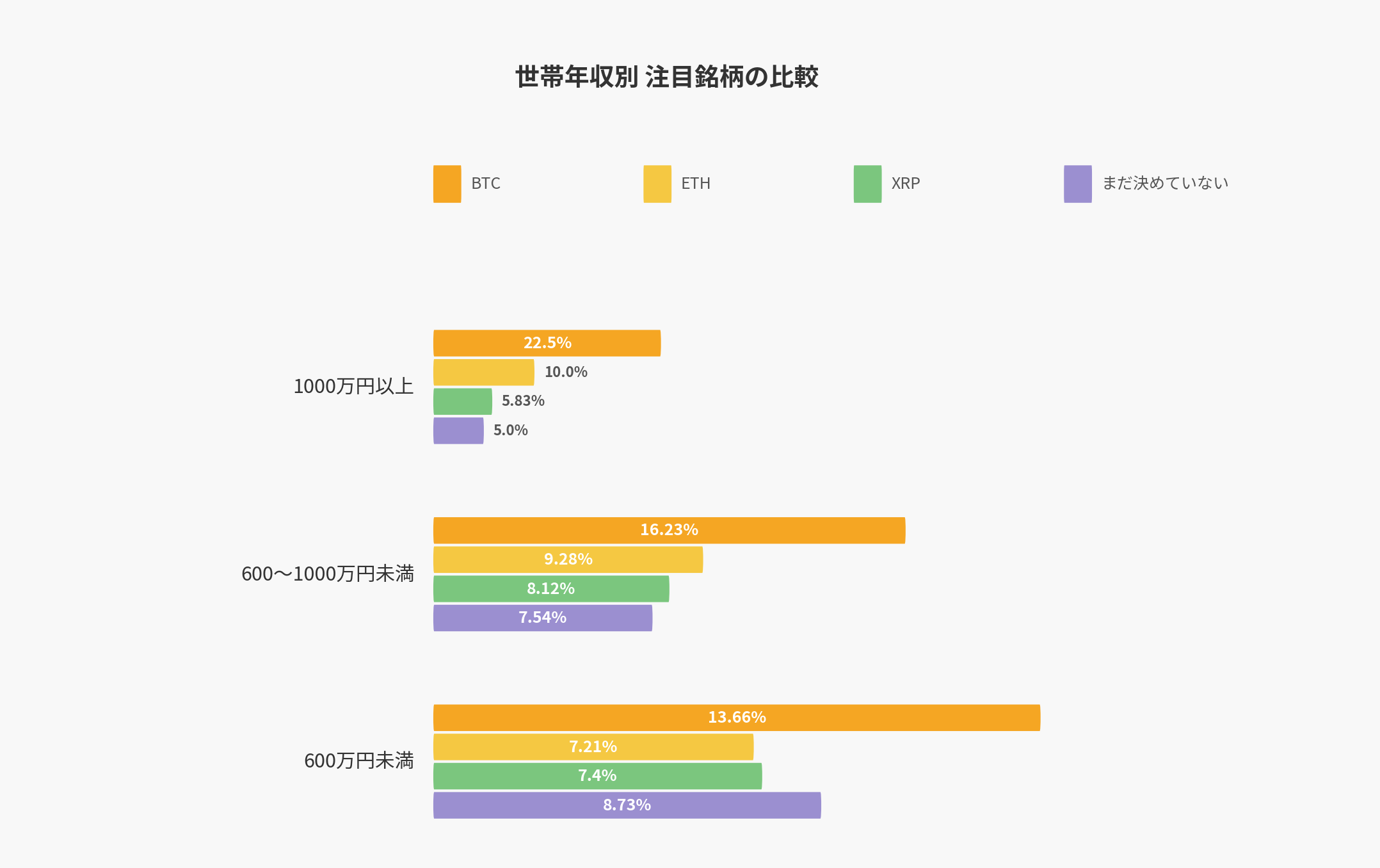
Household Income | n | BTC | ETH | XRP | Undecided |
|---|---|---|---|---|---|
¥10 million or more (approx. $67,000+) | 120 | 22.50% | 10.00% | 5.83% | 5.00% |
¥6–10 million (approx. $40,000–$67,000) | 345 | 16.23% | 9.28% | 8.12% | 7.54% |
Under ¥6 million (approx. under $40,000) | 527 | 13.66% | 7.21% | 7.40% | 8.73% |
(Yen figures converted to USD at an approximate rate of ¥150 = $1, for reference only.)
Cross-tabulating by household income shows that the higher the income bracket, the stronger the intent to invest in Bitcoin.
Among households earning ¥10 million or more, 22.50% support BTC — the highest figure across all income groups.
This suggests that higher-income investors are more likely to view crypto assets as a hedge against inflation and a means of asset protection, rather than as speculative gambling.
By contrast, among households earning under ¥6 million, BTC's share drops to 13.66%, with a greater tendency toward coins valued for their low price and unknown upside potential.
These investors appear to be weighing carefully — or hoping for a big win — with limited discretionary capital.
Because risk tolerance and investment goals differ by income bracket, clear differences also emerge in the types of coins preferred.
Support for Ethereum also rises with income, with higher-income respondents placing more value on its role as a smart contract platform.
XRP, meanwhile, shows little variation by income and draws steady support across a broad range of income brackets.
The data makes clear that, heading into 2026, personal financial circumstances exert a strong bias on which coins investors select.
Long-Term Potential Tops the List of Reasons to Buy — But Social Media Influence Cannot Be Ignored
Long-Term Potential Is the Top Reason at 32.9%
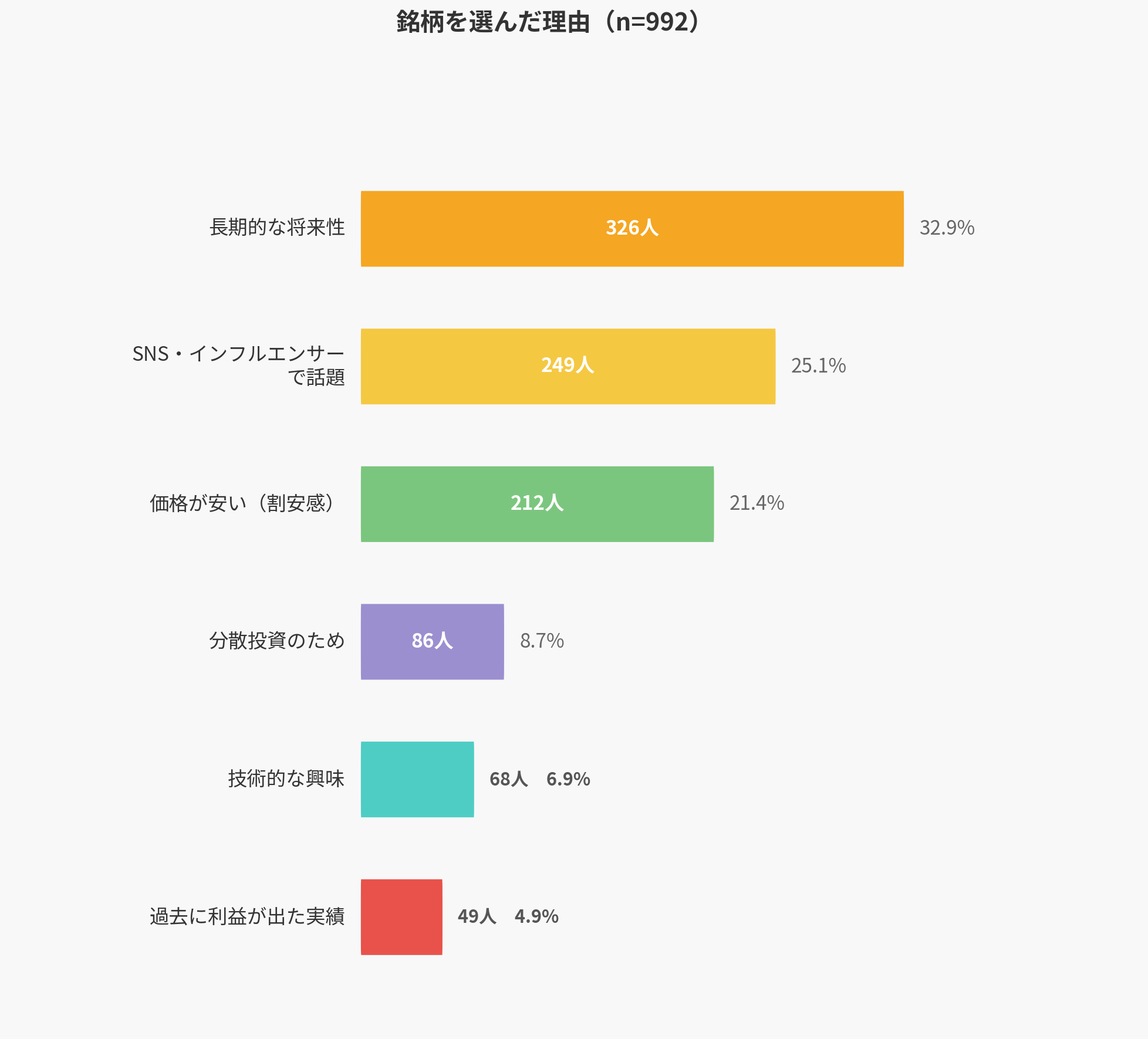
Reason for Interest | Share |
|---|---|
Long-term potential | 32.9% |
Trending on social media/among influencers | 25.1% |
Low price (perceived value) | 21.4% |
Portfolio diversification | 8.7% |
Technical interest | 6.9% |
Past profit track record | 4.9% |
The most common reason for choosing a coin was long-term potential, cited by 32.9% of respondents.
Roughly one in three investors is selecting coins based on a project's fundamental value and future adoption potential rather than short-term price movements.
As the market matures, a more disciplined, fundamentals-based approach to investing appears to be taking hold.
At the same time, social media and influencer buzz accounts for 25.1% of responses, showing it remains a powerful force.
One in four investors is making investment decisions based on trends they see on social media, revealing how strongly the spread of information drives coin selection.
This reflects a market structure unique to crypto assets, where buzz itself can push prices higher.
Another 21.4% cited low price or perceived value, showing that investment criteria are split.
A certain share of investors is driven by the psychology of accumulating a large quantity of low-priced coins, or by hopes of a rebound.
The data shows a market split roughly in two: the conventional rationale of long-term potential versus more emotional or intuitive factors like social buzz and price.
Short-Term Traders Prioritize Social Media Buzz, Long-Term Holders Choose Potential
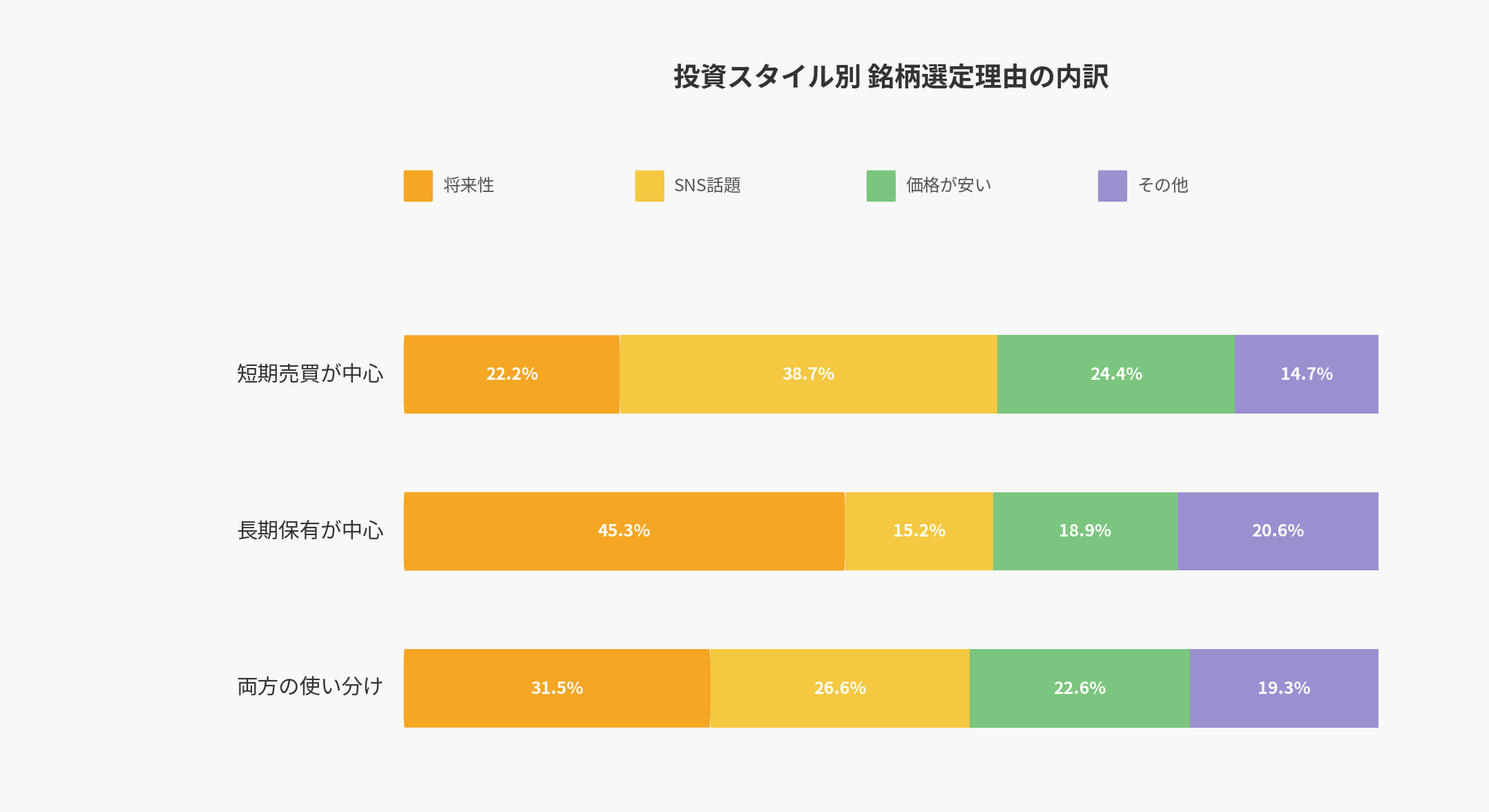
Investment Style | n | Long-Term Potential | Social Media Buzz | Low Price | Other |
|---|---|---|---|---|---|
Mainly short-term trading | 225 | 22.2% | 38.7% | 24.4% | 14.7% |
Mainly long-term holding | 349 | 45.3% | 15.2% | 18.9% | 20.6% |
Mix of both | 124 | 31.5% | 26.6% | 22.6% | 19.3% |
Broken down by investment style, 38.7% of short-term traders cited social media and influencer buzz as their reason for choosing a coin.
The numbers confirm that, for short-term traders who need to catch a trend early, social media is an indispensable source of information.
The more frequently investors trade, the more they tend to rely on real-time external information.
By contrast, among investors who assume long-term holding, 45.3% prioritize long-term potential — a result consistent with their investment style.
For HODLers, the data confirms that value appreciation over a multi-year horizon matters far more than short-term trends.
Only 15.2% chose a coin based on social media buzz, showing a coin-selection process markedly different from that of short-term traders.
A defining feature of the 2026 market is that the qualities investors look for in a coin differ clearly by investment style.
Investors who dollar-cost average or invest long-term tend to look for a project's underlying substance, while short-term traders prioritize liquidity and buzz.
Matching one's information-gathering approach to one's own investment style will likely be a key factor in determining investment outcomes.
Nearly 70% of Investors Who Prioritize Social Media Buzz Have Experienced Investment Losses
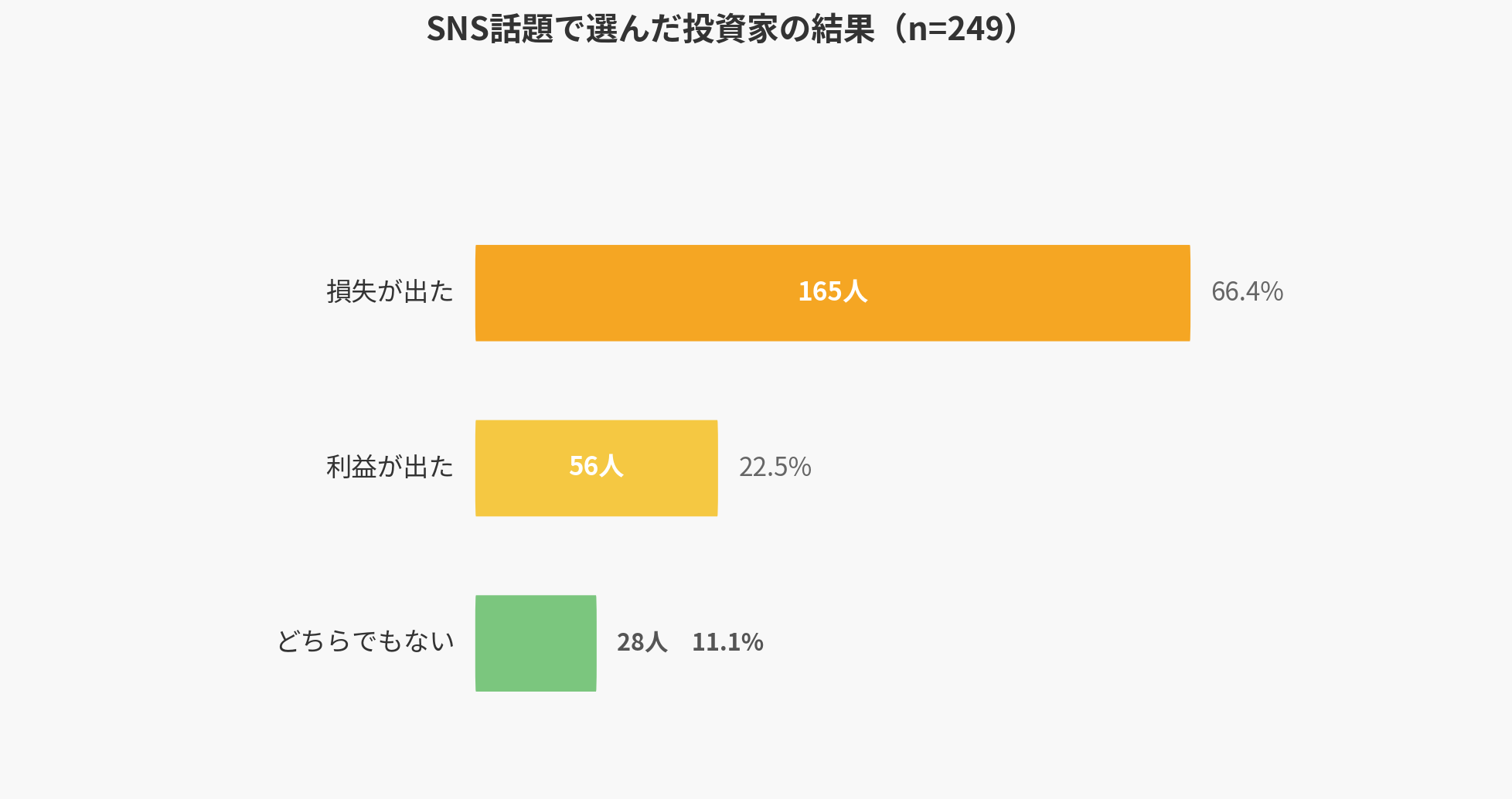
Reason for Interest: Social Media | n | Made a Profit | Incurred a Loss | Neither |
|---|---|---|---|---|
Prioritized social media buzz | 249 | 22.5% | 66.4% | 11.1% |
Focusing on the group that chose a coin based on social media buzz, about 66.4% reported having incurred a loss on their investment.
The numbers reflect the risk of buying at a peak after being drawn in by hype, or entering a trade after the information has already gone stale.
Choosing a coin based on social media is easy to do, but the data shows it is also a very high-risk behavior closely linked to investment losses.
Compared to investors who focused on long-term potential — who tend to show lower loss rates — the risk of relying on social media stands out even more starkly.
Investing purely by following others' recommendations or trends means lacking one's own decision-making framework, which also tends to delay actions such as cutting losses.
Given that 25.1% of investors currently rely on social media as their guide, this high loss rate is a fact that cannot be overlooked.
The data suggests that, for crypto investing in 2026, social media can be a powerful tool — but it is also a double-edged sword.
It underscores, once again, the importance of verifying information and checking a project's primary sources.
Pausing to evaluate a coin's long-term potential before jumping on a trend appears essential to achieving stable returns.
58.5% of Investors Plan to Increase Their Crypto Holdings in 2026
Intent to Expand Investment Reaches Nearly 60%, Signaling an Expansionary Mood
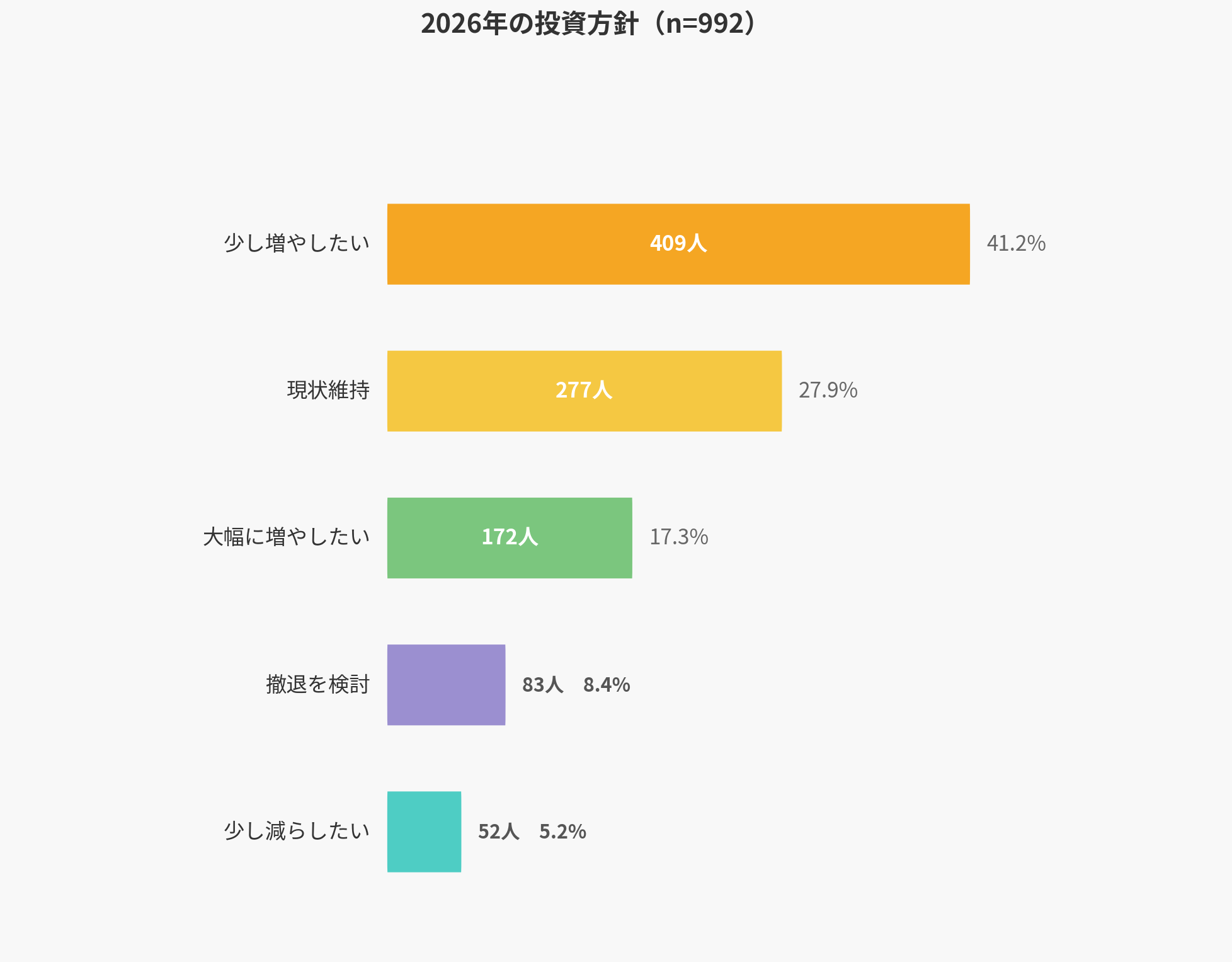
Plan | Share |
|---|---|
Increase slightly | 41.2% |
Keep current holdings | 27.9% |
Increase significantly | 17.3% |
Considering exiting | 8.4% |
Decrease slightly | 5.2% |
Asked about their investment plans for 2026, the most common response was “increase slightly,” at 41.2%.
Combined with the 17.3% who want to “increase significantly,” a total of 58.5% of respondents plan to expand their crypto investments.
The results reveal that many investors view the current market environment positively and are planning to commit additional capital.
At the same time, 27.9% said they would “keep current holdings,” reflecting a persistent, cautious wait-and-see stance.
Roughly three in ten investors are choosing to maintain their current portfolio and wait for the market to mature, rather than aggressively chasing growth.
While bullish, growth-oriented investors are the majority, the presence of risk-conscious investors also contributes to overall market stability.
Only 8.4% said they were “considering exiting” and 5.2% wanted to “decrease slightly,” meaning just over one in ten respondents intend to scale back.
More than 80% of investors chose to continue or expand their investments, indicating that expectations for the crypto market remain very high.
The data suggests that additional capital inflows from existing investors will be a major factor supporting the market in 2026.
Over 60% of Long-Term Holders Plan to Expand Assets Through Additional Investment
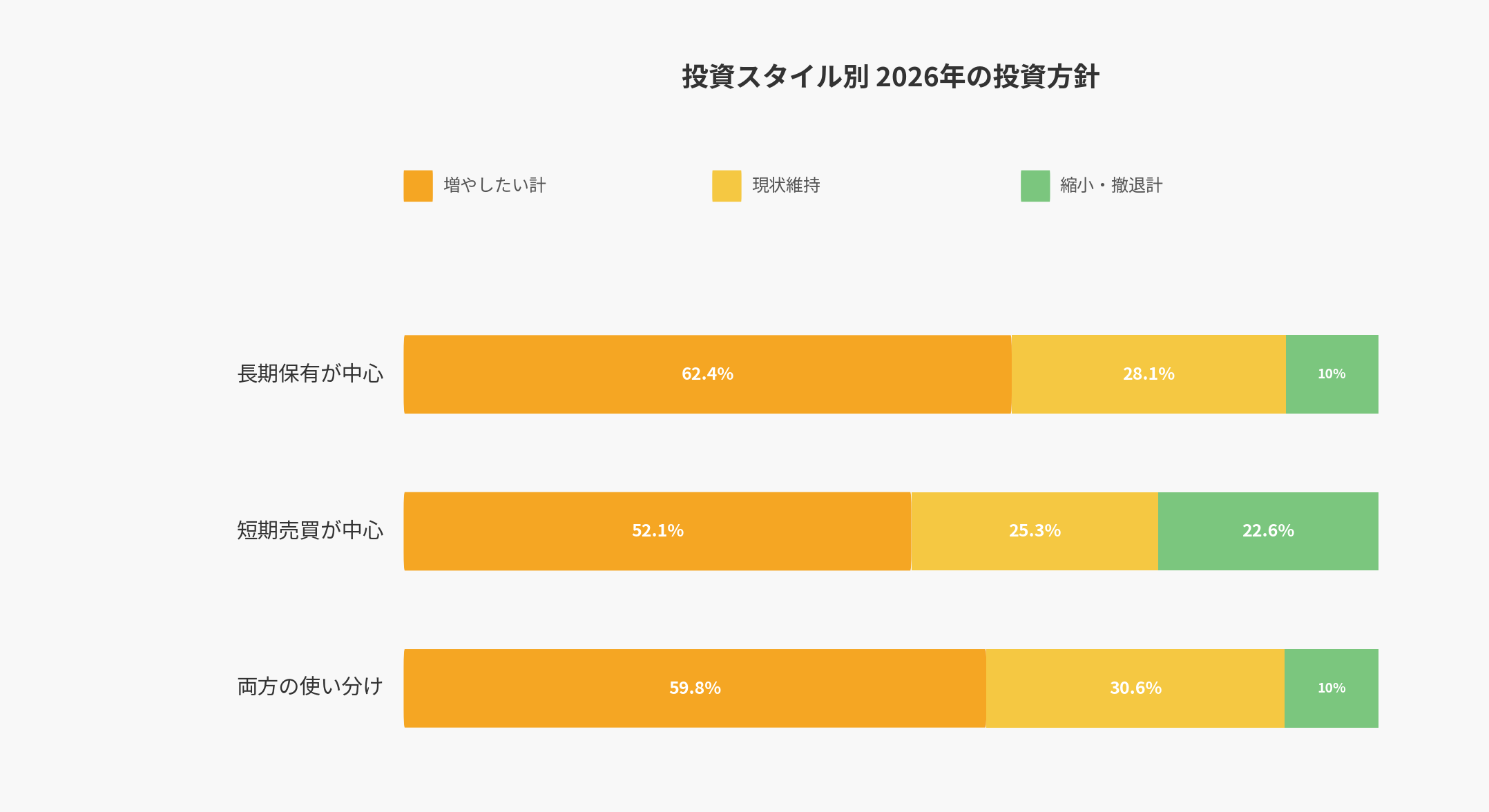
Investment Style | n | Total Wanting to Increase | Keep Current Holdings | Total Wanting to Reduce/Exit |
|---|---|---|---|---|
Mainly long-term holding | 349 | 62.4% | 28.1% | 9.5% |
Mainly short-term trading | 225 | 52.1% | 25.3% | 22.6% |
Mix of both | 124 | 59.8% | 30.6% | 9.6% |
By investment style, 62.4% of long-term holders (HODLers) said they wanted to increase their holdings — the highest level of expansion intent among all styles.
Investors who believe in long-term value appreciation notably tend to view current price levels as an opportunity to buy more.
Because they are planning their exit over a multi-year horizon, these investors clearly show a willingness to keep adding capital regardless of short-term volatility.
Among short-term traders, 52.1% want to increase their holdings, but 22.6% are considering reducing or exiting — a higher share than for any other style.
Because short-term traders operate amid sharp price swings, market fatigue or poor performance tends to translate directly into a change of course.
While their appetite for profit opportunities is high, the numbers reveal a flexible — or perhaps unforgiving — willingness to pull capital out immediately if conditions warrant.
Among investors who use “a mix of both” styles, 59.8% also intend to increase their holdings, showing that balanced investors, too, remain broadly bullish.
This reflects an intent to optimize asset allocation according to market conditions rather than sticking rigidly to one style.
Overall, more than half of investors — regardless of style — appear to view 2026 as “a year to go on the offensive.”
Over 80% of Investors With 3+ Years of Experience Plan to Continue or Expand
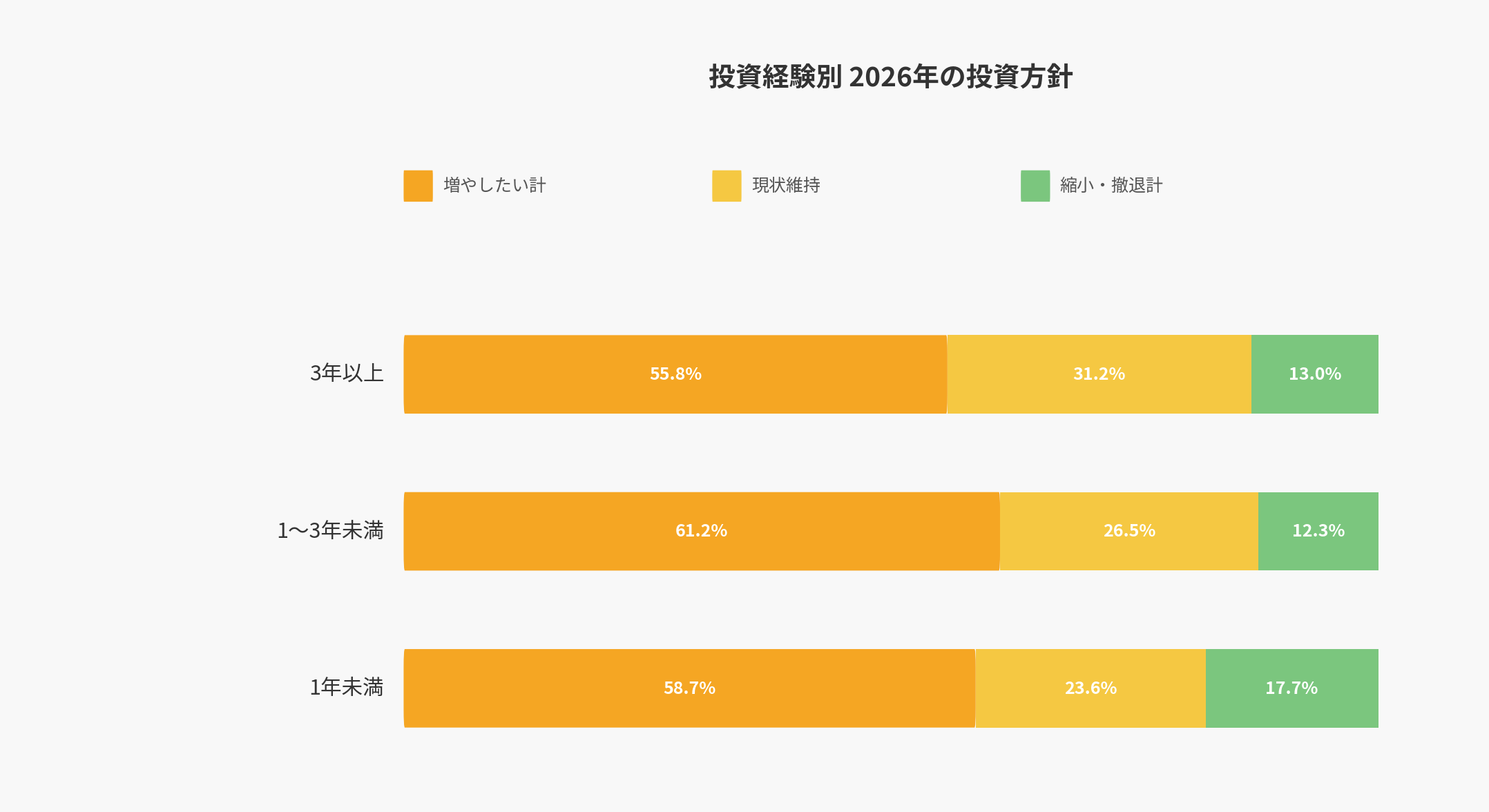
Investment Experience | n | Total Wanting to Increase | Keep Current Holdings | Total Wanting to Reduce/Exit |
|---|---|---|---|---|
3+ years | 412 | 55.8% | 31.2% | 13.0% |
1–3 years | 385 | 61.2% | 26.5% | 12.3% |
Under 1 year | 195 | 58.7% | 23.6% | 17.7% |
Cross-tabulated by investment experience, about 87% of veteran investors with three or more years of experience plan to continue or expand their investments.
Investors who have lived through past crashes and surges tend to have developed the discipline to stay the course calmly, even during temporary corrections.
Their understanding of long-term market cycles appears to be the basis for maintaining a bullish stance even at this 2026 milestone.
Among newer investors with under a year of experience, the desire to increase holdings is high at 58.7%, but their intent to exit or scale back — at 17.7% — is the highest of any group.
This suggests that a certain share of investors entered the market with high hopes but grew anxious after encountering crypto's characteristically sharp price swings.
Because beginners are more likely to walk away if they don't experience early success, this is a phase where coin selection and risk management become even more important.
The fact that mid-tier investors with one to three years of experience show the highest expansion intent, at 61.2%, symbolizes the current strength of the market.
This group is likely concentrated with investors who have accumulated some knowledge and are confident about significant gains in the next bull run.
Regardless of generation or experience level, overwhelmingly positive responses dominate 2026 investment plans, laying the groundwork for further market maturity.
Summary
Our survey of crypto purchase intent heading into 2026 found that Bitcoin remains the clear leader with 15.6% of the vote, continuing to command overwhelming support.
At the same time, emerging challengers such as Solana and meme coins are gaining ground, revealing that investor attention is becoming increasingly diversified.
What stands out is the clear divide between two camps: investors who follow the conventional path of prioritizing long-term potential, and trend-chasers who follow social media buzz — with markedly different outcomes.
The data showing that investing based on social media leads to a loss rate of around 70% speaks powerfully to the importance of information literacy.
About six in ten investors say they want to “increase” their investments in 2026, suggesting the market remains in an expansionary phase.
Rather than chasing trends impulsively, however, calm coin selection grounded in one's own investment style remains the only reliable path to success in the next market cycle.
Survey Overview
Survey date: March 23, 2026
Survey method: Internet survey
Respondents: Men and women residing in Japan (current or former crypto asset investors)
Valid responses: 992
Conducted by: Clabo Inc.
Survey Questions
- Do you have experience investing in crypto assets (virtual currencies)?
- Which best describes your primary investment style?
- Besides crypto assets, what other investments or asset management methods are you currently using? (Select all that apply)
- Which crypto assets are you considering purchasing or adding to in 2026? (Select all that apply)
- What best describes why you became interested in that coin?
- Which best describes your investment plans for crypto assets in 2026?
This article is for informational purposes only and does not constitute financial or investment advice. Please consult a qualified professional before making investment decisions.


