


As interest in crypto assets (also known as virtual currencies) continues to grow, "what should I buy first?" is a question many newcomers face.
This article analyzes the results of an original survey of 504 people, including those with crypto purchase experience, examining which crypto asset they bought first, how much they invested initially, what motivated their purchase, and how they gathered information.
Of the 504 survey respondents, 280 (55.6%) reported having purchased crypto assets before. This article focuses primarily on the responses from these 280 people to reveal the reality of the "first step" into crypto investing.
Survey Overview
Item | Details |
|---|---|
Survey period | February 24, 2026 |
Survey population | 504 men and women nationwide, aged 20 and over |
Valid responses | 280 (respondents with crypto purchase experience) |
Survey method | Online survey |
Respondent gender | Male 67.9% / Female 32.1% |
Age distribution | 20s 17.1%, 30s 30.4%, 40s 22.5%, 50s 22.1%, 60s and older 7.9% |
Household income | Under JPY 4 million 31.1%, JPY 4-8 million 50.7%, JPY 8 million or more 18.2% |
First Crypto Asset Purchased Ranking | About 90% Chose Bitcoin (BTC)
Ranking Results
.png)
Among the 123 valid responses that specified a particular crypto asset, Bitcoin (BTC) was the most common first purchase, chosen by 109 people (88.6%) — a share that far outpaces every other asset.
Rank | Crypto Asset | Responses | Share |
|---|---|---|---|
1st | Bitcoin (BTC) | 109 | 88.6% |
2nd | Ethereum (ETH) | 5 | 4.1% |
3rd | XRP | 4 | 3.3% |
4th | Dogecoin (DOGE) | 1 | 0.8% |
4th | BNB (formerly Binance Coin) | 1 | 0.8% |
4th | NEM | 1 | 0.8% |
*Calculated based on 123 valid responses. Answers such as exchange names or responses that were not crypto asset names were excluded as invalid.
Why Bitcoin Is the Top Choice
Bitcoin’s overwhelming share aligns with the survey’s findings on purchase motivation, discussed later. “I thought it was well-known and reliable” was the most common reason cited, a pattern consistent with responses concentrating on Bitcoin, the most recognized crypto asset among the general public.
Bitcoin is also listed by every major Crypto Asset Exchange Service Provider in Japan, making it an accessible entry point for beginners in terms of where to buy it.
Bitcoin Selection Rate by Age Group
By age group, respondents in their 30s had the highest Bitcoin selection rate at 47.1%, followed by those in their 20s (41.7%) and 50s (35.5%). The rate dropped to 21.4–25.0% among respondents aged 60 and older, indicating that older age groups were more likely to choose an asset other than Bitcoin or give an invalid response.
Age group | Bitcoin selection rate | Respondents |
|---|---|---|
20s | 41.7% | 48 |
30s | 47.1% | 85 |
40s | 34.9% | 63 |
50s | 35.5% | 62 |
60s and older | 22.7% | 22 |
First Investment Amount: “Under JPY 10,000” Most Common | About 70% Started With Under JPY 50,000
Distribution of First Investment Amounts
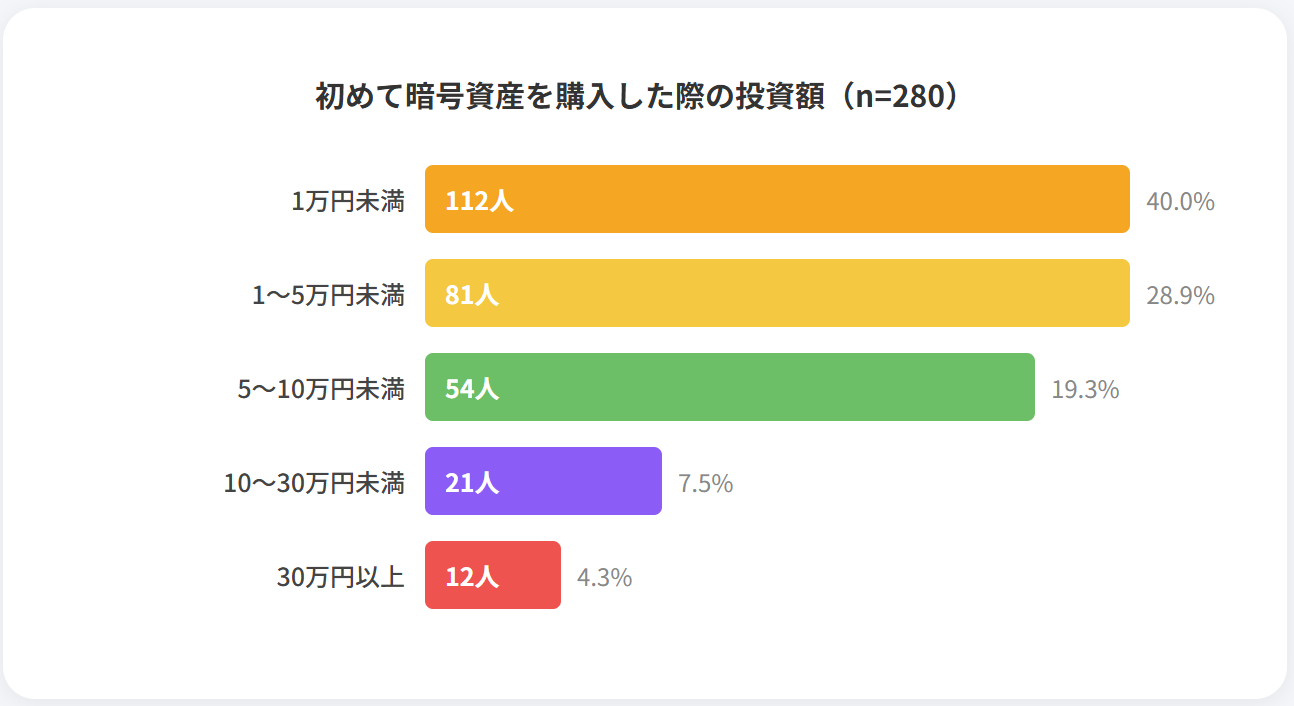
When asked about the amount they invested when first purchasing crypto assets, “under JPY 10,000” was the most common answer, chosen by 112 people (40.0%). Combined with “JPY 10,000 to under 50,000” (81 people, 28.9%), about 70% (68.9%) of respondents started crypto investing with under JPY 50,000.
First investment amount | Responses | Share | Cumulative share |
|---|---|---|---|
Under JPY 10,000 | 112 | 40.0% | 40.0% |
JPY 10,000–under 50,000 | 81 | 28.9% | 68.9% |
JPY 50,000–under 100,000 | 54 | 19.3% | 88.2% |
JPY 100,000–under 300,000 | 21 | 7.5% | 95.7% |
JPY 300,000 or more | 12 | 4.3% | 100.0% |
Relationship With Years of Experience | 70% of Those With Under 1 Year of Experience Started With Under JPY 10,000
Looking at first investment amounts by years of experience, 70.0% of respondents with “under 1 year” of experience started with under JPY 10,000. By contrast, among those with “5 years or more” of experience, 22.2% reported starting with JPY 300,000 or more, suggesting that investors with longer track records tend to commit larger amounts from the outset.
This trend suggests that the barrier to entering the crypto asset market has lowered over time. As an environment that allows investors to start with small amounts has become more established, it appears that more recent entrants are beginning their investments with more cautious amounts.
Differences in First Investment Amount by Gender
Comparing by gender, “under JPY 10,000” was chosen by 43.3% of women, slightly higher than the 38.4% among men.
Men, on the other hand, were more likely to invest larger initial amounts, with 20.5% choosing “JPY 50,000–under 100,000” (versus 16.7% for women) and 5.3% choosing “JPY 300,000 or more” (versus 2.2% for women).
Reasons for Choosing a First Crypto Asset: “Name Recognition” and “Price Growth Expectations” Are the Top Two Motives
Overall Trends in Purchase Motivation
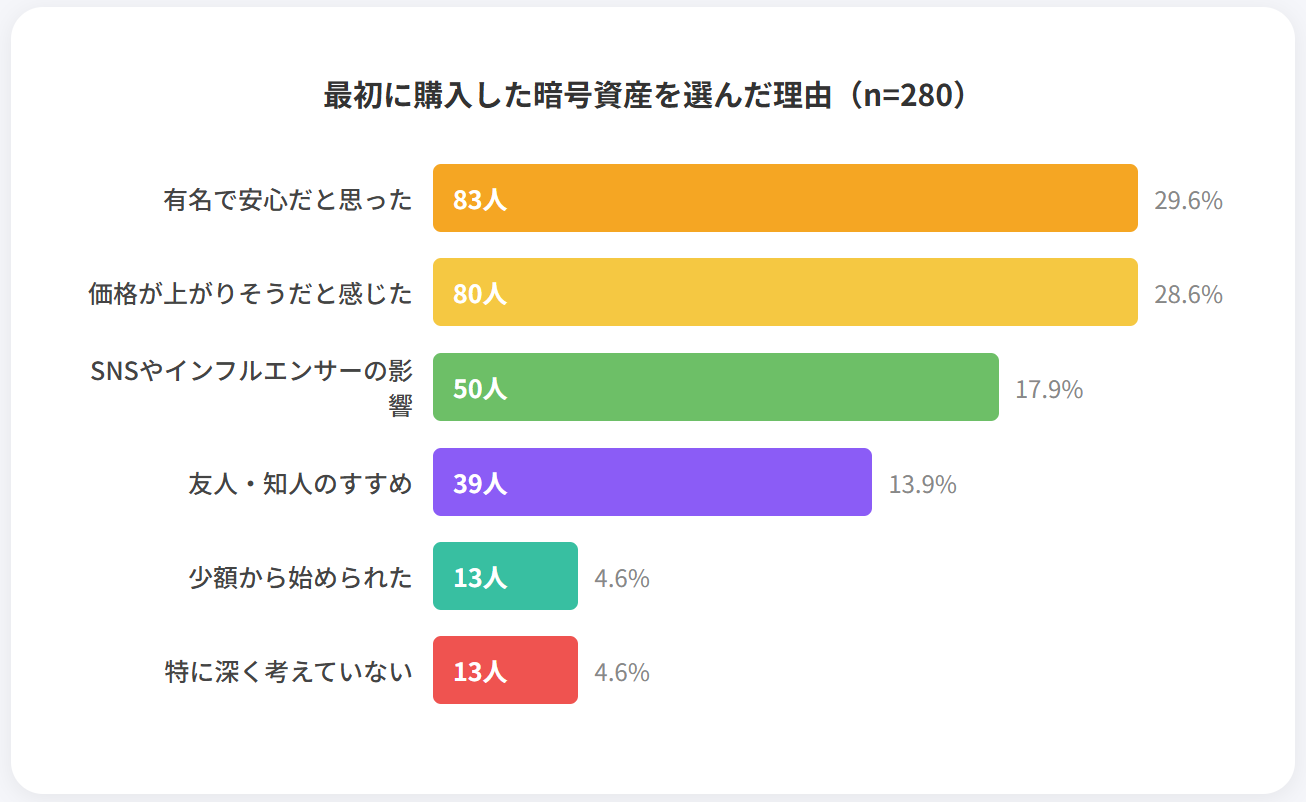
When asked for the single biggest reason they chose the crypto asset they purchased first, “I thought it was well-known and reliable” was the most common answer, cited by 83 people (29.6%), closely followed by “I felt the price would rise” at 80 people (28.6%). These two motives together account for about 60% of all responses.
Reason for choosing | Responses | Share |
|---|---|---|
I thought it was well-known and reliable | 83 | 29.6% |
I felt the price would rise | 80 | 28.6% |
Influence of social media or influencers | 50 | 17.9% |
Recommendation from a friend or acquaintance | 39 | 13.9% |
Could start with a small amount | 13 | 4.6% |
Didn’t think about it much | 13 | 4.6% |
Other | 2 | 0.7% |
Purchase Motivation by Age Group | Social Media Influence Notable Among 20s and 60s
By age group, respondents in their 30s most often cited “well-known and reliable” at 34.1%, reflecting a solid, cautious decision-making basis for choosing crypto assets. Among those in their 20s, “influence of social media or influencers” accounted for 22.9%, and the figure was similarly high at 28.6% among those in their 60s.
This suggests that social media is a routine information channel for people in their 20s, and also indicates that exposure to investment information through digital media has advanced to a certain degree even among people in their 60s.
Purchase Motivation by First Investment Amount | Smaller Investments Place More Weight on Name Recognition
Among respondents whose first investment was “under JPY 10,000,” “well-known and reliable” stood out sharply at 39.3%. This share declines as the investment amount increases; among those in the “JPY 50,000–under 100,000” bracket, “influence of social media or influencers” was the most common reason, at 31.5%.
Those who start with small amounts tend to place strong weight on simply “knowing” the asset, while those who invest larger amounts appear to base their decisions more on outside information and analysis.
YouTube Is the Top Information Source | Used by More Than Half Across All Age Groups
Use of Information Sources (Multiple Answers Allowed)
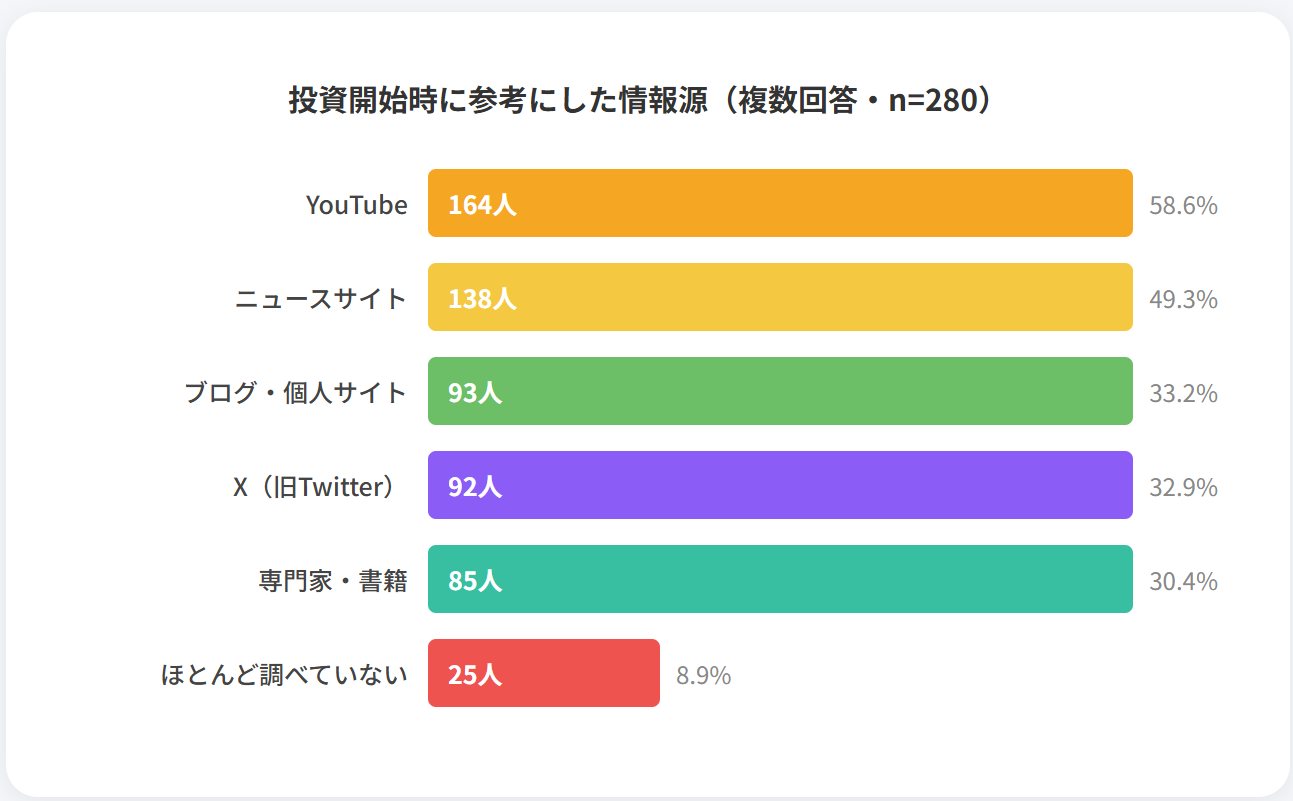
Asked (with multiple answers allowed) which information sources they consulted when starting to invest, respondents cited YouTube most often, at 164 people (58.6%). News sites (49.3%), blogs and personal websites (33.2%), and X (formerly Twitter) (32.9%) followed.
Information source | Responses | Selection rate |
|---|---|---|
YouTube | 164 | 58.6% |
News sites | 138 | 49.3% |
Blogs and personal websites | 93 | 33.2% |
X (formerly Twitter) | 92 | 32.9% |
Experts and books | 85 | 30.4% |
Did little to no research | 25 | 8.9% |
Other | 11 | 3.9% |
YouTube Usage Rate by Age Group | 20s Stand Out at 70.8%
Looking at YouTube usage by age group, respondents in their 20s had the highest rate at 70.8%. Usage remained at 54–59% among older age groups as well, showing that YouTube plays a central role in crypto asset information-gathering across all generations.
Video media’s ability to visually convey chart movements and wallet operation procedures is thought to make it well suited for learning about crypto assets, a relatively new subject area.
Age group | YouTube usage rate | Respondents |
|---|---|---|
20s | 70.8% | 48 |
30s | 58.8% | 85 |
40s | 54.0% | 63 |
50s | 54.8% | 62 |
60s | 57.1% | 14 |
70 and older | 50.0% | 8 |
8.9% of Respondents “Did Little to No Research”
At the same time, 25 people (8.9%) reported doing little to no research. Crypto assets carry significant price-volatility risk, and starting to invest without adequate information-gathering carries real risk. Improving information literacy remains an important challenge for the healthy development of the crypto asset market.
“Long-Term Holding” Is the Dominant Investment Style | About 60% Among Those With Over 5 Years of Experience
Overall Trends in Investment Style
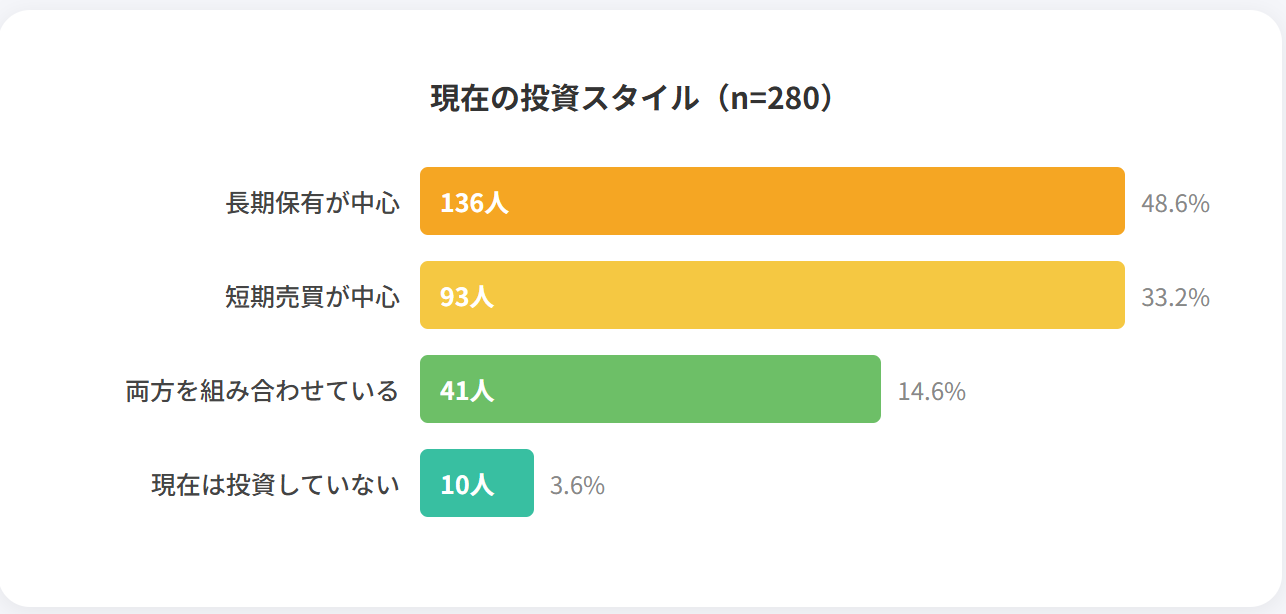
Regarding current investment style, “primarily long-term holding” was the most common response, chosen by 136 people (48.6%). “Primarily short-term trading” followed at 93 people (33.2%), “a combination of both” at 41 people (14.6%), and “not currently investing” at 10 people (3.6%).
Relationship With Years of Experience | Investors Shift Toward Long-Term Holding as They Gain Experience
Cross-tabulating years of experience with investment style reveals a clear trend. Among respondents with 5 years or more of experience, long-term holding reaches 58.3%, while short-term trading stays at just 13.9%.
By contrast, among respondents with 1 to under 3 years of experience, short-term trading is the most common style at 40.0%. This confirms an investment behavior pattern in which interest tends to concentrate on short-term gains soon after starting crypto investing, before shifting toward a longer-term perspective as market experience accumulates.
Years of experience | Long-term holding | Short-term trading | Both | Stopped investing |
|---|---|---|---|---|
Under 1 year | 50.0% | 32.5% | 8.8% | 8.8% |
1 to under 3 years | 43.5% | 40.0% | 14.8% | 1.7% |
3 to under 5 years | 51.0% | 32.7% | 16.3% | 0.0% |
5 years or more | 58.3% | 13.9% | 25.0% | 2.8% |
Top Concern Is “Scams and Hacking” | Security Worries Outrank Price Volatility
Overall Trends in Areas of Concern (Multiple Answers Allowed)
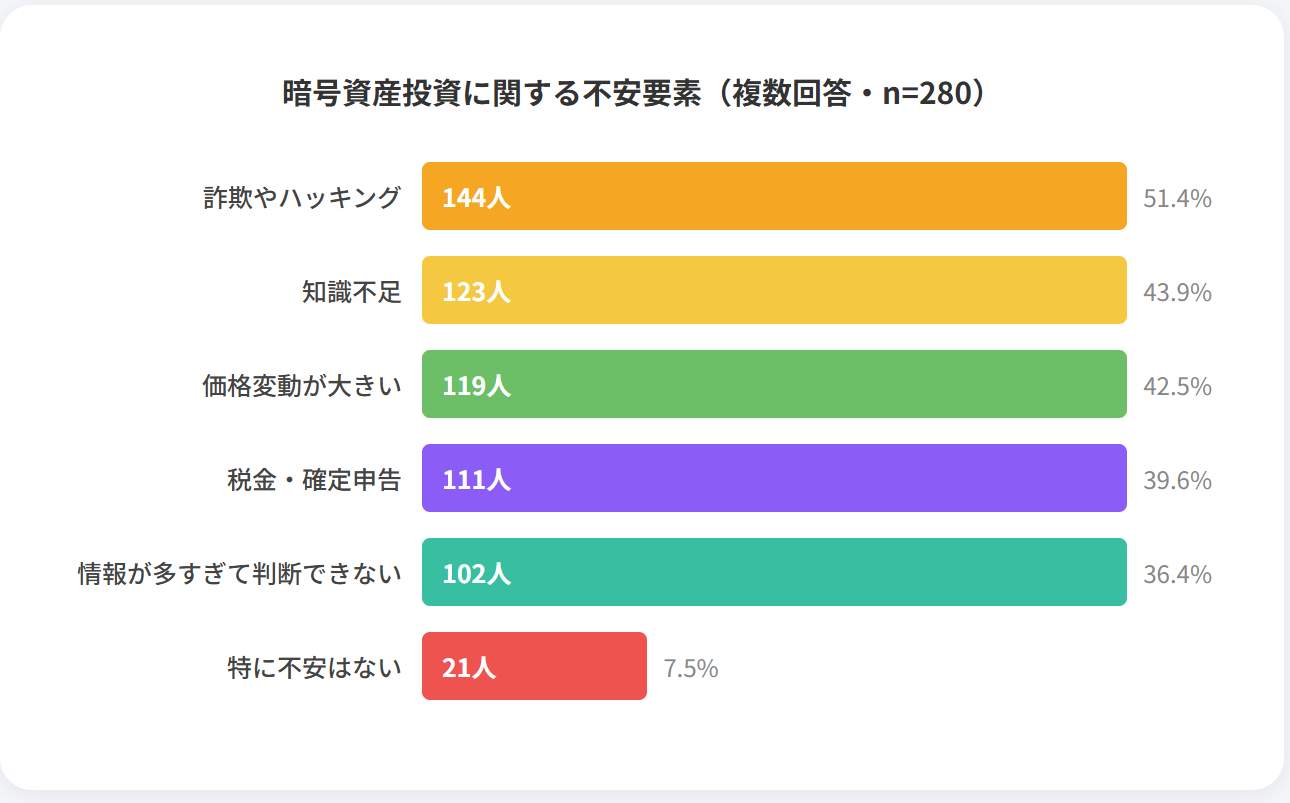
Asked (with multiple answers allowed) about their concerns regarding crypto asset investing, “scams or hacking” was the most common answer, cited by 144 people (51.4%). “Lack of knowledge” followed at 123 people (43.9%), “large price volatility” at 119 people (42.5%), and “taxes and tax filing” at 111 people (39.6%).
While “price volatility” is commonly cited as crypto assets’ biggest risk, it is notable that actual investors rank security concerns as their top worry.
Concern | Responses | Selection rate |
|---|---|---|
Scams or hacking | 144 | 51.4% |
Lack of knowledge | 123 | 43.9% |
Large price volatility | 119 | 42.5% |
Taxes and tax filing | 111 | 39.6% |
Too much information to make a judgment | 102 | 36.4% |
No particular concerns | 21 | 7.5% |
Other | 8 | 2.9% |
Concerns by Age Group | “Taxes and Tax Filing” Cited by About 50% of Those in Their 20s and 30s
Breaking the data down by age group reveals clear differences in the nature of respondents’ concerns. “Taxes and tax filing” was cited by close to 50% of respondents in their 20s and 30s. Because gains from selling crypto assets are, in principle, classified as miscellaneous income and subject to aggregate (comprehensive) taxation, this may feel like a significant burden for younger investors who are less experienced with filing a final tax return.
Note: As of July 2026, gains from crypto asset sales in Japan are taxed as miscellaneous income under aggregate taxation, and losses can be offset only against other miscellaneous income, not against salary or other income categories. On July 15, 2026, Japan’s Diet passed an amendment to the Financial Instruments and Exchange Act (FIEA) that will reclassify crypto assets as financial instruments; a flat 20% separate self-assessment tax rate is expected to apply once the amended law takes effect, likely from January 2028.
Among those in their 40s and 50s, “lack of knowledge” (50.8% and 45.2%, respectively) and “too much information to make a judgment” (50.8% and 21.0%) rank highest. The concern over “information overload” is particularly pronounced among people in their 40s compared with other age groups, likely reflecting the difficulty of sorting through crypto asset information while balancing work and family responsibilities.
Among those aged 60 and older, “large price volatility” is the top concern, at 57.1–75.0%, reflecting a strong emphasis on capital preservation.
Most Wanted Future Information: “Investment Style Diagnosis” Tops the List | Demand for Guidance Tailored to the Individual
Desired Information and Support (Multiple Answers Allowed)
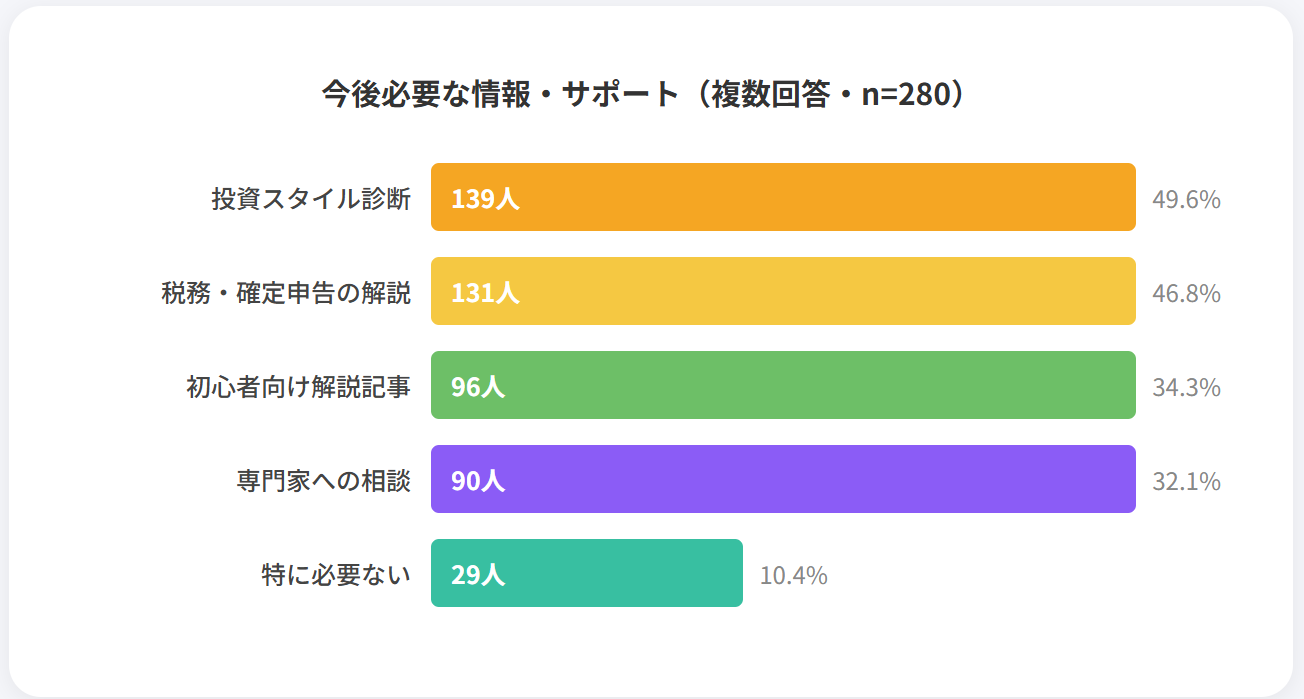
Asked what information or support would help them feel more confident continuing to invest, respondents most often cited “investment style diagnosis,” at 139 people (49.6%). “Explanations of tax and tax-filing procedures” followed at 131 people (46.8%), and “beginner-friendly explainer articles” at 96 people (34.3%).
Desired information | Responses | Selection rate |
|---|---|---|
Investment style diagnosis | 139 | 49.6% |
Explanations of tax and tax-filing procedures | 131 | 46.8% |
Beginner-friendly explainer articles | 96 | 34.3% |
Consultation with an expert | 90 | 32.1% |
Nothing in particular needed | 29 | 10.4% |
Why “Investment Style Diagnosis” Is in Demand
“Investment style diagnosis,” the most requested item, reflects a desire to objectively understand one’s own investment behavior and risk tolerance. While crypto assets accommodate approaches ranging from long-term holding to short-term trading, many investors appear to feel they lack a clear basis for determining which method suits them.
The 46.8% share for “explanations of tax and tax-filing procedures” is also notable. The tax system governing gains from crypto asset sales is complex, and there is clear demand for the knowledge needed to file accurately. Note that for questions about crypto asset taxation in individual cases, consulting a licensed tax accountant is recommended.
Summary: What the Survey Reveals About Crypto Beginners
The survey results yield five key findings about the “first step” into crypto asset investing.
- About 90% of first crypto purchases were Bitcoin. Name recognition and a sense of reliability were the biggest factors in asset selection, with respondents in their 30s showing the highest Bitcoin selection rate.
- About 70% of first investments were under JPY 50,000. Notably, 70% of respondents with under 1 year of experience started with under JPY 10,000, confirming that starting small is the dominant pattern.
- The two leading purchase motives are “name recognition” and “expectation of price growth.” Respondents with smaller first investments placed more weight on name recognition, while those with larger investments were more strongly influenced by outside information.
- YouTube is the primary information source. More than half of all age groups use it, reaching about 70% among those in their 20s, making video media a key channel for crypto asset learning.
- The top concern is “scams and hacking,” which outranks price volatility. By age group, tax issues stand out for those in their 20s and 30s, information overload for those in their 40s and 50s, and price volatility concerns for those aged 60 and older.
Institutional development and technological innovation continue to lower the barriers to entering the crypto asset market. As this survey shows, many people are starting to invest cautiously with small amounts, and the perception of crypto assets as “an investment for special people” is gradually changing.
At the same time, concerns about security and taxation remain deeply rooted, reaffirming the importance of providing accurate, trustworthy information.
This report is intended for informational purposes only and does not constitute an invitation to invest or investment advice of any kind. Crypto asset investing carries significant risk, and investment decisions should be made at your own discretion. We make no guarantee as to the accuracy, completeness, or usefulness of the content of this report. Final investment decisions should be made based on your own judgment, and we recommend consulting a qualified professional as needed.
Survey Overview
Survey date: February 24, 2026
Survey method: Online survey
Survey population: Men and women residing in Japan (people currently investing in crypto assets or who have invested in the past)
Valid responses: 504
Conducted by: Clabo Inc.
Survey Questions
- Have you ever purchased virtual currency (crypto assets)?
- How many years ago did you start investing in virtual currency?
- How much did you invest when you first purchased virtual currency?
- What virtual currency did you purchase first?
- What was the single biggest reason you chose that virtual currency first?
- What information sources did you mainly refer to when you started investing?
- Which best describes your current investment style?
- What is your current total virtual currency investment amount?
- What concerns do you have about virtual currency investing?
- What information or support would help you invest with more confidence going forward?
This article is for informational purposes only and does not constitute financial or investment advice. Please consult a qualified professional before making investment decisions.


