


Ethereum (ETH) is one of the most well-known crypto assets (also known as virtual currencies) for which holders can earn rewards through staking (in Japanese). If you hold ETH, you may be able to earn additional ETH through staking, not just by aiming for capital gains from buying and selling.
Interest in staking is high: a survey of 309 crypto asset investors found that more than 80% had experience using staking or lending services.
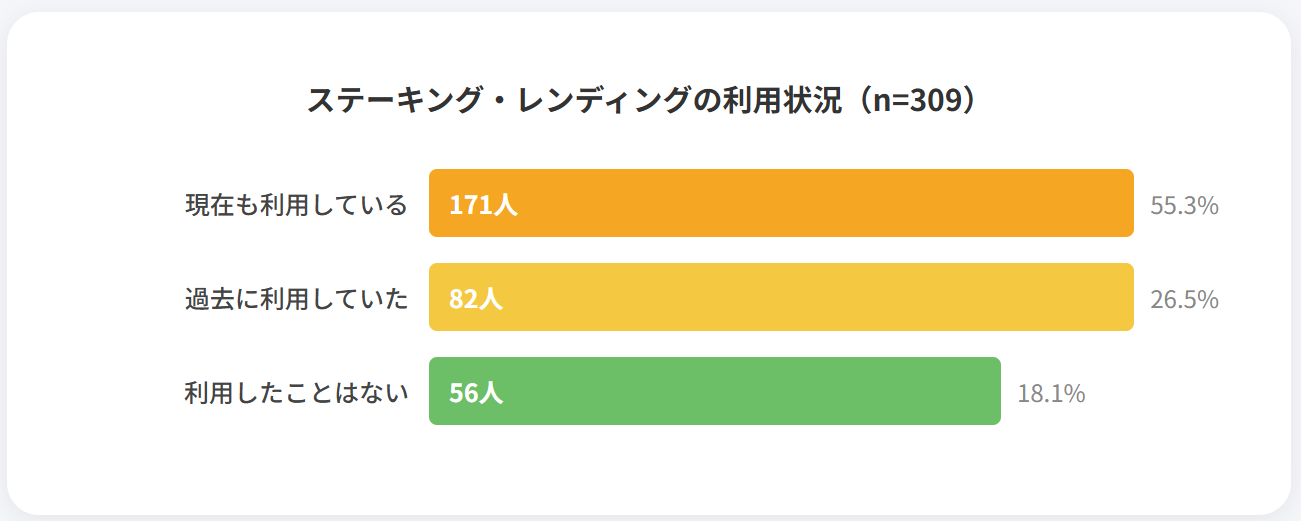
Many people may think, "If I can earn rewards just by depositing ETH, that sounds like a good deal." In fact, since you may be able to earn additional rewards from ETH you already hold, staking has genuinely attracted attention from investors who are considering long-term holding.
However, there are important points to understand before staking. Even if you receive rewards, you could still end up with a loss if the price of ETH falls, and some services do not allow you to sell or withdraw immediately. In addition, taxes may apply to the rewards you receive, so using a staking service without understanding these details could cause problems later.
This article explains, in beginner-friendly terms, the main ways to stake Ethereum, their advantages and disadvantages, how rewards work, and the tax implications. Let's start by understanding the basics so you can judge whether staking is the right fit for you.
Main Ways to Stake Ethereum

There are broadly three ways to stake Ethereum: using a domestic crypto exchange service provider, using a staking pool, or running your own validator.
To state the conclusion up front, staking services offered by domestic crypto exchange service providers are generally the easiest option for beginners to consider. To understand the characteristics and differences of each option, let's look at all three methods in turn.
Domestic Exchange Services Are Easy for Beginners to Start
Staking services offered by domestic Crypto Asset Exchange Service Providers (crypto exchanges) are an approach that beginners can start with relatively easily. Typically, you purchase ETH on an exchange (order-matching marketplace) and then apply for the relevant staking service. With some services, simply holding the target asset in your account is enough to be automatically enrolled in staking.
In fact, several major domestic crypto exchanges in Japan offer staking services. Representative examples include the following providers.
Service details vary by provider. Be sure to check items such as the types of crypto assets supported, how the reward rate is determined, the timing of reward payouts, minimum holding requirements, and whether you can sell during the staking period.
Staking does not guarantee a profit simply because you deposit your assets. While you may be able to receive rewards, if the price of ETH falls, the value of your assets in yen terms may decrease. In addition, some exchanges deduct fees from staking rewards.
Before using a service, it is important to check the official website and terms of service, and to understand the eligible assets, how rewards are calculated, fees, withdrawal conditions, and how the provider handles service suspensions. Rather than comparing reward rates alone, it is also worth considering practical usability factors such as whether you can sell at any time and how often rewards are paid out.
Staking Pools Are Easier to Start With a Small Amount, but Harder to Manage
A staking pool is a method in which multiple users pool their ETH together to participate in staking with a combined balance. As described later, "running your own validator" generally requires 32 ETH. Using a staking pool, however, makes it easier to participate in staking with a smaller amount of ETH than that. This makes it a more accessible option for people who find it difficult to prepare a large lump sum.
On the other hand, staking pools can be more difficult to manage than domestic exchange services. Some pools involve overseas services or self-custody wallets, meaning you need to check the mechanics of the service, fees, withdrawal methods, and supported networks yourself.
Some services also issue a separate token in exchange for the ETH you deposit, and using such a service without understanding this mechanism could expose you to unexpected risks.
In addition, the operator, fee structure, and reward distribution method differ from pool to pool. Rather than comparing reward rates alone, it is important to check the operator's track record, usage conditions, and ease of withdrawal. While staking pools are easy to join with a small amount, they should only be used after fully understanding the details of the service.
Running Your Own Validator Is for Advanced Users
Running your own validator is a way to participate directly in Ethereum staking. A validator refers to a participant on the Ethereum network involved in verifying transactions and producing blocks.
This method generally requires preparing 32 ETH and managing dedicated software and a stable network connection. Because it involves more than simply depositing ETH — you must set up and continuously manage your own operating environment — it is not considered suitable for beginners (source: ethereum.org).
If you operate a validator yourself, configuration mistakes or operational shortcomings can reduce your rewards. In some cases, you may also incur a penalty known as slashing. For this reason, lower-maintenance options such as staking services offered by domestic exchanges are a more realistic choice for crypto asset beginners to consider.
Key Points to Know Before Staking Ethereum
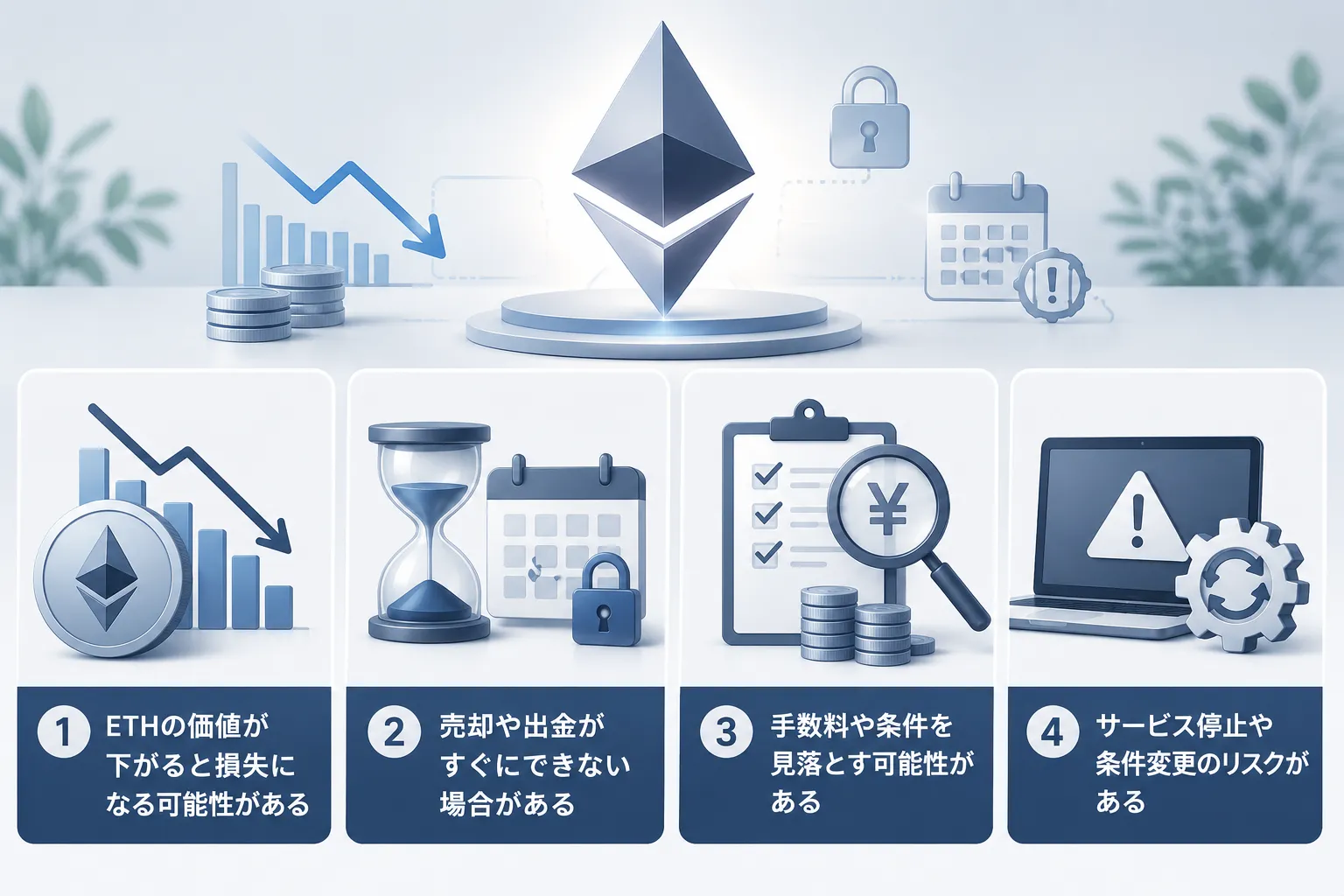
Staking, where you can earn rewards simply by depositing your assets, may seem to have nothing but upside at first glance. However, there are risks and points of caution you should understand before you begin.
For example, you may not be able to freely sell your assets while staking, and the value of your assets can fall due to ETH price fluctuations. Fees and terms also differ by service, so it is important to check the details carefully.
Here, we explain the main points you should know before starting to stake Ethereum.
A Drop in ETH's Value Could Result in a Loss
Even if your ETH balance increases through staking rewards, you could still end up with a loss in yen terms if the value of ETH has fallen.
For example, suppose you staked 10 ETH (worth ¥5,000,000) when 1 ETH = ¥500,000. If you earned a 5% reward over one year, bringing your balance to 10.5 ETH, but the price of ETH had fallen to ¥400,000 by that point, your assets would be worth approximately ¥4,200,000. Even though your ETH balance has increased, the result in yen terms is below your original principal of ¥5,000,000.
Conversely, if the price of ETH rises during the staking period, you benefit from both the increase in quantity from rewards and the rise in price. In this way, your final gain or loss depends not only on the staking reward but also heavily on the direction of the ETH price.
Crypto assets can experience larger price swings than stocks or investment trusts. Prices can rise sharply or fall sharply within a short period, so rather than focusing on the yield alone, it is important to weigh the risk from the perspective of whether you could continue holding even through a significant price drop.
Staking is also not a principal-guaranteed mechanism like a bank deposit. While there is a possibility of earning rewards, there is also a possibility of losses from price fluctuations, so it is important to use only funds you can afford to risk.
You May Not Be Able to Sell or Withdraw Immediately
With staking, you cannot always freely sell or withdraw the ETH you have deposited at any time. Mechanisms vary by service, but your assets may be locked for a set period, or a waiting period may apply between requesting to unstake and actually being able to withdraw.
Because of these restrictions, even if you suddenly need funds or want to sell in response to market movements, you may not be able to move your assets at the moment you need to.
Because crypto asset prices are volatile, restricted liquidity is one of the risks involved. If the price falls while you are waiting for a withdrawal or sale to become available, you may end up having to sell at a less favorable price than expected. Likewise, during a rising market, you may miss the timing to lock in profits.
Before starting to stake, check in advance whether early cancellation is possible, the waiting period after unstaking, whether there are any withdrawal restrictions, and whether a minimum deposit period applies, and choose a service that matches your own investment approach.
You Could Overlook Fees or Conditions
When choosing a staking service, it is important not to judge based on the displayed reward rate alone. This is because the reward amount you actually receive can vary depending on each service's fees and applicable conditions.
The first thing to check is fees. Some exchanges and staking services deduct a set percentage as a fee from the staking rewards you receive. As a result, even if two services display a similar annual rate, the final amount you receive can differ depending on whether a fee applies and how large it is.
You should also check the conditions under which rewards apply. Some services require you to hold a minimum amount of ETH to participate, or only generate rewards during a specified period. In some cases, the date rewards start accruing and the payout date are set in advance, so rewards do not necessarily start accruing the moment you deposit.
In this way, when comparing staking services, you need to look beyond the headline annual rate and comprehensively check factors such as fees and reward conditions. By comparing the actual amount you would receive along with the terms of use, it becomes easier to choose the service that best suits you.
There Is a Risk of Service Suspension or Changes to Terms
When using a staking service offered by a crypto exchange, you need to understand that there is a risk of dependence on the service provider.
For example, take the conditions relating to staking rewards. Reward rates, fees, and eligible assets may be revised due to changes in the network environment or the provider's own policies. This means the current rate is not guaranteed to continue in the future, and you may not achieve the returns you expected.
In addition, because the exchange manages the ETH you deposit through its staking service, system failures or maintenance could temporarily make the service unavailable.
For this reason, when using a staking service, be sure to also check price volatility risk and the terms of use specific to each service.
How Much Are Ethereum Staking Rewards?
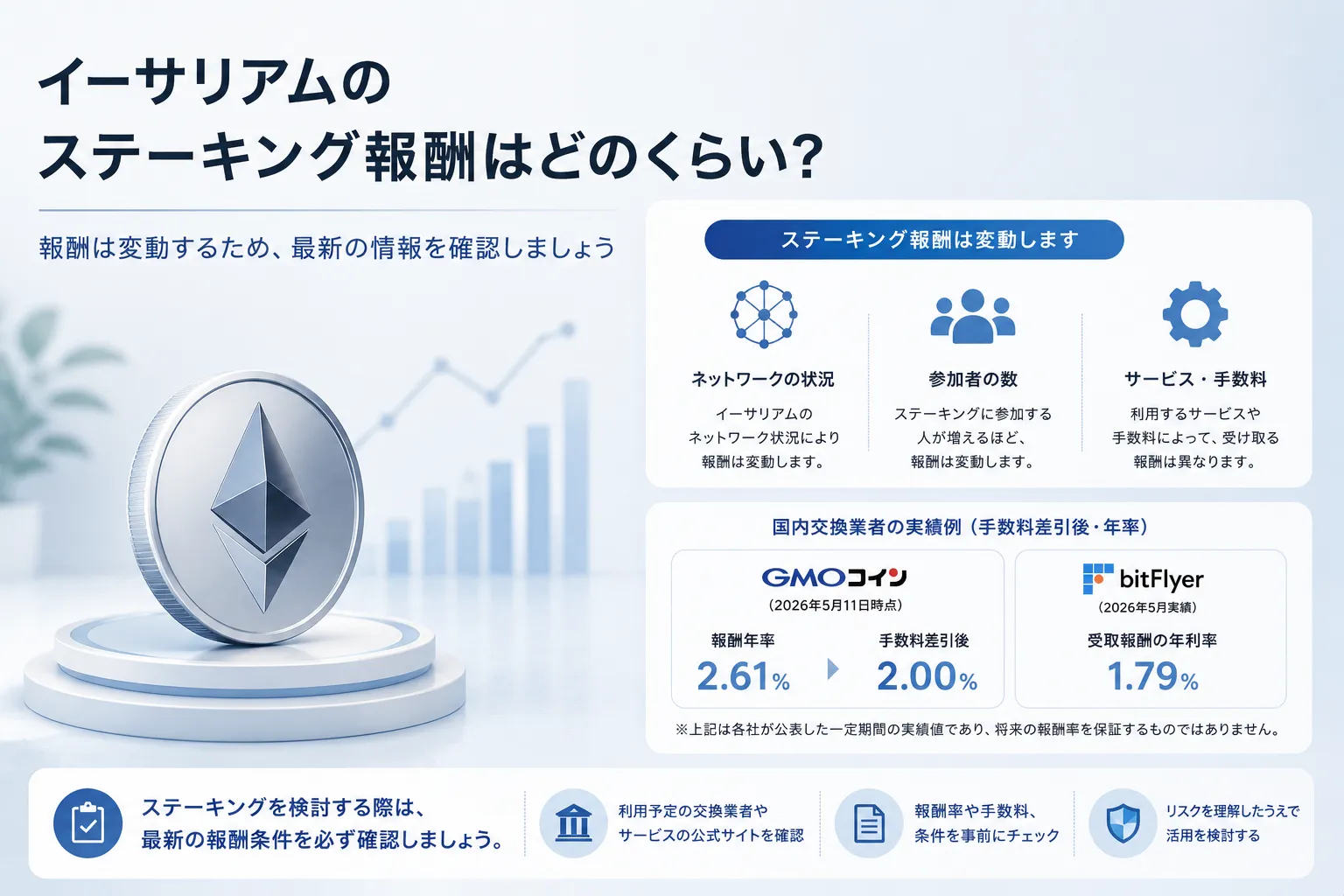
Ethereum staking rewards are not a fixed yield. They fluctuate depending on network conditions, the number of staking participants, the service used, fees, and other factors. For this reason, it is not possible to state definitively that "Ethereum staking rewards are X% per year."
As a rough benchmark, ETH staking rewards published by domestic exchanges are, in some cases, around 2% annually after fees. For example, GMO Coin announced in a notice dated May 11, 2026, that the annualized reward rate for ETH is 2.61%, or 2.00% after fees (source: GMO Coin).
bitFlyer has also disclosed that, based on May 2026 actual results, the annual rate of staking rewards it receives from the Ethereum network is 2.55%, while the annual rate users receive is 1.79%.
Annual rate of staking rewards received by bitFlyer from the Ethereum network: 2.55%
Annual rate of staking rewards received by customers: 1.79%Source: Staking | bitFlyer
However, these are actual results disclosed by each company for a specific period and do not guarantee future reward rates. When considering staking, it is important to check the latest reward terms on the official website of the crypto exchange or staking service you plan to use.
Staking Rewards May Be Subject to Tax

Ethereum staking rewards may be subject to tax. Even if you receive the reward in ETH, it can be treated for tax purposes as "acquiring a crypto asset."
The National Tax Agency (NTA) explains that when a crypto asset is acquired through mining, staking, lending, or similar means, any resulting gain is subject to income tax or corporate tax. In other words, a tax liability can arise at the time the reward is received, even if it has not been converted into yen.
Where crypto assets are acquired through mining, staking, lending, or similar means, any resulting gain is subject to income tax or corporate tax.
Source: Tax Treatment of Crypto Assets, etc. | National Tax Agency (in Japanese)
Note: Under Japan's tax rules as of July 2026, gains from selling crypto assets are treated as miscellaneous income and taxed under the aggregate (progressive) taxation system. On July 15, 2026, an amendment to the Financial Instruments and Exchange Act (FIEA) was passed by the House of Councillors, which will reclassify crypto assets as financial instruments under the FIEA. Once this amended law takes effect — expected from January 2028 — a flat 20% separate self-assessment tax rate is expected to apply instead.
At the same time, not a small number of people fail to correctly file their crypto asset taxes. In a survey conducted by our company, only 22.9% of respondents said they file a tax return in years when they made a profit from crypto assets, while 21.7% said they "recognized that filing was required but did not file," and a combined 17.4% either did not know they needed to file or could not judge whether they needed to.
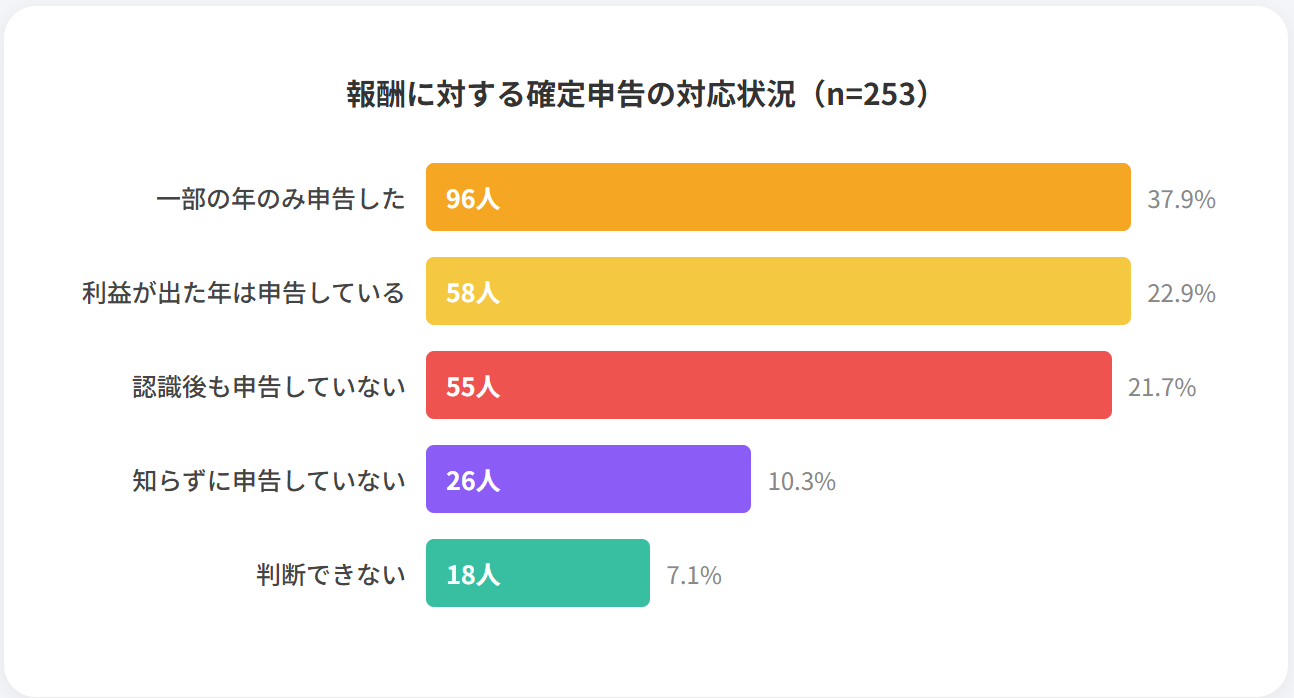
When an individual receives staking rewards, the rewards are usually treated as miscellaneous income. However, the applicable income category and whether a filing is required can vary depending on your other income, the scale of your transactions, and whether you keep records. Note that if you incur a loss on crypto assets, it can only be offset against other miscellaneous income — it cannot be offset against employment income or other income categories. If you are unsure how to classify or report your income, it is important to consult the tax office or a tax professional (related: an explanation of how to think about tax filing for crypto asset staking rewards (in Japanese)).
Record the Market Value at the Time You Receive the Reward
When you receive a staking reward, it is important to keep records that let you confirm the date you received it, the amount of ETH, and its yen value at that time. This is because, for tax purposes, staking rewards can be assessed based on their market value at the time they were received.
For example, even if you receive the reward in ETH, calculating your tax requires not just "how much ETH you received" but also "what it was worth in yen at the time you received it." Looking only at the price when you later sell may not give you an accurate picture of the income at the time the reward was acquired, so it is important to confirm the value at the time of acquisition.
If you use an exchange, you may be able to check reward payouts through your transaction history or annual transaction report. However, not all the necessary information is necessarily organized clearly. To avoid difficulties when filing, it is a good idea to keep your own records at the time each reward is paid.
It Can Also Affect Your Gain/Loss Calculation When You Sell
ETH received as a staking reward is also relevant to the gain/loss calculation when you later sell it. This is because the market value at the time you received the reward can be treated as the acquisition cost of that ETH.
For example, suppose you received 0.1 ETH as a staking reward, and its market value at that time was ¥50,000. If the price of ETH later rose and you sold that same 0.1 ETH for ¥70,000, the acquisition cost would be ¥50,000 and the sale price ¥70,000, so the ¥20,000 difference would be calculated as your gain.
In this way, staking rewards can affect not only your tax position at the time you receive them, but also the calculation when you later sell. Keeping a record of the date, quantity, and market value of each reward makes it easier to confirm your gain or loss at the time of sale.
Tax treatment of crypto assets can vary depending on your transaction details and holding status. If you are unsure how to proceed, please consult a tax professional or the tax office.
Conclusion
Ethereum staking is a method that offers long-term ETH holders the potential to increase their holdings. In particular, using a staking service from a domestic exchange means you do not need to run your own validator, which makes it accessible even for beginners.
At the same time, staking is not a principal-guaranteed investment, and it carries risks such as ETH price declines, withdrawal restrictions, fees, and service suspensions or changes to terms. Even if you earn rewards, this does not guarantee a profit in yen terms.
In addition, staking rewards may be subject to tax. It is important to record the date, quantity, and market value of each reward, and to be prepared for the gain/loss calculation when you eventually sell.
If you are considering staking Ethereum, avoid judging based on the reward rate alone. Check the terms and risks of the service you plan to use, and consider whether it fits your own holding strategy.
This article is for informational purposes only and does not constitute financial or investment advice. Please consult a qualified professional before making investment decisions.


