


When it comes to long-term crypto assets (also known as virtual currencies) holdings, how do you manage your assets?
This survey examines crypto investors' actual storage habits and the criteria they use when deciding whether to move funds elsewhere.
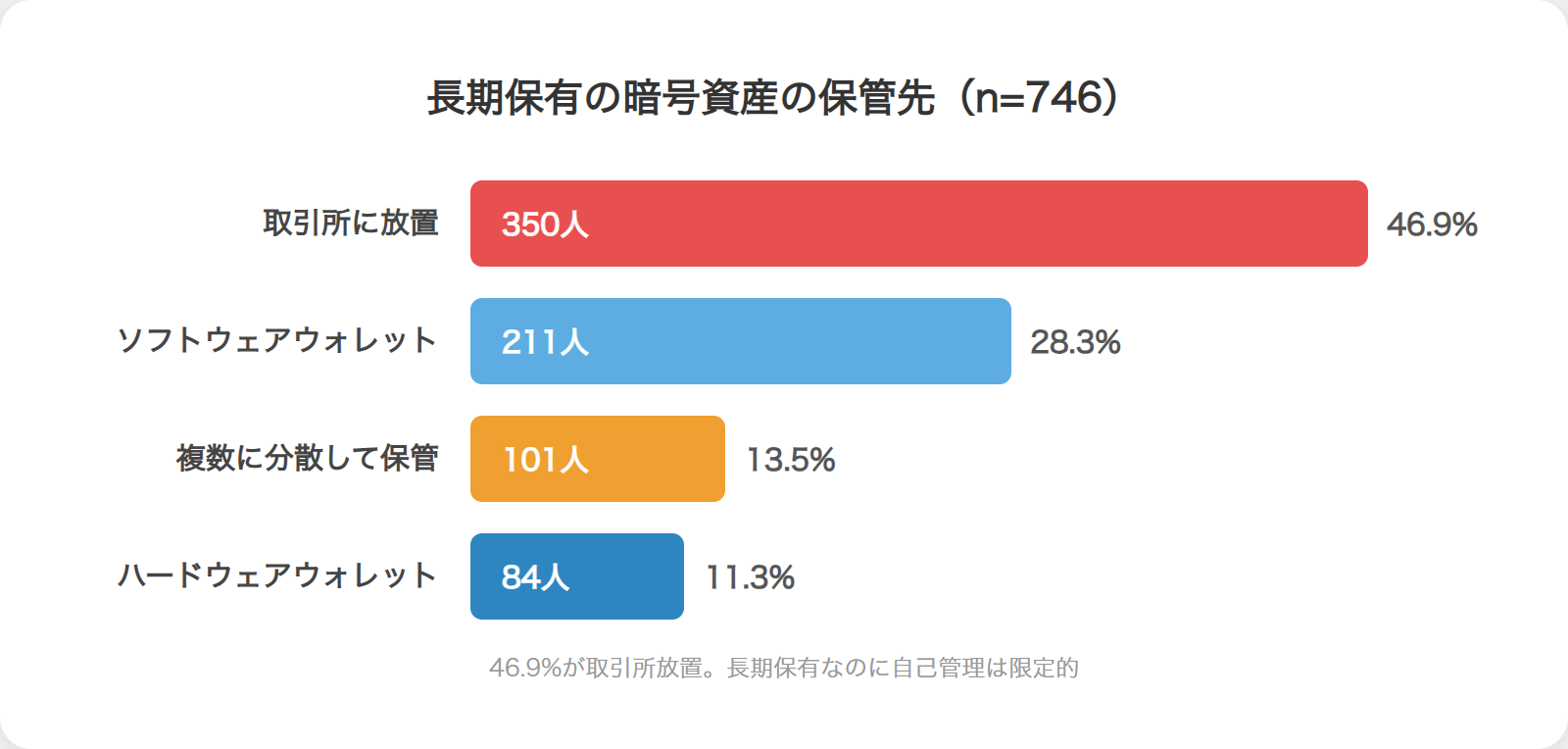
The results show that 46.9% of investors choose to keep their holdings on a convenient exchange, while management methods vary widely by age, years of experience, and holding size.
In particular, there is a striking gap between hardware wallet ownership (55.9%) and actual usage (11.3%) that cannot be ignored.
This article takes a closer look at generational trends and the transfer thresholds that vary by holding size.
Why do so many investors continue to rely on exchanges, and what does it take to move toward true self-custody? We unpack the answers below.
46.9% of Long-Term Crypto Holdings Are Left on Exchanges
Roughly Half of Holders Choose to Keep Assets on an Exchange
Storage Method | Responses | Share |
|---|---|---|
Left on an exchange | 350 | 46.9% |
Software wallet | 211 | 28.3% |
Spread across multiple storage methods | 101 | 13.5% |
Hardware wallet | 84 | 11.3% |
When we asked long-term holders where they store their assets, 46.9%—nearly half of all respondents—said they leave them "on an exchange."
Even as awareness grows around the importance of managing crypto assets securely, the reality is that the majority still prioritize convenience and keep their holdings deposited with an exchange.
While this offers the benefit of easy trading access, this figure is not something to overlook when weighing the risk of exchange insolvency or security incidents.
Even amid growing calls for stronger security practices, the practical reality is that most investors still rely on exchanges for custody.
For many investors, the barrier to self-custody remains high.
This points to the need to reconsider the balance between convenience and security.
Software Wallet Usage Stands at 28.3%
The second most common answer, after keeping assets on an exchange, was "software wallet" at 28.3%.
Software wallets, which can be installed directly on a device, pair well with mobile use and have become a popular entry point for investors taking their first step away from exchanges.
They appear to serve as a middle ground for investors who want to avoid the risks of leaving assets on an exchange but aren't ready to invest in a hardware wallet.
Meanwhile, the share of investors choosing distributed storage or hardware wallets remains limited.
13.5% of investors reported spreading their holdings across multiple storage methods, while just 11.3% use a dedicated hardware wallet.
Investors who prioritize strong security remain a minority within the overall investor base.
Nearly 40% Have Never Transferred Their Wallet
Item | Responses | Share |
|---|---|---|
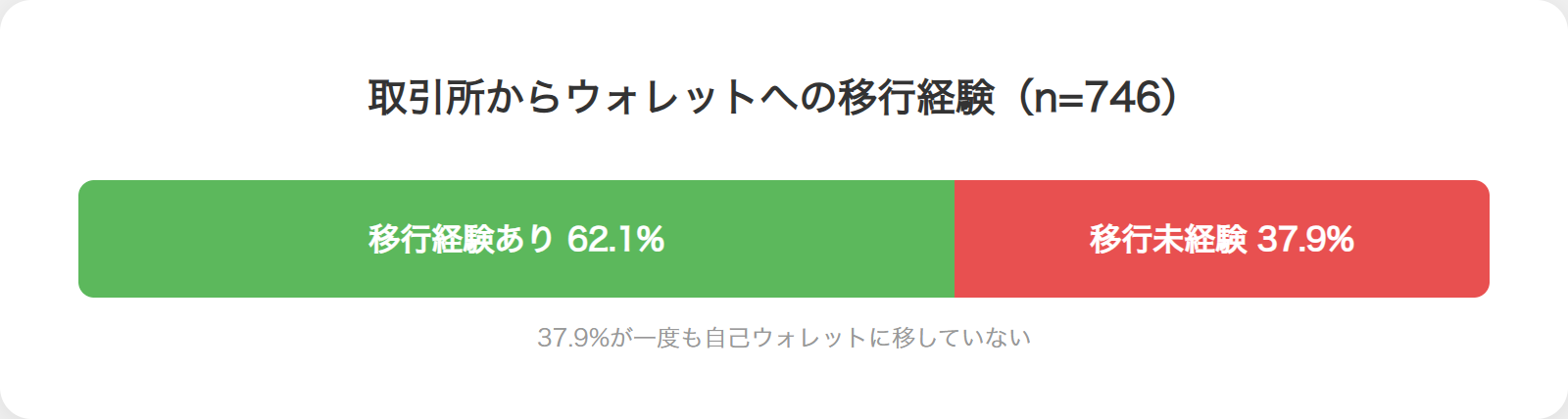
Have transferred before | 463 | 62.1% |
Never transferred | 283 | 37.9% |
When asked whether they had ever transferred assets to a wallet, 37.9% said they had "never" done so.
In other words, more than one in three long-term holders has never moved assets away from the exchange where they originally purchased them.
Taking custody of one's own assets may present a high psychological and technical barrier for beginners in particular.
On the other hand, the data also shows that 62.1% of investors have tried some form of storage method other than keeping assets on an exchange.
This suggests that, once tried, the habit tends to stick.
Encouraging investors to start with a small amount and build up a track record of successful wallet management may be the fastest way to raise security awareness.
Reliance on Exchanges Rises With Age
Age Group | Left on Exchange | Software Wallet |
|---|---|---|
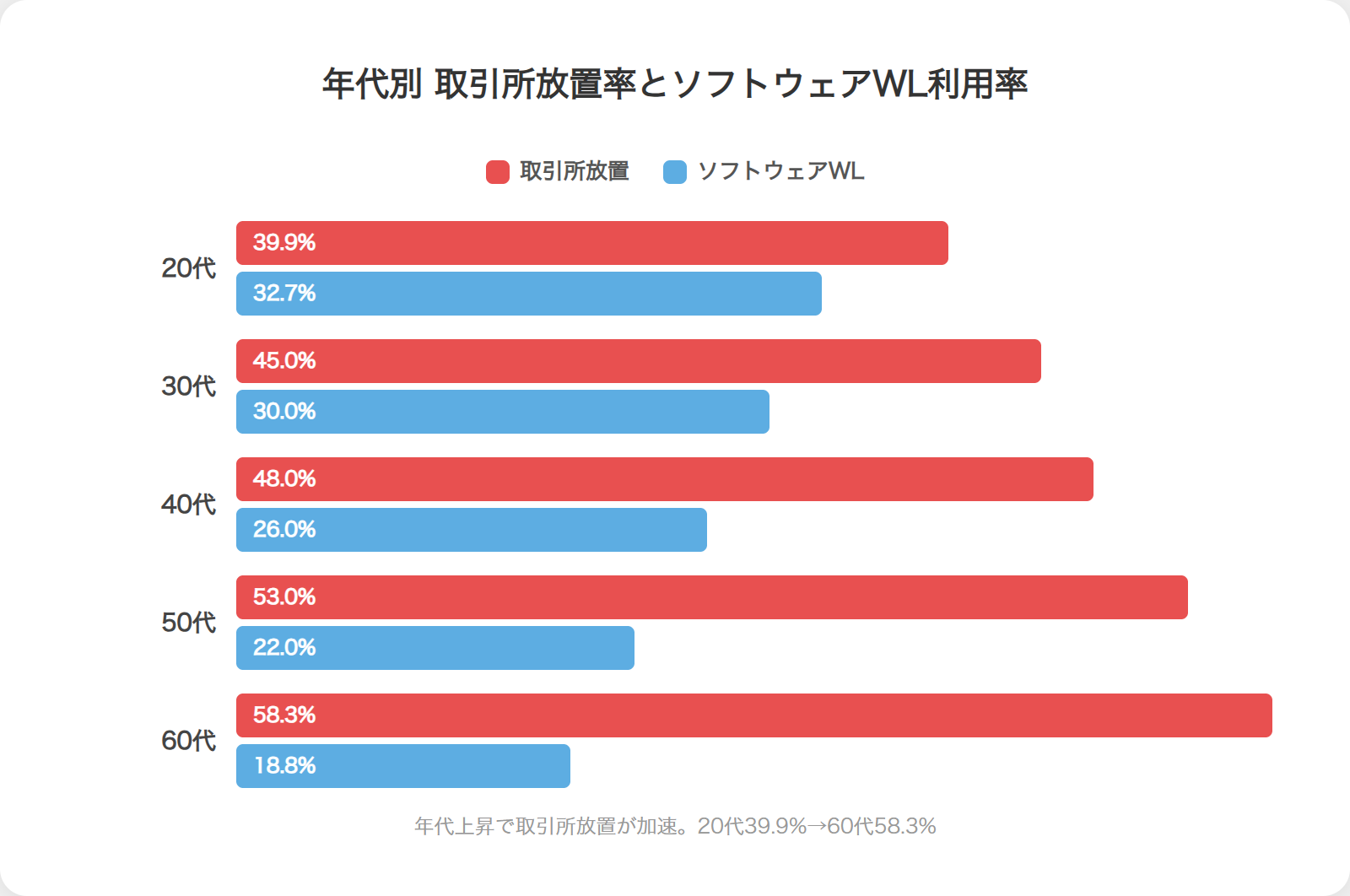
20s | 39.9% | 32.7% |
30s | 45.0% | 30.0% |
40s | 48.0% | 26.0% |
50s | 53.0% | 22.0% |
60s | 58.3% | 18.8% |
How Storage Choices Differ by Age Group
This survey found a clear upward trend in the share of investors "leaving assets on an exchange" as age increases.
The exchange-dependency rate, which stood at just 39.9% among investors in their 20s, climbs to 53.0% for those in their 50s and reaches 58.3% among investors in their 60s.
The tendency to prioritize convenience in asset management appears to strengthen with each successive generation.
Meanwhile, software wallet usage declined as age increased.
Usage fell from 32.7% among investors in their 20s to 18.8% among those in their 60s—roughly half.
Younger investors appear more flexible about adopting new tools, while older investors tend to take a more conservative approach and stick with services they already use.
Younger Investors Show a Distinct Management Style
Among investors in their 20s, software wallet usage stood at 32.7%, the highest of any age group.
As this figure declines with each successive age group, it suggests that younger investors place greater weight on the convenience of managing everything through a smartphone app.
For them, using a wallet is likely a natural extension of their everyday digital experience.
They appear to avoid complex device setup and instead prioritize the convenience of completing everything within a smartphone app.
Younger investors, who represent the next generation of crypto adoption, are beginning to shift away from the centralized environment of exchanges toward more autonomous self-custody.
Older Investors Show Strong Trust in Exchanges
Why do older investors tend to keep their assets on an exchange for longer?
One likely explanation is a strong aversion to the "loss risk" that comes with personally managing a seed phrase and safeguarding one's own assets.
When considering worst-case scenarios, they may judge that relying on an exchange with established support infrastructure is the safer choice.
Self-custody methods such as hardware wallets carry the added weight of personal responsibility when technical problems arise.
Rather than the idea of "protecting your own assets," a more conservative mindset—placing trust in a reliable third party—appears to shape older investors' approach to investing.
This could be interpreted as a reflection of the financial literacy they have built up over many years.
Storage Choices Shift With Experience
Years of Investing Experience | Left on Exchange |
|---|---|
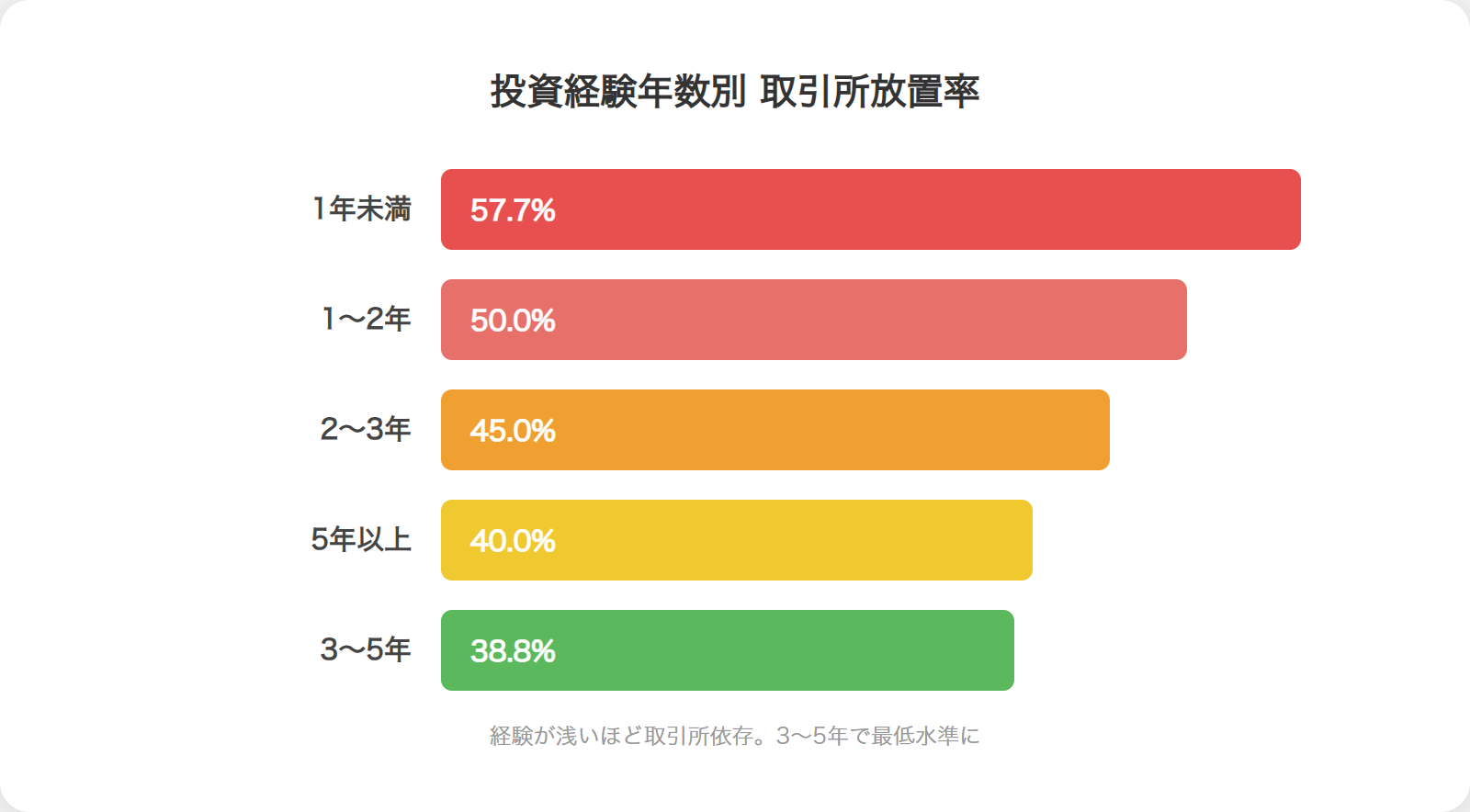
Under 1 year | 57.7% |
1–2 years | 50.0% |
2–3 years | 45.0% |
3–5 years | 38.8% |
5+ years | 40.0% |
Less Experienced Investors Show Higher Exchange Dependency
This survey revealed that investors with less crypto investing experience are more likely to leave their assets on an exchange.
Among investors with less than one year of experience in particular, 57.7%—a majority—chose to "leave assets on an exchange."
Since these investors are still in the early stages of learning about the importance of asset management, it appears that enjoying the convenience of an exchange takes priority for now.
This dependency rate gradually declines as investing experience grows.
It falls to 50.0% among investors with 1–2 years of experience and 45.0% among those with 2–3 years, suggesting that interest in autonomous asset management gradually rises with experience.
For investors who have just purchased crypto for the first time, moving assets to an external wallet may represent more than a simple technical task—it may carry a real psychological hurdle.
Hardware Wallet Usage Rises Among Investors With 3–5 Years of Experience
Notably, hardware wallet usage among investors with 3–5 years of experience stood out at 23.3%.
This period may correspond to a stage where investors have already lived through at least one market cycle and are beginning to develop a heightened awareness of security as their holdings grow.
A certain number of investors appear to have begun taking self-protective measures after concretely considering risks such as "what happens if an exchange gets hacked."
On the other hand, hardware wallet usage does not necessarily peak among the most experienced group—investors with 5 or more years of experience.
This may reflect the fact that these veteran investors have already established their own management routines, or that they practice more advanced, varied storage methods, such as isolating a portion of their holdings in a cold wallet.
The data reflects a growing sophistication in storage methods that tracks with years of experience.
How Experience Shapes Self-Custody Awareness
In crypto investing, security is ultimately a matter of individual judgment—how far an investor chooses to go.
Relying on an exchange may feel like the right answer early on, but as holdings grow and experience accumulates, the motivation to take back control of one's own asset management tends to strengthen.
This shift can be seen as part of the maturation process unique to crypto assets as an emerging asset class.
Managing one's own wallet also means taking on the new responsibility of loss risk.
But once an investor understands and can control that risk, they may be said to truly own their crypto assets in the fullest sense.
Raising appropriate security awareness at each stage of an investor's growth is a challenge for the industry as a whole.
Transfer Thresholds Scale With Holding Size
What the Distribution of Transfer Thresholds Reveals About Investor Caution
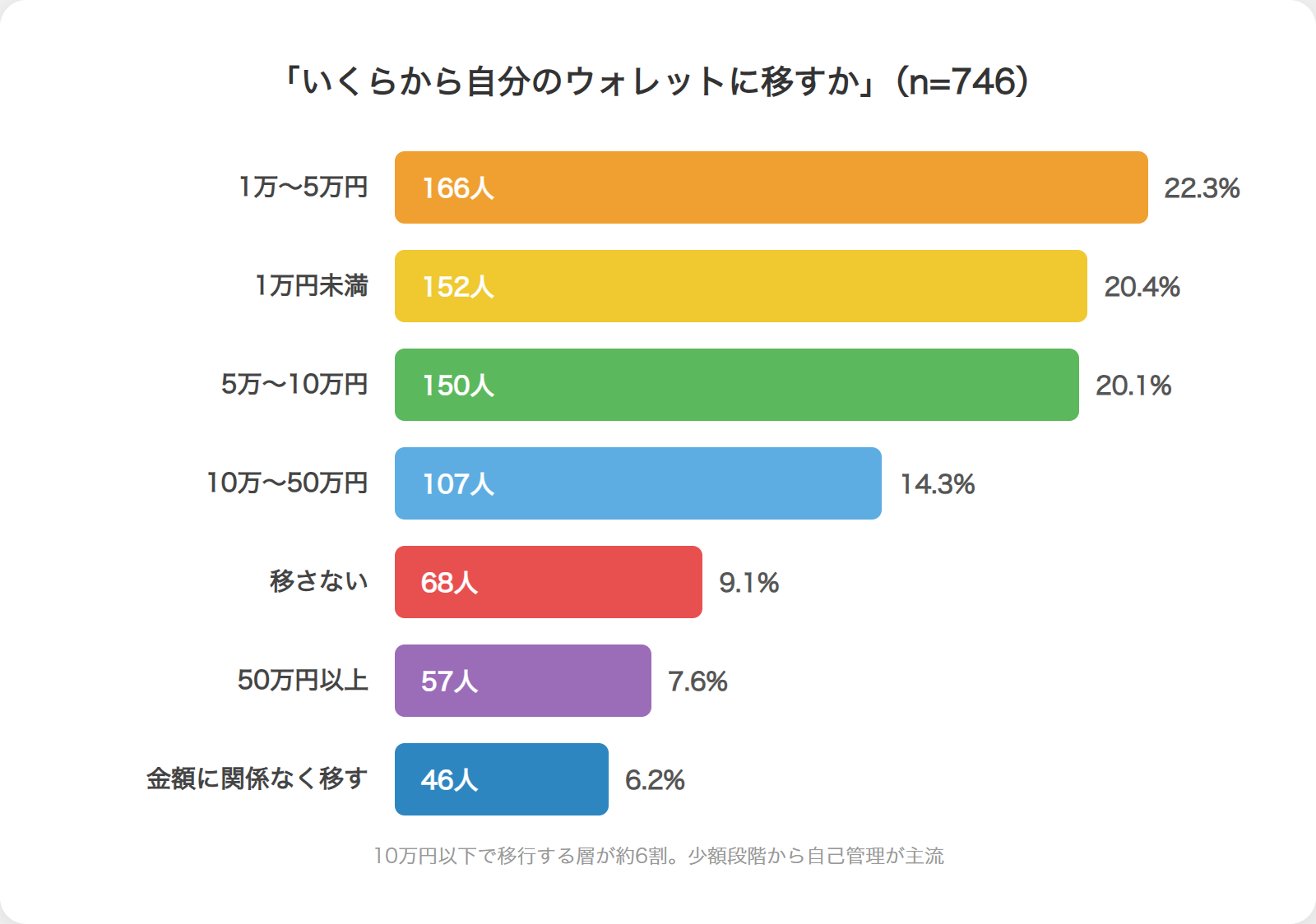
Transfer Threshold | Responses | Share |
|---|---|---|
¥10,000–¥50,000 | 166 | 22.3% |
Under ¥10,000 | 152 | 20.4% |
¥50,000–¥100,000 | 150 | 20.1% |
¥100,000–¥500,000 | 107 | 14.3% |
Never transfers | 68 | 9.1% |
¥500,000 or more | 57 | 7.6% |
Transfers regardless of amount | 46 | 6.2% |
When we asked investors at what "threshold amount" they move crypto to a wallet, the most common answer was ¥10,000–¥50,000 (roughly $65–$330), the earliest of the small-amount brackets, at 22.3%.
This was followed by under ¥10,000 (roughly under $65) at 20.4% and ¥50,000–¥100,000 (roughly $330–$660) at 20.1%—together, about 60% of investors move to self-custody once their holdings reach ¥100,000 or less.
This shows a clear intent among many investors to withdraw assets from exchanges and take control early on.
Meanwhile, 9.1% of respondents said they "never transfer."
The reasons likely vary—some may trust their exchange's security, while others may simply want to avoid the hassle of the transfer process.
Regardless, the risk of leaving assets on an exchange is never zero, no matter the amount.
Whatever the threshold, having a personal "transfer rule" of your own is the first step toward protecting your assets.
How Holding Size Shapes Real-World Decision Criteria
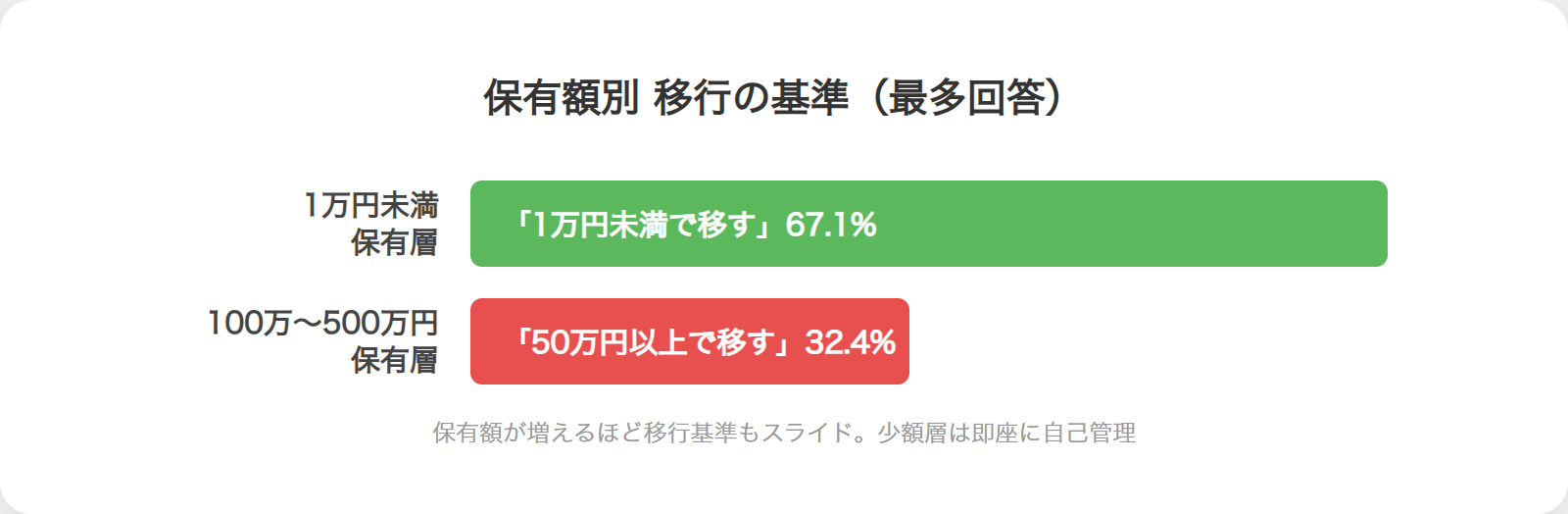
Holding Size | Most Common Transfer Threshold |
|---|---|
Under ¥10,000 | Transfers at under ¥10,000 (67.1%) |
¥1,000,000–¥5,000,000 | Transfers at ¥500,000 or more (32.4%) |
Cross-tabulating transfer thresholds by holding size reveals that the threshold clearly shifts upward as holding size grows.
Among investors holding under ¥10,000 (roughly under $65), 67.1% move their assets to a wallet as soon as they reach the "under ¥10,000" stage.
Because these holdings are small, the barrier to management appears lower, allowing investors to move quickly toward self-custody.
By contrast, among the mid-size group holding between ¥1,000,000 and ¥5,000,000 (roughly $6,600–$33,000), "¥500,000 or more" was the most common transfer threshold at 32.4%.
This suggests a more conservative psychology at play—investors only take the step of moving assets to a wallet once their holdings reach a certain scale.
As holding size increases, investors appear to weigh loss risk against the effort involved and carefully time their transfer decision.
How Management Awareness Shifts as Holdings Grow
Comparing small-holding and mid-size investors reveals a clear structure in which the transfer threshold rises in step with holding size.
While roughly 70% of investors holding under ¥10,000 transfer their assets immediately, once holdings reach around ¥1,000,000, the threshold for making that decision shifts up to "¥500,000 or more."
This is because, as holding size grows, both the risk of a mistake during the transfer process and the potential scale of loss also increase.
While this caution makes sense, the longer assets remain on an exchange, the more risk accumulates over that period.
Building the habit of transferring assets to a wallet regularly—even in small amounts—directly supports a stronger defensive posture once holding size grows larger.
The mindset of managing one's own assets through a personal wallet, regardless of amount, may serve as one indicator of maturity as a crypto investor.
Hardware Wallet Ownership Stands at 55.9%, but Long-Term Storage Use Is Only 11.3%
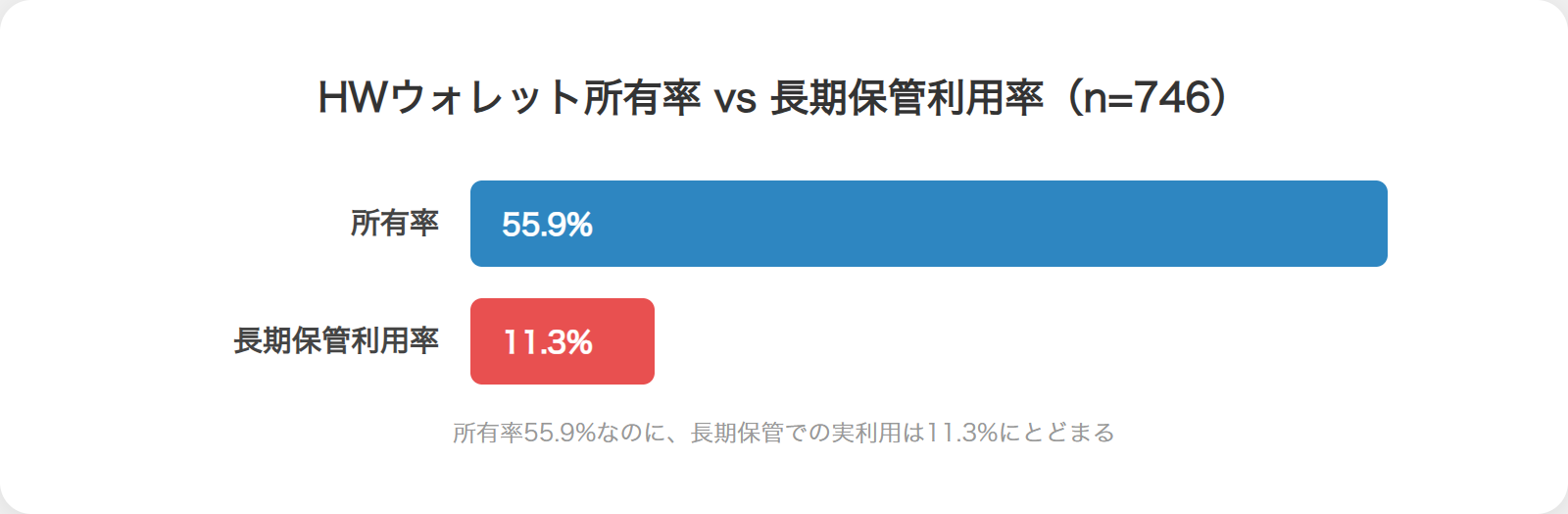
Item | Share |
|---|---|
Hardware wallet ownership rate | 55.9% |
Hardware wallet non-ownership rate | 11.3% |
An Ownership Rate of 55.9% Points to Strong Adoption
This survey found that 55.9%—more than half—of crypto investors own a hardware wallet.
Reflecting rising security awareness, more and more investors are purchasing dedicated devices.
This shows that many investors are indeed preparing for a worst-case scenario.
However, looking back at the earlier storage data, only 11.3% actually use a hardware wallet for long-term storage.
There is a wide gap between ownership and actual usage.
This figure suggests that a substantial number of investors "own one but aren't making full use of it."
The Technical Barriers Holding Down Usage
Why is there such a wide gap between ownership and usage?
The background likely includes the inherent complexity of managing a hardware wallet, along with a strong psychological fear of losing assets due to operational mistakes.
Concerns such as sending funds to the wrong address, or losing or damaging the device, appear to discourage everyday use.
For many investors, a hardware wallet may function more like an insurance policy—something purchased for peace of mind.
Rather than actually moving assets onto the device, many investors seem to gain psychological reassurance simply from having one on hand.
But as long as assets remain on an exchange, the underlying security risk is not fundamentally resolved.
Shifting the Mindset From Ownership to Actual Use
Simply owning a hardware wallet does not, by itself, protect your assets.
Its true value is realized only when assets are moved off an exchange and into your own custody.
With many investors having already cleared the first step of ownership, the next step is to make actual use of that device part of their everyday management routine.
Assets intended for long-term holding, in particular, should be isolated in a cold wallet, where attack risk is lower.
Once set up, a high level of security is maintained going forward.
The hope is for investors to move beyond "just owning" a device and fully put their hardware wallet to work—shifting to a more advanced investment style that puts self-custody into practice.
Summary
How crypto assets are managed reflects an investor's stage of growth.
This survey found that roughly half of long-term holders keep their assets on an exchange.
While prioritizing convenience carries a certain logic, shifting toward autonomous self-custody is essential when weighing the security risks involved.
In particular, the tendency for exchange dependency to rise with age, and the gap between hardware wallet ownership and actual use, stand out as key challenges going forward.
Setting a personal "transfer threshold" appropriate to your holding size, and putting any device you already own to proper use, is the path toward becoming a more mature investor.
Taking custody of your crypto assets into your own hands means accepting loss risk in exchange for true ownership.
Let this survey serve as an opportunity to revisit your own security practices.
Survey Overview
Survey date: April 10, 2026
Survey method: Internet survey
Survey subjects: Men and women residing in Japan (people currently investing in crypto assets, or with past investment experience)
Valid responses: 746
Conducted by: Clabo Inc.
Survey Questions
- Have you ever invested in crypto assets (also known as virtual currencies)?
- How many years of crypto investing experience do you have?
- What is the total value of the crypto assets you currently hold?
- Have you ever transferred assets from an exchange to a wallet?
- At what amount do you typically move assets to your own wallet?
- Where do you store the crypto assets you hold long-term?
- Do you own a hardware wallet?
This article is for informational purposes only and does not constitute financial or investment advice. Please consult a qualified professional before making investment decisions.


