


If you've lost money on crypto assets (also known as virtual currencies), you may wonder whether that loss can be offset against your employment income or gains from stock investing. Since stock investing allows offsetting of gains and losses (and even carry-forward deductions) under certain conditions, it's easy to assume crypto assets would be treated the same way.
The short answer is no. Profits from crypto asset transactions are, in principle, classified as miscellaneous income, so losses in this category cannot be offset against other income such as employment income or stock market gains.
Losses arising from the calculation of miscellaneous income cannot be offset against other categories of income.
That said, simply knowing that "crypto losses can't be offset" doesn't give you the full picture of how they're actually treated for tax purposes. There are a few additional points worth understanding about crypto losses beyond their relationship to other income categories.
This article explains why crypto losses cannot be offset against other income, and what you should check if you end up with a loss on your crypto holdings.
Crypto losses cannot be offset against employment income or stock gains

Even if you incur a loss trading crypto assets, you cannot deduct that loss from your employment income or stock market gains. This is because profits from crypto asset transactions are, in principle, classified as miscellaneous income.
Offsetting of gains and losses is a mechanism that allows a loss in one income category to be deducted against profits in another category when calculating tax. For example, losses from real estate income or business income can, under certain conditions, be offset against other categories of income (source: Offsetting of Gains and Losses | National Tax Agency (NTA)).
Losses arising in the miscellaneous income category, however, cannot be offset against other categories such as employment income. In other words, even if you incur a 500,000 yen (approx. $3,300) loss trading crypto assets, you cannot use that loss to reduce your income tax by deducting it from your employment income.
Stock investing also allows, in some cases, capital losses on listed shares to be offset against dividend income, but crypto assets are treated differently for tax purposes. As a result, crypto losses cannot be offset against gains from stocks or investment trusts either.
For these reasons, it's important to remember that crypto losses must be considered separately from other categories of income.
Gains and losses within the same year's crypto transactions can be netted against each other
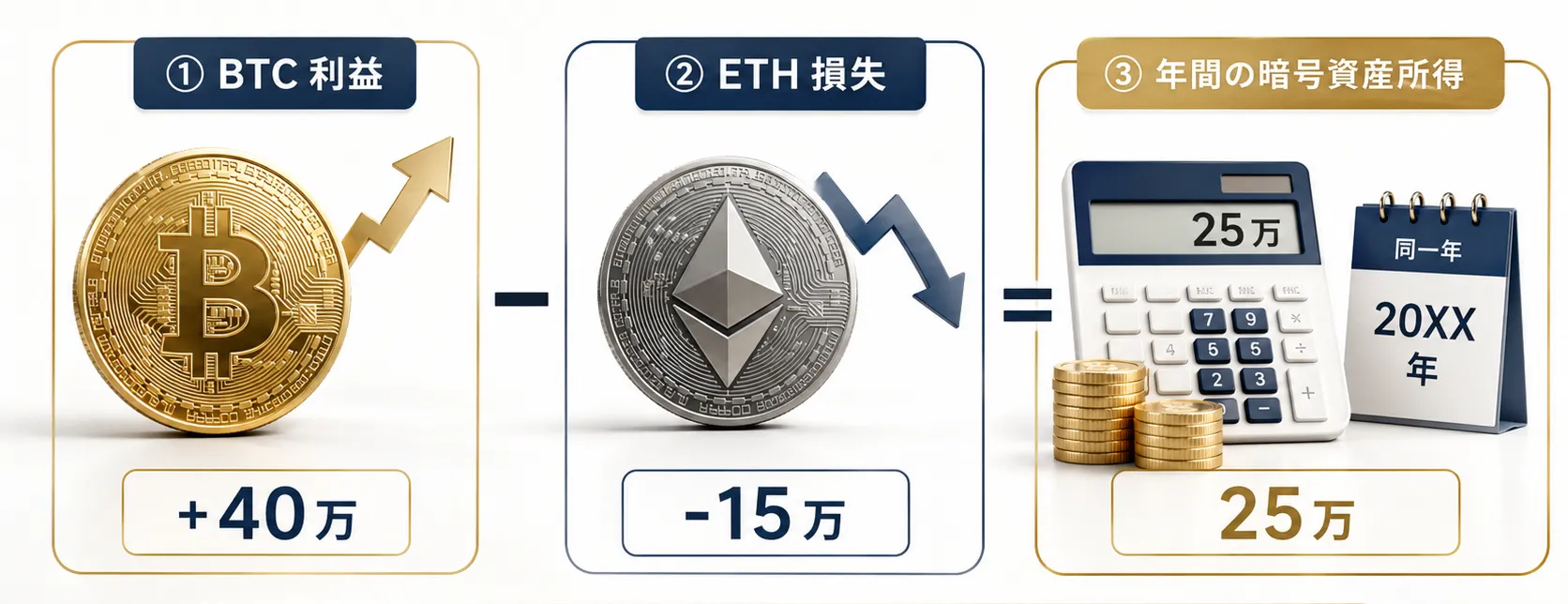
As noted, crypto losses cannot be offset against employment income or stock gains. However, gains and losses from crypto transactions occurring within the same calendar year can be netted against each other when calculating your annual income.
For example, if you made a profit of 400,000 yen selling BTC but incurred a loss of 150,000 yen selling ETH, your overall crypto trading profit for the year would be treated as 250,000 yen. This is because multiple crypto transactions during the year are aggregated together.
It's worth noting that this calculation is conceptually different from tax-law "offsetting of gains and losses." Offsetting of gains and losses refers to the mechanism that allows profits and losses across different income categories to be offset within certain limits. Netting gains and losses within the same year's crypto transactions, by contrast, is simply part of the process of calculating the amount of miscellaneous income itself.
Without understanding this distinction, it's easy to mistakenly conclude that "gains and losses on crypto assets can never be netted against each other." In reality, gains and losses from crypto transactions within the same year can be aggregated as part of calculating your annual miscellaneous income — something worth knowing to avoid leaving money on the table.
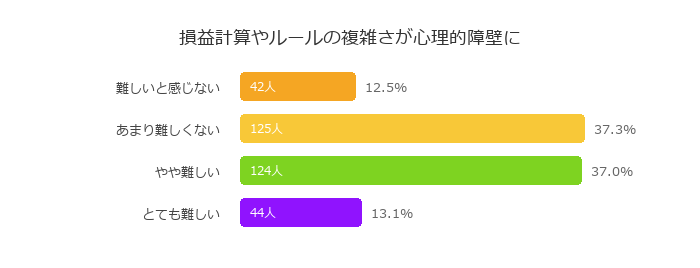
This kind of complexity is a challenge that many crypto holders share. In a survey conducted by our company, 37.01% of respondents said they find calculating crypto gains/losses and the related rules "somewhat difficult," and 13.13% said they find it "very difficult" — a combined 50.14%, meaning roughly half of respondents find it challenging.
One reason people find this difficult is the process of calculating crypto gains and losses itself. Because profits from crypto transactions are, in principle, classified as miscellaneous income, you need to check your annual gains and losses based on annual transaction reports and trading history. This can be especially complicated if you use multiple Crypto Asset Exchange Service Providers or also trade on overseas exchanges, since calculating acquisition costs and aggregating trading history becomes more involved.
If you have income from sources other than crypto assets, how that income is treated can vary depending on its nature and taxation method. Don't assume on your own whether a crypto loss can be offset against other income — consult a tax accountant or your local tax office as needed.
Crypto losses cannot be carried forward to the following year

In stock investing, capital losses on listed shares can, if certain conditions are met, be carried forward to future years. Because of this, some people are used to the idea of "deducting this year's loss from next year's gains and onward."
Crypto losses, however, cannot currently be carried forward in this way. For example, even if you incur a 1,000,000 yen (approx. $6,700) loss on crypto transactions this year, you cannot deduct that loss from next year's crypto trading gains.
That said, this treatment could change in the future. Japan's Fiscal Year 2026 Tax Reform Outline includes a proposal to allow, under certain conditions, a carry-forward deduction for losses related to "specified crypto assets."
Where, among the amount of loss arising from the transfer of specified crypto assets to a person conducting crypto asset trading business, there remains an amount that cannot be deducted even after deduction from the amount of transfer income, etc. related to specified crypto assets for the year in which the transfer occurred, a carry-forward deduction of that remaining amount from the amount of transfer income, etc. related to specified crypto assets for each of the three years following that year shall be permitted, subject to certain requirements.
Source: Fiscal Year 2026 Tax Reform Outline | Ministry of Finance (MOF)
It's also worth noting that Japan's tax treatment of crypto assets is undergoing broader structural change beyond this loss carry-forward proposal. As of July 2026, under current law, gains from selling crypto assets remain classified as miscellaneous income and taxed under Japan's aggregate (progressive) taxation system. However, on July 15, 2026, amendments to the Financial Instruments and Exchange Act (FIEA) that reclassify crypto assets as financial instruments under that law were passed by the House of Councillors. Under the amended law, crypto assets are expected to become eligible for a flat 20% separate self-assessment tax rate starting from the year following the amended law's effective date, which is currently expected to be around January 2028.
If this loss carry-forward proposal is enacted, it would, within certain limits, allow crypto losses to be deducted from income in each of the following three years. Since crypto losses have not been carry-forward eligible until now, this would represent a significant change in tax treatment.
That said, as the quoted text indicates, the proposal applies only to "specified crypto assets" and losses "arising from transfers to a person conducting crypto asset trading business," among other conditions — it does not grant unconditional carry-forward deductions for all crypto transactions. When it comes time to file, be sure to check not only the current rules but also whatever tax rules apply in the year you're filing for.
What to check if you incur a crypto loss

Even if you've incurred a loss on crypto assets, that doesn't mean there's nothing to check. Whether something that looks like a loss is actually treated as one for tax purposes depends on the details of the transaction and your overall situation for the year.
In particular, when calculating crypto gains and losses, looking at a single transaction in isolation can lead to a figure that doesn't match your actual taxable income. Precisely because offsetting of gains and losses and carry-forward deductions aren't available, it's important to first organize your transactions for the year accurately and confirm whether they actually qualify as a loss.
Below are some basic points worth checking if you've incurred a crypto loss.
Organize your full-year trading history
If you've incurred a crypto loss, start by organizing your trading history for the full year. Gains and losses are determined, in principle, for the period from January 1 to December 31, so you need to review all of that year's transactions without omission.
What needs to be checked isn't limited to selling crypto assets. Depending on the details, exchanging one crypto asset for another, or using crypto assets to pay for goods or services, can also be subject to gain/loss calculation. In other words, it's not accurate to assume that "tax only applies when I convert to Japanese yen."
For example, even if you simply exchange one crypto asset you hold for another, that exchange can trigger a realized gain or loss at that point, requiring a calculation. Also, if you've received staking rewards or lending rewards, the taxable amount is calculated based on the market value at the time you received them, so it's important to check the price at that time.
Furthermore, if you use multiple exchanges (order-matching marketplaces), you need to consolidate the trading history from each one before calculating your annual gains and losses. You may have a loss on one exchange while showing a profit on another.
Understanding your full-year trading activity and accurately aggregating your gains and losses is the foundation for correctly calculating your taxable income.
Check your acquisition cost, sale price, and fees
To calculate your crypto gains and losses, you need to check the acquisition cost, sale price, and fees involved. Acquisition cost refers to "the amount at which you acquired the crypto asset," while sale price refers to "the amount at which you sold it."
For example, if you purchased a crypto asset for 500,000 yen and sold it for 300,000 yen, a simple calculation would show a loss of 200,000 yen. However, the actual tax calculation must also account for fees incurred at the time of purchase and sale, as well as the method used to calculate acquisition cost when you've made multiple purchases over time.
In particular, if you've purchased the same crypto asset multiple times, how you calculate the acquisition cost of the portion you sold becomes important. If you can't accurately determine your acquisition cost, you also can't accurately calculate your gain or loss.
The treatment of fees also requires attention. Fees directly related to a transaction may be reflected in the gain/loss calculation, but not all fees qualify as deductible expenses. It's important to calculate your gains and losses based on your actual transaction details, referring to your trading history and annual transaction reports.
Unrealized losses on crypto you haven't sold don't count as losses for tax purposes
Even if the price of a crypto asset has fallen, it isn't treated as a tax loss as long as you haven't sold it. What's known as an unrealized loss refers to a situation where the current market value of your holdings is below your acquisition cost.
For example, if a crypto asset you purchased for 1,000,000 yen has fallen in market value to 600,000 yen, that doesn't mean a 400,000 yen loss has been finalized as long as you haven't sold it. At this stage, it cannot be reflected as a tax loss in your annual gains and losses.
On the other hand, if you sell that crypto asset, or exchange it for another crypto asset, it may become subject to gain/loss calculation. When determining whether you've incurred a crypto loss, don't just look at whether the price has fallen — check whether you've actually sold or exchanged it.
Confusing unrealized losses with realized losses can lead to miscalculating your taxable income. Even if it feels like you've incurred a loss, it's important to confirm whether that loss has actually been realized for tax purposes.
If you're unsure how to calculate crypto gains and losses, consult a tax accountant or your local tax office

Calculating crypto gains and losses can become complicated depending on the details of your transactions. In particular, care is needed if you use multiple exchanges, exchange one crypto asset for another, receive staking or lending rewards, or trade on overseas platforms.
Crypto losses cannot be offset against employment income or stock gains. Under current rules, they also cannot be carried forward to future years. On the other hand, gains and losses within the same year's crypto transactions can be aggregated and calculated together.
In this way, crypto taxation involves a mix of "things you can't do" and "things you still need to check and calculate." Just because offsetting of gains and losses isn't available doesn't mean you can skip organizing your trading history and calculating your gains and losses.
If you're unsure how your own transactions will be treated, consult a tax accountant or your local tax office. This is especially important if your transaction amounts are large or if you have concerns about a past filing (related: How Much Does It Cost to Hire a Tax Accountant for Crypto? (in Japanese)).
This article is for informational purposes only and does not constitute financial or investment advice. Please consult a qualified professional before making investment decisions.


