


Which coins are people staking, on which platforms, and at what yields? We gathered the data to answer the questions only real practitioners can.
Clabo surveyed 600 holders of crypto assets (also known as virtual currencies) and, among them, identified 320 respondents with hands-on staking experience. We tallied their coins staked, platforms used, perceived yields, how they use their rewards, tax-filing pain points, and any trouble they encountered. Unless otherwise noted, all figures below use the 320 experienced respondents as the base (n=320).
*The figures in this article are based on respondents' self-reported answers.
1. 53% Have Staked Before, and Domestic Exchanges Dominate
Of all 600 respondents, 53.3% (320 people) had staking experience. Among those, 75.3% said they are "currently still staking," showing that most people who start tend to keep going. By venue (multiple answers allowed), "domestic exchanges" (order-matching marketplaces operated by Japan-licensed exchange businesses) came out on top at 70.0%.
1-1. Currently Still Staking? (n=320)
Status | Responses | Share |
|---|---|---|
Currently staking | 241 | 75.3% |
Used to stake but stopped | 79 | 24.7% |
1-2. Platforms/Services Used (Multiple Answers, n=320)
Platform | Responses | Share |
|---|---|---|
Domestic exchanges | 224 | 70.0% |
Wallets (e.g., MetaMask) | 78 | 24.4% |
Overseas exchanges | 66 | 20.6% |
Liquid staking (e.g., Lido) | 42 | 13.1% |
Running own node | 22 | 6.9% |
Staking through a corporate entity | 14 | 4.4% |
2. Coin Rankings: ETH Tops the List at 38%
By coin staked (multiple answers allowed), ETH came out on top at 38.4%, followed by SOL (27.8%), DOT (22.5%), ATOM (21.6%), and ADA (19.7%) — a fairly even spread across the major staking-compatible coins.
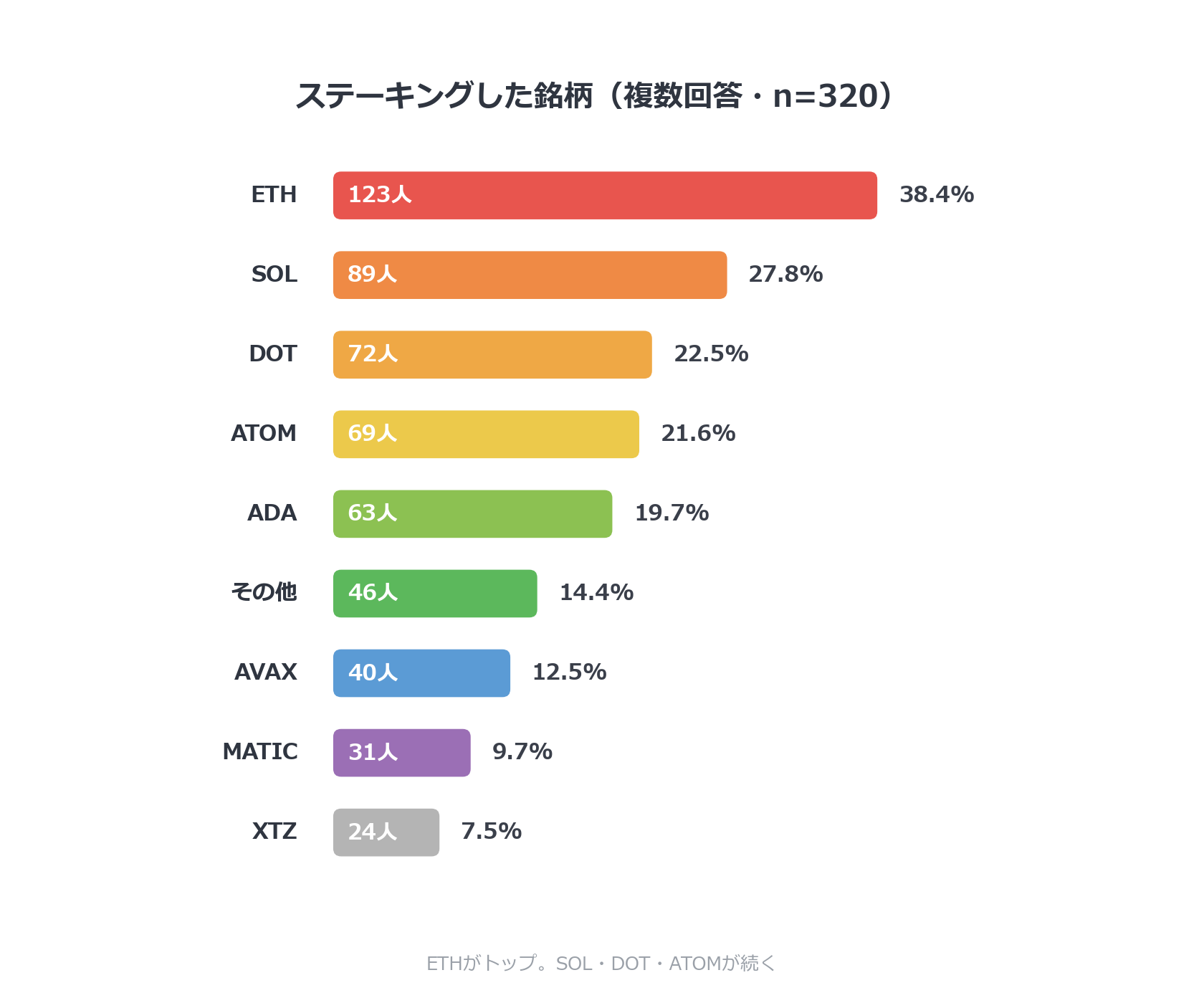
Coin (Multiple Answers, n=320) | Responses | Share |
|---|---|---|
ETH | 123 | 38.4% |
SOL | 89 | 27.8% |
DOT | 72 | 22.5% |
ATOM | 69 | 21.6% |
ADA | 63 | 19.7% |
Other | 46 | 14.4% |
AVAX | 40 | 12.5% |
MATIC | 31 | 9.7% |
XTZ | 24 | 7.5% |
3. Perceived Yields Cluster Around 2–6%
For respondents' main coin, perceived annual yield (APR/APY) clustered around "2–4%" (24.7%), "4–6%" (23.4%), and "under 2%" (22.5%) — together, the "2–6%" band accounts for roughly 48%. 14.7% said they "don't know," indicating a meaningful segment isn't tracking their yield precisely.
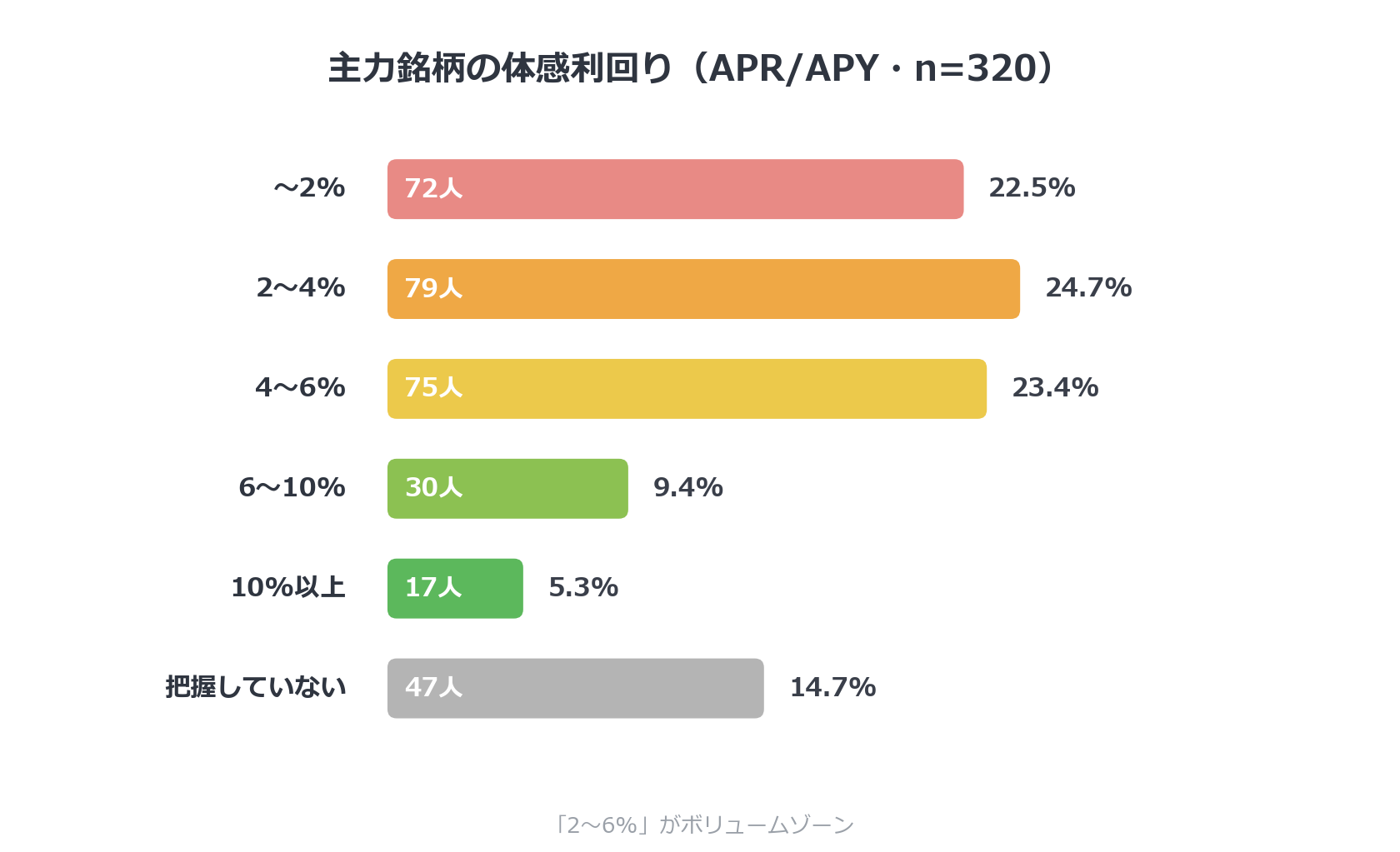
3-1. Perceived Yield, by Response Count (n=320)
Perceived Yield | Responses | Share |
|---|---|---|
Under 2% | 72 | 22.5% |
2–4% | 79 | 24.7% |
4–6% | 75 | 23.4% |
6–10% | 30 | 9.4% |
10% or more | 17 | 5.3% |
Don't know | 47 | 14.7% |
3-2. The More Capital Staked, the Higher the Perceived Yield
Cross-tabulating perceived yield against amount staked revealed a clear correlation. Among respondents staking ¥10 million or more, 45% reported yields of "10% or more," while among those staking under ¥100,000, 37% reported "under 2%" and 35% said "don't know."
Perceived Yield \ Amount Staked | Under ¥100K | ¥100K–¥500K | ¥500K–¥1M | ¥10M+ |
|---|---|---|---|---|
Under 2% | 37% | 17% | 18% | 18% |
4–6% | 6% | 30% | 37% | 9% |
10% or more | 2% | 5% | 1% | 45% |
Don't know | 35% | 8% | 3% | 0% |
4. Half Reinvest Rewards, and 80% Compound Their Returns
Over the past year, reward amounts clustered around "¥50,000–¥100,000" (24.7%), "under ¥10,000" (23.1%), and "¥10,000–¥50,000" (20.6%). Compounding — putting rewards back into staking — is common: "some of it" (41.6%) plus "all of it" (39.7%) together reach 81.3%.
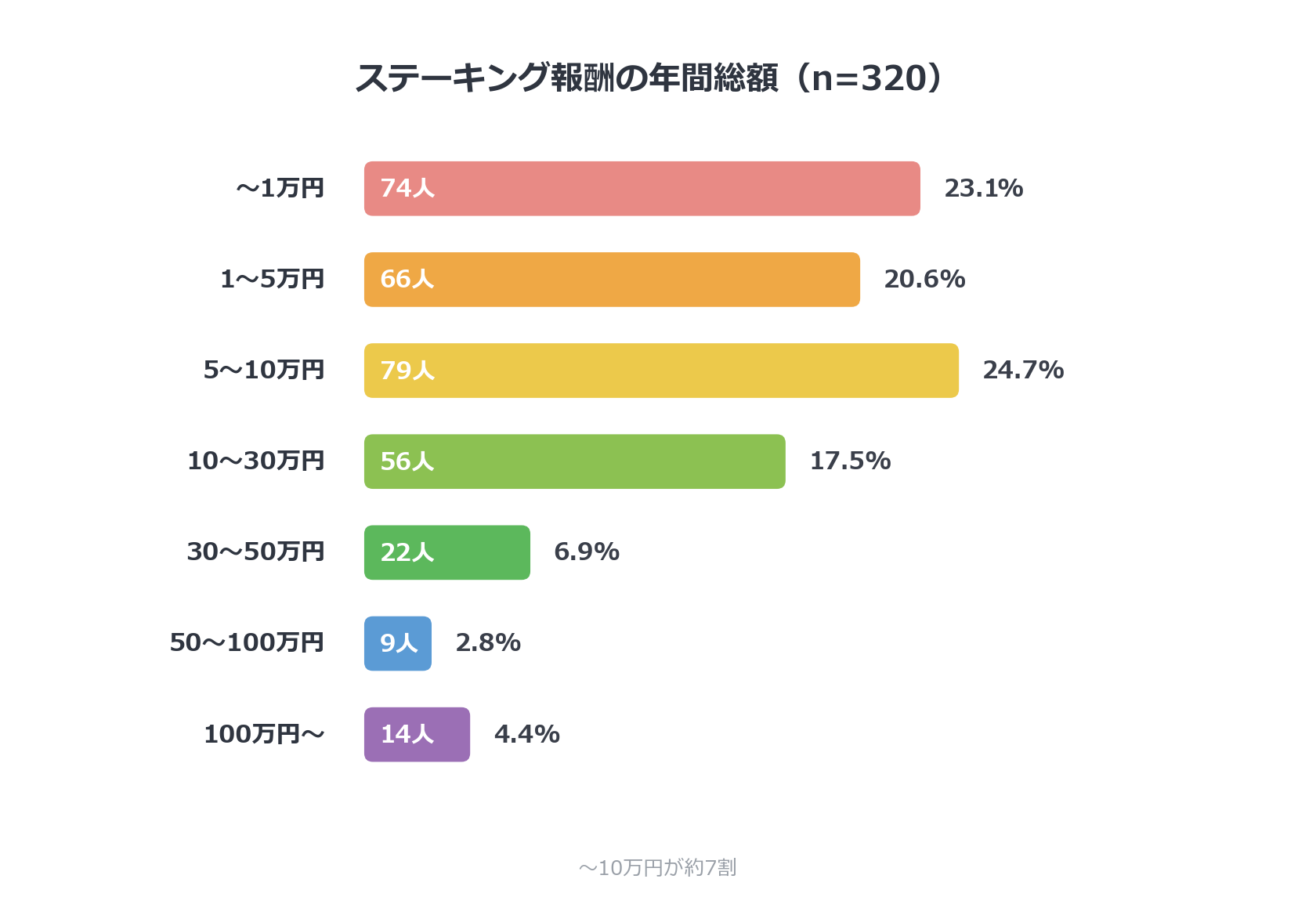
4-1. Total Annual Rewards (n=320)
Total Annual Rewards | Responses | Share |
|---|---|---|
Under ¥10,000 | 74 | 23.1% |
¥10,000–¥50,000 | 66 | 20.6% |
¥50,000–¥100,000 | 79 | 24.7% |
¥100,000–¥300,000 | 56 | 17.5% |
¥300,000–¥500,000 | 22 | 6.9% |
¥500,000–¥1,000,000 | 9 | 2.8% |
¥1,000,000 or more | 14 | 4.4% |
4-2. What Rewards Are Used For (Multiple Answers, n=320)
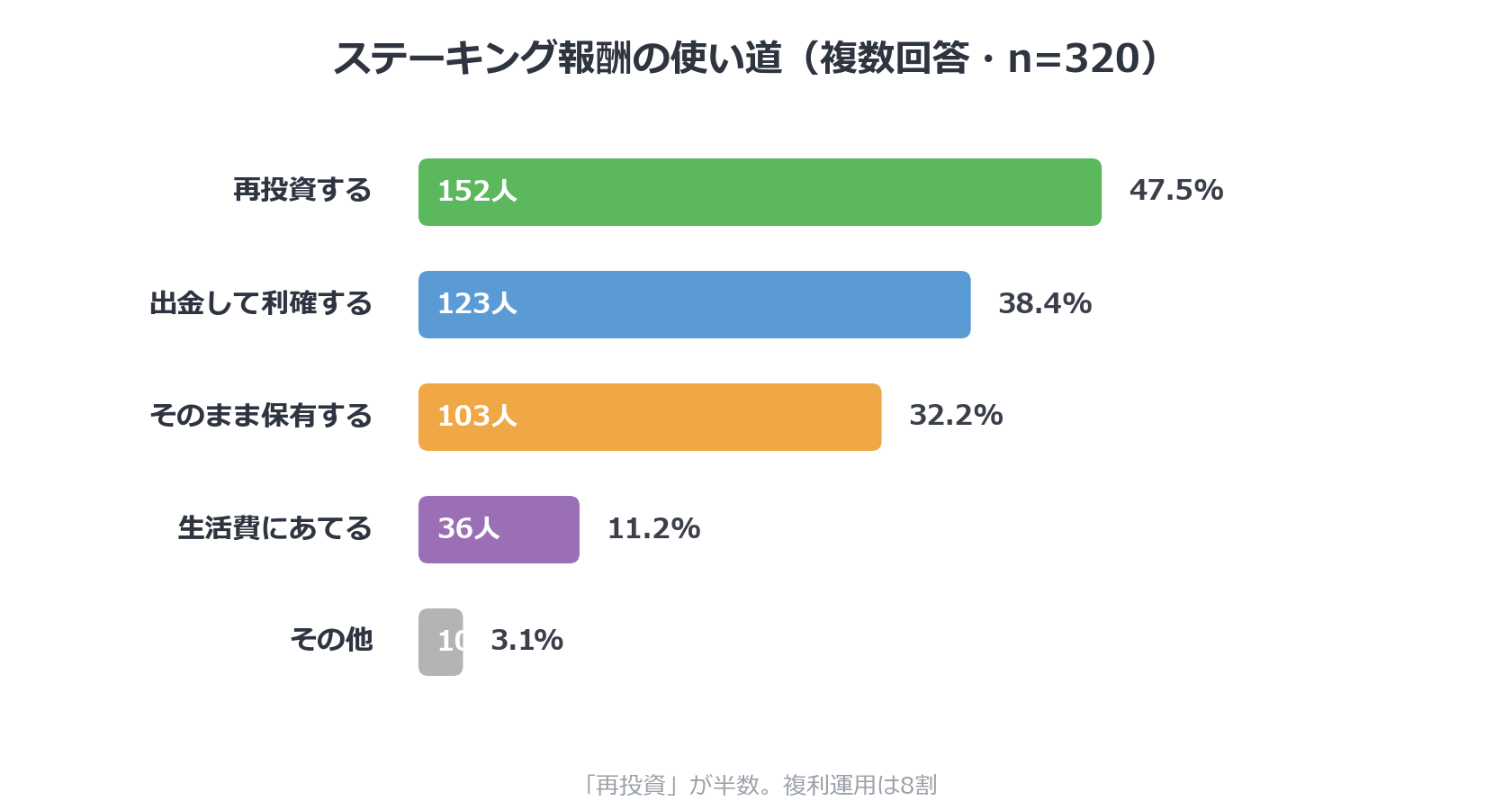
Use | Responses | Share |
|---|---|---|
Reinvest it | 152 | 47.5% |
Withdraw and lock in gains | 123 | 38.4% |
Hold as-is | 103 | 32.2% |
Use for living expenses | 36 | 11.2% |
Other | 10 | 3.1% |
5. Where Tax Filing Gets Tricky: Cost Basis and Timing of Recognition
The top pain points around staking taxes and tax filing (multiple answers allowed) were "unclear cost basis" (39.4%), "unclear timing for recognizing income" (38.4%), and "calculations are too complex" (35.3%). Because staking rewards must, in principle, be recorded by value and date every time they are received, it's easy to see why many respondents get stuck here.
Under Japan's current tax rules (as of July 2026), gains from crypto assets — including staking rewards — are treated as miscellaneous income and subject to aggregate (progressive) taxation. On July 15, 2026, an amendment to the Financial Instruments and Exchange Act (FIEA) passed Japan's House of Councillors, moving crypto assets into the FIEA's scope as a financial instrument; a flat 20% separate self-assessment tax rate is expected to apply from the year after the amended law takes effect (likely January 2028). In the meantime, losses from crypto assets, including staking, can only be offset against other miscellaneous income — they cannot be offset against employment income or other income categories.
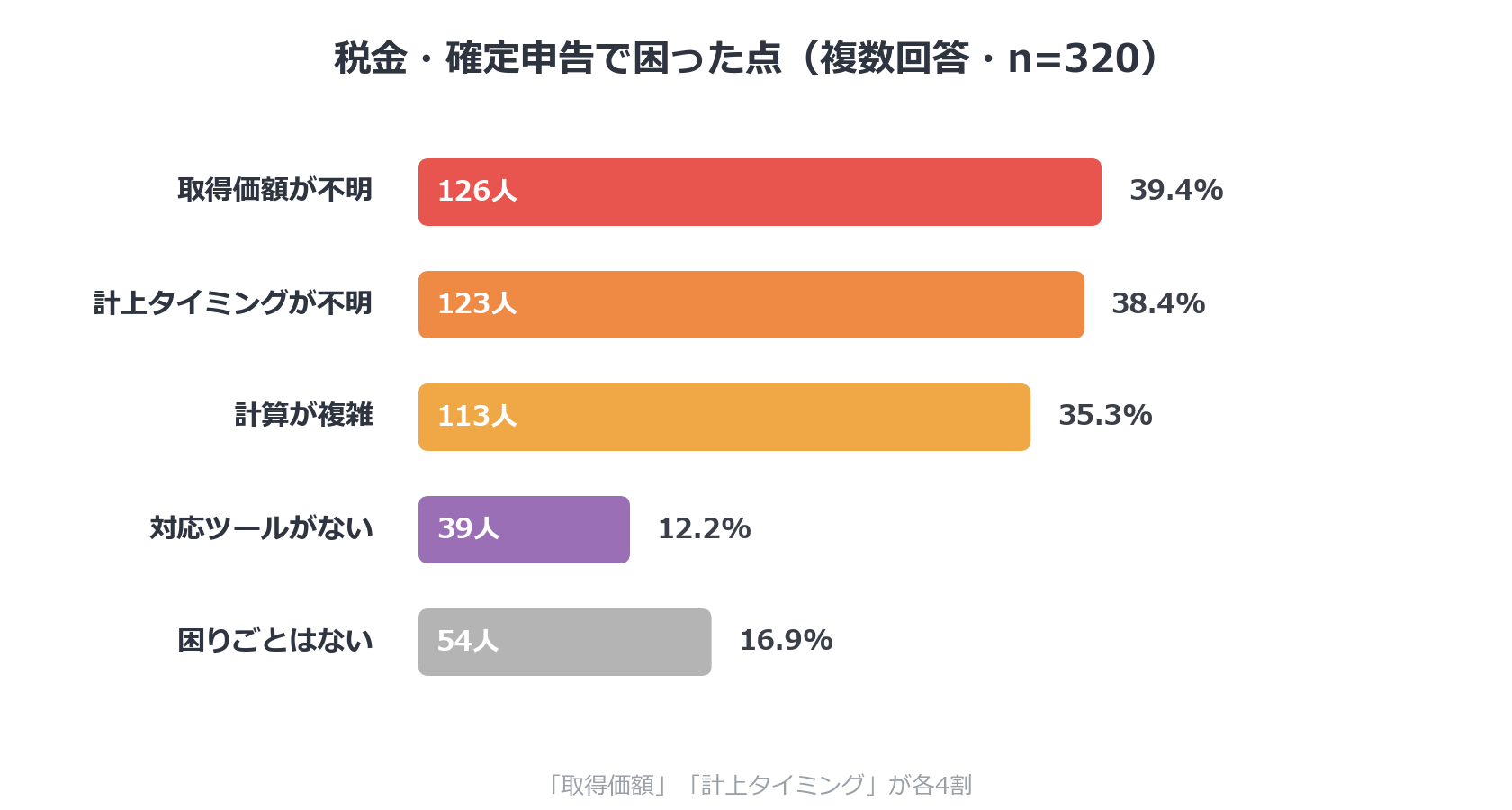
Pain Point (Multiple Answers, n=320) | Responses | Share |
|---|---|---|
Unclear cost basis | 126 | 39.4% |
Unclear timing for recognizing income | 123 | 38.4% |
Calculations are too complex | 113 | 35.3% |
No suitable tools available | 39 | 12.2% |
No particular issues | 54 | 16.9% |
6. Price Drops Are the Most Common Issue Encountered
Among risks and issues respondents experienced (multiple answers allowed), "price decline" was the most common at 43.4%, followed by "service suspension" (30.6%), "concerns about hacking" (25.3%), and "slashing" (24.7%). "Falling victim to fraud" was relatively rare, at 8.8%.
.png)
Issue (Multiple Answers, n=320) | Responses | Share |
|---|---|---|
Price decline | 139 | 43.4% |
Service suspension | 98 | 30.6% |
Concerns about hacking | 81 | 25.3% |
Slashing | 79 | 24.7% |
Falling victim to fraud | 28 | 8.8% |
No issues experienced | 53 | 16.6% |
7. Future Plans Hinge on Yield
Looking ahead, "want to maintain current levels" was the most common response at 43.4%, followed by "want to expand" at 19.1%.
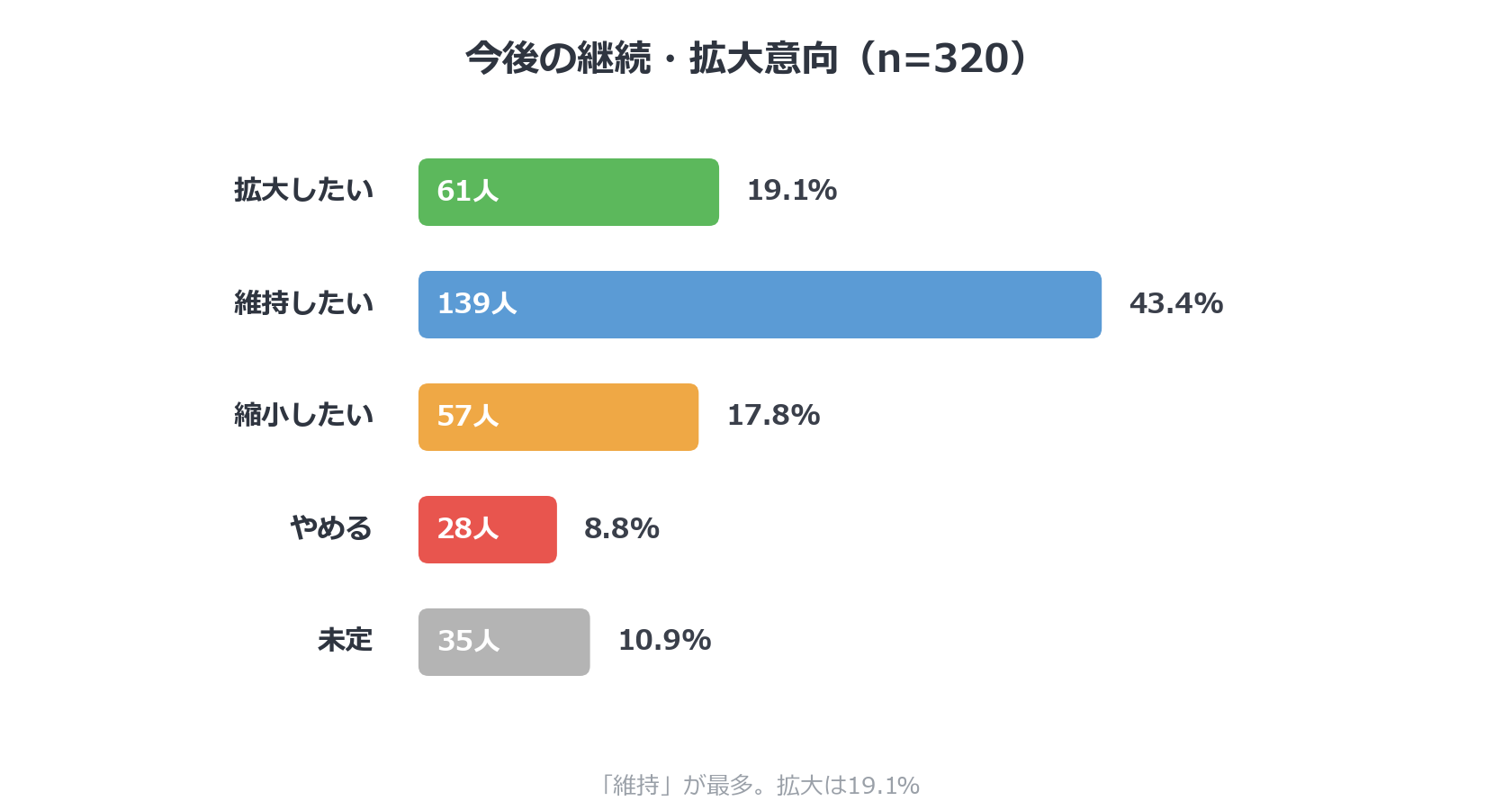
7-1. Distribution of Future Intentions (n=320)
Intention | Responses | Share |
|---|---|---|
Want to expand | 61 | 19.1% |
Want to maintain current levels | 139 | 43.4% |
Want to scale back | 57 | 17.8% |
Plan to stop | 28 | 8.8% |
Undecided | 35 | 10.9% |
7-2. The Higher the Perceived Yield, the Stronger the Urge to Expand
Breaking down future intentions by perceived yield shows a clear trend: the higher the yield, the stronger the desire to expand. Among those reporting "10% or more," 41% said they "want to expand," while among those who "don't know" their yield, intentions were far less settled — 30% said "undecided" and 15% said they "plan to stop."
Intention \ Perceived Yield | Under 2% | 2–4% | 4–6% | 6–10% | 10% or more | Don't know |
|---|---|---|---|---|---|---|
Want to expand | 26% | 15% | 20% | 17% | 41% | 6% |
Plan to stop | 19% | 3% | 1% | 7% | 12% | 15% |
8. Summary
This survey uncovered the following about how staking practitioners actually operate:
- 53.3% of respondents have staking experience; 75.3% of them are still staking today, and 70.0% use domestic exchanges.
- ETH is the most-staked coin at 38.4%, followed by SOL, DOT, and ATOM.
- Perceived yields cluster around "2–6%," and the more capital staked, the higher the yield tends to be.
- Half of respondents reinvest their rewards, and 81.3% compound them to some degree.
- Around 40% each struggle with "cost basis" and "timing of income recognition" for tax purposes.
- "Price decline" is the most common issue, cited by 43.4%, and plans to continue or expand staking are closely tied to perceived yield.
9. Survey Overview
- Survey title: Large-Scale Survey on Real-World Crypto Staking Practices
- Conducted by: Clabo Inc.
- Method: Online self-administered survey
- Target: Men and women with crypto asset staking experience (320 of the 600 total respondents had staking experience)
- Valid responses: 320 (experienced respondents)
- Fielded: May 2026
- Note: The figures in this article are based on respondents' self-reported answers. For multiple-choice questions, totals may exceed 100%.
Charts and figures from this survey may be quoted or reproduced, provided the source is credited as "Clabo Inc. survey."
10. Key Survey Questions
Q1 Have you ever staked crypto assets?
Q2 Are you still staking today?
Q3 Which coin(s) have you staked, or are you currently staking? (select all that apply)
Q4 Which exchange(s) or service(s) do you use for staking? (select all that apply)
Q5 Which range best describes the perceived annual yield (APR/APY) on your main coin?
Q6 What was your total staking reward amount over the past year?
Q7 Do you reinvest your staking rewards back into staking to compound your returns?
Q8 What do you mainly use your staking rewards for? (select all that apply)
Q9 Does the staking service you use have a lock-up period?
Q10 What issues have you had with staking taxes or tax filing? (select all that apply)
Q11 What risks or issues have you experienced with staking? (select all that apply)
Q12 Do you plan to continue, expand, or scale back your staking activity going forward?
Q13 How much have you allocated to staking?
Q14 What is your total investment portfolio size, including crypto assets?
Q15 How long have you been investing in crypto assets?
Q16 Which best describes your position/role in crypto assets and investing?
Q17 Specifically, what issues have you had with staking taxes or tax filing?
This article is for informational purposes only and does not constitute financial or investment advice. Please consult a qualified professional before making investment decisions.


