


How much do married couples really share about money? While many discuss household finances and savings openly, a different picture emerges when it comes to investing — especially in volatile assets like crypto, where a significant number of people don't tell their spouse at all.
Clabo surveyed 566 married men and women who currently hold, or have previously held, crypto assets (also known as virtual currencies). The results show that more than 30% keep their crypto holdings secret from their spouse, and over 40% of those hiding assets are hiding ¥1,000,000 (approx. $6,800) or more. Furthermore, nearly half of respondents said that if something were to happen to them, their family would not be able to locate or access their crypto assets.
“Secret investing” isn't just a matter of marital trust. It's also directly connected to inheritance and end-of-life planning risks — assets that no one else can access or pass on if something happens to their owner. This article walks through what the survey data reveals.
*The figures in this article are based on respondents' self-reported answers.
1. 23.3% of Respondents Don't Share Their Investment Status With Their Spouse
We first asked respondents how much of their investment status they share with their spouse. Only 20.7% said they “share all holdings,” while “share only part of it” was the most common answer at 33.7%. Combining “keep it almost entirely secret” and “hide the fact of investing entirely,” 23.3% of respondents are effectively keeping their investments secret.
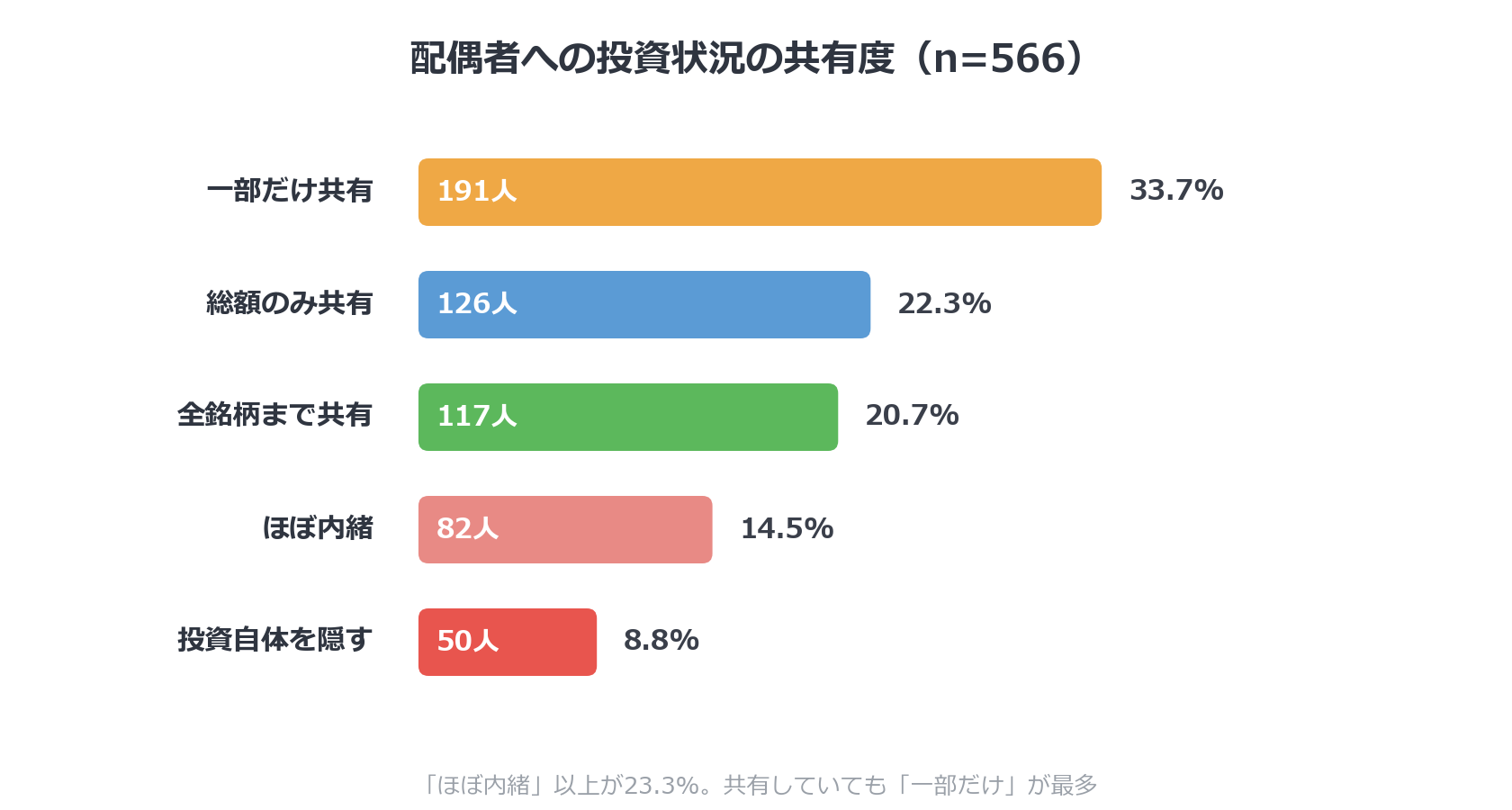
1-1. Level of Investment Disclosure to Spouse (n=566)
Disclosure Level | Responses | Percentage |
|---|---|---|
Share all holdings | 117 | 20.7% |
Share only the total amount | 126 | 22.3% |
Share only part of it | 191 | 33.7% |
Keep it almost entirely secret | 82 | 14.5% |
Hide the fact of investing entirely | 50 | 8.8% |
1-2. 32.2% of Married Investors Keep Crypto Holdings Secret From Their Spouse
Looking at what respondents keep secret (multiple answers allowed), stocks came out on top at 46.8%, followed by investment trusts (mutual funds) at 35.5% and crypto assets at 32.2%. That means 182 of the 566 respondents keep their crypto holdings secret from their spouse. Meanwhile, 20.7% said they have “nothing kept secret.”
.png)
Assets Kept Secret (multiple answers allowed, n=566) | Responses | Percentage |
|---|---|---|
Stocks | 265 | 46.8% |
Investment trusts (mutual funds) | 201 | 35.5% |
Crypto assets | 182 | 32.2% |
FX (foreign exchange margin trading) | 59 | 10.4% |
Other | 47 | 8.3% |
Nothing kept secret | 117 | 20.7% |
1-3. It's the Amount, Not the Fact of Investing, That Gets Hidden
Even among respondents who said they share their investment status, “sharing only part of it” was the norm. Many reveal that they invest, but not which assets they hold or the total amount. The data suggests that the more a topic touches on actual figures, the more likely it is to be withheld between spouses.
2. Secret Crypto Holdings: Over 40% Exceed ¥1 Million (Approx. $6,800)
We asked the 182 respondents who keep crypto assets secret about the estimated value of those holdings. “Up to ¥100,000 (approx. $680)” was the single most common answer at 28.6%, but combined, the brackets of “¥1,000,000 (approx. $6,800) or more” add up to 42.3%. Respondents split into two groups: those hiding small amounts, and those hiding substantial sums.
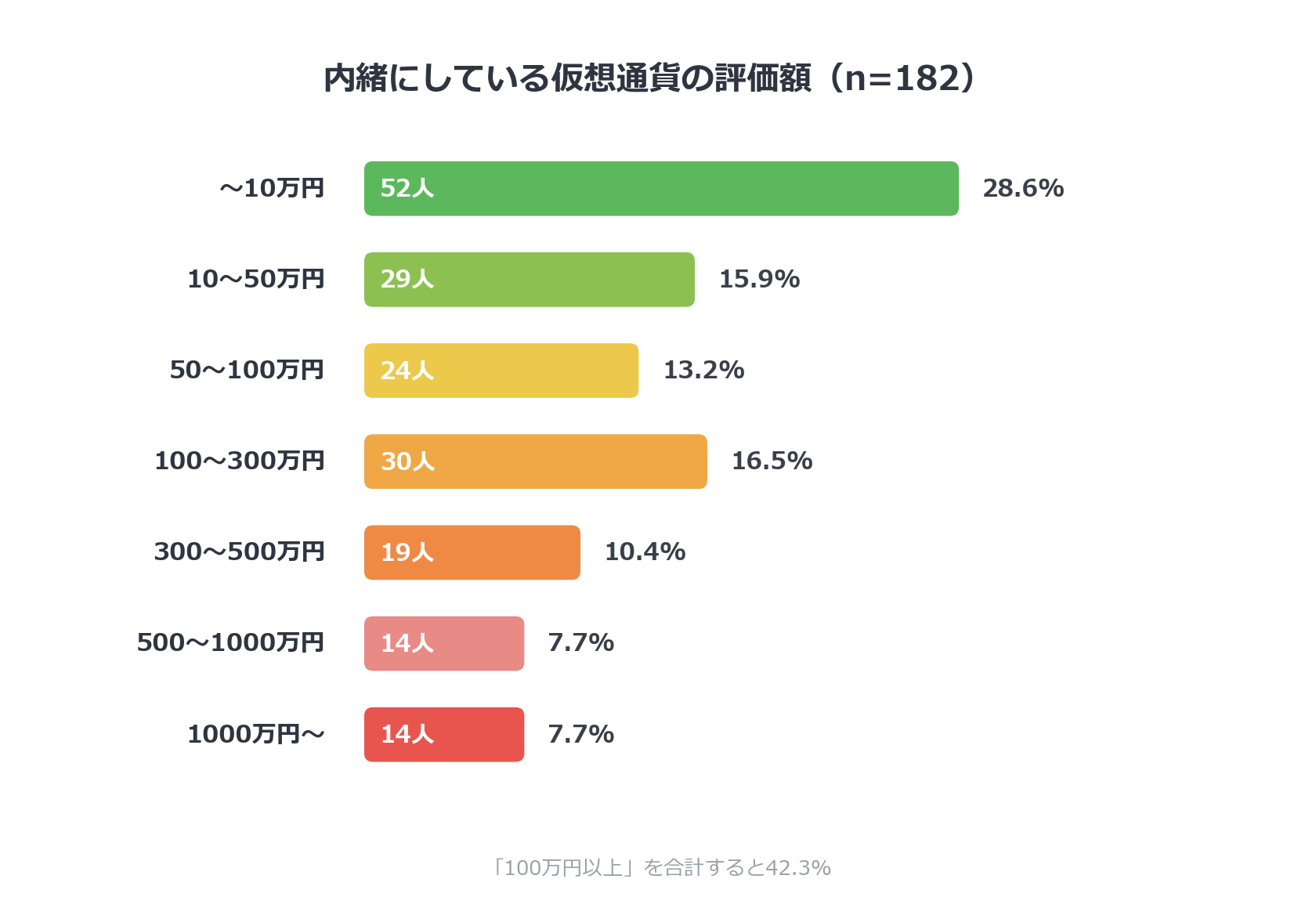
2-1. Distribution of Hidden Holdings' Value (n=182)
Value | Responses | Percentage |
|---|---|---|
Up to ¥100,000 (approx. $680) | 52 | 28.6% |
¥100,000–500,000 (approx. $680–3,400) | 29 | 15.9% |
¥500,000–1,000,000 (approx. $3,400–6,800) | 24 | 13.2% |
¥1,000,000–3,000,000 (approx. $6,800–20,400) | 30 | 16.5% |
¥3,000,000–5,000,000 (approx. $20,400–34,000) | 19 | 10.4% |
¥5,000,000–10,000,000 (approx. $34,000–68,000) | 14 | 7.7% |
¥10,000,000+ (approx. $68,000+) | 14 | 7.7% |
2-2. The Larger the Total Portfolio, the More Is Hidden
Cross-referencing the hidden amount with total investment assets reveals a clear correlation. Among respondents with total investment assets of ¥100 million (approx. $680,000) or more, 67% keep ¥10 million (approx. $68,000) or more in secret crypto holdings. Conversely, among those with total assets under ¥1 million (approx. $6,800), 62% keep less than ¥100,000 (approx. $680) secret. The larger a respondent's overall portfolio, the larger the amount they tend to hide from their spouse.
Hidden Amount \ Total Investment Assets | Up to ¥1M | ¥1M–5M | ¥5M–10M | ¥100M+ |
|---|---|---|---|---|
Up to ¥100,000 | 62% | 9% | 11% | 13% |
¥1,000,000–3,000,000 | 5% | 32% | 37% | 7% |
¥10,000,000+ | 2% | 0% | 0% | 67% |
*Percentages are calculated within each column (total investment asset bracket).
3. Top Reason for Secrecy: “I Want to Use It Freely” at 45.4%
Why do respondents hide their investments from their spouse? Among the 449 who keep something secret, “I want to make my own decisions freely” stood out clearly at 45.4%, followed by “I don't want to be blamed for losses” at 22.5% and “I don't want it treated like gambling” at 18.0%. Rather than avoiding objection, the dominant motivation appears to be a desire for personal discretion.
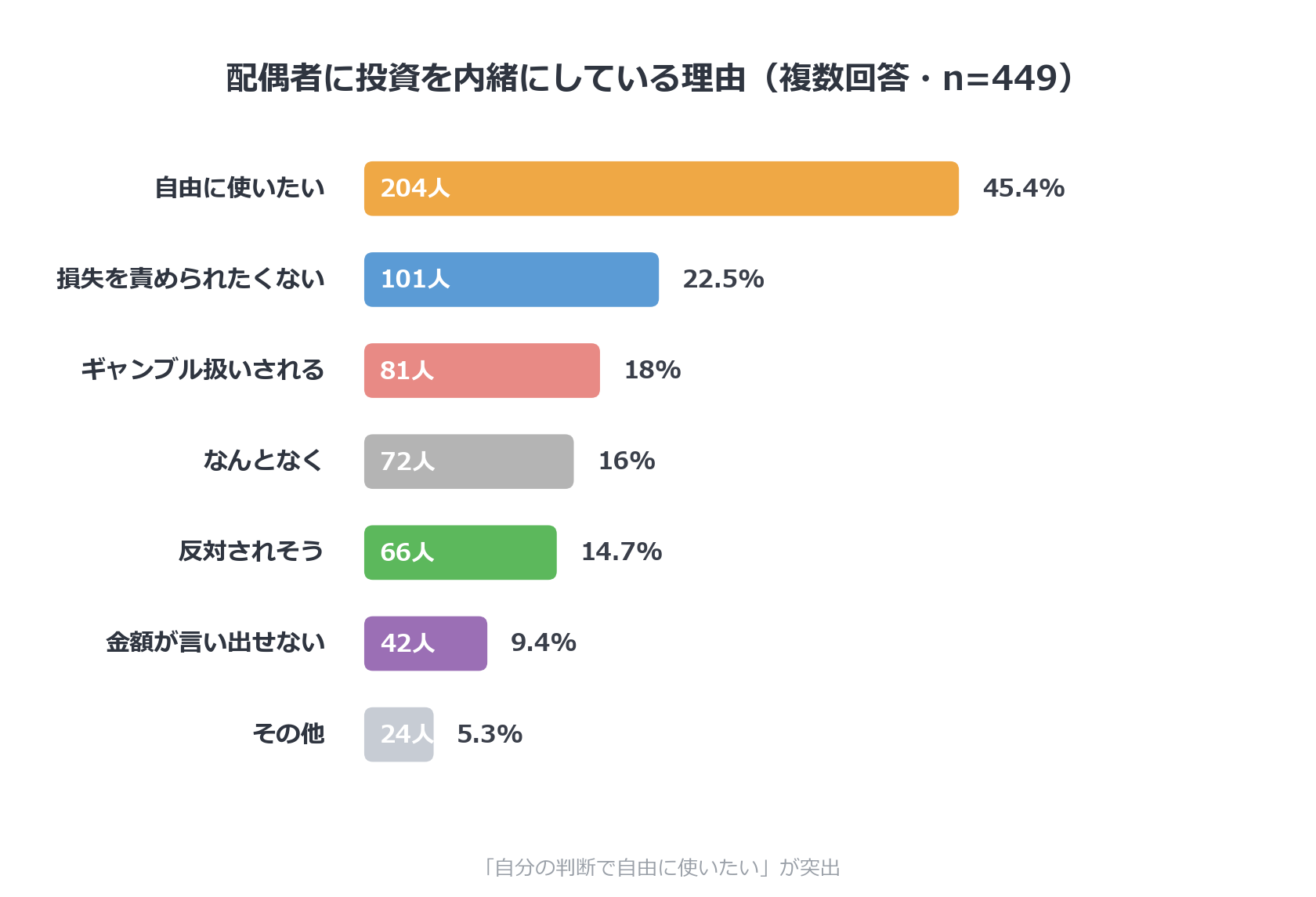
3-1. Reasons for Keeping It Secret (multiple answers allowed, n=449)
Reason | Responses | Percentage |
|---|---|---|
Want to make my own decisions freely | 204 | 45.4% |
Don't want to be blamed for losses | 101 | 22.5% |
Don't want it treated as gambling | 81 | 18.0% |
No particular reason | 72 | 16.0% |
Expect my spouse would object | 66 | 14.7% |
The amount is too large to bring up | 42 | 9.4% |
Other | 24 | 5.3% |
3-2. Secrecy Tends to Last for Years
“3 years or more” was the most common duration of secrecy, accounting for more than half of respondents at 53.0%. Rather than a temporary state, keeping investments secret tends to become a long-running norm.
Duration of Secrecy (n=449) | Responses | Percentage |
|---|---|---|
3 years or more | 238 | 53.0% |
6 months to 1 year | 98 | 21.8% |
1–3 years | 81 | 18.0% |
Less than 6 months | 32 | 7.1% |
4. Over 40% Have Been Found Out — Yet 53% Say It Caused No Problems
Even when respondents believe they've kept things secret, it's not uncommon for their spouse to notice. Combining “discovered in the past” (25.8%) and “discovered but tacitly accepted” (18.7%), 44.5% had been found out in some form.
4-1. Experience of Being Discovered (n=449)
Experience of Discovery | Responses | Percentage |
|---|---|---|
Never discovered | 249 | 55.5% |
Discovered in the past | 116 | 25.8% |
Discovered but tacitly accepted | 84 | 18.7% |
4-2. Even When Discovered, Half Say “No Real Problem”
When it came to the impact on the marriage after being discovered, “no real problem” was the most common response at 53.0%. “Temporary friction” (16.4%) and “brought the marriage to the brink of divorce” (6.9%) were relatively rare. While secrecy is involved, the data suggests it rarely escalates into a major crisis for the household.
Impact When Discovered (n=566) | Responses | Percentage |
|---|---|---|
No real problem | 300 | 53.0% |
Temporary friction | 93 | 16.4% |
Not yet discovered | 93 | 16.4% |
Led to an argument | 41 | 7.2% |
Brought the marriage to the brink of divorce | 39 | 6.9% |
5. 47.5% Say Family Couldn't Access Their Crypto “If Something Happened”
Secret investing raises an issue beyond the marital relationship. Assets whose access information is known only to the account holder cannot be passed on to family if something happens to that person.
Asked whether their family would be able to access their crypto assets if something happened to them, 47.5% answered “not possible.” Even including the 24.4% who said “partially possible,” only 14.0% answered “possible” — meaning full, seamless access.
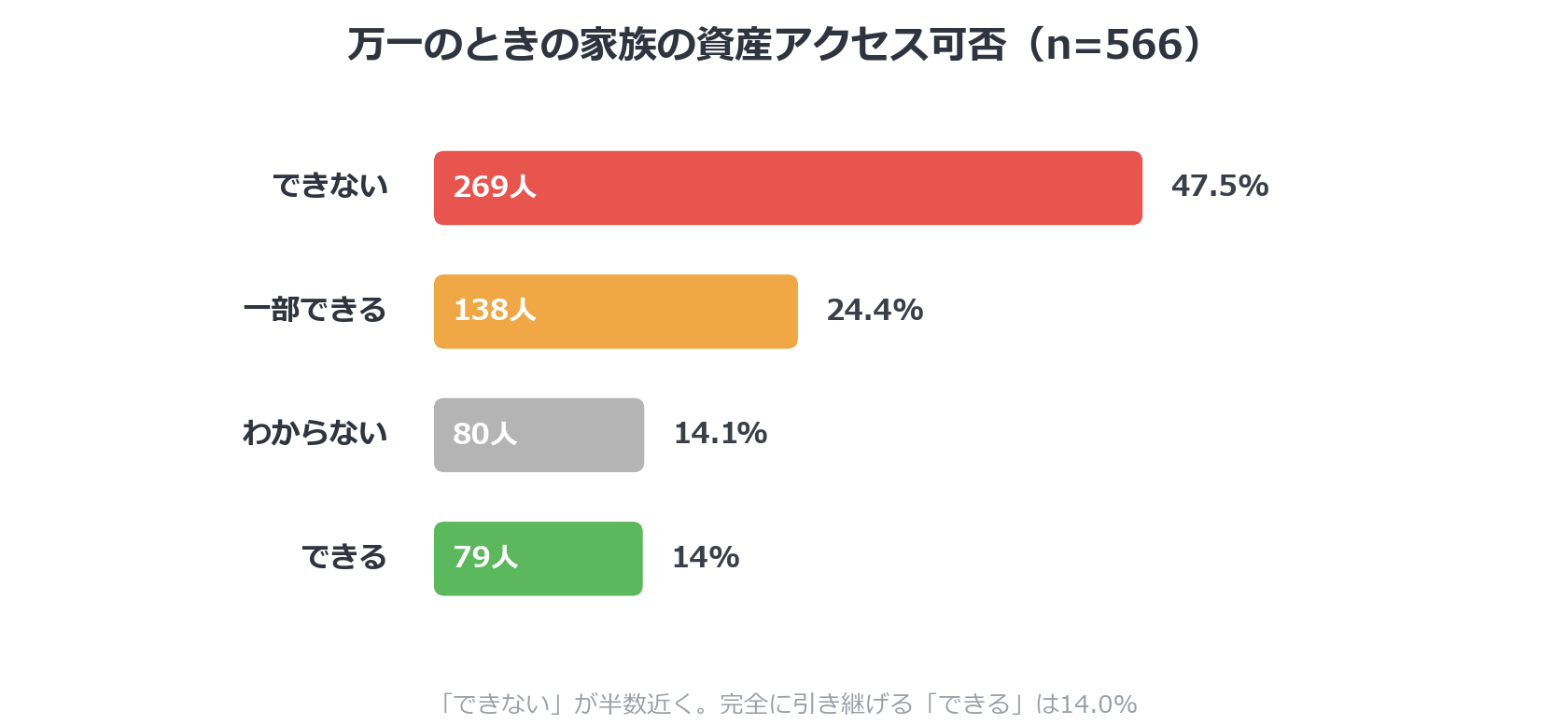
5-1. Whether Family Could Access the Assets (n=566)
Access | Responses | Percentage |
|---|---|---|
Not possible | 269 | 47.5% |
Partially possible | 138 | 24.4% |
Don't know | 80 | 14.1% |
Possible | 79 | 14.0% |
5-2. Nearly 30% Have Taken No Inheritance/End-of-Life Planning Steps, and Feel Anxious About It
On the status of inheritance and end-of-life planning, the two most common answers were “considering it” (31.6%) and “not started, and feel anxious about it” (29.7%), while only 14.3% said they had “already put measures in place.” Many respondents sense the need for such planning but have yet to take concrete steps.
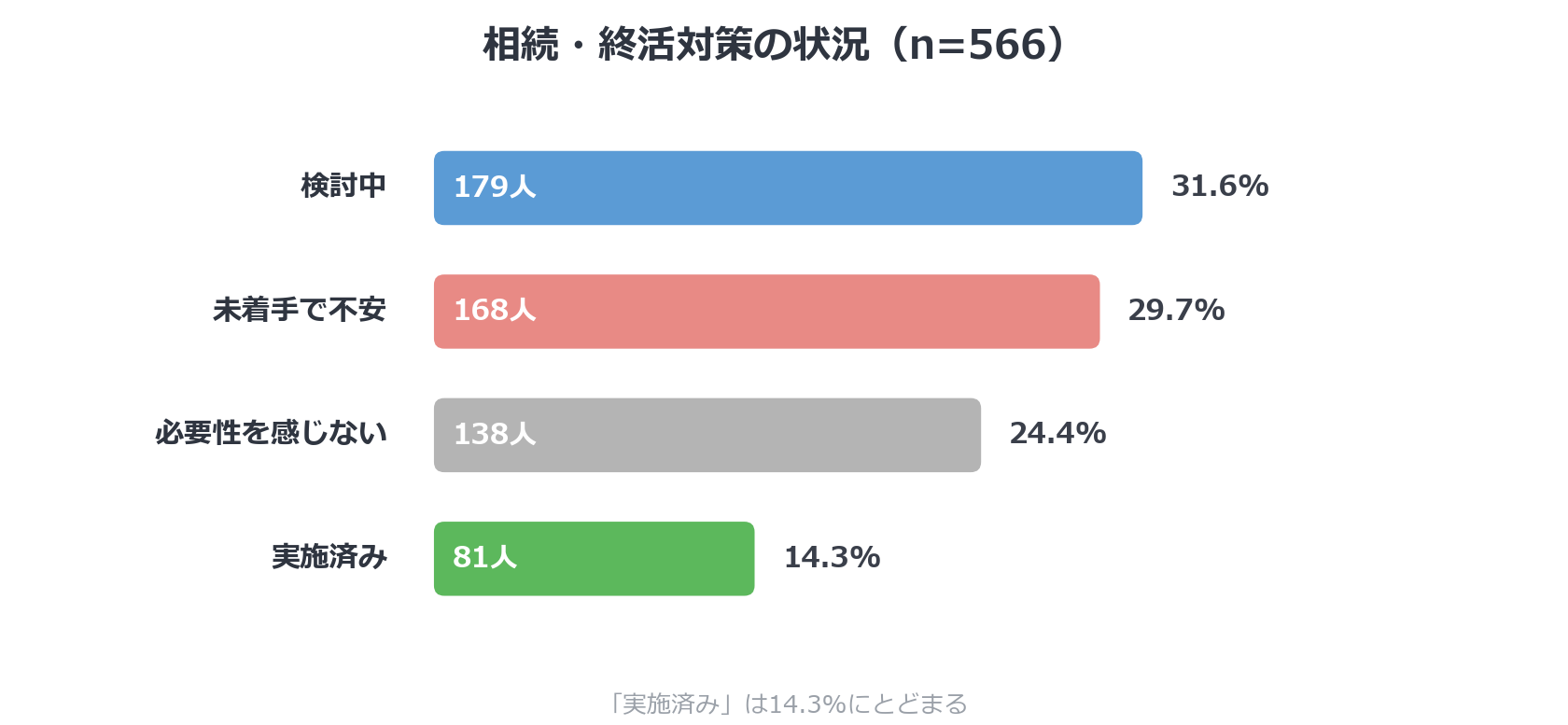
Status of Inheritance/End-of-Life Planning (n=566) | Responses | Percentage |
|---|---|---|
Considering it | 179 | 31.6% |
Not started, and feel anxious about it | 168 | 29.7% |
Don't feel it's necessary | 138 | 24.4% |
Already put measures in place | 81 | 14.3% |
5-3. The Less End-of-Life Planning Has Progressed, the Less Family Can Access the Assets
Cross-referencing family access with end-of-life planning status shows the two move together. Among respondents who have “already put measures in place,” 44% said their family “could access” the assets. Among those who are “not started, and anxious,” 61% said their family “could not”; among those who “don't feel it's necessary,” that figure was 63%. Whether or not preparations have been made translates directly into how easily assets can be passed on.
Family Access \ End-of-Life Planning | Already in place | Considering it | Not started, anxious | Don't feel it's necessary |
|---|---|---|---|---|
Possible | 44% | 13% | 7% | 6% |
Not possible | 17% | 37% | 61% | 63% |
*Percentages are calculated within each column (end-of-life planning status).
6. Summary
This survey revealed the following points about how married investors disclose their holdings:
- 32.2% of respondents keep their crypto holdings secret from their spouse. In order, the most commonly hidden assets are stocks, investment trusts, then crypto.
- 42.3% of hidden crypto holdings are valued at ¥1,000,000 (approx. $6,800) or more. The larger a respondent's total investment assets, the larger the amount they tend to hide.
- The top reason for secrecy is “wanting to make my own decisions freely,” at 45.4%. More than half of respondents have kept this secret for 3 years or more.
- 44.5% have either been discovered in the past or are being tacitly accepted. Meanwhile, 53.0% say discovery has had “no real problem” for their relationship.
- 47.5% of respondents say their family would not be able to access their crypto assets if something happened to them. The less end-of-life planning has progressed, the less access family has.
“Secret investing” is often framed as a matter of communication between spouses, but the data shows it overlaps significantly with asset-management issues like inheritance and succession. When only one person holds the access information, assets risk becoming untraceable and unclaimed — regardless of how good the relationship otherwise is.
7. Survey Overview
- Survey name: Survey on the Reality of “Secret Investing” Among Married Individuals
- Conducted by: Clabo Inc.
- Method: Online self-administered survey
- Respondents: Married men and women who currently hold, or have previously held, crypto assets
- Valid responses: 566
- Conducted: May 2026
- Note: The figures in this article are based on respondents' self-reported answers. Percentages are calculated using the number of respondents to each question as the denominator; for questions allowing multiple answers, totals may exceed 100%.
Charts and figures may be quoted or reproduced provided the source is credited as “Clabo Inc. survey.”
8. Main Survey Questions
Q1 To what extent do you share your investment status with your spouse?
Q2 Which investment assets do you keep secret from your spouse? Please select all that apply.
Q3 What is the current estimated value of the crypto assets you keep secret from your spouse?
Q4 What are your reasons for keeping your investments secret from your spouse? Please select all that apply.
Q5 How long has this secrecy from your spouse continued?
Q6 Has your spouse ever discovered that you were keeping your investments secret?
Q7 If your spouse discovered (or were to discover) that you were keeping it secret, what impact did it have (or do you think it would have) on your marriage?
Q8 If something were to happen to you, would your family be able to access your crypto assets?
Q9 Which of the following best describes your current status regarding inheritance and end-of-life planning for your assets, including crypto?
Q10 What is your total investment asset value (including crypto)?
Q11 Which of the following best describes your position/stance on crypto and investing?
Q12 If you have any reasons for keeping your investments secret from your spouse, or any memorable episodes, please share them freely.
Q13 If something were to happen to you, do you have any concerns about whether your assets would properly pass to your family? If so, please describe your concerns.
This article is for informational purposes only and does not constitute financial or investment advice. Please consult a qualified professional before making investment decisions.


