


To examine the safety of self-custody in crypto assets (also known as virtual currencies), we conducted an original survey of 303 experienced crypto users on how they store their private keys and seed phrases. The results showed that more than 60% of respondents manage their own keys, yet a large share of them rely on digital storage methods such as smartphone notes and screenshots.
Of particular concern is that more than 80% of self-custody users have experienced a "near-miss" incident — coming close to losing or having their keys stolen. This article analyzes the survey data in detail, covering specific storage locations, information-gathering habits, and the literacy gap tied to investment experience.
What defenses are needed to protect one's assets, and how should holders prepare for worst-case scenarios? This article offers insights to help holders overcome the "management wall" they face. In crypto asset investing, where "self-responsibility" is the guiding principle, we hope these survey results help readers strengthen their own literacy and protect their assets.
Years of Experience Reveal a Gap in Custody Awareness
Self-Custody Is the Majority, at Over 60%
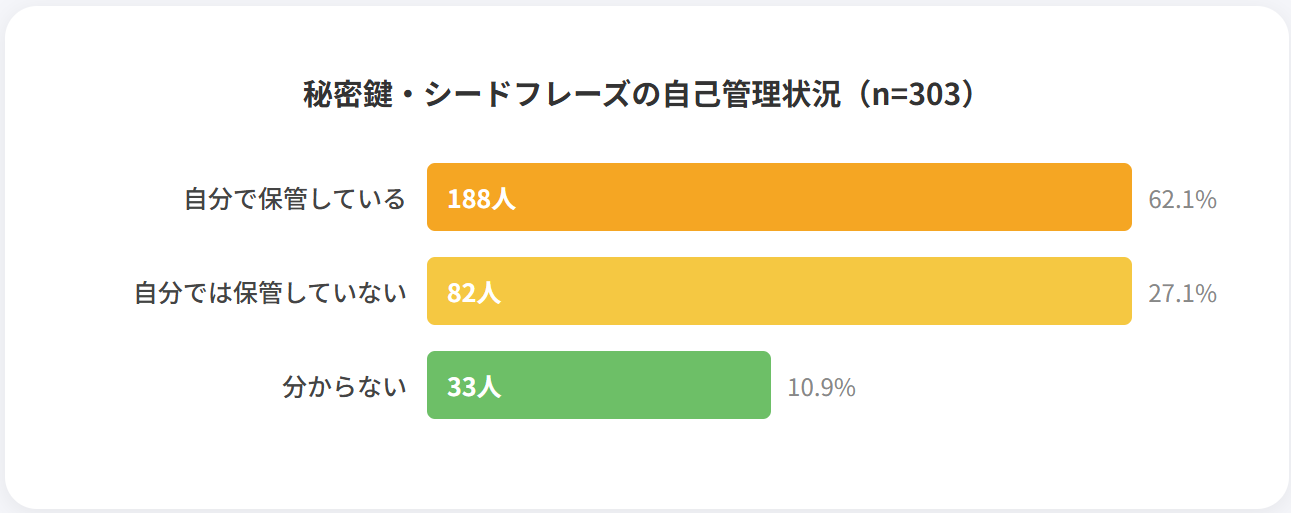
Response | Number of Responses | Percentage |
|---|---|---|
Yes (I manage it myself) | 188 | 62.05% |
No (I don't manage it myself / never thought about it) | 82 | 27.06% |
Not sure | 33 | 10.89% |
We surveyed respondents on "self-custody of private keys" — the most fundamental process in managing crypto assets. The results show that 62.05% of respondents said they manage their keys themselves. In decentralized asset management, self-custody is the foundation of security, and the survey suggests that more than half of holders are aware of this responsibility.
Notably, however, about 30% of holders said they either do not manage their keys themselves or have never thought about it. For those who operate solely through an exchange account, there may be few occasions to think directly about private keys.
However, as more users make external transfers with wallets or use decentralized finance (DeFi), this lack of awareness directly translates into risk. Furthermore, more than 10% of respondents answered "not sure," reflecting a reality in which many continue to hold assets without a clear sense of who actually controls their keys.
While a majority of holders recognize the importance of self-custody, a significant number still run into the "management wall." This is especially true for those using self-custody wallets, where the principle of self-responsibility — with no one else to rely on — weighs heavily.
Among Holders With 3+ Years of Experience, 70% Self-Custody Their Keys
Investment Experience | Yes (self-managed) | No (not self-managed) | Not sure | Percentage (Yes) |
|---|---|---|---|---|
Less than 6 months | 22 | 12 | 5 | 56.41% |
6 months to under 1 year | 58 | 17 | 7 | 70.73% |
1 to under 3 years | 51 | 35 | 9 | 53.68% |
3+ years | 54 | 16 | 5 | 72.00% |
Prefer not to answer | 3 | 2 | 7 | 25.00% |
Cross-referencing years of investment experience with custody status reveals a clear trend: the more experienced a holder is, the more likely they are to self-custody their keys.
Among veteran holders with three or more years of investment experience, 72.00% said they manage their own private keys. This suggests that, over years of holding crypto assets, an awareness of exchange risk and the need for diversified asset management develops naturally.
Interestingly, however, the self-custody rate among holders with 6 months to under 1 year of experience is also high, at 70.73%. This is likely due to recent Web3 trends and the spread of certain wallet apps, which have led more newcomers to enter the space already assuming they will self-custody. In the current market environment, holders aiming for more advanced strategies may be learning to operate wallets at an earlier stage.
Among mid-experience holders (1 to under 3 years), however, the self-custody rate temporarily dips to 53.68%. This group may have lived through past sharp market swings and now deliberately prioritize keeping assets with a professional custodian to avoid risk. It's also possible that some gave up on using complex decentralized services and returned to more convenient options.
Among Holders in Their 50s and Above, "Not Sure" Responses Spike
Age Group | Yes (self-managed) | No (not self-managed) | Not sure | Percentage (Yes) |
|---|---|---|---|---|
20s | 34 | 14 | 4 | 65.38% |
30s | 60 | 22 | 6 | 68.18% |
40s | 49 | 23 | 3 | 65.33% |
50s | 33 | 17 | 16 | 50.00% |
60s | 8 | 4 | 3 | 53.33% |
70s and above | 4 | 2 | 1 | 57.14% |
Looking at the age-group data, holders in their 30s stand out for their strong self-custody awareness. Their self-custody rate reaches 68.18%, the highest of any age group, showing the most proactive attitude toward controlling their own assets. This is likely a result of being a generation that adapts well to digital tools while also taking responsibility for building assets.
By contrast, it is deeply concerning that "not sure" responses spike to about 24.2% among holders in their 50s. A certain proportion of this group is investing without understanding the technical mechanisms protecting their assets. This gap in awareness could become a breeding ground for loss incidents or damage from phishing scams.
From holders in their 20s through their 40s, the self-custody rate holds relatively steady above 60%, confirming a high level of interest among working-age generations. Notably, only 4.00% of respondents in their 40s answered "not sure," indicating strong confidence in their own key management.
Storage Practices Where Convenience and Risk Go Hand in Hand
Smartphone Storage Is the Most Common Method, at Over 30%
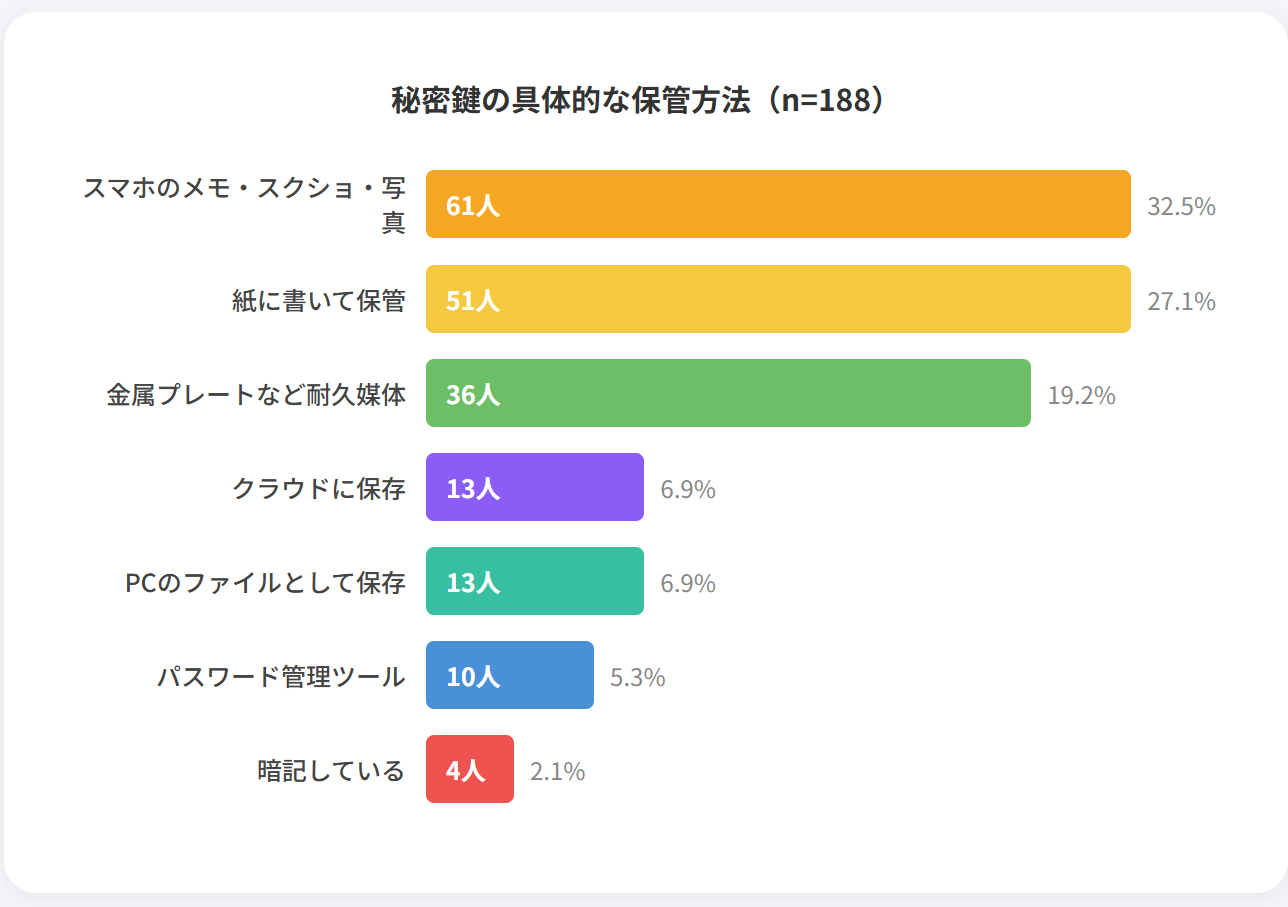
Response | Number of Responses | Percentage |
|---|---|---|
Notes, screenshots, or photos on a smartphone | 61 | 32.45% |
Written down on paper | 51 | 27.13% |
Engraved on a durable medium such as a metal plate | 36 | 19.15% |
Stored in the cloud (Google Drive, iCloud, etc.) | 13 | 6.91% |
Saved as a text or image file on a PC | 13 | 6.91% |
Stored in a password manager | 10 | 5.32% |
Memorized | 4 | 2.13% |
When we surveyed the specific methods holders use to store their private keys, the most common was "notes, screenshots, or photos on a smartphone," at 32.45%. For users managing crypto assets on mobile devices, digital storage — with its easy copy-and-paste convenience — is an appealing option. However, given the risk of phone loss, malware infection, or unintended leakage via cloud sync, this convenience carries significant danger.
Meanwhile, the classic and solid method of "writing it down on paper" also retains strong support, at 27.13%. While this is a leading offline storage method, it still faces the challenge of physical vulnerabilities such as fire or water damage, or simple loss. In addition, the fact that 19.15% use a "metal plate" suggests that some holders, with long-term holding in mind, manage their keys with an extremely high level of risk awareness.
Together, storage in environments still connected to a network — such as cloud services or files on a PC — accounts for about 14% of respondents. Placing a seed phrase online dramatically increases the risk of becoming a target for hacking by malicious third parties. This reveals a reality in which, in the pursuit of convenience, phrases that should serve as a "last line of defense" are left exposed and defenseless against cyberattacks.
A "Designated Spot" at Home Is the Top Choice, at Nearly a Third
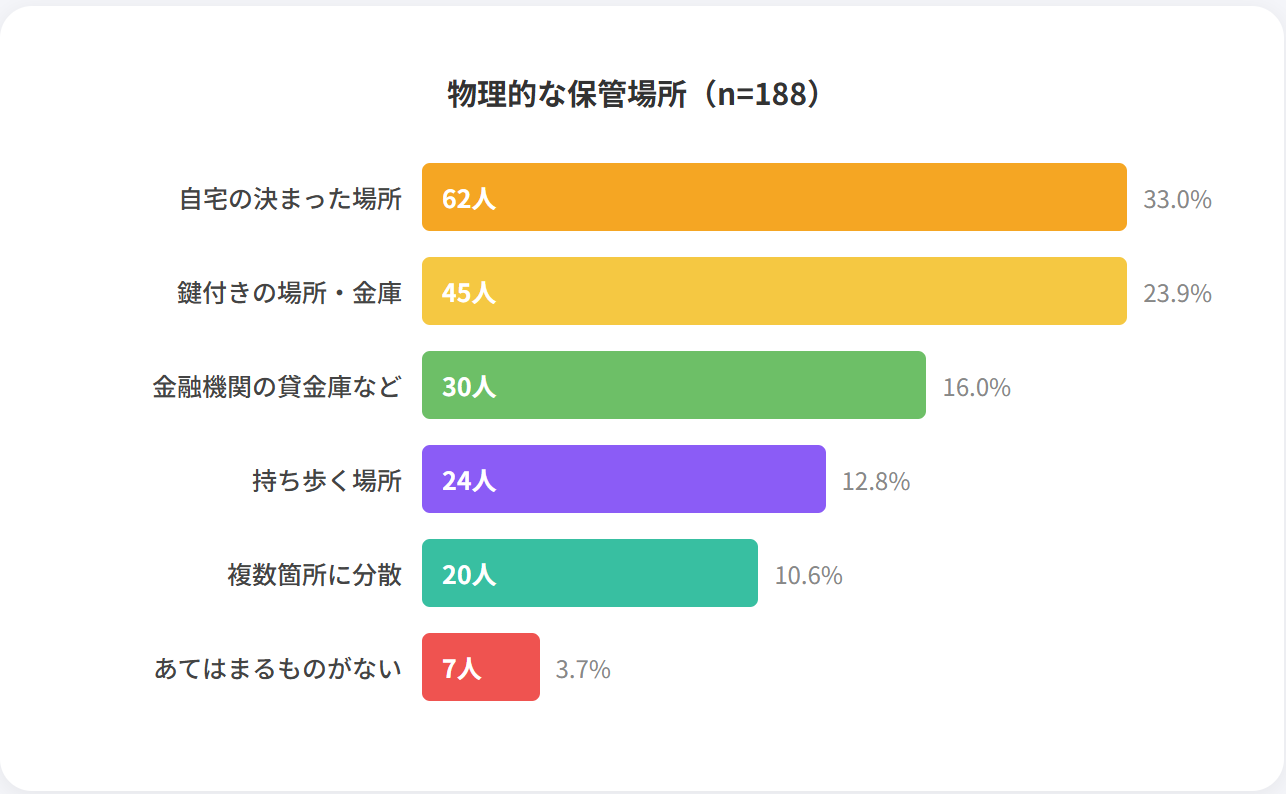
Response | Number of Responses | Percentage |
|---|---|---|
A designated spot at home (drawer, bookshelf, etc.) | 62 | 32.98% |
A locked location (locked drawer, safe, etc.) | 45 | 23.94% |
Outside the home, such as a bank safe deposit box | 30 | 15.96% |
Somewhere carried on their person (wallet, phone case, etc.) | 24 | 12.77% |
Spread across multiple locations | 20 | 10.64% |
None of the above | 7 | 3.72% |
On physical storage locations, the data show that 32.98% keep their key at "a designated spot at home." This offers insufficient protection against accidental disposal by a family member or theft, yet holders tend to choose locations that are easy to access day to day. Because an environment where someone other than the holder can easily grab the key can lead to unintended loss of assets, an appropriate degree of concealment is needed.
Only 23.94% use a "safe or locked drawer," meaning that holders with rigorous physical security measures remain a minority. Also notable is that 12.77% chose "somewhere carried on their person." Given the risk of loss while out or of being robbed, choosing a location one always carries is, from an asset-protection standpoint, an extremely risky decision.
About 10% of holders spread their storage across multiple locations, confirming that the concept of risk hedging has taken hold among a certain segment. However, spreading storage across multiple locations also creates a dilemma: it complicates management and makes full recovery difficult if part of it is lost. To protect physical assets, holders need to reconsider not just where to hide something, but how resilient that location itself is against disasters or third-party intrusion.
Higher-Income Holders Are More Likely to Also Use Off-Site Storage
Household Income | Designated Spot at Home | Locked Location | Bank Safe Deposit Box, etc. | Carried on Person | Spread Across Multiple Locations |
|---|---|---|---|---|---|
Under ¥4 million (approx. US$26,000) | 14 | 5 | 1 | 8 | 1 |
¥4M–¥6M | 17 | 15 | 5 | 7 | 4 |
¥6M–¥8M | 11 | 13 | 7 | 2 | 5 |
¥8M–¥10M | 8 | 6 | 5 | 3 | 6 |
¥10 million and above (approx. US$65,000+) | 12 | 6 | 12 | 4 | 4 |
Looking at the correlation between household income and storage location, a clear trend emerges: the higher the income, the more specialized and rigorous the storage method. Among households with an income of ¥10 million or more in particular, more than 30% of respondents use "off-site storage such as a bank safe deposit box." This reflects the reality that, as the value of their crypto holdings grows, holders reach the limits of at-home management and choose to pay for robust external facilities instead.
By contrast, among households earning under ¥4 million, the proportion choosing "somewhere carried on their person" is relatively high, revealing a lower level of awareness about physical isolation. For small holdings, the damage from a loss may be limited, but management habits are not something that can be suddenly changed once assets grow. Considering a storage location appropriate to the significance of one's assets from the earliest stages of holding is the first step toward preventing a catastrophic loss down the road.
In addition, among households earning ¥8 million or more, the proportion choosing to "spread storage across multiple locations" is also high, suggesting a proactive approach to diversifying risk. Holders who have succeeded in building wealth tend to devote corresponding knowledge and resources not only to digital protection but also to physical security arrangements. Whether one treats crypto assets as mere data or as tangible assets requiring physical defense appears to be the difference that determines the quality of one's key management.
Near-Misses Before Loss: A Risk Lurking in Everyday Life
About 70% Have Secured a Backup
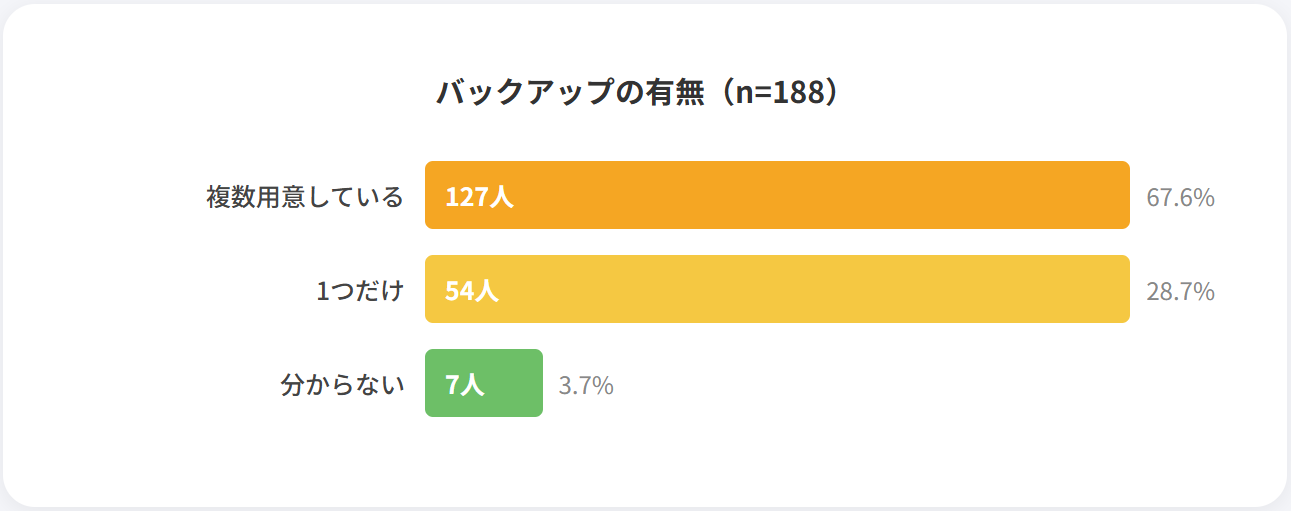
Response | Number of Responses | Percentage |
|---|---|---|
Yes (I have multiple) | 127 | 67.55% |
No (only one) | 54 | 28.72% |
Not sure | 7 | 3.72% |
When we surveyed backup practices for private keys and seed phrases, 67.55% of self-custody holders said they "have multiple backups." Building a system that does not depend on a single storage location is the most basic defense against physical damage or loss.
However, the fact that about 30% of holders still keep only "one" copy is a major security concern. If the storage medium is lost or the writing becomes illegible under these conditions, they lose access to all their assets in that instant. Operating without a clear sense of where recovery options are — including those who answered "not sure" — carries the risk that a single human error could instantly translate into a catastrophic loss.
In an industry built on the principle of self-responsibility, redundant key management is an essential step for safe, long-term holding. Even a blockchain protected by robust cryptography faces its greatest threat in the very analog weakness of inadequate backups on the user's side. The survey results show that while many holders are prepared, a certain number still operate in the extremely precarious situation where "loss equals instant total loss."
Over 80% Have Experienced "Loss" or "Exposure to a Third Party"
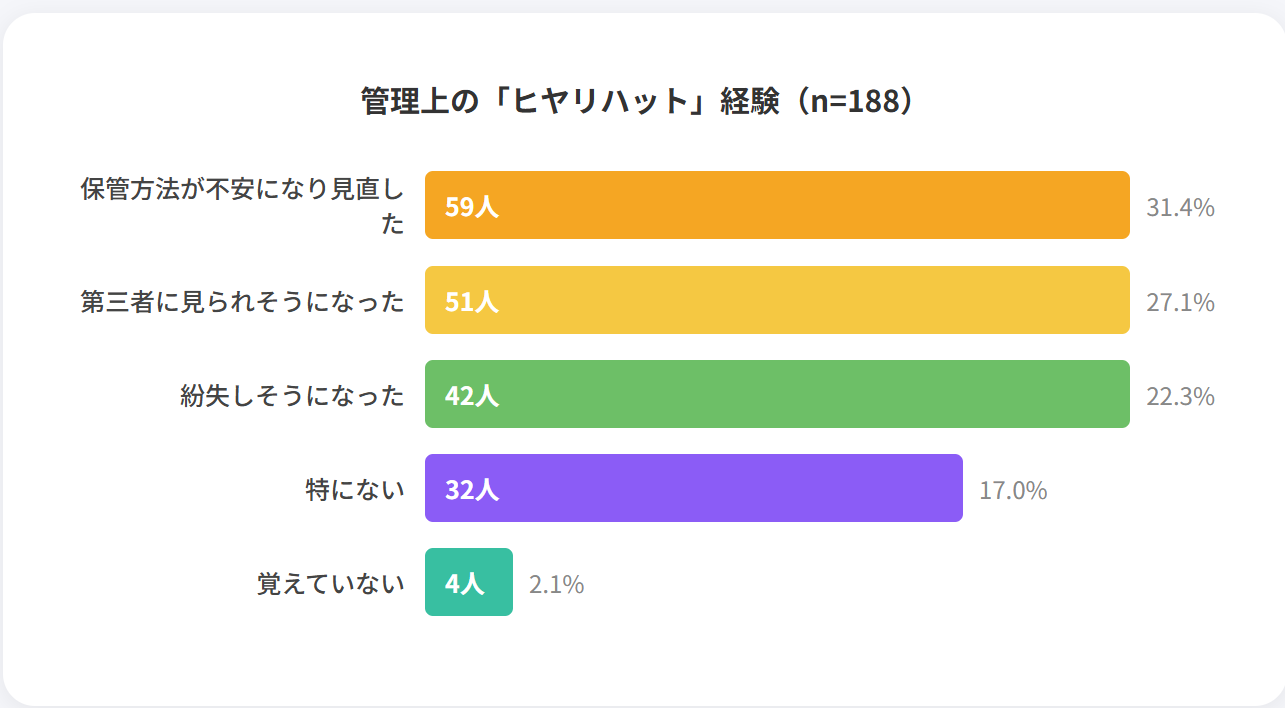
Response | Number of Responses | Percentage |
|---|---|---|
Became anxious about their storage method and revised it | 59 | 31.38% |
Almost had it seen by a third party | 51 | 27.13% |
Almost lost it / temporarily couldn't find it | 42 | 22.34% |
None of the above | 32 | 17.02% |
Don't remember | 4 | 2.13% |
When asked whether they had experienced a "close call" in managing their keys, more than 80% of holders said they had faced some form of anxiety or crisis. The most common response, at 31.38%, was "became anxious about my storage method and revised it," reflecting the psychological burden of operating without full confidence in one's own management setup. This points to a dilemma in which actual management practices have not kept pace with the importance of something as abstract as a seed phrase.
What is more serious is that about half of holders have encountered a concrete near-loss scenario — "almost losing" their key or "almost having it seen by a third party." One misstep in either case could have directly led to a complete loss of assets or unauthorized transfer of funds; holders only narrowly avoided actual damage. Just 17.02% answered "none of the above," showing that the majority of self-custody holders are routinely exposed to management-related stress and risk.
The sheer frequency of these near-misses illustrates just how psychologically and technically demanding self-custody of crypto assets really is. If holders settle on a storage method once and never revisit it, without periodic checks and risk reassessment, they risk eventually facing an incident that goes beyond a mere close call. What the survey reveals is a harsh reality: holders with a truly airtight management setup are rare, and many are protecting their assets on a precarious balance.
Nearly 40% Rank Loss Prevention as Their Top Priority
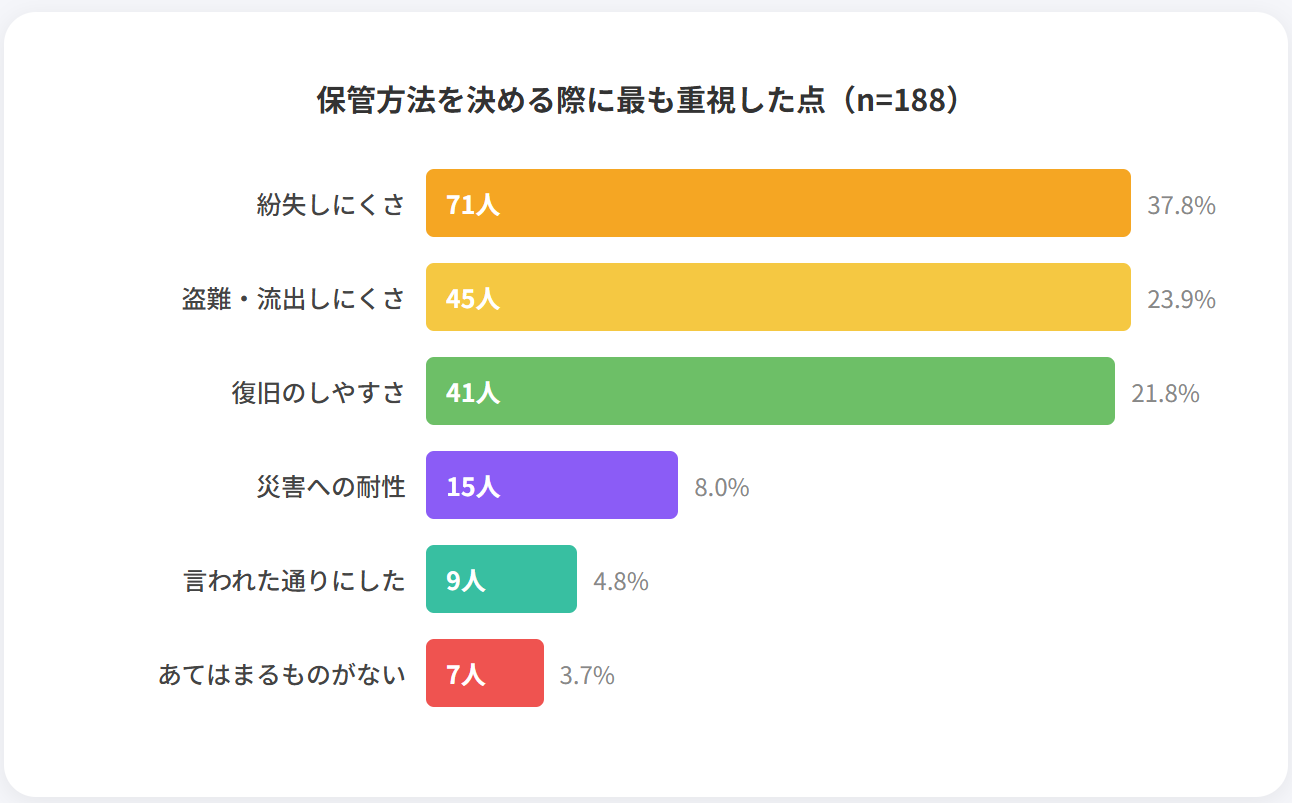
Response | Number of Responses | Percentage |
|---|---|---|
Resistance to loss | 71 | 37.77% |
Resistance to theft or leakage | 45 | 23.94% |
Ease of recovery (findable by the holder or family) | 41 | 21.81% |
Resilience to disasters (fire, flooding, etc.) | 15 | 7.98% |
Did not particularly prioritize; followed instructions given | 9 | 4.79% |
None of the above | 7 | 3.72% |
When choosing a storage method, 37.77% cited "resistance to loss" as their top priority. While "theft" through hacking tends to be emphasized in discussions of crypto assets, this shows that holders' actual concern is directed at "loss through their own mistake." The irreversible nature of losing a private key — with no recourse whatsoever — generates stronger vigilance against one's own management errors than against outside malice.
Meanwhile, only 23.94% prioritize "resistance to theft or leakage," ranking lower than loss prevention. In addition, the 21.81% who selected "ease of recovery" points to a need to ensure that the holder or family members can access the key in an emergency. This symbolizes the reality that many holders struggle to balance "not being seen by anyone" against "being findable when needed."
The fact that fewer than 10% prioritize disaster preparedness (fire, flooding, etc.) suggests that preparation for extreme physical scenarios remains inadequate. Because fireproof safes and metal plates come at a cost, most holders currently focus first on avoiding everyday loss. However, for those aiming for true long-term holding, a more advanced defensive mindset will be needed going forward — one that isolates assets not only from their own mistakes but also from unavoidable environmental risks.
Secondary Risks From the Gap Between Trustworthiness and Accuracy
Only About 30% Refer to Official Guidelines
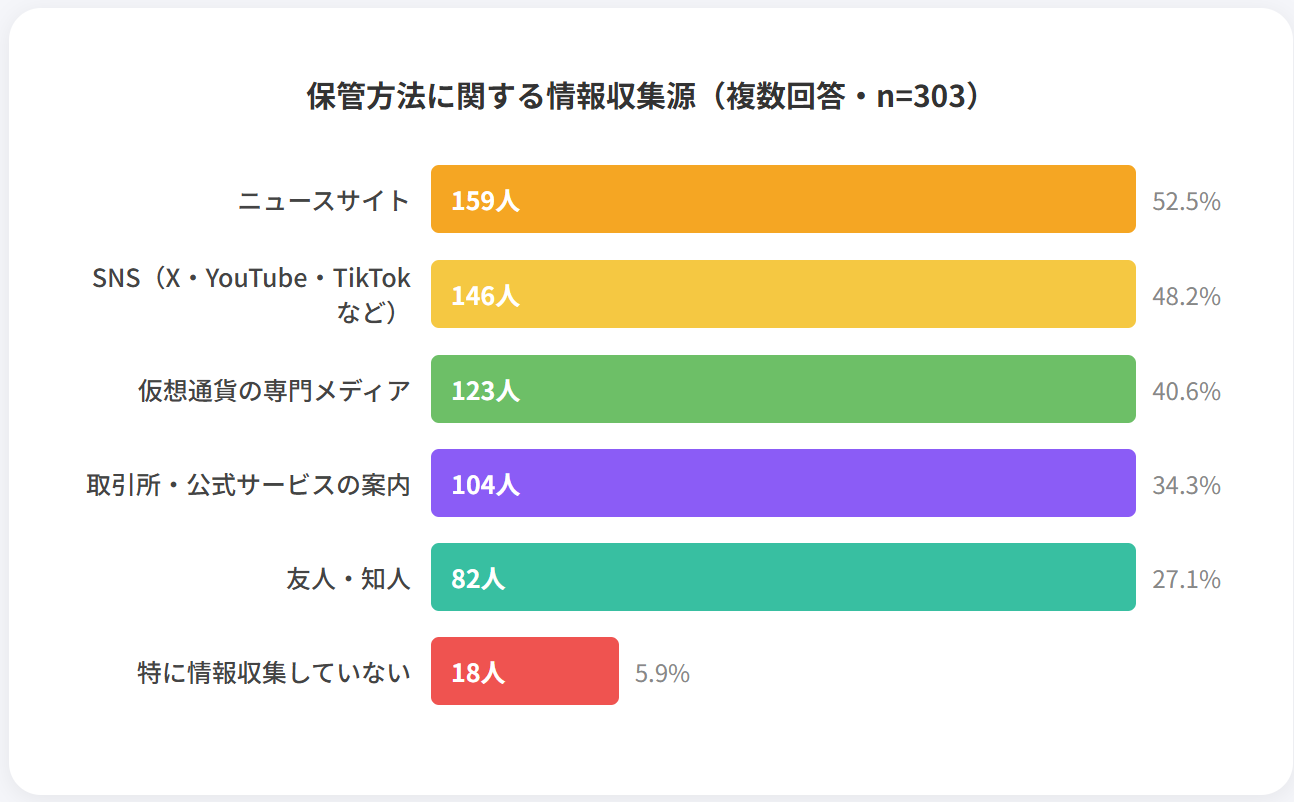
Response | Number of Responses | Percentage |
|---|---|---|
News sites | 159 | 52.48% |
Social media (X, YouTube, TikTok, etc.) | 146 | 48.18% |
Crypto-focused media | 123 | 40.59% |
Guidance from exchanges or official services | 104 | 34.32% |
Friends and acquaintances | 82 | 27.06% |
Do not actively gather information | 18 | 5.94% |
When we surveyed where holders get information on crypto assets and wallet storage, "news sites" came out on top at 52.48%, followed by "social media" at 48.18%. This reveals that many holders rely mainly on media channels that offer timely reporting and a range of perspectives. However, since accurate and inaccurate information tend to mix freely on social media, there is a risk that incorrect storage methods can spread widely, placing a heavy demand on holders' ability to discern reliable information.
A serious concern is that only 34.32% refer to "guidance from exchanges or official services," which ought to be the most accurate source. Official documentation is often avoided for being full of technical jargon, but when it comes to handling a seed phrase, relying on non-official information can increase risk. It cannot be ruled out that a reliance on "secondary information" filtered through a third party's interpretation is one factor contributing to phishing scams and improper storage practices.
In addition, 27.06% of holders also rely on information from "friends and acquaintances," showing that information exchange within closed circles plays a certain role. However, outdated knowledge and misunderstandings can easily become entrenched within such communities, creating a risk that a whole group makes the same security mistake together. Making it a habit to access "primary information" from trustworthy platforms is likely the most reliable defense against future trouble.
Over 30% of Social-Media Users Have Had a Management "Close Call"
Information Source: Social Media | Almost Lost It | Almost Seen by a Third Party | Became Anxious and Revised | None of the Above | Don't Remember |
|---|---|---|---|---|---|
Selected (146 people) | 35 | 46 | 45 | 20 | 0 |
Not selected (157 people) | 7 | 5 | 14 | 12 | 4 |
Cross-tabulating holders who use social media as an information source against their "near-miss" management experiences reveals a pronounced security risk among social-media users. Among holders who use social media, fully 31.5% reported that they "almost had their private key seen by a third party" — an overwhelmingly higher figure than among those who do not use social media. This strongly suggests that active information-gathering and activity on social media may be triggering physical or digital "exposure" of information.
Social-media users also had a high rate — 30.8% — of "became anxious about my storage method and revised it," suggesting that constant exposure to a stream of information makes them more prone to doubting their own management setup. Social media, where the latest hacking techniques and cases of damage are easily made visible, has the effect of raising risk awareness, but it also increases holders' psychological stress. This reveals a complicated reality in which the very means people use to gather information can, ironically, create pressure that leads to management mistakes and openings for operational slip-ups.
By contrast, it is also worth noting that holders who do not use social media as an information source report extremely low rates of trouble such as loss or oversight. Holders who limit their information intake and manage their assets cautiously may, as a result, maintain a calmer management environment. This is not a rejection of social media's convenience and timeliness, but it does call for a self-disciplined approach that asks whether its use is undermining the original goal of safely isolating one's assets.
Literacy Underpins a Solid Storage Setup
Occupation | Social Media | Crypto-Focused Media | News Sites | Official Guidance | Friends and Acquaintances |
|---|---|---|---|---|---|
Civil servants | 15 | 11 | 15 | 11 | 8 |
Company employees (management) | 12 | 13 | 17 | 13 | 5 |
Company employees (general) | 63 | 53 | 72 | 47 | 37 |
Self-employed / freelance | 13 | 12 | 11 | 10 | 7 |
Homemakers | 17 | 14 | 21 | 11 | 12 |
Analyzing information-gathering tendencies by occupation, we found that civil servants and those in management roles refer to official information at above-average rates. Management-level holders in particular place relatively greater weight on guidance from exchanges and official services than on uncertain sources like social media, showing a preference for accuracy. This likely reflects the compliance awareness and risk-management habits cultivated in their day-to-day work carrying over into how they manage crypto assets.
By contrast, general company employees and homemakers still show a high reliance on news sites and social media, leaving room for improvement in reaching official documentation. Holders who avoid official information risk being satisfied with the plain-language explanations found in specialized media or the summarized articles on news sites, and consequently overlooking detailed warnings they should have checked. As things stand, differences in literacy by occupation translate directly into differences in the "quality of information" used to protect one's assets.
In the world of crypto assets, information asymmetry translates directly into losses. Regardless of occupation or lifestyle, building an information-gathering practice grounded in official announcements — rather than leaning on any single media source — is the only way to raise the overall quality of self-custody. Even when referring to the opinions of experts or media outlets, holders are called upon to exercise the discipline of always circling back to primary sources for final confirmation.
Conclusion
This survey has made clear the gap between "ideal" and "reality" in the self-custody of crypto assets. Self-custody now accounts for more than 60% of holders, showing growing awareness of the need to protect one's own assets independently. However, the most common method — digital storage such as smartphone notes and screenshots — reveals a reality in which convenience comes at the cost of significant leakage risk. In a world built on decentralized management, this "dependence on convenience" could prove to be a fatal vulnerability.
Especially serious is the fact that more than 80% of self-custody holders have experienced a "near-miss" — a close call with losing their assets to loss or theft. This shows the psychological burden many holders carry, continuing to manage their assets through trial and error without ever feeling fully confident in their own setup. The less investment experience a holder has, the more passive their key management tends to be, and the literacy gap with veteran holders continues to widen. Self-custody carried out without adequate knowledge is, before any question of profit, an act that jeopardizes the very survival of one's assets.
The tendency to rely on secondary sources such as social media over official guidance when gathering information is also increasing risk. A flood of information not only stokes anxiety but also serves as a gateway to improper actions and phishing damage. To truly protect one's assets, discipline is essential: mastering accurate techniques grounded in official sources rather than leaning on any single media outlet. For anyone pursuing long-term wealth building, prioritizing robust physical and technical defenses is the surest way to navigate an uncertain market.
This article is for informational purposes only and does not constitute financial or investment advice. Please consult a qualified professional before making investment decisions.


