


The seed phrase is the single most important piece of information in managing crypto assets (also known as virtual currencies).
How are you storing yours?
Our survey found that a striking share of investors keep their seed phrase in a smartphone note app. It's convenient, but the risks of loss or hacking are immense.
This article draws on an original survey of crypto asset investors to thoroughly analyze storage practices by age group and years of investing experience.
We unpack, with data to back it up, the reliable storage methods favored by veteran investors and the hidden risks lurking for beginners.
Smartphone note apps are the most common way to store seed phrases
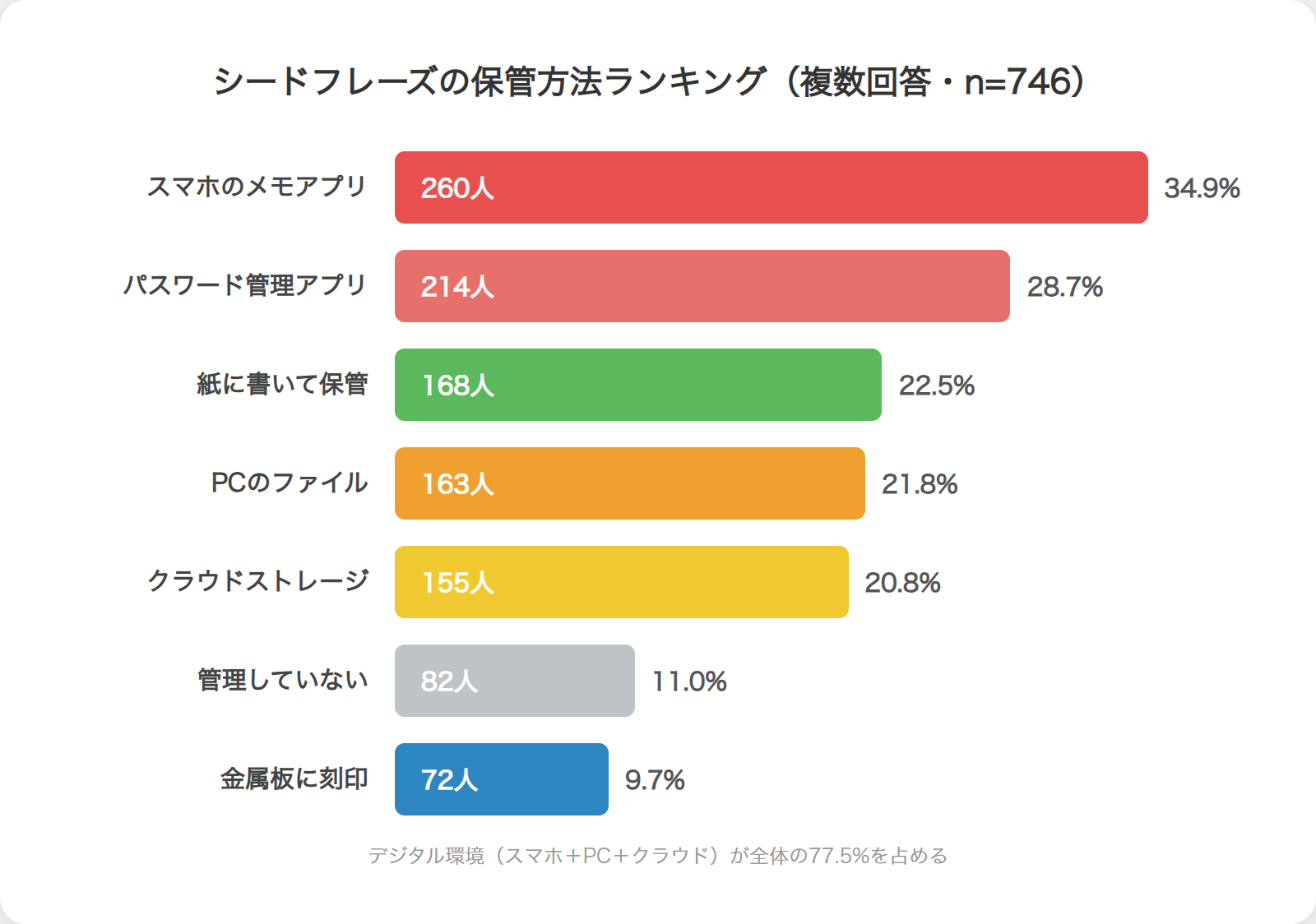
Storage method | Responses | Share |
|---|---|---|
Smartphone note app | 260 | 34.9% |
Password manager app | 214 | 28.7% |
Written on paper | 168 | 22.5% |
File on a PC | 163 | 21.8% |
Cloud storage | 155 | 20.8% |
Not stored/managed | 82 | 11.0% |
Engraved on a metal plate | 72 | 9.7% |
Smartphone note app users reach 34.9%
Many investors prioritize convenience above all, routinely using their smartphones to manage crypto assets.
In this survey, 34.9% of respondents chose a "smartphone note app" as their seed phrase storage location — the largest share of any method.
The ability to jot it down instantly on a device that's always at hand seems to be the draw for many users.
But behind that convenience lies a serious security risk.
Losing the device or a virus infection can directly lead to a loss of assets.
Prioritizing convenience over security means walking a dangerous tightrope, and investors should recognize this.
A management approach that never loses sight of the core purpose — protecting one's assets — is urgently needed.
Paper records remain at just 22.5%
As a long-standing security best practice, writing a seed phrase on paper and storing it offline, away from any network, has been recommended for years.
According to this data, only 22.5% of investors have chosen paper storage.
While it remains a common choice for many, the numbers show it isn't the mainstream approach.
For investors accustomed to digital devices and IT tools in daily life, this analog method may feel inefficient.
On the other hand, paper storage carries an undeniable advantage: zero risk of hacking.
As reliance on digital tools grows, it's concerning that this fundamental method for protecting assets is being overlooked.
Prioritizing convenience, it seems, comes at the cost of abandoning one of the most reliable risk-hedging methods available.
Digital storage accounts for over 70% of respondents overall
Combining smartphone note apps, PC files, and cloud storage, a full 77.5% of respondents rely on some form of digital environment.
The result shows that most investors are storing their seed phrase somewhere accessible online.
While convenience stands out, it's impossible to overlook that these methods are constantly exposed to online threats.
PCs and cloud services are prime targets for cybercrime — hacking, virus infections, phishing attacks, and more.
The fact that so many users choose online digital storage should serve as a wake-up call to fundamentally rethink asset-protection awareness.
Rather than choosing a storage method simply because it's convenient, investors are urged to calmly reconsider what approach will truly protect their assets.
Smartphone note app usage peaks among investors in their 40s
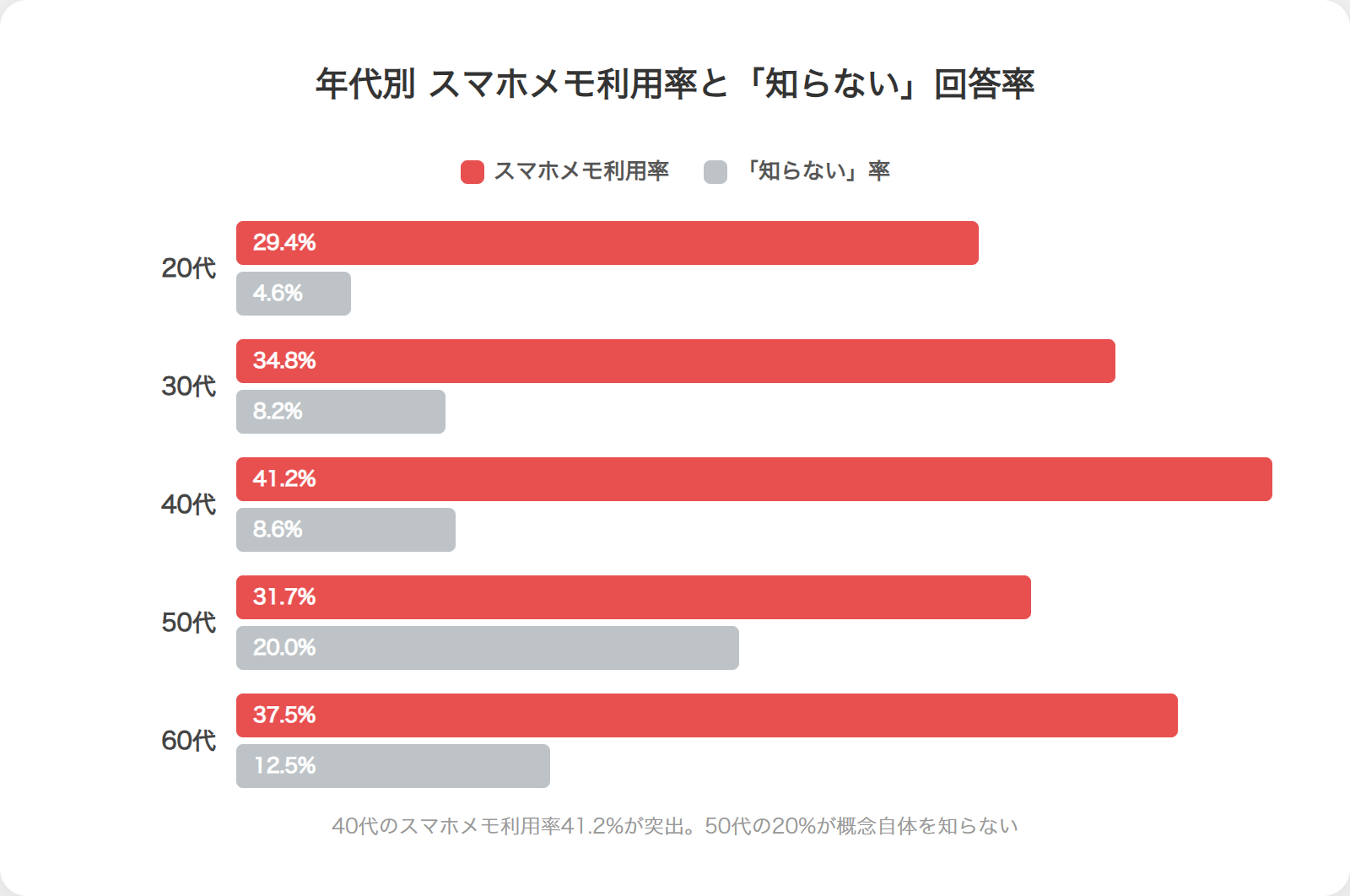
Age group | Smartphone note app usage rate | "Don't know" response rate |
|---|---|---|
20s | 29.4% | 4.6% |
30s | 34.8% | 8.2% |
40s | 41.2% | 8.6% |
50s | 31.7% | 20.0% |
60s | 37.5% | 12.5% |
Investors in their 40s top 40% for smartphone note app usage
Breaking the results down by age group reveals clear generational patterns.
Notably, investors in their 40s stand out with a smartphone note app usage rate of 41.2%.
The fact that this most active investing generation, in the prime of their working years, is disproportionately relying on the riskiest management method cannot be overlooked.
It suggests that while this group makes full use of smartphone convenience, their security awareness may not be keeping pace.
Highly convenient, yet a single mistake could prove fatal — this dependence calls for early improvement.
One in five investors in their 50s has never heard of the concept
Knowledge levels around crypto assets vary widely by generation.
Strikingly, 20.0% of respondents in their 50s said they had never even heard of the concept of a "seed phrase."
Given that awareness gaps among those in their 20s stood at just 4.6%, the generational literacy gap is significant.
This older cohort may simply never have had the opportunity to encounter the concept of seed phrase management.
For anyone holding crypto assets, understanding the importance of the seed phrase — the key to those assets — is essential.
A clear generational gap in management literacy
The age-based analysis reveals a clear divide in how risk management is approached.
Some groups are heavily reliant on smartphone note apps, while others aren't even aware that such management exists in the first place.
Digital natives and other generations likely need different security measures.
Beyond overall trends, every investor should cultivate the habit of learning the "correct storage method" suited to their own age group and circumstances.
Arguably, raising generational literacy is now an even more urgent priority than refining investment strategy itself.
Veteran investors favor paper and metal-plate storage
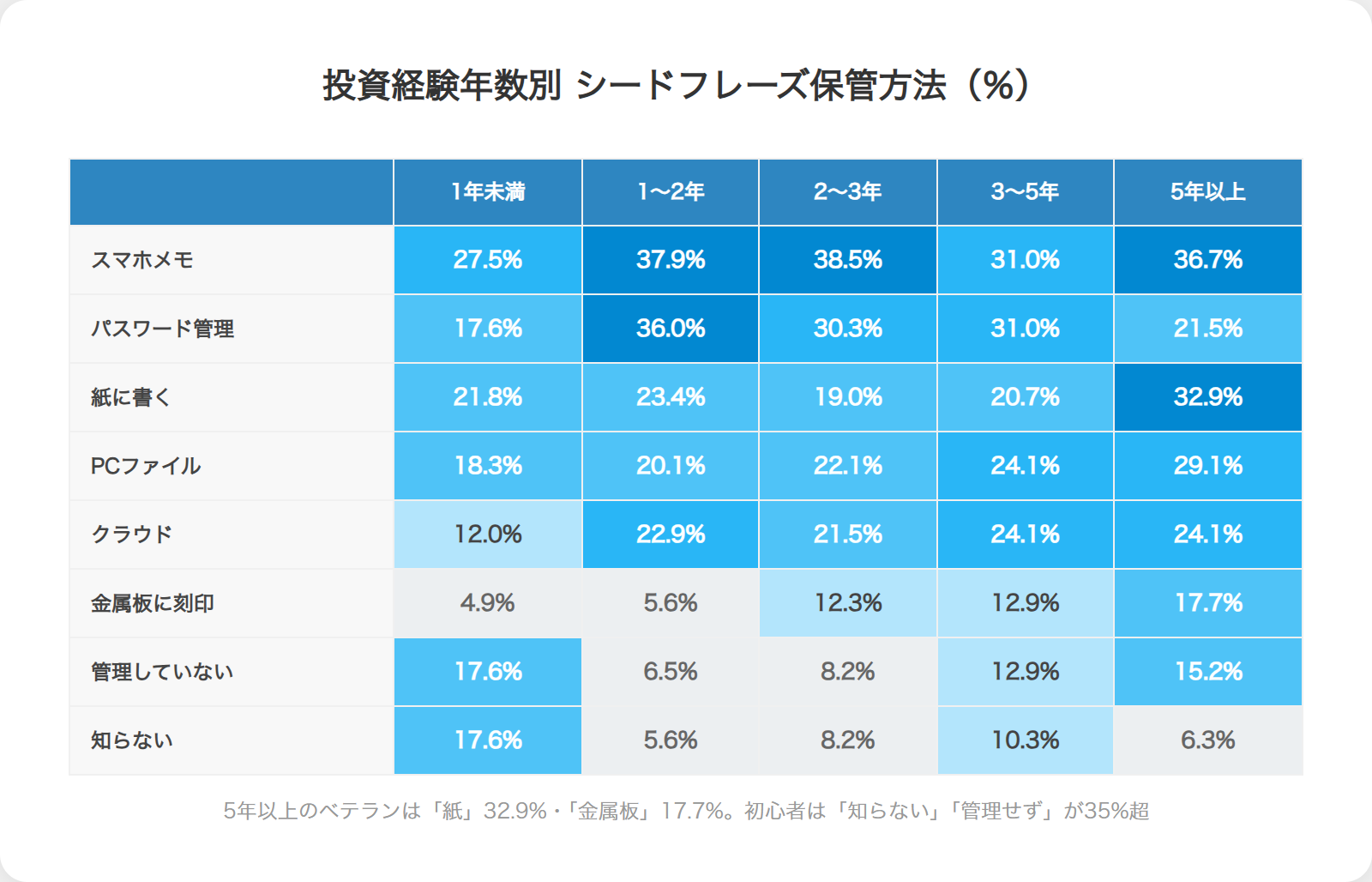
Storage method | Under 1 year | 1–2 years | 2–3 years | 3–5 years | 5+ years |
|---|---|---|---|---|---|
Smartphone note app | 27.5% | 37.9% | 38.5% | 31.0% | 36.7% |
Password manager app | 17.6% | 36.0% | 30.3% | 31.0% | 21.5% |
Written on paper | 21.8% | 23.4% | 19.0% | 20.7% | 32.9% |
File on a PC | 18.3% | 20.1% | 22.1% | 24.1% | 29.1% |
Cloud storage | 12.0% | 22.9% | 21.5% | 24.1% | 24.1% |
Engraved on a metal plate | 4.9% | 5.6% | 12.3% | 12.9% | 17.7% |
Not stored/managed | 17.6% | 6.5% | 8.2% | 12.9% | 15.2% |
Don't know | 17.6% | 5.6% | 8.2% | 10.3% | 6.3% |
Investors with 5+ years of experience favor paper
Veteran investors with more than five years of experience take a markedly conservative approach to security.
In particular, 32.9% of this group store their seed phrase "written on paper," clearly favoring a physical storage method.
Furthermore, 17.7% of this group also use "metal-plate engraving," a method resistant to both hacking and physical damage.
This suggests a well-established awareness of online attack risks, paired with a habit of isolating critical information in an offline environment.
Choosing a labor-intensive analog method instead of relying on digital tools represents the essence of sound asset protection.
It's a good example of how investors who have stayed in the market longest tend to practice management that sticks to the fundamentals.
Immaturity in management practices among beginners
On the other hand, investors with less than a year of experience show a considerably more precarious picture.
17.6% said they "don't manage" their seed phrase, and another 17.6% said they "don't know" what a seed phrase even is.
Combined, more than 35% of beginners are leaving the key to their assets unattended.
Holding crypto assets without understanding how to manage them is a critical problem, given how volatile this market can be.
This points to a serious shortfall in literacy education at the earliest stages of an investor's journey.
Urgent educational outreach is needed to help this group learn to properly protect their assets going forward.
Experience reshapes management awareness
Accumulated investing experience appears to directly correlate with heightened security awareness.
The longer an investor's experience, the more pronounced their shift toward safety-first management methods over sheer convenience.
Beginners often fail to grasp the importance of management at all, but this understanding seems to grow over time as investors learn how difficult it truly is to "protect" their assets.
It's not just success that builds this awareness — weathering the market's rough patches likely sharpens an investor's sensitivity to risk as well.
Updating one's management practices is essential to managing assets over the long term.
As investors grow from beginners into veterans, they need to evolve not just their investment approach, but also their thinking around security.
Storage methods vary by holding size
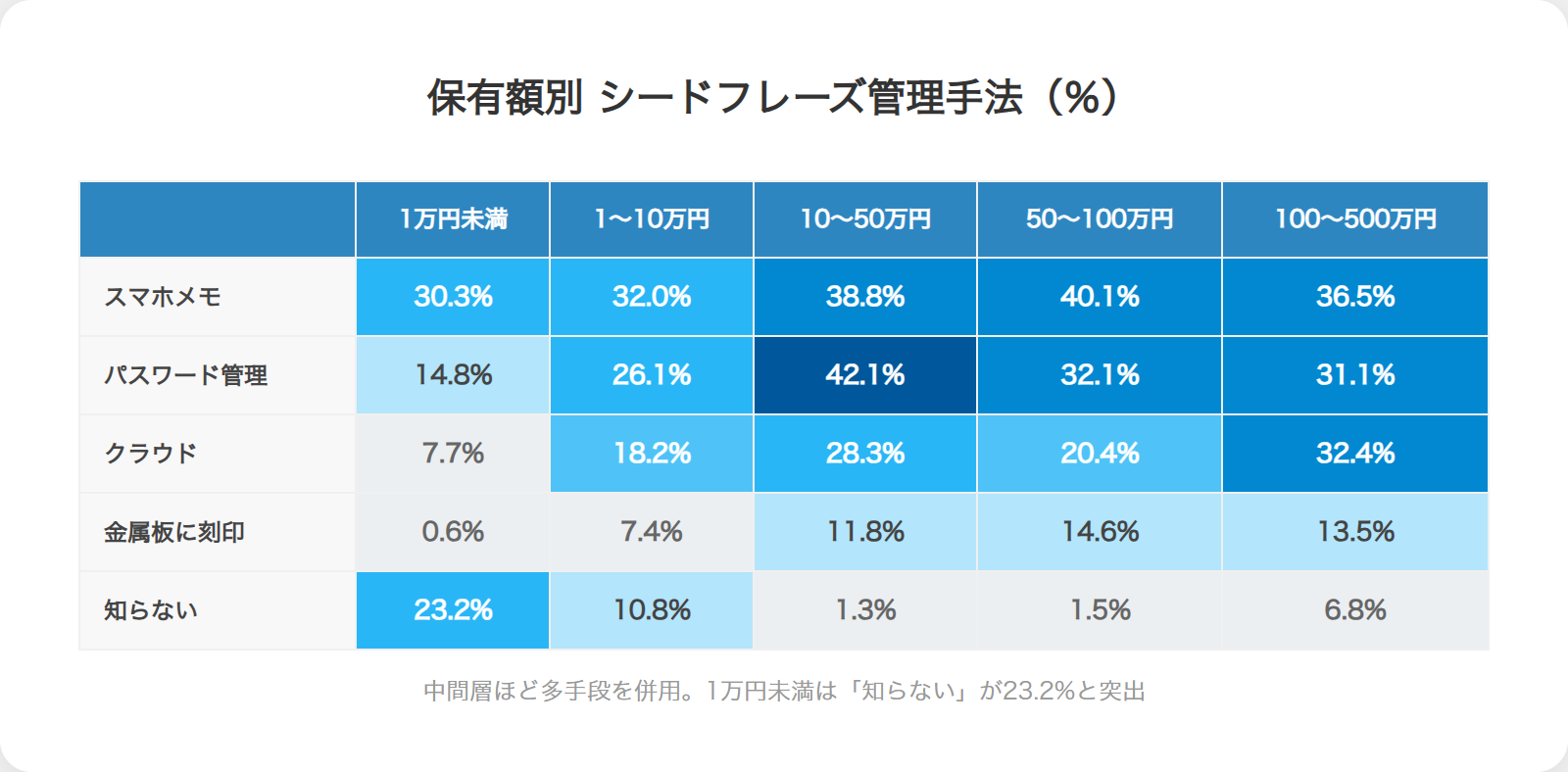
Storage method | Under ¥10,000 | ¥10,000–¥100,000 | ¥100,000–¥500,000 | ¥500,000–¥1,000,000 | ¥1,000,000–¥5,000,000 |
|---|---|---|---|---|---|
Smartphone note app | 30.3% | 32.0% | 38.8% | 40.1% | 36.5% |
Password manager app | 14.8% | 26.1% | 42.1% | 32.1% | 31.1% |
Cloud storage | 7.7% | 18.2% | 28.3% | 20.4% | 32.4% |
Engraved on a metal plate | 0.6% | 7.4% | 11.8% | 14.6% | 13.5% |
Don't know | 23.2% | 10.8% | 1.3% | 1.5% | 6.8% |
Mid-sized holders tend to combine multiple management methods
The larger an investor's total crypto holdings, the more diversified their seed phrase management tends to become.
Among those holding ¥1,000,000–¥5,000,000, 36.5% use smartphone note apps, 31.1% use password manager apps, and 32.4% use cloud storage — multiple methods used in parallel.
Rather than relying on a single storage method, this suggests these investors are spreading risk across the digital domain.
Even among those holding ¥100,000–¥500,000, password manager app usage reached 42.1% — the highest rate across all holding-size brackets.
Mid-sized holders appear to have heightened awareness around storage methods and a stronger tendency to combine multiple tools.
Building an environment where a breach of one management method can be recovered through another is a rational defensive strategy.
A wall of risk-unawareness among small holders
On the other hand, a very different picture emerges among holders with under ¥10,000 in crypto assets.
23.2% said they had never even heard of the concept of a "seed phrase," revealing an extreme lack of awareness or education around management.
As it has become easier to start investing with small amounts, many investors may be entering the market without the time to acquire proper knowledge first.
The crypto market operates under a strong principle of self-responsibility.
Holding assets without the knowledge to manage them carries very significant risk.
Understanding the importance of storage and adopting at least a minimal management method is the essential first step for every investor.
Holding size shapes the optimal management strategy
An investor's total holdings may well reflect the seriousness and knowledge level they bring to management.
As holdings grow, more investors appear to update their security measures and adopt stronger storage methods.
That said, regardless of holding size, seed phrase management is the foundation of asset protection.
A smaller holding is never a valid reason to neglect it.
Building an optimal storage strategy suited to one's own investment style and circumstances matters regardless of how much one holds.
Maintaining a level of defensive awareness appropriate to the size of one's holdings, and gradually raising one's management standards, is what sustains long-term success.
11.7% either don't manage their seed phrase or don't know what it is
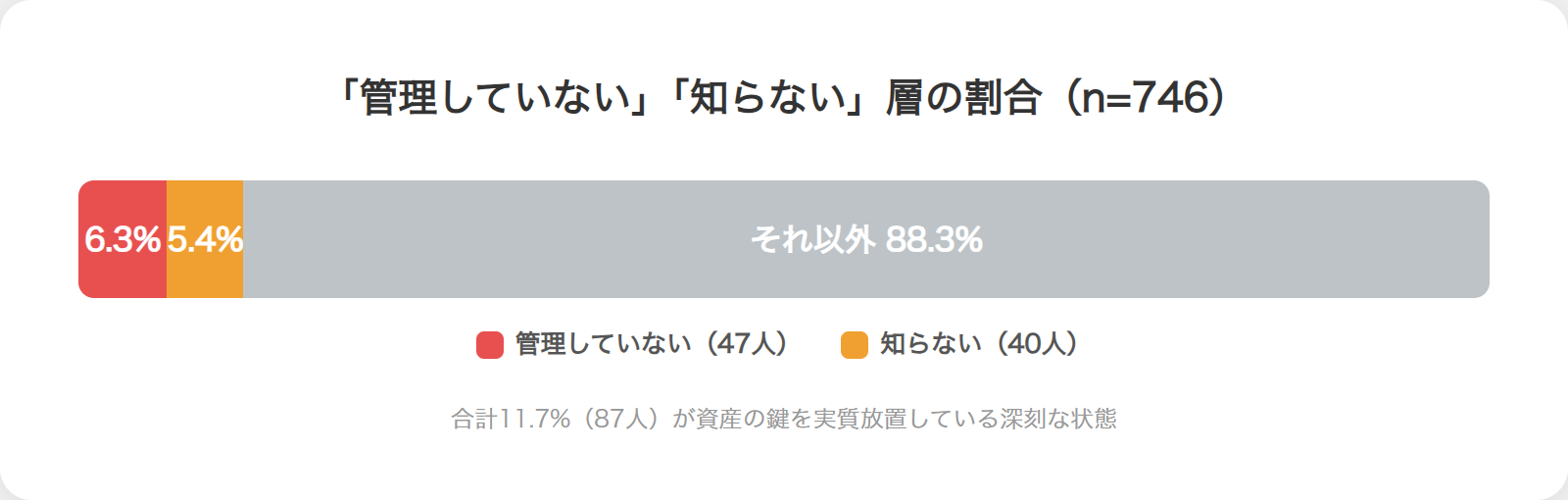
Item | Responses | Share |
|---|---|---|
Not stored/managed | 47 | 6.3% |
Don't know | 40 | 5.4% |
Total | 87 | 11.7% |
Over 10% of investors are leaving the key to their assets unattended
In this survey, 11.7% of respondents said they either "don't manage" their seed phrase or "don't even know" what a seed phrase is.
The fact that more than one in ten holders of crypto assets have secured no access to their own assets is extremely serious.
It's the equivalent of leaving the key to your house somewhere anyone can find it — or not even caring whether the key exists at all.
Without an established management method, it's only a matter of time before these assets could be lost.
Should a sudden market move or a wallet issue occur, this group is first in line to lose their assets.
This is an issue that needs urgent resolution — before continuing to invest any further.
A lack of knowledge underlies the unmanaged group
Digging into this unmanaged group, it appears to be made up largely of investors with little experience.
Many likely trade on an exchange without fully understanding how crypto assets work, and their understanding of wallets simply hasn't caught up.
True ownership of crypto assets, fundamentally, lies with whoever controls the seed phrase to the wallet that holds them.
The fact that this basic concept hasn't taken hold is what leads to neglected management.
Investor literacy education tends to focus heavily on trading techniques.
But "management method" — how to protect one's assets — is arguably the very first knowledge every investor should acquire.
The first step to protecting your assets is understanding your current situation
Recognizing the importance of the seed phrase and beginning to manage it properly is an unavoidable responsibility for every investor.
Anyone in the unmanaged group should immediately check the status of their wallet and create a backup of their seed phrase.
The complacent thought "it's not a large amount yet, so it's fine" doesn't hold up in the crypto market.
Regardless of the amount, assets that have been lost are extremely rarely recovered.
If you truly want to take ownership of your assets, take that first step toward proper management.
Right now, having read this article, is the best time to reassess your own asset-protection practices.
Conclusion
This survey shed light on how crypto asset investors actually manage their seed phrases.
The most common storage method was the "smartphone note app," prioritized for its convenience — but not without a considerable number of investors exposed to the risk of loss or hacking.
Dependence is especially high among investors in their 40s, while those with longer investing experience tend to favor offline management methods such as "paper" or "metal plates."
Regardless of holding size, the importance of management doesn't change — yet smaller holders were more likely to answer "don't know," revealing a clear literacy gap.
Neglecting the seed phrase — the key that protects your assets — leads directly to the risk of losing them.
This survey should serve as a catalyst for every investor to reassess their own management practices and rebuild a stronger asset-defense strategy, whether by appropriately combining digital and analog methods or transitioning toward offline management.
Survey overview
Survey date: April 10, 2026
Survey method: Internet survey
Survey population: Men and women residing in Japan who currently invest, or have previously invested, in crypto assets
Valid responses: 746
Conducted by: Clabo, Inc.
Survey questions
- Do you have experience investing in crypto assets?
- How many years of experience do you have investing in crypto assets?
- What is the total value of the crypto assets you currently hold?
- How do you store your seed phrase?
This article is for informational purposes only and does not constitute financial or investment advice. Please consult a qualified professional before making investment decisions.


