


As the crypto asset market continues to expand, the tactics used by scammers targeting investors are becoming more sophisticated every year.
This article presents the results of an original survey conducted among 746 individuals with experience investing in crypto assets (also known as virtual currencies).
The survey revealed a harsh reality: 61.4% of all respondents had encountered some form of scam or phishing attempt, and 14.1% had actually lost funds as a result.
Among investors in their 20s in particular, 75.2% reported having been targeted by scams, highlighting a structure in which risk is higher among younger investors.
The survey also found that 79.5% of investors regularly witness scam-related posts on social media, revealing an investment environment in which the risk of victimization is a constant presence.
This article breaks down encounter rates by scam type and risk differences by age group, and offers concrete perspectives for protecting your own assets.
61.4% of Investors Have Encountered Scams, 14.1% Lost Funds
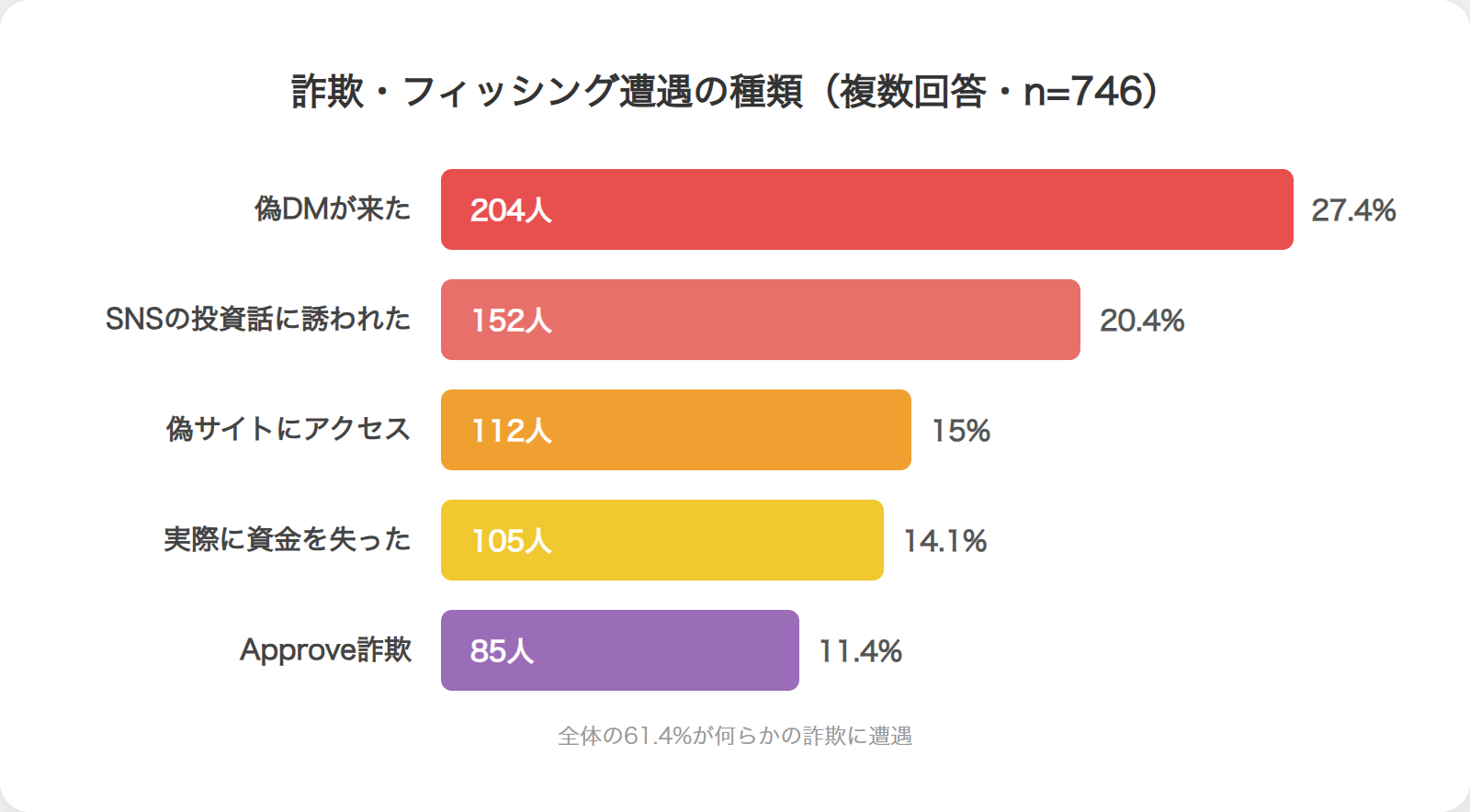
Type of Scam/Phishing | Number of Respondents | Percentage |
|---|---|---|
Received a fake DM | 204 | 27.4% |
Invited to an investment scheme via social media | 152 | 20.4% |
Accessed a fake website | 112 | 15.0% |
Actually lost funds | 105 | 14.1% |
Fell victim to an "Approve" scam | 85 | 11.4% |
Other | 49 | 6.6% |
Over 60% of Investors Have Encountered Some Form of Scam
A survey of 746 crypto asset investors found that 61.4% of all respondents — 458 people — had experienced some form of scam or phishing attempt.
Only 38.6% of investors answered that they had “never encountered” a scam, suggesting that for anyone managing assets in this market, contact with scammers has become an almost unavoidable rite of passage.
As the market continues to grow, the pool of targets for criminal groups keeps expanding in tandem.
It is no exaggeration to say that investors are attacked on a daily basis through multiple channels, including social media DMs, email, and fake websites.
The belief that “suspicious contact would never happen to me” simply does not hold up against the data.
The Severity of the 14.1% Who Actually Lost Funds
Particularly notable is that 105 respondents — 14.1% of the total — reported having “actually lost funds.”
That works out to roughly one in every seven investors suffering real financial harm from scams.
The question investors need to guard against is no longer “whether” they will encounter a scam, but “when” they will be targeted.
With 20.4% having been drawn into social media investment schemes and 15.0% having accessed fake websites, the pattern shows that these incidents are not random but structurally embedded in the market.
Minimizing damage requires building literacy in advance and strictly enforcing personal rules that shut out suspicious contact.
"Approve" Scams at 11.4% — A New Type of Threat Emerges
One threat that has required particular vigilance in recent years is the “Approve scam,” which abuses wallet permissions.
In this survey, 85 respondents — 11.4% — reported encountering this scam, a scale of damage that can no longer be ignored.
This tactic works by tricking victims into signing a transaction on a fake site, thereby granting the attacker permission to withdraw assets from their wallet.
Once a user approves the transaction, assets can be drained without their knowledge, which is why victims often notice the damage only after a delay.
Investors who do not understand the underlying technical mechanics are more likely to be targeted, making it increasingly essential to learn what a contract-approval screen actually means as a core asset-protection skill.
Scam Types Ranked — Fake DMs and Social Media Investment Schemes Are the Two Leading Tactics
Fake DMs Top the List at 27.4% — A Scattershot Tactic Aimed at the Masses
The most common type of scam or phishing encounter, reported by 27.4% of respondents, was the “fake DM.”
More than one in four investors have received direct solicitations from impersonator accounts on messaging services such as X (formerly Twitter), LINE, and Telegram.
Fake DMs are the lowest-cost method for attackers and allow them to reach a wide, unspecified audience.
Scammers go to great lengths to make these messages hard to spot on sight alone, such as impersonating official accounts or using photos stolen from celebrities.
The first line of defense is a simple habit: never open links contained in DMs you were not expecting.
Social Media Investment Schemes at 20.4% — Increasingly Sophisticated Influencer Impersonation
152 respondents — 20.4% — reported having been “invited to an investment scheme via social media.”
Attractive-looking investment tips and solicitation posts featuring phrases like “guaranteed profits” that circulate on social media timelines are among the threats investors encounter most frequently.
Solicitation activity tends to spike especially during bull market phases, when investors’ appetite for opportunities is running high.
Lures from accounts impersonating well-known influencers are particularly hard to detect and tend to lead directly to victimization.
Investors should abandon the assumption that “a large follower count equals trustworthiness” and make a habit of checking for official verification badges and reviewing an account’s post history.
Fake Websites at 15.0% — Sophisticated Traps Hidden in a Single-Character URL Difference
15.0% of investors reported having accessed a fake website mimicking a legitimate exchange or wallet service.
These sites reproduce the design and wording of the real thing so closely that at first glance they are indistinguishable, making it extremely difficult to tell them apart through visual inspection alone.
The mainstream tactic is a spoofed URL involving a single-character difference in the domain or a cleverly constructed fake subdomain.
Accessing such a site via a link from social media or search results risks instantly leaking your login credentials or seed phrase.
Simple habits — always accessing sites through bookmarks and visually double-checking the URL — remain the most effective countermeasures.
75.2% of Investors in Their 20s Have Encountered Scams — Risk Rises Among Younger Investors
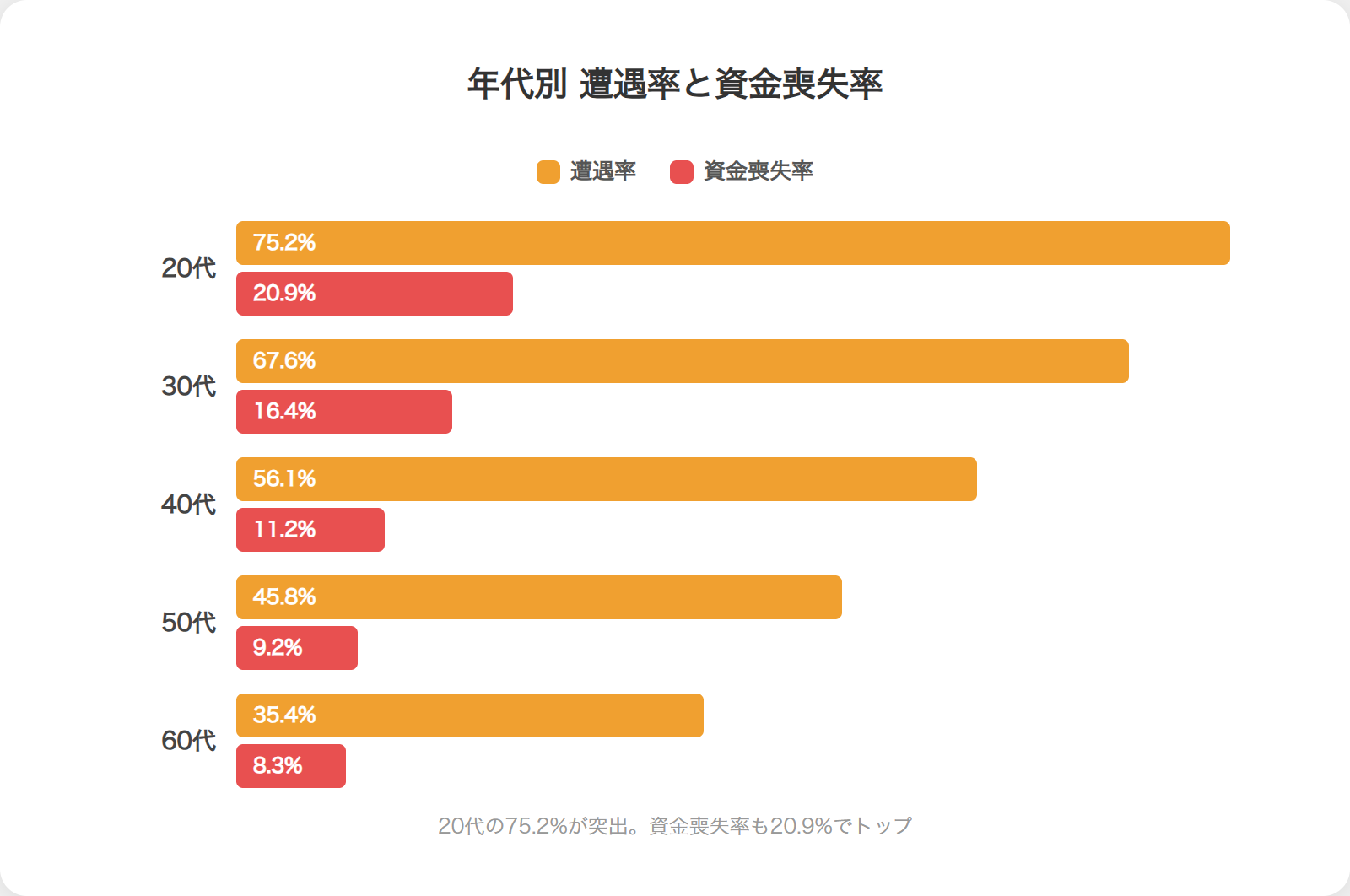
Age Group | n | Encounter Rate | Fund Loss Rate |
|---|---|---|---|
20s | 153 | 75.2% | 20.9% |
30s | 207 | 67.6% | 16.4% |
40s | 187 | 56.1% | 11.2% |
50s | 120 | 45.8% | 9.2% |
60s | 48 | 35.4% | 8.3% |
20s at 75.2% — Digital Natives Are the Prime Targets
A cross-tabulation by age group shows that the scam-encounter rate among investors in their 20s stands out at 75.2%, the highest of any age bracket.
The share who actually lost funds also peaked in this group, at 20.9%, underscoring a structure in which damage grows more severe the younger the investor.
For younger investors, whose activity centers on social media, exposure to fake information and DM solicitations is a routine part of daily life.
In many cases, an emphasis on speed of information leads investors to skip careful checks on URLs and account authenticity.
The convenience they enjoy comes at the cost of being constantly exposed to an entry point for attacks.
60s at 35.4% Encounter Rate — Fewer Points of Contact Offer Some Protection
By contrast, the encounter rate among investors in their 60s remained substantially lower, at 35.4%.
This appears to be a result of differences in how this age group accesses information, which in turn reduces their exposure to scam contact points.
This does not mean, however, that older investors are safe.
Risk remains in terms of the size of potential losses and the technical skills needed to recover from an incident.
Rather than relying too heavily on having fewer points of contact, older investors are encouraged to keep updating their basic defensive knowledge.
Stronger Literacy Is Needed Across All Generations
Even though encounter rates differ by a factor of two, no generation is immune to scams.
The figures for investors in their 30s and 40s likewise show that damage is not concentrated in any single age group.
The principle of “treat any solicitation from an unofficial source with suspicion” is a defense that applies equally across all age groups.
Tailoring countermeasures to one’s own lifestyle is the only reliable path to protecting one’s assets.
Social Media Is a Breeding Ground for Scams — 79.5% Have Witnessed Scam Posts
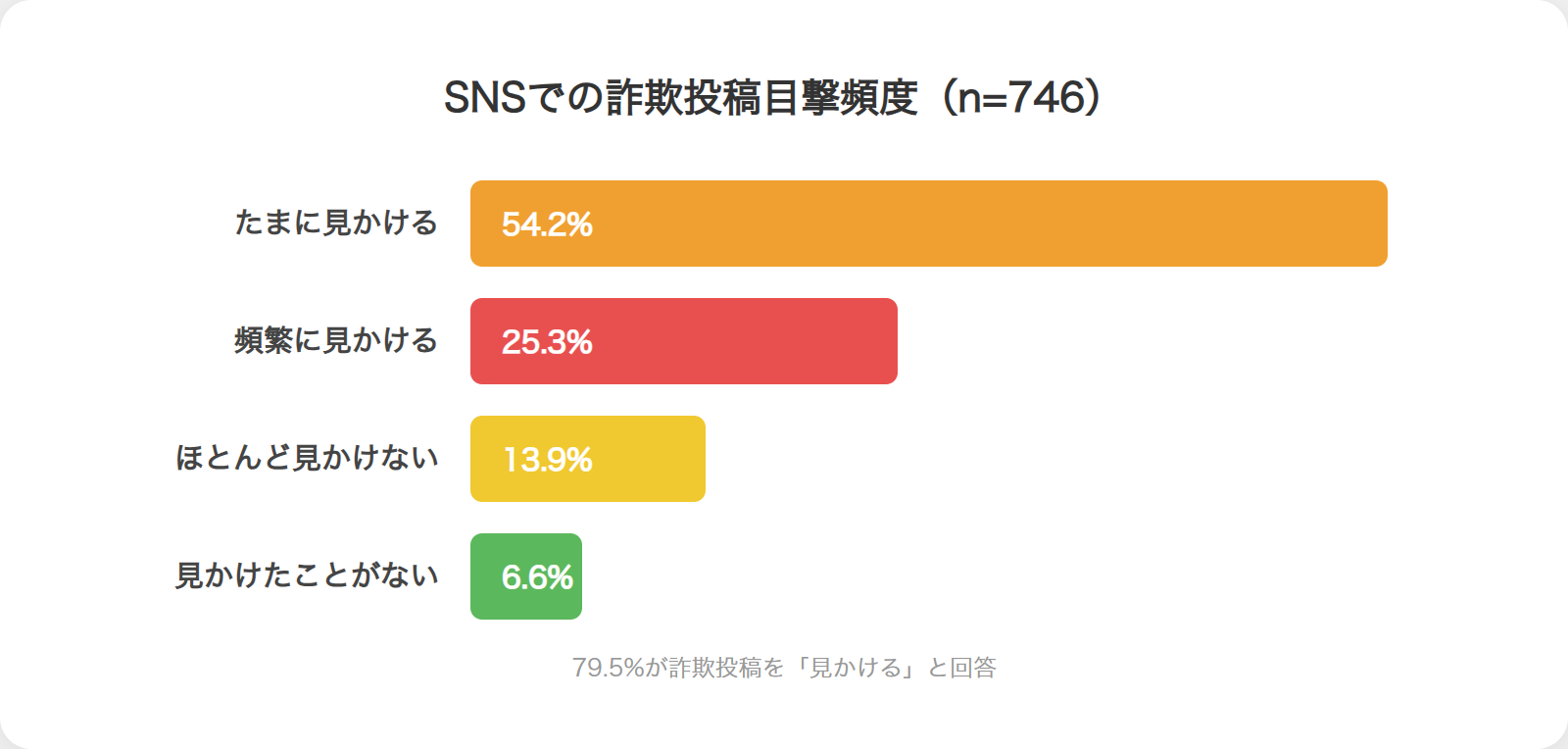
Frequency of Sightings | Number of Respondents | Percentage |
|---|---|---|
Occasionally | 404 | 54.2% |
Frequently | 189 | 25.3% |
Rarely | 104 | 13.9% |
Never | 49 | 6.6% |
One in Four “Frequently” Witness Scam Posts — An Abnormal State of Affairs
When asked how often they see scam-related posts on social media, 79.5% of investors said they do “see” them.
Of these, 25.3% — 189 people — said they see them “frequently,” meaning one in four investors is exposed to scam posts on a routine basis.
Searching for crypto-related keywords now routinely surfaces posts that could lead directly to victimization.
It should also not be overlooked that timeline algorithms create conditions in which malicious posts spread easily.
Abandon the Illusion That “My Social Media Feed Is Safe”
13.9% of respondents said they “rarely” see scam posts, but that does not mean such posts do not exist.
In most cases, this is likely simply because the user’s own filtering settings or areas of interest mean the posts never surface in their feed.
Scam posts have grown so sophisticated that they can no longer be identified at a glance.
The assumption that “my own timeline is clean” may itself be the most dangerous form of overconfidence.
Passive Defenses Have Their Limits
There is no way to counter scam posts on social media other than taking active defensive measures.
Reporting suspicious posts when you see them, blocking suspicious accounts, and periodically reviewing who you follow should all be treated as the minimum baseline for self-defense.
Making it a habit to always pause before engaging with posts touting attractive returns or “exclusive” information is your last line of defense.
Romance Scams and Hacking — Two Hidden Major Risks
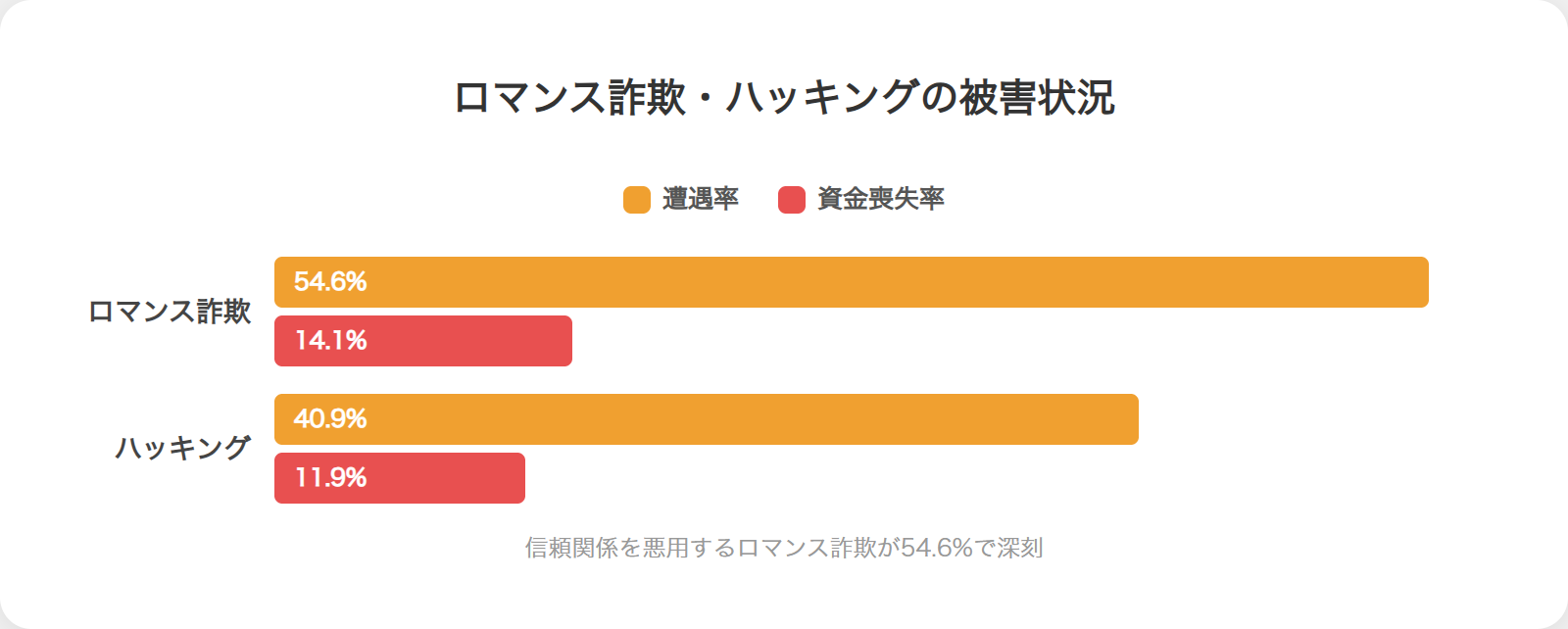
Romance Scams at 54.6% — A Tactic That Exploits Trust
The survey also found that 54.6% of investors had encountered a romance scam (a fraud involving a feigned romantic relationship used to solicit investment).
Of these, 14.1% said they had actually gone through with an investment, underscoring the severity of the damage involved.
In a romance scam, the perpetrator builds a long-term relationship of trust through social media or dating apps before ultimately steering the victim toward an investment.
The psychological manipulation involved is more sophisticated than in ordinary scams, and victims often find it difficult to recognize that they are being deceived.
The moment someone you met online brings up an investment opportunity, that alone should be treated as a strong warning sign.
11.9% Lost Funds to Hacking
On the topic of hacking (unauthorized access), 11.9% of respondents answered “yes, and I lost funds.”
A further 29.0% answered “yes, but my funds were safe,” meaning that in total, more than 40% of investors have faced some form of unauthorized access.
Basic security measures — enabling two-factor authentication on your wallet, storing your seed phrase offline, and changing passwords regularly — are the last line of defense against this kind of damage.
The assumption that “hacking is only a problem for major exchanges” can be a fatal blind spot for individual investors.
Summary
This survey revealed a harsh reality: 61.4% of crypto asset investors have encountered some form of scam or phishing attempt, and 14.1% have actually lost funds.
The figures for investors in their 20s in particular — a 75.2% encounter rate and a 20.9% fund-loss rate — show that the risk of victimization is highest among the digital-native generation.
With 79.5% of investors witnessing scam-related posts on social media, this threat can be described as having become a routine part of daily life.
Scam tactics range widely — fake DMs, social media investment schemes, fake websites, Approve scams, and romance scams — making it difficult to guard against all of them with a single countermeasure.
Understanding the characteristics of each type of scam and putting multiple layers of defense in place has become an essential skill for every crypto asset investor.
Letting go of the belief that “it won’t happen to me” and strictly enforcing personal rules that shut out suspicious contact may be the only real survival strategy for protecting your valuable assets.
Survey Overview
Survey date: April 10, 2026
Survey method: Internet survey
Survey population: Men and women residing in Japan (current or former crypto asset investors)
Valid responses: 746
Conducted by: Clabo Inc.
Survey Questions
- Do you have experience investing in crypto assets (also known as virtual currencies)?
- Have you ever encountered a scam or phishing attempt?
- How often do you see scam-related posts on social media?
- Have you ever encountered a romance scam (involving investment solicitation)?
- Have you ever experienced hacking (unauthorized access)?
This article is for informational purposes only and does not constitute financial or investment advice. Please consult a qualified professional before making investment decisions.


