


"You can easily make money with crypto assets" — sweet-sounding pitches like this now reach people daily through social media and dating apps.
But behind many of these approaches lurks the shadow of an elaborate romance scam.
In an original survey of people with experience investing in crypto assets (also known as virtual currencies), we found that more than half had been approached with an investment solicitation, and a certain share of respondents had actually suffered losses.
Most victims were in their 20s and 30s, and the level of risk also varied by investment style.
This article breaks down what the survey reveals about the real scale of the damage and the characteristics of the users most likely to be targeted.
Half of Crypto Asset Users Have Encountered a Romance Scam
Response | Count | Share |
|---|---|---|
Never encountered one | 339 | 45.4% |
Encountered one but did not invest | 249 | 33.4% |
Encountered one and invested | 105 | 14.1% |
Know someone who was victimized | 53 | 7.1% |
More Than Half Have Been Approached by Scam Solicitations
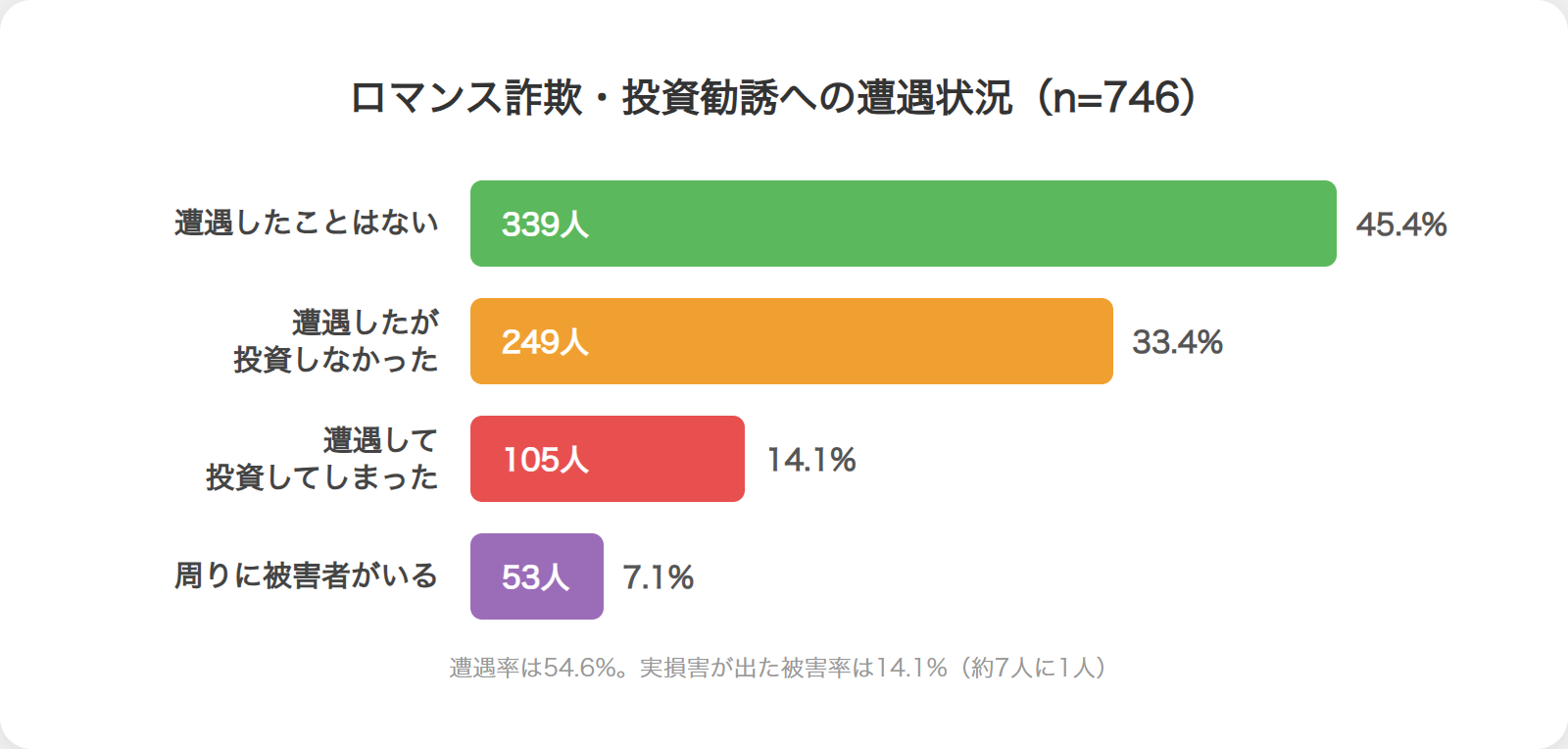
Our proprietary survey found that 54.6% of people with crypto asset experience have been exposed to what is known as a romance scam or a fraudulent investment solicitation.
The pattern of being approached with sweet words via social media or a dating app, and eventually being pressured into a large investment, is no longer something that only happens to other people.
As the crypto asset market has grown, the survey makes clear just how routine these malicious solicitations have become.
The fact that more than half of users have experienced some form of solicitation should be read as a strong warning for the market as a whole.
People who are particularly interested in new technology or financial products tend to be curious by nature, but that same curiosity can also make them an easier target.
Staying alert at all times is essential when engaging in any investment activity.
The Split Between Those Who Avoided Investing and Those Who Did
Not everyone who is approached ends up investing, and that distinction matters.
The data shows that 33.4% of respondents who encountered a solicitation said they "did not invest" — roughly one in three avoided harm through a level-headed decision.
On the other hand, 14.1% said they "did invest," which points to just how sophisticated these scams have become.
What separates these two groups may come down to differences in crypto asset literacy and awareness of common scam tactics.
Once someone gives in to a tempting offer even once, the risk of secondary damage — being asked for even larger sums afterward — rises sharply.
Having the courage to step back the moment something feels "off" is the basic foundation of protecting your assets.
Cases Involving People Around You Cannot Be Ignored Either
Even among respondents who were not directly solicited themselves, 7.1% said someone in their circle had been victimized.
This suggests that a friend or family member may, without your realizing it, have become entangled in a scam or already suffered a loss.
Because information about crypto assets is often exchanged within closed communities, an introduction from someone close to you can lower your guard more easily than a cold approach would.
Especially in recent times, sophisticated AI-generated fake sites and fabricated track records have also become more common.
To protect both yourself and the people around you, it is worth re-affirming that responsibility for how you manage your crypto assets ultimately rests with you.
14.1% Actually Invested, and Losses of ¥100,000–500,000 Were Most Common
Amount lost | Count | Share |
|---|---|---|
¥100,000–500,000 | 39 | 24.7% |
¥10,000–100,000 | 36 | 22.8% |
¥500,000–1,000,000 | 25 | 15.8% |
Under ¥10,000 | 23 | 14.6% |
¥1,000,000 or more | 11 | 7.0% |
14.1% of All Respondents Invested Money After a Scam Solicitation
The survey found that 14.1% of all respondents who received a romance-scam-style solicitation went on to actually invest money.
This is not just a matter of exposure — it reflects real financial harm that must not be overlooked.
The fact that roughly one in seven people became a scam victim is a finding that needs to be taken seriously.
In most cases, victims are likely first drawn in with a small amount.
Once a relationship of trust has been established, subsequent investment solicitations tend to significantly impair a person’s judgment.
This figure shows that anyone who holds crypto assets could potentially become a target.
By the time someone realizes a solicitation was suspicious, the funds have often already been lost.
Building defensive habits in advance is essential to protecting your assets.
Losses of ¥100,000–500,000 Are the Most Common
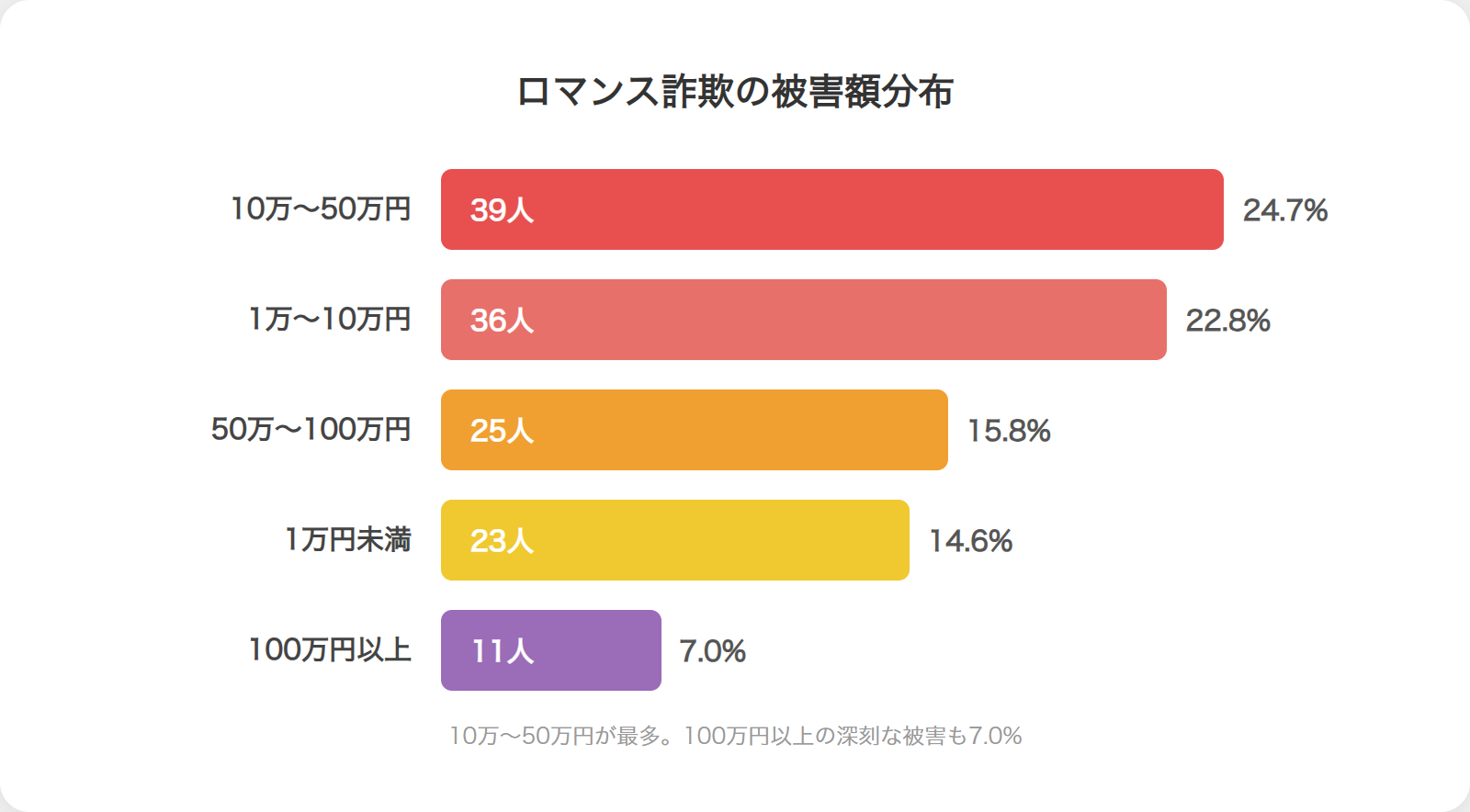
Looking at the breakdown of losses by amount, the ¥100,000–500,000 range was the most common at 24.7%.
Many victims lost a sum in the low hundreds of thousands of yen — a figure that is far from trivial.
This is followed by the ¥10,000–100,000 range at 22.8%.
A smaller loss amount does not mean the problem can be dismissed.
A further 15.8% of respondents lost between ¥500,000 and ¥1,000,000.
The concentration of losses in this mid-range band shows that many users are absorbing similar levels of financial damage.
Even a small initial loss should not be taken lightly.
The risk of an initial loss escalating into a much larger one is a constant danger if it is not stopped early.
7% Suffered Serious Losses of ¥1,000,000 or More
Meanwhile, 7.0% of respondents reported losses of ¥1,000,000 or more.
This represents an extremely serious level of harm that can directly affect a person’s daily life.
Even though this share is not large as a proportion of respondents, a financial loss of this size can significantly derail someone’s life.
The damage is not limited to money alone.
The psychological burden of regretting one’s own misjudgment arises regardless of the amount involved.
The shock of being betrayed by someone you trusted is immeasurable.
Anyone involved in the crypto asset market should keep in mind that the possibility of this kind of large-scale loss is never zero.
Age-Based Analysis Reveals a Crisis Among Users in Their 20s
Age group | Encounter rate | Victim rate |
|---|---|---|
20s | 49.8% | 21.6% |
30s | 39.4% | 18.8% |
40s | 30.8% | 12.5% |
50s | 15.9% | 5.0% |
60s | 12.3% | 3.5% |
Users in Their 20s Have a Near-50% Encounter Rate of 49.8%
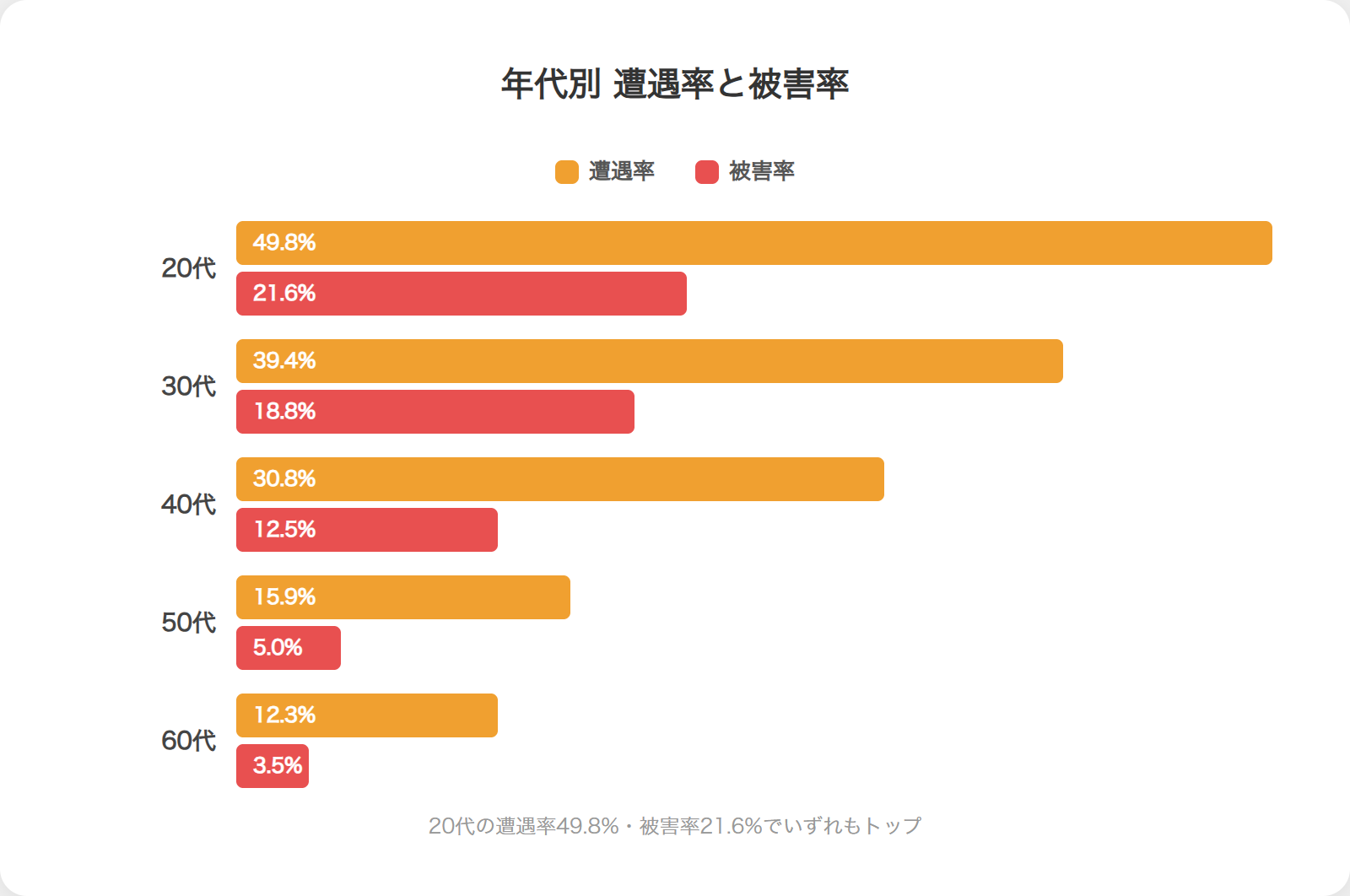
Breaking crypto asset users down by age group, the encounter rate among people in their 20s came out to a striking 49.8%.
Nearly half of all users in this age group have been exposed to a scam solicitation, making clear that younger users are the primary target.
It may be inevitable that generations who spend more time active on social media and apps face more opportunities for contact.
These digital natives tend to have a strong interest in investing, but that also puts them at constant risk of exposure to malicious solicitation tactics.
This figure should not be taken lightly — younger users need to maintain an even stronger sense of caution.
A structural problem is embedded in this age group: it is not just about being approached, but about being pulled one step further in.
The Victim Rate Is Also Highest Among Users in Their 20s, at 21.6%
In line with the encounter rate, the victim rate — the share who actually went on to invest — is also highest among people in their 20s, at 21.6%.
Those in their 30s follow closely at 18.8%, showing that damage is concentrated among younger users in their 20s and 30s.
This figure illustrates just how effectively these tactics work when targeting people with less investment experience.
The psychological drive to build up assets quickly can make people respond strongly to pitches promising “easy profits.”
Raising the baseline level of investment literacy is an urgent priority for encouraging calmer judgment.
Building the ability to evaluate risk correctly, rather than being swept up by momentary emotion, is ultimately the strongest defense.
Encounter and Victim Rates Trend Downward From Age 50 Onward
By contrast, the encounter rate among people in their 50s falls to 15.9% and the victim rate to 5.0%, with the victim rate among people in their 60s falling further still, to 3.5%.
Older age groups tend to rely relatively less on digital tools, which may limit the channels through which fraudulent investment solicitations can reach them.
It is also possible that the risk-management instincts built up over years of social experience act as a protective barrier.
A sharper instinct for immediately recognizing an easy investment pitch as “suspicious” may be what keeps older users further from scams.
That said, as digital touchpoints increase, the risk that new scam methods will spread to older users as well cannot be ruled out.
Staying up to date on new solicitation tactics, regardless of age, remains essential for everyone.
Short-Term Traders Have the Highest Victim Rate, at 18.1%
Investment style | Victim rate |
|---|---|
Short-term trading | 18.1% |
Both (short-term + long-term) | 14.6% |
HODL (long-term holding) | 13.7% |
Yield-focused (e.g., staking) | 9.0% |
Short-Term Traders Have the Highest Victim Rate, at 18.1%
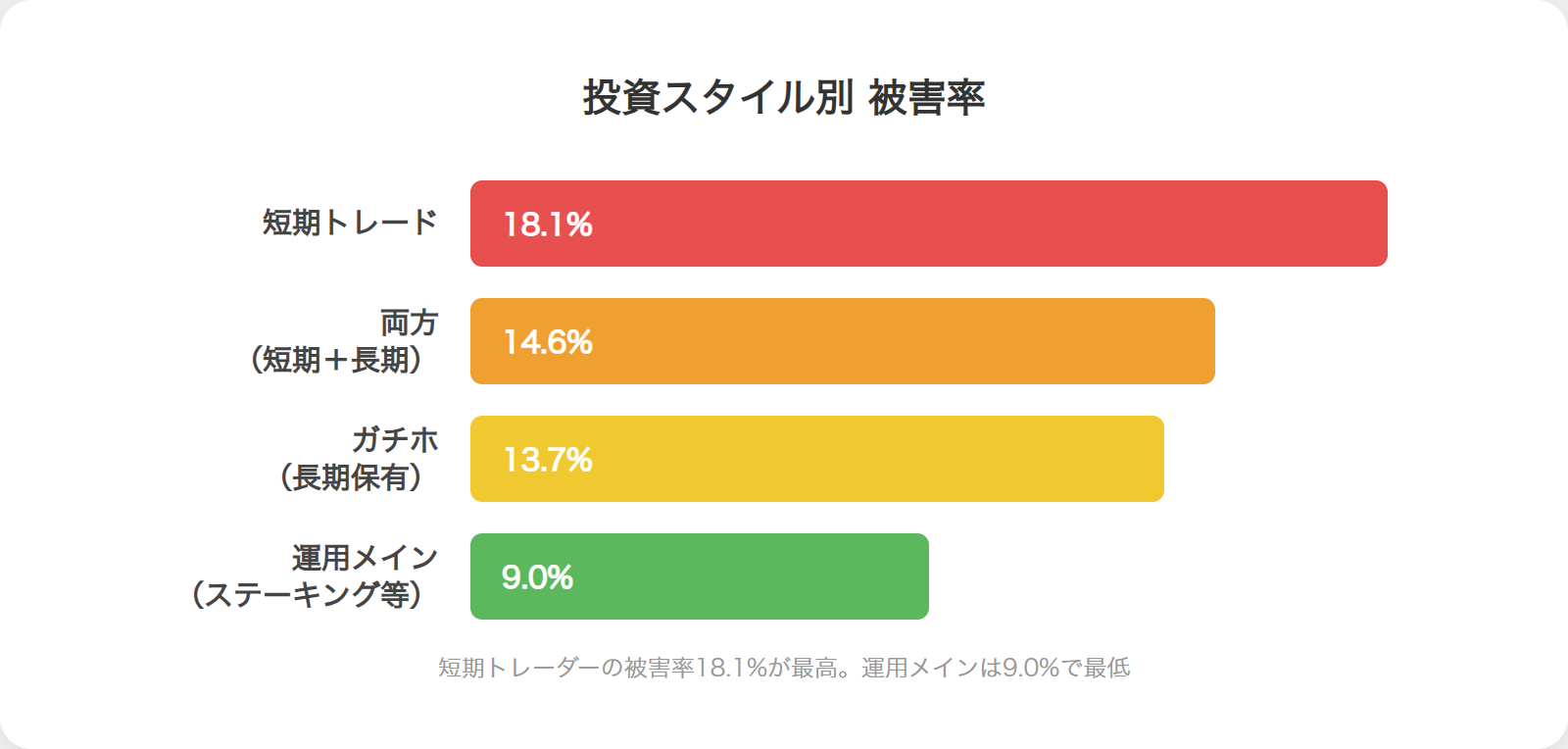
The victim rate among traders whose primary style is short-term trading came out to 18.1%, the highest of any investment style in the survey.
The aggressive posture of chasing short-term profits and targeting market volatility may itself be creating an opening for sweet-sounding solicitations.
Short-term traders tend to constantly seek out new information and jump on opportunities as soon as they appear.
That same eagerness may make them look, to a scammer, like an “easy target.”
A strong drive to capture profit is a normal part of investing, but when that drive turns into impatience, judgment suffers.
Trading at high frequency should be understood as carrying a constant risk of losing one’s composure.
Long-Term Holders and Yield-Focused Investors Avoid Risk More Successfully
The victim rate among long-term holders who mainly HODL came to 13.7%, while yield-focused investors engaged mainly in staking and similar activities stayed as low as 9.0%.
Both figures are clearly lower than the rate for short-term traders.
Long-term holders tend not to react to day-to-day price swings, instead prioritizing steady asset growth over time.
This grounded approach may be what gives them the mental composure not to be lured in by short-term get-rich-quick pitches.
The fact that yield-focused investors recorded the lowest rate, at 9.0%, is also worth noting.
A disciplined approach of managing assets directly through one’s own wallet and earning returns that way appears to build resistance to fraudulent investment solicitations.
Committing to a Clear Investment Style Is the Best Defense
The clear gap in victim rates across investment styles is a good opportunity to reconsider your own position.
Understanding why short-term traders are targeted more often is an important part of that.
Scammers tailor their tactics to match the profile of the target.
For people seeking short-term gains, a pitch like “your money will multiply in a short period” tends to land especially well, which is a major factor behind the resulting losses.
Whatever investment method you use, having your own clear set of standards is essential.
Rather than becoming attached to a particular style, building the habit of calmly scrutinizing information is the single best defense for surviving in the crypto asset market.
68.5% of Victims Are in Their 20s or 30s, and Men Outnumber Women
People in Their 30s Account for 37.1%, Bringing the 20s-and-30s Total to 68.5%
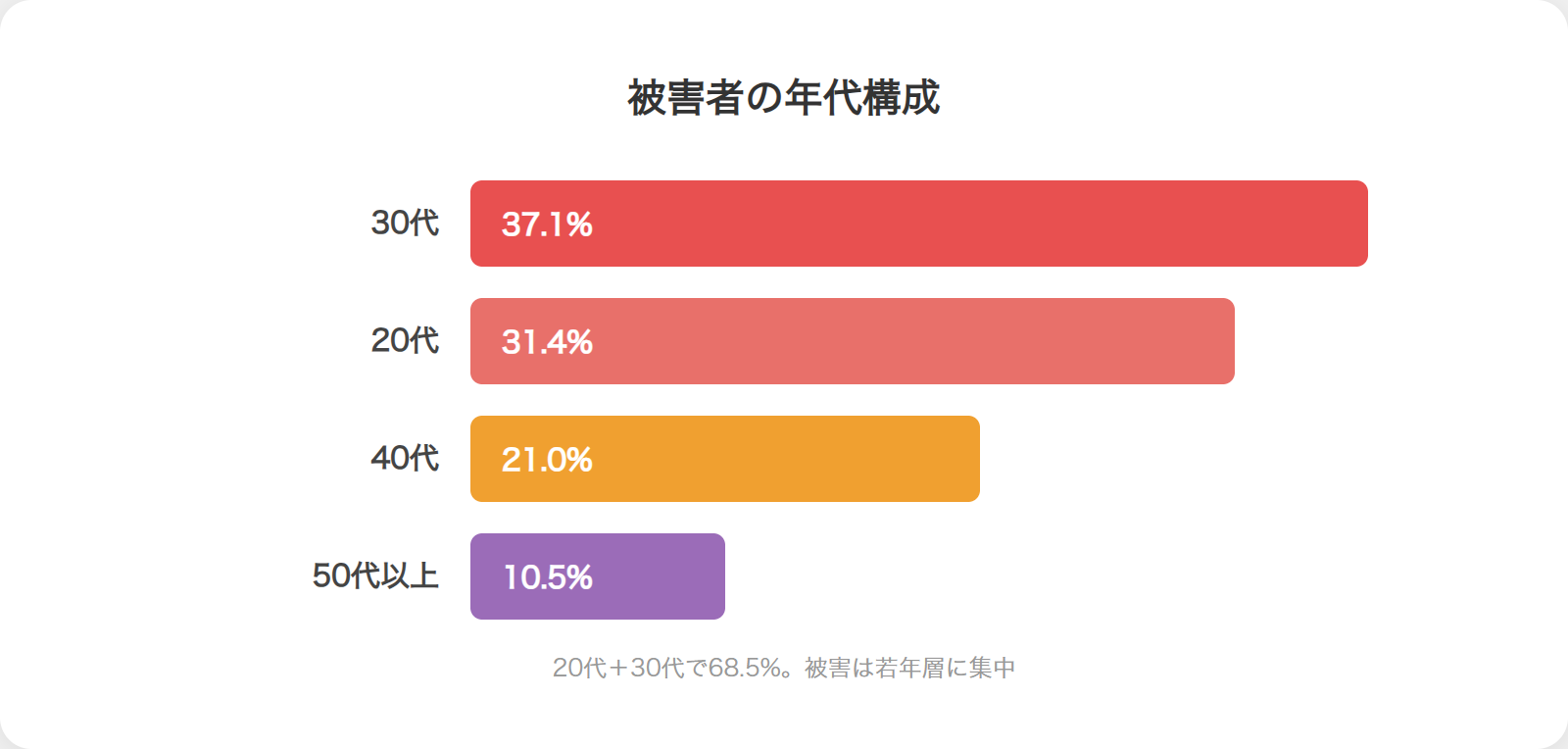
Age group | Share |
|---|---|
30s | 37.1% |
20s | 31.4% |
40s | 21.0% |
50s and older | 10.5% |
Looking at the profile of the 105 respondents who actually invested money, people in their 30s make up the largest share at 37.1%, followed by those in their 20s at 31.4%.
Combined, these two generations account for 68.5% of all victims, showing that harm is heavily concentrated among younger users.
It is clear that younger generations, who tend to have stronger interest in investing, also face a correspondingly higher risk of falling victim to scams.
Sweet-sounding investment solicitations delivered via social media are precisely calibrated to exploit the psychological vulnerabilities of the digital generation.
This age group is typically at an early stage of building up assets, and the impatience to earn a profit as quickly as possible appears to be part of what leads people to fall for a scammer’s pitch.
Men Make Up 59.0%, Outnumbering Women
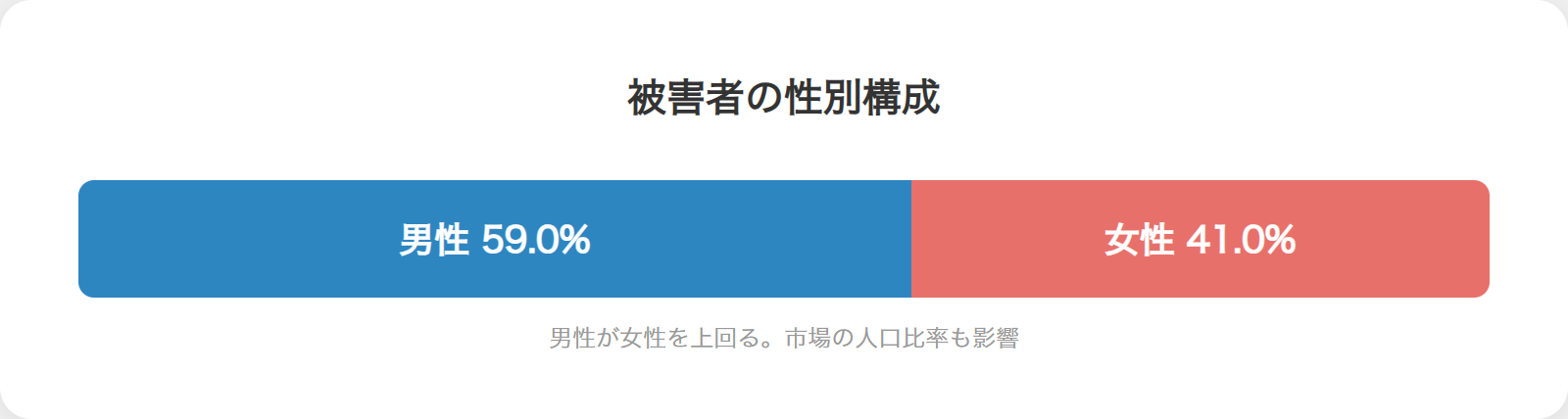
Gender | Share |
|---|---|
Male | 59.0% |
Female | 41.0% |
The gender breakdown of victims was 59.0% male and 41.0% female.
Both men and women were victimized, though the share was somewhat higher among men.
This may partly reflect the fact that the crypto asset market’s core user base skews male.
Rather than a gap in how alert each gender is, this figure may simply mirror the underlying gender balance of the market itself.
In romance scams conducted via social media and dating apps, a common pattern involves an approach modeled on a woman reaching out to a man, and it is possible that this approach is particularly effective on male psychology.
Men Show a Clear Tendency Toward Larger Losses
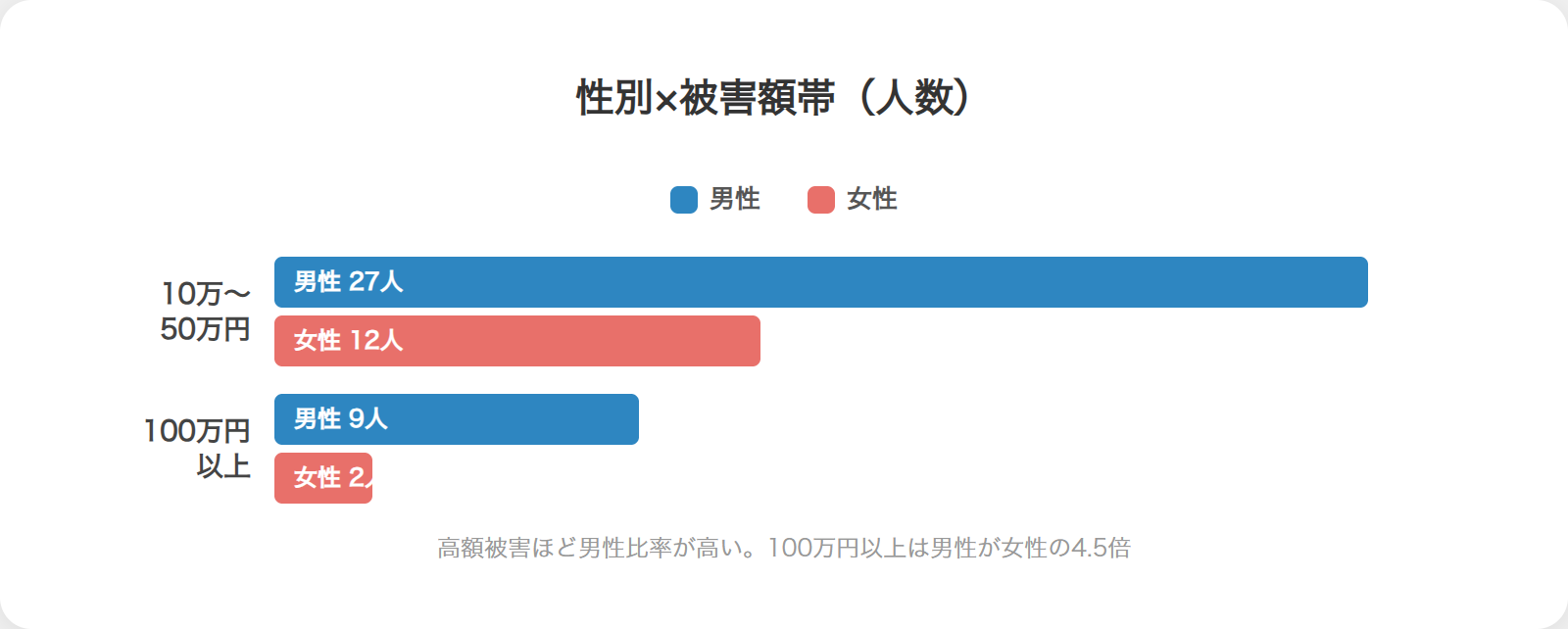
Loss amount | Male | Female |
|---|---|---|
¥100,000–500,000 | 27 respondents | 12 respondents |
¥1,000,000 or more | 9 respondents | 2 respondents |
An analysis of loss amounts shows that men tend to suffer larger losses than women.
In the ¥100,000–500,000 range, 27 men reported losses compared with 12 women.
At the ¥1,000,000-or-more level, the gap widens further — 9 men versus just 2 women — making the scale of men’s losses stand out even more clearly.
This is likely influenced by a broader difference in investing behavior, with men more willing to take on risk and commit larger sums of money.
The desire to “capture an even bigger return” appears to manifest more strongly among men, which likely contributes to the larger scale of their losses.
Summary
More than half of people with crypto asset experience have encountered a romance scam or fraudulent investment solicitation, and the survey reveals that roughly one in seven has actually invested money as a result.
Damage is concentrated among users in their 20s and 30s, and those who favor short-term trading face a correspondingly higher level of risk.
The data also suggests that men tend to suffer larger financial losses than women.
The crypto asset market offers real convenience, but that convenience comes hand in hand with malicious solicitation risk.
As this survey shows, improving your own literacy and maintaining a level-headed set of judgment criteria is the one true line of defense for protecting both your assets and yourself.
Approaching any investment activity with the awareness that risk always lurks behind sweet-sounding words is essential.
Survey Overview
Survey date: April 10, 2026
Survey method: Internet survey
Survey population: Men and women residing in Japan (people currently investing in crypto assets, or with past investment experience)
Valid responses: 746
Conducted by: Clabo Inc.
Survey Questions
- Do you have experience investing in crypto assets (also known as virtual currencies)?
- What is your main investment style?
- Have you ever encountered a romance scam (investment solicitation)?
- Roughly how much money did you lose as a result of that romance scam (investment solicitation)?
This article is for informational purposes only and does not constitute financial or investment advice. Please consult a qualified professional before making investment decisions.


