


"I sent a transfer, but it never arrived." "I tried to withdraw and got an error."
Have you ever run into trouble like this?
In this survey (n=506), among respondents with experience sending or withdrawing crypto assets, 21.5% reported "a close call" and 7.5% reported "an actual problem" — meaning nearly 30% experienced some form of risk.
This survey takes a close look at the pitfalls you should know about, from choosing the wrong network to mistyping a destination address.
Respondent Profile
Category | Respondents | Share |
|---|---|---|
Male | 307 | 60.7% |
Female | 199 | 39.3% |
Generation Y (born 1981–1996) | 188 | 37.2% |
Ice Age Generation (born 1970–1980, Japan's "employment ice age" cohort) | 154 | 30.4% |
Generation Z (born 1997–2012) | 68 | 13.4% |
Bubble Generation (born 1962–1969) | 49 | 9.7% |
Shinjinrui Generation (born 1957–1961) | 31 | 6.1% |
The Reality of Transfer and Withdrawal Experience

The first key finding is that only 37.2% (188 respondents) of the total sample have ever sent or withdrawn crypto assets.
What's interesting is that 18.0% (91 respondents) have investment experience but have never sent or withdrawn crypto assets.
Several factors likely explain this. The most obvious is that some investors limit their trading to a single exchange. There also appears to be anxiety and risk awareness around moving funds to an external wallet.
Another contributing factor is the diversification of storage methods (such as hardware wallets and staking), which has given rise to investment strategies that don't necessarily require conventional transfers or withdrawals.
The Reality of Trouble Rates

The most striking finding is that a full 29.0% (147 respondents) of the 188 people who have sent or withdrawn crypto assets have experienced some kind of trouble.
Breaking this down, "near misses" (trouble that was avoided) accounted for the largest share at 21.5% (109 respondents), while 7.5% (38 respondents) experienced actual trouble.
A further 2.4% (12 respondents) answered "I don't remember."
Ranking of Causes of Transfer and Withdrawal Trouble

So what kinds of trouble are actually occurring?
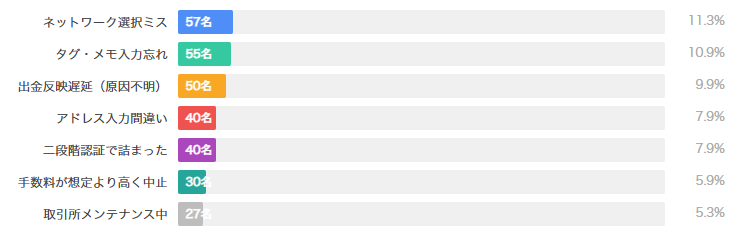
In a multiple-choice question, the most common cause of trouble was "choosing the wrong network," cited by 11.3% (57 respondents). This occurs when the same token exists on multiple blockchains — for example, USDT exists on Ethereum, TRON, and Polygon, among other chains — and a user selects the wrong chain, causing a mismatch between the sending and receiving chains that results in lost funds or a failed transfer.
Distribution of Exchanges Currently in Use
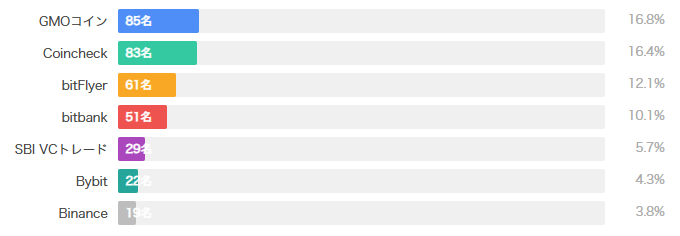
Respondents with transfer and withdrawal experience use a wide range of exchanges. GMO Coin (16.8%) and Coincheck (16.4%) are nearly tied for the top spot, showing that both platforms hold an equally strong position among active users who frequently send and withdraw funds.
What kinds of trouble are most common in your generation? The challenges people face vary by age group.
Trouble Rate Analysis by Generation
Does the trouble rate vary by generation? This survey also carried out a cross-tabulation analysis by generation.
Generation | Share | Respondents | Transfer/Withdrawal Rate | Trouble Rate |
|---|---|---|---|---|
Generation Y | 37.2% | 188 | 42% | 32% |
Ice Age Generation | 30.4% | 154 | 39% | 28% |
Generation Z | 13.4% | 68 | 35% | 25% |
Bubble & Shinjinrui Generations | 15.8% | 80 | 28% | 31% |
The Relationship Between Years of Investment Experience and Trouble
Is there any relationship between years of investment experience and trouble encountered? The survey results show a tendency for more experienced investors to avoid trouble, likely because security practices learned through experience — such as double-checking details and keeping records — become habitual over time.
Years of Experience | Respondents | Share |
|---|---|---|
Less than 1 year | 75 | 14.8% |
1–3 years | 65 | 12.8% |
3–5 years | 35 | 6.9% |
5+ years | 36 | 7.1% |
So how can you protect yourself from trouble? Let's look at concrete steps you can start practicing today.
A Practical Checklist for Preventing Trouble
This survey sheds light on what measures are effective for preventing trouble. Below is a practical checklist based on the survey results.
First, always double-check the address carefully.
Entering the address when sending a transfer is where mistakes happen most often.
- Avoid typing the address manually
- Use a QR code whenever possible
- Save the address to your address book and reuse it
- Always visually confirm the beginning and end of the address
"It's probably correct" is a dangerous assumption — make it a habit to check from scratch every time, and confirm all four of the points above as a set before sending a transfer.
Also, before pressing the send button, check the following four items.
- Address
- Chain (network)
- Token type
- Fee
Choosing the wrong network is a particularly common source of trouble.
Even tokens with the same name won't arrive if they're on the wrong chain.
It's also important to know how to respond if trouble does occur.
- Check your transaction history
- Keep a record of the transaction ID (TXID)
- Contact support as early as possible
- Familiarize yourself with the exchange's compensation policy in advance
Knowing the "what to do if" process in advance can significantly ease your anxiety.
Perceived Risk of Trouble vs. Actual Experience
The survey also asked respondents where they gather information. Social media (25.3%) was the most common source, followed by specialist media (20.8%) and official exchange channels (20.0%).
This suggests that users get information about trouble more from social media than from official channels. In other words, negative information — accounts of actual trouble — tends to spread easily on social media, and this shapes users' overall perception of risk.
Key Findings
This survey revealed that most trouble related to transfers and withdrawals stems from user error. At the same time, only 37.2% of the total sample has actually sent or withdrawn crypto assets — far from a majority even among people with investment experience.
So why do 18.0% of respondents with investment experience never send or withdraw crypto assets? Several reasons likely explain this.
First is the strategy of keeping assets on an exchange. Many investors complete all their trading on a single exchange rather than using multiple platforms. In this case, since there is no need to transfer funds externally, they may continue trading without ever experiencing a withdrawal.
Second is anxiety about trouble. Having heard of cases where address input errors led to lost funds, a certain proportion of people likely avoid sending transfers out of fear that "if I make a mistake, I can't get it back."
Third is the perception that the process is complicated. For beginners in particular, selecting a network or setting fees can feel difficult, which may lead to an "I don't really understand it, so I won't do it" mindset.
In other words, people who don't send or withdraw crypto assets aren't necessarily passive investors — it's more natural to see this as the result of overlapping feelings of "I don't need to," "it's scary," and "it seems difficult."
Summary
Sending and withdrawing funds are basic yet essential operations in crypto assets (also known as virtual currencies) investing. This survey found that 37.2% of respondents have experience sending or withdrawing crypto assets. At the same time, 29.0% of that group have experienced trouble, suggesting that many potential risks exist. The vast majority of these issues are user errors, such as choosing the wrong network (11.3%) and forgetting to enter a tag or memo (10.9%).
Much of this trouble can be prevented with prior knowledge. As this survey shows: "choosing the wrong network," "entering the wrong address," and "forgetting to enter a tag or memo."
All of these can be avoided if you know the correct procedure. Before your first transfer or withdrawal, make it a habit to send a small test amount first and to always copy and paste the destination address.
That's the simplest way to protect your valuable assets.
*All data in this article is based on the survey described above. Percentages are rounded to one decimal place.
This report is provided for informational purposes only and does not constitute a solicitation or recommendation for any investment. Crypto asset investing carries significant risk, and investment decisions should be made at your own responsibility. We provide no guarantee as to the accuracy, completeness, or usefulness of the content of this report. Please make your final investment decisions based on your own judgment and consult a professional as needed.
Additionally, Clabo Inc. offers consultations covering wallet recovery, security measures, asset protection procedures, and other crypto asset-related concerns.
If you have any concerns related to crypto assets, please feel free to use our free initial consultation service.
We can also advise on trouble such as scams, but please also consider using the public and government consultation services listed below.
Consult Clabo (free initial consultation): https://www.clabo-inc.co.jp/contact
Police Consultation Hotline (Japan): #9110
Consumer Hotline (Japan): 188
FSA Fraudulent Investment Consultation Line (Japan): 0570-050588
Survey Overview
Survey date: February 24, 2026
Survey method: Internet survey
Survey population: Men and women residing in Japan (people currently investing in crypto assets, or who have invested in the past)
Valid responses: 188
Conducted by: Clabo Inc.
Survey Questions
- Have you ever sent or withdrawn crypto assets (virtual currency)?
- How many years of experience do you have investing in crypto assets?
- What is your current total investment amount in crypto assets?
- What is your investment style?
- Which crypto asset exchanges do you currently use? (Select all that apply.)
- Have you ever experienced "trouble" or a "close call" when sending or withdrawing crypto assets?
- What were the causes of the trouble (or close call)? (Select all that apply.)
- If you had to choose the single most troublesome cause, which would it be?
- How did you ultimately respond when the trouble occurred?
- What do you find to be the "biggest challenge" with sending or withdrawing crypto assets?
- Where do you primarily gather information when researching how to send or withdraw crypto assets?
- In what situation did the trouble mainly occur?


