


Crypto asset (also known as virtual currency) investment styles broadly fall into two categories: "long-term holding" and "short-term trading." Long-term holding means keeping assets over time in anticipation of future price appreciation, while short-term trading involves buying and selling repeatedly in response to market movements.
Neither approach is inherently correct — the right method depends on an investor's goals, risk tolerance, and lifestyle. So which style do actual crypto investors choose, and why do they settle on it?
This article draws on an original survey of 505 people currently investing in crypto assets to analyze the breakdown of investment styles, the reasons behind them, experiences of switching styles, information sources, and sources of anxiety in detail.
Breakdown of Investment Styles: Long-Term Holding Leads at 56.0%, Short-Term Trading at 25.7%
Overall Distribution of Investment Styles
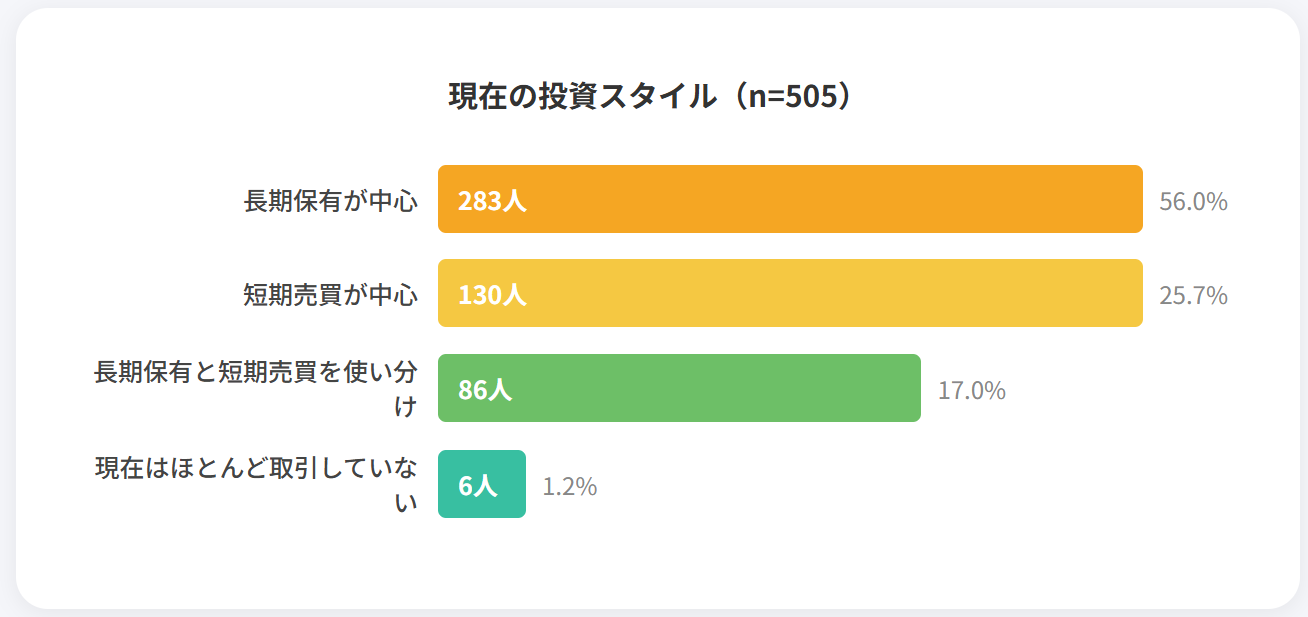
Asked about their current investment style, 283 respondents (56.0%) said "mainly long-term holding," making it the most common answer. This was followed by "mainly short-term trading" at 130 people (25.7%), "a mix of long-term holding and short-term trading" at 86 people (17.0%), and "currently trading very little" at 6 people (1.2%).
Investment Style | Respondents | Share |
|---|---|---|
Mainly long-term holding | 283 | 56.0% |
Mainly short-term trading | 130 | 25.7% |
Mix of long-term holding and short-term trading | 86 | 17.0% |
Currently trading very little | 6 | 1.2% |
More than half of crypto investors center their strategy on long-term holding, and when combined with those who mix long-term holding with other approaches, the figure reaches 73.1%. Crypto assets are known for high price volatility, yet most investors choose a medium- to long-term perspective over chasing short-term price movements.
Investment Style by Age Group: "Mixed Approach" Peaks at 22.5% Among People in Their 40s
By age group, long-term holding ranks first across every generation, though the share varies. People in their 20s show a high 58.4% for long-term holding, while those in their 40s show the highest rate of "mixed approach" across all age groups, at 22.5%.
Age Group | Long-Term Holding | Short-Term Trading | Mixed Approach |
|---|---|---|---|
20s | 58.4% | 26.4% | 14.4% |
30s | 56.8% | 25.7% | 15.5% |
40s | 51.2% | 25.6% | 22.5% |
50s | 55.4% | 27.0% | 16.2% |
60s and older | 62.1% | 24.1% | 13.8% |
People in their 40s tend to have accumulated experience in both their careers and investing, suggesting a tendency to adapt flexibly to circumstances rather than committing to a single fixed style.
The Larger the Investment Amount, the Higher the Share of "Mixed Approach"
Broken down by current investment amount, the share choosing a "mixed approach" rises markedly as the investment amount increases.
Current Investment Amount | Long-Term Holding | Short-Term Trading | Mixed Approach |
|---|---|---|---|
Under ¥10,000 (approx. $65) | 70.0% | 23.0% | 6.0% |
¥10,000–under ¥1,000,000 (approx. $65–$6,500) | 56.1% | 28.5% | 14.9% |
¥1,010,000–under ¥3,000,000 (approx. $6,600–$19,500) | 51.7% | 28.0% | 20.3% |
¥3,010,000–under ¥5,000,000 (approx. $19,600–$32,500) | 18.8% | 37.5% | 37.5% |
¥5,010,000 and above (approx. $32,600 and above) | 29.6% | 25.9% | 37.0% |
Among investors with holdings above ¥3,000,000 (approx. $19,500), the "mixed approach" reaches 37.5%, in some cases surpassing long-term holding. As the size of an investor's portfolio grows, the importance of risk management increases, making a diversified approach — rather than relying on a single style — more attractive.
Reasons for Choosing Long-Term Holding: "Building Future Wealth" and "Avoiding Risk" Are the Two Leading Motivations
Reasons for Investment Style (Analysis of Open-Ended Response Trends)
Asked in an open-ended format why they chose their investment style, respondents showed clear tendencies by style.
Among long-term holders, keywords related to long-term wealth building, such as "building future wealth" and "expecting growth over the long run," were the most common, accounting for 14.8% of all responses. This was followed by risk-averse and safety-oriented responses such as "less risk," "safe," and "stable," at 13.4%.
A certain number of respondents also cited the burden of time and effort as a reason, with comments such as "short-term trading is stressful," "I don't have time to watch it closely," and "I'm busy with work." Long-term holding appears to appeal to busy investors partly because it does not require following the market on a daily basis.
Among short-term traders, responses emphasizing the experience of trading itself, such as "it's fun" and "it's exciting," stood out, along with responses emphasizing immediacy, such as "I want to lock in profits right away" and "short-term moves are easier to predict."
Among respondents who mix both styles, diversification-oriented keywords such as "risk diversification," "balance," and "combining safety with profit" were prominent at 10.5%, reflecting a conscious effort to combine the merits of both approaches.
Summary of Reasons by Style
Investment Style | Main Reasons |
|---|---|
Long-term holding | Building future wealth (14.8%), risk aversion / safety orientation (13.4%), low time and effort required |
Short-term trading | Locking in profits quickly, enjoyment and excitement, short-term moves are easier to predict |
Mixed approach | Risk diversification (10.5%), combining safety with profit, flexible response |
61.4% Have Changed Their Style Before — 79.2% of Short-Term Traders Say They "Previously Used a Different Style"
Overall Trends in Style-Switching Experience
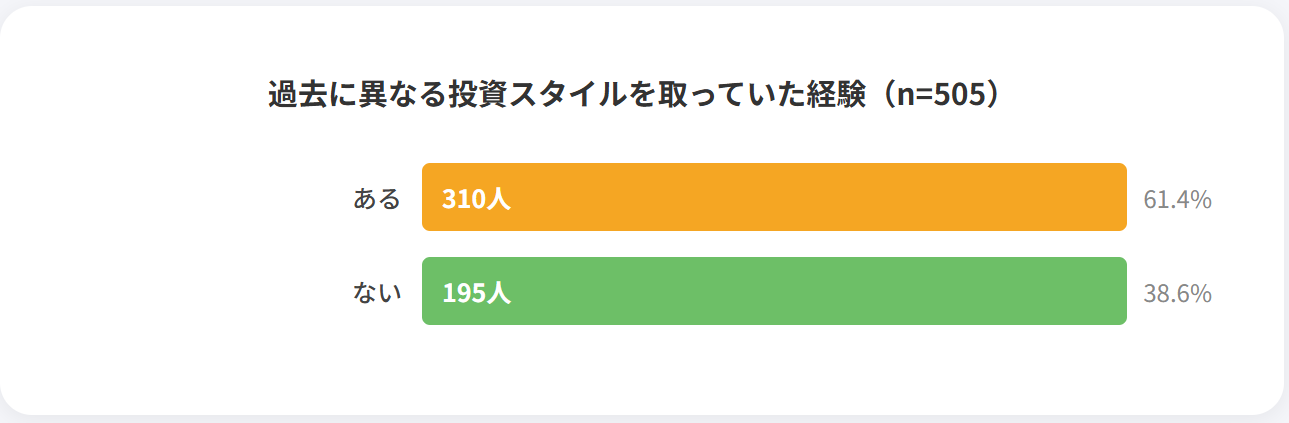
Asked whether they had previously used a different investment style than their current one, 310 people (61.4%) answered "yes." More than 60% of crypto investors have changed their investment style at some point while continuing to invest.
Style-Switching Experience | Respondents | Share |
|---|---|---|
Yes | 310 | 61.4% |
No | 195 | 38.6% |
Rate of Style-Switching Experience by Current Style
Broken down by style, short-term traders show a strikingly high rate of switching experience, at 79.2%.
Current Style | Has Switched Styles Before |
|---|---|
Mainly short-term trading | 79.2% |
Mixed approach | 68.6% |
Mainly long-term holding | 51.9% |
About 80% of short-term traders report that they "previously used a different style," showing that few investors start out as short-term traders from the beginning. This suggests that many investors transition to short-term trading only after first experiencing long-term holding or other styles.
Long-term holders, by contrast, show the lowest switching rate at 51.9%, meaning that roughly half of them chose long-term holding from the start and have stuck with it ever since.
Current Distribution Among Investors Who Have Switched Styles
Among the 310 respondents who have switched styles, 147 (47.4%) currently practice long-term holding, 103 (33.2%) short-term trading, and 59 (19.0%) a mixed approach.
Long-term holding is the most common outcome among those who switched styles, suggesting a pattern in which investors arrive at long-term holding after a period of trial and error.
Information Sources Vary Widely by Style: Long-Term Holders Rely on Social Media, Short-Term Traders on Experts and Analysis Articles
Overall Distribution of Information Sources (Multiple Answers Allowed)
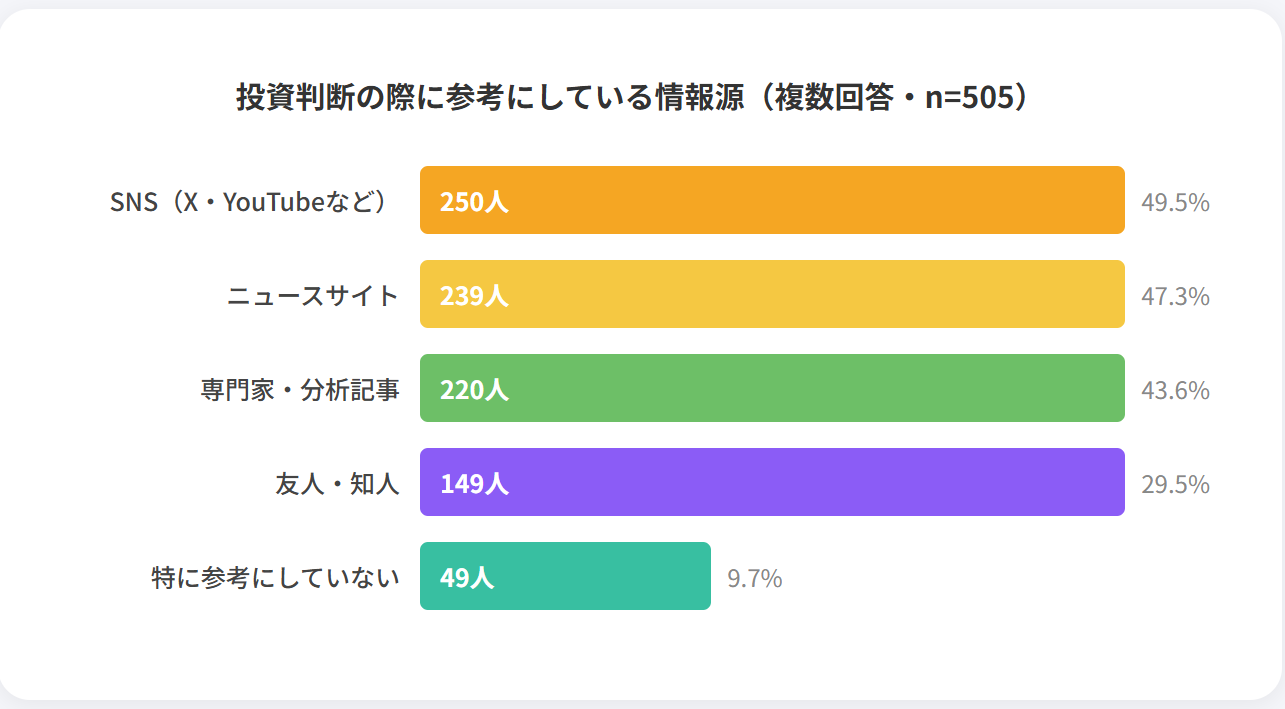
Asked which sources of information they reference when making investment decisions (multiple answers allowed), "social media (X, YouTube, etc.)" was the most common answer, cited by 250 people (49.5%).
Information Source | Respondents | Selection Rate |
|---|---|---|
Social media (X, YouTube, etc.) | 250 | 49.5% |
News sites | 239 | 47.3% |
Experts / analysis articles | 220 | 43.6% |
Friends / acquaintances | 149 | 29.5% |
Do not particularly reference any source | 49 | 9.7% |
Information Sources by Investment Style: Clear Differences Emerge
A cross-tabulation by investment style reveals marked differences in patterns of information-source use.
Information Source | Long-Term Holding | Short-Term Trading | Mixed Approach |
|---|---|---|---|
Social media (X, YouTube, etc.) | 62.2% | 20.0% | 53.5% |
News sites | 47.3% | 42.3% | 57.0% |
Experts / analysis articles | 37.5% | 44.6% | 64.0% |
Friends / acquaintances | 25.1% | 28.5% | 45.3% |
Do not particularly reference any source | 8.5% | 8.5% | 12.8% |
Most notably, there is a large gap in social media usage between long-term holders and short-term traders. Social media use is highest among long-term holders at 62.2%, compared with just 20.0% among short-term traders.
Among short-term traders, "experts / analysis articles" is the top source at 44.6%, indicating a tendency to rely on professional analysis when making trading decisions. Because timing precision directly affects returns in short-term trading, systematic analytical information appears to be valued more than the fragmented information typical of social media.
Investors who mix both styles show high usage rates across all information sources, with "experts / analysis articles" particularly prominent at 64.0%. This suggests they draw on a wide range of sources when making investment decisions.
Sources of Anxiety Also Vary by Style: Long-Term Holders Worry About Timing, Those Who Mix Styles Worry About Information Accuracy
Overall Trends in Sources of Anxiety (Multiple Answers Allowed)
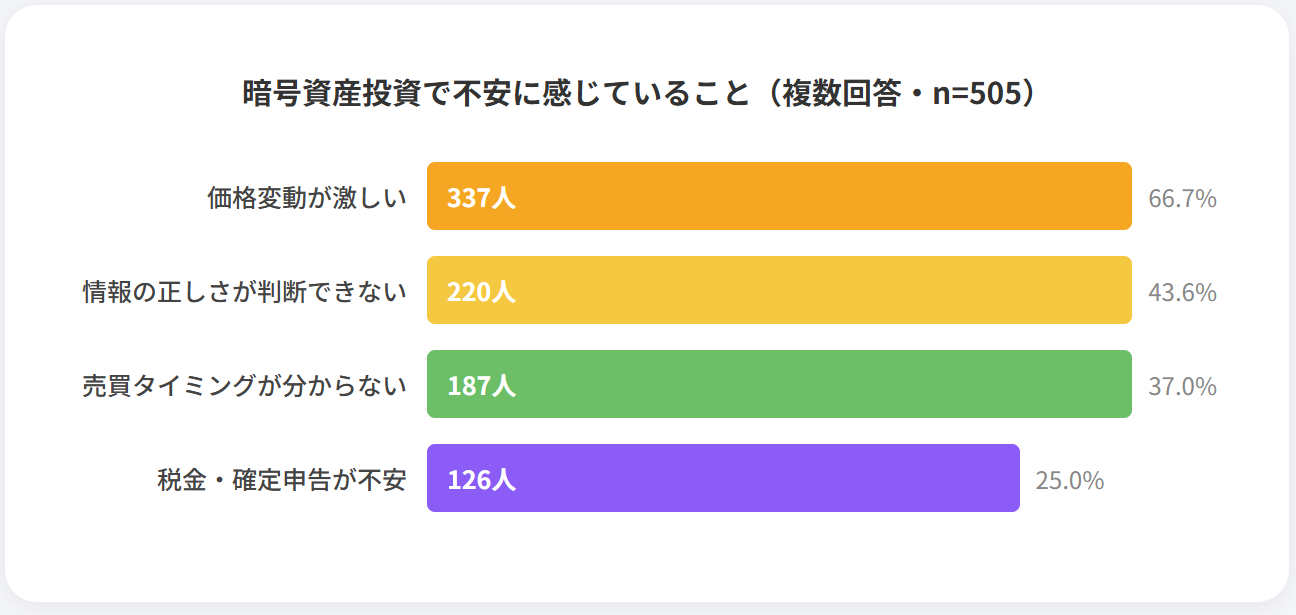
Asked what they find worrying about crypto asset investing (multiple answers allowed), "price volatility is severe" was the most common answer, cited by 337 people (66.7%).
Source of Anxiety | Respondents | Selection Rate |
|---|---|---|
Price volatility is severe | 337 | 66.7% |
Cannot judge whether information is accurate | 220 | 43.6% |
Don't know when to buy or sell | 187 | 37.0% |
Worried about taxes / tax filing | 126 | 25.0% |
Sources of Anxiety by Investment Style
A cross-tabulation by style reveals clear differences in the content of respondents' anxieties.
Source of Anxiety | Long-Term Holding | Short-Term Trading | Mixed Approach |
|---|---|---|---|
Price volatility is severe | 68.6% | 64.6% | 66.3% |
Don't know when to buy or sell | 43.1% | 19.2% | 44.2% |
Cannot judge whether information is accurate | 37.8% | 40.0% | 67.4% |
Worried about taxes / tax filing | 26.9% | 14.6% | 32.6% |
Among long-term holders, "don't know when to buy or sell" is high at 43.1%. This suggests that while they typically hold their assets, they feel uncertain about the exit decision — knowing when to sell.
Among short-term traders, "don't know when to buy or sell" is low at 19.2%, indicating a degree of confidence in timing decisions, while "cannot judge whether information is accurate" is notably high at 40.0%, reflecting persistent concern about the reliability of information.
Among those who mix styles, "cannot judge whether information is accurate" stands out at 67.4%. Drawing on multiple information sources may make it harder to reconcile contradictions and verify accuracy across sources.
Years of Experience and Investment Style: Among Investors With 5+ Years of Experience, 25.3% Use a Mixed Approach
Investment Styles Diversify With Greater Experience
Looking at investment style by years of experience, long-term holding ranks first across every experience band, but the share choosing a "mixed approach" rises as experience increases.
Years of Experience | Long-Term Holding | Short-Term Trading | Mixed Approach |
|---|---|---|---|
Under 1 year | 63.3% | 27.5% | 9.2% |
1–under 3 years | 50.7% | 28.6% | 19.7% |
3–under 5 years | 55.8% | 27.9% | 13.5% |
5 years or more | 54.4% | 19.0% | 25.3% |
Investors with under 1 year of experience show the highest rate of long-term holding, at 63.3%, suggesting that a "hold first and see" approach is common among those just starting out. Among investors with 5 or more years of experience, short-term trading falls to 19.0% while the mixed approach rises to 25.3%, indicating that more experienced investors increasingly combine multiple methods.
Relationship With Initial Investment Amount
Investors who started with a larger initial investment also tend to show a higher share of "mixed approach." Among those whose initial investment was ¥500,000 (approx. $3,250) or more, 26.7% chose a mixed approach, a marked difference from the 10.3% seen among those who started with under ¥10,000 (approx. $65).
Investors who start with a larger amount tend to be more risk-conscious from the outset and more inclined to incorporate multiple styles.
Conclusion: What the Survey Reveals About How Crypto Investors Choose Their Style
This survey yields the following key findings about the investment styles of crypto asset investors.
- Long-term holding is the most common style (56.0%). Including short-term trading (25.7%) and a mixed approach (17.0%), roughly three in four investors incorporate long-term holding into their investment strategy.
- The reasons for long-term holding are "building future wealth" and "avoiding risk." Short-term traders emphasize "enjoyment" and "immediacy," while those who mix styles consciously choose "risk diversification." The reasons behind an investor's style are closely tied to their investment goals and attitude toward risk.
- 61.4% have changed their style before. In particular, 79.2% of short-term traders report having "previously used a different style," showing that most investors arrive at their current style through trial and error.
- Information sources vary widely by style. Long-term holders rely most on social media (62.2%), while short-term traders rely most on experts and analysis articles (44.6%) — even within the same asset class, approaches to gathering information differ.
- The larger the investment amount, the more diversified the style. Among investors with holdings above ¥3,000,000 (approx. $19,500), the "mixed approach" reaches 37.5%, confirming a tendency to respond flexibly rather than commit to a single style.
Learning how other investors have made their choices — and why they settled on their current style — can be a useful reference for finding the approach that suits you. We hope the data in this survey helps inform your own thinking about investment style.
This report is intended for informational purposes only and does not constitute any form of investment solicitation or advice. Crypto asset investment carries significant risk, and investment decisions should be made at your own responsibility. We make no warranty as to the accuracy, completeness, or usefulness of the contents of this report. Please make final investment decisions based on your own judgment, and consult a professional as needed.
Survey Overview
Survey date: February 24, 2026
Survey method: Internet survey
Survey population: Men and women residing in Japan (people currently investing, or who have previously invested, in crypto assets)
Valid responses: 505
Conducted by: Clabo Inc.
Survey Questions
- Have you ever invested in crypto assets (virtual currency)?
- How many years of crypto asset investing experience do you have?
- What was your initial investment amount?
- What is your current crypto asset investment amount?
- Which option best describes your current main investment style?
- What is the main reason you chose that investment style?
- Have you previously used a different investment style than your current one?
- What information sources do you mainly reference when making investment decisions?
- What do you find worrying about crypto asset investing?
This article is for informational purposes only and does not constitute financial or investment advice. Please consult a qualified professional before making investment decisions.


