


People invest in crypto assets (also known as virtual currencies) for very different reasons. Some want to steadily build wealth for the future, others hope for a life-changing windfall, and still others are focused on generating efficient returns over a short time frame.
These differing goals shape the investment style investors choose, the information sources they rely on, and the anxieties they feel. So what purposes drive crypto investors, and how does that purpose shape their behavior?
This article analyzes the results of an original survey of 506 people who currently invest in crypto assets, breaking down differences in investment style, use of profits, information sources, and areas of concern by investment purpose.
Survey Overview
Item | Details |
|---|---|
Survey period | 2025 |
Survey population | Men and women aged 20+ nationwide (1,221 people) |
Valid responses | 506 (people currently investing in crypto assets) |
Survey method | Online survey |
Respondent gender | Male 68.8% / Female 31.2% |
Age breakdown | 20s 24.5%, 30s 29.4%, 40s 24.7%, 50s 15.2%, 60s+ 6.1% |

Clabo free membership
Add Clabo on LINE for 2 weeks of premium articles
You can also read premium articles on tax, transfers and more during the period.
- No credit card required
- No automatic charges after the trial ends
- Available once per account
Distribution of Investment Purposes: "Wealth Building" Leads at 52.8%, "Realizing a Dream" at 20.9%
Overall Distribution of Investment Purposes
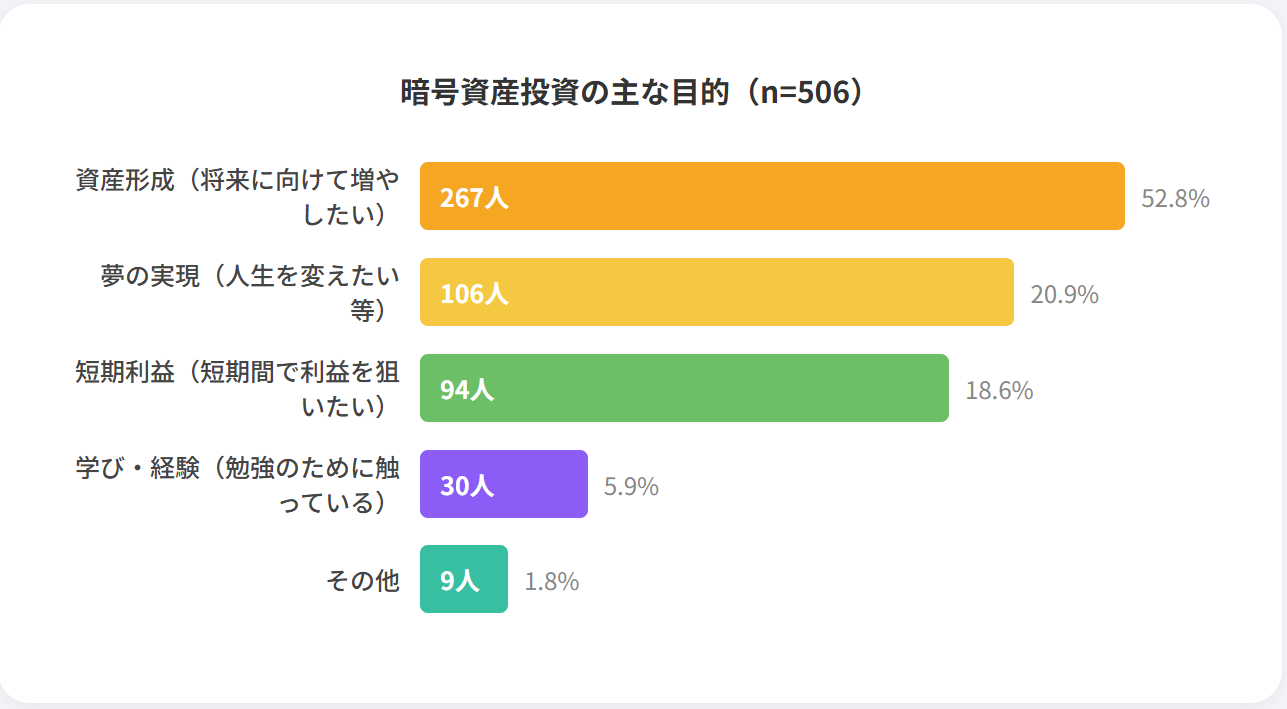
When asked their main purpose for investing in crypto assets, "wealth building (steadily growing assets for the future)" was the top answer, chosen by 267 people (52.8%). This was followed by "realizing a dream (making a life-changing gain)" with 106 people (20.9%), "short-term profit (aiming for gains over a short period)" with 94 people (18.6%), and "learning and experience" with 30 people (5.9%).
Investment Purpose | Respondents | Share |
|---|---|---|
Wealth building (growing assets for the future) | 267 | 52.8% |
Realizing a dream (life-changing gains, etc.) | 106 | 20.9% |
Short-term profit (aiming for gains quickly) | 94 | 18.6% |
Learning and experience (trying it out to learn) | 30 | 5.9% |
Other | 9 | 1.8% |
More than half of crypto investors cite "wealth building" as their purpose, showing that many approach crypto assets with a steady, long-term mindset. At the same time, "realizing a dream" and "short-term profit" together account for 39.5%, indicating that nearly four in ten investors are seeking more aggressive returns.
Investment Purpose by Age Group: "Realizing a Dream" Tops 52.9% for Those 70 and Older
By age group, "wealth building" was the top answer across every bracket from people in their 20s to those in their 50s, ranging from 52% to 56%. Among those aged 70 and older, however, "realizing a dream" stood out sharply at 52.9%, far exceeding "wealth building" at 23.5%.
Age Group | Wealth Building | Realizing a Dream | Short-term Profit | Learning & Experience |
|---|---|---|---|---|
20s | 53.2% | 20.2% | 21.8% | 3.2% |
30s | 52.3% | 22.1% | 14.8% | 10.1% |
40s | 56.0% | 16.0% | 20.0% | 4.0% |
50s | 55.8% | 18.2% | 20.8% | 3.9% |
60s | 42.9% | 42.9% | 14.3% | 0.0% |
70+ | 23.5% | 52.9% | 23.5% | 0.0% |
Investors in their 60s and older appear more likely to choose "realizing a dream" over "wealth building" as their investment purpose, likely reflecting post-retirement life planning and expectations for their second act in life.
Differences by Gender
No major differences were observed by gender, with "wealth building" the top answer for both men (52.0%) and women (54.4%). "Realizing a dream" was chosen by 22.1% of men and 19.0% of women, and "short-term profit" by 18.7% of men and 18.4% of women — almost no gender gap was found in the distribution of investment purposes.
Investment Style by Purpose: 75.5% of "Realizing a Dream" Investors Hold Long-Term
The Relationship Between Investment Purpose and Style
Cross-tabulating investment purpose against investment style shows that style choices differ clearly depending on purpose.
Investment Purpose | Long-term Holding | Short-term Trading | Mix of Both |
|---|---|---|---|
Wealth building | 63.7% | 19.5% | 15.0% |
Realizing a dream | 75.5% | 13.2% | 9.4% |
Short-term profit | 18.1% | 63.8% | 14.9% |
75.5% of investors in the "realizing a dream" group choose long-term holding, the highest rate among all purposes. This shows that investors with the big goal of "changing their life" tend to choose a strategy of waiting for large long-term returns rather than short-term trading.
63.7% of the "wealth building" group also choose long-term holding, consistent with a steady, accumulation-style approach to investing.
By contrast, 63.8% of the "short-term profit" group choose short-term trading, a direct link between purpose and style. The long-term holding rate for this group is just 18.1%, showing that their approach to investing is fundamentally different from investors with other purposes.
Clear Differences in How Profits Are Used by Purpose: 31.1% of "Realizing a Dream" Investors Cover Living Expenses
Overall Distribution of How Profits Are Used
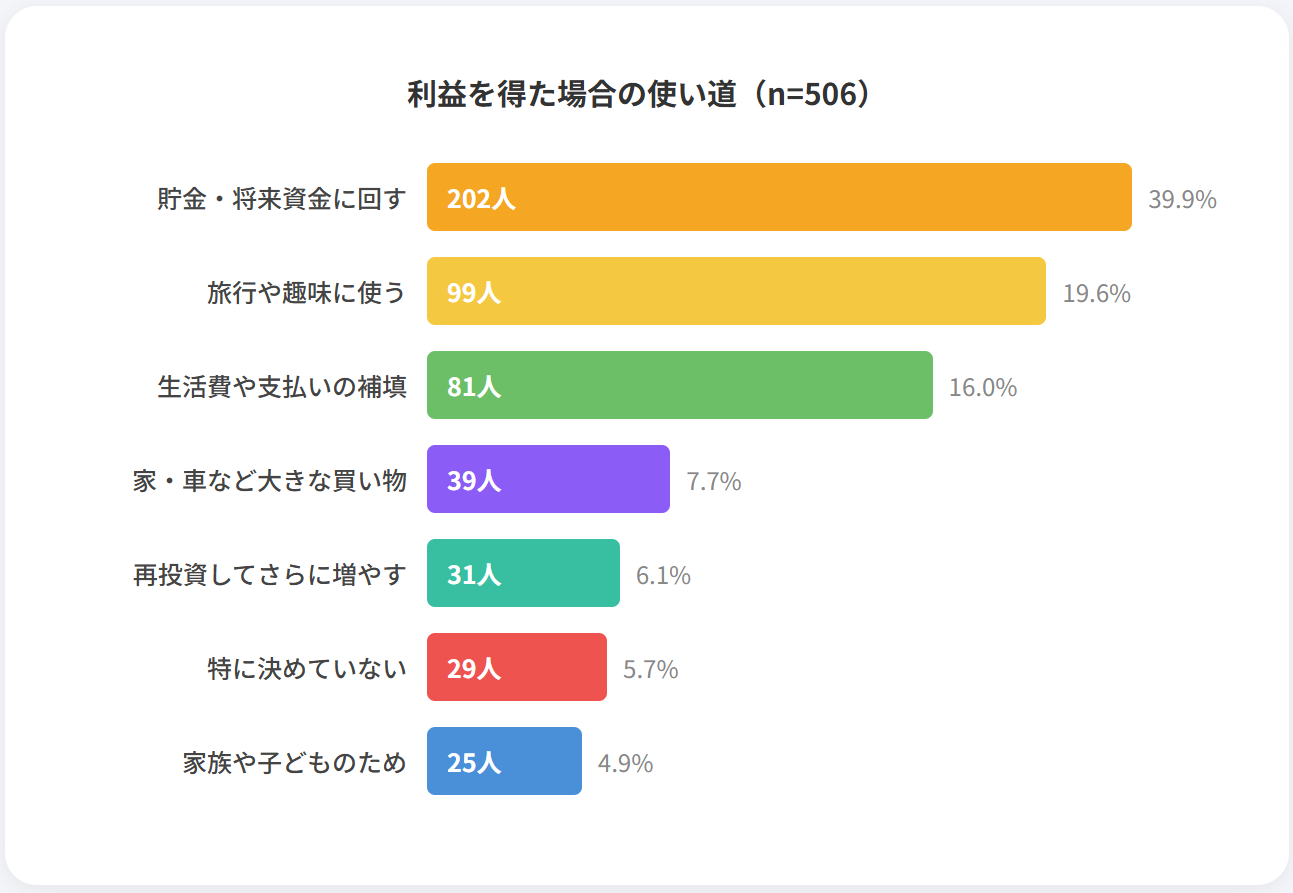
Asked what they would do with profits, "put it toward savings or future funds" was the top answer, chosen by 202 people (39.9%). This was followed by "spend it on travel or hobbies" with 99 people (19.6%) and "cover living expenses or bills" with 81 people (16.0%).
Use of Profits | Respondents | Share |
|---|---|---|
Save it / put toward future funds | 202 | 39.9% |
Spend on travel or hobbies | 99 | 19.6% |
Cover living expenses or bills | 81 | 16.0% |
Big purchases (home, car, etc.) | 39 | 7.7% |
Reinvest to grow it further | 31 | 6.1% |
Haven't decided | 29 | 5.7% |
For family or children | 25 | 4.9% |
How Profits Are Used, by Investment Purpose
Cross-tabulating by investment purpose reveals clear differences in how profits are used.
The wealth-building group overwhelmingly favors "saving it for the future" at 48.3%, clearly showing a preference for putting profits back into savings rather than spending them. "Spending on travel or hobbies" is limited to 17.6%.
The "realizing a dream" group also ranks "saving for the future" highest at 41.5%, but "covering living expenses or bills" comes in second at 31.1%. This 31.1% figure stands out sharply compared with the wealth-building group (13.1%) and the short-term profit group (10.6%).
It is notable that about three in ten investors who want to "change their life" plan to use profits to cover living expenses. This suggests they may be facing financial difficulties in their current lives and view crypto investing as one way to address them.
The short-term profit group ranks "spending on travel or hobbies" highest at 33.0%, clearly favoring using profits for their own experiences and enjoyment. "Big purchases such as a home or car" was also higher for this group than for others, at 16.0%.
Use of Profits | Wealth Building | Realizing a Dream | Short-term Profit |
|---|---|---|---|
Savings / future funds | 48.3% | 41.5% | 22.3% |
Travel or hobbies | 17.6% | 15.1% | 33.0% |
Covering living expenses | 13.1% | 31.1% | 10.6% |
Home, car, etc. | 6.0% | 5.7% | 16.0% |
Reinvestment | 6.7% | 2.8% | 4.3% |
Information Sources Vary Widely by Investment Purpose: Short-term Profit Group's SNS Usage Low at 22.3%
Overall Distribution of Information Sources (Multiple Answers)
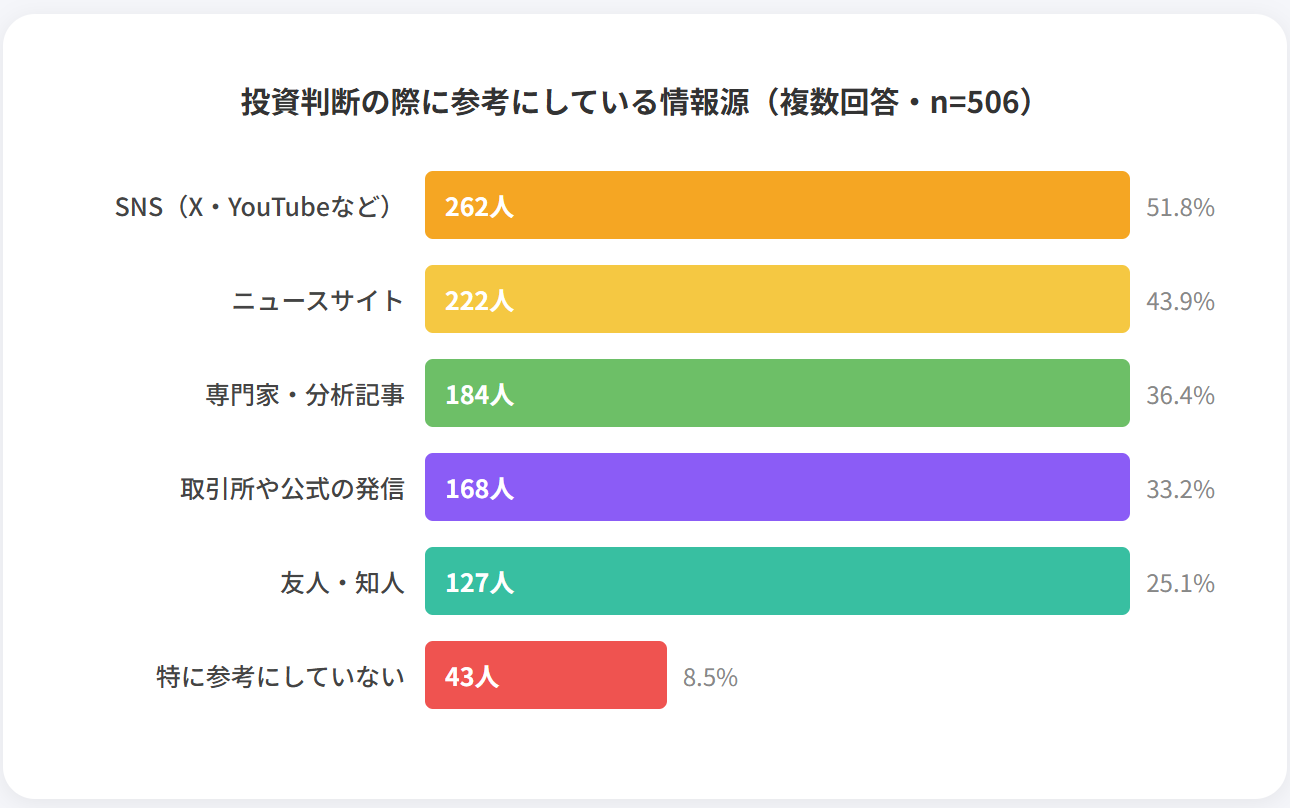
Asked what information sources they use for investment decisions, "SNS (X, YouTube, etc.)" was the top answer, cited by 262 people (51.8%).
Information Source | Respondents | Selection Rate |
|---|---|---|
SNS (X, YouTube, etc.) | 262 | 51.8% |
News sites | 222 | 43.9% |
Expert commentary / analysis articles | 184 | 36.4% |
Exchange or official announcements | 168 | 33.2% |
Friends and acquaintances | 127 | 25.1% |
Don't rely on any particular source | 43 | 8.5% |
Information Sources by Investment Purpose: The Short-term Profit Group Stands Apart
Cross-tabulating by investment purpose confirms that the short-term profit group's information sources differ sharply from the others.
Information Source | Wealth Building | Realizing a Dream | Short-term Profit |
|---|---|---|---|
SNS | 60.3% | 61.3% | 22.3% |
News sites | 46.4% | 55.7% | 29.8% |
Exchange or official announcements | 34.1% | 29.2% | 39.4% |
Expert commentary / analysis articles | 37.8% | 32.1% | 41.5% |
Friends and acquaintances | 27.7% | 19.8% | 27.7% |
Don't rely on any particular source | 4.5% | 5.7% | 13.8% |
Both the "wealth building" and "realizing a dream" groups rank SNS highest, at over 60%. For investors with a long-term perspective, SNS likely functions as a way to track market trends and buzz around specific tokens.
By contrast, SNS usage is far lower among the "short-term profit" group at 22.3%, with "expert commentary and analysis articles" (41.5%) and "exchange or official announcements" (39.4%) ranking higher instead. Because timing accuracy is directly tied to returns in short-term trading, this group appears to place greater weight on sources with rigorous analysis over the fragmented information typical of SNS.
Another notable feature is that "don't rely on any particular source" is relatively high among the short-term profit group at 13.8%. This suggests a meaningful segment of confident short-term traders who make decisions based solely on their own analysis.
Concerns Also Differ by Investment Purpose: Taxes Worry the Wealth-Building Group, While the Short-term Profit Group Reports Fewer Concerns
Overall Trends in Investor Concerns (Multiple Answers)
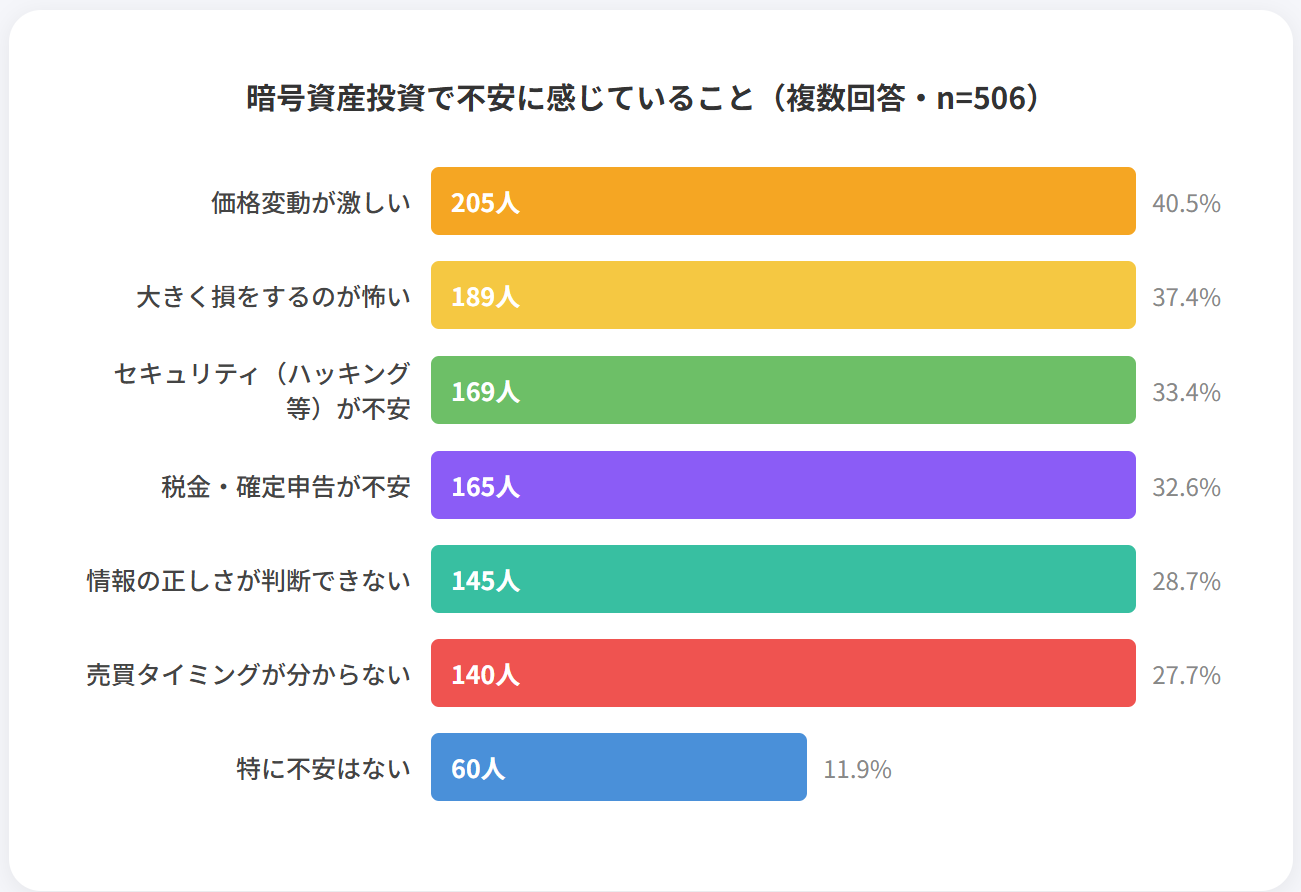
Asked (with multiple answers allowed) what concerns them about crypto investing, "sharp price volatility" was the top answer, cited by 205 people (40.5%).
Concern | Respondents | Selection Rate |
|---|---|---|
Sharp price volatility | 205 | 40.5% |
Fear of large losses | 189 | 37.4% |
Security concerns (hacking, etc.) | 169 | 33.4% |
Concerns about taxes and tax filing | 165 | 32.6% |
Difficulty judging whether information is accurate | 145 | 28.7% |
Not knowing the right timing to buy or sell | 140 | 27.7% |
No particular concerns | 60 | 11.9% |
Concerns by Investment Purpose
Cross-tabulating by purpose reveals marked differences in the nature of investors' concerns.
Concern | Wealth Building | Realizing a Dream | Short-term Profit |
|---|---|---|---|
Sharp price volatility | 46.4% | 41.5% | 27.7% |
Fear of large losses | 37.8% | 38.7% | 35.1% |
Security concerns | 36.7% | 34.0% | 29.8% |
Concerns about taxes and filing | 36.3% | 37.7% | 21.3% |
Difficulty judging accuracy of information | 33.3% | 28.3% | 14.9% |
Not knowing buy/sell timing | 27.7% | 31.1% | 23.4% |
No particular concerns | 10.1% | 7.5% | 18.1% |
The "wealth building" group reports high concern levels across the board, with "price volatility" (46.4%) and "taxes and tax filing" (36.3%) especially prominent. This likely reflects a strong desire to protect assets over the long term, which heightens concern about downside price risk and tax handling.
The "realizing a dream" group ranks "fear of large losses" highest at 38.7%, with "taxes and tax filing" also elevated at 37.7%. This reveals an ambivalent psychology: investors hoping for large returns while simultaneously fearing large losses.
The "short-term profit" group reports lower concern levels overall, with "no particular concerns" at 18.1% — roughly double the rate of the other groups. This may reflect confidence among experienced short-term traders that they can control risk themselves. However, the low 14.9% figure for "difficulty judging whether information is accurate" could also indicate lower sensitivity to information accuracy, so this should not necessarily be read as a positive sign.
Years of Experience and Investment Amount: The Short-term Profit Group Peaks at 1–3 Years (54.3%), With ¥1.01–3 Million Most Common
Investment Purpose by Years of Experience
Looking at investment purpose by years of experience, the "short-term profit" group stands out with 54.3% having 1 to under 3 years of experience. The "realizing a dream" group, meanwhile, shows a polarized pattern, with 35.8% having under 1 year of experience and 22.6% having 5 or more years — concentrated at both the least- and most-experienced ends.
Investment Purpose | Under 1 Year | 1–3 Years | 3–5 Years | 5+ Years |
|---|---|---|---|---|
Wealth building | 16.9% | 43.8% | 22.8% | 16.5% |
Realizing a dream | 35.8% | 32.1% | 9.4% | 22.6% |
Short-term profit | 18.1% | 54.3% | 20.2% | 7.4% |
Only 7.4% of the "short-term profit" group has 5 or more years of experience. This suggests that few investors continue short-term trading over the long haul, and that many likely shift to other styles — or stop investing altogether — as they gain experience.
Current Investment Amount
Looking at current investment amounts by purpose, the "short-term profit" group stands out with 59.6% holding ¥1.01–3 million (roughly $6,700–$20,000). This likely reflects the fact that short-term trading requires a certain amount of capital to generate meaningful profit.
For the "wealth building" group, "under ¥1 million" (roughly under $6,700) is the most common range at 40.8%, suggesting many investors in this group invest within a comfortable, sustainable range. For the "realizing a dream" group, "under ¥10,000" (roughly under $70) is highest at 31.1%, indicating a meaningful number of investors hoping to hit it big with a small stake.
Conclusion: Investment Purpose Shapes Investment Behavior
This survey's results yield the following key findings on the relationship between crypto investors' purposes and their behavior.
- "Wealth building" is the leading investment purpose (52.8%). However, "realizing a dream" (20.9%) and "short-term profit" (18.6%) together approach four in ten, showing that a large segment also seeks aggressive returns from crypto assets.
- Investment purpose and investment style are strongly linked. 75.5% of the "realizing a dream" group choose long-term holding, while 63.8% of the "short-term profit" group choose short-term trading — a clear relationship in which purpose determines style.
- How profits are used reflects investors' financial circumstances. 31.1% of the "realizing a dream" group intend to use profits to cover living expenses — more than double the rate for other purposes. This suggests that investors' current living circumstances may influence their motivation to invest in crypto assets.
- Information sources clearly differ by investment purpose. SNS usage exceeds 60% for both the "wealth building" and "realizing a dream" groups, while the "short-term profit" group emphasizes expert commentary and exchange announcements. The quality of information investors seek for decision-making changes with their purpose.
- The degree of concern also varies by purpose. The "short-term profit" group reports the highest rate of "no particular concerns" at 18.1%, while the "realizing a dream" group shows hope and fear coexisting. The "wealth building" group shows pronounced concern about taxes and price volatility.
The optimal approach to crypto investing differs depending on one's purpose. It is important to clarify why you are investing and to choose an investment style, information sources, and risk management approach that fit that purpose.
Disclaimer
This article is intended for informational purposes only and does not constitute a solicitation to invest. Trading crypto assets carries various risks, including price volatility. Please make any final investment decisions at your own responsibility.
For tax matters, we recommend consulting a licensed tax accountant regarding your individual circumstances.
Past price performance does not guarantee future returns.
This article is for informational purposes only and does not constitute financial or investment advice. Please consult a qualified professional before making investment decisions.
Survey Overview
Survey date: February 24, 2026
Survey method: Online survey
Survey population: Men and women residing in Japan (people currently investing, or who have previously invested, in crypto assets)
Valid responses: 506
Conducted by: Clabo Inc.
Survey Questions
- Have you ever invested in crypto assets (virtual currencies)?
- How many years of experience do you have investing in crypto assets?
- What was your initial investment amount?
- What is your current investment amount in crypto assets?
- Which of the following best describes your main purpose for investing in crypto assets? (Choose one.)
- Which best describes your current primary investment style?
- What is your main reason for choosing that investment style?
- If you earn a profit, how would you like to use it (or how do you plan to use it)?
- What information sources do you mainly refer to when making investment decisions?
- What concerns do you have about investing in crypto assets?


