


The trigger that makes someone decide, "I need to buy a hardware wallet," varies from person to person.
Some investors only start considering one in a panic after their holdings grow, while others act immediately after seeing news of losses suffered by other people.
A survey of people with experience in crypto assets (also known as virtual currencies) found that hardware wallet (HW) ownership had reached 55.9%.
When HW owners among the 417 respondents were asked what drove their purchase decision, the most common answer, cited by 38.1%, was "I was worried about security," revealing that a vague sense of unease is the single strongest driver of purchase behavior.
A cross-analysis by holdings, age group, and investment style further clarified exactly who does and does not own an HW.
One especially notable finding is the generational gap: ownership among people in their 20s or younger tops all age groups at 78.5%, while it falls to just 35.0% among those in their 50s.
This article uses the raw survey data to unpack the real motivations behind HW purchases and the line that separates owners from non-owners.
Use it as a benchmark to judge whether you yourself are an investor who should own one.
The Reality of HW Purchases: 38.1% of Owners Bought Due to "Security Fears"
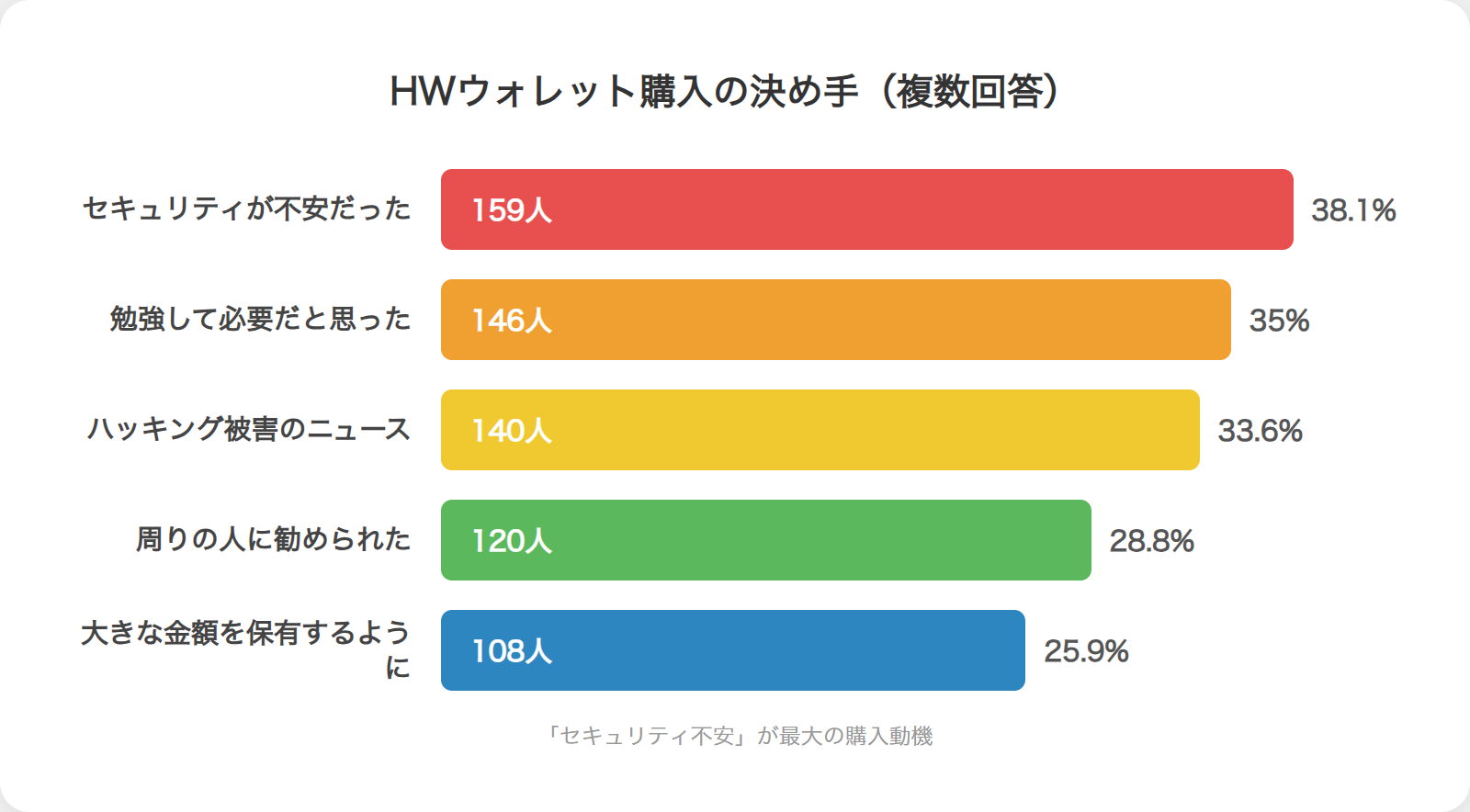
Reason for Purchase | Responses | Share |
|---|---|---|
I was worried about security | 159 | 38.1% |
I studied the topic and decided it was necessary | 146 | 35.0% |
I saw news of hacking incidents | 140 | 33.6% |
Someone around me recommended it | 120 | 28.8% |
My holdings grew to a large amount | 108 | 25.9% |
"I Was Worried About Security" (38.1%): Vague Unease Is the Biggest Motivator
When the 417 investors who purchased a hardware wallet were asked what drove their decision, the top answer, at 38.1%, was "I was worried about security."
The fact that a "vague sense of unease," rather than any specific loss experience, is the strongest driver of purchase behavior is emblematic of the psychology of crypto asset investors.
Anyone who participates in the market has, at some point, wondered whether it's really safe to leave assets sitting on an exchange, or whether the risk of a hack or exchange failure could happen to them too.
The data suggests that a hardware wallet is being chosen as the ultimate solution to resolve that anxiety.
The simple motive of "buying because you're worried" may in fact be the healthiest reason of all.
Investors who sense a risk and act before it materializes, rather than scrambling after a loss occurs, are more likely to protect their assets successfully over the long term.
"I Studied the Topic and Decided It Was Necessary" (35.0%): The Knowledge-Driven Buyer Segment
The second most common motivation, at 35.0%, was "I studied the topic and decided it was necessary."
One in three HW owners falls into this group: people who gathered information from books, online articles, and communities, came to understand the need for a hardware wallet on their own, and then bought one.
This group is distinguished by making decisions grounded in technical understanding rather than being swept along by anxiety or trends.
Having grasped the principles of managing public and private keys, as well as the difference between a cold wallet and a hot wallet, they actively choose the tool that fits their own needs.
In crypto asset investing, this "knowledge-driven" approach is the most reliably repeatable form of defense.
Investors who don't stop at absorbing information but actually apply it to their own setup are the ones equipped to survive in the market over the long haul.
"News of Hacking Incidents" (33.6%): Buying Triggered by Other People's Losses
The third-place answer, "I saw news of hacking incidents" at 33.6%, shows how industry-wide events directly influence individual investment behavior.
News of exchange breaches or a prominent influencer's wallet being hijacked is not treated as someone else's problem by investors — it's taken personally.
"Someone around me recommended it" (28.8%) and "My holdings grew to a large amount" (25.9%) also ranked highly.
A certain number of cases show that personal networks and concrete life events, such as a jump in the size of one's holdings, act as the trigger for adopting an HW.
Whether or not you can act the moment you encounter news of a breach is a turning point that significantly separates strong asset protection from weak protection going forward.
Investors who put off buying with a "someday" mindset and investors who order one the instant they see the news carry fundamentally different levels of risk, even within the same market.
¥500,000 in Holdings Is the Tipping Point: 21.3% Ownership Under ¥10,000 vs. 74.5% Above ¥500,000
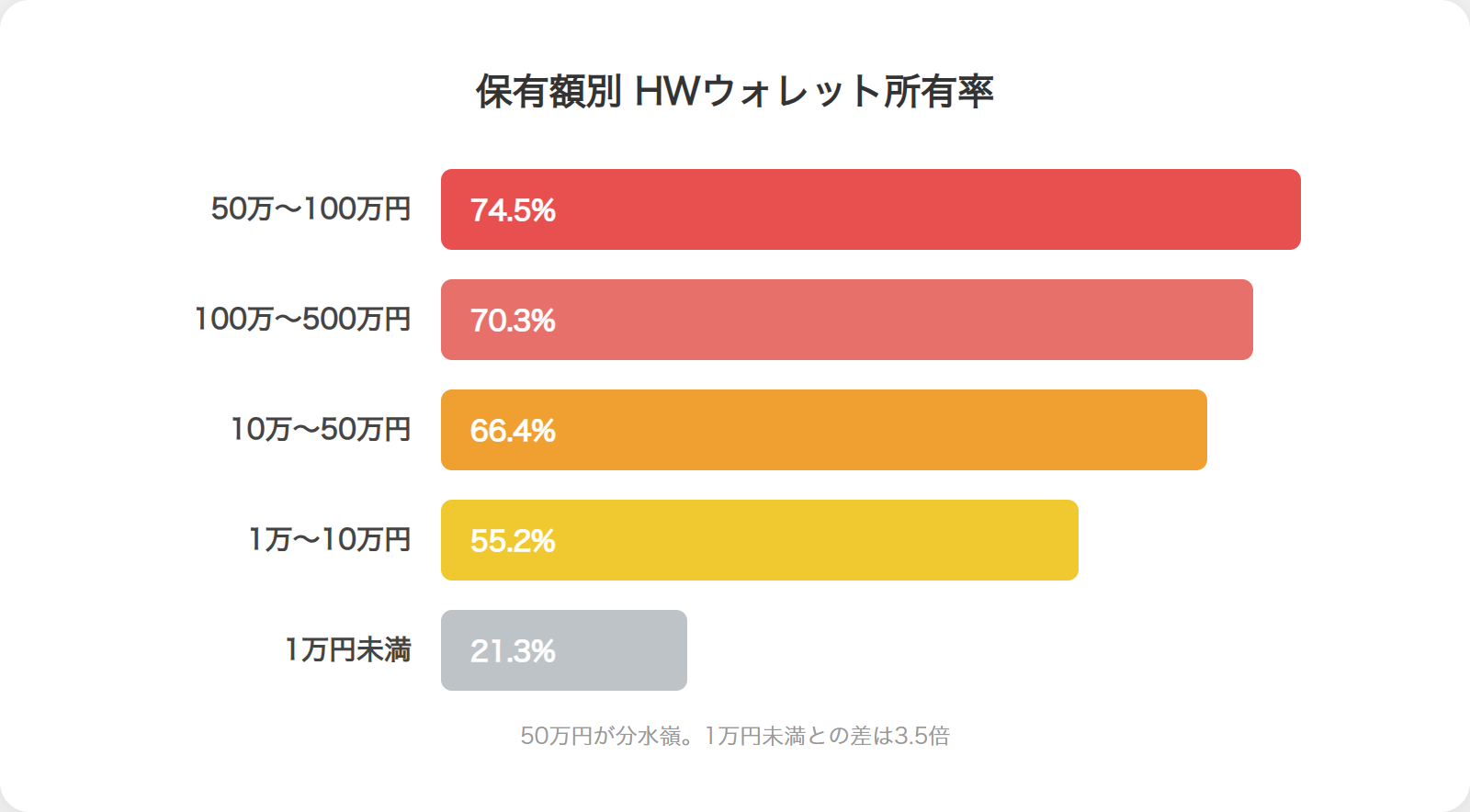
Holdings | n | HW Ownership Rate |
|---|---|---|
Under ¥10,000 | 155 | 21.3% |
¥10,000–under ¥100,000 | 203 | 55.2% |
¥100,000–under ¥500,000 | 152 | 66.4% |
¥500,000–under ¥1,000,000 | 137 | 74.5% |
¥1,000,000–under ¥5,000,000 | 74 | 70.3% |
21.3% Ownership Among Investors Under ¥10,000: Weak Defenses for Small Investors
Looking at HW ownership rates by holdings, the under-¥10,000 tier came in at just 21.3%, overwhelmingly lower than every other holdings bracket.
That works out to only one in five people in this tier owning a hardware wallet, exposing just how thin the defenses of small-scale investors really are.
Behind the decision to skip a purchase likely lies a kind of economic rationality: "it's such a small amount that it wouldn't hurt to lose it" or "buying an HW would actually cost more than the assets themselves."
It's understandable that some investors would judge a device costing tens of thousands of yen to be poor value against holdings worth only a few thousand yen.
What tends to get overlooked here, however, is the question of whether your defenses will already be in place once your assets grow.
Rather than scrambling to buy an HW after your holdings have grown ten- or a hundred-fold, building it into your practice while your assets are still small is arguably the right path for a long-term investor.
Ownership Peaks at 74.5% in the ¥500,000–1,000,000 Tier: The Psychological Threshold of "An Amount Worth Protecting"
HW ownership peaks in the ¥500,000–under-¥1,000,000 tier, hitting a high of 74.5%.
That is 3.5 times the rate seen in the under-¥10,000 tier, suggesting that "an amount worth protecting" functions as a psychological threshold for investors.
For many individual investors, ¥500,000 marks the line beyond which losing the money would affect their daily life, and security awareness tends to jump sharply once holdings cross this threshold.
It also appears to line up with the point at which investors start seriously weighing risks such as unauthorized exchange access or suspended withdrawals.
What's interesting is that ownership dips slightly once holdings exceed ¥1,000,000, falling to 70.3% in the ¥1,000,000–5,000,000 tier.
Investors in this bracket may be using multiple hardware wallets or hedging risk through distributed management, suggesting a management strategy that can't be captured by a simple yes-or-no ownership question.
78.5% Ownership Among People in Their 20s or Younger: The Surprising Truth Behind the Generational Gap
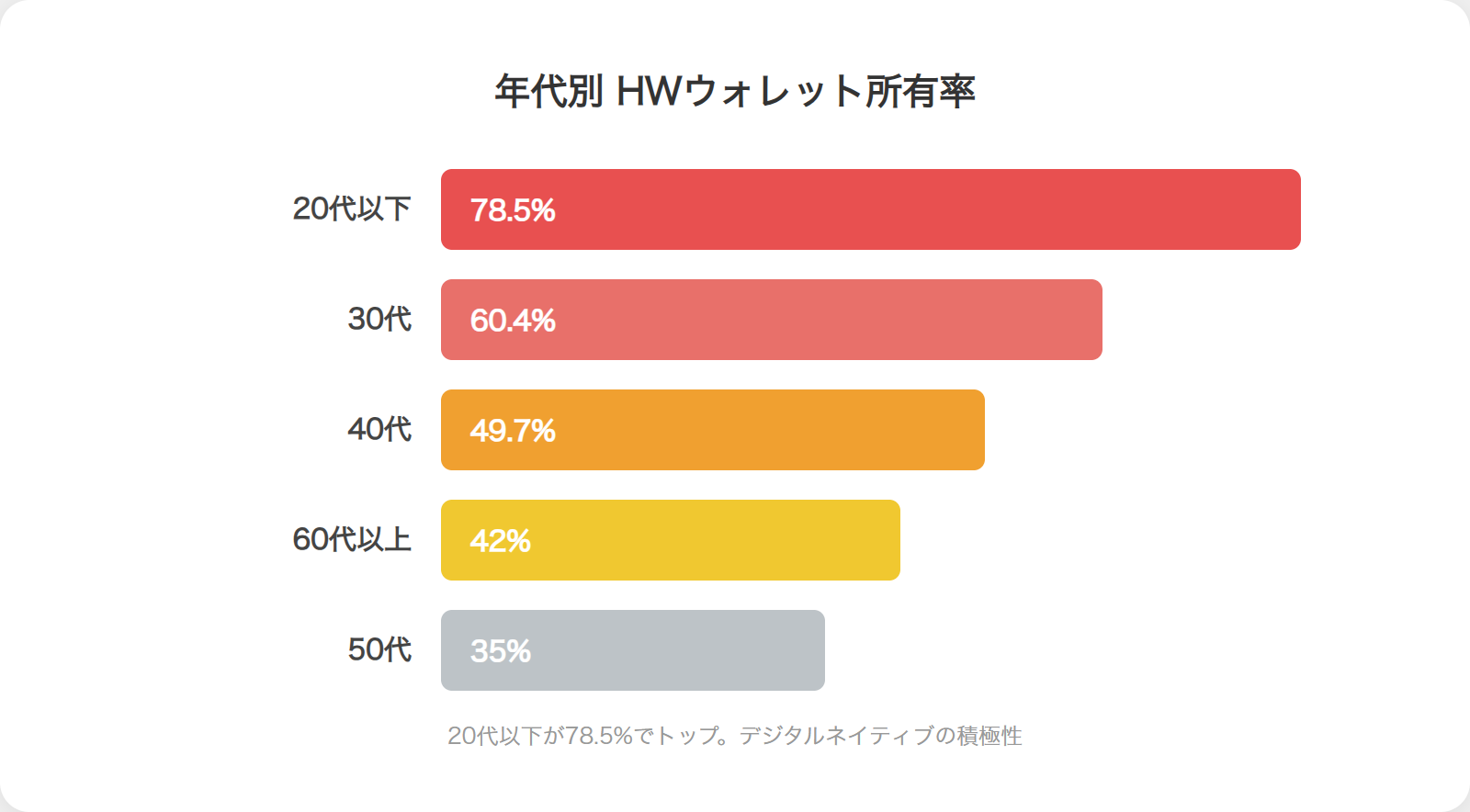
Age Group | n | HW Ownership Rate |
|---|---|---|
20s or younger | 163 | 78.5% |
30s | 207 | 60.4% |
40s | 187 | 49.7% |
50s | 120 | 35.0% |
60s or older | 69 | 42.0% |
20s or Younger Lead at 78.5%: The Proactive Digital-Native Generation
Cross-tabulating by age group shows that HW ownership among people in their 20s or younger tops every other age group at 78.5%.
That means more than three in four people in this group own a physical security device — a picture that runs counter to the common assumption, showing that the psychological barrier to owning a hardware wallet is actually lower among younger investors.
Because this generation is exposed to crypto asset information on social media and YouTube as a matter of daily routine, awareness of hardware wallets and how to use them likely comes naturally.
A high sensitivity to information and the ability to keep up with the latest security trends appear to be factors driving HW adoption.
In addition, younger investors tend to be less likely to feel the psychological hurdle of thinking "the setup looks complicated."
Because they're accustomed to setting up smartphones and various apps, they can approach the initial HW setup with an "I'll figure it out as I go" mindset — a factor that appears to directly translate into higher ownership.
35.0% Ownership Among People in Their 50s: The Flip Side of Caution in Older Investors
By contrast, HW ownership among people in their 50s came in at just 35.0%, the worst figure of any age group.
That's more than double the gap versus people in their 20s or younger, revealing a fundamentally different approach to hardware wallets across generations.
People in their 50s are, notably, an age group where a growing number are turning to crypto assets as a place to invest retirement payouts or funds for old age.
The fact that a physical safeguard like a hardware wallet has yet to take hold among them is nonetheless an issue the industry as a whole should address.
One likely factor behind this is a sense of resistance toward HW setup procedures and English-language interfaces.
It's also plausible that a cautious mindset — worrying about losing access to their assets if something goes wrong — is paradoxically what delays the adoption of protective measures.
The fact that people 60 and older show a higher ownership rate than those in their 50s, at 42.0%, also suggests that age alone doesn't fully explain the pattern — differences in each generation's channels for accessing information appear to play a role as well.
Investment Style Divides HW Ownership: "Both" Style at 71.3% vs. "HODL" Style at 46.9%
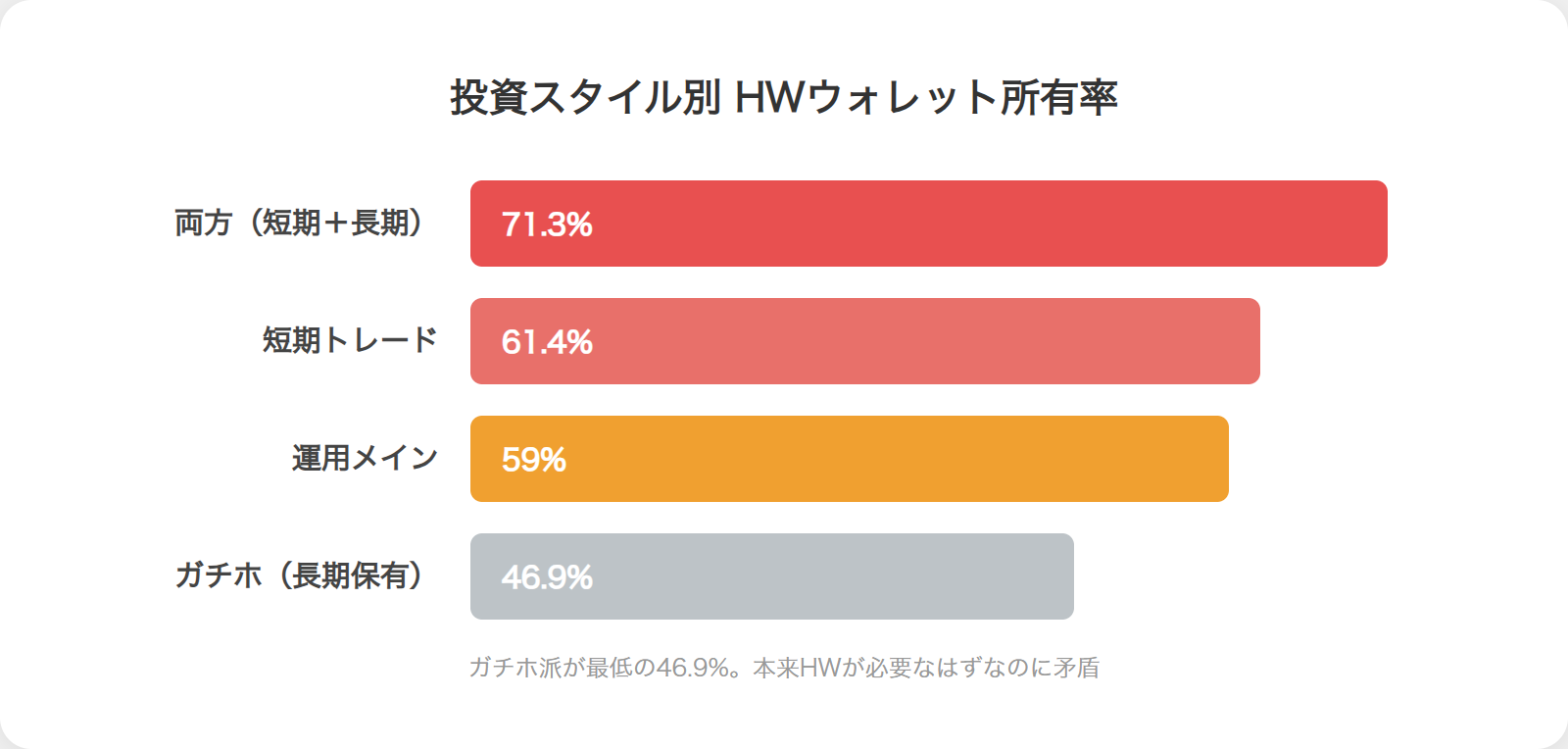
Investment Style | n | HW Ownership Rate |
|---|---|---|
Both (short-term + long-term) | 178 | 71.3% |
Short-term trading | 210 | 61.4% |
Mainly yield strategies (e.g., staking) | 78 | 59.0% |
HODL (long-term holding) | 226 | 46.9% |
"Both" Style Highest at 71.3%: The More Multifaceted the Strategy, the More an HW Is Needed
Looking at investment styles, HW ownership was highest among the "both" group — those who combine short-term trading with long-term holding — at 71.3%.
Investors who use multiple strategies at once tend to hold more tokens and more exchange accounts, and their security risk expands in proportion.
The "both" group needs to physically separate the funds used for short-term trading from the funds set aside for long-term holding, which effectively requires using a cold wallet and a hot wallet in tandem.
For investors whose strategy is built around this kind of dual-track operation, a hardware wallet is essential infrastructure, and their high ownership rate is a rational outcome.
The 61.4% figure for short-term traders and the 59.0% figure for those mainly pursuing yield strategies likewise suggest that many investors in each group build defenses in proportion to how actively they trade.
HODLers' 46.9% Is a Surprisingly Low Figure: A Gap Between Strategy and Practice
One surprising result is that HW ownership among the "HODL" group — those whose core strategy is long-term holding — stopped at just 46.9%.
Long-term holding is, by definition, a strategy of holding assets for an extended period without frequent buying and selling, so logically, cold-wallet storage should be the best fit.
Despite that, more than half of HODLers don't own a hardware wallet, revealing a significant gap between strategy and practice.
A certain number of them consider themselves to be "holding long-term" while their assets sit in an exchange wallet, and this has to be described as an approach that underestimates liquidity risk and the risk of exchange insolvency.
If you're serious about holding long-term, moving your assets to a hardware wallet is a step you can't avoid.
What's needed is a shift in mindset that aligns your management practices with your actual investment style.
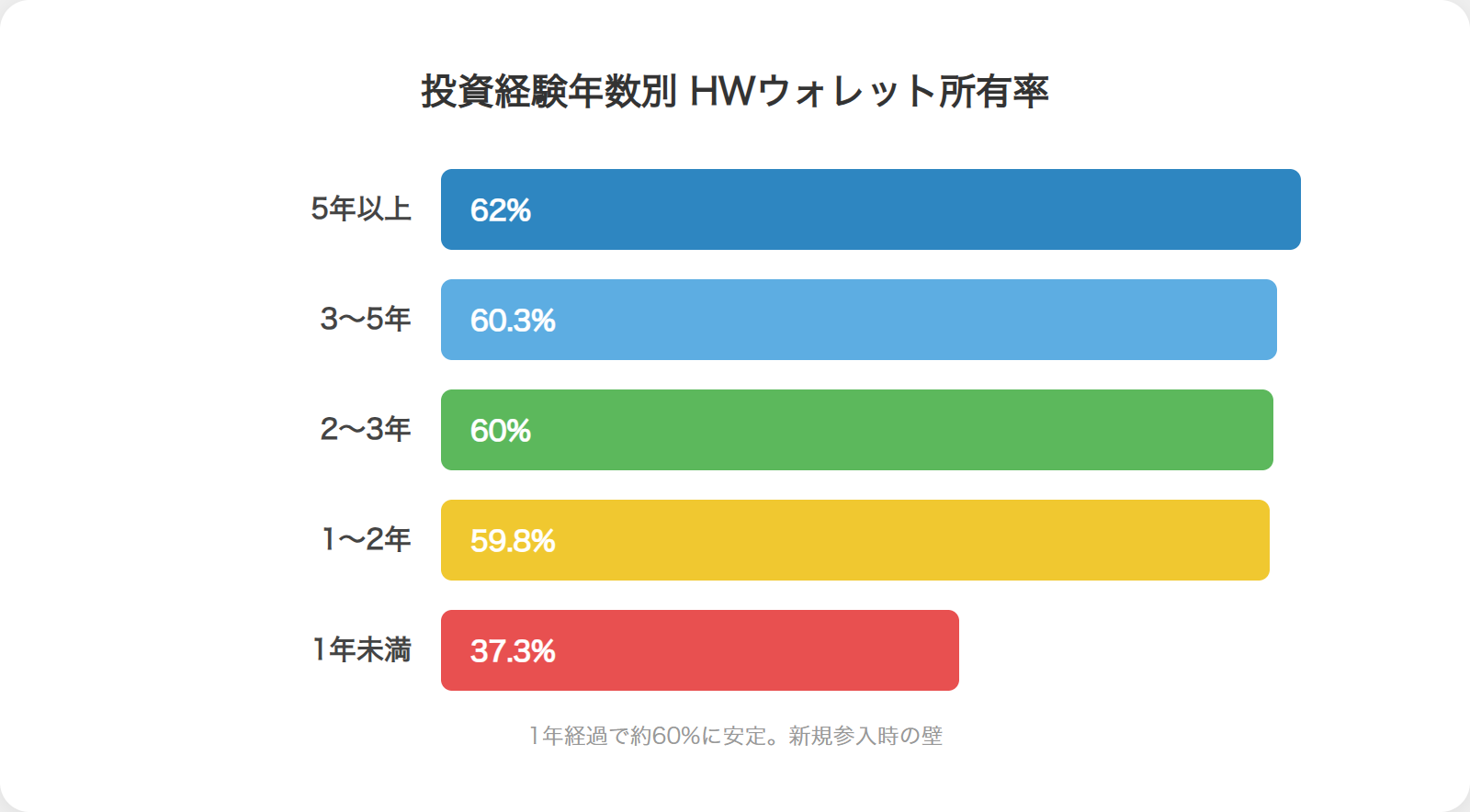
Ownership Stabilizes With Experience: 37.3% Among Those Under 1 Year Shows the Barrier New Entrants Face
Years of Investing Experience | n | HW Ownership Rate |
|---|---|---|
Under 1 year | 142 | 37.3% |
1–under 2 years | 214 | 59.8% |
2–under 3 years | 195 | 60.0% |
3–under 5 years | 116 | 60.3% |
5 years or more | 79 | 62.0% |
Looking at HW ownership by years of investing experience, new entrants with under a year of experience stop at just 37.3%, while every experience bracket at one year or more stabilizes at around 60%. This points to a structure in which HW adoption advances a notch once an investor passes the one-year mark.
In the year immediately after entering the market, the priority is likely getting comfortable with trading itself, leaving little bandwidth left over for security setup.
Yet this "first year" is exactly when scam losses and loss-of-access trouble tend to cluster, making it, if anything, the phase in which defenses should be strongest.
The fact that veterans with five or more years of experience post the highest rate, 62.0%, also highlights a structure in which the more experience investors accumulate, the more they come to feel the need for a hardware wallet.
What new entrants should emulate is the behavioral principle of veteran investors.
Adopting a hardware wallet before getting used to trading is the shortest route to protecting your assets successfully over the long term.
Summary
This survey found that the leading reason for buying a hardware wallet, cited by 38.1% of respondents, was "I was worried about security."
The findings show that a vague sense of unease is, in fact, the healthiest purchase motivation of all.
¥500,000 in holdings functions as one clear tipping point, with an ownership gap of more than threefold between the under-¥10,000 tier (21.3%) and the ¥500,000–1,000,000 tier (74.5%).
By age group, people in their 20s or younger lead at 78.5%, while those in their 50s trail at 35.0%, revealing a structure in which the more conservative generation isn't necessarily the more cautious one.
By investment style, the "both" group, which combines short-term and long-term approaches, posted the highest rate at 71.3%.
At the same time, the survey exposed a contradiction: the "HODL" group, which should need a hardware wallet the most, stopped at just 46.9%.
By years of experience, those with under one year posted the lowest rate at 37.3%, making clear that building a defensive setup lags behind for new entrants.
The criteria for who "should" buy a hardware wallet are clear.
For investors with holdings above ¥500,000, those combining short-term and long-term strategies, those attuned to security news, and anyone who refuses to use "it's a hassle" as an excuse, a hardware wallet is no longer optional — it's essential infrastructure.
The time spent putting it off with a "someday" mindset is itself the biggest risk of all.
Survey Overview
Survey date: April 10, 2026
Survey method: Internet survey
Survey population: Men and women residing in Japan (people currently investing in crypto assets, or who have invested in the past)
Valid responses: 417
Conducted by: Clabo Inc.
Survey Questions
- Do you have experience investing in crypto assets?
- How many years of experience do you have investing in crypto assets?
- What is the total value of the crypto assets you currently hold?
- Which of the following describes your investment style?
- Do you own a hardware wallet?
- What was the deciding factor in your purchase of a hardware wallet?
This article is for informational purposes only and does not constitute financial or investment advice. Please consult a qualified professional before making investment decisions.


