


"Should I move to an overseas exchange?" "Is it fine to keep using my current exchange?"
You are not the only one asking these questions. According to this survey (n=1,265), about 33.6% of investors have switched from a domestic to an overseas exchange at some point, and the most common reason was "lower fees."
Meanwhile, users who stay with domestic exchanges most value "the reassurance of Japanese-language support" and "trust in security." Let's use this data to find hints for choosing the best exchange for you.
Investment experience with crypto assets (also known as virtual currencies)

Looking at respondents' investment experience, 39.5% (500 people) said they "currently invest," while 43.1% (545 people) said they have "never invested," accounting for nearly half of respondents.
17.4% (220 people) said they "used to invest but no longer do." Among those with investment experience, the most common initial investment amount was "under ¥100,000 (~$640 at July 2026 exchange rates)" at 32.8% (415 people), showing that starting with a small amount is the mainstream approach.
The first exchange used and current usage status

Asked which type of exchange they used first, an overwhelming majority of experienced investors named a domestic exchange, at 53.8% (680 people). Only 3.2% (40 people) started with an overseas exchange, confirming that most Japanese crypto investors enter the market through a domestic exchange.
However, looking at current usage, the picture shifts. "Domestic exchanges only" remains the largest group at 30.8% (389 people), but "both domestic and overseas" at 11.6% (147 people) and "overseas exchanges only" at 9.6% (122 people) have also reached notable levels.
Reasons for switching to an overseas exchange (multiple answers allowed)
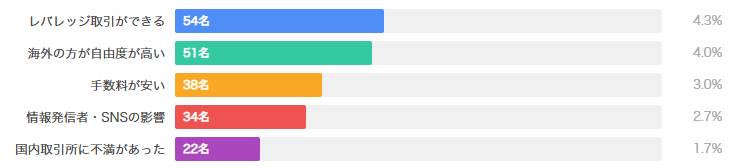
Among those who switched from a domestic to an overseas exchange (multiple answers allowed), the most common reason was "can use leveraged trading (margin trading)" at 4.3% (54 people), followed by "overseas exchanges offer more freedom" at 4.0% (51 people), "lower fees" at 3.0% (38 people), and "influence from crypto commentators or social media" at 2.7% (34 people).
What stands out is that the shift is not driven only by practical motives such as a wider range of listed tokens or lower fees — influence from influencers and social media also plays a notable role.
Notably, only 1.7% (22 people) cited "dissatisfaction with their domestic exchange," suggesting that the move is driven more by pursuing new features than by leaving out of frustration.
Reasons for using both domestic and overseas exchanges (multiple answers allowed)
Among the 147 respondents who use both domestic and overseas exchanges, the top reason was "lower fees" at 5.1% (65 people), followed by "overseas exchanges offer more freedom" at 5.0% (63 people), "can use leveraged trading (margin trading)" at 4.8% (61 people), "a wider variety of listed tokens" at 4.1% (52 people), and "influence from crypto commentators or social media" at 3.7% (47 people).
Investors who choose to "use both" rather than fully switch appear to keep the ease of use and safety of their domestic exchange while also accessing a wider range of tokens and features through an overseas exchange.
What keeps you with your current exchange? What do other users value most?
Reasons for sticking with domestic exchanges (multiple answers allowed)
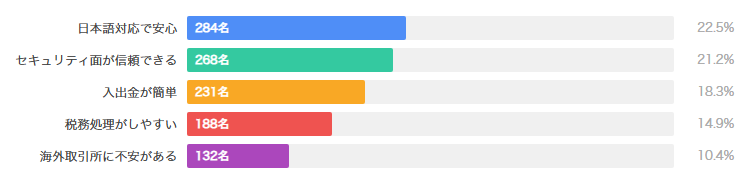
Among reasons for continuing to use a domestic exchange (multiple answers allowed), "reassurance from Japanese-language support" ranked highest at 22.5% (284 people), followed by "trust in security" at 21.2% (268 people), "easy deposits and withdrawals" at 18.3% (231 people), "easier tax filing process" at 14.9% (188 people), and "concerns about overseas exchanges" at 10.4% (132 people).
The results clearly show that Japanese-language support and a sense of security are the strongest competitive advantages of domestic exchanges.
Exchange usage trends by generation
Exchange usage patterns differ by generation. Generation Y (born 1982-1996) makes up the largest share of respondents at 37.0%, shows a high rate of investment experience, and tends to use both domestic and overseas exchanges confidently.
Generation Z (born 1997-2012) accounts for 15.9% and is characterized by gathering information through social media and favoring small, mobile-first investing. The "Ice Age generation" (born 1971-1981) — a term used in Japan for those who entered the job market during its post-bubble economic downturn — makes up a large share at 27.5% and tends to prioritize safety and Japanese-language support, forming the core user base of domestic exchanges. Among the Bubble generation and older, "concerns about overseas exchanges" was relatively more common, reflecting a preference for domestic exchanges with a clearer regulatory environment.
Initial investment amount and the barrier to entry
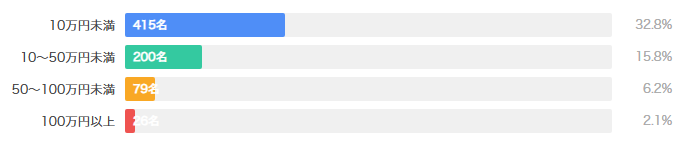
Among investors with experience, the most common initial investment amount was "under ¥100,000" at 32.8% (415 people), followed by "¥100,000 to under ¥500,000" at 15.8% (200 people), "¥500,000 to under ¥1 million" at 6.2% (79 people), and "¥1 million or more" at 2.1% (26 people). Most investors start with a small amount when entering crypto assets, and domestic exchanges are often chosen as the first platform largely thanks to a UI designed for low-amount entry and beginner-friendly support.
Conversely, one reason overseas exchanges are less often chosen by beginners is insufficient Japanese-language support and a more complex initial registration process.
Where do you go for information about exchanges and the market? The way you choose your information sources can significantly shape the quality of your investment decisions.
Trends in information sources

Asked about their sources of information on crypto asset investing (multiple answers allowed), "social media (X, YouTube, etc.)" ranked highest at 28.7% (363 people), followed by "news sites" at 23.7% (300 people), "specialist media" at 21.1% (267 people), and "acquaintances or communities" at 19.5% (247 people).
While social media is the top information source overall, only 7.7% (97 people) said they had "no particular source," showing that the majority of investors actively seek out information.
Those who move to overseas exchanges appear more likely to be influenced by social media and influencers, while those who stay with domestic exchanges tend to place more weight on news sites and specialist media.
Regulatory differences between domestic and overseas exchanges
One of the biggest differences between domestic and overseas exchanges is whether they are registered with Japan's Financial Services Agency (FSA). Domestic exchanges are required to register with the FSA under the Payment Services Act (PSA) or the Financial Instruments and Exchange Act (FIEA).
They are required to segregate customer assets, undergo annual external audits, and implement Anti-Money Laundering (AML) measures. While this regulatory compliance raises operating costs, it also provides users with a sense of security and legal protection.
Overseas exchanges, by contrast, are generally not bound by Japanese regulations. This lets them offer higher leverage ratios and a wider range of trading features, but the level of customer protection varies significantly from exchange to exchange.
The fact that a meaningful share of respondents cited "concerns about overseas exchanges (10.4%)" as a reason for staying domestic suggests that the presence or absence of regulation directly shapes users' sense of trust.
Summary
Whether domestic or overseas is the "right" choice depends on your investment style and goals. This survey shows that many users choose an exchange based on three main factors: fees, the range of listed tokens, and a sense of security.
The first step is to clarify what matters most to you, then choose an exchange that fits — this is what leads to sustainable, long-term investing. If you're still deciding, use the data in this survey as a point of comparison.
Survey overview
Survey date: February 24, 2026
Survey method: Internet survey
Survey population: Men and women residing in Japan (current or former crypto asset investors)
Valid responses: 1,265
Conducted by: Clabo Inc.
Survey questions
- Have you ever invested in crypto assets?
- Have you ever switched from a domestic exchange to an overseas exchange?
- How much was your initial crypto asset investment?
- Which type of crypto asset exchange do you currently use most?
- Which type of crypto asset exchange did you use first?
- What was your reason for switching to (or also using) an overseas exchange?
- What is your reason for continuing to use a domestic exchange?
- What are your main sources of information on crypto asset investing?
- Do you have any concerns about using overseas exchanges?
This article is for informational purposes only and does not constitute financial or investment advice. Please consult a qualified professional before making investment decisions.


