


"Fees here feel high, but how do they really compare to other platforms?"
You're not alone in wondering that every time you make a trade. In this survey (n=515), 26.4% of respondents said "withdrawal fees are high," while 22.7% cited "the fee structure is hard to understand" as a source of dissatisfaction.
What's more, roughly 46% of users said they had "considered or actually switched" exchanges, making fees one of the most important criteria when choosing an exchange today. Let's dig into the data to see whether your exchange's fees are really a good deal.
Survey Demographics
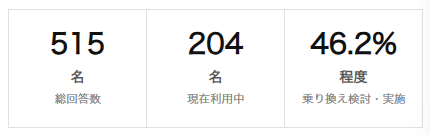
Category | Respondents | Share |
|---|---|---|
Male | 310 | 60.2% |
Female | 205 | 39.8% |
Generation Y (born 1981-1996) | 187 | 36.3% |
Ice Age generation (born 1970-1980, Japan's "employment ice age" cohort) | 147 | 28.5% |
Generation Z (born 1997-2012) | 87 | 16.9% |
Bubble generation (born 1962-1969) | 48 | 9.3% |
Shinjinrui generation (born 1957-1961) | 29 | 5.6% |
Current Exchange Usage
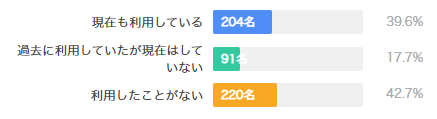
Looking at respondents' exchange usage, 39.6% (204 people) said they currently use an exchange.
Notably, the group who used an exchange in the past but no longer does (91 people, 17.7%) suggests that fee increases, switching to a competitor, or exiting the market altogether may all be restraining continued trading.
Main Exchanges Currently in Use (Multiple Answers)
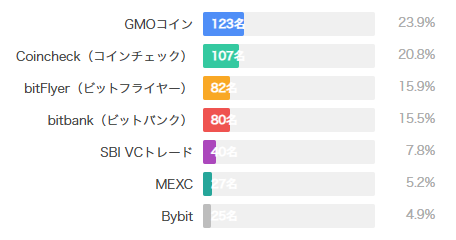
The survey found that among currently used exchanges, GMO Coin is the most widely used, at 23.9%.
Conventional wisdom has held that Coincheck commands the largest share, but this survey found GMO Coin in the top spot instead. This may reflect a shift in user choice driven by improvements in fee competitiveness, user interface, and overall service quality.
bitFlyer (15.9%) and Coincheck (20.8%), both major domestic exchanges (exchanges licensed and operating in Japan), also rank near the top, while SBI VC Trade (7.8%) and overseas exchanges such as MEXC (5.2%) and Bybit (4.9%) see some usage as well.
Ranking of Exchanges Perceived as Having the Highest Fees
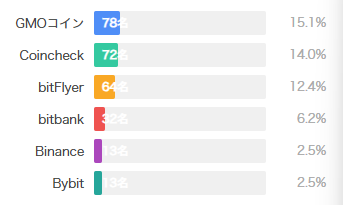
Which exchanges do investors feel have the "highest fees"?
The survey results reveal an interesting pattern. GMO Coin (15.1%) and Coincheck (14.0%) top the list, which likely reflects their large user bases as well as genuine dissatisfaction with their fee structures.
bitFlyer (12.4%) also accounts for a notable share. That these major exchanges are singled out for "high" fees suggests intensifying fee competition in the market, and that the availability of lower-cost options, including overseas exchanges, is shifting user expectations.
Reasons Fees Feel High
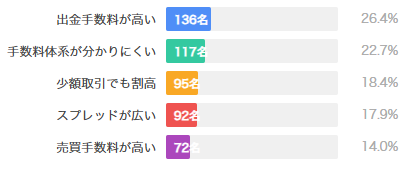
Investors' reasons for perceiving fees as high vary widely. The survey results reveal the following ranking. The largest group of investors (26.4%) cited "withdrawal fees are high."
Other reasons cited include "the fee structure is hard to understand" (22.7%) and "the spread is wide" (17.9%).
Anxiety and Dissatisfaction Around Fees, in Detail
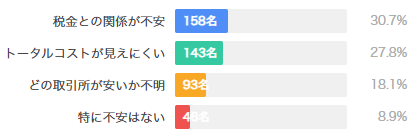
Digging further into anxieties and complaints around fees, the largest group, 30.7% (158 people), cited "anxiety about the relationship with taxes" as their top concern. This suggests that many users are weighing not just the profitability of crypto asset (also known as virtual currency) investing but also the burden of tax filing and record-keeping.
How Fees Drive Users to Switch Exchanges
One of the most important findings is the extent to which fees drive users to switch exchanges. The survey found that fully 46.2% (238 people) of investors said they had "considered or actually switched exchanges because of fees." Of that group, 23.9% (123 people) considered switching but did not follow through, while 22.3% (115 people) actually switched.
Because fees are a key factor shaping competition among exchanges, this figure carries real significance.
Switching status | Respondents | Share |
|---|---|---|
Actually switched | 115 | 22.3% |
Considered but did not switch | 123 | 23.9% |
Never considered it | 57 | 11.1% |
Total (switching-related) | 238 | 46.2% |
Fee Sensitivity by Generation
Sensitivity to fees varies significantly by generation.
Generation | Share | Respondents | Fee sensitivity | Switching consideration rate |
|---|---|---|---|---|
Generation Y | 36.3% | 187 | High | 48% |
Ice Age generation | 28.5% | 147 | Moderate | 44% |
Generation Z | 16.9% | 87 | Highest | 52% |
Bubble / Shinjinrui generations | 14.9% | 77 | Low | 38% |
Trading Style and Fee Sensitivity
Fee sensitivity differs markedly by trading style. For short-term traders, transaction fees and spreads directly affect profit margins, so their fee sensitivity tends to be very high.
Long-term holders, by contrast, trade less frequently, so they tend to prioritize security and service quality over fees. This difference shows up in the gap between the two groups' likelihood of considering a switch.
For active traders who trade frequently in particular, fees are a factor that directly affects profit. Survey data suggests that among short-term traders, the rate of considering a switch due to fees may exceed 50%. Because higher trading volume means fees add up faster, comparing volume-based discount programs and fee structures in advance is key to managing costs.
The Need for Fee Transparency
If you feel that "I don't really understand how the fees work," you're not alone — 22.7% of investors share that concern. Because each exchange charges several different types of fees, understanding the following categories in advance will help you calculate your total cost accurately.
- Trading fees on the exchange (maker fees, taker fees)
- Spread (the gap between the buy and sell price)
- Deposit fees
- Withdrawal fees (fiat currency)
- Crypto asset transfer fees
- Swap points on leveraged trading
Because these fees combine to affect your total cost, it can be hard to see the full picture. To avoid losing out, it's worth checking an exchange's official fee schedule page or using a comparison site. Making it a habit to estimate your total cost before trading can help you avoid unexpected expenses.
Key Takeaways
This survey shows that while fees are an important factor in choosing an exchange, they alone do not function as the deciding factor. GMO Coin's 23.9% usage rate is likely the result of a combination of factors: transparent fee structures, beginner-friendly support, and an intuitive user interface.
At the same time, 17.7% of respondents said they used an exchange in the past but no longer do. Not a few of them appear to have switched exchanges after a fee increase or general dissatisfaction with the service.
If you feel that "my current exchange's fees are high," comparing it against other exchanges is one option worth considering.
Overseas exchanges (Bybit at 4.9%; Binance's fees were not cited as feeling high) also see notable use, with low fees and a wide range of listed tokens as their strengths — though they come with challenges such as regulatory risk, limited language support, and more complex tax reporting.
The question of fees is, in fact, closely tied to taxes. Understanding the relationship accurately is essential to making an informed decision.
Tax Concerns Are the Biggest Worry | The Hidden Cost of Fees
It's worth highlighting that "anxiety about the relationship with taxes" was the single largest concern related to fees, cited by 30.7% (158 people) of respondents.
In Japan, gains and losses from crypto asset trading are, in principle, treated as miscellaneous income and must be reported through the annual final tax return (kakutei shinkoku), and trading fees can be included in the calculation as part of the acquisition cost or transfer expenses.
However, tracking trade history and calculating fees is complex, and 27.8% of respondents said it's hard to see their total cost — adding significant psychological burden to tax processing. This is especially true for investors using multiple exchanges, where reconciling gains and losses across platforms becomes cumbersome, and the difficulty of understanding fee structures (22.7%) compounds the problem. Going forward, improving the accuracy of exchanges' annual profit-and-loss reports and building better tax-integration features stand out as important areas for improvement.
Note on Japan's crypto tax rules: as of July 2026, gains from selling crypto assets in Japan are treated as miscellaneous income and taxed under the aggregate (progressive) taxation system, alongside a taxpayer's other income. On July 15, 2026, an amended Financial Instruments and Exchange Act was passed by Japan's House of Councillors, which will reclassify crypto assets as financial instruments under the FIEA; a flat 20% separate self-assessment tax rate is expected to apply starting the fiscal year after the amended law takes effect (projected January 2028). Under the current rules, losses from crypto trading can only be offset against other miscellaneous income, not against employment income or other income categories.
Conclusion
Exchange fees are unquestionably an important factor for investors, but most investors are also weighing a broader set of considerations. That's evident from the fact that 46.2% of users said they had "considered or actually switched" exchanges because of fees.
Some users may feel dissatisfied with fees yet still hesitate to switch. This survey shows that a meaningful share of users considered switching but ultimately did not follow through. Comparing fees is easier than it sounds — start by comparing the fees for the transactions you use most often (spot trading, withdrawals, transfers). Over the course of a year, differences in fees can easily add up to tens of thousands of yen.
*All data in this article is based on the survey described above. Percentages are rounded to one decimal place.
This report is intended for informational purposes only and does not constitute any solicitation or advice regarding investment. Crypto asset investment carries significant risk, and all investment decisions should be made at your own responsibility. We make no warranty as to the accuracy, completeness, or usefulness of the content of this report. Please make your own final investment decisions and consult a qualified professional as needed.
Survey Overview
Survey date: February 24, 2026
Survey method: Internet survey
Survey population: Men and women living in Japan (people currently investing, or who have previously invested, in crypto assets)
Valid responses: 204
Conducted by: Clabo Inc.
Survey Questions
- Are you currently investing using a crypto asset exchange?
- How many years of crypto asset investing experience do you have?
- What is your current total crypto asset investment amount?
- Which crypto asset exchanges do you currently use? (Select all that apply)
- Considering the overall service, which single exchange do you feel has the highest fees?
- Why do you feel that exchange's fees are high?
- Have you ever switched exchanges (or considered switching) because of high fees?
- Do you feel any anxiety or dissatisfaction regarding crypto trading fees?
- What concerns you about crypto asset investing?
This article is for informational purposes only and does not constitute financial or investment advice. Please consult a qualified professional before making investment decisions.


