


"Since the AI trades automatically, your money grows just by leaving it alone."
Some people who have been approached with a pitch like this may be wondering whether they can trust it. Others may have already purchased a tool or deposited funds, only to find they cannot withdraw as expected, and are now searching for answers out of concern that it may have been a scam.
When it comes to automated trading in crypto assets (also known as virtual currencies), consultations are being reported to consumer affairs centers across Japan by people who were sold expensive tools and then denied withdrawals. At the same time, automated trading itself is not illegal, and there are legitimate tools that use it.
Because both safe and risky offerings are described using the same words, it is important to be able to judge for yourself whether what you are looking at is legitimate or fraudulent. This article introduces the common tactics and warning signs that can help you determine whether a crypto asset auto-trading tool is legal or a scam.
Conclusion: Auto-Trading Tools Themselves Are Legal — Scams Are Common in Pitches Promising Guaranteed Profits
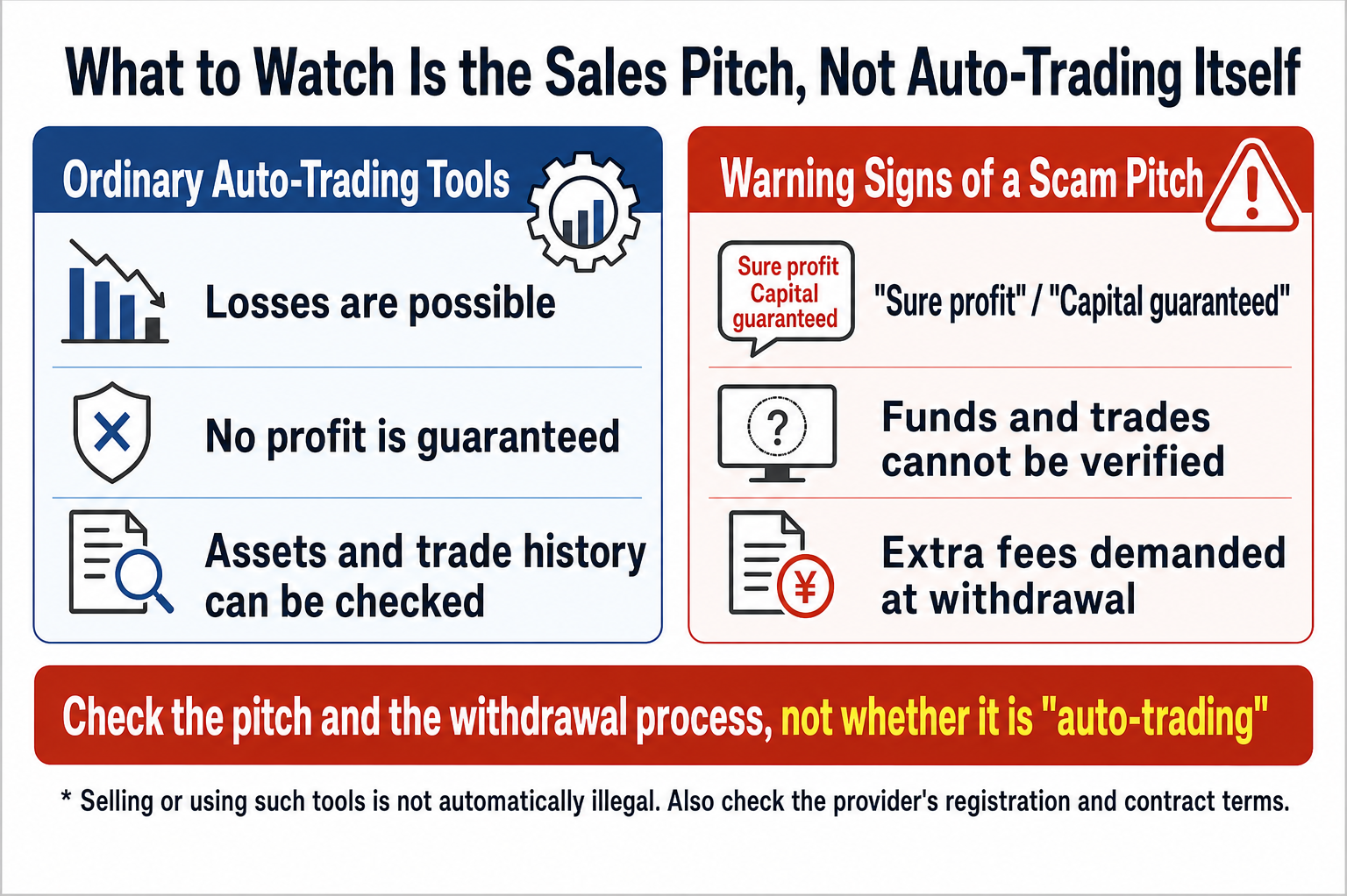
To state the conclusion up front: what you need to be cautious about is not the automated trading mechanism itself, but the way it is used in solicitations. Both are described using the same terms, yet their substance can be very different.
An auto-trading tool, in the broadest sense, is any mechanism that automatically executes trades in crypto assets and other instruments based on preset conditions. Legitimately used automated trading tools share certain traits: they do not conceal the possibility of losses, they do not guarantee profits, and users can check their own asset and transaction history for themselves.
Examples include official trading functions offered by crypto asset exchanges, or individually developed programs linked to an exchange's API. These remain tools that users operate under their own control. For this reason, selling or using an auto-trading tool is not, in itself, illegal.
Fraudulent solicitations, by contrast, show the opposite characteristics. They make promises that should never occur in genuine investing, such as "you're guaranteed to profit" or "the AI earns automatically, so your principal is guaranteed." Users are unable to verify the substance of the funds or trades on their own, and when they try to withdraw, they are asked for additional payments under the guise of fees or taxes. Cases in which the money is never returned have been reported repeatedly.
Cases have long been occurring in which people are unilaterally solicited to invest in FX, binary options, crypto assets, and similar products with claims such as "if you study at our seminar, you'll be able to win" or "if you use our auto-trading software, you'll profit without doing anything." In particular, many consultations come from people who invested after being solicited by someone they met on social media.
Source: Financial Services Agency (FSA)
In short, the point to check when judging whether something is legitimate or a scam is not "whether it's automated trading," but whether it involves unrealistic promises such as "guaranteed profit" or "principal guaranteed," or reluctance to process withdrawals.
Why Auto-Trading Tools Have Long Been a Breeding Ground for Scams
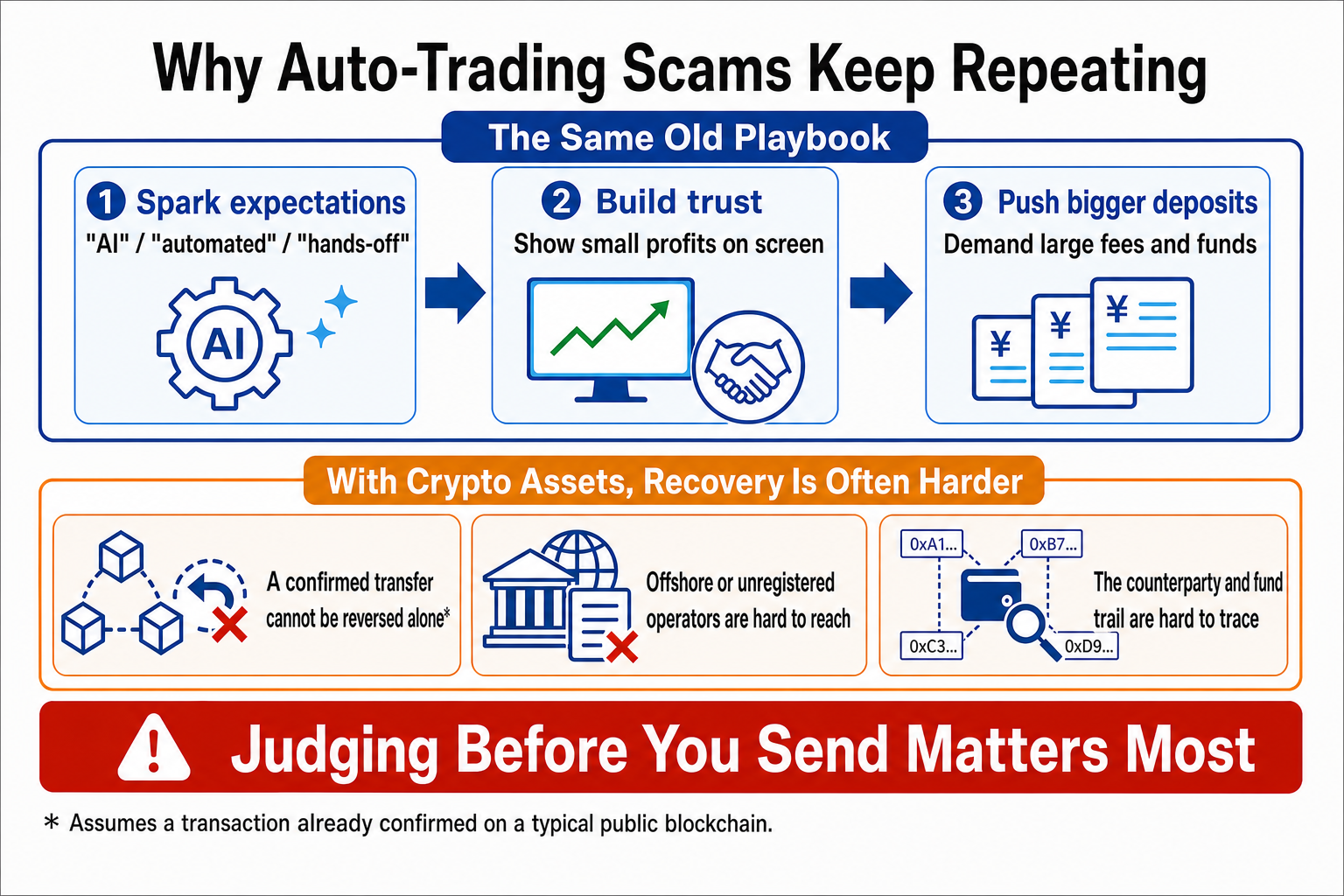
Scams disguised as automated trading did not suddenly appear with crypto assets. The same pattern of harm has long been repeated in the worlds of FX and stock investing as well.
This section explains why the pitch "you'll profit automatically" is so effective at drawing people in, what patterns of tactics exist, and why the harm tends to be especially severe when it involves crypto assets.
Why the "Profit Without Lifting a Finger" Pitch Is So Effective
The wish to "grow money without any effort" is one that many people naturally hold. Automated trading appeals directly to this desire. In addition, words like "AI," "algorithm," and "automated" carry an impression of a scientific, reliable mechanism that does not depend on human judgment, and the less specialized knowledge someone has, the more likely they are to think, "I don't fully understand it, but it must be amazing."
Those who solicit victims approach them with this psychology in mind. A typical pattern is to explain that you can start with a small amount, build trust by making it appear as though small profits are being generated early on, and then encourage the victim to increase the amount invested.
Because the scheme is designed to build trust before any losses occur and then gradually draw victims in deeper, it is not necessarily the case that a victim was especially careless. It is important to recognize that the mechanism itself is built to make calm judgment difficult.
Two Types of Auto-Trading Scams Also Seen in FX and Stocks
Fraudulent solicitations involving automated investment trading broadly fall into two types. The first is the tool-sales type, in which high-priced software or membership rights are sold with claims such as "if you use this system, you're guaranteed to win." The second is the entrusted-management type, in which funds are collected with promises such as "if you deposit your funds with us, we'll trade automatically and grow them," but in reality there is no actual trading activity, or new deposits are simply used to pay out existing participants.
Main Pitch | What Actually Happens | Stated Purpose of the Funds | |
|---|---|---|---|
Tool-Sales Type | Use this system and you're guaranteed to win | High-priced software or membership rights are sold. The performance may not match the advertising. | Tool purchase fee / usage fee |
Entrusted-Management Type | Deposit your funds and we'll trade automatically to grow them | Funds are collected, but there may be no actual trading activity, or new deposits may simply be used to pay out existing participants. | Funds deposited for management |
Solicitations like these have long been flagged as a problem, and the National Consumer Affairs Center of Japan (NCAC) has also warned about tactics that push people to purchase FX auto-trading systems with promises of guaranteed profit. Even when the label changes from FX to crypto assets, the underlying structure — promising to "grow your money automatically and reliably" in order to extract fees or funds — remains the same.
Why the Harm Tends to Be More Severe With Crypto Assets
Even with the same underlying scam structure, there are circumstances that make recovering losses especially difficult when crypto assets are involved.
The first is that a transfer cannot be reversed after the fact. A crypto asset transfer is designed to become final once it is recorded on the blockchain, and there is no intermediary administrator who can cancel it. Once funds have been sent to the other party, it is generally not possible to pull them back through your own will alone, which is why perpetrators tend to specifically request payment in crypto assets, fully aware of this characteristic.
The second is that the operators used in these solicitations are frequently unregistered entities based overseas. Operating a Crypto Asset Exchange Business within Japan requires registration under the Payment Services Act (PSA), and registered operators are required to, among other things, manage users' assets separately from their own. Unregistered operators soliciting from overseas, however, fall outside these regulations, and in practice it is difficult for Japanese authorities to reach them with guidance or sanctions.
In many cases, the company's location and the identity of the operator are unclear, and even after noticing the harm, victims often find themselves unable to determine whom to ask for a refund. The FSA has published warnings about unregistered operators soliciting investors, but its enforcement power has limits when it comes to operators based overseas.
The third is that the flow of funds is difficult to trace. Because crypto assets are exchanged using wallet addresses rather than names, the transaction record itself remains, but it is not obvious at a glance who owns a given address. Perpetrators sometimes disperse the assets they receive across multiple wallets and overseas exchanges, making it far from easy to identify who ultimately received the funds and where they were converted to cash.
Because these three factors combine, scams involving crypto assets tend to result in larger losses and are more difficult to recover after the fact. That is precisely why it is so important to identify a scam before you send any funds.
Common Tactics Used in Crypto Asset Auto-Trading Tool Scams
This section organizes how the harm actually tends to unfold. Knowing these tactics in advance is one of the most practical forms of preparation, helping you recognize a familiar pattern the moment you are approached.
Below, we look at three aspects in turn: the typical flow from initial contact through to withdrawal refusal, the phrases commonly used to lure victims, and the ways these schemes combine with other malicious practices. Please note that what follows describes general patterns only and does not name any specific business or product.
The Typical Flow From Solicitation to Withdrawal Refusal
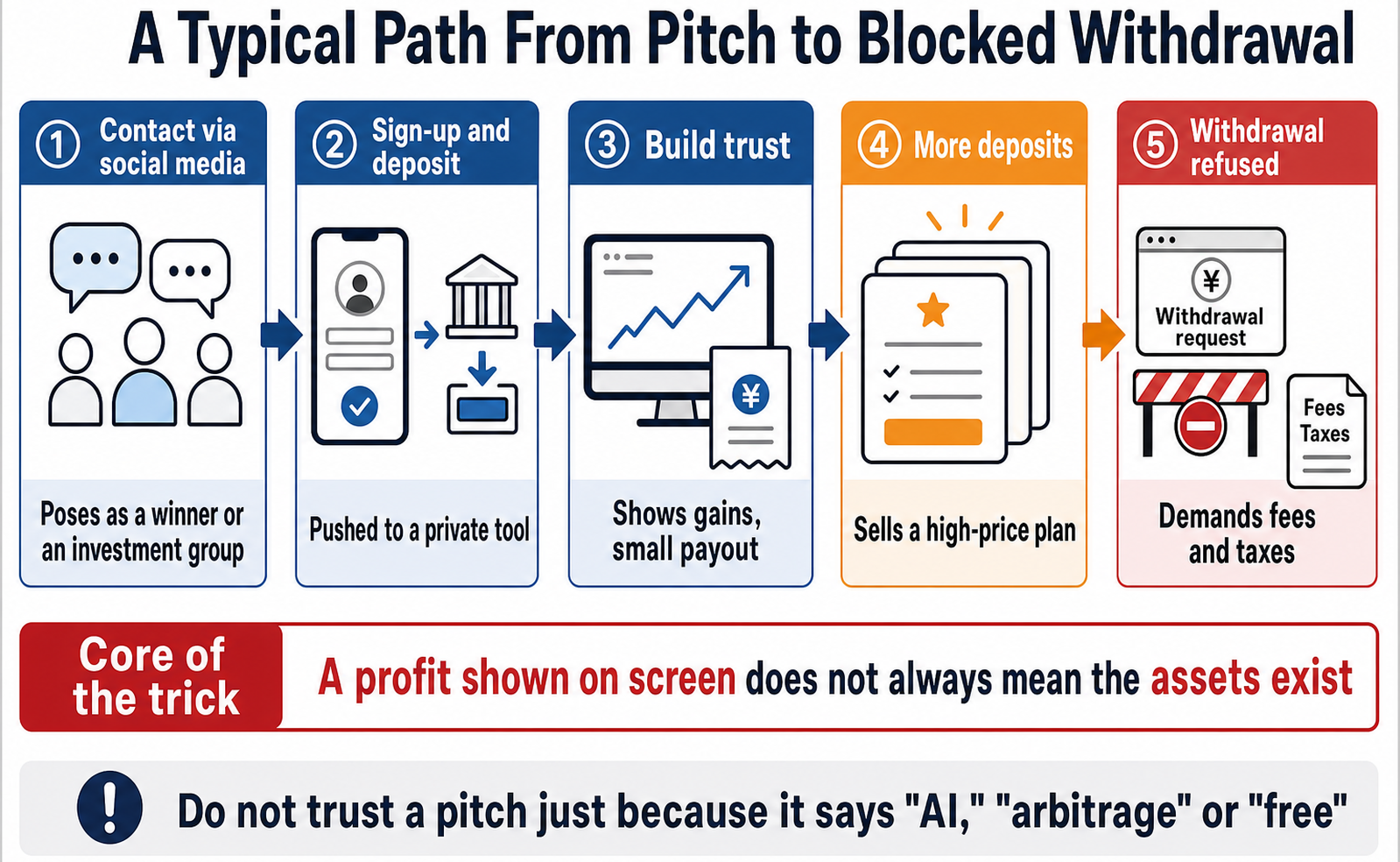
Reported cases of harm tend to follow common stages. The entry point is usually contact made through social media, dating/matching apps, or messaging-app groups. Approaches often come through a person who appears to be a successful investor, or through a community that appears to be sharing valuable information.
Next, the victim is encouraged to register with a dedicated tool or app and deposit funds. For a while, the on-screen display shows profits steadily increasing, and small withdrawals may even be honored to build trust.
Once the user feels reassured, they are asked for additional deposits with claims such as "upgrading to a higher-tier plan will increase your profits." Then, once a substantial amount has accumulated and the user requests a withdrawal, further payments are demanded under the guise of fees, taxes, or security deposits — and the case ultimately ends with the user unable to withdraw and unable to reach the operator.
The core of this tactic is that the profits shown on screen are merely a display, with no actual assets backing them.
Pitches Invoking "AI Auto-Trading" and "Arbitrage"
Solicitations repeatedly use technical-sounding language that projects certainty. Common examples are explanations such as "AI-powered auto-trading" or "arbitrage means you can profit risk-free from price differences." AI and arbitrage are both real technologies and trading methods, but in these pitches, genuine concepts like these are borrowed to make it sound as if guaranteed profit is assured — and that is exactly the point to be cautious about.
Another pattern uses a "free tool" as the entry point. The offer of a free service is used to get victims to register, and after making it appear that profits are being generated, they are guided toward switching to a paid version or making additional deposits.
This exploits the sense that "it's free, so it's safe" — but the absence of a cost is not proof of safety. No matter how technical a pitch sounds, if it is accompanied by phrases like "guaranteed," "certain to," or "principal guaranteed," it is important to pause and verify before proceeding.
Cases Combined With MLM or Ponzi Schemes
Solicitations involving auto-trading tools are sometimes combined with other malicious schemes.
One is a chain-style form of solicitation in which people are told they will receive a reward for introducing acquaintances or friends, spreading the scheme person to person. Because the invitation comes from someone close to the victim, it is harder to refuse, which is a factor that allows the harm to spread easily (related: What Is MLM (Multi-Level Marketing)?).
The other is an unsustainable, hand-to-mouth structure in which what is described as profit from automated trading is, in reality, simply new deposits being funneled to earlier participants. Once new deposits stop coming in, the scheme collapses and many participants lose their funds (related: What Is a Ponzi Scheme?).
The explanation of "automated trading" is sometimes used as a disguise to obscure this flow of funds. For a more detailed explanation of related tactics, please see the articles organized by type of solicitation.
How to Identify a Dangerous Auto-Trading Tool: A Self-Check
Having reviewed these tactics, what matters most is being able to judge for yourself whether what you are being offered is dangerous.
This section introduces warning signs and how to verify an operator, steps you can use to check the risk level of a tool you have been offered, and the objective criteria to consider if you are contemplating using an auto-trading tool.
Warning Signs and How to Check for Unregistered Operators
In crypto asset auto-trading, you should be wary if you encounter any of the following expressions.
- Principal guaranteed
- Guaranteed to profit
- No risk
- Limited-time only
- Special offer just for you
As a basic premise, no investment offers guaranteed returns. In addition, explanations that appear to guarantee your principal may constitute a misrepresentation of superior quality (yuryo gonin) under Japan's Act against Unjustifiable Premiums and Misleading Representations, and the Financial Instruments and Exchange Act (FIEA) prohibits soliciting investors by providing conclusive assessments.
The Financial Instruments and Exchange Act (Article 38) prohibits securities companies and their officers or employees from soliciting investors by presenting conclusive assessments, such as claiming that the price of a security will definitely rise or definitely fall. Therefore, if a sales representative at a securities company were to tell you something like, "this stock is guaranteed to go up," or "if you keep holding this stock, your losses will only keep growing, so you should sell now," that representative may be committing a violation of the law.
Source: Securities and Exchange Surveillance Commission (SESC)
It is also effective to check whether the operator is registered. Operating a Crypto Asset Exchange Business within Japan requires registration, and the FSA publishes a list of registered operators. Conversely, for operators soliciting without registration, the FSA publishes their names under "Names of Entities Conducting Unregistered Financial Instruments Business."
By cross-checking the name of the operator that approached you against this official information, you can get a reasonable sense of whether you are dealing with a high-risk party.
Self-Check: How Risky Is the Tool You Were Offered?
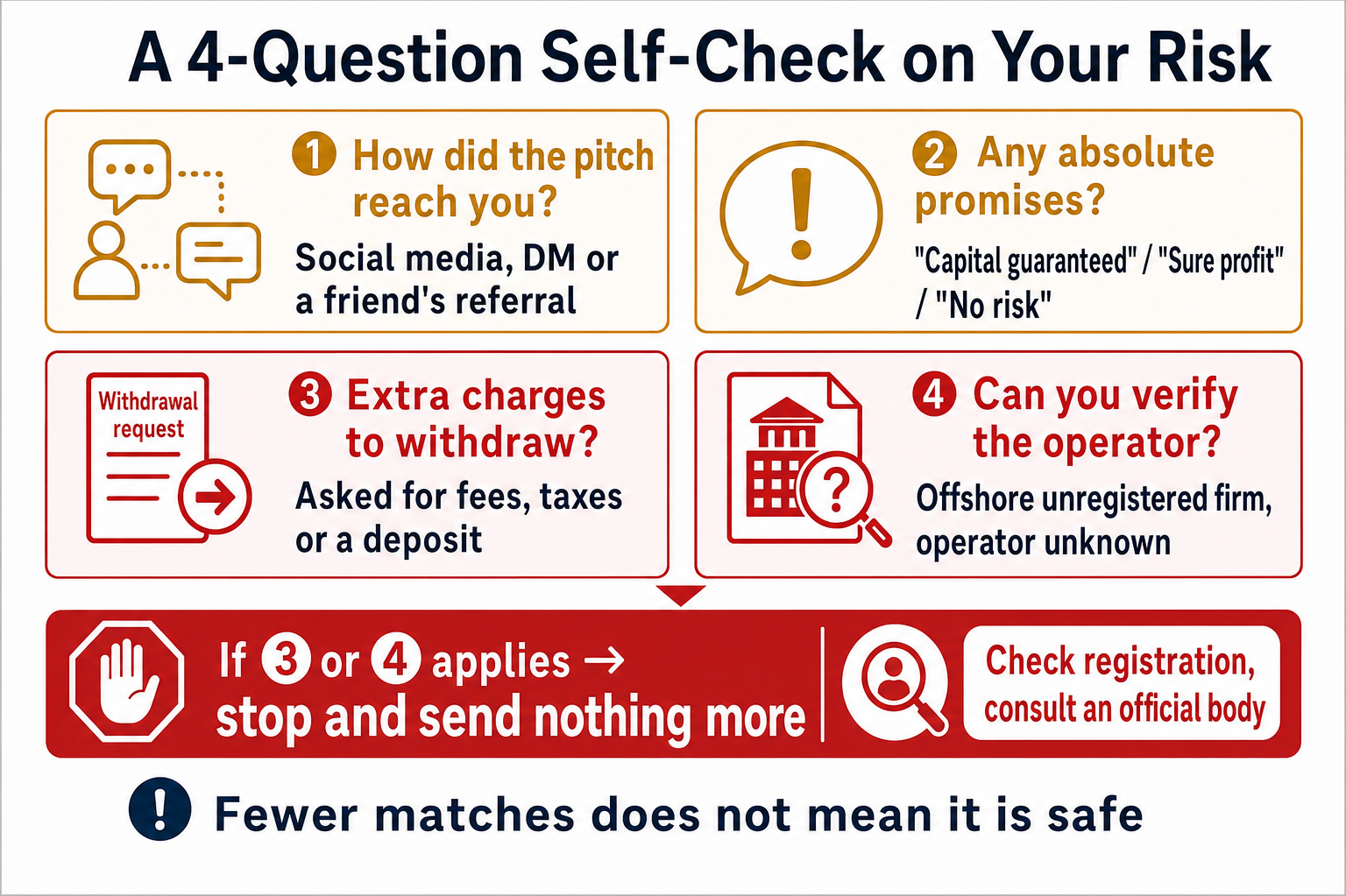
If you are unsure how to judge, try answering the following four questions in order.
- Where did the initial contact come from?
- Did the pitch include expressions such as "principal guaranteed" or "guaranteed to profit"?
- When you tried to withdraw, were you asked for an additional deposit under the guise of "fees," "taxes," or a "security deposit"?
- Is the operator a registered domestic entity, an unregistered overseas entity, or is this simply unknown?
If you were asked for an additional deposit at withdrawal, or if the operator is an unregistered overseas entity or unknown, you should treat these as high-risk indicators and proceed with caution. Being asked for a new payment at the withdrawal stage in particular is a classic point at which losses expand. For example, in April 2026, manga artist Jun Tanaka revealed that he fell victim to an investment scam and lost as much as 5,832,000 yen (approx. US$39,000 at roughly 150 yen to the US dollar).
It began when Tanaka's wife found an ad on X (formerly Twitter) reading "a side job that takes only a few entries at home." He joined a program in which he clicked as instructed each day to help "operate" the crypto asset Ethereum, accumulating rewards. During this, an event was suddenly held claiming that if participants prepared their own funds, the operation would multiply them five times over. He revealed, "I prepared 1,000,000 yen and took part."
From there, he was shown a series of money movements — the 1,000,000 yen he had put in dropped to zero in his own hands, while an additional 800,000 yen grew to 7,200,000 yen under the hands of the investment group's "representative." He was then asked to pay a "technical fee" of 1,440,000 yen to the representative in order to withdraw the 7,200,000 yen.
Source: Sanyo Shimbun
The more of these items apply, the greater the risk, but a low number does not guarantee safety either. If you feel even the slightest concern, we recommend consulting one of the public contact points introduced later before proceeding with any contract or additional deposit.
Objective Criteria to Check Before Choosing a Legitimate Tool
When considering a trading service that includes automated trading, it is also worth touching on the objective criteria that can inform your judgment. This is not an endorsement of any particular tool, but the following are points worth checking.
- Whether the operator holds the necessary registration in Japan
- Whether fees and the track record of the trading activity are clearly disclosed
- Whether third-party audits or outside verification have been conducted
By contrast, user testimonials or social media posts claiming "I made money" are difficult to verify and are sometimes created specifically for promotional purposes. Rather than feeling reassured simply because there are many positive reviews, it is essential to check the operator's own registration status and disclosures yourself. When you cannot reach a clear judgment, choosing not to force a conclusion on your own is also an important way to protect yourself.
Is It True That Auto-Trading "Doesn't Make Money"?
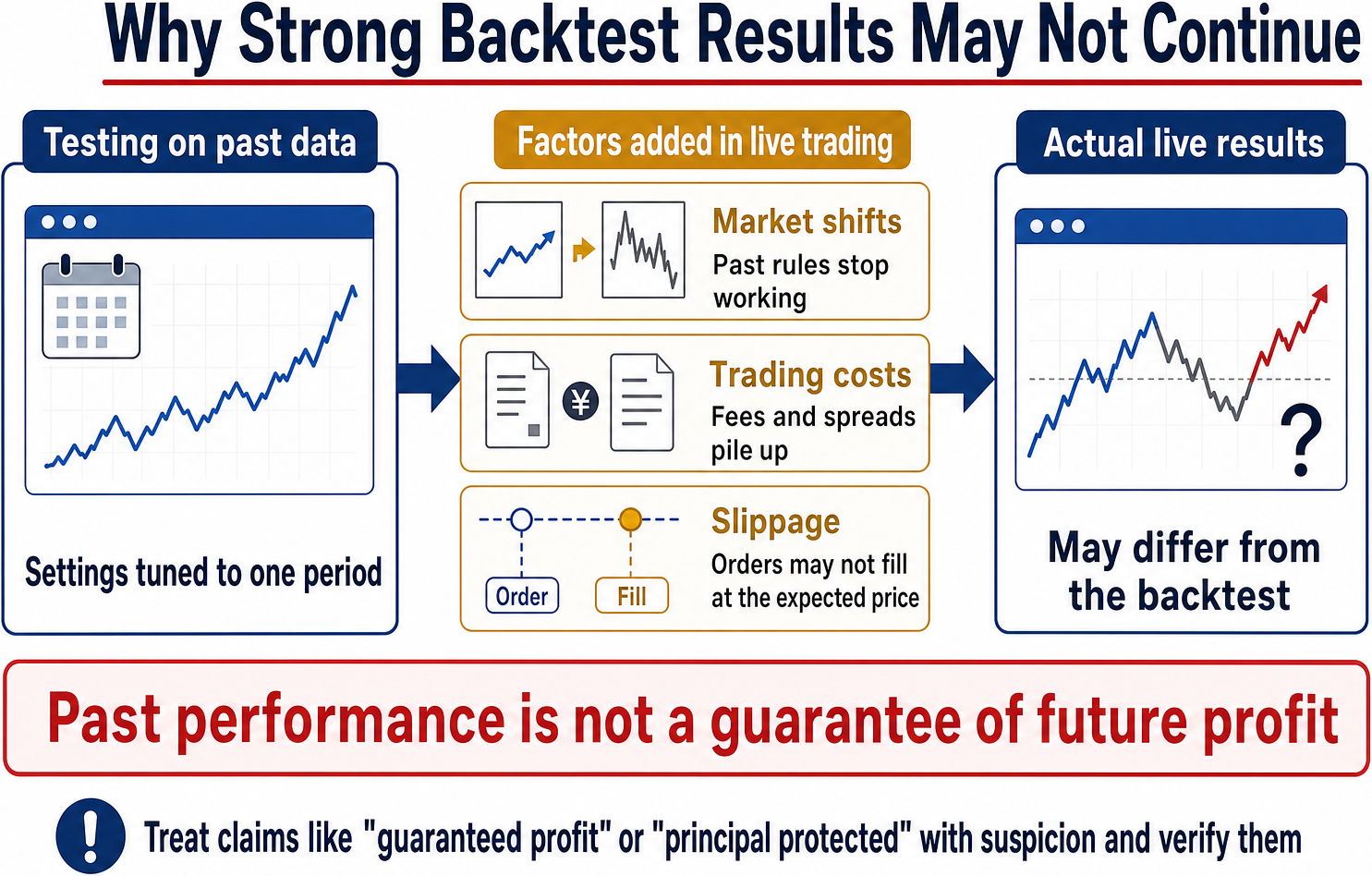
The claim that "crypto asset auto-trading doesn't make money" is also often heard. This is a separate issue from whether something is a scam, but understanding the gap between expectation and reality is useful for spotting unrealistic promises.
This section organizes why it is difficult to keep winning even with a legitimate tool, and the mechanisms behind that difficulty, then considers how you should regard claims of "guaranteed profit" in light of them.
Why It's Difficult to Keep Winning Even With a Legitimate Tool
Even using a legitimate auto-trading tool, generating consistent, ongoing profit is not easy. Markets are constantly changing, and it is not uncommon for a trading rule that worked at one point to stop working once market conditions shift. Crypto assets in particular are subject to large price swings, and sudden movements beyond what was anticipated can cause preset conditions to backfire.
In addition, costs such as fees and the spread (the difference between buy and sell prices) apply to every trade. Even though each cost may be small on its own, automated trading tends to involve a high number of trades, and these costs add up to squeeze profits.
In other words, failing to win is not necessarily because the tool is poorly made — it is largely due to factors inherent to investing itself, namely market uncertainty and cost.
Why Strong Backtest Results Can Still Lose Money in Live Trading
Solicitations for auto-trading tools often use explanations such as, "when tested against past data, the results were strong." Checking performance by applying a strategy to historical market data is called a backtest, but a good result there does not guarantee the same profit in actual, live trading.
One reason is over-fitting the settings to past data. If a strategy is tuned to match the price movements of a specific period precisely, its backtested results can be made to look as good as one wants, but that does not mean it will remain effective in future markets.
Furthermore, in actual trading, slippage can occur, where an order does not execute at the intended price. It is important to understand that strong backtest results are only outcomes achieved under a limited set of past conditions, and they do not promise future profit.
This Is Why You Should Doubt Any "Guaranteed Profit" Pitch
Given all of this, the reality is that even people with specialized expertise find it difficult to keep winning in the market. A pitch that flatly declares "guaranteed profit," "principal guaranteed," or "steady growth every month" is therefore unrealistic from its very premise.
Honestly conveying the possibility of losses is the hallmark of a sincere explanation about investing. Conversely, any pitch that never mentions risk and emphasizes only guaranteed profit should raise suspicion that it may contain fraudulent elements. It is worth keeping in mind that an explanation that openly acknowledges "you might not make money" is often, in fact, the more trustworthy one.
What to Do and Where to Get Help if You Suspect a Scam
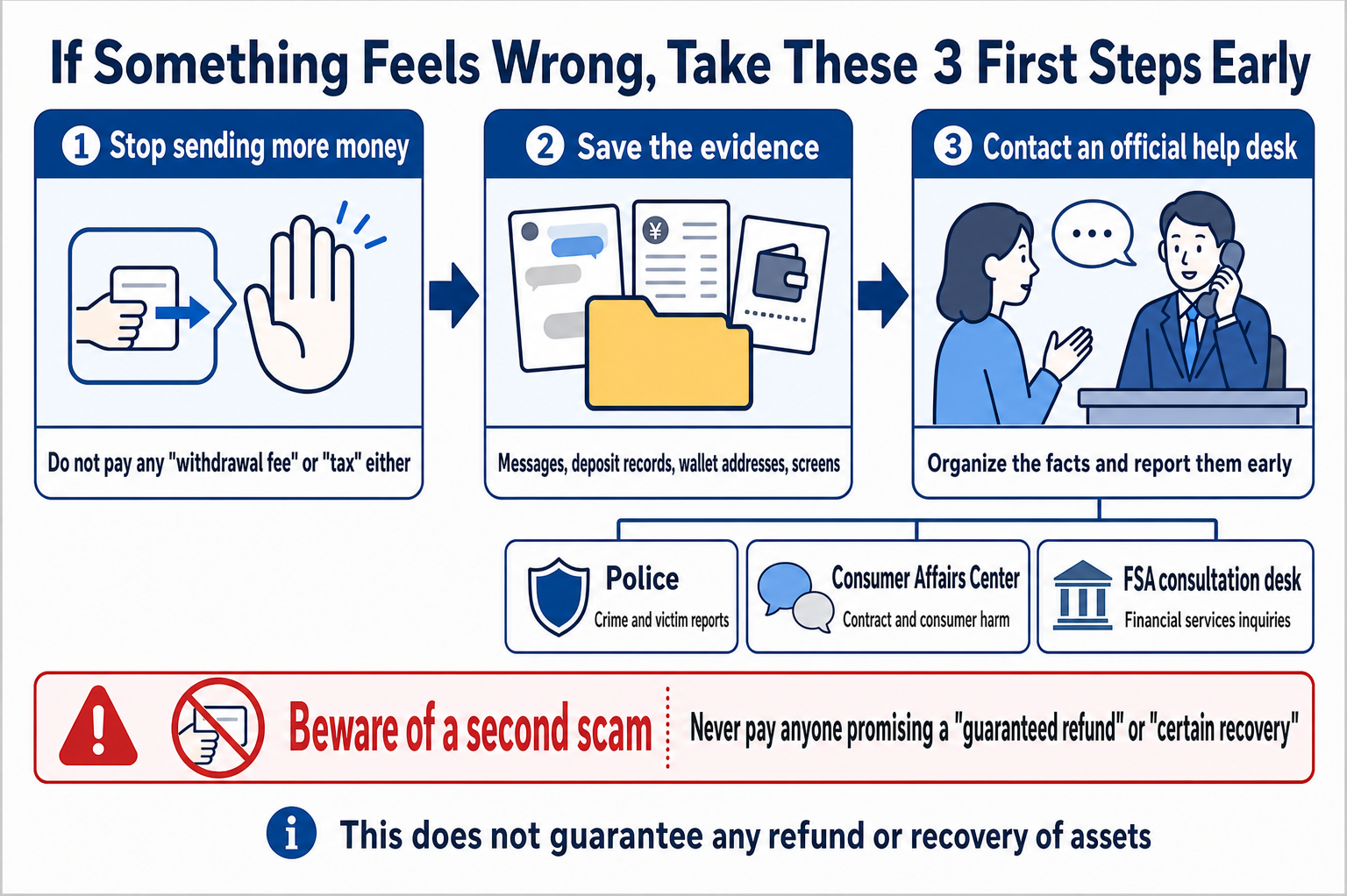
You may already have made a deposit or entered into an agreement and now feel uneasy about it. If so, do not try to handle it alone — acting as quickly as possible helps prevent the harm from spreading further.
This section introduces the initial steps you can take on your own, the public contact points available for consultation, and important points to be aware of when considering a refund or asset recovery.
First Steps When You Can't Withdraw or Reach the Operator
If you find yourself unable to withdraw funds or unable to reach the other party, the most important first step is to stop making any additional deposits. Even if you are told "you can withdraw if you pay just a little more," complying is likely to make the harm even worse.
Every time he prepared more money, another fee demand followed, until finally he received a message saying, "Because you are sending a large sum, you are suspected of a crime. We will introduce you to a specialized international lawyer, so please pay a retainer fee of 720,000 yen." Tanaka recalled, "When I looked at the image of the lawyer they had attached, it was such an obviously suspicious, AI-generated-looking image of a Black lawyer that I finally realized what was going on."
Source: Sanyo Shimbun
The moment you are asked for a new payment in order to withdraw funds, treat that as a point where you need to be extremely cautious.
Beyond that, keep evidence. Save the messages you exchanged, the other party's account information, the date, time, and amount of any deposits, the destination address and transaction records, and the tool's on-screen displays. Keeping these as screenshots or written records will be helpful when you later consult someone.
Choosing the Right Public Consultation Point
There are several places you can turn to for help if you have been victimized, and which one to use depends on your situation. Please note that the following are contact points within Japan: the numbers listed can generally only be dialed from within the country, and consultations are handled primarily in Japanese.
Contact Point | Contact Details | Main Role |
|---|---|---|
Police Consultation Hotline | #9110 | General-purpose hotline for consultations about crime and victimization. For emergencies, call 110. |
Prefectural Police Cybercrime Consultation Desk | See each prefectural police website | Consultations on unauthorized access and online fraud. |
Consumer Hotline | 188 | Connects you to a local consumer affairs center for consultations on contracts and harm in general. |
FSA Counseling Office for Financial Services Users | 0570-016811 | Consultations on financial services, including Crypto Asset Exchange Businesses. |
National Consumer Affairs Center of Japan (NCAC) | Directs you to the appropriate consultation window | The central body for consumer-life consultations; also issues warnings about common tactics. |
Even if the amount lost is small, or the other party is an overseas operator, there is no need to hesitate about whether it is appropriate to seek help. By organizing and explaining your situation, you can be guided toward the appropriate response and toward any other consultation points you should contact. The earlier you seek help, the more likely you are to still have options available.
How to Think About Refunds and Asset Recovery, and Guarding Against Secondary Harm
Whether you can recover money you have paid depends on various conditions, including the payment method, how much time has passed since the harm occurred, and the location and jurisdiction of the other party. In reality, recovery tends to be more difficult when funds were sent in crypto assets to an unregistered overseas operator.
To accurately assess your chances, the first step is to consult a professional, such as a lawyer or a certified judicial scrivener, or one of the public contact points mentioned above, and organize your situation with their help.
One thing to watch out for here is secondary harm. There have been reports of a separate type of harm in which scam victims are approached with promises such as "we will definitely get your money back" or "we can guarantee the recovery of your assets," and are then made to pay fees. As a general rule, only lawyers and similar licensed professionals may handle another person's legal affairs for compensation, so you should be very cautious of anyone who casually promises a guaranteed recovery.
To avoid falling for another too-good-to-be-true offer while you are already in the middle of dealing with harm, we recommend limiting your consultations to public contact points and licensed professionals.
Frequently Asked Questions (FAQ)

Finally, here is a summary of the questions that commonly come up when you have been approached about a crypto asset auto-trading tool or are worried about possible harm. Please review the items that concern you and use them as a guide for your judgment.
Are all auto-trading tools scams?
No. There are also legitimately used auto-trading tools, such as functions officially provided by exchanges. What is dangerous is anything involving promises like "guaranteed profit," or that involves a refusal to process withdrawals.
If it uses AI for auto-trading, is a profit guaranteed?
Even when AI is used, the effects of market fluctuations and costs cannot be avoided, and continuous profit is not guaranteed. We recommend treating an explanation of "it's AI, so it's certain" as a warning sign rather than reassurance.
Is a tool safe if it's free to use?
Being free is not proof of safety. Tactics have been reported in which a free offer is used to get people to register before guiding them toward a paid version or additional deposits. Judge based on the operator's registration status and the substance of its explanations, not on whether there is a cost.
Is being unable to withdraw a sign of a scam?
If you are asked for an additional deposit under the guise of fees, taxes, or similar when trying to withdraw, that is a typical example of a situation calling for caution. We recommend that you first stop making any further deposits, keep evidence, and then consult a public contact point.
Will I get a refund of the money I paid?
Whether a refund is possible varies depending on conditions such as the payment method, how much time has passed, and the location of the other party, so no single answer applies to every case. It is important to first consult a lawyer or a consumer affairs center and organize your situation with their help. Please be very careful about secondary harm from parties who promise a guaranteed refund.
Summary
Crypto asset auto-trading tools are not illegal in themselves, and there are legitimate uses of the mechanism, such as official functions provided by exchanges. What causes problems is fraudulent selling or operation involving unrealistic promises such as "guaranteed profit" or "principal guaranteed," combined with a refusal to allow withdrawals.
This same structure, which has persisted since the era of FX and stock trading, tends to result in more severe harm with crypto assets because of the irreversibility of transfers and the presence of unregistered overseas operators. Checking how you were first approached, watching for language that promises guaranteed returns, being alert to additional demands at withdrawal, and verifying the operator's registration status — and consulting a public contact point promptly if you feel even the slightest concern — form the basic foundation for protecting yourself.
This article is for informational purposes only and does not constitute financial or investment advice. Please consult a qualified professional before making investment decisions.


