


A "Ponzi scheme" is a type of investment fraud with no real underlying operation, in which money from newly joined investors is simply funneled to earlier investors and disguised as "returns." Because there is no genuine business activity, the scheme is guaranteed to collapse the moment new money stops flowing in.
In recent years, this technique has surged within the world of crypto assets (also known as virtual currencies). Cases abound where people are lured in with pitches like "AI generates high returns through automated trading" or "our proprietary token is guaranteed to rise in value," only to discover it was a Ponzi scheme all along. The Financial Services Agency (FSA) has also repeatedly issued warnings under the banner "Beware of fraudulent investment solicitations."
In fact, damages from investment and romance scams conducted via social media and dating apps reached approximately ¥127.1 billion (roughly $850 million) in 2024, a roughly 2.8-fold increase year-over-year, according to reports. Because crypto assets offer high anonymity and many operators are based overseas, victims often discover the fraud only after the funds have already vanished — a situation that is common in this space.
This article explains the basics of what a Ponzi scheme is and how it works, the differences from pyramid schemes and multi-level marketing, the patterns commonly seen in crypto-related scams, real-world fraud cases, and how to spot the warning signs to protect yourself — all explained in a way that's accessible to beginners.
What Is a Ponzi Scheme? A Clear Explanation of the Mechanism
A Ponzi scheme is a type of investment fraud with no real underlying operation, in which money from newly joined investors is simply funneled to earlier investors as "returns."
For example, suppose you deposit money after being told, "You're guaranteed a 10% monthly return." In reality, however, the money you deposited is never invested or put to work anywhere. So if nothing is actually being managed, where do the promised "returns" actually come from?
The source is the money deposited by other investors who joined after you. Rather than profit generated through investment, the newly incoming money is simply passed straight through to earlier investors as "returns." No business is actually generating profit — money is merely moving between participants.
This is the essential nature of a Ponzi scheme. Because the source of "returns" is not investment profit but the money of new participants, payouts appear to arrive smoothly at first, creating the illusion that "this is really making money." But as long as the funds originate from new participants, the scheme has a built-in structural limit.
In fact, the Ponzi scheme is a classic fraud technique that has existed for more than a century. So why does a technique that has been known for so long still persist — and why has it been spreading damage particularly in the crypto asset space in recent years? Let's start by looking at where the name comes from, and then examine why it poses such a danger today.
The Origin of the Name "Ponzi Scheme"
The name "Ponzi scheme" comes from a single individual: Charles Ponzi, who carried out a massive investment fraud in the United States in the early 20th century.
Around 1920, he pitched investors on the idea that exploiting exchange-rate differences on International Reply Coupons could dramatically grow their money in a short period. He promised returns of "50% in 45 days, 100% in 90 days" — payouts that were unrealistic even by the standards of the time.
In reality, almost none of the money was actually invested in reply coupons. He simply funneled money collected from new investors into "returns" paid to earlier investors — precisely the technique we now call a "Ponzi scheme."
Because payouts were made in the early stages, word of mouth spread and many people poured in money — until the scheme eventually collapsed. Ponzi himself was convicted of fraud. Because the case became so emblematic, "investment fraud that simply recycles new money as returns" came to be known, after him, as a Ponzi scheme.
Why "Crypto x Ponzi" Is Especially Dangerous Today
While the Ponzi scheme itself is an old technique, what demands particular caution today is its combination with crypto assets. The reason is that the mechanics of crypto assets happen to be extremely "convenient" for those running Ponzi schemes.
- The heavy use of technical jargon makes it difficult for ordinary people to verify how the scheme actually works
- Funds can be transferred across borders instantly
- Sharp price swings make claims of "explosive gains" seem plausible
These characteristics are exploited as a cover for fraud.
The scale of the damage has grown to a point where it can no longer be dismissed as someone else's problem. According to Japan's National Police Agency, damages from social-media-based investment and romance scams reached ¥127.19 billion (roughly $850 million) in 2024, a roughly 2.8-fold surge from the previous year.
In 2024 (Reiwa 6), the number of recognized cases of SNS-based investment and romance fraud (referred to as the "total recognized cases" in 1(2) below) was 10,237 (+6,391 cases, +166.2%), and the total damages amounted to ¥127.19 billion (+¥81.68 billion, +179.4%) — both figures showing a marked increase compared to the previous year.
The following official channels publish primary information on the realities of this damage and points of caution, and it's worth reviewing them.
- Financial Services Agency (FSA): Beware of Fraudulent Investment Solicitations
- Tokyo Metropolitan Police Department: Beware of Crypto Asset Investment Fraud
- National Consumer Affairs Center of Japan: Consultations Related to Crypto Assets
So exactly what kind of "mechanism" do these Ponzi schemes use to collect money — and why are they destined to collapse?
[Illustrated] Why Ponzi Schemes Are Destined to Collapse
Ponzi schemes manage to deceive so many people because they look almost indistinguishable from "legitimate investments." Because returns are actually paid out and, at first, money grows just as promised, victims become convinced "this is the real thing."
But once you understand how money actually moves behind the scenes, the picture changes completely. A Ponzi scheme isn't "an investment that's working out" — it's a structure with collapse built into its very design. Conversely, once you understand this structure, you'll be able to recognize the same shape even in crypto projects that appear brand-new.
Here, we'll unpack this in three steps.
- Where the collected funds actually go
- Why collapse is inevitable
- The timing and warning signs of when operators "disappear"
Let's start with the "flow of money" — something victims can never see for themselves.
Where the Collected Funds Actually Go
As mentioned above, Ponzi schemes don't actually invest the money they collect. They simply pass the money of later investors straight through to earlier investors as "returns."
In other words, the money isn't growing through any "investment" — it's simply circulating among the participants. There is no real underlying activity, such as trading stocks, FX, or crypto assets, generating profit anywhere. And with every transfer, the operator skims off a portion, calling it a "fee."
In crypto-based Ponzi schemes, this flow becomes even harder to see. Transfers are completed wallet-to-wallet without passing through a bank, and a proprietary dashboard displays plausible-looking "performance figures," making it easy to create the illusion that funds are "growing" even when nothing is actually moving.
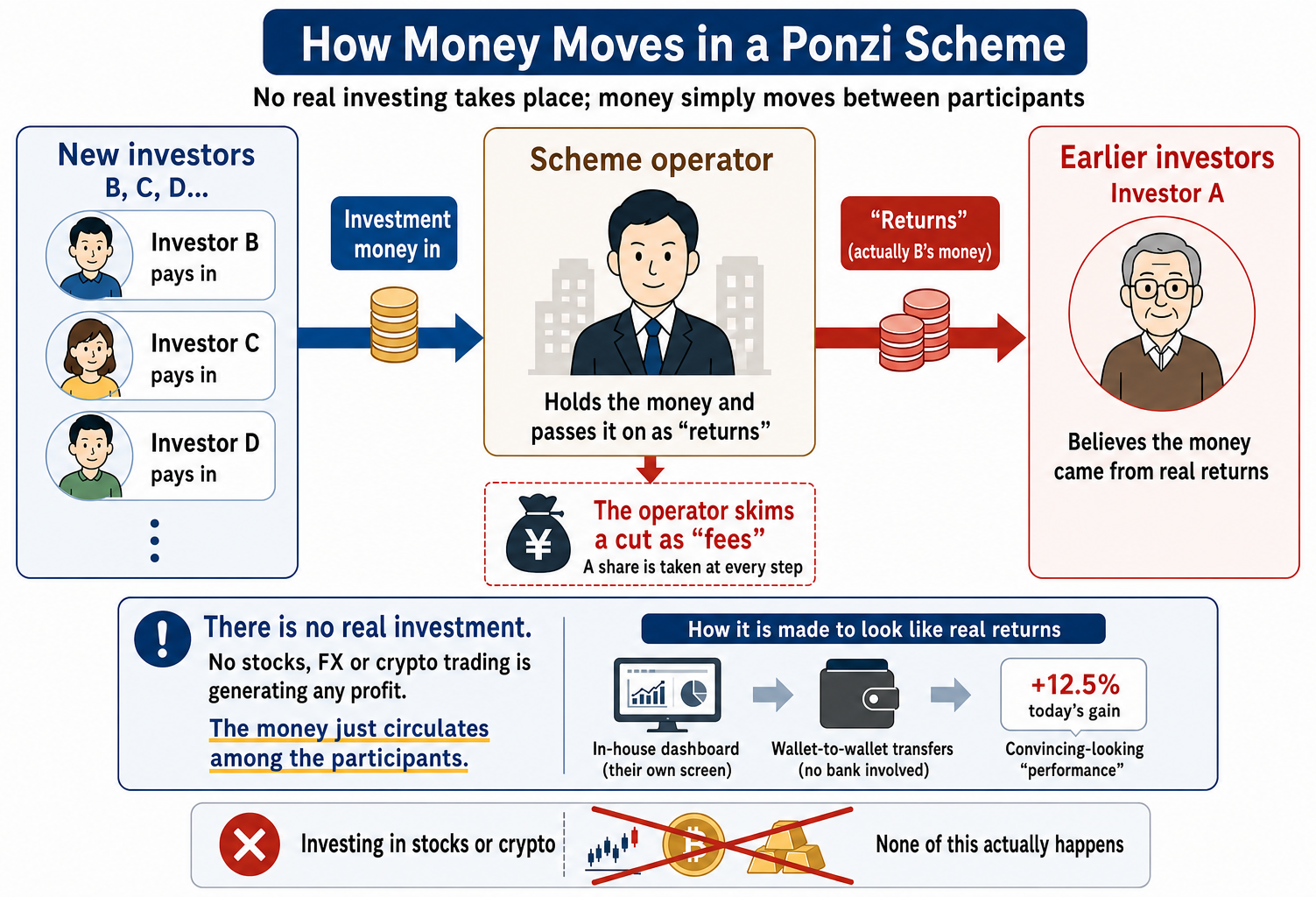
In this way, the flow of money in a Ponzi scheme isn't a mechanism for "growing" funds — it's merely a mechanism for "circulating" them. So why does this "circulation-only" mechanism inevitably grind to a halt, rather than just hitting a temporary snag?
Why Ponzi Schemes Always Collapse
A Ponzi scheme is mathematically destined to collapse from the very start, regardless of economic conditions or investment skill. As explained in the previous section, the entire source of "returns" is the money of new investors. But because the promised returns are large — such as "10% every month" — sustaining those payouts requires continually recruiting more new investors than before.
Suppose, for example, that covering the returns requires collecting new money at a pace of 1.5 times each month. Starting with just 10 people, maintaining that pace would require hundreds of new participants within a few months, tens of thousands within a year, and — within just a few years — a number of new participants exceeding the entire population of Japan. Naturally, growth at that rate can never continue in reality. The moment the pace of recruitment fails to keep up with the pace of payouts, the fund runs dry and the scheme collapses.
In crypto-related schemes, this collapse tends to arrive more abruptly. While memberships can surge quickly through social media and online recruitment, bad rumors also spread just as fast, and once new inflows stop, withdrawal requests tend to cascade in all at once.
What matters is that collapse isn't a matter of "if," but "when." And that "when" is precisely the moment the operator is watching for most carefully — and preparing to exploit.
When and How Operators Vanish With the Funds
Precisely because operators know the scheme is destined to collapse, they aim to disappear before it fully breaks down — at the moment when the largest pile of funds is on hand. Situations commonly used as the trigger to "vanish" include the following.
- When new recruitment starts to slow down
- When withdrawal requests suddenly surge
- Immediately after a large campaign has finished pulling in a big round of funds
There are also common warning signs that appear right before operators disappear. To minimize your losses, you shouldn't overlook changes such as the following.
- Withdrawal conditions suddenly tighten, with newly introduced rules such as "a minimum lock-up of X months" or "a required fee"
- Withdrawals are suspended, citing reasons such as "system maintenance" or "responding to a financial regulator's review"
- Communication from the operator decreases, and updates to social media accounts or the website stop
- The operator suddenly starts emphasizing even higher returns or referral bonuses more aggressively than before
In crypto-based Ponzi schemes, it's common for operators to "vanish" by suddenly making the entire website or app inaccessible one day, cutting off any access to the assets deposited in wallets. Unlike bank accounts, tracking or freezing these funds is difficult, which is also part of what makes recovering losses so hard.
Every one of these signs indicates that collapse is approaching. If any of them seem to apply, the first step in protecting yourself is to stop depositing any further money and to attempt an early withdrawal to whatever extent possible.
Common Ponzi Scheme Tactics Seen in Crypto Assets
Crypto-based Ponzi schemes don't always approach you in a form that's obviously fraudulent at a glance. Even if you believe "I would never fall for a suspicious investment pitch," your guard can lower — and you can still get caught — if the offer comes through a trusted acquaintance, or if your first payout or withdrawal succeeds.
With that in mind, this section explains the most common crypto Ponzi scheme tactics, organized by the entry point of the pitch. As you read, check whether you or your family may have encountered a similar story.
"Fund Management" and "Lending" Types Promising High Returns and Principal Guarantees
The most classic — and the type most prone to large losses — are these "fund management" and "lending" schemes.
- "Deposit your crypto assets with us, and our professionals will manage them for you."
- "While your assets are deposited, you'll earn X% interest (returns) every month."
- "Your principal is guaranteed."
Collecting funds with pitches like these is the typical pattern. Because a legitimate service called "lending" — earning interest by lending out crypto assets — actually exists, beginners in particular tend to believe, "oh, so that kind of mechanism does exist," making them especially susceptible.
But remember the fundamental rule of Ponzi schemes: "guaranteed principal" and "high returns" can never coexist in any legitimate financial product. The very act of claiming a "guaranteed principal" for a volatile asset like crypto is, in itself, a sign that the structure doesn't add up.
This exact pattern played out in real life in the massive overseas fraud case known as BitConnect. Calling itself a lending program, BitConnect claimed its proprietary technology generated profit from crypto price movements and offered guaranteed returns, collecting funds from investors around the world.
According to the U.S. Department of Justice, however, the reality was a textbook Ponzi scheme — paying earlier investors with money from later investors. A key U.S. promoter pleaded guilty to conspiracy to commit fraud in September 2021, and a court ordered restitution to roughly 800 victims in more than 40 countries worldwide (as of the DOJ's 2022 announcement).
In truth, however, BitConnect operated a textbook Ponzi scheme by paying earlier BitConnect investors with money from later investors. Arcaro and his co-conspirators ensured that up to 15% of the money invested into BitConnect went directly into a slush fund to be used for the benefit of its owner and promoters.
Source: Office of Public Affairs
If you hear phrases like "just deposit it and watch it grow" or "far better than leaving it in a bank," your first move should be to suspect a fund-management-style Ponzi scheme.
Proprietary Token and Proprietary Blockchain Types
The next most common type involves getting you to buy a "proprietary token (proprietary coin)" issued exclusively by the operator. Using pitches like the following, victims are induced to purchase the token in exchange for Japanese yen or Bitcoin.
- "Buy now while you can — once it lists, the price will multiply dozens of times over."
- "This is a next-generation currency running on our own proprietary blockchain."
The key thing to check is whether that token can actually be bought and sold on a legitimate exchange (a registered crypto asset exchange service provider) that anyone can use.
Unlike Bitcoin or Ethereum, which can be freely traded on open markets, this type of token's price is displayed only within a proprietary site or app controlled by the operator. In other words, the operator can freely manipulate the price, and when you actually try to withdraw, you often find you can't cash it out at all.
In even more malicious cases, the claim of "running on a proprietary blockchain" is itself a complete fabrication — there have been massive overseas fraud cases where no blockchain existed at all.
You need to calmly ask yourself whether phrases like "pre-listing, limited sale, only now" are being used as a smokescreen to hide the lack of any real backing for the asset's value.
Types Disguised as "Arbitrage AI" or "Automated Trading"
The "arbitrage AI" and "automated trading (bot)" types exploit the dreamlike appeal of "AI will handle all the hard parts for you."
They solicit investment with explanations like, "Our AI runs arbitrage 24/7, exploiting price differences between exchanges, so you earn risk-free profits every day," or "Our cutting-edge AI system trades automatically, so even beginners can grow their money while they sleep." The technical, high-tech-sounding language is designed to create the illusion of "wow, this sounds impressive" and "this seems legitimate."
What's worth pausing to consider here is that no one can actually verify whether the AI is truly generating profit. In the typical structure, no such system exists at all — the operator is simply funneling collected money out as "returns."
In fact, there have been reported cases in which a scheme claiming to "manage crypto assets through arbitrage AI" collected tens of billions of yen, and a court later ruled it to be a Ponzi scheme (source: The Jubilee Ace Case | Consumer Law News).
Technical terms like "AI," "arbitrage," and "automated trading" may simply be used to obscure the fact that there's no real profit-generating activity behind them. If you ask how it works and get brushed off with "it's too complicated to explain," that's a red flag worth heeding.
Impersonating or Exploiting Celebrities and Public Figures
People tend to let their guard down the instant a familiar name or face appears. This tactic exploits that psychology by using celebrities and public figures. Particularly serious in recent years is the rise of ads and accounts impersonating real, well-known individuals.
These scams use the photos and names of well-known business figures or investors without permission to make it appear as though the person is personally endorsing the scheme, then direct victims to social media ads or LINE groups. What's important to note here is that the celebrity whose name is used is, in the vast majority of cases, also a victim — exploited without their consent. The very assumption that "if a celebrity is involved, it must be safe" is exactly what this tactic is designed to exploit.
The fact that it "looks like the person is personally promoting it" provides zero basis for trust. Judging the investment offer based on its actual substance — rather than on names, titles, or photos — is what will protect you.
Solicitation via Social Media and Dating Apps (Romance Investment Scams)
Finally, the tactic that has driven the largest growth in damages in recent years is solicitation that begins on social media or dating apps — the so-called "romance investment scam."
Scammers connect with victims through dating apps, social media, or direct messages on Instagram or X (formerly Twitter), spending weeks or months building romantic feelings and a strong sense of trust. Once the victim has let their guard down, the scammer naturally steers the conversation toward investment with lines like, "for our future together" or "I know a great crypto investment opportunity." The defining feature of this tactic is that it starts with building trust, not with money.
According to National Police Agency statistics, the scale of damages reached roughly ¥127.1 billion (around $850 million) in 2024. People who believe "I would never fall for a romance scam" are often the ones most likely to lose their cool judgment in the face of a trust relationship carefully built over time.
If someone you met online recommends a crypto investment, don't take it at face value no matter how sincere they seem — pause and think it through first.
Real-World Ponzi Scheme Cases
A Ponzi scheme isn't a rare kind of fraud that only catches out a small number of people. Changing its name and appearance, it continues to produce new victims around the world — including within Japan — even today.
Especially since the spread of crypto assets, funds can be gathered across borders almost instantly, which is why both the "scale" and "speed" of the resulting damage have grown to unprecedented levels.
From here, let's look at real cases that occurred both overseas and within Japan.
Ponzi Scheme Cases Overseas
Among crypto-based Ponzi schemes, the following are representative cases that caused especially large losses and were formally classified as fraud through legal proceedings.
OneCoin | OneCoin marketed itself as a next-generation crypto asset to raise funds, but it is alleged that no blockchain ever existed to back its transactions. Total losses worldwide are estimated at roughly $4 billion (approximately ¥640 billion), and its co-founders were prosecuted for fraud and related charges in the United States (source: United States Department of Justice). |
|---|---|
PlusToken | PlusToken promised high returns to anyone who deposited crypto assets into its dedicated wallet. It attracted around 2 million members, mainly across Asia, and the crypto assets it collected were valued at more than 50 billion yuan at the time — making it, at the time, considered the largest Ponzi scheme in history. Starting in 2019, Chinese authorities arrested numerous ringleaders (source: Supreme People's Procuratorate of the People's Republic of China). |
BitConnect | BitConnect grew rapidly by promising high returns — averaging around 1% daily and up to 2% — through a system that locked up funds for a set period. It claimed to generate profit through a proprietary trading bot, but in reality it used money from new investors to pay existing investors. Having collected roughly $2 billion from investors, in 2021 the SEC filed suit against its operating entity, founders, and key promoters for fraud and the offer and sale of unregistered securities (source: SEC.gov). |
Celsius | Celsius, a U.S. crypto lending platform promising high yields, initially appeared to be a legitimate service but collapsed in 2022. Founder Alex Mashinsky pleaded guilty to commodities fraud and securities fraud and was sentenced to 12 years in prison in May 2025 (source: Atarashii Keizai). |
Cases Within Japan
Overseas cases may seem like distant stories. But numerous instances of the exact same structure have also been confirmed within Japan. As the tactics grow more sophisticated, this is by no means someone else's problem.
The Jubilee Ace Case | This case involved raising funds by claiming to "run AI-driven automated arbitrage on crypto assets, generating stable profits," with total funds collected estimated at approximately ¥65 billion. Akira Tamai, who led the scheme, was arrested on suspicion of violating the Financial Instruments and Exchange Act (FIEA) for unregistered business operations, and on October 9, 2024, the Tokyo District Court ruled that "the existence of the arbitrage activity is unclear, and this constitutes what is known as a Ponzi scheme" (source: Consumer Law News). |
|---|---|
The Rawbiz "Ark Cash" Proprietary Currency Case | This case involved soliciting investment in "Ark Cash," a worthless proprietary currency not listed on any exchange, allegedly taking Bitcoin from victims in exchange. Victims were told things like "if it lists within a year, its value will multiply more than tenfold," resulting in total damages of roughly ¥2 billion across approximately 1,500 people nationwide. Six individuals, including the president of the operating company Rawbiz, were arrested on suspicion of violating the Payment Services Act (PSA) and committing fraud (source: Bunshun Online). |
Looking at these cases together, you'll notice that no matter how different the tactics may look on the surface, they share a common thread: promising high returns while the actual underlying operation can never be verified.
How to Spot a Ponzi Scheme
Because a Ponzi scheme continues paying out returns right up until the moment it collapses, the people caught up in it are often the ones most convinced "this is the real thing." That's exactly why the strongest defense is to pause the moment you're approached and check the offer, one by one, against checkpoints you already know in advance.
Fortunately, Ponzi schemes share common "warning signs" regardless of the specific tactic used. And when crypto assets are involved, there are additional field-specific points worth checking. Here, we'll organize how to spot them from two angles.
Warning Signs
No matter how polished a Ponzi scheme's presentation may be, its structure inevitably produces several "common signs" that can't be fully hidden. If even one of the following five applies, it should be treated as a strong warning sign.
① It Claims a Guaranteed Principal
Any investment, by definition, carries the risk of losing value. Flatly stating "your principal is guaranteed to come back" or "you will never lose money" is inherently unnatural for something billed as an investment.
In Japan, soliciting investment while guaranteeing the principal is, in principle, prohibited under Japan’s Shusshi-hō — the Act Regulating the Receipt of Contributions, Receipt of Deposits and Interest Rates.
In truth, however, BitConnect operated a textbook Ponzi scheme by paying earlier BitConnect investors with money from later investors. Arcaro and his co-conspirators ensured that up to 15% of the money invested into BitConnect went directly into a slush fund to be used for the benefit of its owner and promoters.
Source: e-Gov Japanese Law Search
The moment you hear the phrase "guaranteed principal," it's reasonable to suspect fraud right away.
② Returns That Are Too High or Wildly Out of Line With the Market
Numbers like "10% monthly," "over 100% annually," or "your assets will double while you do nothing" are essentially unachievable through real-world investment management. Because a Ponzi scheme simply recycles new investors' money as returns, it can advertise any attractive number it likes.
Don't think "high returns = a good deal." Think instead: "returns that are too high = a sign that the funding source doesn't add up."
③ Referral Bonuses or Recruitment Rewards Are Offered
A structure where "you get a reward for referring friends" or "your income grows as you recruit more people beneath you" strongly suggests that the actual source of profit is recruiting people, not any genuine investment return.
A legitimate investment, by nature, works fine without recruiting anyone else. A model that grows through chains of referrals is, more often than not, simply postponing its inevitable collapse.
④ Withdrawals Are Met With Resistance
Being told things like, "there's a special campaign right now, so you're better off keeping it deposited for another 3 months" or "withdrawing requires a large fee or advance tax payment," while the operator drags its feet on returning your money, is a classic late-stage symptom.
If returns are displayed as numbers on an account balance, but you're given excuses and delays the moment you try to actually cash them out, that can be a sign the operator's funds are starting to run dry.
⑤ The Actual Operation or Profit Source Is Unclear
Despite claims like "AI earns money automatically" or "we have proprietary winning logic," when you ask exactly how the profit is generated, you're brushed off with "that's a trade secret" or "it's too technical to explain." This state of "never actually being explained" is itself the biggest red flag.
A legitimate business should be able to explain its profit mechanism in plain terms, even to a layperson. If even one of these signs applies, treat it with caution; if several overlap, it's wise to consider it "almost certainly fraudulent" and keep your distance.
Crypto-Specific Points to Check
When crypto assets are involved, there are field-specific points worth checking in addition to the common signs above. Beginners in particular tend to be intimidated by strings of technical terms into thinking "I don't quite get it, but it sounds impressive" — but calmly checking the following points alone can bring the outline of any suspicious activity into much sharper focus.
① Can the Profit Source Be Explained in Plain Terms?
Phrases like "through blockchain," "through arbitrage," or "through staking rewards" deserve more scrutiny the more legitimate they sound.
What matters isn't the vocabulary, but whether the operator can logically explain where that money ultimately comes from and why. If they only string together technical terms without letting you trace the actual source of the funds, be suspicious.
② Is the Whitepaper's Content Specific?
Legitimate crypto projects generally publish a document known as a "whitepaper" that details the technical mechanism and issuance plan.
If no whitepaper exists, or if its contents are filled only with price talk — "guaranteed profits," "the price will be X times higher in the future" — without touching on the actual technology or operations, you can judge its credibility to be low.
③ Is It Listed on an Exchange, and Is There Real Liquidity?
A token that "isn't listed on any exchange yet — now is your chance" leaves its issuer free to control the price and withdrawals entirely on their own.
A currency that can't be freely bought or sold on a third-party exchange may be impossible to cash out when it matters, and its value ultimately depends on whatever price the issuer decides to quote.
④ Are Third-Party Audits and Operator Information Disclosed?
Has the asset management undergone an external audit? Are the operating company's location, responsible parties, and registration status disclosed? Operating a crypto asset exchange business within Japan requires registration with the FSA, but there are also many cases where unregistered operators pose as legitimate overseas businesses. Take a moment to consider whether you should really be entrusting your money to an operator whose true identity you can't see.
These are all points you can check simply by "asking" and "looking into it," even with only shallow knowledge of crypto assets. If the other party can't give you a proper answer, or seems to be dodging the question, that in itself is the clearest answer you'll get.
How to Avoid Falling Victim, and What to Do If You Do
Because scam tactics grow more sophisticated every year, it's entirely possible to be deceived even after learning how Ponzi schemes work. In fact, the FSA and the National Consumer Affairs Center of Japan receive a large number of inquiries related to crypto asset investment solicitations.
What matters is knowing, in advance, both the "prevention" you can practice before falling victim and the "consultation resources" you can rely on if you ever do get caught up in one. Here, we introduce concrete prevention methods along with official consultation channels for those who have already been affected.
How to Prevent Falling for a Ponzi Scheme
To guard against investment fraud, including Ponzi schemes, the first principle to keep in mind — one that Japan's Government Public Relations Online also repeatedly emphasizes — is to treat claims like "guaranteed profit" or "guaranteed principal with high returns" with suspicion from the outset.
In finance, return and risk are always two sides of the same coin — "high return with no risk" cannot exist as a matter of principle. Keeping this at the core, simply adopting the following habits can close off many of the entry points to being victimized.
① Don't Sign On the Spot for a Deal That Sounds Too Good
Pitches designed to rob you of time to think — "only now," "only for you," "you have to decide today or the spot will be filled" — are themselves a danger sign. If you're being rushed, take it home with you and sleep on it. That alone is enough to restore your composure. A genuinely good investment opportunity won't disappear just because you waited a few days.
② Always Consult a "Third Party" Before Putting Up Any Money
Scam pitches typically try to stop you from telling anyone, with lines like "don't tell people around you" or "keep this between us." Conversely, simply talking to a disinterested third party — family, friends — is itself a powerful preventive measure. If you have no one to talk to, reaching out to an official consultation channel is also effective.
③ Check for Yourself Whether the Operator Is Registered
Soliciting investment within Japan requires registration with the FSA. The FSA's official website publishes a list of registered operators, as well as warnings about unregistered and malicious operators. Make it a habit to check with your own eyes whether the other party is a properly registered operator.
④ Treat Investment Pitches via Social Media or Dating Apps With Suspicion
Recent damages have surged from solicitations by people met through social media or dating apps. If you make it a habit to suspect fraud whenever someone you've only met online brings up money or crypto assets, you can avoid a great deal of harm.
⑤ Don't Skip the Crypto-Specific Checks
For any crypto investment pitch, check whether the other party can concretely explain exactly where the profit comes from. If asking how it works only gets you vague answers like "AI earns it automatically" or "through arbitrage," there's a high chance no real underlying operation exists.
Use Official Consultation Channels
Even if you've already transferred money, or the other party has become unreachable, you don't need to handle it alone. Japan has official channels where you can consult free of charge about investment troubles and fraud damage.
One point of caution: once you've been victimized, you may feel desperate enough to turn to operators or social media accounts claiming "we'll get your money back." Be careful, though — among these are also solicitations aimed at causing "secondary victimization" by exploiting a victim's desperation.
For any money-related consultation, we strongly recommend starting with the official channels introduced below. And acting quickly matters — the longer it takes after you notice the fraud, the harder it becomes to trace and respond to the funds. The moment something feels "off," consult an official channel as soon as possible.
Counseling Office for Financial Services Users (Financial Services Agency)
This is the FSA's consultation window for troubles and questions related to investment solicitations and financial products. You can consult even before entering into any contract, on questions like "is this operator registered?" or "is this investment offer legitimate?"
- Official site: https://www.fsa.go.jp/ordinary/chuui/attention.html
- Phone: 0570-050588
- Hours: Weekdays, 10:00 a.m.–5:00 p.m. (Japan Standard Time)
Consumer Hotline
This is a number for consulting about troubles related to contracts and transactions in general. Calling "188" from within Japan (no area code needed) connects you to your nearest Consumer Affairs Center or consumer consultation window, where a specialist counselor will assist you.
You can consult even at an early stage — for example, "I was solicited for a suspicious investment" or "I want to cancel, but they won't respond."
Police Consultation Hotline and Your Local Police Station
If you've fallen victim to fraud, or believe you're about to, you can consult the police. For urgent matters, call "110," but if it's "not an immediate emergency, but I want to discuss my concerns or damages," the number to use is "#9110." Both numbers are reachable only from within Japan.
- Official site: https://www.keishicho.metro.tokyo.lg.jp/sodan/nettrouble/jirei/cryptocurrency_fraud.html
National Consumer Affairs Center of Japan
This center publishes consultation cases, damage trends, and tips for handling issues related to crypto assets. It can serve as a useful reference for judging whether your own case constitutes fraud.
- Official site: https://www.kokusen.go.jp/soudan_topics/data/crypto.html
Frequently Asked Questions (FAQ)
So far, we've covered everything from how Ponzi schemes work to how to spot them. Finally, let's wrap up with a compact Q&A addressing common questions from beginners.
What Is a Ponzi Scheme?
A Ponzi scheme is an investment fraud with no real underlying operation, in which money collected from later investors is simply funneled to earlier investors as "returns."
It collects funds by promising "guaranteed high returns," but that profit isn't generated by any real investment activity — it's simply money paid in by new investors. The moment new funds stop coming in, the scheme collapses, and most investors lose their principal.
Why Do People Fall for Ponzi Schemes?
Many people assume "I'd surely notice something suspicious," but in reality, even knowledgeable people fall victim. The reason is that early investors really do receive "returns," which creates a genuine track record of "it really pays off."
As people who received returns recommend the scheme to family and friends, saying "it really paid off," a chain of trust spreads. On top of that, a sense of exclusivity — "only now," "only for you" — along with staged appearances by celebrities or experts, and flashy displays of lifestyle on social media, all work together to dull people's rational judgment.
Remembering the principle that "if it sounds too good to be true, there's a catch" is, above all else, the best form of prevention.
How Long Has the Ponzi Scheme Existed?
The fraud case involving Charles Ponzi, the person the "Ponzi scheme" is named after, took place in the United States around 1920. In other words, as a technique, it has existed for more than a century — a very classic form of fraud.
Yet its essential nature hasn't changed at all today. In recent years, its combination with crypto assets has made it easier for damages to spread rapidly across borders. The reality is that an old technique is simply being repeated, wearing the disguise of the latest technology.
What's the Difference Between a Ponzi Scheme and a Pyramid Scheme?
Put simply, they differ in how money is collected and in how the profit is explained to participants.
A Ponzi scheme solicits investment by claiming "we will manage and grow your money," whereas a pyramid scheme (nezumi-kō) is a structure in which participants continuously recruit new members, with the entry fees or membership dues flowing up to those recruited earlier. That said, both schemes simply funnel new money to existing participants, and both are equally destined to collapse eventually.
Summary
A Ponzi scheme is an investment fraud with no real underlying operation, in which money collected from later investors is simply funneled to earlier investors as "returns." It's a classic technique that has existed largely unchanged for more than a century, yet it continues to spread damage in the crypto asset space today.
The entry points vary widely — pitches like "AI manages your money automatically," "our proprietary token is guaranteed to rise," or "guaranteed principal with high returns," ads impersonating celebrities, and solicitations via social media or dating apps. But what's happening beneath the surface hasn't changed, then or now.
That's exactly why, rather than memorizing individual tactics one by one, holding onto the principle — "be suspicious of any offer that promises high returns but can't concretely explain the source of its profit" — is the best defense of all. If something ever feels off, don't carry it alone: consult an official channel promptly, such as the FSA's consultation office, the Consumer Hotline, or the Police Consultation Hotline.
Equipping yourself with correct knowledge and calmly evaluating tempting offers is the most reliable way to protect your own assets and those of the people you care about.
This article is for informational purposes only and does not constitute financial or investment advice. Please consult a qualified professional before making investment decisions.


