


If you have earned a profit from crypto assets (also known as virtual currencies), it is important to correctly understand how the resulting tax is calculated. Treating it the same way as stocks or mutual funds can cause you to overlook differences in the applicable tax rate and how losses are handled, which can lead to unexpected misunderstandings.
This is because profits from crypto assets are, in principle, classified as miscellaneous income and subject to aggregate taxation. Aggregate taxation is a system in which income tax is calculated by combining multiple types of income, such as employment income and business income. This means you cannot consider the tax burden on your crypto profits in isolation.
In practice, income from crypto asset sales and various forms of rewards is combined with other income, such as employment income, to determine the final tax amount. Therefore, when thinking about crypto taxes, it is important to consider not just the profit from your trading but your overall income as well.
This article explains how crypto asset profits are treated under aggregate taxation, along with the transactions that commonly trigger taxable income and the basics of calculating that income.
Crypto asset profits are, in principle, subject to aggregate taxation

When you generate a profit from selling or using crypto assets, that profit is, in principle, classified as miscellaneous income. Miscellaneous income, like employment income and business income, is subject to aggregate taxation.
Profits arising from the sale or use of crypto assets are, in principle, classified as miscellaneous income and require a final income tax return, except where they arise incidental to activities that give rise to business income or other categories of income.
Source: Tax Treatment of Crypto Assets | National Tax Agency (NTA)
Under aggregate taxation, income tax is calculated after combining eligible income. For example, if a salaried employee also earns a profit from crypto assets, the tax rate is not determined by isolating the crypto income alone. Instead, the tax amount is calculated based on the combined total, including employment income and other sources.
This point is important when thinking about crypto taxes. Even if the crypto profit itself is the same amount, the resulting tax burden can vary depending on your other income.
Crypto assets are taxed differently from stocks and mutual funds
When considering crypto taxes, it helps to understand how they differ from stocks and mutual funds. Capital gains from stocks and mutual funds are, in principle, subject to separate self-assessment taxation, a system in which the tax amount is calculated separately from other income.
Crypto asset profits, on the other hand, are subject to aggregate taxation under the current system, as noted above. In other words, they differ from stocks and mutual funds in that they are calculated by combining them with employment income and other income (related: What Is the Difference Between Aggregate and Separate Taxation? A Clear Explanation of the Tax Differences Between Crypto Assets and Stock Investing (in Japanese)).
People with investment experience sometimes assume crypto assets can be treated the same as stocks. However, because crypto assets differ in their tax rate and how losses are handled, it is best not to lump them together with other investment products.
Even salaried employees may need to file a final tax return for crypto gains
Salaried employees generally have their tax matters settled through their employer's year-end adjustment. However, if you earn a certain level of profit from crypto assets, additional confirmation may be required.
Generally, if a salaried employee's total income other than employment income (including miscellaneous income from crypto assets) exceeds ¥200,000 (roughly US$1,300–1,400 at recent exchange rates) in a year, a final tax return may be required. Few people accurately understand this rule: in Clabo's own awareness survey, only 20.82% of respondents said they “understand the content and can explain it to others.”
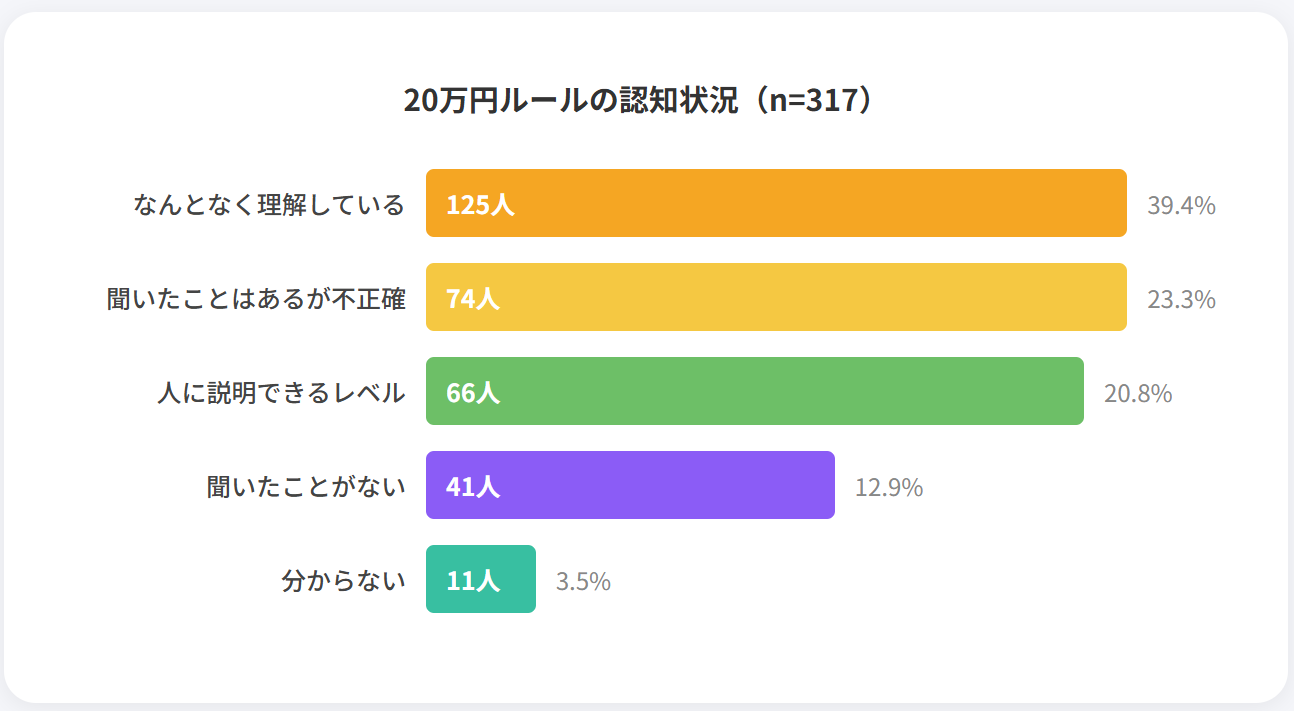
The most common response, at 39.43%, was “I have a vague understanding,” followed by 23.34% who said “I've heard of it but don't know the details.” These results suggest that even among people who are aware the rule exists, many do not understand the specific conditions for its application.
With crypto assets in particular, it is easy to overlook exactly which transactions generate taxable income. For example, income calculations may be required not only when you sell crypto assets for a profit, but also when you exchange one crypto asset for another and realize a gain. Even if you have not converted the asset into Japanese yen, tax authorities may still determine that income has arisen.
Whether a final tax return is required also depends on factors such as your employment income and whether you have other sources of income. In addition, even when a final income tax return is not required, you may still need to file a resident tax return, so this point requires attention.
For these reasons, it is best not to assume that being a salaried employee automatically means no filing is required. If you have earned a profit from crypto assets, check the details of your transactions and income amount, and consult a tax office or a certified tax accountant as needed.
Common transactions that trigger income subject to aggregate taxation

With crypto assets, taxable income is not limited to transactions where you sell for cash. Income calculations may also be required in various other situations, including exchanges, payments, and receiving rewards.
One point that deserves particular attention is that a tax liability can arise even in transactions that never convert back into Japanese yen. Exchanging one crypto asset for another, or using crypto assets to purchase goods, may be treated for tax purposes as if the asset were disposed of.
Understanding aggregate taxation for crypto assets, therefore, requires knowing which types of transactions are likely to generate taxable income.
Selling crypto assets for a profit
The most straightforward case is selling crypto assets for a profit. If you sell at a higher price than your purchase price, the difference becomes subject to income calculation.
For example, if you purchased a crypto asset for ¥1,000,000 (roughly US$6,700) and sold it for ¥1,500,000 (roughly US$10,000), a simple calculation would show a profit of ¥500,000 (roughly US$3,300). In an actual income calculation, factors such as the acquisition cost and fees must also be considered, but a sale that generates a gain can be subject to taxation.
Simply holding crypto assets does not, in principle, generate income. However, once you sell and realize a profit, it must be treated as income subject to aggregate taxation.
Exchanging one crypto asset for another for a profit
Income may also arise when you exchange one crypto asset for another. For example, if you exchange Bitcoin for Ethereum, this is treated for tax purposes as though you sold the Bitcoin and used the proceeds to acquire Ethereum.
In this case, if the market value of the crypto asset you exchanged exceeds its acquisition cost, a profit may result. Some people assume that because they have not converted anything into Japanese yen, taxes do not apply, but income calculations may be required even for crypto-to-crypto exchanges.
In fact, there is a case involving a private individual who, believing that exchanges between crypto assets did not need to be reported, only declared the portion converted into cash. The tax office subsequently identified the unreported income, and the individual was assessed over ¥200 million (roughly US$1.3 million) in back taxes.
He did not think the exchanged portion needed to be declared and filed his final tax return excluding it, only the portion converted into cash. In September of last year, the tax office pointed out the unreported income, and the additional tax assessment, including the penalty for underreporting, exceeded ¥200 million.
Cases like this show that exchanging one crypto asset for another is not simply swapping assets — it is a transaction that needs to be confirmed as one requiring an income calculation for tax purposes. If you frequently exchange multiple crypto assets, it is worth organizing the market value and acquisition cost for each transaction. As the number of transactions grows, the calculations tend to become more complex, so it is important to keep records from an early stage.
Using crypto assets to purchase goods or services
Even when you use crypto assets to purchase goods or services, income may arise for tax purposes. This is because, at the moment you make a crypto payment, the crypto asset is treated as though it had been transferred or disposed of.
For example, if you use a crypto asset that you originally acquired for ¥100,000 (roughly US$670) to purchase goods worth ¥150,000 (roughly US$1,000) at current market value, income may arise on the ¥50,000 (roughly US$330) portion corresponding to the appreciation in the crypto asset's value. Even if the crypto asset was used purely to make a purchase, it is treated for tax purposes as a disposal, so you need to confirm whether a profit has arisen.
People who use crypto assets for everyday payments tend to overlook this point. Even payments made for purchasing purposes require an income calculation based on the acquisition cost and the market value at the time of use, so it is important to keep records of the transaction details and market value.
Receiving rewards from staking or lending
Staking is a mechanism in which you contribute your held crypto assets to the operation of a blockchain network and receive rewards in return. Lending, on the other hand, refers to lending out your held crypto assets to a third party and receiving a usage fee as a reward.
These rewards are typically paid in crypto assets rather than Japanese yen. As a result, some people assume that because they have not received cash, taxes do not apply. However, even when rewards are received in crypto assets, they must be calculated for tax purposes based on the market value at the time they were received.
When crypto assets are acquired through mining, staking, lending, or similar means, the resulting profit is subject to income tax or corporate tax.
Source: Tax Treatment of Crypto Assets | National Tax Agency (NTA)
In addition, if you later sell a crypto asset received as a reward, the market value at the time of receipt becomes its acquisition cost. It is therefore important to record details such as the date and quantity received, the yen-equivalent value at the time of receipt, and the transaction history. Without this information, it becomes difficult to accurately calculate both the income at the time of receipt and any subsequent gain or loss upon sale.
How to calculate crypto income subject to aggregate taxation

When thinking about crypto taxes, it is important to first understand how the income amount is determined. Crypto assets involve many types of transactions, and the tax treatment can vary depending on the case.
There are also points to confirm depending on the details of your transactions and holdings when calculating the income amount. Understanding these details correctly makes it easier to avoid calculation errors when filing.
This section explains the basic approach to calculating crypto income and the points worth checking.
Income is calculated by subtracting necessary expenses from revenue
Crypto income is basically calculated by subtracting necessary expenses from the revenue amount. Revenue refers to the amount received from selling crypto assets, or the market value at the time crypto assets are used to purchase goods — in short, “the value of the crypto assets at the time you gave them up.”
The first thing to confirm as a necessary expense is the acquisition cost of the crypto assets sold. Acquisition cost refers to the amount spent to acquire the crypto assets that were sold. For example, if you sell crypto assets you previously purchased, the acquisition cost of those assets factors into the income calculation.
Fees paid when selling crypto assets are also a representative example of a necessary expense. The NTA's FAQ also lists the acquisition cost and sale-related fees as examples of necessary expenses in income calculations for crypto asset sales.
On the other hand, expenses such as internet connection fees, smartphone data charges, and computer purchase costs cannot always be treated as necessary expenses in full. These may be included as necessary expenses only to the extent that they can be recognized as directly necessary for crypto asset sales.
For example, if you use the same internet connection for both crypto trading and everyday use, you need to be able to clearly identify the portion used for crypto trading. In addition, for assets such as computers that have a useful life of one year or more and exceed a certain value, the cost cannot be expensed in full in a single year — it must instead be recorded as depreciation over multiple years.
For this reason, when calculating crypto income, it is important to distinguish between “costs directly tied to a transaction, such as the purchase price and sales fees” and “costs that require an explanation of their connection to the transaction, such as internet fees and computer costs.” If it is difficult to handle expense treatment on your own judgment, it is advisable to organize your transaction history and receipts and then consult a certified tax accountant or the tax office.
Acquisition cost is calculated using the total average method or the moving average method
If you have purchased crypto assets on multiple occasions, you need to determine the acquisition cost when calculating income at the time of sale. Acquisition cost refers to the price at which the crypto asset sold or used was originally acquired — in short, “the value of the crypto asset at the time you obtained it.”
For example, you might have purchased the same type of Bitcoin three times, at ¥3,000,000 (roughly US$20,000), ¥5,000,000 (roughly US$33,000), and ¥7,000,000 (roughly US$47,000) respectively. In such a case, the acquisition cost of the Bitcoin sold is not simply treated as “the first batch purchased” — instead, it is calculated using a defined method.
There are two main methods for calculating the acquisition cost of crypto assets: the total average method and the moving average method. Under the total average method, the average unit cost is calculated by dividing the total acquisition cost of a given crypto asset acquired over the year by the total quantity acquired. Because the calculation is done for the year as a whole, this method is relatively easy to organize.
The moving average method, on the other hand, recalculates the average unit cost each time crypto assets are acquired, based on the book value and quantity held at that point in time. Because the average unit cost is updated with every purchase, this method reflects each transaction's acquisition cost in finer detail, but the calculations tend to become more complex.
Both the total average method and the moving average method are used to calculate acquisition cost for crypto assets, but they differ in approach and effort required, and the resulting income amount can differ even for the same set of transactions. The main differences are summarized below.
Item | Total average method | Moving average method |
|---|---|---|
Basic approach | Calculates the average unit cost by combining all of the same type of crypto asset acquired within a year | Recalculates the average unit cost every time a crypto asset is acquired |
Timing of calculation | In principle, calculated once for all transactions over the year | Average unit cost is updated with each purchase or acquisition |
Ease of calculation | Relatively easy to calculate | Requires calculation with every transaction, so it tends to be complex |
When transaction volume is high | Easy to organize using annual transaction reports or statements | Per-transaction records become more important |
Impact on income amount | May produce a different income amount compared to the moving average method | May produce a different income amount compared to the total average method |
Best suited for | People with fewer transactions who want to keep the calculation as simple as possible | People who want to closely reflect price fluctuations at each point of acquisition |
If no election is filed | For individuals, the total average method applies by default | Using the moving average method requires a formal election filing |
Changing methods | Requires a formal procedure to change after selection | Requires a formal procedure to change after selection |
Caution | Appears simple, but does not always produce a more favorable income amount | Allows for more detailed calculation, but places a greater burden on record-keeping |
Note that for individuals who have not filed an election for their valuation method, the total average method applies by default. In addition, if you wish to change your selected valuation method later, you must submit an application for approval of the change to the director of your local tax office and receive approval.
To value crypto assets held as of the end of the year (December 31), which forms the basis for calculating the acquisition cost related to the sale of crypto assets, a "Notification of Crypto Asset Valuation Method for Income Tax Purposes" must be submitted, selecting either the "total average method" or the "moving average method."
If you wish to change this selected valuation method (including cases where the total average method applied because no notification was filed), you must submit an application (an "Application for Approval of Change in Crypto Asset Valuation Method for Income Tax Purposes") stating the details of the proposed change to the director of your local tax office by March 15 of the year in which you wish to make the change, and receive approval.
Source: Tax Treatment of Crypto Assets | National Tax Agency (NTA)
For this reason, the method used to calculate acquisition cost is not something you can freely change every year. If you have a high volume of transactions, or if you are unsure which method to choose, check your annual transaction report or the NTA's worksheet, and consult a certified tax accountant or the tax office as needed.
Without transaction history and fee records, calculations become difficult
The transactions you need to check for crypto income calculations are not limited to sales. Crypto-to-crypto exchanges, transfers between wallets, and rewards received from staking or lending are also transactions you need to review your history for. Because you need to organize the revenue amount, acquisition cost, and fees for each transaction, it is important to keep records on an ongoing basis so that you always have access to the information needed for income calculations, including the following:
- Date of sale
- Quantity sold
- Sale price
- Purchase price
- Fees
If you use a domestic crypto asset exchange service provider, checking your annual transaction report makes it easier to understand your purchase and sale details. The NTA's FAQ also directs users to check the annual transaction report for transactions conducted through domestic crypto asset exchange service providers.
For crypto asset transactions on and after January 1, 2018, the National Tax Agency has requested that crypto asset exchange service providers issue an "Annual Transaction Report" stating the following items, among others (see "2-9 Contents of the Annual Transaction Report").
- Quantity purchased during the year: the quantity of crypto assets purchased during the year
- Amount purchased during the year: the amount paid to purchase crypto assets during the year (acquisition cost)
- Quantity sold during the year: the quantity of crypto assets sold during the year
- Amount sold during the year: the amount received from selling crypto assets during the yearIf you do not have your annual transaction report on hand, please request that the crypto asset exchange service provider (re-)issue it.
Source: Tax Treatment of Crypto Assets | National Tax Agency (NTA)
On the other hand, for transactions on overseas exchanges, peer-to-peer trades, or self-custodied wallets, information may not be organized as neatly as it is with a domestic exchange. In such cases, you will need to confirm the acquisition cost and sale price using sources such as bank account deposit and withdrawal history, exchange transaction history, and market rates published by crypto asset exchange service providers.
Also, if you use multiple exchanges, your transaction history can become fragmented. For example, if you purchase a crypto asset on Exchange A, transfer it to Exchange B, and later sell it there, you may not be able to grasp your overall gain or loss from the records of a single exchange alone.
Fee records are also important, since fees paid for trading or transfers can factor into income calculations. In addition to the history shown on the trading screen, it is helpful to retain annual transaction reports, transfer history, and wallet history as well.
If you later lose track of the acquisition cost or sale price, it not only takes longer to calculate but also makes it harder to accurately determine your income amount. When trading crypto assets, it is important to keep records with each transaction so that you can review everything together at year-end or before filing your final tax return.
Crypto asset losses cannot always be treated the same as stock losses

When thinking about crypto taxes, it is important to understand not only how profits are treated but also how losses are handled. People with experience investing in stocks or mutual funds, in particular, tend to assume the same rules apply, which can lead them into unexpected pitfalls.
If you do not correctly understand the tax treatment of losses, you may find yourself confused when filing your final tax return. With that in mind, this section explains two key points to know about crypto asset losses.
In principle, losses cannot be offset against other income
Under the current system, a loss from crypto asset trading is not automatically offset against other income, such as employment income or business income. Offsetting of gains and losses is a mechanism in which a loss generated in one category of income is set off against a gain in another category of income.
For example, even if a salaried employee incurs a ¥500,000 (roughly US$3,300) loss on crypto asset trading, that loss cannot be deducted from employment income to reduce the tax burden. This is because, under the current system, crypto asset income is, in principle, classified as miscellaneous income.
A loss arising in the calculation of the amount of miscellaneous income cannot be deducted from (offset against) other income, such as employment income.
Source: Tax Treatment of Crypto Assets | National Tax Agency (NTA)
Under the Income Tax Act, losses that can be offset against other income are limited to those arising in the calculation of "real estate income, business income, forestry income, or capital gains (transfer income)." Miscellaneous income does not fall into any of these categories, so even if a loss arises in the calculation of miscellaneous income, it cannot be deducted from (offset against) other income. This is an important distinction from stock investing: because crypto losses are confined within the miscellaneous income category, they cannot be used to reduce tax on your salary or other income — a common point of confusion that can lead to misfiling.
Losses cannot be carried forward to future years
With stocks and mutual funds, under certain conditions, losses can be carried forward to offset gains in future years. Crypto assets, however, currently cannot have their trading losses carried forward to subsequent years under the present system (related: What Is the Difference Between Offsetting Gains and Losses and Carrying Forward Losses? (in Japanese)).
For example, suppose you incurred a ¥1,000,000 (roughly US$6,700) loss on crypto assets in one year and earned a ¥1,000,000 profit the following year. For crypto assets, because the year a loss occurs and the year a profit occurs must, under the current system, basically be treated separately, the prior year's loss cannot necessarily be deducted from the following year's profit.
Note that the tax treatment of crypto asset losses is expected to be revised as part of upcoming tax reform.
Where, among losses arising from the transfer of specified crypto assets to a person engaged in the crypto asset trading business, there remains an amount that cannot be fully deducted from the amount of transfer income, etc. related to specified crypto assets for the year in which the transfer occurred, that undeducted amount may, under certain conditions, be carried forward and deducted from the amount of transfer income, etc. related to specified crypto assets for each of the three years following that year.
Source: Fiscal Year 2026 Tax Reform Outline | Ministry of Finance (in Japanese)
For certain specified crypto assets, a mechanism is expected to be introduced, alongside the shift to separate taxation, that would allow losses to be carried forward for up to three years.
Crypto assets may be shifted to separate taxation

As explained above, under the current system, crypto asset profits are, in principle, classified as miscellaneous income and combined with employment income and other income under aggregate taxation. However, the Ministry of Finance's Fiscal Year 2026 Tax Reform Outline sets out a policy of shifting to "separate taxation," which would tax certain specified crypto assets separately from other income.
Where a resident, etc. transfers crypto assets (limited to crypto assets registered in the register of financial instruments business operators, hereinafter "specified crypto assets") to a person engaged in the crypto asset trading business (tentative name), the resulting transfer income, etc. will be taxed separately from other income at a rate of 20% (15% income tax, 5% individual resident tax).
Source: Fiscal Year 2026 Tax Reform Outline | Ministry of Finance (in Japanese)
Separate taxation is a system in which the tax amount for the relevant income is calculated on its own, without being combined with employment income, business income, or other income. It may be easiest to understand this as a potential shift toward a tax treatment closer to that of capital gains on stocks and mutual funds.
That said, not all crypto asset transactions would necessarily fall under separate taxation. The tax reform outline uses the term "specified crypto assets," so the scope of eligible assets and transactions requires careful attention.
In addition, the shift to separate taxation is premised on amendments to the Financial Instruments and Exchange Act (FIEA) and related legislation. As such, even after seeing news of the reform, it does not mean the change can be immediately applied to your current filing. When filing, it is important to confirm which system applies to the year in question.
Editorial update (as of July 24, 2026): As of publication, under current law, profits from selling crypto assets are classified as miscellaneous income and subject to aggregate taxation, as described throughout this article. Separately, on July 15, 2026, the amended FIEA was passed by Japan's House of Councillors in a plenary session, formally moving crypto assets to be treated as financial instruments under the FIEA. Based on this development, the 20% separate self-assessment tax rate discussed above is expected to take effect from the fiscal year following the amended law's implementation, currently projected around January 2028. Readers should confirm the rules in force for the specific tax year they are filing, as the transition timeline may still be adjusted before implementation.
If you are unsure about aggregate taxation on crypto assets, consult a professional

Crypto taxes are not something to be overly anxious about, as long as you have correctly organized the details of your transactions. If you review your sales, exchanges, and reward receipts and determine your income amount, it becomes easier to gauge whether filing is required and what your tax liability is likely to be.
At the same time, crypto taxes are an area where misunderstandings can easily arise if you approach them with the same mindset as stocks or mutual funds. Crypto-to-crypto exchanges, transactions that have not been converted into Japanese yen, and rewards from staking or lending can all potentially generate taxable income. If you trade frequently or use multiple exchanges and wallets, the calculations can become more complex.
What deserves particular caution is self-judgment along the lines of "it's a small amount, so it should be fine" or "I haven't converted it to yen, so I probably don't need to report it." Because crypto transaction histories remain on exchanges and the blockchain, unreported income can later be identified by tax authorities. If required filings are not made, you may face an unexpectedly large burden from additional tax assessments and late-payment penalties.
The more time that passes, the harder it becomes to reconstruct your transaction history. If you lose access to records from an exchange you previously used, or forget the reason behind a wallet-to-wallet transfer, it takes longer to calculate your income accurately. As a result, you may end up scrambling to prepare just before the filing deadline.
If you are unsure, it is important to consult a certified tax accountant or the tax office. When consulting, organizing your annual transaction reports, transaction history, wallet transfer records, and fee records in advance will make it easier to explain your situation.
Crypto tax treatment can vary depending on your transaction details and holdings. If you find it difficult to proceed on your own judgment, consult a professional early to avoid unreported income or calculation errors (related: How Much Do Tax Accountant Fees Cost for Crypto Assets? (in Japanese)).
Conclusion
Under the current system, crypto asset profits are, in principle, classified as miscellaneous income and subject to aggregate taxation. Because aggregate taxation combines the tax calculation with employment income and other income, the tax treatment differs from that of stocks and mutual funds.
In addition, taxable income from crypto assets is not limited to sales — it can also arise from crypto-to-crypto exchanges, purchases of goods or services, and rewards received from staking or lending. Please note that a tax review may be required even in cases where the crypto assets were never converted into Japanese yen.
Accurately understanding your crypto tax burden requires records of your transaction history, acquisition cost, and fees. Once you understand how aggregate taxation works, calculate your income based on your own transaction details, and consult a professional whenever you are unsure.
This article is for informational purposes only and does not constitute financial or investment advice. Please consult a qualified professional before making investment decisions.


