


Are investors who hold crypto assets (also known as virtual currencies) really going all-in on crypto alone? Our original survey of 992 respondents reveals a surprising reality that overturns that assumption.
In fact, only 7.9% of respondents are "all-in" investors who hold crypto assets exclusively. More than 90% of investors skillfully combine crypto with other financial assets, such as Japan's new NISA program and stock investing.
This article breaks down the ranking of investment types most commonly combined with crypto, along with the "golden ratio" of fund allocation that many investors are curious about. Based on the latest data, we unpack how today's investors are diversifying risk and building wealth wisely.
About 95% of Crypto Investors Diversify by Combining Other Assets
New NISA Adoption Drives Mutual Fund Combination to a Leading 22.4%
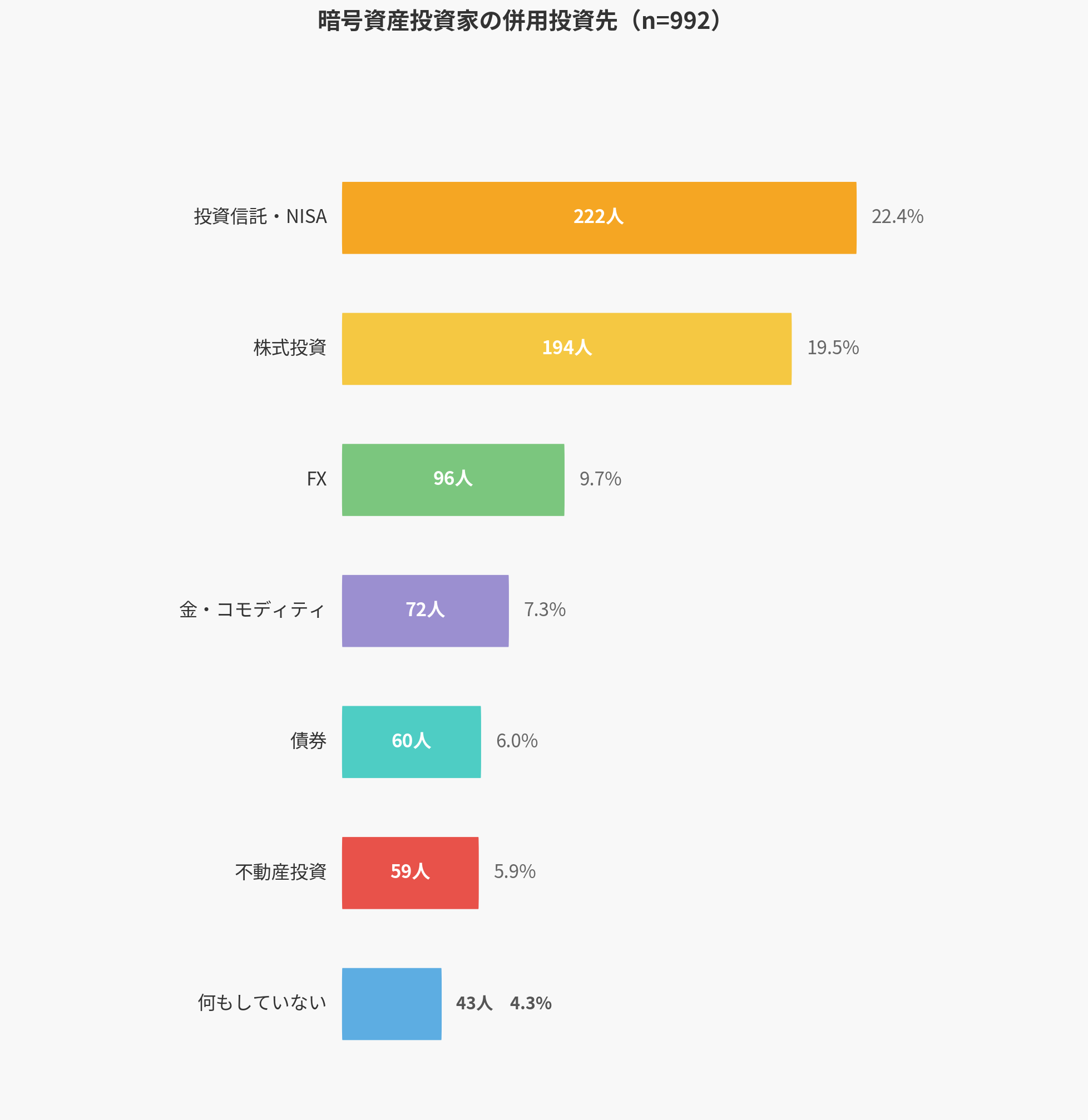
Investment Type | Adoption Rate |
|---|---|
Mutual funds / NISA | 22.4% |
Stock investing | 19.5% |
FX | 9.7% |
Gold / commodities | 7.3% |
Bonds | 6.0% |
Real estate investment | 5.9% |
None of the above | 4.3% |
Among crypto investors, an extremely high share also invest in other financial products in parallel. The adoption rate for "mutual funds / NISA" in particular reaches 22.4%, making clear that many investors are pursuing steady wealth-building while taking advantage of tax-advantaged schemes.
Partly due to the influence of Japan's new NISA program, launched in 2024, a growing number of investors are combining high-risk, high-return crypto assets with stable index-fund investing. "Stock investing" also boasts a high 19.5% combination rate, suggesting investors are building portfolios by weighing traditional financial assets against digital assets.
Meanwhile, only 4.3% of respondents said they were "not doing anything else," revealing that roughly 95% of crypto investors practice some form of diversification. Putting everything into crypto assets alone is no longer the mainstream risk approach among today's investors.
Investors in Their 30s Show NISA and Stock Combination Rates Both Above 20%
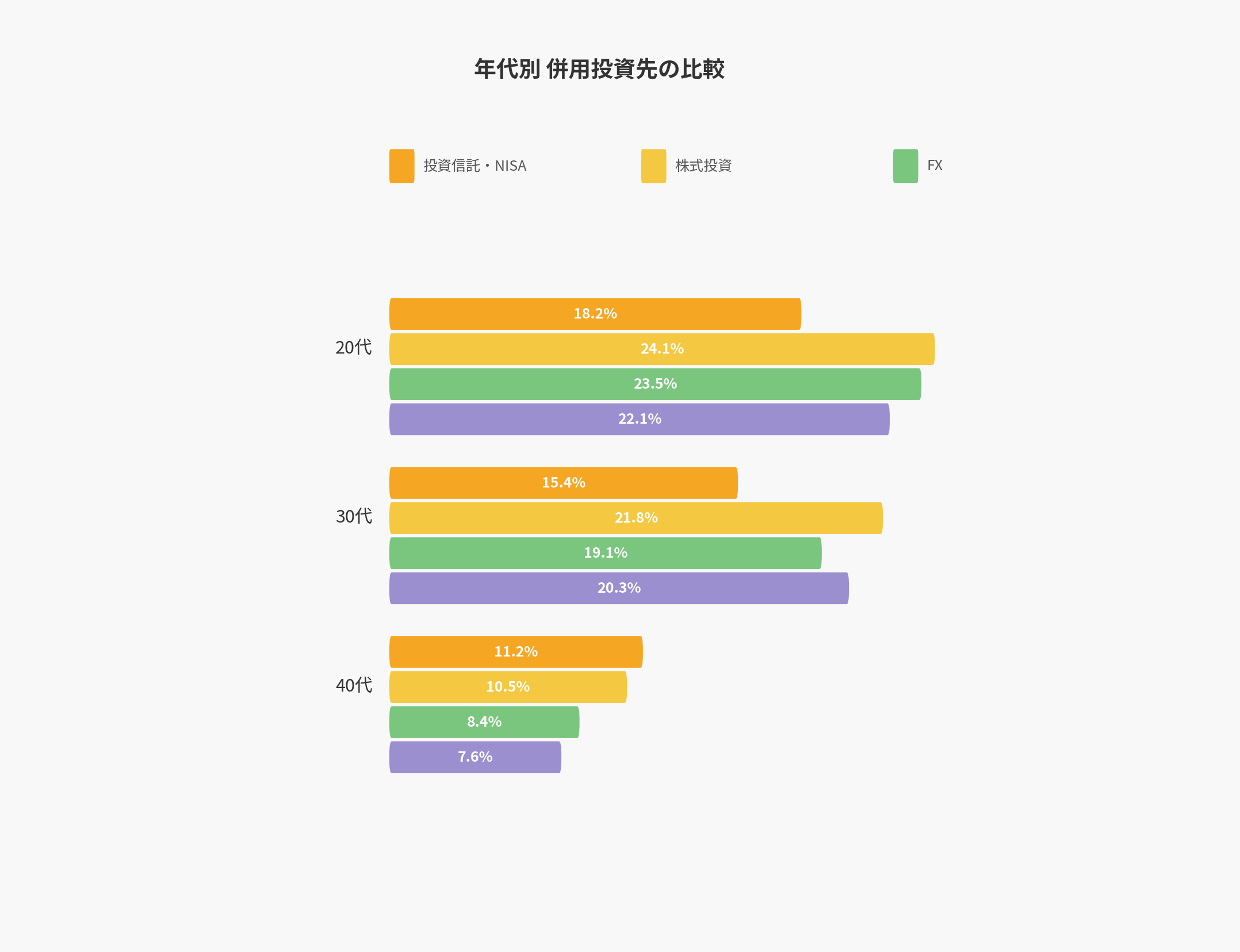
Age Group | Mutual Funds / NISA | Stock Investing | FX |
|---|---|---|---|
20s | 18.2% | 15.4% | 11.2% |
30s | 24.1% | 21.8% | 10.5% |
40s | 23.5% | 19.1% | 8.4% |
50s | 22.1% | 20.3% | 7.6% |
Looking at trends by age group, investors in their 30s stand out for their proactive combination of assets, with mutual funds / NISA usage at 24.1% and stock investing at 21.8% — the highest of any generation. This generation, which shows a strong awareness of future wealth-building, tends to treat crypto assets as a growth allocation while steadily building up a solid asset base.
Among investors in their 20s, the FX adoption rate is 11.2%, higher than other age groups, pointing to a tendency to pursue capital efficiency through more volatile products. In contrast, those in their 40s and above show stable allocation to NISA and stocks, and the data suggests they are adjusting their risk tolerance as their life stage changes.
The prevalence of a two-pronged strategy — "defensive" NISA paired with "offensive" crypto — among the working generation likely reflects the spread of investor education and the digitization of information. Rather than sticking to a single asset class, the data clearly shows a high level of literacy in flexibly using multiple options.
Households Earning ¥10 Million or More Also Accelerate Diversification into Real Estate and Gold
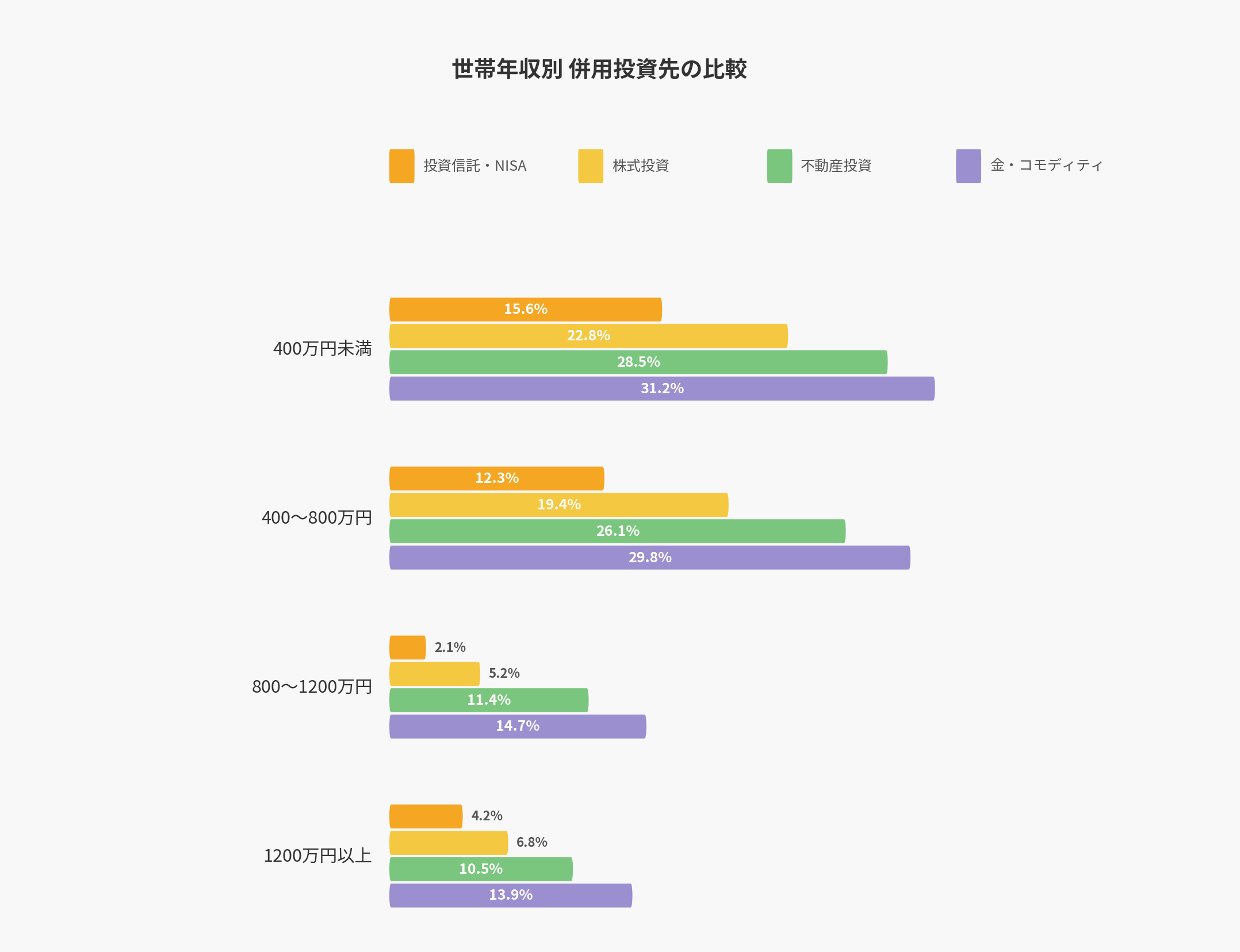
Household Income | Mutual Funds / NISA | Stock Investing | Real Estate Investment | Gold / Commodities |
|---|---|---|---|---|
Under ¥4 million | 15.6% | 12.3% | 2.1% | 4.2% |
¥4–8 million | 22.8% | 19.4% | 5.2% | 6.8% |
¥8–12 million | 28.5% | 26.1% | 11.4% | 10.5% |
¥12 million and above | 31.2% | 29.8% | 14.7% | 13.9% |
The data reveals a clear "asset diversification rule": as household income rises, the variety of asset types combined with crypto expands markedly. Among households earning ¥12 million or more (roughly US$80,000 at approximately ¥150/US$1), not only do NISA and stock adoption rates exceed 30%, but allocation to real estate investment (14.7%) and gold (13.9%) also increases noticeably.
Investors with greater financial capacity tend to redirect crypto gains into other real or income-generating assets, strengthening the overall robustness of their portfolios. Among households earning under ¥4 million, NISA adoption remains at just 15.6%, suggesting a tendency to concentrate on lower-entry-barrier options such as crypto or mutual funds.
Notably, once household income exceeds ¥8 million, interest in traditionally defensive assets such as "bonds" and "real estate" rises sharply. This is thought to reflect an exit-strategy mindset in which investors, once they reach a certain level of assets, begin converting crypto gains into "harder" assets.
Allocations of 30% or Less to Crypto Are the Most Common, at Roughly 40%
Conservative Investors Who Treat Crypto as a Secondary Holding Lead at 38.8%
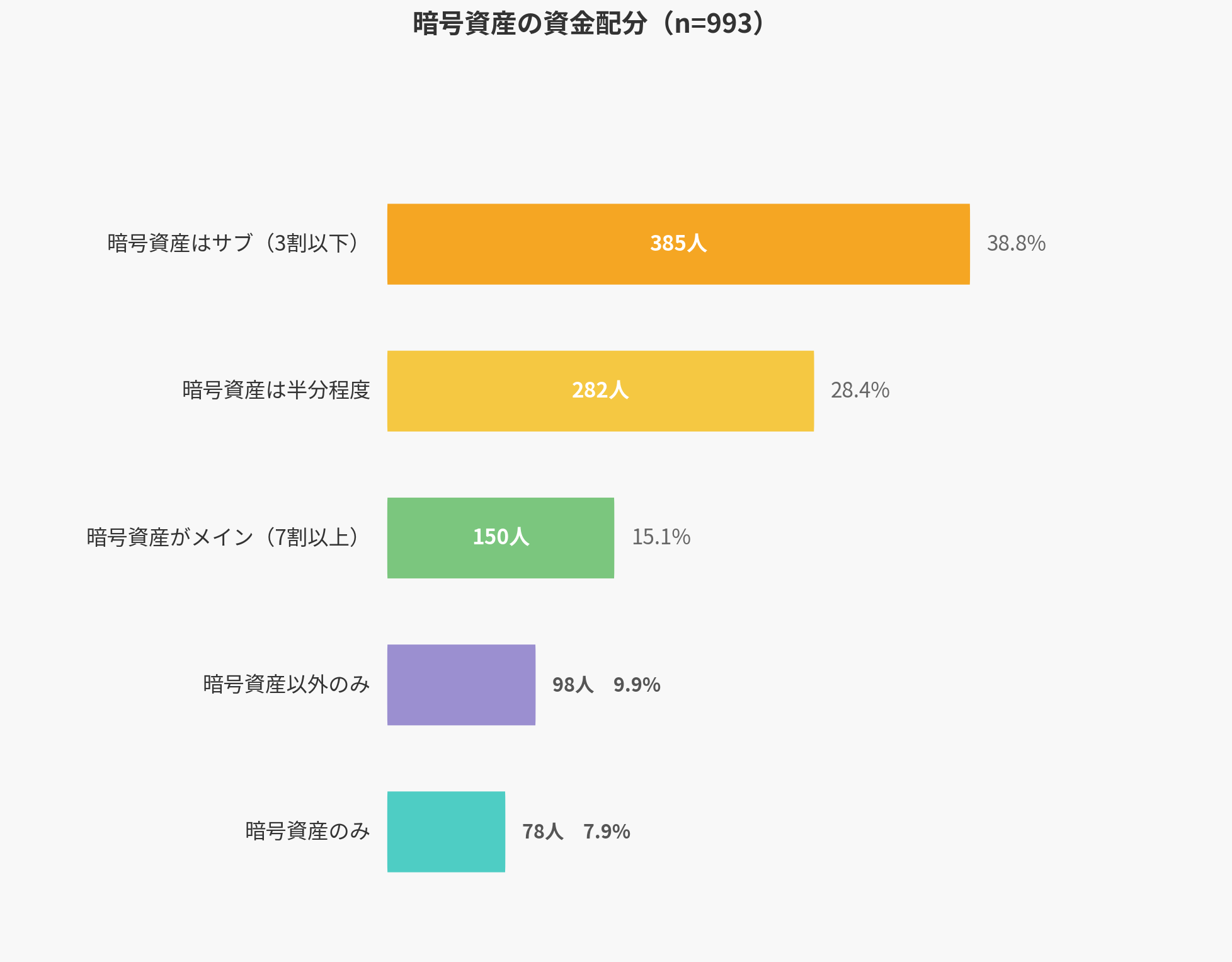
Approach to Fund Allocation | Respondents | Share |
|---|---|---|
Crypto is secondary (30% or less) | 385 people | 38.8% |
Crypto is about half | 282 people | 28.4% |
Crypto is the main holding (70% or more) | 150 people | 15.1% |
Non-crypto assets only | 98 people | 9.9% |
Crypto assets only | 78 people | 7.9% |
When we surveyed the share of crypto assets within investors' overall portfolios, "30% or less, as a secondary holding" was the most common answer at 38.8%. This shows that most investors do not treat crypto as the core of their asset-building strategy, but rather incorporate it in a limited way, using surplus funds or as a growth allocation.
The next most common response, at 28.4%, was "about half," indicating a meaningful group of investors who hold crypto and traditional assets in a balanced mix. Meanwhile, only 7.9% are "all-in" investors holding crypto assets exclusively, suggesting that risk-diversifying investment behavior has become the norm.
Given market volatility, a "core-satellite strategy" — holding a stable core asset base while using crypto as an accent — has become widespread. This trend suggests that crypto assets have shifted from a niche speculative instrument to a standard component of the typical individual investor's portfolio.
Short-Term Traders Show a Higher-Than-15% Concentration in Crypto
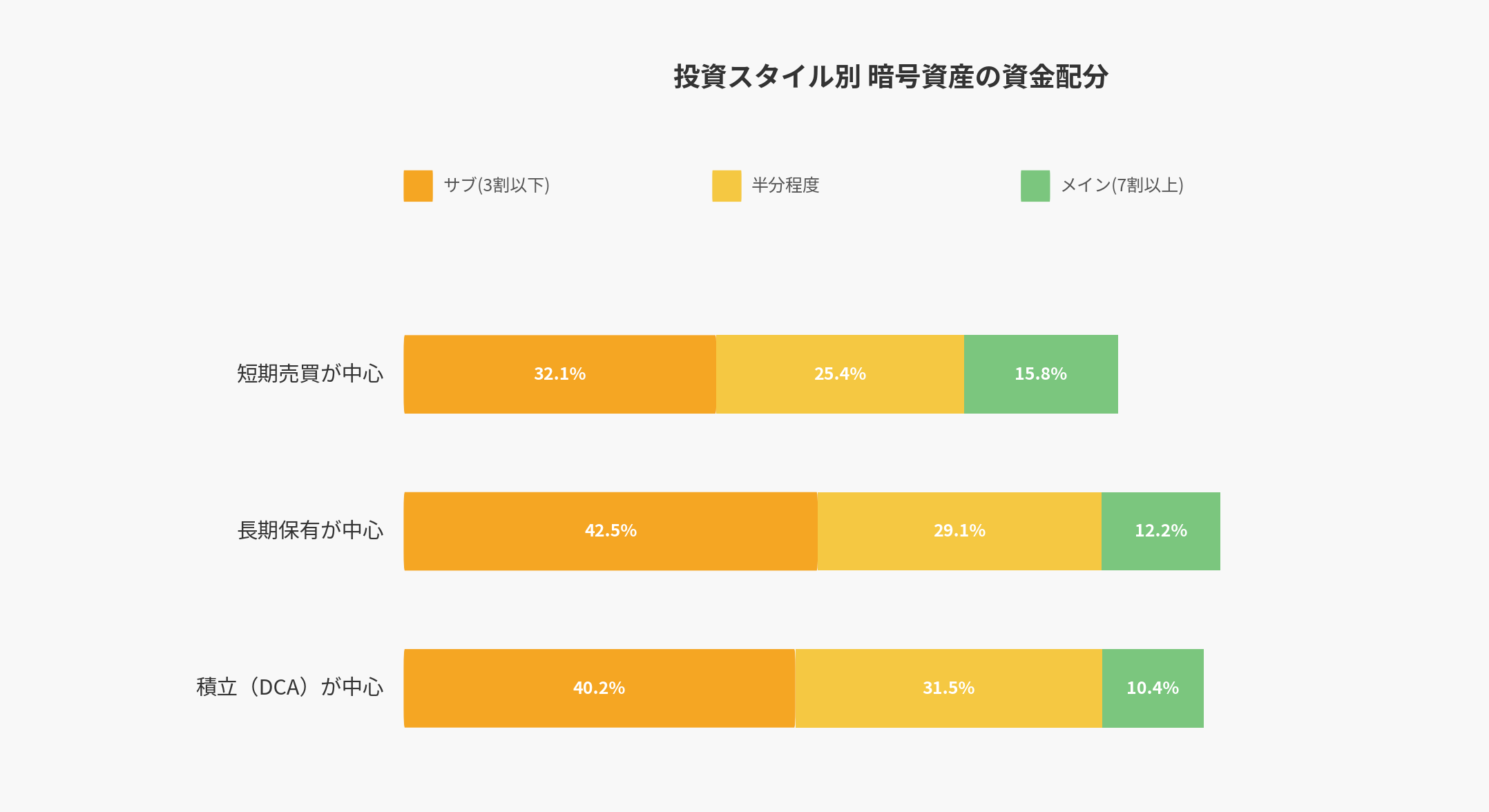
Investment Style | Crypto is secondary (30% or less) | Crypto is about half | Crypto is the main holding (70% or more) |
|---|---|---|---|
Primarily short-term trading | 32.1% | 25.4% | 15.8% |
Primarily long-term holding | 42.5% | 29.1% | 12.2% |
Primarily dollar-cost averaging (DCA) | 40.2% | 31.5% | 10.4% |
Analyzing fund allocation by investment style, investors who primarily trade short-term show the highest share choosing "70% or more as the main holding," at 15.8%, higher than other styles. When aiming to profit from short-term price movements, this suggests an intent to maximize capital efficiency by concentrating funds in crypto assets.
By contrast, among those whose primary style is long-term holding or dollar-cost averaging, more than about 40% choose "30% or less as a secondary holding," a clearly more conservative allocation preference. In particular, DCA investors tend to combine monthly fixed-amount purchases with NISA contributions, placing greater emphasis on the stability of their overall asset base.
The fact that many investors strategically adjust their crypto weighting according to their own investment objectives reflects the growing maturity of the market as a whole. Whether pursuing short-term "offense" or long-term "defense" clearly shapes what the optimal portfolio looks like.
Nearly Half of Public-Sector Employees Keep Crypto Allocation at 30% or Less
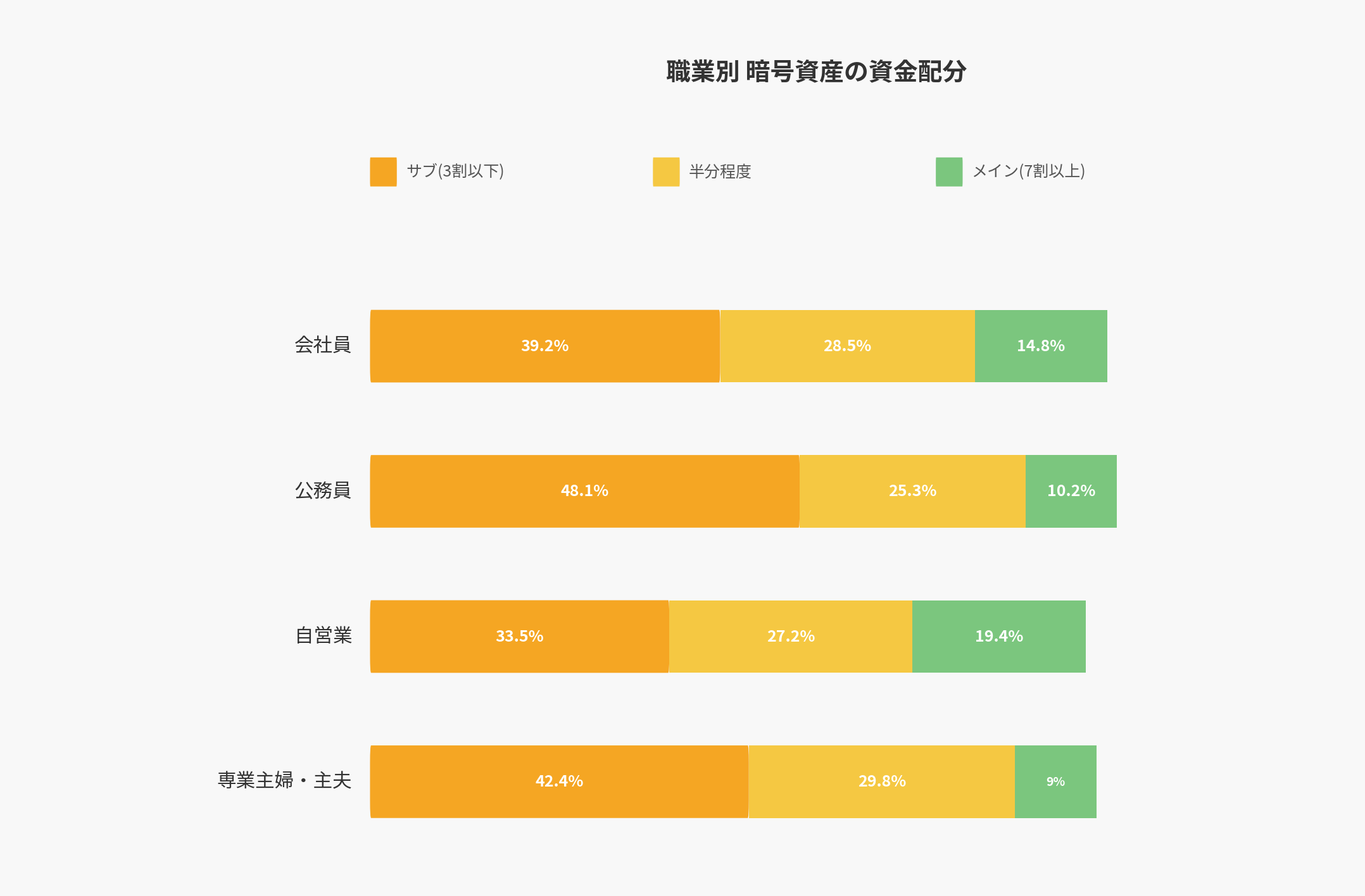
Occupation | Crypto is secondary (30% or less) | Crypto is about half | Crypto is the main holding (70% or more) |
|---|---|---|---|
Company employee | 39.2% | 28.5% | 14.8% |
Public-sector employee | 48.1% | 25.3% | 10.2% |
Self-employed | 33.5% | 27.2% | 19.4% |
Homemaker | 42.4% | 29.8% | 9.1% |
Looking at fund allocation by occupation, 48.1% of public-sector employees answered "30% or less as a secondary holding," the most conservative tendency of any occupation surveyed. Given the nature of their work, this group tends to place a strong emphasis on stability and treats crypto assets with caution, as just one part of their overall holdings.
In contrast, among the self-employed, "70% or more as the main holding" reached 19.4%, indicating a comparatively larger share of investors willing to take on risk in pursuit of greater returns. Having discretion over how they deploy their own funds may be connected to their more assertive crypto allocation.
Company employees and homemakers likewise show "secondary holding" as the most common response, suggesting they typically incorporate crypto within a reasonable range while considering household finances and future preparedness. The stability of one's income base and the nature of one's earnings appear to be strongly reflected in this sophisticated investment decision of how much to allocate to crypto assets.
As Total Investment Grows, Diversification Expands from NISA into Stocks and Real Estate
Investors With Under ¥1 Million Invested Emphasize Small-Scale Diversification via NISA at About 30%
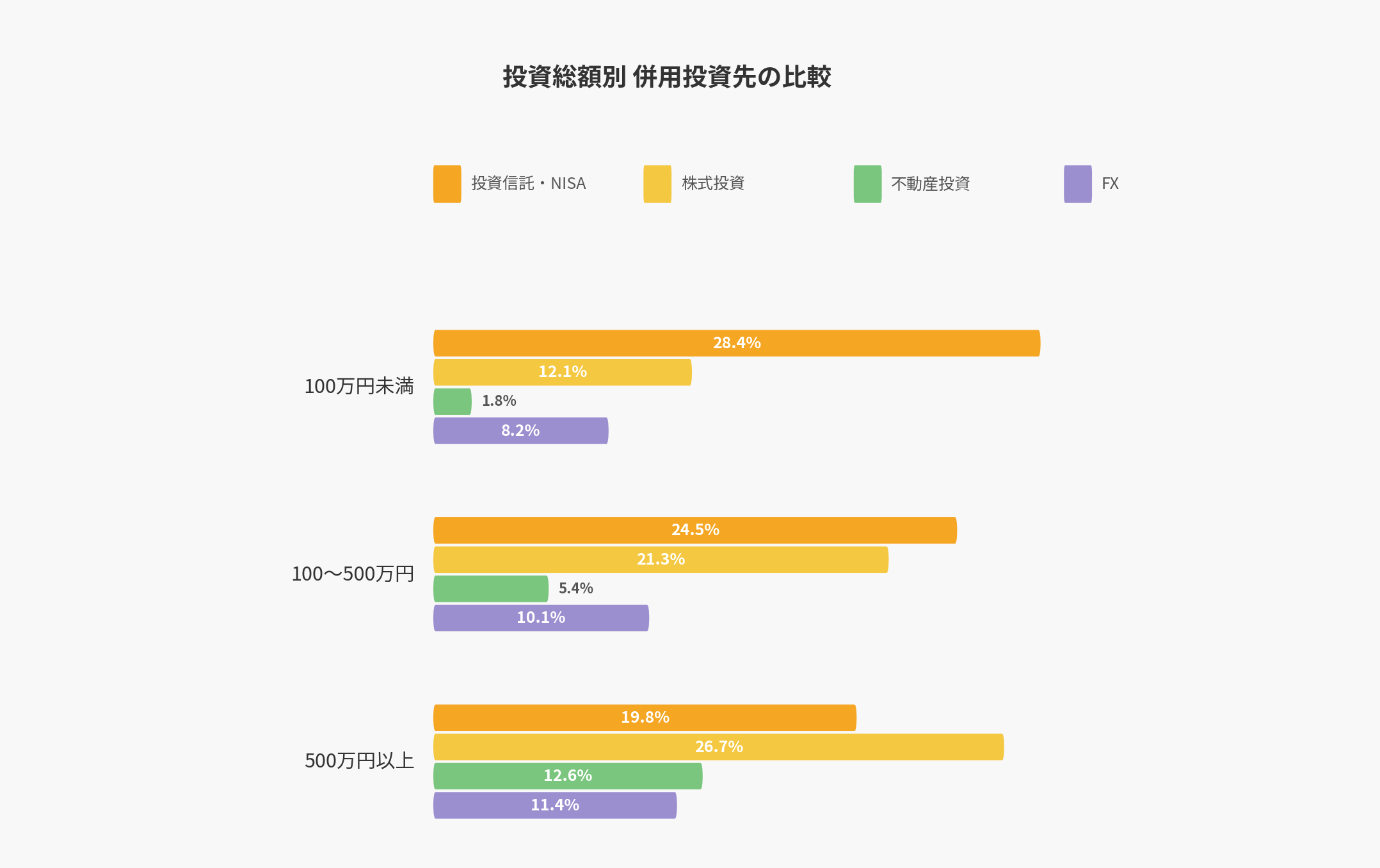
Combined Investment | Under ¥1 million | ¥1–5 million | ¥5 million and above |
|---|---|---|---|
Mutual funds / NISA | 28.4% | 24.5% | 19.8% |
Stock investing | 12.1% | 21.3% | 26.7% |
Real estate investment | 1.8% | 5.4% | 12.6% |
FX | 8.2% | 10.1% | 11.4% |
Among investors whose total crypto investment is still under ¥1 million (roughly US$6,700), the combination rate with NISA / mutual funds is highest, at 28.4%. This points to a defensive posture in which investors wisely make use of a tax-advantaged scheme to offset the high risk of crypto assets, even at an early, small-scale stage.
Meanwhile, this group's combination rate with stock investing remains at just 12.1%, suggesting continued caution toward investments that require individual stock analysis or a larger lump sum. Combining crypto assets with mutual funds — both accessible with relatively small amounts — appears to be the standard approach for today's novice investors.
Building on a foundation of low-cost index investing during the early, lower-investment stage is a sound strategy for long-term wealth-building. By using crypto assets as an entry point while simultaneously learning about NISA, the “orthodox” form of investing, investors appear to be building well-rounded investment experience.
Affluent Investors With ¥5 Million or More Also Shore Up Their Defenses, With Stock Combination Exceeding 26%
Combined Investment | Under ¥1 million | ¥1–5 million | ¥5 million and above |
|---|---|---|---|
Stock investing | 12.1% | 21.3% | 26.7% |
Gold / commodities | 3.5% | 7.2% | 13.1% |
Bonds | 2.1% | 5.8% | 11.5% |
None of the above | 6.4% | 3.2% | 1.9% |
Once total assets exceed ¥5 million (roughly US$33,000), the pattern of combined investments clearly shifts toward "multi-asset diversification for both offense and defense." Not only does the stock-combination rate rise to 26.7%, but allocation to traditional safe-haven assets such as gold and bonds also expands to over 10%.
As portfolio size grows, the need to incorporate low-correlation assets increases, in order to cushion the overall impact of a sharp crypto downturn. The fact that only 1.9% of this group answered "not doing anything else" also shows that investors moving larger sums place greater emphasis on thorough diversification.
Diversification within this group appears characterized less by pure profit-seeking and more by "asset defense." It is likely that investors are channeling capital gains from crypto into stable assets such as stock dividends and physical assets like gold, in pursuit of lasting wealth-building.
Real Estate Investment Adoption Surpasses 10% Once Household Income Crosses ¥8 Million
Household Income | Mutual Funds / NISA | Stock Investing | Real Estate Investment |
|---|---|---|---|
Under ¥4 million | 15.6% | 12.3% | 2.1% |
¥4–8 million | 22.8% | 19.4% | 5.2% |
¥8–12 million | 28.5% | 26.1% | 11.4% |
¥12 million and above | 31.2% | 29.8% | 14.7% |
Analyzing the correlation between household income and combined investments, we found a distinctive shift: participation in the high-ticket asset class of real estate investment rises sharply once household income crosses the ¥8 million mark. Among households earning ¥8 million or more, the real estate combination rate is 11.4% — more than five times higher than among households earning under ¥4 million (2.1%).
Investors with a certain level of income and creditworthiness tend to combine holding a highly liquid asset like crypto with leveraged real estate investment funded through financing. Combining "digital assets" and "physical assets" — polar opposites in nature — is a hallmark strategy among affluent investors for adding depth to their portfolios.
Additionally, among the top bracket earning ¥12 million or more, NISA adoption is also extremely high at 31.2%, reflecting a determination to make full use of every available tax-advantaged scheme. It is only natural that investment options expand as income rises, but underlying this is the deeply rooted investment principle of “risk management through diversification.”
Summary
This survey makes clear that the reality of crypto investors is not "all-in concentration" but rather a highly strategic shift toward "diversified investing." Roughly 95% of respondents combine crypto with at least one other asset, and the fact that NISA and mutual funds were the most common at 22.4% is likely no coincidence, given the spread of the new NISA program.
In terms of fund allocation, the most common approach, at 38.8%, is to keep crypto assets at "30% or less, as a secondary holding" — a posture of steadily growing wealth while managing volatility has become mainstream. At the same time, among investors with over ¥5 million invested or higher household income, we also confirmed an accelerating trend toward diversification into traditional assets such as stocks, real estate, and gold.
Crypto assets are no longer an isolated speculative instrument; they have established a place for themselves as the “spice” that accelerates portfolio growth. Combining the stability of NISA with the explosive potential of crypto assets, in a way suited to one's own investment style and asset size, is the advanced strategy that today's investors are called upon to pursue.
Survey Overview
Survey date: March 23, 2026
Survey method: Internet survey
Survey population: Men and women residing in Japan (people currently investing, or who have previously invested, in crypto assets)
Valid responses: 992
Conducted by: Clabo, Inc.
Survey Questions
- Have you ever invested in crypto assets?
- Which of the following is closest to your total cumulative investment in crypto assets to date?
- Which of the following is closest to your primary investment style?
- Besides crypto assets, which investments or asset-management approaches are you currently using? (Select all that apply.)
- Which of the following best describes your approach to fund allocation between crypto assets and other investments (stocks, NISA, etc.)?
This article is for informational purposes only and does not constitute financial or investment advice. Please consult a qualified professional before making investment decisions.


