


How familiar has "accumulation investing" — a dollar-cost averaging (DCA) approach to crypto assets (also known as virtual currencies) — become for investors today?
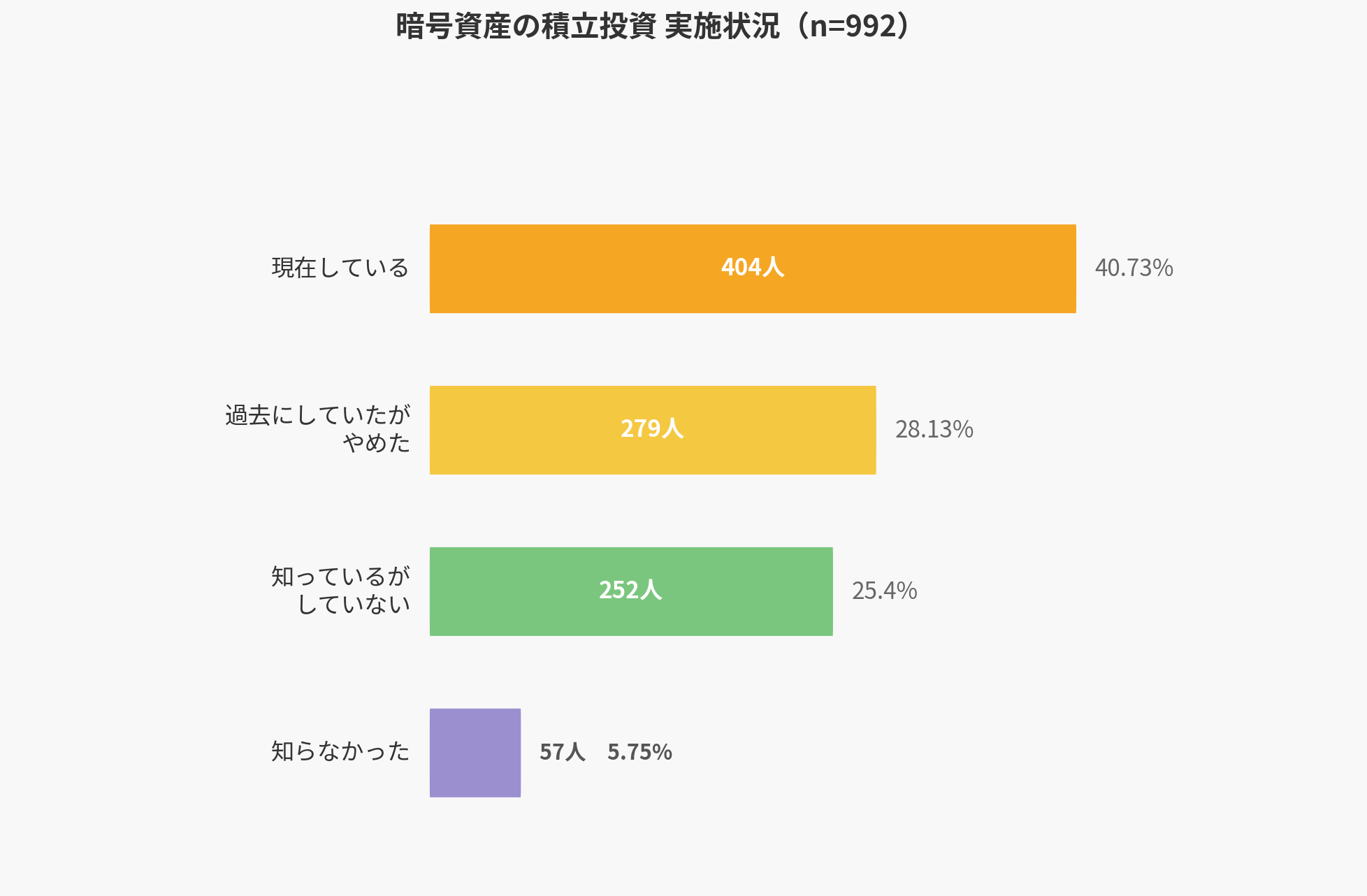
In our company's latest survey of 992 respondents, roughly four in ten said they are currently practicing crypto asset DCA investing.
At the same time, while the method itself is widely known, nearly 30% of respondents make up a "dropout" group who tried it in the past and gave up, highlighting how difficult it can be to stick with.
This article takes a deep dive into DCA adoption from three angles — "currently doing it," "did it in the past," and "never done it" — and uses hard numbers to show the decisive differences in adoption rates across investing styles.
We also analyzed investors' bullish outlook heading into 2026.
More than half of respondents said they want to increase their investment, suggesting strong expectations for further market growth ahead.
DCA Adoption Broken Down Into Three Groups: Current, Past, and Never
About 40% Currently Use DCA, Showing a Steady Approach Has Taken Hold Even in Crypto
Response | Responses | Percentage |
|---|---|---|
Currently doing it | 404 | 40.73% |
Did it in the past but stopped | 279 | 28.13% |
Aware of it but not doing it | 252 | 25.40% |
Was not aware of it | 57 | 5.75% |
In a survey of 992 crypto asset investors about their DCA investing habits, 40.73% said they are "currently doing it."
This suggests that even in the crypto asset market, led by Bitcoin, a steady investing style like dollar-cost averaging — designed to reduce price volatility risk — has become mainstream.
Meanwhile, 25.40% fall into the "aware of it but not doing it" group, revealing that a certain number of investors know about the method but haven't put it into practice.
In such a highly volatile market, this likely reflects a growing split between investors who deliberately prefer manual trading and those who prefer automated accumulation.
Only a very small share — 5.75% — said they were not even aware DCA investing was an option.
In the fast-moving crypto asset world, this data shows that awareness of the DCA services offered by major exchanges is extremely high, making it a familiar option for investors.
About 30% Have Stopped, Highlighting the Difficulty of Staying the Course and the Question of Exit Strategy
Response | Responses | Percentage |
|---|---|---|
Currently doing it | 404 | 40.73% |
Did it in the past but stopped | 279 | 28.13% |
Aware of it but not doing it | 252 | 25.40% |
Was not aware of it | 57 | 5.75% |
Notably, 28.13% of respondents said they "did it in the past but stopped."
DCA investing is well suited to long-term asset building, but it's not uncommon for investors to stop partway through due to crypto-specific sharp price swings, reaching a target amount, or a change in how they need to use their funds.
The size of this "dropout" group suggests just how much DCA investing tests an investor's resolve to keep going.
It's likely that a meaningful portion of this roughly 30% includes investors who, faced with unrealized losses during a downturn, were unable to keep making mechanical purchases and stopped.
Alternatively, some may fit a "strategic pause" pattern, having locked in sufficient profits through DCA and now waiting for the next opportunity.
Beyond the simple fact of "stopping," this figure reflects the fast pace unique to the crypto asset market and shifts in each investor's individual risk tolerance.
Awareness Tops 94%, but a Psychological Barrier Keeps Some From Acting
Response | Responses | Percentage |
|---|---|---|
Currently doing it | 404 | 40.73% |
Did it in the past but stopped | 279 | 28.13% |
Aware of it but not doing it | 252 | 25.40% |
Was not aware of it | 57 | 5.75% |
This survey found that 94.26% of respondents are aware DCA investing exists, showing it has become common knowledge among crypto asset investors.
However, among the 25.40% who are aware of it but said they "aren't doing it," a certain frustration unique to DCA investing appears to be at play.
While DCA is low-risk, it sits at the opposite end of the spectrum from the high-risk, high-reward trading style pursued by so-called "oku-ri-bito" (investors who made a fortune, literally "those who arrived at 100 million yen").
A desire not to miss out on big opportunities, combined with a wish to decide the timing of buys and sells for themselves, may be what's holding some investors back from switching to automated accumulation.
While DCA offers the advantage of being able to start with a small amount, it can look inefficient to investors who would rather deploy a lump sum all at once.
The choice to fully understand the merits of the method yet deliberately not adopt it clearly reflects the different ways individual investors approach the market.
DCA Adoption by Investing Style: 52% of "HODLers" Are Currently Accumulating
Over Half of Long-Term Holders Continue DCA, Showing Strong Fit With the Method
Cross-tabulating investing style against DCA adoption found that 52.0% of investors who identify as long-term holders (HODLers) are currently continuing DCA investing.
The HODL philosophy of "holding on without being swayed by every price swing" and the mechanical, ongoing buying that defines DCA investing appear to be an extremely strong strategic match.
This group also has the lowest "stopped in the past" rate of any style, at just 16.2%, and the data clearly shows a tendency to keep up DCA investing for the long haul once started.
For investors who ignore short-term price swings and look forward to value years down the line, DCA appears to have settled in as the lowest-stress, most rational choice.
Interestingly, even among investors who identify as "DCA-style" investors, only 48.0% are currently doing it, while roughly 30% have already stopped.
This reveals a reality in which investors who treat DCA as their main method still flexibly shift between accelerating and pausing depending on the market phase and their own financial situation.
Over 40% of Investors Who Combine Multiple Styles Have Stopped DCA, as Method Selection Accelerates
Investing Style | Currently Doing It | Did It in the Past but Stopped | Aware of It but Not Doing It | Was Not Aware of It |
|---|---|---|---|---|
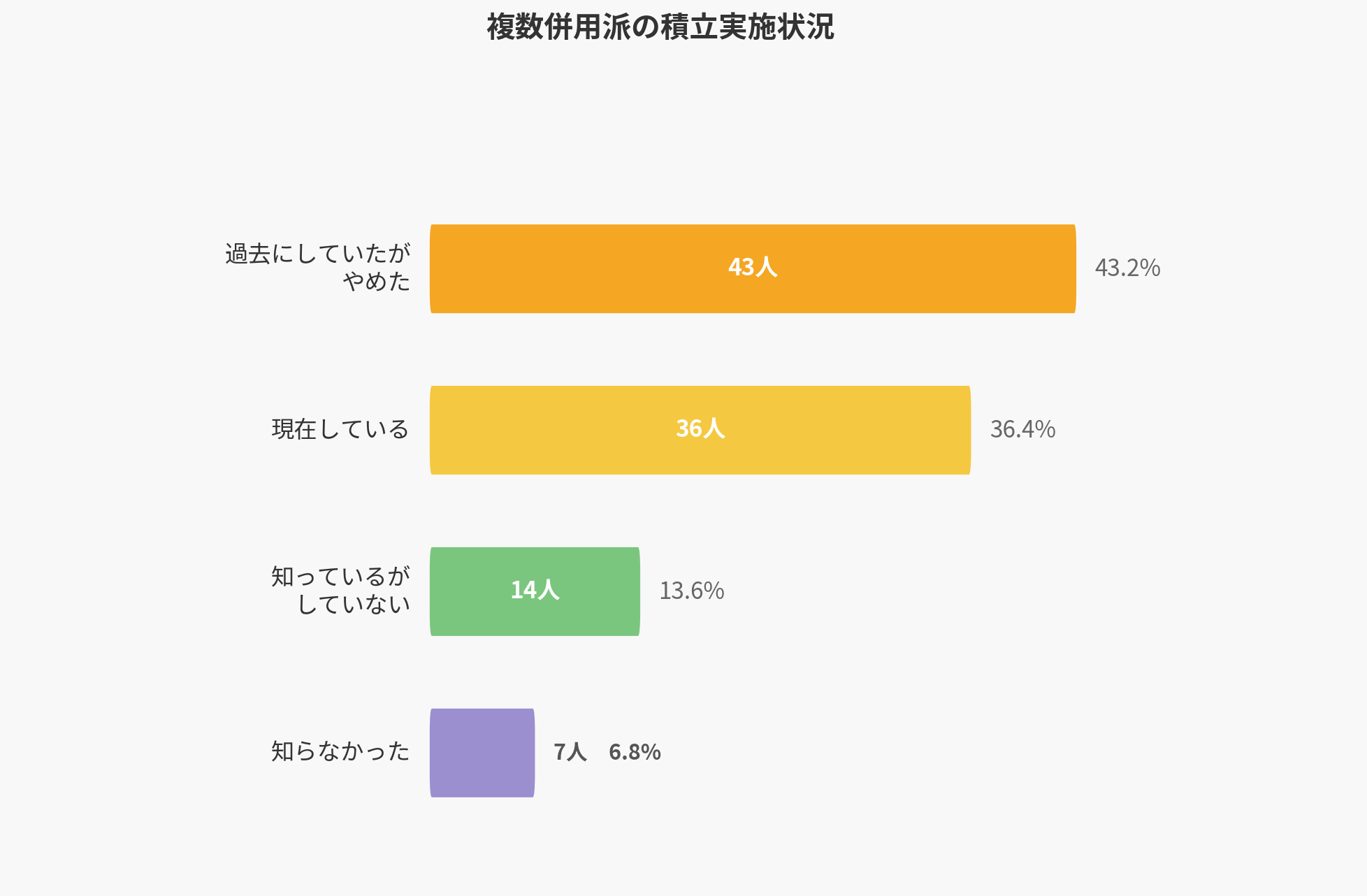
Combining multiple styles | 36.4% | 43.2% | 13.6% | 6.8% |
Among investors who mix multiple methods (the "combination" group), a high 43.2% said they "did DCA in the past but stopped."
This is likely the result of trial and error across various investing strategies, with these investors concluding that DCA didn't suit their investing efficiency or personality and redirecting funds to other methods.
The combination group is sensitive to changes in market conditions, and may be making agile decisions such as ramping up spot purchases or leveraged trading during rallies while pausing DCA during sideways markets.
The relatively low 13.6% "aware of it but not doing it" rate also suggests these investors tried DCA at least once before rebuilding their own portfolio approach.
For investors who see DCA not as the "foundation" of asset building but simply as one option among many, deciding to stop is not necessarily a negative.
Rather, in a market as versatile as crypto assets, it seems inevitable that a certain number of investors will move away from DCA as they refine their approach to match their own investment goals.
Short-Term Traders Have the Lowest DCA Rate at 25%, but Still 1 in 4 Combine It
Investing Style | Currently Doing It | Did It in the Past but Stopped | Aware of It but Not Doing It | Was Not Aware of It |
|---|---|---|---|---|
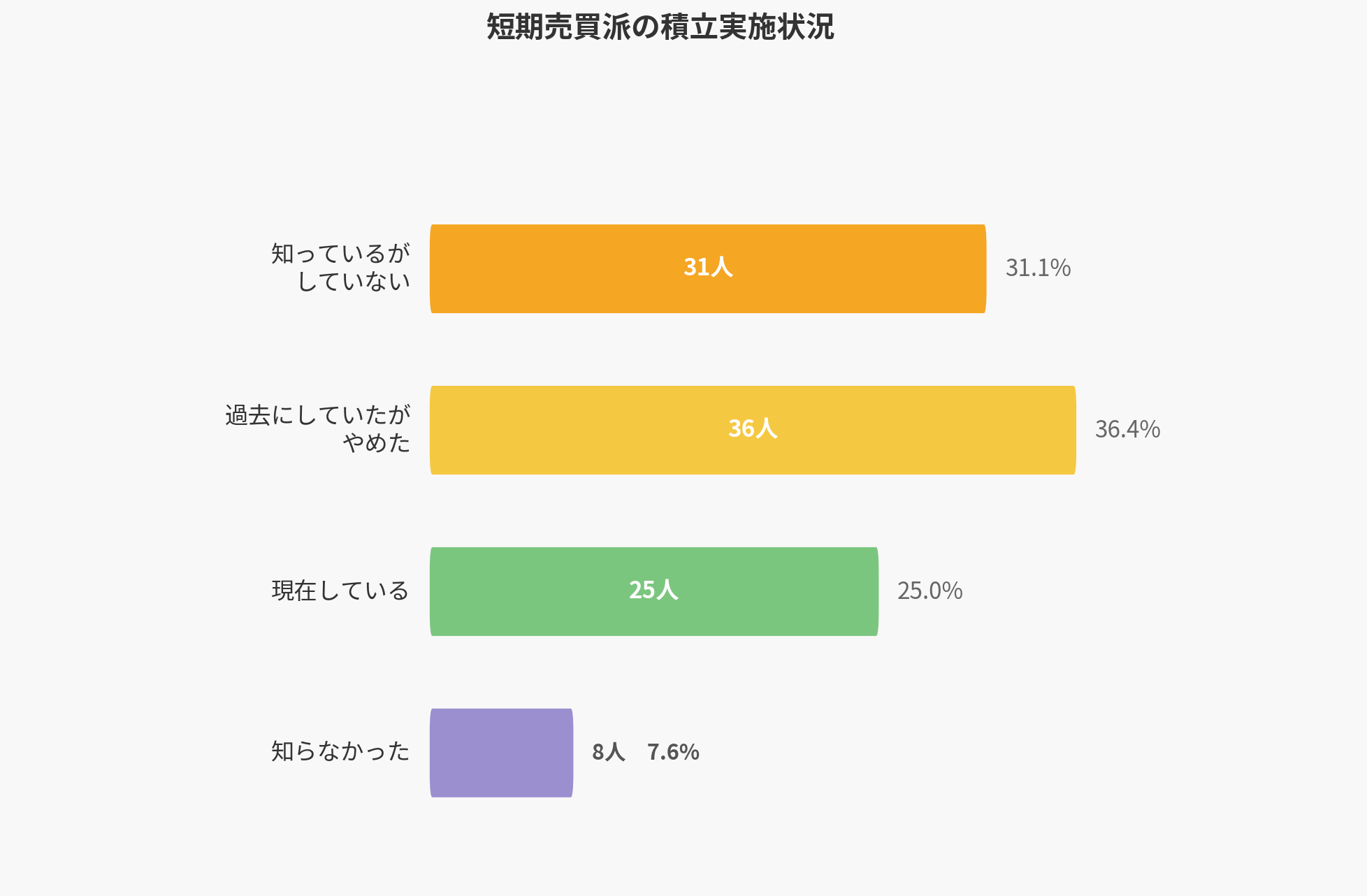
Short-term trading | 25.0% | 36.4% | 31.1% | 7.6% |
The DCA adoption rate among investors whose main style is short-term trading was 25.0%, the lowest of any style.
For a style that prioritizes locking in immediate profits through trading, DCA — which ties up funds over a long period and averages out the purchase price — tends to feel less appealing in terms of capital efficiency.
However, the fact that even one in four short-term traders continues DCA investing points to demand for it as a risk hedge.
A certain number of investors take a two-pronged approach, actively pursuing profits through day-to-day trading while also steadily accumulating Bitcoin and other assets as a "defensive" holding.
On the other hand, this group has the highest "aware of it but not doing it" rate at 31.1%, clearly showing a deliberate choice not to use it despite understanding its merits.
A trader's particular pride in reading the market with their own skill may be what sets DCA — which hands decisions over to a system — apart from their approach.
What Investment Plans Reveal About Why People Stop DCA and the Barriers to Sticking With It
Over 58% Want to Increase Investment, Yet 30% Have Dropped Out of DCA
2026 Investment Plans | Percentage |
|---|---|
Increase somewhat | 41.2% |
Maintain current level | 27.9% |
Increase significantly | 17.3% |
Considering exiting | 8.4% |
Decrease somewhat | 5.2% |
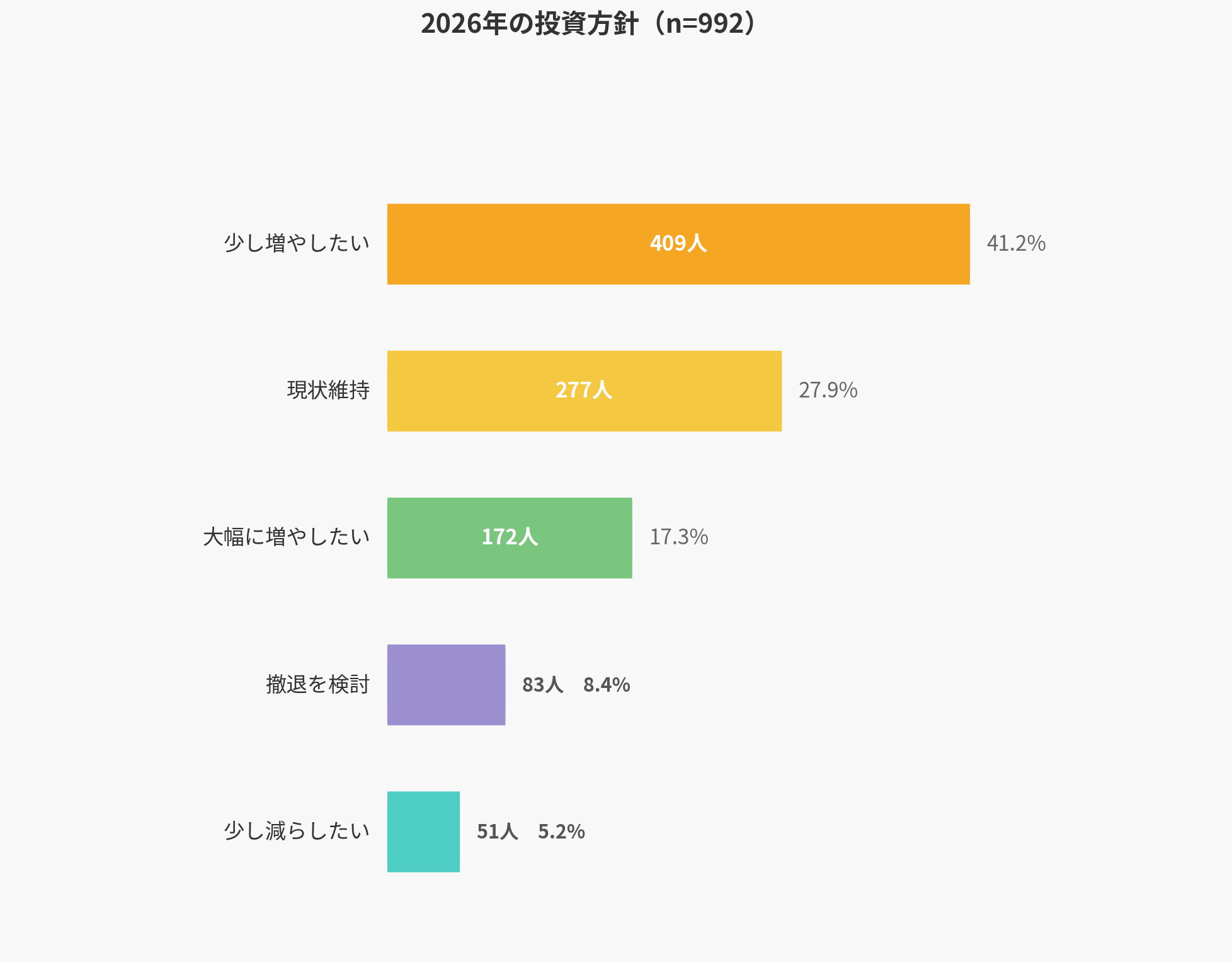
Asked about their 2026 investment plans, the bullish group combining "increase significantly" and "increase somewhat" reached 58.5%.
Even as this many investors show a bullish stance toward the market, the fact that 28.1% previously did DCA investing but stopped cannot be overlooked.
A pursuit of efficiency likely lies behind investors who want to grow their holdings yet have stopped DCA.
DCA suits steady asset building, but as market excitement heats up, plenty of investors decide to switch to lump-sum investing or concentrate their funds in specific altcoins instead.
It's also possible that some investors are resetting the "method" of DCA itself while keeping their overall expectations for the market intact.
In a bull market, rather than just continuing to buy steadily, some investors strategically move funds toward higher-return methods — and this kind of deliberate exit is likely part of that roughly 30% figure.
For Roughly 8% Considering Exiting, a Failed Attempt at DCA May Be a Factor
2026 Investment Plans | Percentage |
|---|---|
Considering exiting | 8.4% |
Decrease somewhat | 5.2% |
In this survey, only 8.4% of investors said they are "considering exiting," meaning the market as a whole still maintains a high retention rate.
However, there is a concern that this exit-minded group includes cases where giving up on DCA investing partway through led to a negative impression of investing itself.
DCA investing requires the nerve to keep buying even during downturns, and the experience of stopping because unrealized losses became unbearable can be psychologically painful for investors.
Once someone frames their DCA attempt as a "failure," it can easily become a motivation to leave the crypto asset market altogether, underscoring the difficulty of sticking with it.
Meanwhile, the 5.2% who want to "decrease somewhat" appear to be at the stage of adjusting their DCA amount as part of risk management.
Rather than a full exit, this group is making a calm decision to rebalance their portfolio, reflecting an attempt to maintain a healthy distance from the market.
The Roughly 28% Who Chose "Maintain Current Level" Are Prime Candidates to Resume DCA
2026 Investment Plans | Percentage |
|---|---|
Maintain current level | 27.9% |
The 27.9% who chose "maintain current level" as their investment plan overlap heavily with the "aware of it but not doing it" and "stopped" DCA groups.
While they are currently holding off on active buying, they haven't lost confidence in crypto assets and appear to be watching the next trend from the sidelines.
For this group, DCA investing is a highly effective way to "re-enter" and engage more deeply with the market again.
Even those who have stopped once still have plenty of potential to return to steady DCA investing if the market enters a stable phase or new growth prospects emerge.
Choosing to "maintain current level" is, in other words, a state of being "ready to move at any time."
Given how high awareness already is — with only 5.7% unaware of DCA investing — this points to a deep pool of potential investors who could turn back into active DCA participants given the right trigger.
58.5% of Investors Plan to Increase Their Investment in 2026
Investors Planning to Expand Make Up a Majority, Showing a Clear Bullish Stance on Crypto Assets
Response | Responses | Percentage |
|---|---|---|
Increase somewhat | 409 | 41.2% |
Maintain current level | 277 | 27.9% |
Increase significantly | 172 | 17.3% |
Considering exiting | 83 | 8.4% |
Decrease somewhat | 51 | 5.2% |
Asked about their 2026 investment plans, the "expansion" group combining "increase somewhat" (41.2%) and "increase significantly" (17.3%) reached 58.5%.
A majority of investors still hold a bullish outlook on the crypto asset market and continue to see it as a major means of building wealth.
The fact that roughly 17% specifically want to "increase significantly" suggests that a solid contingent of ambitious investors chasing high returns remains firmly in place, even amid a highly volatile market environment.
This appears to reflect continued confidence in major assets led by Bitcoin, along with ongoing interest in new technologies and projects.
At the same time, it's worth noting that the most common response was the more cautious "increase somewhat," rather than reckless expansion.
The data reflects a maturing investor mindset — moving away from gambling for a windfall and toward steadily building assets within the bounds of one's disposable funds.
Investors are increasingly allocating assets with a long-term perspective, rather than being swept up by a passing boom.
This kind of positive investment sentiment should serve as a powerful engine for the continued growth of the DCA investing market.
Heading into 2026, crypto assets can be seen as being in the process of establishing themselves as a more mainstream asset class.
Roughly 28% Choose to Maintain, Reflecting Market Resilience and a Wait-and-See Investor Base
Response | Responses | Percentage |
|---|---|---|
Maintain current level | 277 | 27.9% |
27.9% of investors chose "maintain current level" as their investment plan, meaning roughly 30% are holding steady on their current portfolio.
This group can be read as a "resilient base" — holding off on aggressive additional investment while staying in the market without selling their holdings.
Behind the decision to maintain current levels lies both a calm, watchful eye on where the market is heading and the confidence of already having completed their ideal asset allocation.
Choosing not to force a move and instead wait for the right opportunity is an important element of long-term asset building, and it likely also contributes to market stability.
For investors continuing DCA without changing their settings, simply buying on autopilot may also fall under the "maintain current level" category.
It's highly significant that a steady base of investors who stick to their own investing rules without getting swept up in excessive excitement is what gives the crypto asset market its depth.
Choosing to watch from the sidelines doesn't necessarily reflect a passive stance — it can also be read as strategic waiting in preparation for the next big wave.
Given the fast pace unique to the crypto asset market, deliberately not moving reflects a prudent attempt to control risk.
There is ample potential for these investors to eventually shift into the "expansion" camp, underpinning the market's latent room for growth.
Fewer Than 1 in 10 Are Considering Exiting, With Optimism Far Outweighing Negative Sentiment
Response | Responses | Percentage |
|---|---|---|
Considering exiting | 83 | 8.4% |
Decrease somewhat | 51 | 5.2% |
The "shrinking" group — combining "considering exiting" (8.4%) and "decrease somewhat" (5.2%) — came to just 13.6% overall.
Compared with the 58.5% expansion group, the gap is overwhelming: the energy pushing new money into the market far outweighs the number of people leaving it.
Possible reasons for considering an exit include locking in profits after reaching a target amount or a change in risk tolerance, but overall this represents only a small slice of the movement.
This low exit intent also demonstrates that crypto assets are recognized by many people as a lasting investment target rather than a "passing fad."
The fact that only around 5% want to "decrease somewhat" also speaks to how deep-rooted expectations remain for the value of their holdings to rise.
While some investors are stepping back, a far larger group aiming to enter or expand their positions points to an extremely healthy cycle within the market.
Heading into 2026, it's clear that while investors carry some factors pushing toward contraction, they hold, on the whole, strong confidence in further market growth.
Even if a short-term price correction occurs, the fact that a majority want to "increase" their holdings should act as a powerful factor supporting the market.
It's no exaggeration to say that investing in crypto assets is no longer a niche pursuit but has become established as a realistic, forward-looking option.
Summary
This survey found that DCA investing has become established as a leading method in the crypto asset market, practiced by roughly four in ten investors.
Among long-term holders — often called "HODLers" — the adoption rate is especially high at 52.0%, showing it has become deeply embedded as a foundation for asset building.
At the same time, the fact that roughly 28% have given up on DCA in the past speaks to how hard it is to "stay the course" in the highly volatile crypto asset market.
When faced with short-term price swings and unrealized losses, whether an investor can keep to their mechanical rules is what separates good outcomes from bad.
Looking ahead to 2026, as many as 58.5% of investors express a bullish intention to "increase" their investment.
For investors with this kind of growth appetite, DCA investing should remain the most realistic option for spreading risk while steadily moving forward.
With awareness of the method now above 94%, the key going forward will be moving beyond simply "knowing about" DCA and learning how to actually put it to work, optimized for each investor's own style.
Survey Overview
Survey date: March 23, 2026
Survey method: Internet survey
Survey subjects: Men and women residing in Japan (people currently investing in crypto assets or with past investment experience)
Valid responses: 992
Conducted by: Clabo Inc.
Survey Questions
- Have you ever invested in crypto assets (virtual currency)?
- What is closest to the total amount you have invested in crypto assets so far?
- What best describes your main investing style?
- What is your current status regarding "DCA investing" in crypto assets (automatically or manually purchasing a fixed amount each month)?
- What best describes your investment plan for crypto assets in 2026?
This article is for informational purposes only and does not constitute financial or investment advice. Please consult a qualified professional before making investment decisions.


