


“I know security matters. But setting it up is such a hassle.”
That honest admission is quietly undermining the real-world defenses of crypto investors.
A survey of crypto assets (also known as virtual currencies) investors found that only 29.4% have two-factor authentication (2FA) enabled across every service they use.
The largest group — nearly 45% of respondents — falls into a half-measure category: 2FA enabled on “some services only,” leaving them under the illusion that they are protected.
When asked for their honest views on security, the largest share — 43.7% — said they know it’s important but find it too much of a hassle.
The data reveal a precarious tendency to prioritize short-term convenience over safety.
This article examines the gap between crypto investors’ security awareness and their actual behavior, drawing on cross-tabulated data by holdings amount and age group.
We also walk through a “five-minute defense” you can take today to protect your assets, along with the fundamental measures needed to prevent hacking losses.
Only 29.4% Have Full 2FA Enabled — The State of Investor 2FA Adoption
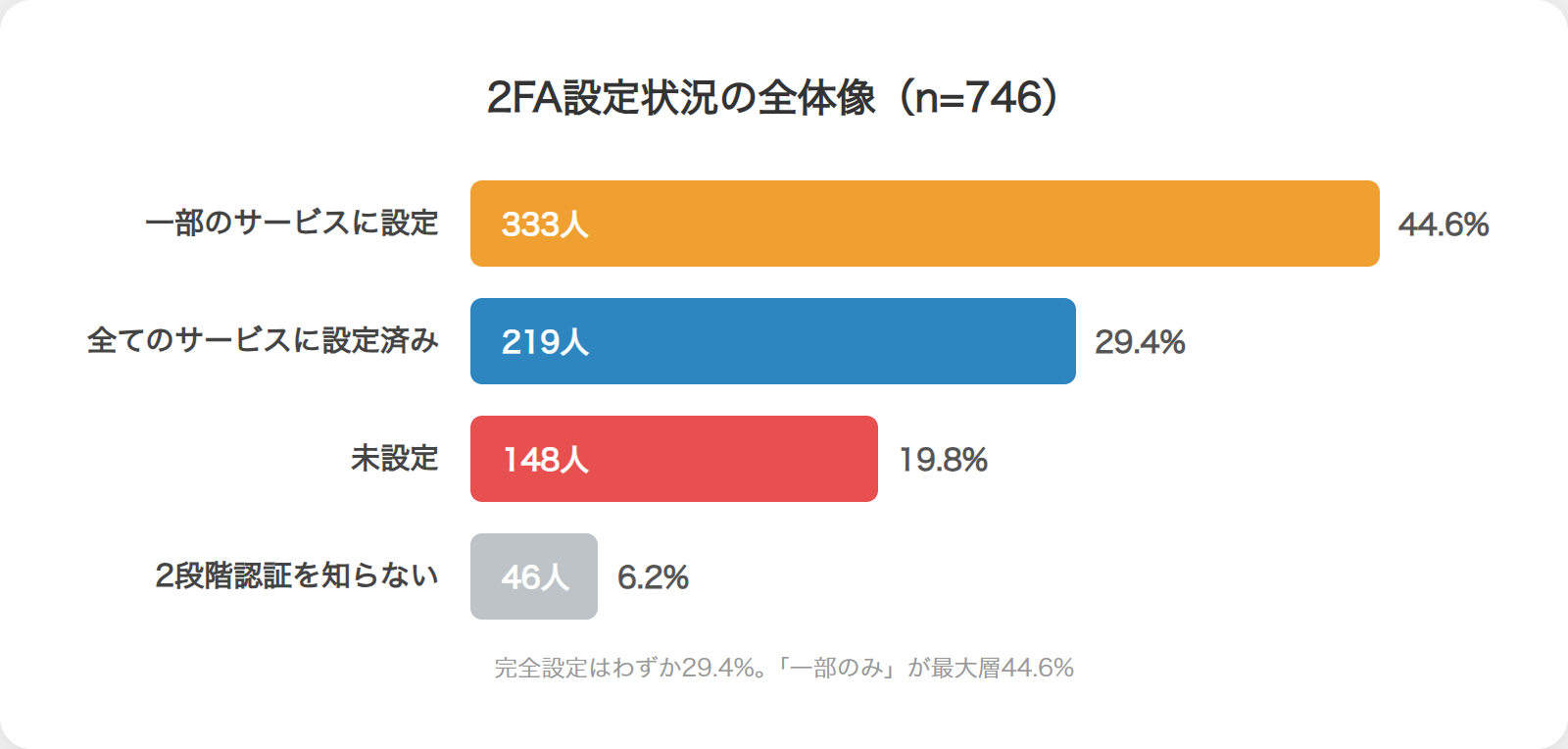
Response | Number of Respondents | Percentage |
|---|---|---|
Enabled on some services | 333 | 44.6% |
Enabled on all services | 219 | 29.4% |
Not enabled | 148 | 19.8% |
Not aware of 2FA | 46 | 6.2% |
“Enabled on Some Services” at 44.6% — The Blind Spot in the Largest Group
The largest group in this survey consists of investors who have enabled two-factor authentication (2FA) on only “some” of the crypto-related services they use.
At 44.6%, this figure reveals a common but limited mindset: the belief that protecting your main exchange (order-matching marketplace) is enough.
However, attackers persistently target the weakest link in any defense, meaning this partial setup rests on a precarious balance.
In the crypto world, it’s common knowledge that a single security gap can cascade into other assets and personal information being compromised.
The false sense of security that comes from “protecting the main accounts” can itself become the biggest vulnerability.
Skipping authentication on some services for the sake of convenience is effectively exposing your own assets to risk — 2FA needs to be enabled at every touchpoint.
Because crypto assets operate on a strict principle of self-responsibility, a single mistake can lead to irreversible loss.
Eliminating the false confidence of “thinking you’re protected” and completing security setup across every account and wallet you manage is the bare minimum expected of any investor.
Not Enabled (19.8%) Plus Unaware (6.2%) — One in Four Investors Has a Security Blind Spot
The fact that 19.8% of crypto asset holders have “not enabled” two-factor authentication at all, and a further 6.2% report they are not even aware of what 2FA is, cannot be overlooked.
Combined, these two groups make up 26.0% of respondents — meaning roughly one in four investors is participating in the market with no defense at all.
This group carries a constant risk of losing all of their assets instantly the moment a single password leaks.
In today’s crypto asset market, 2FA should be treated not as a “recommendation” but as a “requirement.”
Despite this, the reasons for not setting it up likely include discomfort with the setup process and a broader lack of education about the actual risks involved.
No matter how robust the systems built by crypto asset exchanges are, they cannot compensate for an open door on the user’s side.
Leaving these security blind spots unaddressed undermines trust in the market as a whole.
Raising individual investors’ awareness of asset protection ultimately strengthens the entire crypto asset ecosystem.
43.7% Say “I Know It’s Important, But It’s a Hassle” — The Gap Between Attitude and Action
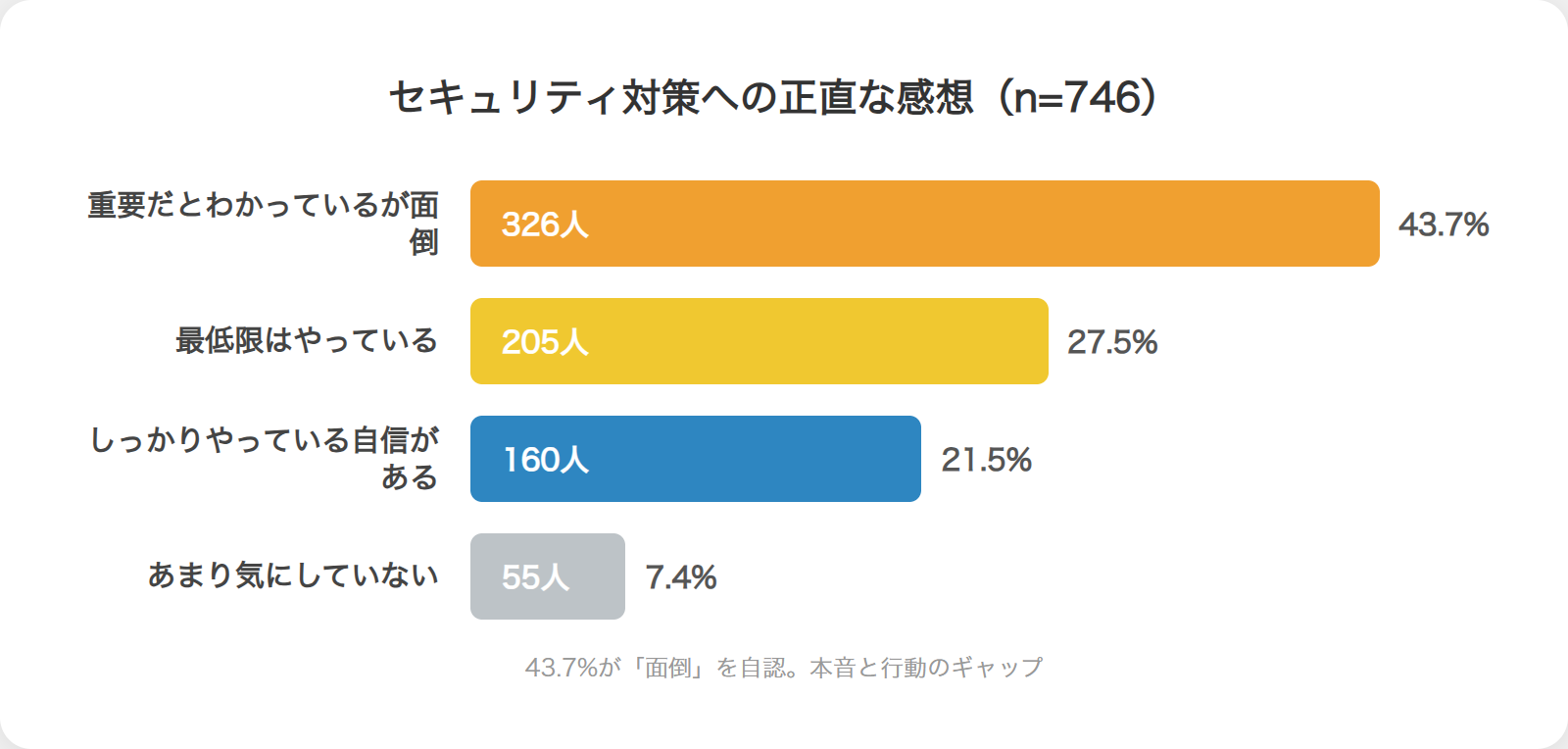
Attitude Toward Security | Number of Respondents | Percentage |
|---|---|---|
Know it’s important, but it’s a hassle | 326 | 43.7% |
Doing the bare minimum | 205 | 27.5% |
Confident I’m doing it properly | 160 | 21.5% |
Don’t really think about it | 55 | 7.4% |
59.5% of the “Partial Setup” Group Admits It’s “a Hassle”
When asked for their honest opinion on security measures, 43.7% of investors said they “know it’s important but find it a hassle.”
Notably, when narrowed down to investors who have enabled 2FA on “only some services,” the share who admit to finding it a hassle jumps to 59.5%.
This paints a realistic picture of investors who understand the importance of security but give up partway through the setup process.
Many start the process only to abandon it after running into the hassle of switching between authenticator apps for each of their exchanges and wallets.
Because every new service requires setting up 2FA again, many investors likely end up perpetually playing catch-up.
This accumulated “hassle” is exactly what creates gaps in defense.
However, the cost of skimping on this “small amount of effort” is an extremely heavy risk: the total loss of your assets.
Convenience and security are always in tension, but when it comes to managing crypto assets, safety should clearly take priority.
“Don’t Really Think About It” (7.4%) — The Danger of Normalcy Bias
The 7.4% of respondents who said they “don’t really think about it” have fallen into the biggest trap in security: normalcy bias.
This is a classic case of unfounded confidence masking an objective risk.
Hacking is not something that only happens to other people — every device connected to the internet is a potential target at all times, and this group appears to lack that awareness.
Notably, when narrowed down to small-scale investors holding less than ¥10,000, the share who “don’t really think about it” jumps to 18.7%.
This likely reflects the assumption that “small amounts aren’t worth targeting,” but for attackers, weak defenses matter more than the size of the holdings when selecting a target.
Ignorance and overconfidence are exactly the openings attackers find easiest to exploit.
By the time the assumption that “it won’t happen to me” is shattered, your assets are often already gone — that is the harsh reality of the crypto asset world.
Letting go of overconfidence and building double or triple layers of defense while assuming the worst is the path a wise investor should follow.
The 2FA Setup Gap Splits Sharply by Holdings Amount
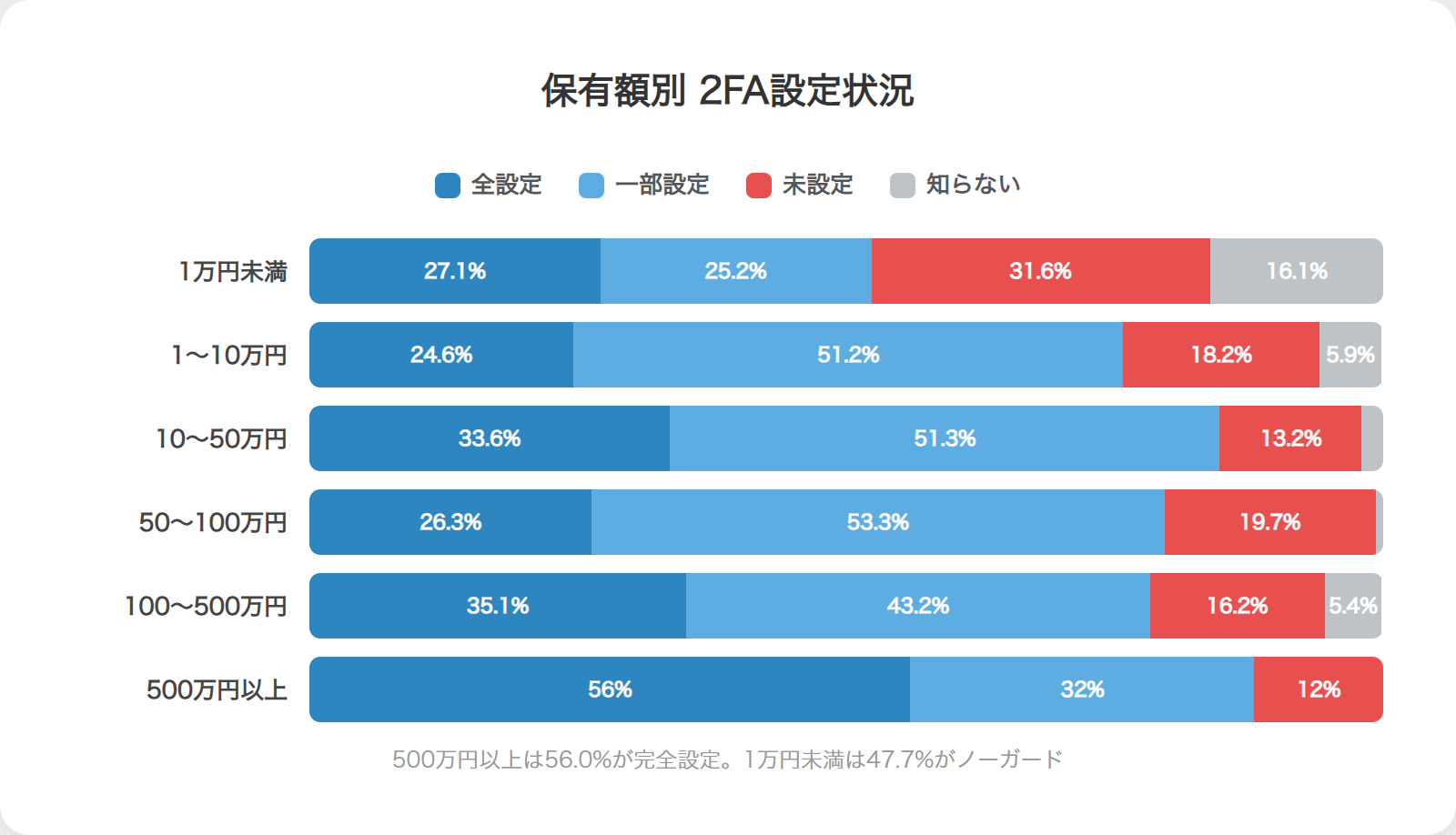
Holdings Amount | n | Fully Enabled | Partially Enabled | Not Enabled | Unaware |
|---|---|---|---|---|---|
Under ¥10,000 | 155 | 27.1% | 25.2% | 31.6% | 16.1% |
¥10,000–under ¥100,000 | 203 | 24.6% | 51.2% | 18.2% | 5.9% |
¥100,000–under ¥500,000 | 152 | 33.6% | 51.3% | 13.2% | 2.0% |
¥500,000–under ¥1,000,000 | 137 | 26.3% | 53.3% | 19.7% | 0.7% |
¥1,000,000–under ¥5,000,000 | 74 | 35.1% | 43.2% | 16.2% | 5.4% |
¥5,000,000 and above | 25 | 56.0% | 32.0% | 12.0% | 0.0% |
47.7% of Investors Holding Under ¥10,000 Have No Guard at All
Cross-tabulating holdings amount with 2FA setup status makes clear that the smaller an investor’s holdings, the more likely they are to neglect security.
Among those holding under ¥10,000 in particular, 31.6% have “not enabled” 2FA and 16.1% are “unaware” of it — together, 47.7% of this group has no defense at all.
This figure is more than double that of other groups, suggesting that the psychological complacency of “it’s a small amount, so it won’t hurt if it’s stolen” directly translates into abandoning even basic protections.
In reality, however, the size of your holdings has nothing to do with crypto asset security.
Even with small holdings, a single security gap can serve as a foothold for attackers to target other personal information and connected services.
An investor deciding for themselves that their assets are “not worth protecting” is precisely what creates the biggest opportunity for attackers.
Even small-scale investors, if they anticipate growing their holdings in the future, should build the habit of ironclad security from the very start.
Rather than scrambling to set it up after your assets have grown, adopting 2FA even before you deposit a single yen is the right approach for any investor with a long-term outlook.
56.0% of Investors Holding ¥5,000,000 or More Have Full 2FA Enabled
By contrast, among high-net-worth holders with over ¥5,000,000 in crypto assets, the share reporting 2FA “enabled on all services” rises to 56.0%.
That’s roughly double the 27.1% seen among those holding under ¥10,000, revealing a clear correlation between holdings amount and security awareness.
Investors managing larger sums likely understand that losses from unauthorized access would be a fatal blow.
High-net-worth holders combine multiple authentication methods and don’t hesitate to put in the effort needed to minimize risk.
This willingness to “protect it, no matter the effort” appears to be a common trait among investors who survive in the market over the long term.
Naturally, the seriousness with which one approaches defense differs between “an amount you could recover from losing entirely” and “an amount that would change your life if lost.”
That said, full 2FA setup should ideally be the standard across every holdings bracket, regardless of amount.
Investors of all sizes need to return to the fundamental principle of crypto asset investing: you are responsible for protecting your own assets.
2FA Literacy Gaps by Age Group and Years of Experience
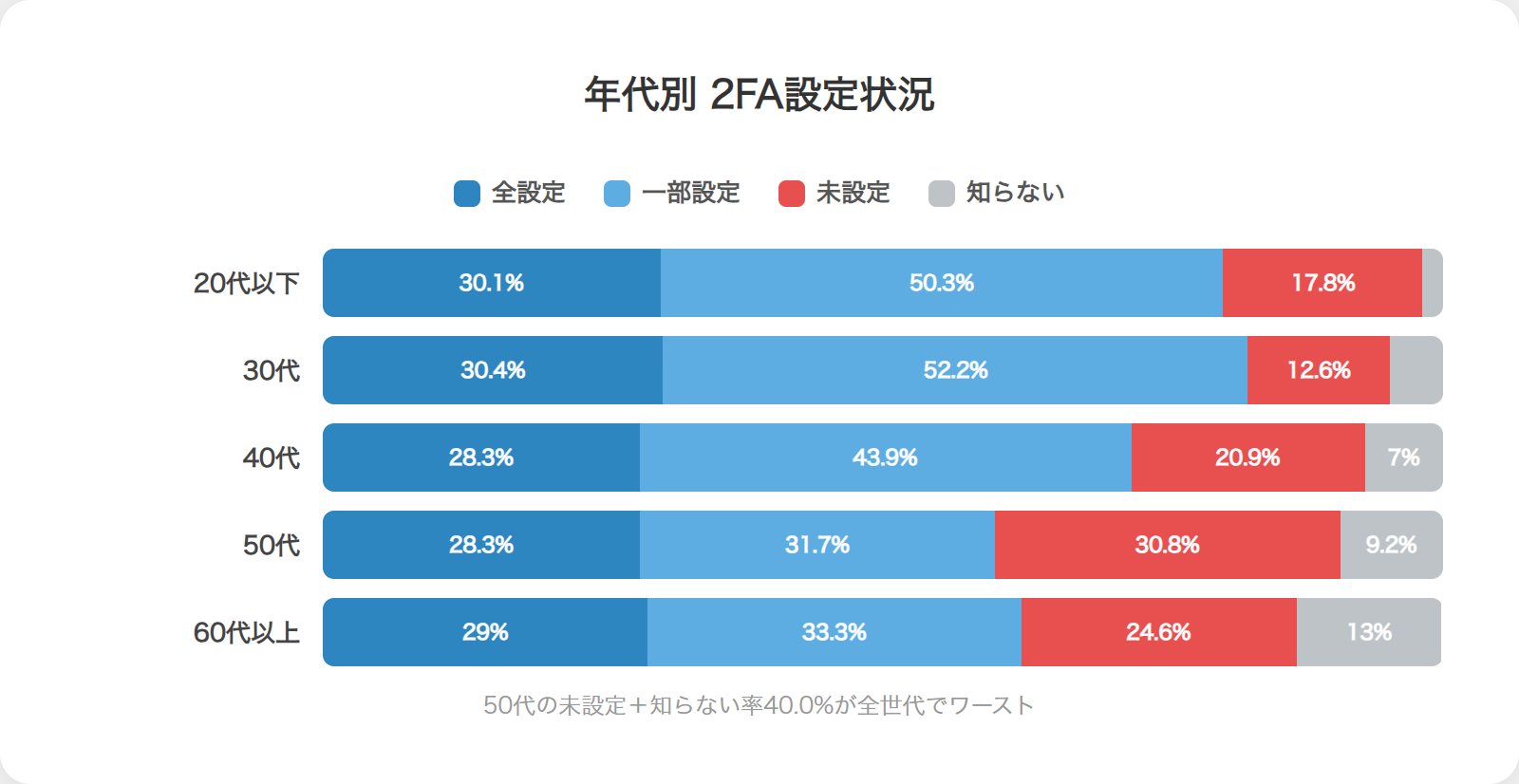
Age Group | n | Fully Enabled | Partially Enabled | Not Enabled | Unaware |
|---|---|---|---|---|---|
20s and under | 163 | 30.1% | 50.3% | 17.8% | 1.8% |
30s | 207 | 30.4% | 52.2% | 12.6% | 4.8% |
40s | 187 | 28.3% | 43.9% | 20.9% | 7.0% |
50s | 120 | 28.3% | 31.7% | 30.8% | 9.2% |
60s and above | 69 | 29.0% | 33.3% | 24.6% | 13.0% |
Combined “Not Enabled + Unaware” Rate for the 50s Hits 40.0% — Risk Lurking Among Middle-Aged and Older Investors
Cross-tabulating the data by age group shows that among investors in their 50s, 30.8% have “not enabled” 2FA and 9.2% are “unaware” of it — a combined 40.0%, the worst figure of any age group.
This reveals that, despite being a generation central to wealth-building, this group lags significantly behind other age groups in security awareness.
The 50s is also an age bracket where a growing number of people are turning to crypto assets as a destination for retirement payouts and post-retirement savings.
Despite this, the fact that even the most basic protections have not taken hold is a serious problem.
Among those 60 and above, 13.0% report being “unaware” of 2FA — the highest rate of any age group — making education for senior investors an urgent priority for the industry as a whole.
Support from family members or younger people nearby, as well as more user-friendly setup guides from exchanges themselves, are essential steps toward closing this generational gap.
Building an environment where middle-aged and older investors can invest in crypto assets with peace of mind is a fundamental challenge tied to the healthy growth of the market.
16.9% of Investors With Under One Year of Experience Are “Unaware of 2FA”
Years of Experience | n | Fully Enabled | Partially Enabled | Not Enabled | Unaware |
|---|---|---|---|---|---|
Under 1 year | 142 | 35.2% | 23.9% | 23.9% | 16.9% |
1–under 2 years | 214 | 26.6% | 52.3% | 15.9% | 5.1% |
2–under 3 years | 195 | 24.1% | 50.3% | 22.6% | 3.1% |
3–under 5 years | 116 | 31.0% | 44.8% | 20.7% | 3.4% |
5 years or more | 79 | 36.7% | 46.8% | 15.2% | 1.3% |
Breaking the data down by years of investing experience reveals an interesting polarization.
Among new entrants with under one year of experience, 35.2% have “enabled 2FA on all services” — a relatively high figure — while 16.9% are “unaware of 2FA,” the highest rate across all experience brackets.
This shows a mix of highly security-conscious investors and those with no knowledge at all, indicating an extremely wide knowledge gap at the point of entry.
As experience increases, the “unaware” rate drops dramatically, falling to just 1.3% among veterans with five or more years of experience.
This suggests investors naturally build up security knowledge as they trade, but if they suffer a loss along the way, that knowledge comes too late.
Whether a new entrant fully sets up 2FA within their first month is likely to have a major impact on their ability to defend their assets throughout their investing journey.
The fact that veterans with five or more years of experience have the highest “fully enabled” rate at 36.7% shows that security is a prerequisite for surviving in the market long term.
For new entrants especially, mimicking the behavior of veterans is the shortest path to survival.
Conclusion
This survey reveals that, while most crypto asset investors understand the importance of security, they are held back by the psychological barrier of “hassle.”
Only 29.4% of investors have two-factor authentication (2FA) enabled across all services, while 43.7% openly admit they “know it’s important, but it’s a hassle.”
Among those holding under ¥10,000 in particular, 47.7% have no defense at all, and the combined “not enabled” plus “unaware” rate among those in their 50s is 40.0%, the worst of any age group.
Investors should bear in mind that prioritizing convenience over defense carries the irreversible risk of losing all of their assets.
Here are three concrete steps to get past the “hassle” barrier.
First, install an authenticator app such as Google Authenticator on your smartphone.
Second, take stock of every exchange and wallet you hold, and enable 2FA on all of them without exception.
Third, always write down your backup recovery codes on paper and store them safely offline.
The setup process itself is a simple task that takes roughly five minutes to complete, and skimping on those few minutes while carrying an ongoing risk of losing your future assets is an extremely inefficient investment decision.
Just five minutes of effort can reliably protect your future assets and peace of mind.
Survey Overview
Survey date: April 10, 2026
Survey method: Internet survey
Survey target: Men and women residing in Japan who currently invest, or have previously invested, in crypto assets
Valid responses: 746
Conducted by: Clabo Inc.
Survey Questions
- Do you have experience investing in crypto assets (also known as virtual currencies)?
- How many years of experience do you have investing in crypto assets?
- What is the total value of the crypto assets you currently hold?
- Have you enabled two-factor authentication (2FA)?
- Honestly, how do you feel about security measures?
This article is for informational purposes only and does not constitute financial or investment advice. Please consult a qualified professional before making investment decisions.


