


"Can you explain to someone else what blockchain actually is?"
Only 9.8% of users could confidently answer "yes" to this question.
This survey of 1,239 people found that more than 65% of users are trading crypto assets (also known as virtual currencies) without fully understanding blockchain.
Continuing to invest without understanding how the technology works means carrying hidden risks. Now is the time to reassess your own level of understanding.
If you invest in crypto assets, understanding the blockchain technology that underpins them matters. This report surveyed 1,239 people to comprehensively examine their understanding of blockchain technology, awareness of the underlying technology, how they source information, and the relationship between investment experience and understanding.
The results revealed wide variation in understanding even among experienced investors, and showed that technical understanding is not necessarily strongly linked to actual investment behavior. These findings strongly suggest the importance of education and investor protection in the crypto asset market.
Survey Demographics

Category | Responses | Share |
|---|---|---|
Male | 763 | 61.6% |
Female | 476 | 38.4% |

Clabo free membership
Add Clabo on LINE for 2 weeks of premium articles
You can also read premium articles on tax, transfers and more during the period.
- No credit card required
- No automatic charges after the trial ends
- Available once per account
The Reality of Blockchain Understanding

Blockchain technology is the foundation of crypto assets, and the level of understanding directly affects the quality of investors' decision-making.
This survey measured understanding across multiple dimensions. The first question asked, "Can you explain blockchain in your own words?"
Only 121 respondents (9.8%) answered "Yes, I can explain it." This means that only about 10% of all users have an explainable level of understanding.
Another 302 respondents (24.4%) answered "I can mostly explain it," bringing the combined group able to explain blockchain (9.8% + 24.4% = 34.2%) to only about one-third. Meanwhile, those who find it hard to explain — "explaining is difficult" (241 respondents, 19.4%) and "cannot explain it at all" (54 respondents, 4.4%) — together reach about 24%, showing that a substantial share of users struggle to explain blockchain technology.
Distribution of Understanding of the Underlying Technology

Is being able to explain blockchain itself the same as understanding the underlying technology as a whole?
In fact, these appear to be different dimensions. Measuring technical understanding from a broader perspective revealed an interesting distribution. The largest group, "I have a vague understanding," reached 350 respondents (28.2%), suggesting a state of "knowing the term but lacking a systematic understanding."
The group who "know the term but can't explain it" numbered 182 (14.7%), suggesting awareness at the word level but a lack of systematic understanding of its meaning and role.
Meanwhile, those who "can explain it to others" numbered 127 (10.3%).
Notably, while the earlier question about explaining blockchain found an "able to explain" group of 34.2%, the "can explain" group for the underlying technology (10.3%) is markedly smaller.
This suggests that while users have knowledge at the terminology level, they lack a fundamental understanding of the technology.
The Paradox of Understanding Among Experienced Investors

One of the most notable findings of this survey is that the relationship between investment experience and understanding is not necessarily strong.
Of the survey respondents, 58.0% (718 people) have investment experience, while a substantial number — 521 people, or 42.0% — do not.
In other words, blockchain education needs to reach not only experienced investors but also the broader pool of potential investors.
It is also notable that a considerable share of experienced investors fall into the "explaining is difficult" or "cannot explain at all" groups.
Ranking of Information Sources
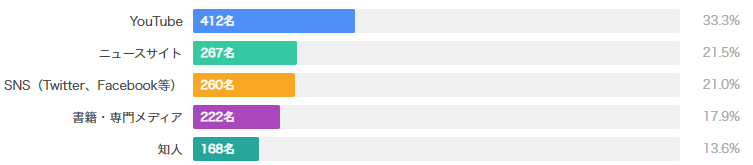
Where users obtain information about blockchain technology has a major influence on how their understanding is formed. This survey asked, as a multiple-choice question, "Where do you get information about blockchain?"
The top information source was "YouTube," cited by 412 respondents (33.3%). This suggests that video content is especially effective at promoting visual understanding of complex technical explanations.
The second-ranked source was "news sites," cited by 267 respondents (21.5%). Industry news, technical explainer articles, and market analysis all function as specialized information sources. The third-ranked source was "social media," cited by 260 respondents (21.0%).
Information sharing through social media platforms such as Twitter, Facebook, and TikTok was found to play a major role, especially in how younger users obtain information.
These were followed by "books and specialist media" (222 respondents, 17.9%) and "acquaintances" (168 respondents, 13.6%), showing that a diverse range of information sources is being used.
Ranking of Investors' Main Concerns
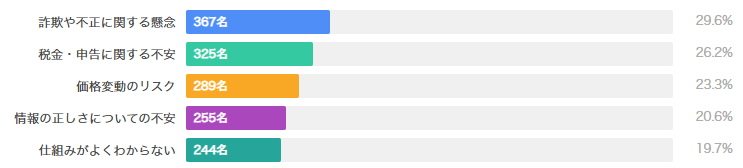
A lack of understanding of blockchain technology leads to a variety of concerns among users.
This survey asked, as a multiple-choice question, "What concerns do you have about investing in crypto assets?"
The most common concern was "worry about fraud or wrongdoing," cited by 367 respondents (29.6%). This revealed that vulnerability to fraud stemming from a lack of technical understanding exists as a latent concern among users.
The second-ranked concern was "the risk of price volatility," cited by 289 respondents (23.3%). When investors don't understand the underlying reasons behind market movements, their psychological anxiety tends to be amplified.
The third-ranked concern was "worry about taxes and tax filing," cited by 325 respondents (26.2%), suggesting that the complexity of crypto asset tax treatment is not well understood by many users. Other frequent responses included "concern about the accuracy of information" (255 respondents, 20.6%) and "not understanding how it works" (244 respondents, 19.7%), revealing that a wide range of concerns arise overall from a lack of technical understanding.
Cross-Analysis of Understanding by Generation
Understanding of blockchain technology may show different patterns across generations.
The survey respondents break down by generation as follows. Generation Y (born 1981–1996) is the largest group at 39.5%, followed by the Ice Age Generation (born 1970–1980) at 28.7%, and Generation Z (born 1997–2012) at 13.1%.
Generation | Birth Years | Respondents | Share |
|---|---|---|---|
Generation Y | 1981–1996 | 489 | 39.5% |
Generation Z | 1997–2012 | 162 | 13.1% |
Ice Age Generation | 1970–1980 | 356 | 28.7% |
Bubble Generation | 1960–1969 | 118 | 9.5% |
Why YouTube Is the Top Information Source
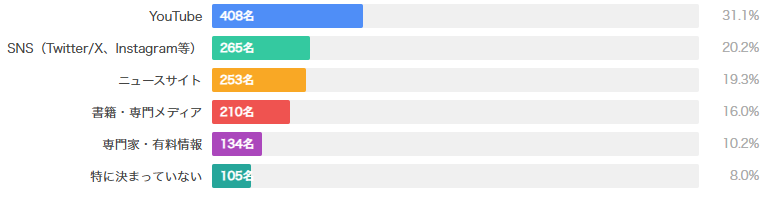
One of the most interesting findings of this survey is that YouTube is the top information source for crypto assets and blockchain. 412 users (33.3%) cited YouTube as an information source, far outpacing news sites (21.5%) and social media (21.0%).
One likely reason is that many users want to understand complex technical concepts visually.
Video content that explains how blockchain works — which is difficult to grasp from text alone — through animation and diagrams is likely highly effective.
At the same time, however, the quality of information on YouTube varies enormously. While some creators provide accurate technical explanations, others put out inaccurate or sensationalized content. If users lack the ability to tell these apart, getting information from YouTube risks amplifying misunderstanding rather than improving understanding — so caution is warranted.
Correlation Between Years of Experience and Understanding
Among experienced investors, the survey also examined how many years of experience they had. The largest group had 1–3 years of experience (308 respondents, 24.9%), followed by beginners with less than 1 year (190 respondents, 15.3%), those with 3–5 years (122 respondents, 9.8%), and veterans with 5 or more years (98 respondents, 7.9%).
Notably, having more years of investment experience does not necessarily mean a higher level of understanding of blockchain technology. Even users with long investment histories may have knowledge concentrated in practical investing skills — such as technical analysis and portfolio management — without necessarily reaching a fundamental understanding of the underlying technology.
In other words, "having investment experience" and "understanding the technology" are different dimensions of capability, suggesting that the education the market needs must integrate both.
That said, safely managing crypto assets requires not only practical, hands-on knowledge but also a deep understanding at the technical level. Put another way, some users do not yet recognize the importance of this.
The Risk of "Investing Without Understanding"
The most concerning finding of this survey is the existence of a group who are "investing without understanding."
The situation in which users who cannot explain blockchain technology — or who only have a "vague" understanding of it — are investing substantial amounts carries many risks.
The first risk is vulnerability to fraud. Users with insufficient technical understanding may fall for fraudulent schemes — such as Ponzi schemes, fake currency projects, or fraudulent investment advisors — more easily.
The second risk is excessive reliance on market psychology. When investment decisions are made without a technical basis, investors become overly influenced by market sentiment, media coverage, and others' recommendations. As a result, speculative behavior increases, amplifying the risk of losses.
The third risk is delayed response to the regulatory environment. Crypto asset regulation is continually evolving, and technical considerations underlie those changes. Users with insufficient technical understanding may be less able to keep up with such regulatory shifts.
The fourth risk is increased psychological burden. Investing without understanding tends to generate excessive anxiety and impatience during price swings, which can lead to irrational selling decisions and a deterioration in investment performance.
Conclusion
The findings from this survey can be summarized as follows.
First, understanding of blockchain technology is seriously lacking across the market as a whole. About 65% of users remain at a level of understanding where they cannot adequately explain blockchain — an important challenge that reflects the market's maturity.
Second, the correlation between investment experience and technical understanding is weak. A considerable share of users who are actively investing still lack technical understanding, which is a concerning situation from a risk management standpoint.
Third, YouTube's overwhelming dominance as an information source stands out. About one-third of users cite YouTube as their primary information source, a trend expected to continue. As the importance of information quality control and literacy education grows, the role and responsibility of video media will only increase.
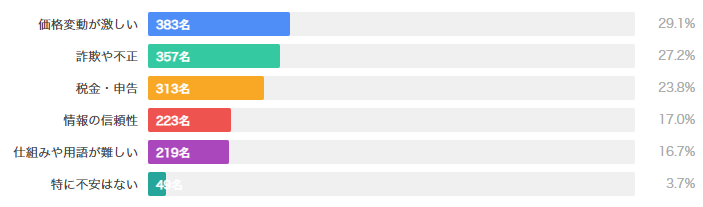
Fourth, a wide range of concerns stem from a lack of technical understanding. Many worries — fear of fraud, tax-related anxiety, fear of market volatility, and more — could potentially be eased by deepening technical understanding.
Survey Overview
Survey date: February 24, 2026
Method: Internet survey
Respondents: Men and women residing in Japan (people currently investing in crypto assets, or who have invested in the past)
Valid responses: 718
Conducted by: Clabo, Inc.
Survey Questions
- Have you ever invested in virtual currency?
- How many years of experience do you have investing in virtual currency?
- Please select the option that best matches your current investment style.
- How well do you think you understand the underlying technology of virtual currency?
- Can you explain the meaning of the term "blockchain" in your own words?
- Where do you mainly get information about virtual currency?
- Have you ever tried to learn about the technical mechanisms involved?
- What concerns do you have about investing in virtual currency?
- What worries do you have about virtual currency investing?
This report is intended for informational purposes only and does not constitute a solicitation or recommendation to invest. Investing in crypto assets carries a high degree of risk, and investment decisions should be made at your own responsibility. No warranty is provided regarding the accuracy, completeness, or usefulness of the content of this report. Please make final investment decisions based on your own judgment and consult a professional as needed.


