


Staking is a well-known way to earn rewards on crypto assets (also known as virtual currencies) you already hold. Given that, some long-term Bitcoin holders may wonder, "Can't I stake BTC too?"
The short answer is that Bitcoin does not support the standard type of staking used by coins like ETH or ADA. That's because Bitcoin relies on mining to validate transactions, a mechanism that is fundamentally different from the Proof-of-Stake (PoS) model, in which holders lock up crypto assets to participate in network operations.
That said, this doesn't mean there is no way to earn rewards while holding Bitcoin. One common option is lending, where you lend out your BTC and receive a fee in return.
This article explains why Bitcoin doesn't support standard staking, how you can still earn rewards while holding BTC, and what to watch out for when using lending services.
Why Bitcoin Doesn't Support Standard Staking
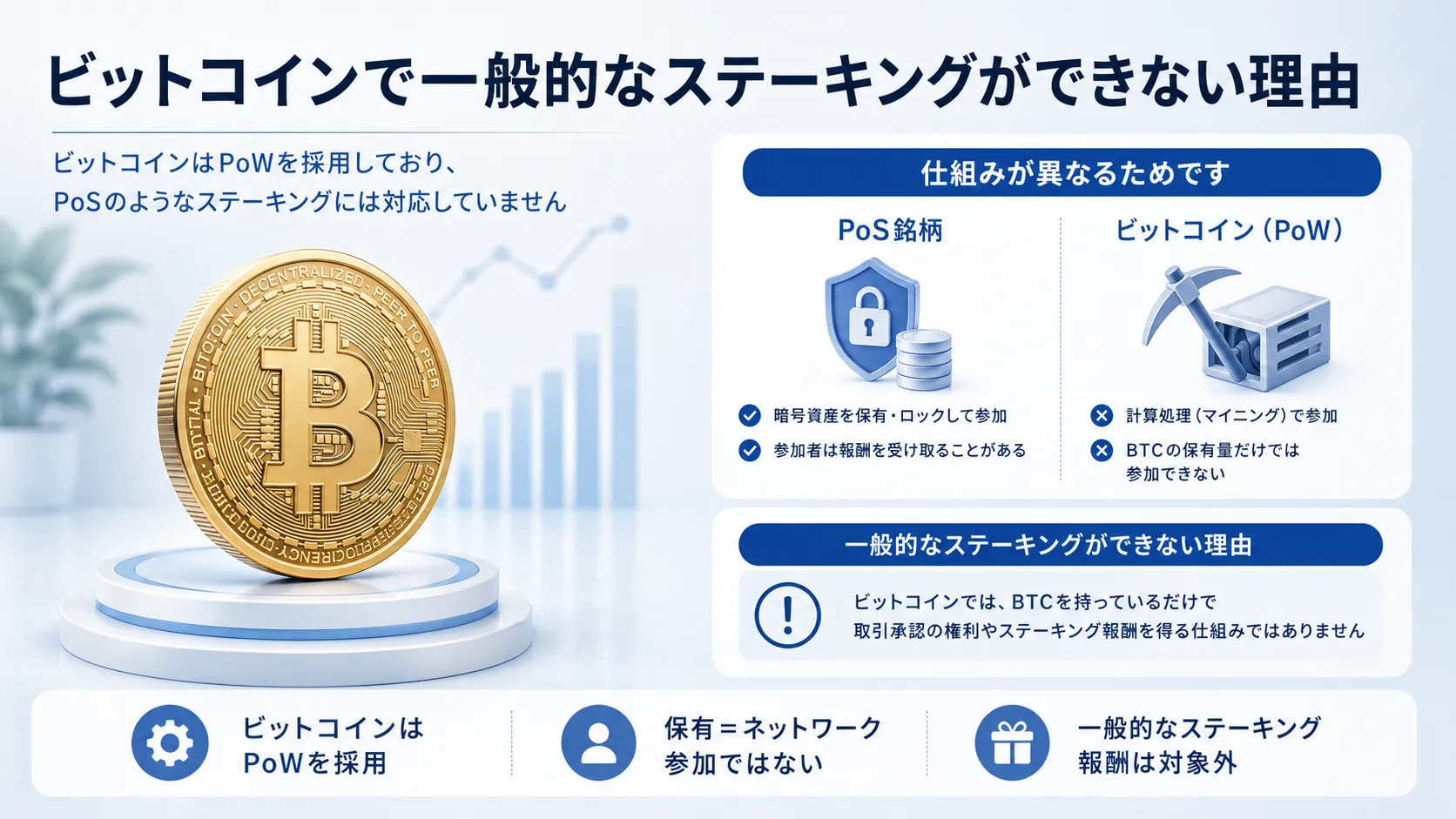
The reason Bitcoin doesn't support standard staking comes down to its transaction-validation design itself, which was never built around staking. Every crypto network needs a mechanism to decide "who verifies transactions and records them as valid." This mechanism is called a consensus algorithm.
Staking is mainly used by crypto assets that adopt Proof of Stake (PoS). Under PoS, holding and locking up the relevant crypto asset lets you participate in transaction validation and block creation, and in return you may receive staking rewards.
Bitcoin, by contrast, uses a different mechanism called Proof of Work (PoW). Under PoW, participants known as miners perform computational work to take part in transaction validation and block creation. In return, they receive newly issued BTC and transaction fees.
In other words, for PoS coins, holding and locking the asset is a condition for participating in the network. For Bitcoin, simply holding BTC has no direct bearing on the right to validate transactions. Even holding a large amount of BTC doesn't, by itself, let you take part in transaction verification or earn network-validation rewards.
In this way, PoS coins and PoW coins like Bitcoin have different requirements for participating in transaction validation, which is why Bitcoin does not support standard staking.
Major Crypto Assets That Support Staking
Crypto assets known to support staking include Ethereum, Solana, and Cardano. These use PoS or PoS-like mechanisms, and holding the relevant coin may allow you to earn staking rewards.
That said, not every crypto asset supports staking. Even for the same coin, conditions such as "which assets are eligible, reward rates, lock-up periods, and whether early withdrawal is possible" can vary depending on the crypto asset exchange service provider or platform you use.
Rather than assuming any crypto asset can be staked, it's important to first confirm whether the coin you hold supports staking, then compare the terms across different services.
"Bitcoin Staking" Schemes Also Exist
While Bitcoin doesn't support standard staking, mechanisms referred to as "Bitcoin staking" have emerged in recent years. For example, some protocols let you lock up BTC for a set period and use it to help secure other networks.
Bitcoin staking in Babylon protocol enables BTC holders to lock their assets in a time-bound contract as security collateral, earning rewards for securing networks. The protocol implements a slashing mechanism where staked assets may be forfeited if protocol security rules are violated, similar to traditional security deposits but with protocol-enforced penalties.
Source: Babylon Docs
This doesn't mean Bitcoin itself has been converted into a PoS-style crypto asset. The underlying mechanism and how rewards arise are different from standard staking as used by coins like ETH or ADA.
In addition, services described as "Bitcoin staking" typically require locking up assets for a set period, and depending on each protocol's rules, part of your assets could be forfeited if a violation occurs.
So while "Bitcoin staking" mechanisms do exist, their features and risks differ from standard PoS-style staking. If you're considering using one, it's important to fully understand how it works before making a decision.
Lending Is an Option for Earning Rewards on BTC Holdings
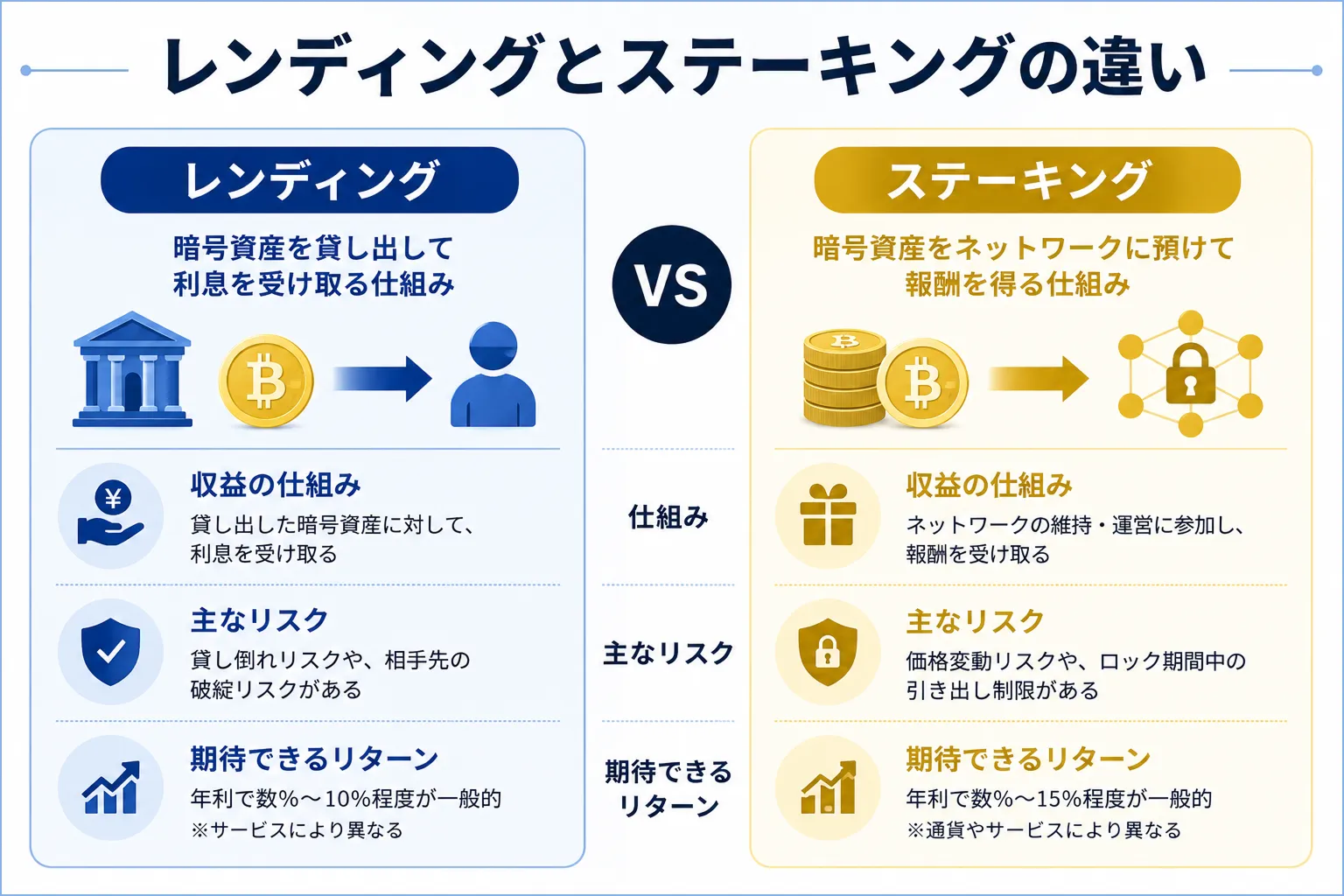
Bitcoin doesn't support staking, but there are still several ways to put BTC holdings to work. Among these, lending draws particular attention from investors focused on holding long term.
That said, using lending without fully understanding how it works and its characteristics can expose you to risks you didn't anticipate. Here we cover the basic mechanics of lending and key points to watch out for.
Lending Means Lending Out BTC in Exchange for a Fee
With lending, you lend the BTC you hold to a crypto asset exchange service provider or similar platform. Once the lending period ends, you receive back the BTC you lent along with a reward equivalent to a lending fee.
Rewards vary depending on terms such as "which asset, quantity, period, and service" you use. For example, even for the same BTC lending, terms can differ between a short-term loan and a long-term one.
Because lending offers a way to potentially earn rewards without selling your BTC, it's an option worth considering for long-term holders. On the other hand, you typically can't freely sell or transfer your BTC while it's on loan, which may not suit people who expect to need access to their funds.
Lending and Staking Work Differently
Lending and staking are both sometimes introduced as ways to earn rewards while holding crypto assets. However, the mechanisms that generate those rewards are quite different.
Staking involves participating in network operations for a PoS-type crypto asset and receiving rewards in return. Lending, on the other hand, involves lending your BTC or other holdings to a service provider and receiving a fee in return.
A helpful analogy: staking is like joining a condominium's management association, taking part in building operations and decision-making, and receiving a benefit in return for that involvement. Lending, by contrast, is more like renting out a room you own to a third party and earning rental income.
In short, staking generates rewards through participation in network operations, while lending generates returns through lending out an asset.
Understanding this distinction helps avoid the misconception that "I'm staking my Bitcoin." When earning rewards on BTC, it's worth confirming whether the service is actually staking, lending, or some other type of yield product (related: What's the Difference Between Lending and Staking? Benefits, Risks, and How to Choose (in Japanese)).
Points to Check Before Using Bitcoin Lending

Bitcoin lending is one way to earn rewards while holding BTC. However, focusing on yield alone can lead to unexpected losses or complications.
Three points in particular deserve attention: the risk associated with the platform you lend to, restrictions during the lending period, and the tax treatment of rewards. These are considerations specific to lending that differ from staking.
Check the Risk of the Platform You're Lending To
With lending, rather than keeping your BTC in your own wallet, you hand it over to a crypto asset exchange service provider or similar platform. This makes the management practices and creditworthiness of that platform an important consideration.
For example, if the platform experiences business failure, service suspension, asset loss due to unauthorized access, or withdrawal restrictions, the return of your deposited BTC could be delayed, or you might be unable to recover some or all of it. Depending on the lending scheme and contract terms, how your deposited BTC is managed and what happens in the event of trouble can also vary.
When using a lending service, it's important not to judge based on yield alone, but to thoroughly check the platform's reliability, service details, lending terms, and risk disclosures. In particular, confirm in advance whether there is any principal guarantee, how assets are managed, the conditions for early cancellation, and what happens in the event of the platform's failure.
Withdrawals or Sales May Be Restricted During the Lending Period
With lending, you may not be able to freely withdraw your BTC during the lending period. Some services don't allow early cancellation at all, and others allow it only under certain conditions.
Bitcoin is a highly volatile crypto asset. If the price falls sharply during the lending period and you can't sell immediately, it may be harder to limit your losses.
Also, even if the lending fee increases the quantity of BTC you hold, the yen-denominated value of your holdings can still decline if the BTC price drops significantly. An increase in BTC terms is not the same as a profit in yen terms.
Before using a lending service, it's worth confirming whether you're comfortable having your assets locked up for the lending period. This is especially important if there's a chance you might need to sell your BTC in the short term.
Rewards May Be Subject to Tax
Rewards received through lending may be subject to tax. Even when the reward is paid in crypto assets, tax rules generally require calculating income based on its value at the time it was received, which means it can be taxed differently from gains on a sale.
When crypto assets are acquired through mining, staking, lending, or similar means, any profit arising from that acquisition is subject to income tax or corporate tax.
Source: Tax Treatment of Crypto Assets, etc. | National Tax Agency (NTA)
In a survey of 309 crypto asset holders conducted by our company, 55.3% of respondents said they "currently use" staking or lending, and 26.5% said they "have used it in the past." Combined, 81.8% had experience using such services, showing that these are familiar ways for many investors to put their holdings to work.
On the question of tax awareness, however, only 57 out of 253 respondents (22.5%) clearly understood that such rewards are subject to tax filing. In addition, 23.3% said they "thought it wasn't taxable since it's separate from trading gains," and 9.1% said they "had never thought about the tax implications at all." While use of these services is spreading, understanding of the tax treatment of lending and staking rewards may not have caught up.
Continuing to use these services without a solid grasp of the tax rules can make it difficult to track the information needed for income calculations. For instance, because rewards may be treated as income at the point they're received, it's important to record the yen-equivalent value at the time each reward is received.
In addition, if the BTC price falls after you receive a lending reward, a gap can emerge between the taxable income amount and the asset's actual current value. Even though the reward was counted as a certain amount of income at the time it was received, the value of that holding can subsequently decline due to price movements.
For this reason, it's important to track and record the value at the time of acquisition. How rewards are taxed can vary depending on your overall trading activity and income classification. If you're unsure, consult a tax accountant or your local tax office.
Under Japan's current tax rules (as of July 2026), gains from selling crypto assets are generally classified as miscellaneous income and taxed under the aggregate (progressive) taxation system, together with other income such as salary. Losses on crypto assets can only be offset against other miscellaneous income — they cannot be offset against employment income or other income categories. Separately, on July 15, 2026, Japan's Diet passed an amendment to the Financial Instruments and Exchange Act (FIEA) that will reclassify crypto assets as financial instruments under that law; once the amended law takes effect (expected from January 2028), a flat 20% separate self-assessment tax rate is expected to apply going forward.
Conclusion: Bitcoin Isn't for Staking — Choose the Approach That Fits Your Goals
Bitcoin doesn't have the kind of staking mechanism used by coins like ETH or ADA. That's because staking is a mechanism used by PoS-type crypto assets, and it works differently from the PoW model that Bitcoin uses.
If you want to put your BTC holdings to work, lending is worth considering, since it lets you earn rewards by lending BTC to a service provider without selling it. When using lending, be sure to weigh factors such as platform credit risk, restrictions on withdrawing your assets, and tax considerations, and confirm whether the approach truly fits your needs before committing.
When putting Bitcoin to work, it's important to choose an approach that matches your goals while keeping asset safety in mind.
This article is for informational purposes only and does not constitute financial or investment advice. Please consult a qualified professional before making investment decisions.


