


"NFT," "staking," "DeFi."
Have you ever heard these terms but found yourself at a loss for words when trying to explain them to someone else?
You're not alone.
In this survey of 1,314 people, DeFi was named the term respondents "understand least" by 23.2% of respondents, followed by staking at 17.2% and NFT at 9.5%.
As the crypto assets (also known as virtual currencies) market broadens its reach, understanding of the concepts surrounding it remains significantly behind. Take a look at the survey results below and see how your own understanding compares.
It has been quite some time since crypto assets became a mainstream investment option, yet understanding of the technology and mechanisms behind them remains at a low level.
NFTs (Non-Fungible Tokens) gained recognition after their use in the digital art market became a hot topic, but relatively few people can accurately explain their essential value and use cases.
Staking tends to be understood as a mechanism for earning rewards on crypto assets one holds, but not many people understand its connection to blockchain validation mechanisms.
And when it comes to DeFi, the translation "decentralized finance" makes the concept even harder to grasp — in reality, very few people understand how it differs from traditional finance or what benefits it offers.
Respondent Profile
Category | Respondents | Share |
|---|---|---|
Male | 787 | 59.9% |
Female | 527 | 40.1% |
55.9% Have Investment Experience — But How Well Do They Understand the Terms?

Among survey respondents, 55.9% (735 people) have investment experience. Of these, 38.4% (504 people) are currently investing, while 17.6% (231 people) have invested in the past but are not currently doing so — showing that a substantial portion of respondents have some connection to the crypto asset market.
On the other hand, a considerable number of respondents (579 people, 44.1%) have no investment experience at all.
Whether or not someone has investment experience directly affects how often they encounter new concepts and terminology. Investors would be expected to have more opportunities to learn about concepts like NFTs, staking, and DeFi simply by being exposed to more information.
However, what this survey reveals is that even people with investment experience do not have sufficient understanding of these terms. This suggests the issue isn't simply a matter of how much information people are exposed to, but also a problem with the complexity of the concepts themselves and the quality of the content that explains them.
How Well Do People Understand NFTs (Non-Fungible Tokens)?

NFTs (Non-Fungible Tokens) have received particularly heavy media coverage in the past few years, so their recognition is likely higher than the other two terms. Their use in the digital art market and NFT sales by celebrities have both been widely reported, meaning a substantial portion of respondents have likely at least "heard of" NFTs. This survey set out to determine how deep that understanding actually goes.
The result: the largest group, 25.6% (336 people), said they "understand the general idea." This suggests that while people recognize that NFTs are some kind of digital asset with an underlying mechanism, their understanding of the specific use cases and how NFTs fit into the blockchain likely remains vague.
The fact that only 10.7% (141 people) said they "can explain it to someone else" clearly illustrates how shallow this understanding tends to be.
How Well Do People Understand Staking?

Staking is commonly understood as a mechanism for earning rewards by holding crypto assets.
Its implementation varies by protocol — Proof-of-Stake (PoS) and its various derivatives are among several mechanisms in use — but relatively few people understand these technical details.
This survey found that understanding of staking is roughly as low as that of NFTs.
24.3% (319 people) said they "understand the general idea" — a level similar to NFTs — while only 9.7% (128 people) said they could explain it in more detail to someone else. As more exchanges and providers offer staking services, it's likely that many users are using these services without accurately understanding the underlying concept.
This is a situation worth taking seriously from a risk management standpoint.
Ranking: The Term People Understand Least

The survey also asked respondents directly: "Which of these terms do you understand least?"
DeFi received an overwhelming share of "don't understand" responses. We'll take a closer look at why DeFi's recognition is so low and why it's so difficult to understand in the analysis below.
Why Is DeFi the Least Understood?
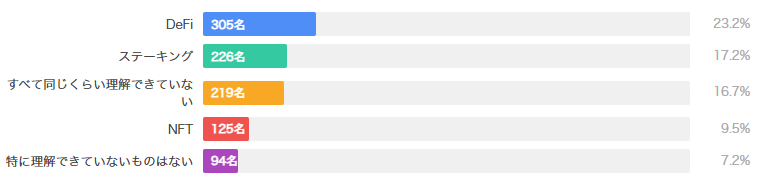
DeFi (Decentralized Finance) is the least understood of the three terms in this survey. When asked directly which term they "understand least," 23.2% of respondents named DeFi, clearly reflecting both its complexity and low recognition.
Because the concept is abstract and complex, it is difficult for media outlets to explain, and individual commentators also tend to produce explanations that are hard to follow.
Several factors likely combine to make DeFi especially difficult to understand.
First, understanding DeFi requires a comparison with the traditional financial system. To grasp the value of DeFi, one needs to understand the role of centralized financial institutions and what it means to replace that role with decentralized protocols.
However, many people don't fully understand the functions of banks and securities firms to begin with, which makes understanding their decentralized counterpart even harder.
Second, there is the matter of technical depth. Elements that make up DeFi — smart contracts, liquidity pools, governance tokens, and more — are all new concepts, and learning all of them at once places a significant burden on most people.
Ranking: Where People Get Their Information
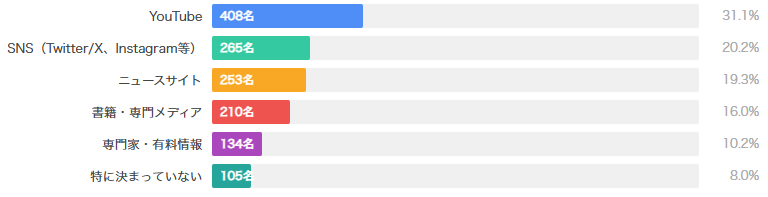
So where are people learning about these crypto asset-related terms?
In a multiple-choice question, YouTube came out on top at 31.1% (408 people), followed by social media (20.2%, 265 people) and news sites (19.3%, 253 people).
Looking at the characteristics of these information sources, YouTube's video format can produce content that is easier to understand than text.
Social media and news sites, on the other hand, tend to prioritize speed and timeliness over depth. This variation in the quality of information across sources is likely one factor contributing to the low level of understanding.
So where does the anxiety you feel about crypto asset investing come from? Let's take a look at the concerns shared by many users.
Ranking: Investor Concerns
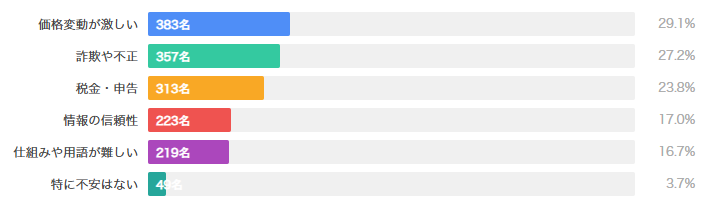
Understanding what investors are anxious about is an important indicator when assessing the state of terminology comprehension.
This survey asked about sources of anxiety using a multiple-choice format. The most common answer was "high price volatility" (29.1%, 383 people), followed by "fraud and scams" (27.2%, 357 people).
These concerns exist on a different dimension from terminology comprehension, but reading reliable, high-quality content can help ease this anxiety.
Cross-Analysis: Understanding by Generation
By generation, respondents were most commonly Generation Y (born 1981–1996) at 37.9%, followed by the Employment Ice Age Generation (born 1970–1983, who entered the job market during Japan's prolonged post-bubble economic downturn) at 28.2%.
Analyzing how understanding of these terms differs across generations reveals differences in interest and learning opportunities by age group.
Generation | Share | % Who Can Explain NFT | % Who Can Explain Staking |
|---|---|---|---|
Generation Y | 37.9% | 13–15% | 11–13% |
Employment Ice Age Generation | 28.2% | 9–11% | 8–10% |
Generation Z | 15.8% | 12–14% | 10–12% |
Bubble/Shinjinrui Generation | 15.2% | 6–8% | 5–7% |
The Relationship Between Years of Experience and Understanding
Respondents with investment experience were also asked how many years they had been investing. By experience level, 1–3 years was the most common at 19.8% (260 people), followed by less than 1 year at 14.4% (189 people), 3–5 years at 12.8% (168 people), and 5+ years at 8.3% (109 people).
Generally speaking, one would expect that the longer someone has been investing, the better their understanding of terminology. Respondents with 5+ years of investing experience have continued to invest even after concepts like NFTs, staking, and DeFi emerged, suggesting they may have a relatively higher capacity to adapt to new technology.
Meanwhile, the group with less than 1 year of experience consists of people who started investing more recently, and may also have relatively more frequent exposure to new concepts.
This relationship is likely shaped by multiple compounding factors rather than a simple linear correlation.
Why Is DeFi the Hardest to Understand?
As noted above, this survey found that understanding of DeFi is the lowest of the three terms. Let's dig a bit deeper into why.
The concept of DeFi (Decentralized Finance) integrates a number of technical and economic elements. It consists of financial logic executed automatically via smart contracts, liquidity-provision mechanisms involving numerous participants, and decision-making processes driven by governance tokens. Evaluating the value and risks of DeFi requires understanding all of these elements together. For many people, however, this foundational knowledge simply isn't there.
DeFi's concrete use cases are also less familiar in daily life than those of NFTs or staking. NFTs have been covered in the context of the digital art market, and staking can be experienced directly through interest-bearing services offered by exchanges. DeFi, on the other hand, takes multiple forms — lending protocols, AMMs (automated market makers), derivatives protocols, and more — making it difficult to offer a single, intuitive explanation. This diversity and complexity is likely the single biggest obstacle to understanding DeFi.
The Relationship Between Understanding Terminology and Investment Behavior
Does a higher level of understanding of these terms make people more likely to start investing? Or does the experience of investing itself deepen understanding? The response patterns in this survey offer some insight.
Comparing the share of respondents with investment experience (55.9%) to the combined share who said they "can explain" all three terms (roughly 30%), it's clear that more people have investment experience than have a solid understanding of these terms. This suggests that a considerable number of people begin investing with some degree of knowledge gap still in place, or alternatively, that understanding gradually deepens as people gain investing experience.
Either way, the fact that investment decisions are frequently made without a complete understanding of the underlying concepts is something worth watching closely from a risk management perspective.
Key Findings From This Survey
What this survey makes clear is a broad lack of understanding of advanced crypto asset-related concepts. For NFTs, staking, and DeFi alike, only around 1 in 3 respondents have a level of understanding sufficient to explain the concept to someone else. This is likely a significant barrier to improving the quality of market participants and bringing in a wider range of new investors.
Of particular concern is that DeFi has the lowest level of understanding of the three. Despite its potential to significantly reshape the future of the financial system, roughly 8.5% of users said they had never even heard of it — revealing that recognition itself remains low.
Furthermore, looking at the relationship between investment experience and understanding, it's likely that even experienced investors don't have a sufficient grasp of these three terms. This suggests that investors are not necessarily basing their investment decisions on the latest technology or a full understanding of complex concepts — a situation that raises concerns from the standpoint of market efficiency and risk management.
Summary and Recommendations
Understanding of advanced crypto asset concepts like NFTs, staking, and DeFi remains low across the market as a whole. This points to a lack of sufficient educational infrastructure in this field.
So what specific measures are needed? First, content needs to be developed that explains these concepts in ways beginners can understand. It's important to convey complex technology through simple language, diagrams, and video. A multi-stage learning path is needed, allowing people to progress step by step from basic concepts for beginners to technical detail for more advanced users.
Second, exchanges and providers need to offer educational guidance built into their products. It's essential to create an environment where users can learn while using NFT marketplaces, staking services, and DeFi protocols. This requires a multi-layered support system, from onboarding education at the point of sign-up to ongoing learning opportunities.
Third, schools and public institutions need to provide broader financial technology education to the general public. Understanding crypto assets is increasingly becoming part of modern financial literacy. Educational outreach is urgently needed across all age groups, from the young to the elderly.
What this survey reveals is that many users remain at a "vaguely familiar" level without reaching a deeper understanding. But this isn't a problem unique to you — it's a market-wide issue, and access to high-quality learning content still has a long way to go. Start by picking whichever of "DeFi," "staking," or "NFT" you find hardest, and commit to learning it in depth starting today. The deeper your understanding, the sharper your investment judgment is likely to become.
This report is intended for informational purposes only and does not constitute any solicitation or advice regarding investment. Investing in crypto assets carries significant risk, and all investment decisions should be made at your own responsibility. We make no guarantee as to the accuracy, completeness, or usefulness of the content of this report. Please make any final investment decisions based on your own judgment, and consult a professional as needed.
Survey Overview
Survey date: February 24, 2026
Survey method: Internet survey
Survey population: Men and women residing in Japan (currently investing in crypto assets, or with past investment experience)
Valid responses: 1,314
Conducted by: Clabo Inc.
Survey Questions
- Have you ever invested in cryptocurrency?
- How many years of cryptocurrency investing experience do you have?
- Which of the following best describes your current investment style?
- For each of the following terms, please select the option that best matches your level of understanding: [NFT]
- For each of the following terms, please select the option that best matches your level of understanding: [Staking]
- For each of the following terms, please select the option that best matches your level of understanding: [DeFi]
- Of the three terms above, which do you feel you "understand least"?
- Where do you primarily get information about cryptocurrency?
- Have you ever felt you wanted to relearn basic terminology?
- What concerns you most about investing in cryptocurrency?
- Would you be interested in using content that teaches these concepts from the basics?
This article is for informational purposes only and does not constitute financial or investment advice. Please consult a qualified professional before making investment decisions.


