


Alongside stock investing and FX trading, crypto assets (also known as virtual currencies) have become one of the most talked-about investment options in recent years.
Investors who make substantial profits are sometimes referred to in Japan as "okurihito" (roughly, "hundred-millionaires"), and the topic has drawn further attention as U.S. presidents, prominent executives, and investors have publicly discussed it. Many people are likely curious about what it's all about.
At the same time, some people feel uneasy about crypto assets. For example:
- They exist only as data, with no physical form
- They are not issued by a government or central bank
- Their prices can fluctuate significantly
Given these characteristics, it's a natural reaction to approach them with caution.
That said, crypto assets are not something reserved only for a select few.
By understanding how they work, you can get a clearer picture of both their characteristics and their risks.
This article explains, from the basics, what crypto assets are and the mechanisms that underpin them.
What Are Crypto Assets?

Crypto assets are data-based property values that can be traded over the internet.
In Japan, they are defined under the Payment Services Act (PSA), which sets out the following legal characteristics.
- Can be used as a means of payment to unspecified parties
- Can be bought, sold, or exchanged with unspecified parties
- Is recorded entirely as electronic data
- Can be transferred through a network
- Is not legal tender such as the Japanese yen or U.S. dollar
- Is not a currency-denominated asset such as a prepaid card balance
Reference: Payment Services Act (PSA)
Crypto assets are not legal tender issued by a state or central bank, unlike the Japanese yen.
Their value is not guaranteed by any specific issuer; instead, prices are determined by supply and demand in the market.
Well-known examples of crypto assets include Bitcoin and Ethereum.
A defining feature of these assets is that they allow value to be transferred directly over a network, without going through a central administrator such as a bank.
Crypto asset prices are sensitive to a range of factors, including supply and demand, investor sentiment, and regulatory developments, and can fluctuate sharply over short periods.
Anyone considering using or investing in crypto assets needs to understand this price volatility risk.
How Do They Differ From the Yen or Dollar?
Yen or Dollar | Managed by the state, which tends to make it stable. |
|---|---|
Crypto Assets | Not dependent on any state and highly flexible, but prices tend to fluctuate. |
The key difference between crypto assets and currencies like the yen or dollar lies in how they are issued and managed.
The yen and dollar are issued primarily by central banks, which adjust the money supply through monetary policy.
In the case of the Japanese yen, the Bank of Japan issues banknotes, and their circulation is managed in coordination with the government.
The presence of such a central institution helps maintain institutional stability.
By contrast, most crypto assets are not issued or managed by any particular state or central bank.
With public-type crypto assets such as Bitcoin, a technology called blockchain allows participants around the world to share transaction records and verify their validity according to a set of predefined rules.
This structure allows the network as a whole to operate without a central administrator.
That said, not all crypto assets share the same structure — private-type systems with a clearly defined operating entity also exist.
Another difference lies in how value is transferred.
Sending yen or dollars overseas requires going through procedures at a bank or other financial institution.
Crypto assets, on the other hand, are often designed to be transferred directly over a network, allowing transactions without an intermediary institution.
Even so, there is a difference in terms of stability.
The value of the yen and dollar is kept stable through the institutional design of central banks, whereas crypto asset prices are determined by market supply and demand and can therefore fluctuate significantly over short periods.
Why Do Crypto Assets Have Value Even Though They're Just Data?

Crypto assets derive their value mainly from two factors: market demand and scarcity built into their design.
The yen and dollar themselves do not derive value from the paper or metal they are made of, either.
Their value exists because a central bank issues them and society as a whole accepts them as a means of payment.
Crypto assets work in a similar way: their value depends on market participants recognizing them as a medium of exchange or an investment asset.
That said, price is not determined by demand alone — it is also shaped by the balance between demand and supply.
For example, some crypto assets, such as Bitcoin, have a maximum issuance limit built into their program in advance.
In Bitcoin's case, the total supply is capped at 21 million coins, and unlike a central bank, no policy decision can be made to increase that supply.
This cap is a rule shared across the entire network, and changing it without the consensus of participants is extremely difficult.
Because the supply is fixed, the structure tends to push prices higher when demand increases.
In addition, blockchain technology allows transaction records to be verified and shared across the network.
Unilaterally rewriting past records is practically very difficult, and this tamper resistance also forms part of the trust placed in crypto assets.
To summarize, the value of crypto assets is built on the following:
- Demand exists in the market for using or holding them
- Supply is limited by the program itself (e.g., Bitcoin is capped at 21 million coins)
- A mechanism that makes transaction records difficult to tamper with
These elements combine to give crypto assets their value.
How Do Crypto Assets Differ From Stock Investing?

Investing in crypto assets may feel similar to stock investing.
In practice, however, the underlying mechanisms and rules differ significantly.
From here, this article explains the differences by comparing crypto assets with stock investing.
Management Structures and Trading Hours Differ
In stock investing, shares are managed through a securities company, and trading hours are fixed.
Trading is generally only possible during weekday daytime hours, with no trading at night or on holidays.
This is because trading takes place within a framework set by government regulations and exchange rules.
Crypto assets, by contrast, follow a very different management approach.
Rather than being managed collectively by a specific state or central institution, transaction records are shared across the entire network.
As a result, there is no clear restriction on trading hours, and a defining feature is that crypto assets can be bought and sold around the clock, 24 hours a day.
This freedom is an advantage, but it also comes with a caveat.
Because you cannot choose when prices move, significant swings can occur while you are asleep or at work.
Unlike stock investing, there is no clear break where things "settle down once trading hours end."
In other words, crypto assets have the characteristic of being tradable at any time, but with prices that keep moving continuously.
In Japan, Crypto Asset Profits Are Subject to Aggregate Taxation
In Japan, profits from stock investing — such as capital gains and dividends — are treated as separate self-assessment taxation.
The tax rate is generally 20.315% (15% income tax + a special reconstruction income tax + 5% resident tax), calculated separately from other income such as salary.
As a result, even for high earners, the tax rate applied to stock profits generally stays the same, which makes it easier to forecast the resulting tax burden.
Crypto asset gains, on the other hand, are in principle classified in Japan as miscellaneous income.
Miscellaneous income is subject to aggregate taxation (comprehensive taxation), meaning the tax amount is calculated by combining it with other income, such as employment income.
Note that losses from crypto asset transactions can only be offset against other miscellaneous income within the same tax year — they cannot be offset against employment income or other income categories.
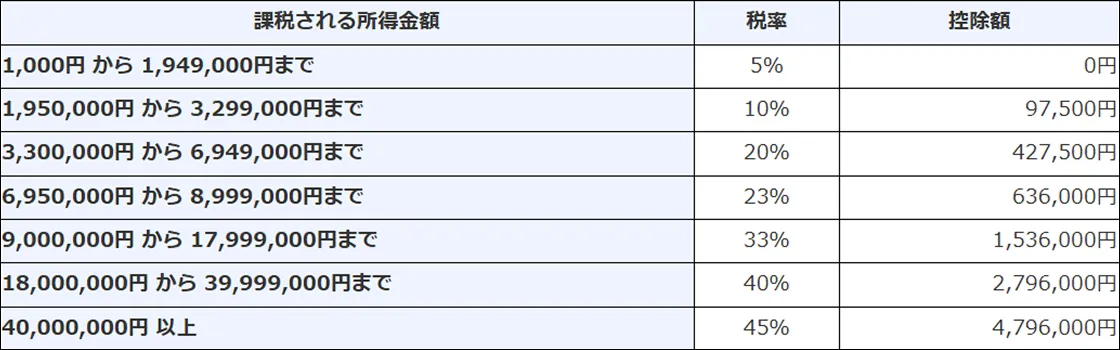
Japan's income tax follows a progressive tax rate ranging from 5% to 45%, as shown below, with a resident tax of approximately 10% added on top.
Reference: Income Tax Rates | National Tax Agency (NTA)
Note on regulatory timing: as of July 2026, under current law, gains from selling crypto assets are treated as miscellaneous income subject to aggregate taxation as described above. On July 15, 2026, a bill amending the Financial Instruments and Exchange Act (FIEA) was passed by Japan's House of Councillors in a plenary session, which will reclassify crypto assets as financial instruments under the FIEA. A separate self-assessment tax rate of 20% is expected to apply starting from the fiscal year following the amended law's enforcement, currently anticipated around January 2028.
This article is for informational purposes only and does not constitute financial or investment advice. Please consult a qualified professional before making investment decisions.


