


When the price of a crypto asset (also known as virtual currency) you hold suddenly plunges and the words "unrealized loss" fill the screen, few people can stay calm.
This survey analyzed the real behavior and psychological state of 1,226 crypto investors when faced with unrealized losses.
The results showed that among beginners with less than six months of investing experience, about 30% chose to "sell immediately" out of anxiety, while veteran investors displayed remarkably composed responses.
What determines the fork in the road between "cutting losses" and "holding on" is not the size of the investment amount.
This article breaks down the investor profile that avoids missing out on gains even during sudden market swings, along with the judgment criteria for making decisions you won't regret, based on what the data revealed.
Investment Amount Directly Shapes Decisions During Unrealized Losses
Investors with Over ¥200,000 Lean Toward Buying More
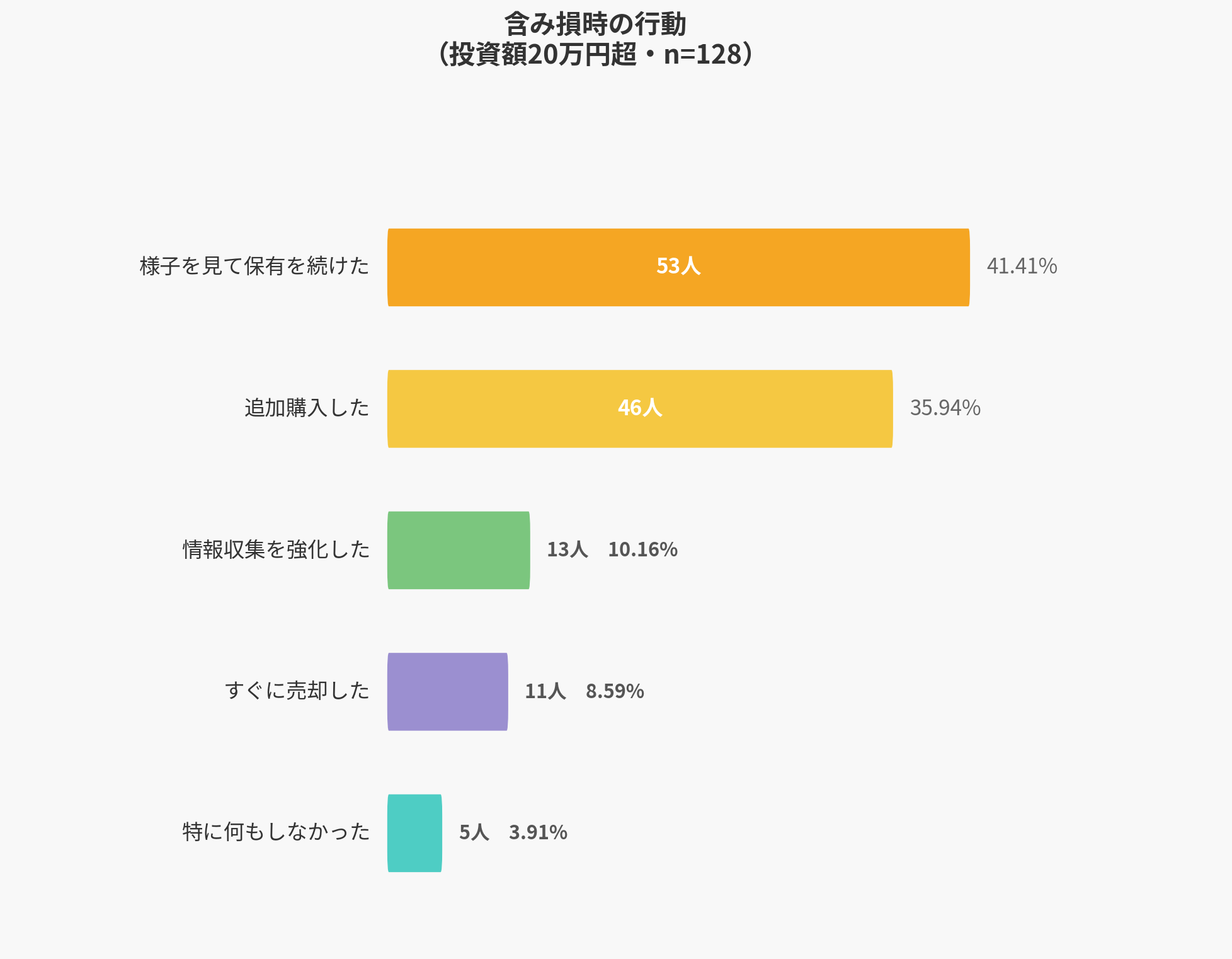
Response | Count | Share |
|---|---|---|
Watched and continued holding | 53 | 41.41% |
Bought more | 46 | 35.94% |
Stepped up research | 13 | 10.16% |
Sold immediately | 11 | 8.59% |
Did nothing in particular | 5 | 3.91% |
Among investors with more than ¥200,000 invested, the share choosing to "buy more" when unrealized losses appeared rose noticeably.
Roughly 36% of investors in the ¥200,000-to-under-¥500,000 bracket bought more, a figure nearly five times higher than among investors with under ¥50,000 invested.
The larger the asset base, the stronger the tendency to treat a price decline as a prime buying opportunity.
Meanwhile, the calm "continued holding" group also exceeded 40%, suggesting an attitude of not being swayed by short-term volatility.
This group likely already has some investing experience under its belt and appears to be making calm decisions grounded in its own portfolio management approach.
The picture that emerges is of investors who do not treat unrealized losses purely as risk, but instead build them into a strategic step toward future gains.
Especially notable is that "sold immediately" — the response most closely tied to panic selling — stayed under 10%.
Investors who have committed a certain amount of capital tend to understand the need for cutting losses while still avoiding rash, panic-driven selling.
For mid-to-high-tier investors, an unrealized loss is interpreted not as a signal to retreat but as an occasion to reassess strategy or adjust positions.
Investors Under ¥50,000 Split Between Watching and Selling Immediately
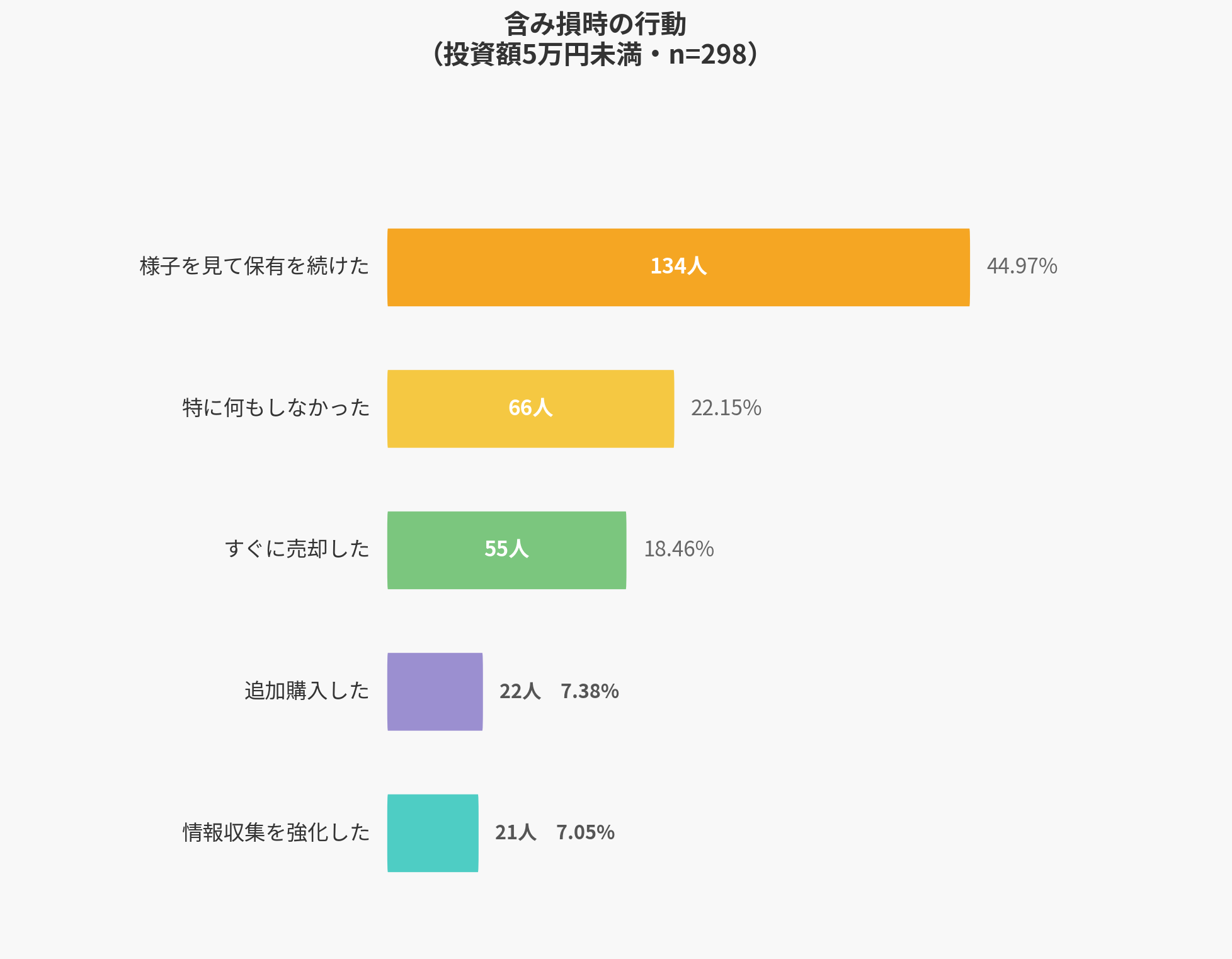
Response | Count | Share |
|---|---|---|
Watched and continued holding | 134 | 44.97% |
Did nothing in particular | 66 | 22.15% |
Sold immediately | 55 | 18.46% |
Bought more | 22 | 7.38% |
Stepped up research | 21 | 7.05% |
Among small-scale investors with under ¥50,000 invested, behavior around unrealized losses shows a striking split.
Combining "watched and continued holding" with "did nothing in particular" reaches about 67%, meaning the large majority chose to maintain the status quo.
This is likely because, with such a small amount at stake, the loss itself is limited, giving investors the psychological room to leave it alone without disrupting daily life.
On the other hand, about 18% of investors in this bracket "sold immediately" the moment an unrealized loss appeared — the highest share of any investment-amount bracket.
This points to a clear pattern of panic selling, where beginners who started with a small amount of capital panic in the face of an unexpected drop and abandon their holdings.
Whether calmly watching or reacting emotionally with an immediate sale, this bracket shows unstable investment behavior without a settled decision-making framework.
In addition, proactive responses such as "buying more" or "stepping up research" each fall under 10%, highlighting how few options this group tends to act on.
The smaller the investment amount, the more investors seem to fall into a near "thought paralysis" state, passively watching the market rather than actively responding to it.
For small-scale investors in particular, building the right mindset for handling unrealized losses may be the key factor that determines long-term outcomes.
Over Half of Investors With More Than ¥1,000,000 Calmly Hold On
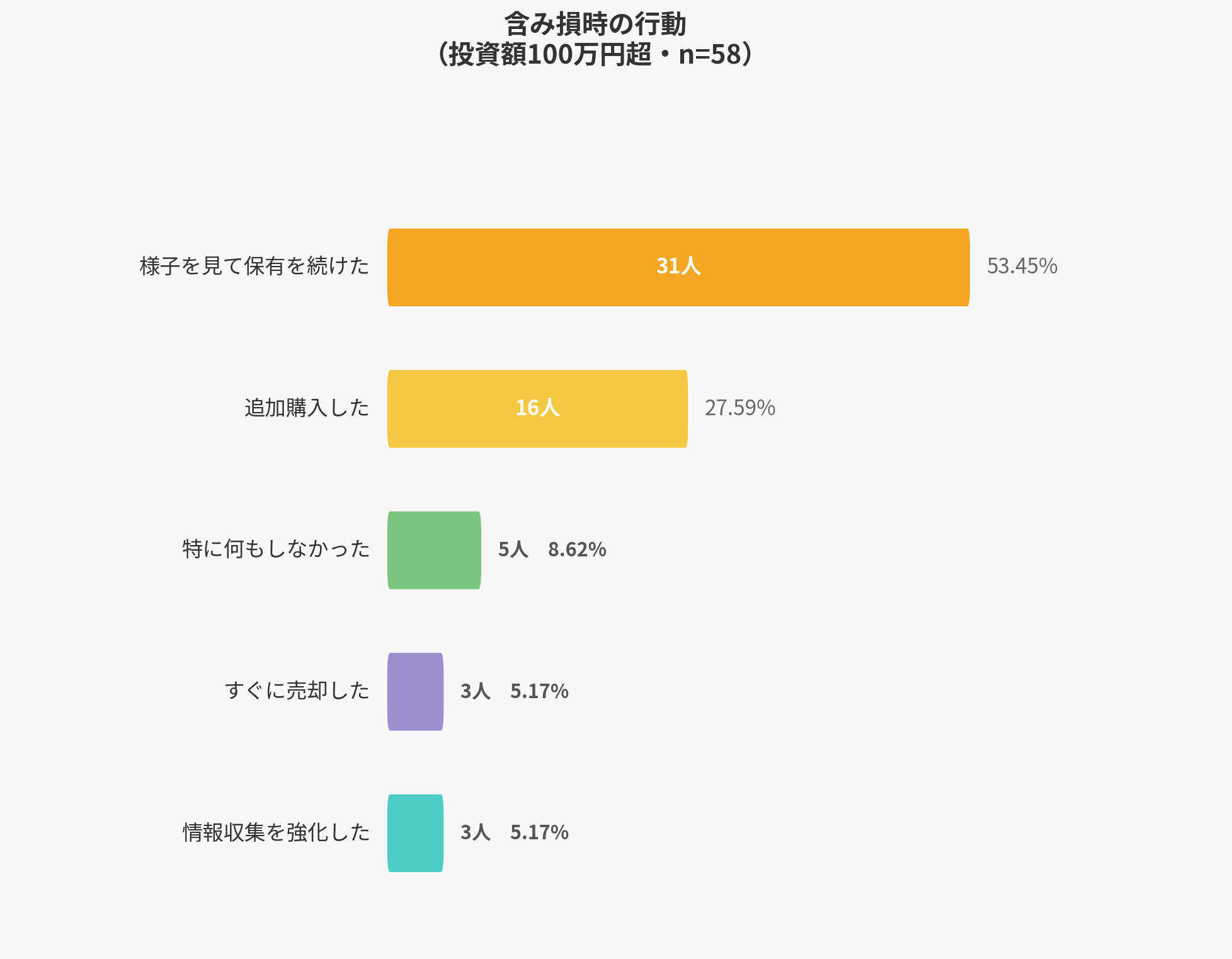
Response | Count | Share |
|---|---|---|
Watched and continued holding | 31 | 53.45% |
Bought more | 16 | 27.59% |
Did nothing in particular | 5 | 8.62% |
Sold immediately | 3 | 5.17% |
Stepped up research | 3 | 5.17% |
Among the top bracket of investors with more than ¥1,000,000 invested, over 53% answered that they "watched and continued holding."
For high-value investors, unrealized losses are a routine occurrence, underscoring a rock-solid mental discipline and level of capital management that is not thrown off by short-term price swings.
Precisely because they are moving substantial capital, this data reflects a seasoned stance built on a deep understanding of the risk of abandoning a position on a fleeting emotion.
Furthermore, about 28% went as far as "buying more," a strong indicator that this group had not backed off from an offensive posture.
A common thread among this bracket is investment behavior that closely resembles that of a professional — using a price decline strategically to lower the average acquisition cost.
In this bracket, "cutting losses" (selling immediately) accounted for only around 5%, demonstrating a high level of discipline: without a clear exit rule, they do not let go of assets carelessly.
What stands out across high-value investors' behavior is that anxious "did nothing in particular" responses were extremely rare, while "continued holding" as a deliberate strategy stood out clearly.
Financial capacity certainly plays a role, but even more so, a firm investment philosophy built on past experience appears to be what drives their behavior.
The data once again confirms that investors who successfully grow their assets substantially make autonomous decisions even in the difficult moments of unrealized losses.
Accumulated Investing Experience Changes Resilience to Unrealized Losses
Beginners Under Six Months Show Notable Panic Selling and Decision Paralysis
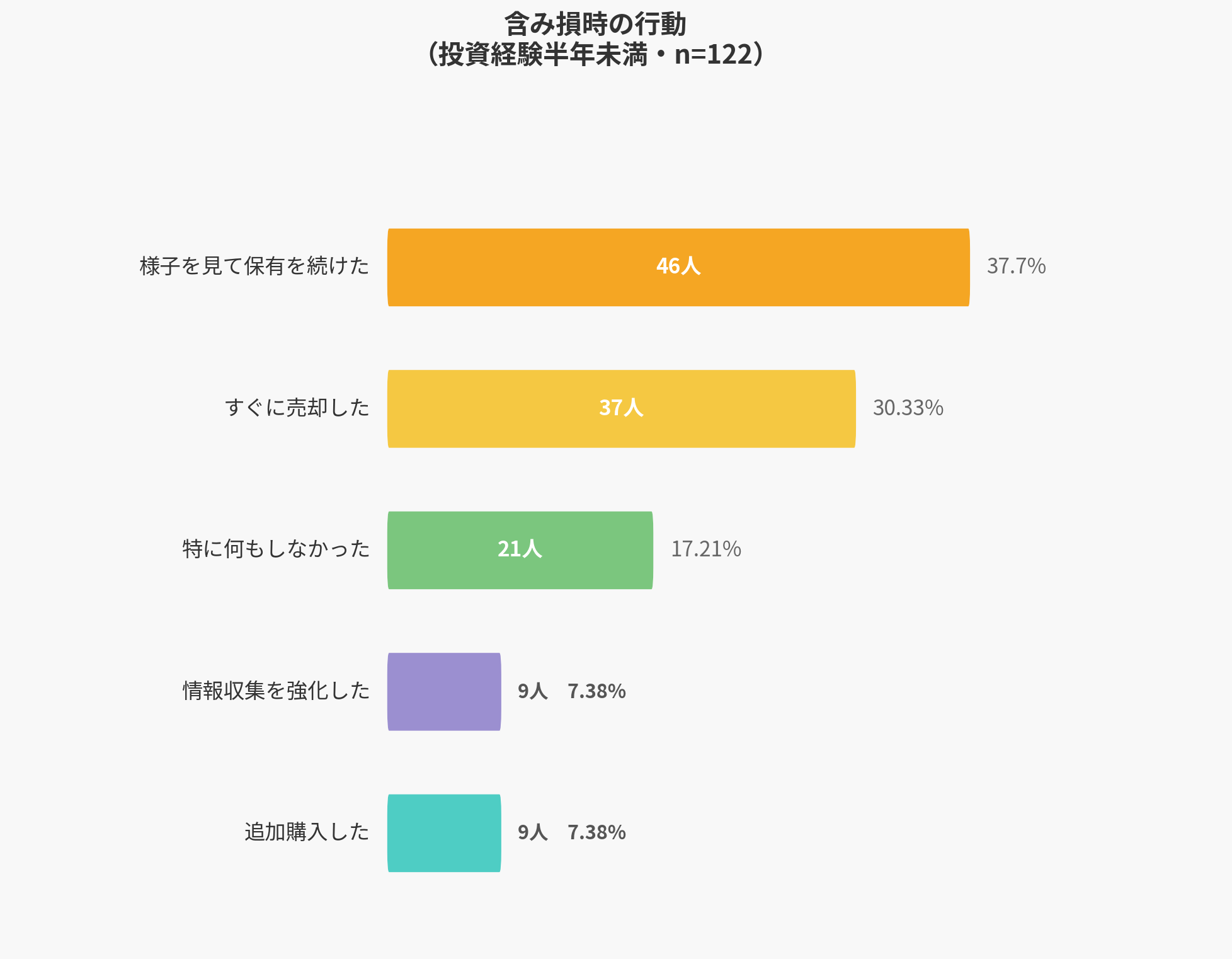
Response | Count | Share |
|---|---|---|
Watched and continued holding | 46 | 37.70% |
Sold immediately | 37 | 30.33% |
Did nothing in particular | 21 | 17.21% |
Stepped up research | 9 | 7.38% |
Bought more | 9 | 7.38% |
Among beginners with less than six months of crypto investing experience, behavior in the face of unrealized losses reflects a deep sense of urgency.
The share who answered "sold immediately" reached about 30%, by far the highest figure across all experience brackets.
At a stage when investors have not yet grown accustomed to price swings, there is a clear tendency to lock in a loss simply to escape the fear of watching assets shrink.
In addition, the passive response of "did nothing in particular" accounted for about 17%, pointing to a kind of frozen state that stems from lacking any decision-making criteria.
The data suggests that, rather than deliberately staying put, a significant number of beginners fall into "thought paralysis," unsure of how they should act.
Proactive actions that should matter for asset building — buying more or stepping up research — accounted for only about 7% each.
These results show that beginners need more than knowledge alone to get through unrealized losses; psychological resilience is essential.
Preventing "panic selling," where an investor exits the market after a single downturn, requires simulating scenarios in advance.
In the early stages of experience, not being swayed by every price swing and getting used to the market's ups and downs with a small amount first is key to boosting long-term survival odds.
Mid-Tier Investors With One to Three Years of Experience Establish Calm, Continued Holding
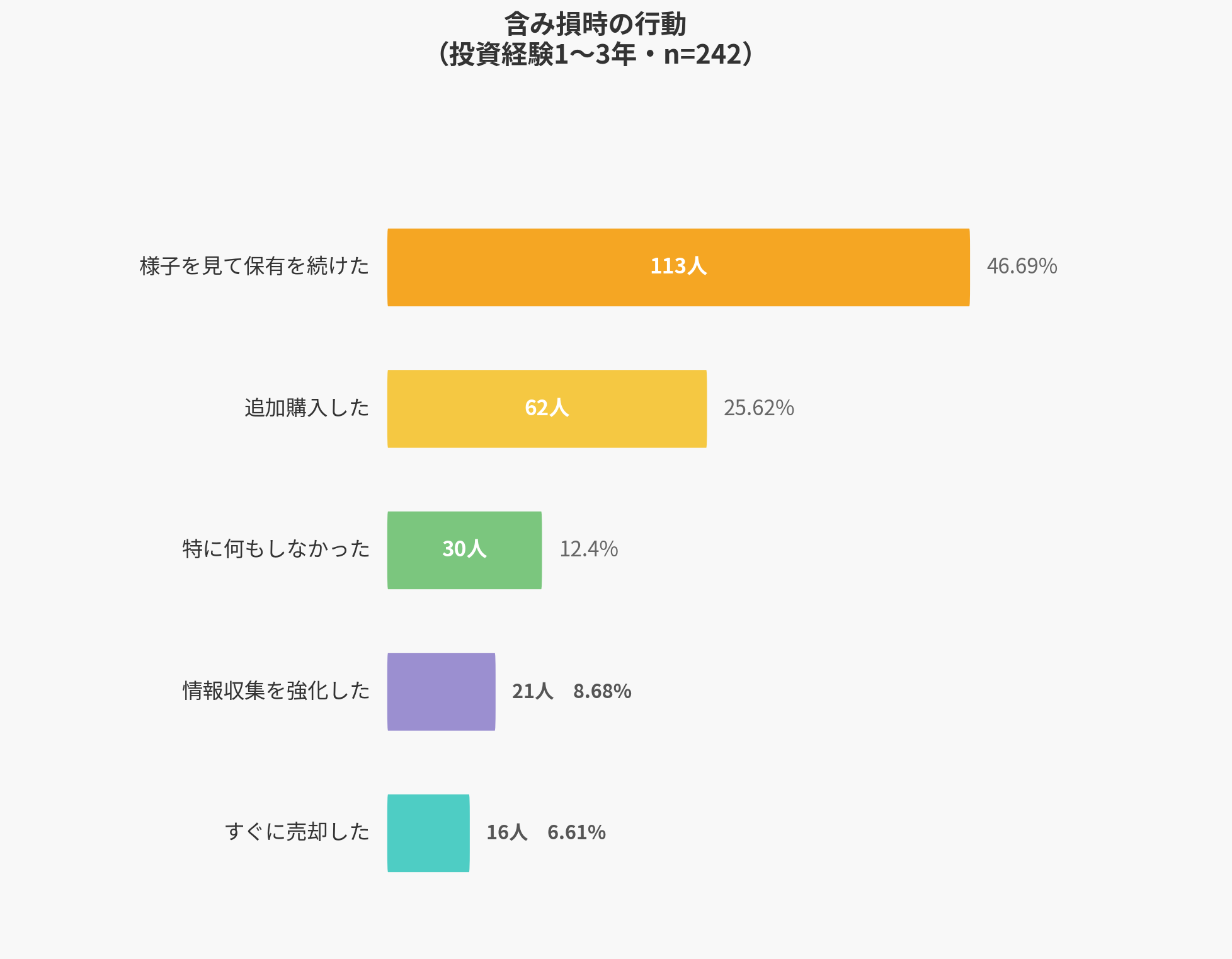
Response | Count | Share |
|---|---|---|
Watched and continued holding | 113 | 46.69% |
Bought more | 62 | 25.62% |
Did nothing in particular | 30 | 12.40% |
Stepped up research | 21 | 8.68% |
Sold immediately | 16 | 6.61% |
Once investing experience reaches one to three years, behavior in the face of unrealized losses shifts dramatically.
The share answering "sold immediately" plummets to just under 7%, a gap of roughly 4.5 times compared with the beginner bracket.
This is clear evidence that, through several years of market experience, investors gain the composure to treat crypto's characteristic volatility as something already "priced in."
Notably, about 47% answered "watched and continued holding," and a further roughly 26% chose to "buy more."
This bracket has begun to treat downturns strategically — not simply as a loss, but as a preparation period ahead of a future rebound.
An autonomous investment judgment appears to be taking hold, one that trusts the potential of the assets held and is not thrown off by near-term price swings.
For mid-tier investors, an unrealized loss is not a signal to retreat, but rather an important process for strengthening their portfolio.
A meaningful share also chose to "step up research," clearly reflecting an attitude of trying to make decisions grounded in evidence.
As experience accumulates, investors appear to be moving from being dominated by market fear to a stage where they can objectively step back and assess the situation.
Veterans With Five-Plus Years of Experience Maintain Strategic Composure
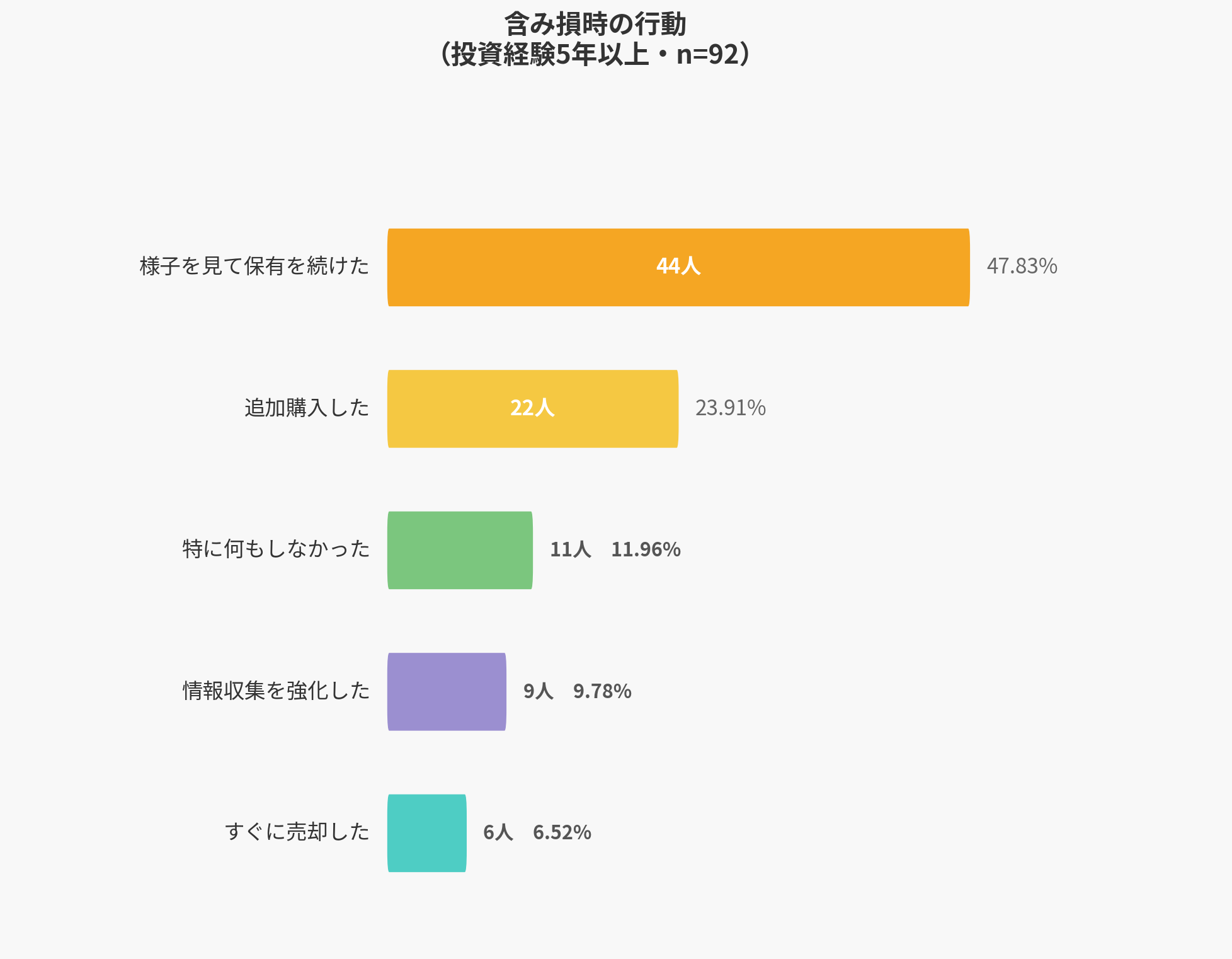
Response | Count | Share |
|---|---|---|
Watched and continued holding | 44 | 47.83% |
Bought more | 22 | 23.91% |
Did nothing in particular | 11 | 11.96% |
Stepped up research | 9 | 9.78% |
Sold immediately | 6 | 6.52% |
Among veteran investors with more than five years of experience, an astonishing degree of composure and discipline holds up even amid unrealized losses.
The share who answered "watched and continued holding" reached about 48%, the highest level of stability across all attribute groups.
Having weathered numerous large-scale crashes and rallies over the years, these investors have developed an unshakable mentality that doesn't get rattled by a temporary loss on paper.
The share who "bought more" was also high, at about 24%, showing that buying the dip has become a fully routinized part of their investing behavior.
Meanwhile, only about 6% "sold immediately," a figure that confirms in the data a seasoned investment philosophy that avoids careless loss-cutting.
For veteran investors, being in a state of unrealized loss appears to be fully accepted as simply "part of investing."
What's interesting is that "did nothing in particular," common among beginners, has evolved among veterans into "deliberate, strategic inaction."
Rather than rushing to gather information, calmly watching the market according to predetermined rules could be described as the ultimate form of investing.
It was reaffirmed that the longer investors survive in the market, the more they combine emotion-free, mechanical judgment with deep trust in the market.
The Correlation Between Mental State, Investment Style, and Behavior
Over 70% of Investors Who Sold Report Strong Anxiety or Stress
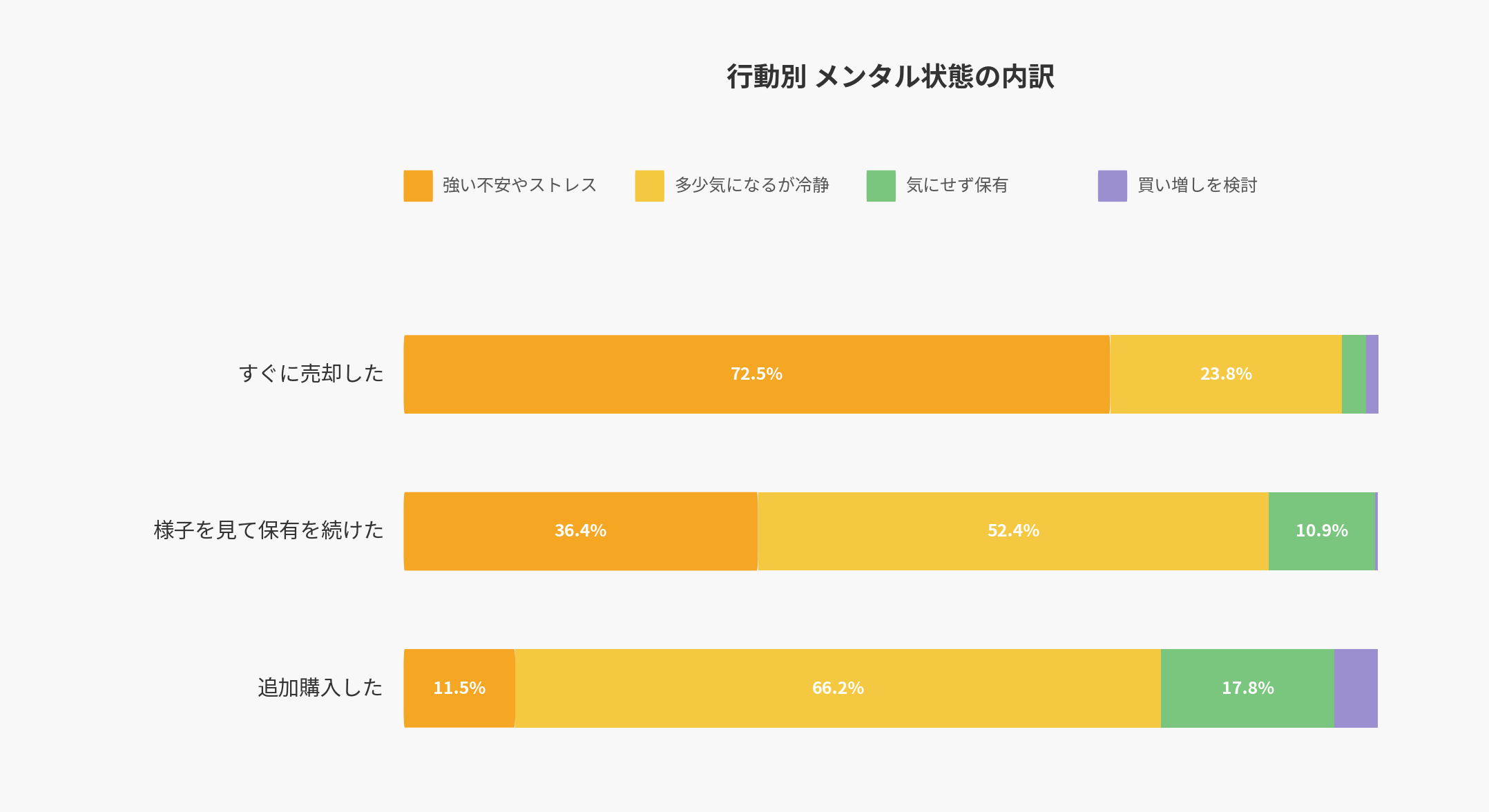
Response | Somewhat concerned but calm | Strong anxiety or stress | Unconcerned, holding as is | Considering buying more |
|---|---|---|---|---|
Sold immediately | 23.75% | 72.50% | 2.50% | 1.25% |
Watched and continued holding | 52.42% | 36.36% | 10.91% | 0.30% |
Bought more | 66.24% | 11.46% | 17.83% | 4.46% |
Among investors who "sold immediately" when facing an unrealized loss, a striking 72.5% reported feeling "strong anxiety or stress."
This figure is overwhelmingly higher than for any other behavior pattern, strongly suggesting that the decision to cut losses was not a strategic one, but rather a "defensive reaction" aimed at escaping psychological distress.
Decisions made under the grip of emotion often carry the risk of selling right at the market bottom.
By contrast, among investors who "bought more," about 66% reported being "somewhat concerned but able to stay calm" — a starkly different result.
Only around 11% reported strong anxiety, showing that mental stability is a near-essential precondition for supporting proactive investment behavior.
Without a calm state of mind, it is extremely difficult to hold the perspective needed to see a downturn as an opportunity.
More than half of those who chose to "watch and continue holding" also stayed calm, with that psychological margin making the option to "wait" possible in the first place.
Unrealized losses are an unavoidable part of crypto investing, but how an investor receives them can significantly shape their asset trajectory going forward.
Understanding one's own mental tolerance and investing within that range is a first step toward preventing panic selling.
Short-Term Traders Show Higher Loss-Cutting Rates and Are Also Active Buyers
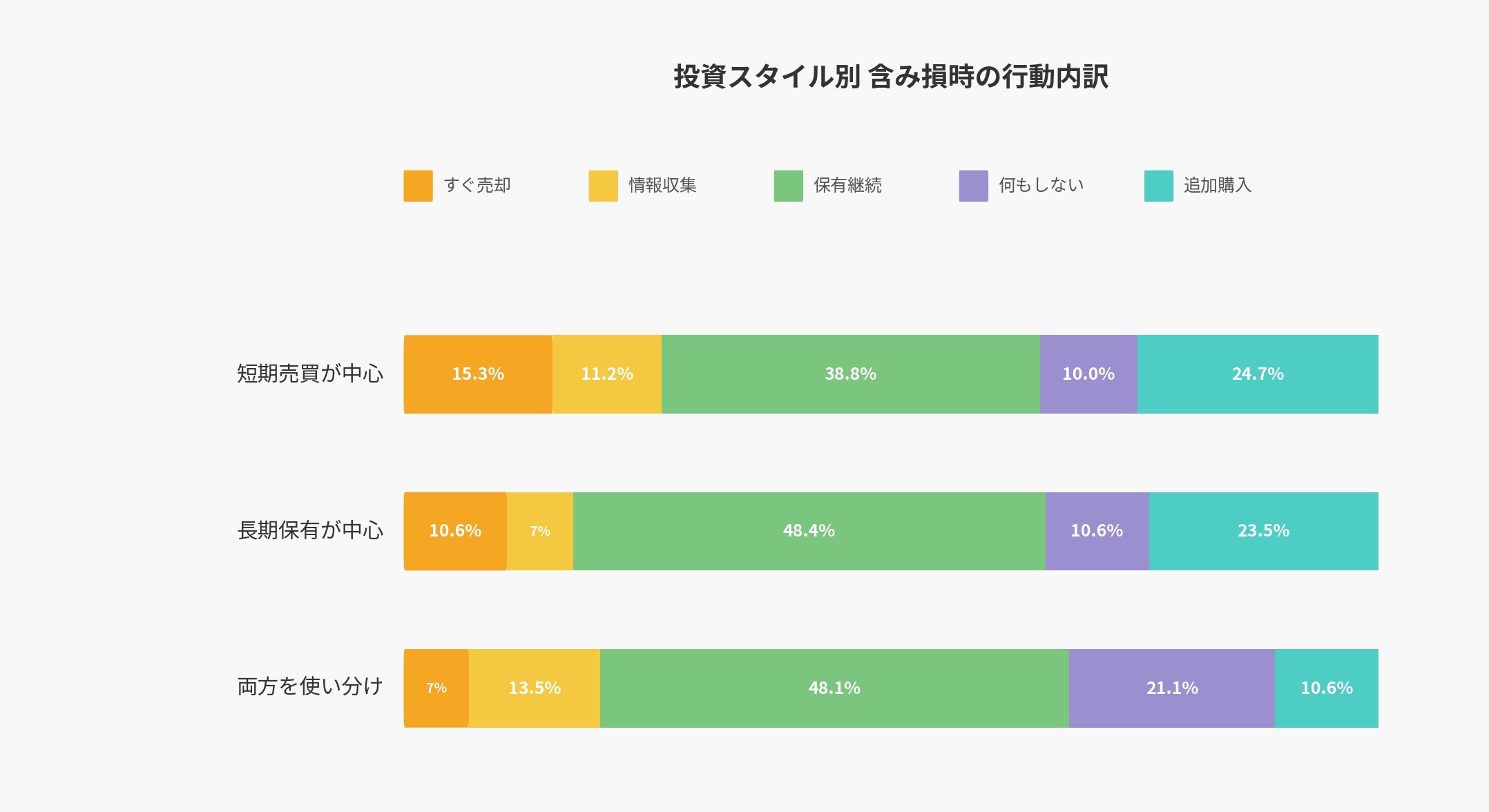
Response | Sold immediately | Stepped up research | Continued holding | Did nothing | Bought more |
|---|---|---|---|---|---|
Mainly short-term trading | 15.29% | 11.18% | 38.82% | 10.00% | 24.71% |
Mainly long-term holding | 10.63% | 6.79% | 48.42% | 10.63% | 23.53% |
A mix of both | 6.73% | 13.46% | 48.08% | 21.15% | 10.58% |
Analyzing behavior around unrealized losses by investment style, about 15% of investors whose primary approach is short-term trading chose to "sell immediately."
This is a higher share than among long-term holders (about 10.6%), suggesting that, given the emphasis short-term trading places on turnover, prompt loss-cutting is being thoroughly practiced.
At the same time, about 25% also "bought more," making clear an aggressive posture aimed at capturing short-term price swings.
Among investors who describe themselves as long-term holders, close to half — about 48% — answered that they "watched and continued holding."
Because they are approaching investing with a long horizon, a well-established style has taken hold in which a temporary unrealized loss is treated as within expectations.
That said, the fact that about 10% of even the long-term holding group cut their losses illustrates how difficult it can be to stick with "HODLing" (long-term holding) through crypto's sharp downturns.
What's interesting is that among the hybrid group that mixes short-term and long-term approaches, "did nothing in particular" stood out at a notably high roughly 21%.
Using multiple strategies at once may create hesitation over which rule should apply when an unrealized loss occurs, resulting in a choice to simply "wait and watch."
Regardless of style, whether an investor can maintain their own "form" in the adverse situation of an unrealized loss serves as a measure of investing maturity.
The Line Between Aimless Inaction and Calm, Continued Holding
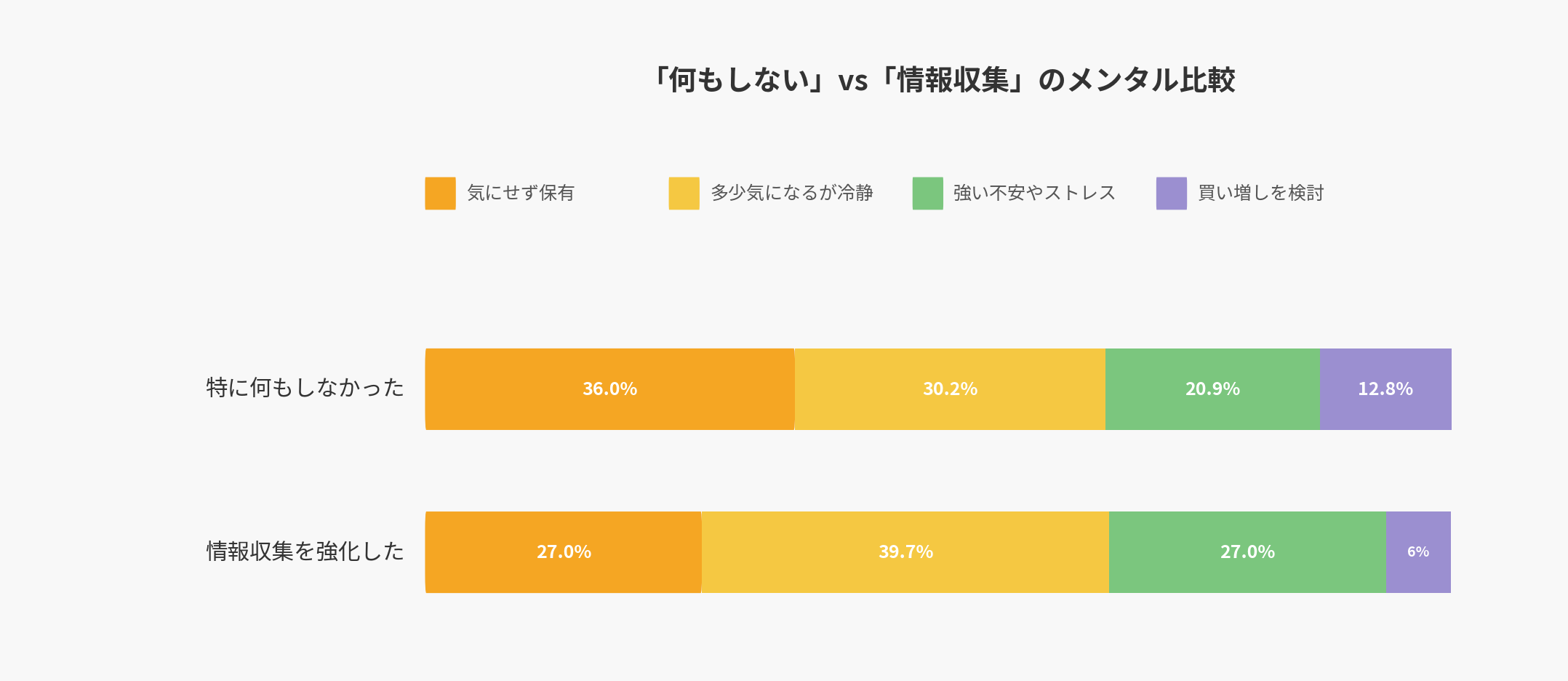
Response | Somewhat concerned but calm | Strong anxiety or stress | Unconcerned, holding as is | Considering buying more |
|---|---|---|---|---|
Did nothing in particular | 30.23% | 20.93% | 36.05% | 12.79% |
Stepped up research | 39.68% | 26.98% | 26.98% | 6.35% |
Looking at the mental-state breakdown for investors who answered "did nothing in particular," about 36% said they could "hold on without concern," while about 21% reported "strong anxiety."
Even though the behavior looks identical — "doing nothing" — the underlying reality splits into two very different states: "confident holding" and "thought paralysis driven by anxiety."
Inaction accompanied by anxiety carries the risk that, unable to withstand a further market decline, the investor ends up dumping assets at the worst possible moment.
By contrast, among investors who "stepped up research" in response to an unrealized loss, about 40% stayed calm while about 27% took action despite feeling strong anxiety.
This group is converting the emotion of anxiety into energy for "learning," taking a rational approach of searching for grounds for their decisions rather than blindly selling.
Gaining an objective view of the current situation through research helps stabilize one's mental state and works toward connecting to the next appropriate move — a very healthy attitude for an investor to take.
What the data shows is that "doing nothing" during an unrealized loss is not necessarily the right answer.
If it is grounded in a strategy, that is fine, but if it stems from avoidance driven by anxiety, it is worth pausing to reconfirm one's investment approach.
While it may be difficult to eliminate emotion entirely, incorporating concrete actions such as research or reconfirming one's rules is the shorter path to long-term success.
Summary
This survey of 1,226 investors found that what separates behavior during unrealized losses is not investment size, but "experience" and "mindset."
While about 30% of beginners with under six months of experience panic and "sell immediately," more than half of mid-tier and veteran investors with three or more years of experience calmly continue to hold.
The fact that more than 70% of those reporting "strong anxiety" chose to sell immediately illustrates the risk that emotion can undermine strategy.
Building long-term wealth requires the mental resilience to treat a downturn as "within expectations."
Rather than freezing up in a panic, acting steadily according to rules set in advance is the shortest path to becoming an investor who doesn't lose.
Survey Overview
Survey date: February 24, 2026
Survey method: Internet survey
Survey subjects: Men and women residing in Japan (people currently investing in crypto assets or with past investing experience)
Valid responses: 1,226
Conducted by: Clabo Inc.
Survey Questions
- Are you currently investing in crypto assets?
- How many years of crypto investing experience do you have?
- What is your current investment amount in crypto assets?
- Which best describes your investment style?
- When you are facing an unrealized loss, which best describes your mental state?
- Which action best describes what you did when facing an unrealized loss?
This article is for informational purposes only and does not constitute financial or investment advice. Please consult a qualified professional before making investment decisions.


