


Managing income and expenses accurately in crypto assets (also known as virtual currencies) trading is a challenge investors cannot avoid.
This survey found that roughly 80% of investors have experience using a profit/loss calculation tool, reflecting a search for more efficient asset management.
What stands out most is that once an investor's current holdings exceed ¥10,000 (roughly $65–$70), tool usage jumps past the 50% mark, rising more than 20 percentage points at that threshold.
Among investors holding ¥500,000 (roughly $3,300–$3,500) or more, the non-usage rate falls below 3%, suggesting that adopting a tool has become something close to a "shared norm" for sustaining investment activity smoothly.
This article uses the survey data to explain how using these tools eases tax-related anxiety and translates directly into peace of mind.
It also takes a closer look at continued usage among long-term holders and the challenges faced by short-term traders, offering guidance for identifying the management approach best suited to each investor's stage.
Note for international readers: As of July 2026, gains from selling crypto assets in Japan are taxed as miscellaneous income under aggregate (progressive) taxation, and such losses can only be offset against other miscellaneous income — not against salary or other income categories. On July 15, 2026, Japan's amended Financial Instruments and Exchange Act was approved by the House of Councillors, which will reclassify crypto assets as financial instruments under the FIEA; a flat 20% separate self-assessment tax rate is expected to apply once the amended law takes effect, likely from January 2028.
The ¥10,000 Threshold: Tool Usage Crosses 50%
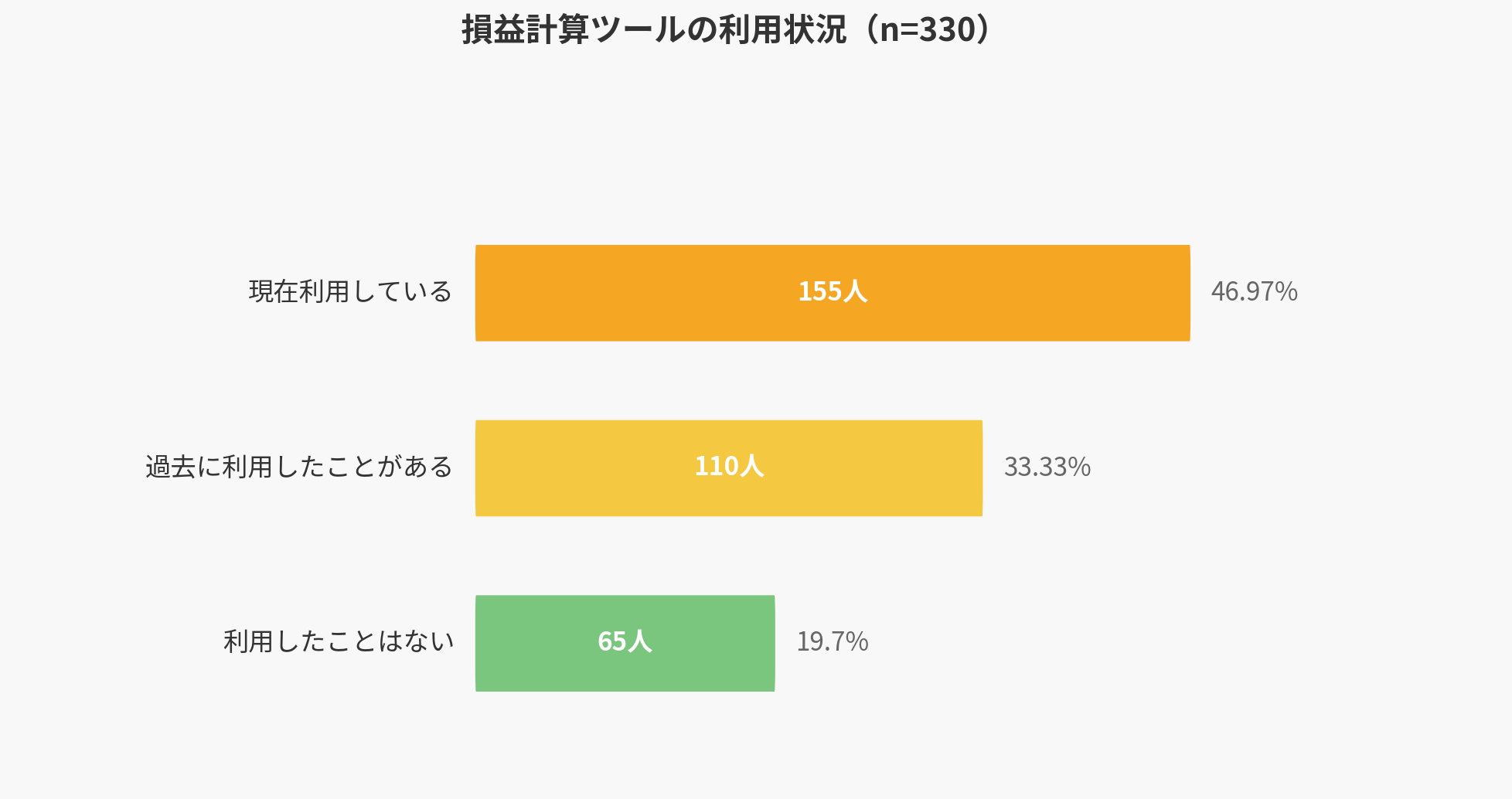
80% Have Tried a Tool, and Nearly Half Still Use One Today
Response | Number of Respondents | Percentage |
|---|---|---|
Currently using | 155 | 46.97% |
Used in the past but not currently | 110 | 33.33% |
Never used | 65 | 19.70% |
A survey of crypto asset profit/loss calculation tool usage found that roughly 80% of respondents overall have experience using one.
Specifically, "currently using" accounted for 46.97%, while "used in the past" reached 33.33%.
This suggests that the overwhelming majority of investors have felt the limits of manual calculation in crypto trading and sought some form of systematic support.
On the other hand, about 53% of respondents are currently not using a tool, indicating that there are hurdles to continued use and that some level of temporary drop-off does occur.
Still, the fact that 80% of investors have tried a tool at least once shows that automating profit/loss calculation has become an extremely accessible option for investors.
The findings highlight that adopting a tool is increasingly becoming the de facto standard as a first step toward proper profit management.
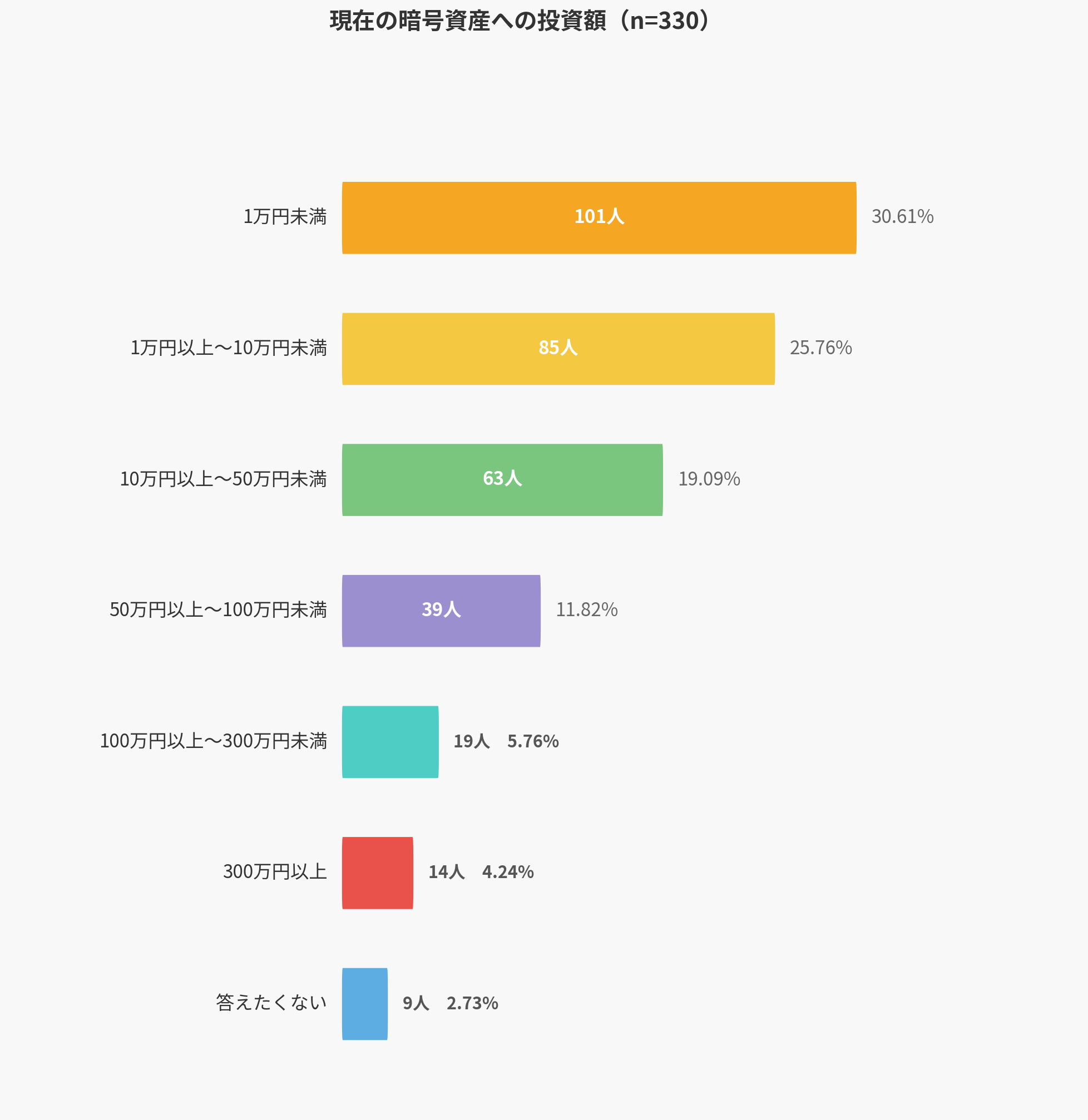
70% Invest ¥10,000 or More, Spanning a Wide Range of Investors
Response | Number of Respondents | Percentage |
|---|---|---|
Under ¥10,000 | 101 | 30.61% |
¥10,000 – under ¥100,000 | 85 | 25.76% |
¥100,000 – under ¥500,000 | 63 | 19.09% |
¥500,000 – under ¥1,000,000 | 39 | 11.82% |
¥1,000,000 – under ¥3,000,000 | 19 | 5.76% |
¥3,000,000 or more | 14 | 4.24% |
Prefer not to say | 9 | 2.73% |
When asked about their current crypto asset investment amount, small-scale investors holding under ¥10,000 formed the largest group at 30.61%.
At the same time, investors holding ¥10,000 or more collectively reached about 70%, confirming that a large share of individual investors have committed a meaningful amount of capital to the crypto market.
In particular, more than 30% of respondents combined fall within the ¥100,000-to-under-¥1,000,000 range, showing a substantial cohort holding crypto as part of full-fledged asset management.
Taking advantage of crypto's low barrier to entry, roughly 30% of respondents hold under ¥10,000, while around 10% are higher-stakes investors holding more than ¥1,000,000.
This wide range of investment amounts is a defining feature of today's market, and it is increasingly important to match management approaches to the scale of one's holdings.
Understanding which stage your own investment currently sits at is an essential step toward choosing the right tool and managing risk appropriately.
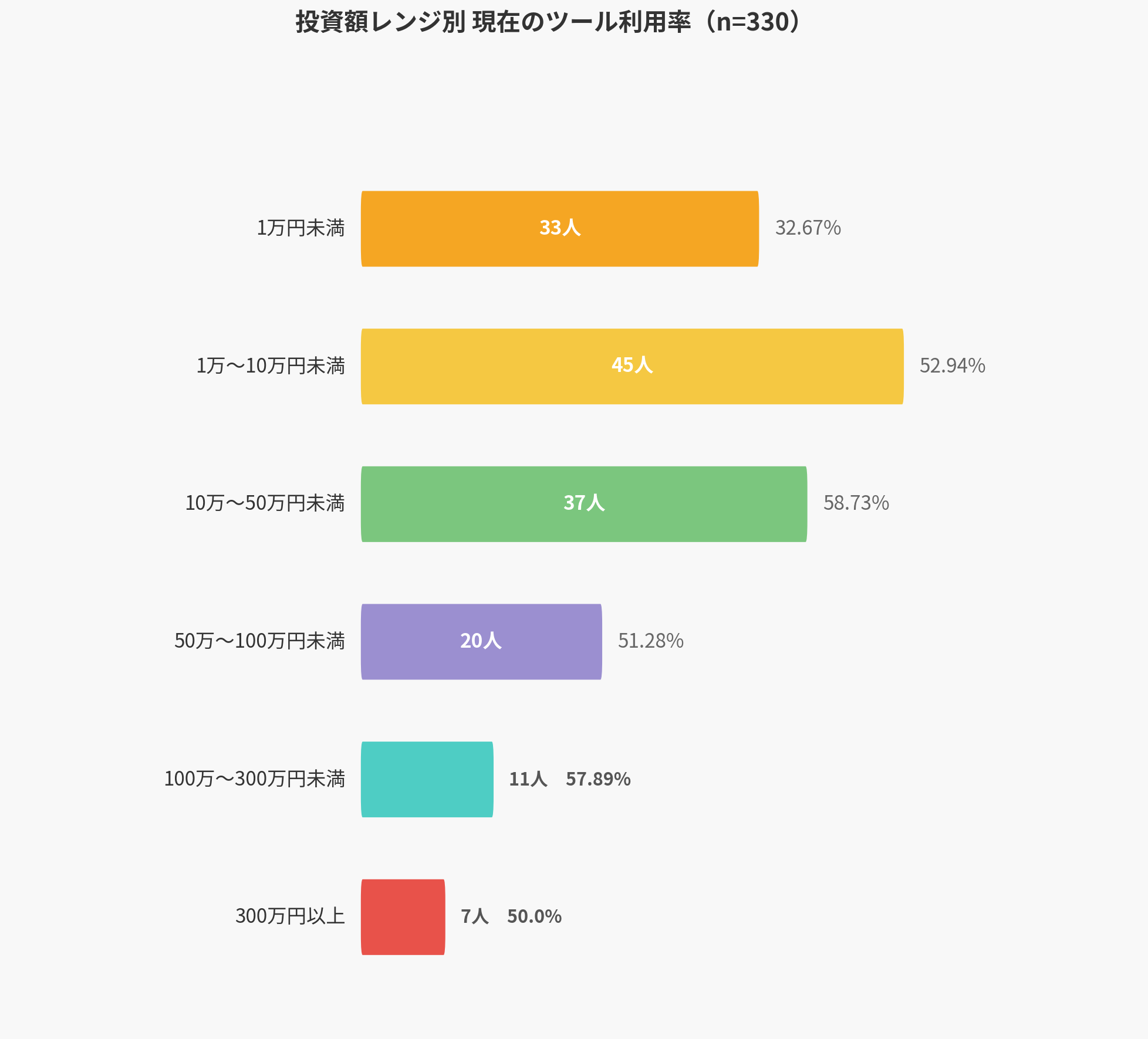
Usage Surges at ¥10,000; Adoption Becomes the Norm Above ¥500,000
Current Investment Amount | Currently Using | Used in the Past | Never Used |
|---|---|---|---|
Under ¥10,000 | 33 (32.67%) | 33 (32.67%) | 35 (34.65%) |
¥10,000 – under ¥100,000 | 45 (52.94%) | 29 (34.12%) | 11 (12.94%) |
¥100,000 – under ¥500,000 | 37 (58.73%) | 19 (30.16%) | 7 (11.11%) |
¥500,000 – under ¥1,000,000 | 20 (51.28%) | 18 (46.15%) | 1 (2.56%) |
¥1,000,000 – under ¥3,000,000 | 11 (57.89%) | 5 (26.32%) | 3 (15.79%) |
¥3,000,000 or more | 7 (50.00%) | 3 (21.43%) | 4 (28.57%) |
Prefer not to say | 2 (22.22%) | 3 (33.33%) | 4 (44.44%) |
Cross-analyzing investment amount against tool usage revealed a dramatic shift at the ¥10,000 mark.
Among investors holding under ¥10,000, the current-usage rate is 32.67%, but it jumps to 52.94% once holdings reach ¥10,000-to-under-¥100,000, a gap of more than 20 percentage points.
Crossing the ¥10,000 threshold appears to be the point at which trading frequency and the importance of record-keeping increase, prompting many investors to recognize the need for a profit/loss calculation tool.
Among investors holding ¥500,000-to-under-¥1,000,000, the non-usage rate falls to just 2.56%, an overwhelming result showing that nearly everyone in this bracket has adopted a tool at some point.
For investors at this scale, tracking profit and loss by hand is close to impossible, making tool use effectively a necessity.
Combining accurate profit/loss calculation with efficient preparation for the final tax return (kakutei shinkoku), the moment an investor's holdings exceed ¥10,000 can be seen as the right time to start considering a tool.
Using a Tool Eases Tax-Related Anxiety and Brings Peace of Mind
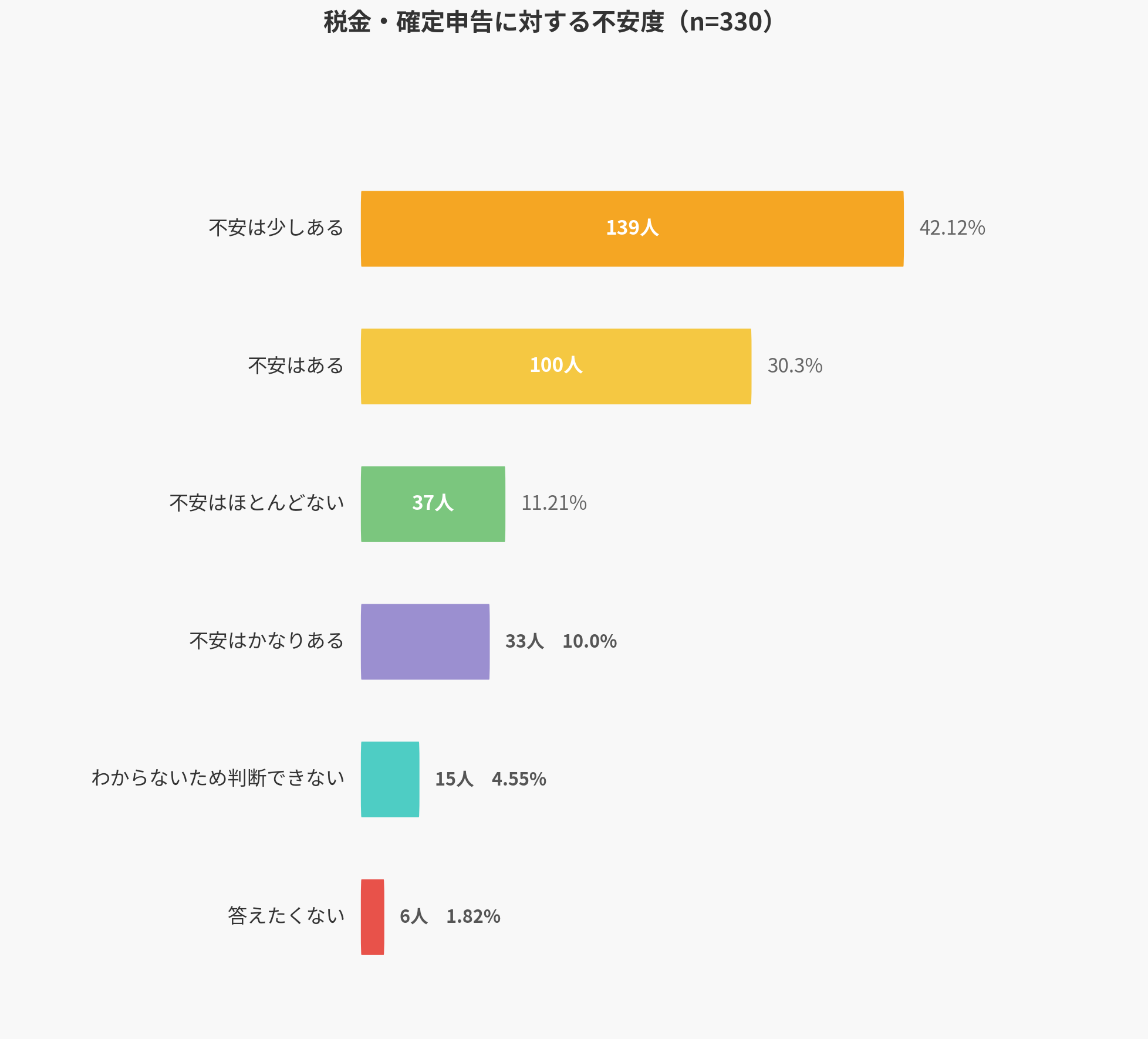
Over 80% of Investors Feel Some Degree of Anxiety About Taxes
Response | Number of Respondents | Percentage |
|---|---|---|
Somewhat anxious | 139 | 42.12% |
Anxious | 100 | 30.30% |
Barely anxious | 37 | 11.21% |
Very anxious | 33 | 10.00% |
Can't say, unsure | 15 | 4.55% |
Prefer not to say | 6 | 1.82% |
A survey of anxiety levels around crypto asset taxes and the final tax return found that, surprisingly, more than 80% of investors overall feel some degree of anxiety.
Combining "somewhat anxious," "anxious," and "very anxious" reaches 82.42%, highlighting that tax handling is a major psychological burden for investors.
The complex, crypto-specific calculation rules, along with the perception that the legal framework is still evolving, appear to be driving this widespread anxiety.
Notably, about 10% of respondents are seriously concerned, answering "very anxious," and a good number of voices worry about the risk of accidental omissions in their filing.
Meanwhile, only around 11% of investors can confidently say they are "barely anxious," meaning that for the large majority, the final tax return remains an unavoidable source of worry.
This high anxiety rate likely reflects not just a lack of knowledge, but also a technical concern: a lack of confidence in the accuracy of the tallying they do themselves.
Continued Users Report Much Lower Anxiety and Easier Management
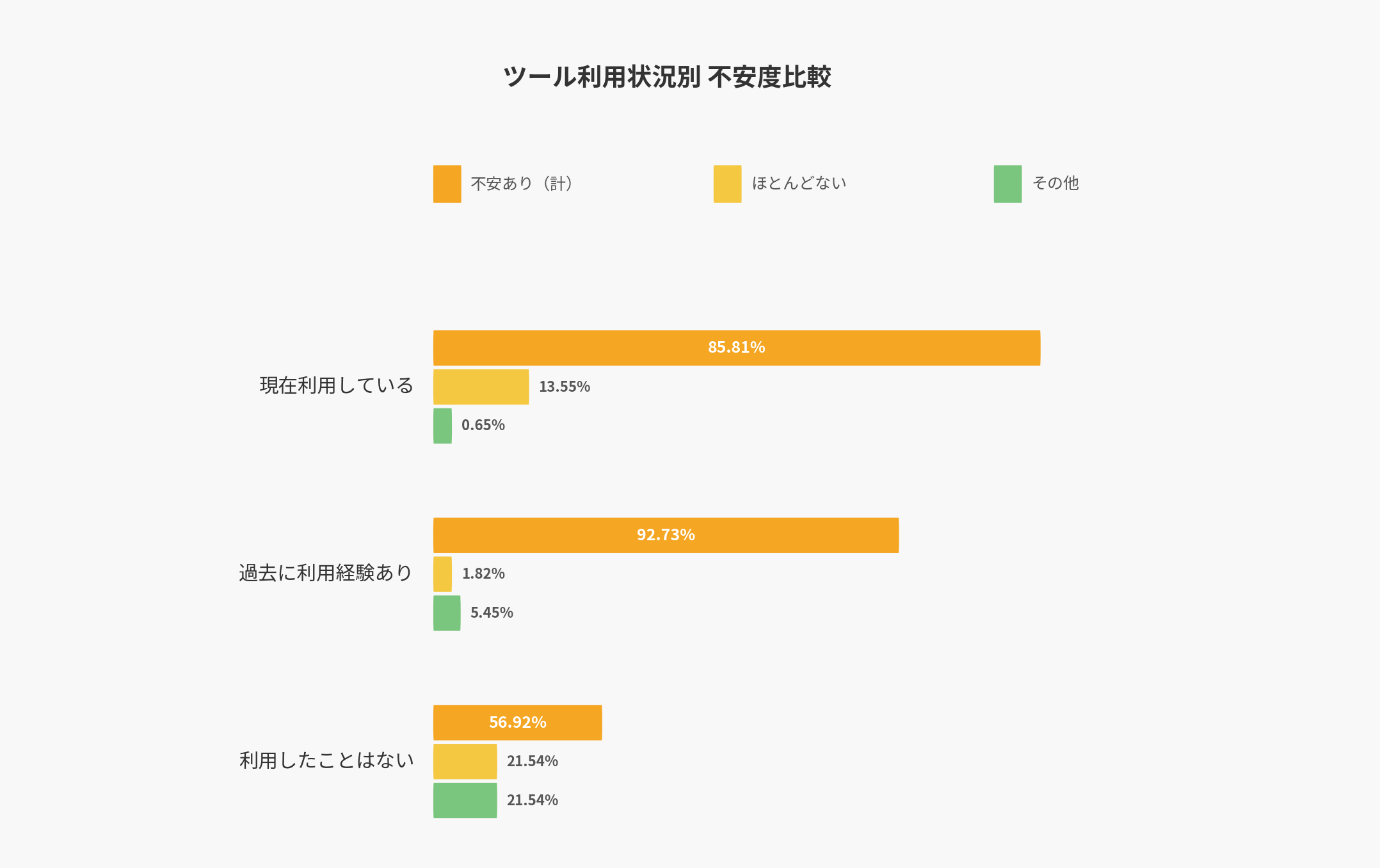
Tool Usage Status | Anxious (Total) | Barely Anxious | Other |
|---|---|---|---|
Currently using | 133 (85.81%) | 21 (13.55%) | 1 (0.65%) |
Used in the past | 102 (92.73%) | 2 (1.82%) | 6 (5.45%) |
Never used | 37 (56.92%) | 14 (21.54%) | 14 (21.54%) |
*"Anxious (Total)" combines "very anxious," "anxious," and "somewhat anxious."
Looking at the correlation between tool usage and anxiety level, the share reporting "barely anxious" is notably higher among people who are still using a tool today.
Among current users, 13.55% report no anxiety, compared with just 1.82% among those who used a tool in the past but have since stopped, a sharp decline.
This suggests that once investors step away from automated tallying, tracking their own profit and loss becomes difficult again, reigniting their fear of tax-related risk.
Interestingly, among those who have never used a tool, responses like "can't say, unsure" exceed 18%, suggesting they may not even be aware of their own anxiety.
Still, the data shows that as investment amounts grow and users enter a phase where filing is actually required, whether or not they have a tool becomes directly tied to their peace of mind.
The confidence that comes from being able to calculate accurate figures with a tool appears to serve as a powerful psychological anchor amid complex tax processes, helping create an environment where investors can focus on investing.
Anxiety Peaks Among Investors Who Stopped Using a Tool
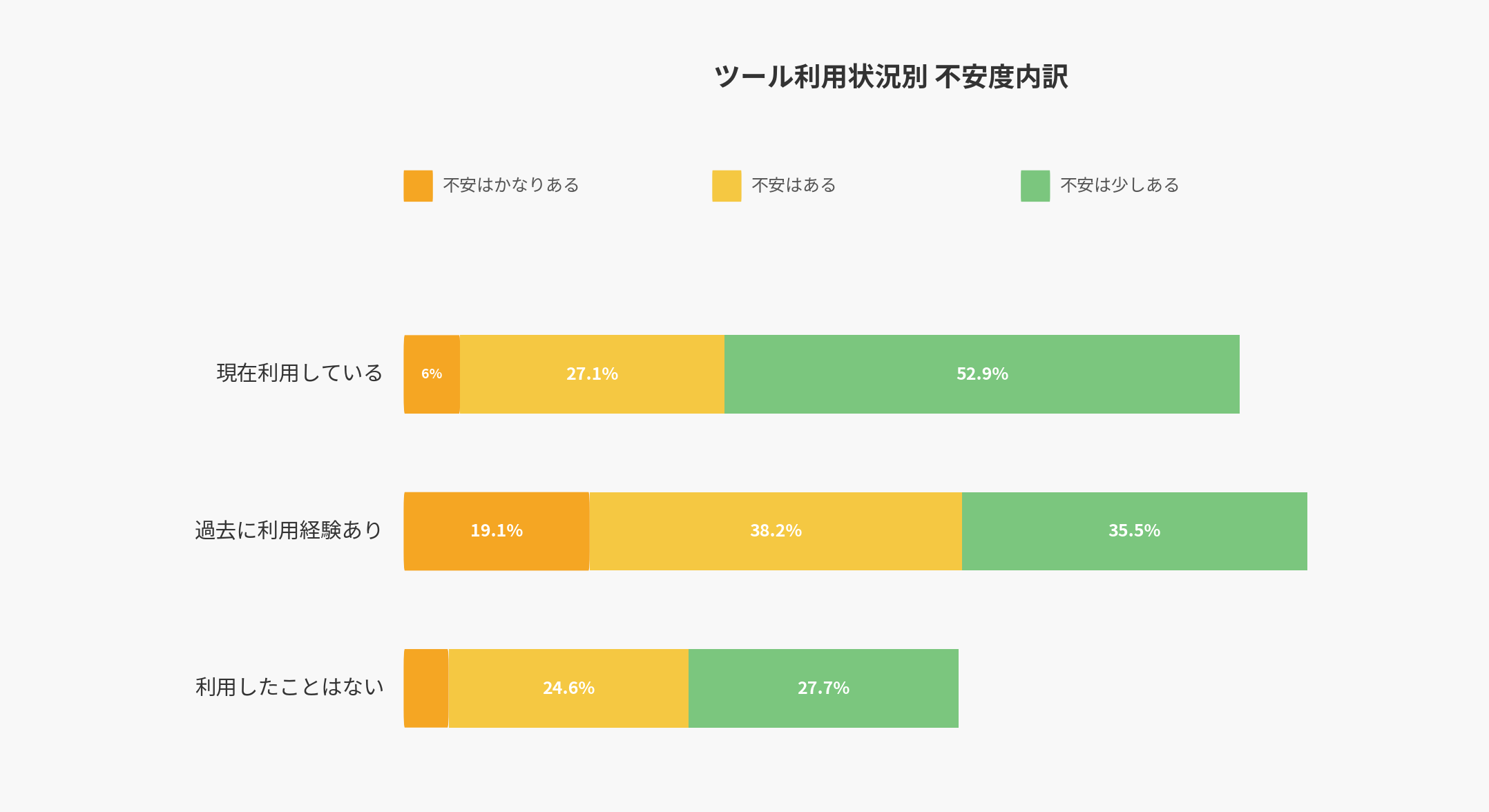
Tool Usage Status | Very Anxious | Anxious | Somewhat Anxious |
|---|---|---|---|
Currently using | 9 (5.81%) | 42 (27.10%) | 82 (52.90%) |
Used in the past | 21 (19.09%) | 42 (38.18%) | 39 (35.45%) |
Never used | 3 (4.62%) | 16 (24.62%) | 18 (27.69%) |
A closer look highlights just how serious the anxiety is among the "churned" group — investors who used a tool in the past but no longer do.
Within this group, "very anxious" reaches 19.09%, more than three times the 5.81% seen among current users.
Having once enjoyed the convenience of automation, returning to manual management — or abandoning tracking altogether — for whatever reason appears to drive this sharp rise in anxiety.
By contrast, more than half of current users report only relatively mild concern, "somewhat anxious."
This shows that while using a tool does not eliminate anxiety entirely, having a practical, evidence-based record keeps anxiety within a manageable range.
When it comes to preparing for a possible tax audit and paying taxes accurately, ongoing tool use functions as more than just an efficiency gain — it acts as a genuine "psychological safety net."
Over 50% of Long-Term Holders Use a Tool for Ongoing Management
Long-Term Holding Is the Most Common Style, With Short-Term Traders Close to 30%
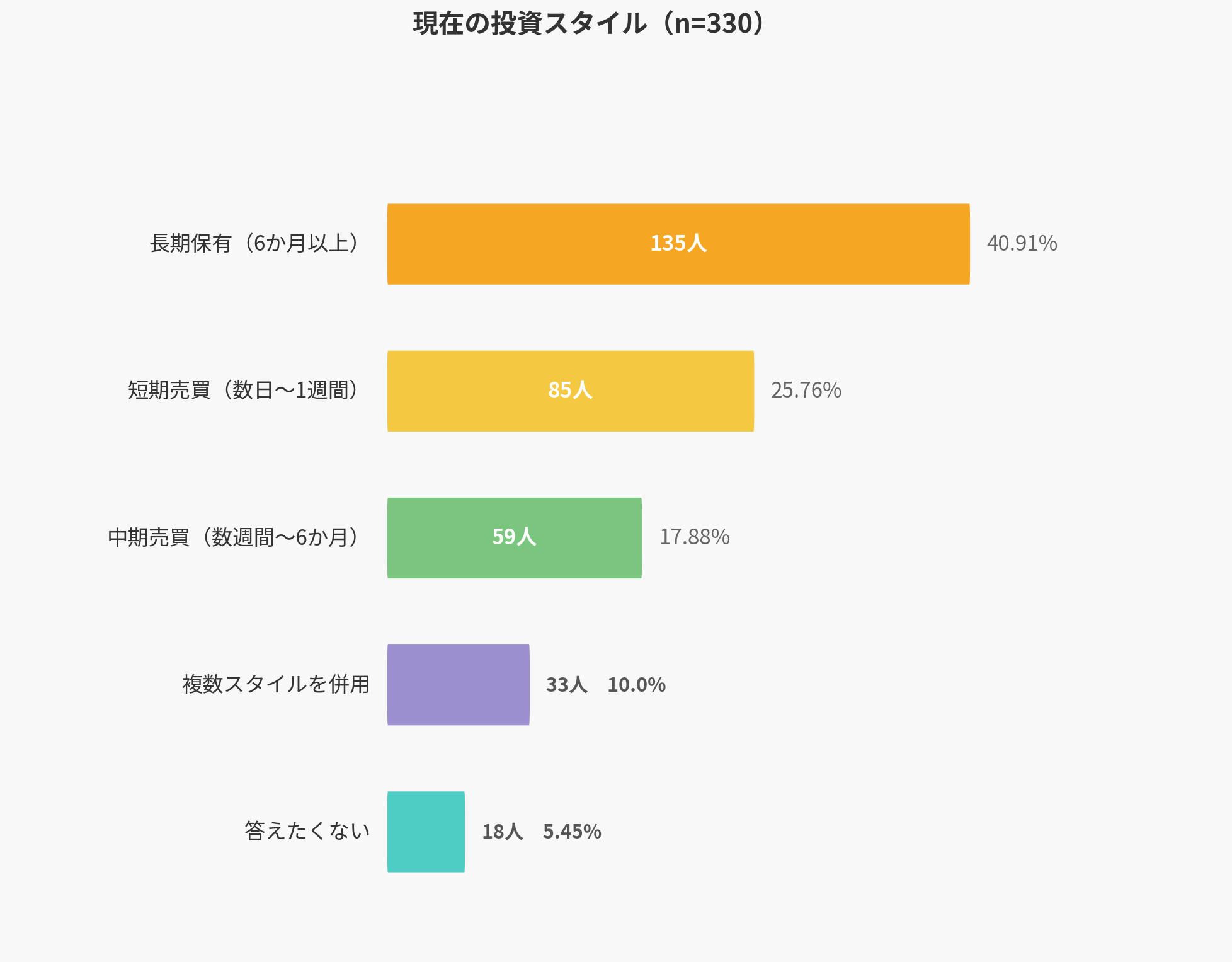
Response | Number of Respondents | Percentage |
|---|---|---|
Long-term holding (typically 6 months or more) | 135 | 40.91% |
Short-term trading (typically within a few days to about a week) | 85 | 25.76% |
Medium-term trading (typically a few weeks to about 6 months) | 59 | 17.88% |
A mix of styles in roughly equal measure | 33 | 10.00% |
Prefer not to say | 18 | 5.45% |
A survey of primary investment styles found that "HODLers" focused on long-term holding form the largest group at 40.91%.
Meanwhile, short- and medium-term trading combined account for more than 40%, showing that a meaningful share of investors remain active traders capitalizing on market volatility.
The results show a healthy balance in the crypto market between investors waiting for long-term asset growth and those aiming to build profit through a higher turnover of trades.
About 10% of investors combine multiple styles, suggesting they flexibly switch approaches depending on market conditions.
Compared with other financial products, crypto assets allow for a wider range of investment strategies, which in turn creates diversity in how individuals manage their holdings.
Notably, short-term traders make up about 26% of respondents — more than one in four investors overall.
Since a higher number of trades increases the complexity of profit/loss calculation, the presence of this active group is one factor driving demand for tools.
Choosing a management approach suited to one's own style will be key to sustaining stable investment activity.
Longer-Term Holders Show Higher Current Usage, With 56% Still Using a Tool
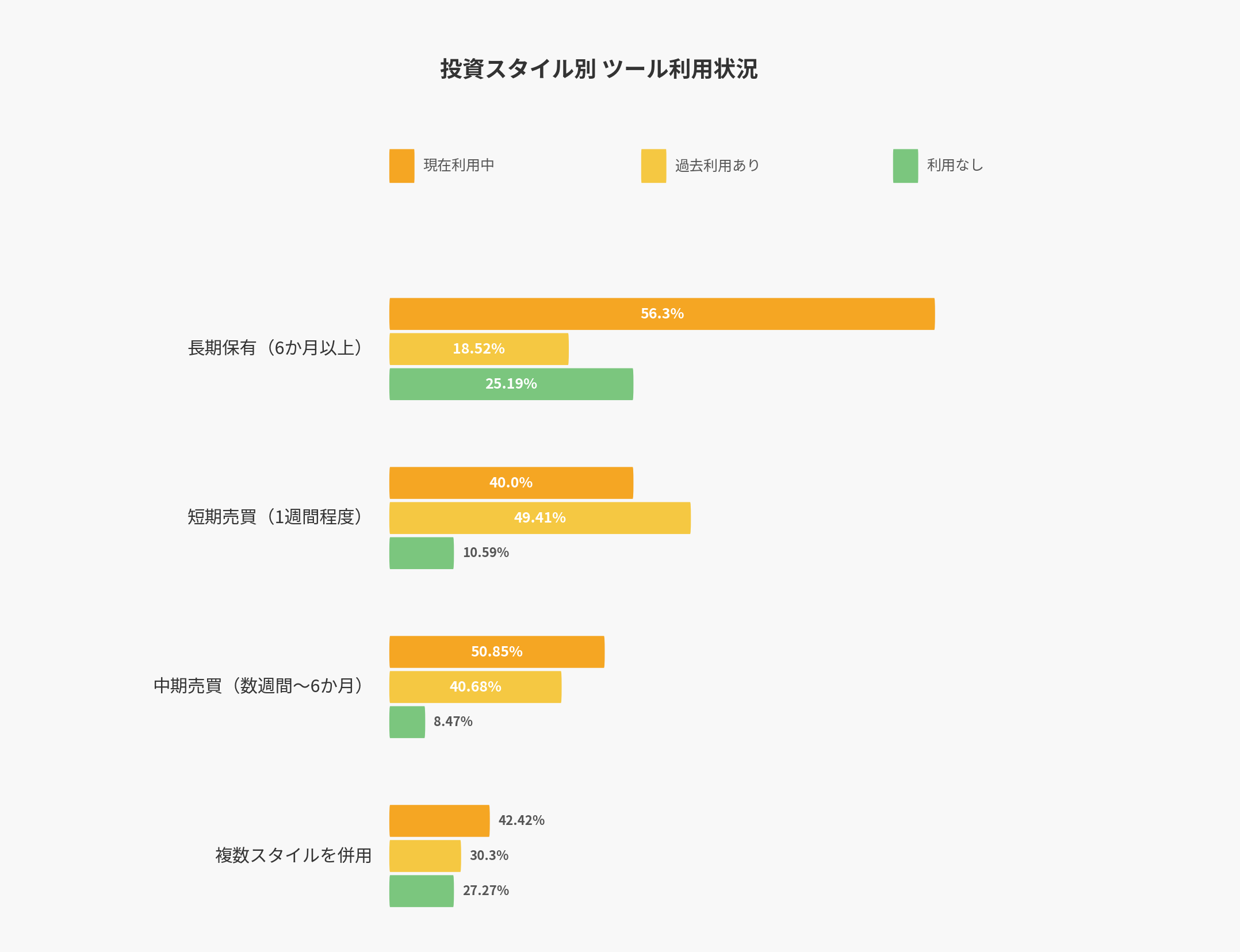
Investment Style | Currently Using | Used in the Past | Never Used |
|---|---|---|---|
Long-term holding (6 months or more) | 76 (56.30%) | 25 (18.52%) | 34 (25.19%) |
Short-term trading (about a week) | 34 (40.00%) | 42 (49.41%) | 9 (10.59%) |
Medium-term trading (a few weeks to 6 months) | 30 (50.85%) | 24 (40.68%) | 5 (8.47%) |
Multiple styles combined | 14 (42.42%) | 10 (30.30%) | 9 (27.27%) |
Breaking down tool usage by investment style, long-term holders show the highest current-usage rate at 56.30%, highlighting their strong commitment to ongoing record-keeping.
At first glance, long-term holding — with fewer trades — might seem easier to manage, but the longer the holding period, the greater the risk of losing track of the original acquisition cost.
This suggests that long-term holders in particular tend to adopt a tool early and keep an accurate record of acquisition prices, preparing in advance for a future sale.
Among medium-term traders as well, more than half are currently using a tool, showing that appropriate tool adoption based on asset size and holding period is taking hold.
Investors building assets with a long-term perspective appear more willing to invest in the infrastructure needed to avoid tax-related mistakes.
Short-Term Traders Show 90% Usage Experience, but Churn Stands Out
Investment Style | Currently Using | Used in the Past | Never Used |
|---|---|---|---|
Short-term trading (about a week) | 34 (40.00%) | 42 (49.41%) | 9 (10.59%) |
Among investors whose primary style is short-term trading, tool usage experience (current plus past) reached an extremely high level of about 90%.
For this high-frequency trading group, adopting a tool is not a "choice" but essential equipment for making profit/loss calculation possible at all.
However, it should not be overlooked that the churned group — those who used a tool in the past but no longer do — reaches 49.41%, the highest rate of any style.
Short-term trading tends to generate a huge volume of transaction history, which raises the bar for tools in terms of API integration issues and computational load.
These technical hurdles, combined with the burden of frequently realizing gains and losses, may lead traders to temporarily stop using a tool out of fatigue.
Precisely because this style involves such a high number of trades, maintaining a stress-free, highly accurate calculation environment is a key factor directly tied to long-term investment results.
Conclusion
This survey's results reveal both the reality of profit/loss management in crypto asset investing and a clear turning point tied to investment scale.
Most notably, once an investor's current holdings exceed ¥10,000, tool usage crosses the 50% mark, jumping more than 20 percentage points at that point.
As holdings grow and trading activity becomes more serious, many investors appear to recognize the limits of manual calculation and choose to adopt a system as "essential infrastructure."
Using a tool also contributes to investors' peace of mind.
While more than 80% of investors in this survey feel anxious about tax matters, ongoing tool users show a notably higher share reporting "barely anxious," demonstrating that practical, evidence-based tracking directly translates into a sense of security.
To keep achieving stable results in the crypto market, adopting the right tool once holdings exceed ¥10,000 — and keeping tax-related risk under control — can be considered the first step of a savvy investor.
Survey Overview
Survey date: February 24, 2026
Survey method: Internet survey
Survey population: Men and women residing in Japan (people currently investing in crypto assets, or who have invested in the past)
Valid responses: 330
Conducted by: Clabo Inc.
Survey Questions
- Have you ever used virtual currency (crypto assets)?
- Which of the following best describes your current investment amount in virtual currency?
- Which of the following best describes your primary investment style?
- Do you use a dedicated tool to tally profit and loss for virtual currency, for purposes of calculating gains/losses or preparing your taxes and final tax return?
- Which of the following best describes your current level of anxiety about virtual currency taxes and the final tax return?
This article is for informational purposes only and does not constitute financial or investment advice. Please consult a qualified professional before making investment decisions.


