


As crypto assets (also known as virtual currencies) have become more widespread, the complexity of tax processing behind that convenience has become an issue that many holders can no longer ignore. Under Japan’s current system, profits from crypto assets are generally classified as miscellaneous income, and individuals are required to calculate their gains and losses and file an accurate tax return on their own — a process that is far from simple.
This article presents the results of an original survey of 338 crypto asset users and analyzes in detail where holders run into trouble and what specifically concerns them. The survey reveals that roughly 70% of users face some kind of tax-related challenge, and that higher-income holders tend to encounter more serious problems — among other notable findings.
In particular, many respondents reported struggling with “how to think about calculating gains and losses” and “the difficulty of technical terminology,” raising questions about how holders should go about gathering the information they need to file correctly. Using the survey’s data, this article sets out to identify exactly what makes up the tax “wall” that crypto asset holders run into.
Note for readers outside Japan: Under the tax rules in effect as of July 2026, gains from selling crypto assets in Japan are treated as miscellaneous income and taxed under aggregate (comprehensive) taxation alongside salary and other income, at progressive rates of up to 45% (plus a flat 10% residence tax). On July 15, 2026, Japan’s amended Financial Instruments and Exchange Act (FIEA) was passed by the House of Councillors, which will reclassify crypto assets as financial products under the FIEA; a flat 20% separate self-assessment tax rate is expected to take effect the year after the amended law is enforced (likely January 2028). Under the current rules, losses on crypto assets can only be offset against other miscellaneous income — they cannot be offset against salary income or other income categories; how loss offsetting will work under the prospective rules has not yet been finalized.
Nearly 70% of Holders Have Struggled With Taxes
69.2% of Crypto Asset Users Report Feeling Tax-Related Challenges
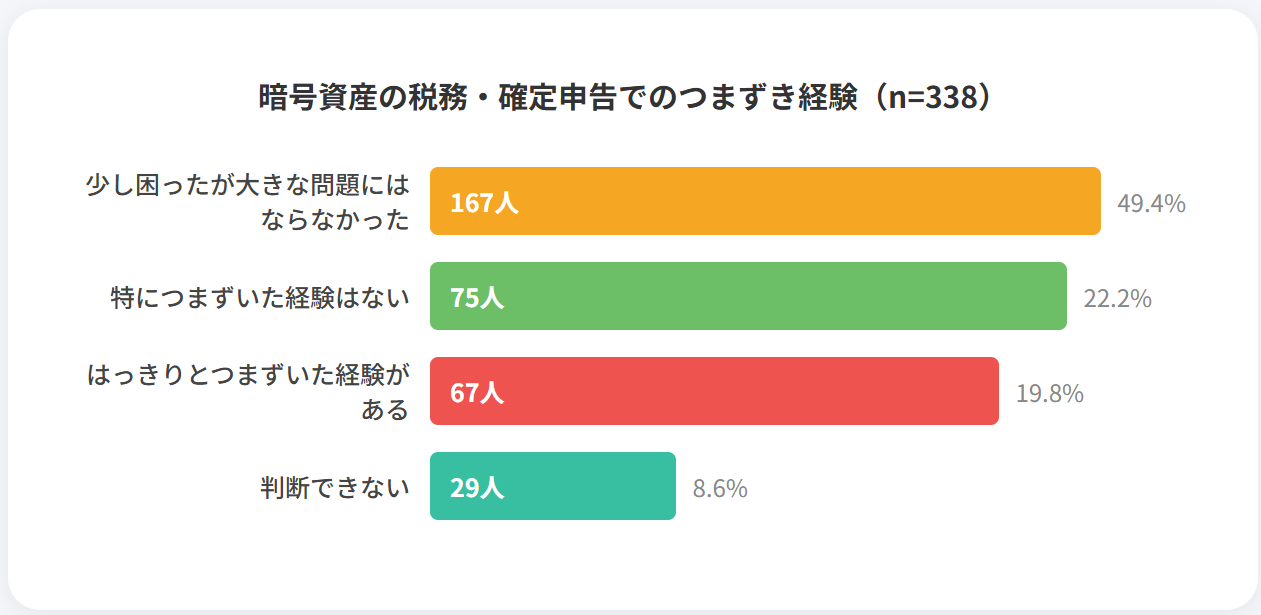
Category | Responses | Percentage |
|---|---|---|
Clearly experienced difficulties | 67 | 19.82% |
Had some trouble, but it wasn’t a major issue | 167 | 49.41% |
No particular difficulties | 75 | 22.19% |
Can’t say | 29 | 8.58% |
We surveyed 338 crypto asset users about their actual experiences with taxes and final tax returns (kakutei shinkoku). The results show that the group who “clearly experienced difficulties” combined with those who “had some trouble” reaches 69.23%. This reveals that roughly 70% of respondents have faced some kind of tax-related hurdle in the course of using crypto assets.
The roughly one-fifth of respondents who answered that they “clearly experienced difficulties” are likely to have faced practical trouble that went beyond simple confusion. While crypto assets are highly convenient, much of the responsibility for calculating gains and losses and determining whether a filing is required falls on individual users, and the data suggests many are struggling to adapt to the system. Meanwhile, only a little over 20% report no difficulties at all, indicating that for the majority of users, tax matters are a concern that is hard to avoid.
Among Households Earning Over ¥10 Million, Nearly 80% Report Challenges
Household Income | Clearly Struggled | Had Some Trouble | No Difficulties | Can’t Say |
|---|---|---|---|---|
Under ¥4 million | 14.2% | 45.1% | 31.0% | 9.7% |
¥4–8 million | 18.5% | 51.2% | 22.7% | 7.6% |
¥8–10 million | 24.1% | 53.7% | 14.8% | 7.4% |
¥10 million and above | 31.4% | 48.6% | 11.4% | 8.6% |
Breaking the results down by household income shows a clear trend: the higher the income, the more likely respondents are to have faced tax-related challenges. Among households earning ¥10 million or more per year (roughly US$67,000, using an illustrative rate of ¥150/JPY per USD), close to 80% of respondents reported having some kind of trouble. This is likely because higher-income holders tend to invest larger amounts and trade more frequently, which increases the complexity of their tax calculations proportionally.
One notable point is that the share of respondents who “clearly struggled” rises sharply once household income exceeds ¥8 million. Holders whose income from sources other than salary tends to be larger face a stronger need for an accurate final tax return, which makes them more likely to hit practical obstacles. The data shows that as asset holdings grow, individuals increasingly reach a point where their own knowledge alone is no longer enough to keep up.
Nearly 70% of Salaried Employees Struggle With Taxes
Occupation | Clearly Struggled | Had Some Trouble | No Difficulties | Can’t Say |
|---|---|---|---|---|
Salaried employee | 21.3% | 49.8% | 21.1% | 7.8% |
Self-employed / freelance | 22.5% | 45.0% | 25.0% | 7.5% |
Civil servant | 15.4% | 53.8% | 23.1% | 7.7% |
Student / homemaker / other | 12.8% | 46.2% | 28.2% | 12.8% |
Looking at the data by occupation, 69.2% of salaried employees — the largest group of market participants — report having “struggled” with taxes. For employees who are used to having their employer handle withholding and year-end tax adjustments, managing crypto asset gains and losses on their own appears to carry a high psychological barrier. As interest in side income and personal investing grows, tax risk is emerging as a real barrier to entry.
Even among the self-employed, who are already accustomed to filing final tax returns, 22.5% reported that they “clearly struggled.” This is likely influenced by calculation rules specific to crypto assets — such as the moving average method and the total average method — that differ from how business income is reported. Across every occupation, the group reporting “no difficulties” is a minority, suggesting the market has reached a phase where broad improvement in tax literacy is needed regardless of occupation.
Lack of Understanding Within the First Year Is the Biggest Barrier to Filing
Many Holders Get Confused by “Gain/Loss Calculations” Soon After They Start
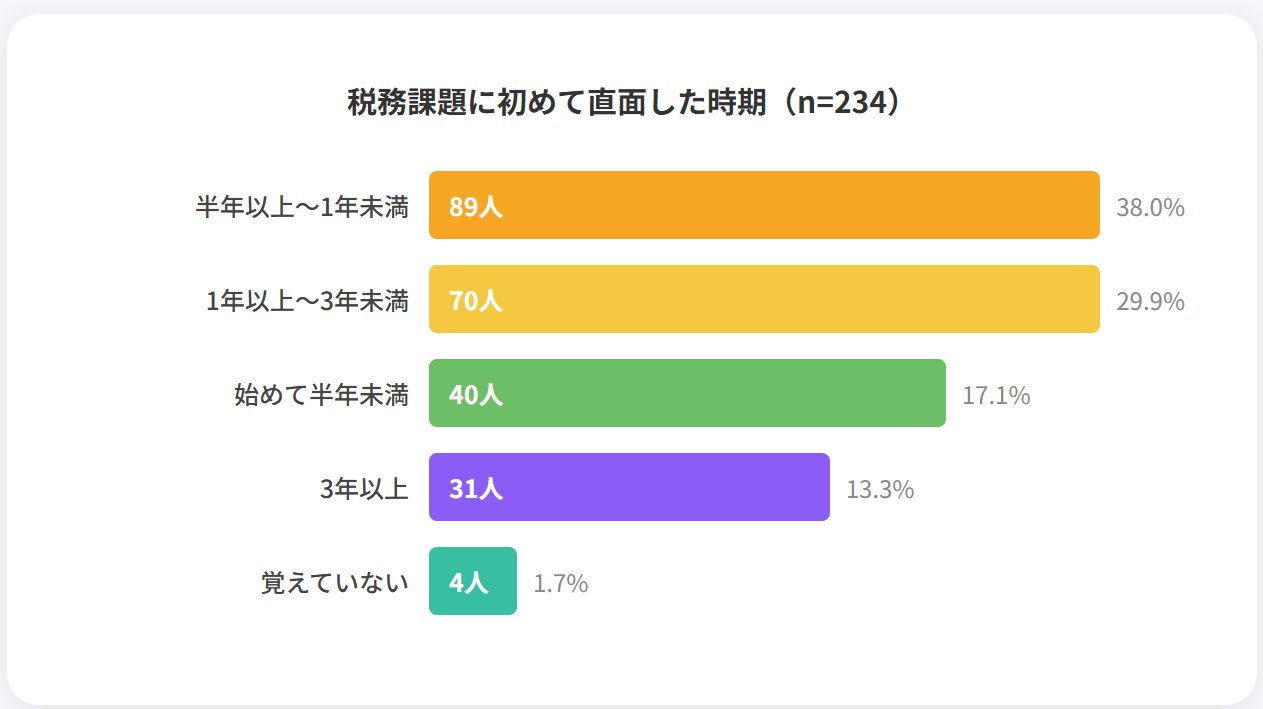
Category | Responses | Percentage |
|---|---|---|
Less than 6 months since starting | 40 | 17.09% |
6 months to less than 1 year | 89 | 38.03% |
1 to less than 3 years | 70 | 29.91% |
3 years or more | 31 | 13.25% |
Don’t remember | 4 | 1.71% |
When we asked about the timing of respondents’ tax-related struggles, holders within their first year of trading accounted for a majority — 55.12% combined. In particular, a large share of respondents struggled in the “6 months to less than 1 year” window, reaching about 38% of the total. This suggests that holders tend to realize how difficult the practical side of tax filing is right around the time they approach — or first become aware of — their first final tax return after starting to trade crypto assets.
At the same time, it’s worth noting that 13.25% of veteran holders with three or more years of experience also reported having “struggled.” Even long-term investors may run into new challenges when they venture into newer forms of trading such as DeFi or NFTs, or when rule changes stem from legal amendments. That said, the core of the problem remains concentrated among newer entrants, underscoring how important it is to educate beginners early on how to calculate gains and losses.
The Top Concern: “How to Think About Gain/Loss Calculations”
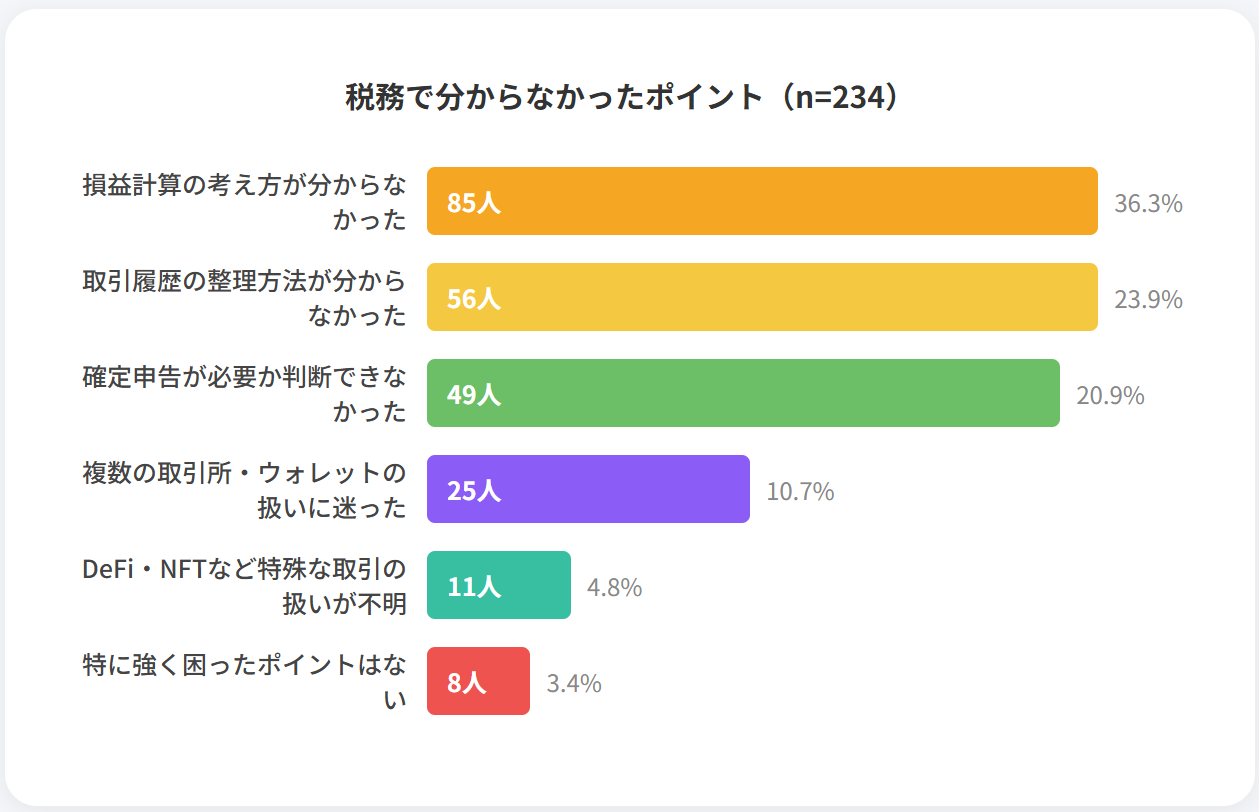
Point of Confusion | Responses | Percentage |
|---|---|---|
Didn’t understand how to calculate gains and losses | 85 | 36.32% |
Didn’t know how to organize transaction history | 56 | 23.93% |
Couldn’t determine whether a final tax return was required | 49 | 20.94% |
Was unsure how to handle multiple exchanges/wallets | 25 | 10.68% |
Didn’t understand how to handle special transactions such as DeFi or NFTs | 11 | 4.76% |
No particular point of difficulty | 8 | 3.42% |
When asked specifically what they didn’t understand, “how to calculate gains and losses” was the top answer at 36.32%. Crypto assets can trigger a taxable event not only through buying and selling, but also through crypto-to-crypto exchanges and use in payments — creating a wide range of taxable moments. The fact that these calculation rules aren’t intuitive is likely the main reason so many users find themselves confused.
Another serious issue is that more than 20% of respondents are unsure whether they need to file a final tax return at all. Many appear not to fully grasp the conditions under which filing isn’t required — for example, for salaried employees whose crypto-related profit is ¥200,000 or less. About 24% also struggle with “organizing transaction history,” revealing that even before the calculations themselves, purely administrative tasks — such as exporting CSV files from an exchange (order-book exchange) and managing that data — are a significant burden.
For the Prime Working-Age Generations, Paperwork Is the Sticking Point
Point of Concern | 20s | 30s | 40s | 50s | 60s and older |
|---|---|---|---|---|---|
How to calculate gains/losses | 42.1% | 34.8% | 33.3% | 38.5% | 30.0% |
Organizing transaction history | 18.4% | 27.5% | 26.3% | 23.1% | 20.0% |
Determining whether filing is required | 21.1% | 18.8% | 22.8% | 19.2% | 30.0% |
Handling multiple exchanges | 10.5% | 11.6% | 10.5% | 11.5% | 10.0% |
Cross-tabulating the results by age reveals that respondents in their 30s and 40s are more likely than other age groups to struggle with “organizing transaction history.” This generation tends to be busy with work and family, leaving limited time for the detailed work of consolidating transaction data. This suggests they are the group that would benefit most from convenient, automated calculation tools.
Meanwhile, among holders in their 60s and older, “determining whether filing is required” reaches 30.0% — the highest of any age group. Because Japan’s crypto tax rules are frequently amended, it’s difficult to read accurate information straight from official sources, which appears to make this generation more cautious in their judgment. Among younger holders in their 20s, over 40% are confused by the basic concept of gain/loss calculation itself, a result that directly reflects a lack of foundational knowledge.
40% Wish They Had Learned the “Basics of Calculation” Sooner
Lost in a Sea of Information
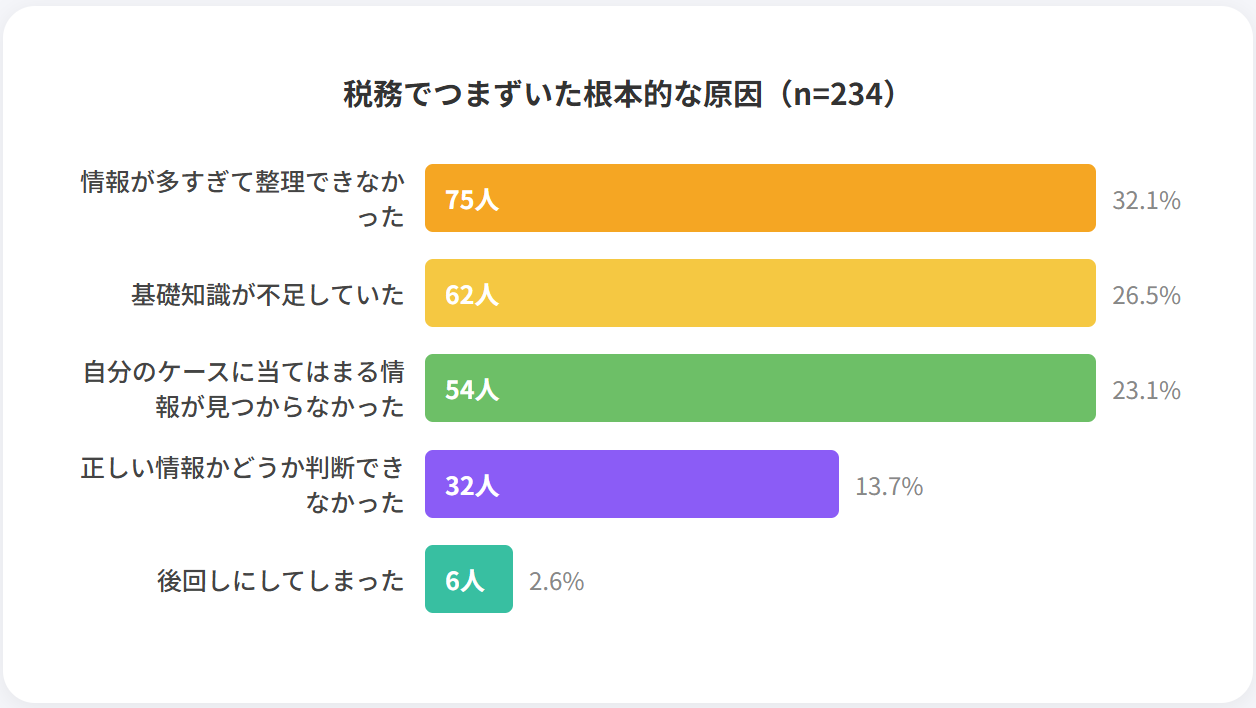
Cause | Responses | Percentage |
|---|---|---|
Too much information to organize | 75 | 32.05% |
Lacked foundational knowledge | 62 | 26.50% |
Couldn’t find information that applied to their own situation | 54 | 23.08% |
Couldn’t tell whether information was accurate | 32 | 13.68% |
Put it off | 6 | 2.56% |
No particular cause comes to mind | 5 | 2.14% |
When asked about the root cause of their tax-related struggles, “too much information to organize” was the most common answer, at 32.05%. While the internet is flooded with information about crypto tax matters, many holders say they feel they’ve hit a wall trying to sift through that mass of data to find what applies to them and understand it in a systematic way. The findings suggest that the issue isn’t a lack of information at all — if anything, an overabundance of information is what’s dulling holders’ judgment.
Next came “lack of foundational knowledge” at 26.50% and “information that didn’t fit their situation” at 23.08%. These two issues appear to be two sides of the same coin — without a solid base of tax knowledge, it becomes difficult to apply that knowledge to individual, real-world cases. It’s also worth highlighting that 13.68% of respondents said they “couldn’t tell whether information was accurate.” Because this is a field where the rules change frequently, it’s clear that holders are keenly aware of the risk of being led astray by outdated or incorrect information.
What Holders Wish They’d Known Beforehand: “How to Calculate”
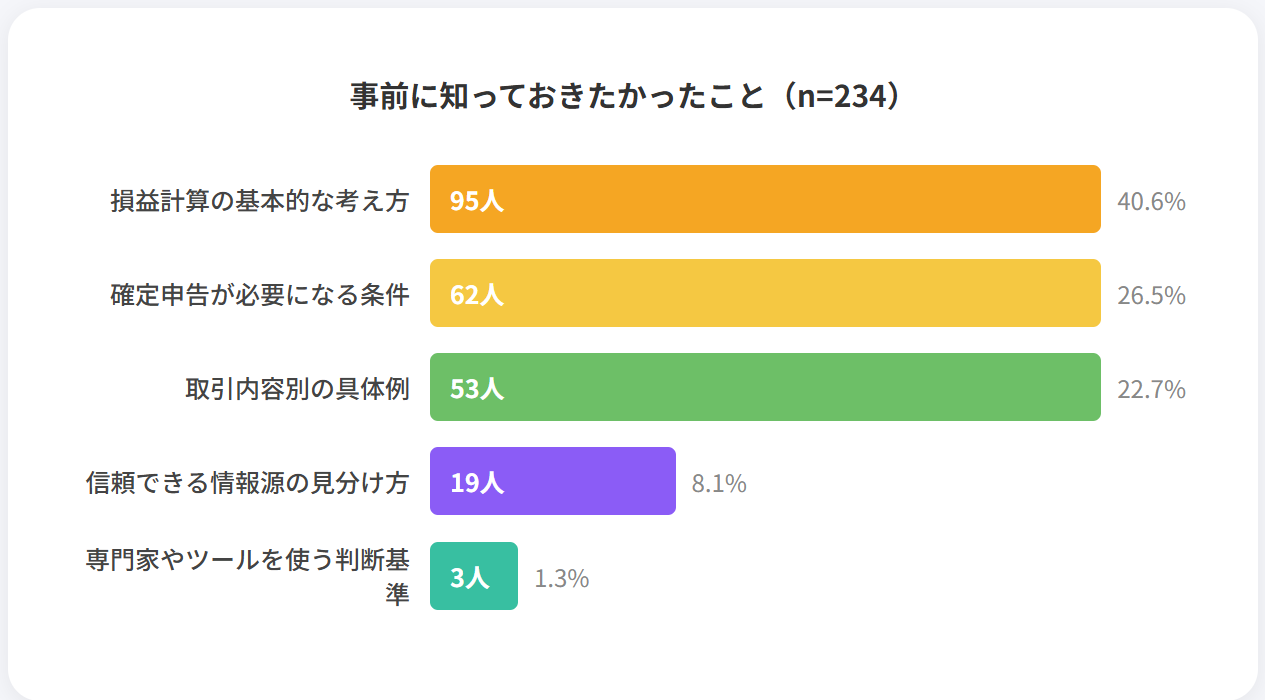
What They Wish They’d Known | Responses | Percentage |
|---|---|---|
Basic approach to calculating gains and losses | 95 | 40.63% |
The conditions that trigger a filing requirement | 62 | 26.50% |
Concrete examples by transaction type | 53 | 22.65% |
How to identify reliable sources of information | 19 | 8.12% |
Criteria for deciding when to use a professional or a tool | 3 | 1.28% |
Nothing in particular | 2 | 0.85% |
Looking back on their past troubles and asked what they wish they’d known beforehand, over 40% of holders cited “the basic approach to calculating gains and losses.” This reconfirms that the biggest obstacle in crypto tax filing is grasping the fundamental rule of when, and at what point, a taxable profit is realized and how much it amounts to. Understanding at least the basic calculation flow before starting to invest appears to be the best way to avoid confusion down the road.
Responses citing “the conditions that trigger a filing requirement” were also high, at 26.50%. This points to the risk of holders needlessly worrying even when filing isn’t actually required, or conversely, failing to notice that they do have a filing obligation and leaving it unaddressed. Demand for “concrete examples by transaction type” also exceeded 20%, another notable finding as more diverse strategies such as staking and lending become common and calls grow for specific, hands-on calculation guides.
Those in Their 30s and 40s Place Greater Weight on “Their Own Situation”
Age Group | Lack of Foundational Knowledge | Couldn’t Organize Information | Wanted Info for Own Situation | Couldn’t Judge Accuracy |
|---|---|---|---|---|
20s | 31.6% | 34.2% | 15.8% | 13.2% |
30s | 26.1% | 31.9% | 24.6% | 14.5% |
40s | 24.6% | 31.6% | 26.3% | 14.0% |
50s | 26.9% | 30.8% | 23.1% | 15.4% |
60s and older | 20.0% | 30.0% | 30.0% | 10.0% |
A cross-tabulation by age shows that respondents in their 30s and 40s — the prime working-age generation — are more likely to say they “couldn’t find information that applied to their own situation.” This generation tends to be active in asset management and often uses multiple tokens and services at once, which is likely why their trading patterns become more complex. This suggests they are a group that strongly needs advice and support tailored to their individual circumstances, something that generic explainer articles can’t provide.
Meanwhile, younger holders in their 20s cite “lack of foundational knowledge” at the highest rate of any age group, at 31.6%. This suggests that many entered the crypto market first, drawn by how easy it is to get started, while learning the practical side — taxes — got pushed to the back burner. In contrast, senior holders more often cite “too much information to organize” and “difficulty judging what’s accurate,” reflecting a strong wariness toward the unverified information that circulates online.
Self-Directed Solutions Are the Norm, but Over 30% Consult a Professional
Self-Research and Tools Are the Pillars of Problem-Solving
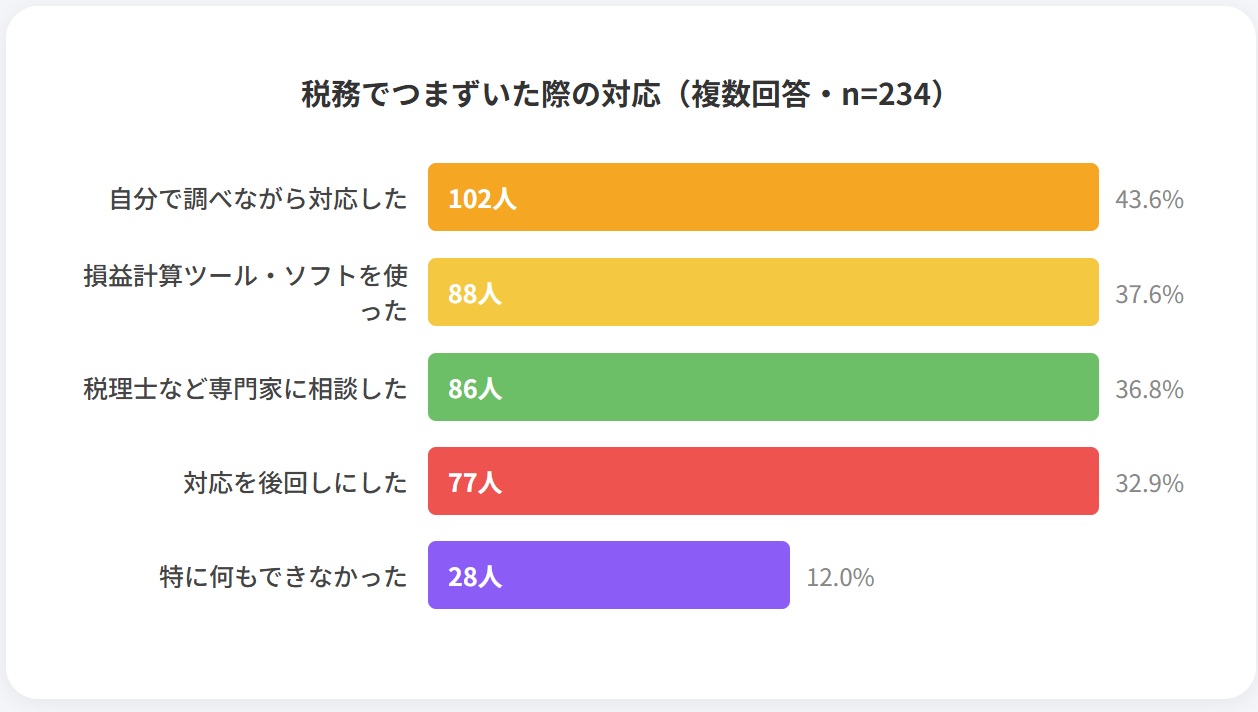
Actions Taken to Resolve the Issue (multiple answers) | Responses | Percentage |
|---|---|---|
Researched and handled it themselves | 102 | 43.59% |
Used gain/loss calculation tools or software | 88 | 37.61% |
Consulted a professional such as a tax accountant | 86 | 36.75% |
Put off dealing with it | 77 | 32.91% |
Couldn’t do anything about it | 28 | 11.97% |
Never experienced difficulties | 3 | 1.28% |
Asked what they did when they ran into tax trouble, “researched and handled it themselves” was the top response at 43.59%. Many holders first try to resolve the issue on their own. Use of gain/loss calculation tools (37.61%) and consultations with a tax accountant (36.75%) were also fairly common, showing that a meaningful share of holders opt for effective solutions such as automating calculations or drawing on professional expertise.
What’s concerning, however, is that 32.91% of respondents said they “put off dealing with it.” Leaving crypto tax matters unaddressed can carry risks such as additional penalty taxes, yet the survey reveals that roughly one in three holders is delaying a resolution. More than 10% also said they “couldn’t do anything about it,” raising concerns about the scale of latent tax risk that remains unresolved simply because holders can’t find a solution.
Households Earning ¥8 Million or More Actively Turn to Professionals
Household Income | Researched It Themselves | Used a Tool | Consulted a Professional | Put It Off |
|---|---|---|---|---|
Under ¥4 million | 52.1% | 33.8% | 22.5% | 38.0% |
¥4–8 million | 41.2% | 36.1% | 37.0% | 32.8% |
¥8–10 million | 38.9% | 40.7% | 51.9% | 27.8% |
¥10 million and above | 34.3% | 48.6% | 54.3% | 22.9% |
A cross-tabulation by household income shows that the share of respondents who “consulted a professional such as a tax accountant” rises markedly as income increases. Among households earning ¥8 million to under ¥10 million, 51.9% relied on a professional, and among those earning ¥10 million or more, that figure reaches 54.3% — a majority in both groups. As income rises, investment amounts tend to grow, and so does the risk of penalties resulting from an incorrect filing, which appears to drive higher earners to pay for professional help in order to ensure accuracy.
By contrast, among households earning under ¥4 million, “put it off” is high at 38.0%, while consultations with professionals are limited to around 20%. When trading volume is relatively small, holders may conclude that a professional’s fee isn’t worth the cost, potentially creating a vicious cycle in which the matter simply goes unresolved if self-directed solutions prove too difficult. This data underscores the importance of accessible public consultation services and low-cost tools, regardless of a holder’s income or the scale of their trading.
Self-Employed and Freelance Holders Are Split Between “Professionals” and “Putting It Off”
Occupation | Researched It Themselves | Used a Tool | Consulted a Professional | Put It Off |
|---|---|---|---|---|
Salaried employee | 42.4% | 39.1% | 36.2% | 33.7% |
Self-employed / freelance | 47.5% | 35.0% | 45.0% | 37.5% |
Civil servant | 38.5% | 42.3% | 30.8% | 26.9% |
Student / homemaker / other | 53.8% | 28.2% | 30.8% | 28.2% |
Breaking the data down by occupation, self-employed and freelance respondents show a high rate of “consulted a professional” at 45.0%, while also posting the highest rate of “put it off” among all occupations, at 37.5%. This is likely because, while the self-employed already have a point of contact with a tax accountant through their business filings, the sheer volume of their day-to-day work leads them to keep deferring the cumbersome calculations for crypto assets. It appears that even holders who are highly capable at general administrative work still feel crypto-specific tax processing as a separate, heavy burden.
By contrast, civil servants have a low “put it off” rate of 26.9%, suggesting a steady, diligent approach to their tax processing. Among students and homemakers, “researched it themselves” exceeds 50%, indicating a common pattern of using available free time to acquire the knowledge on their own. Across every occupation, the data shows that a holder’s approach to resolving the issue is heavily shaped by their access to expert knowledge and how much discretionary time they have.
40% Have a Persistent Anxiety About Whether Information Is Accurate
“Difficult Terminology” and “Doesn’t Fit My Case” Get in the Way of Research
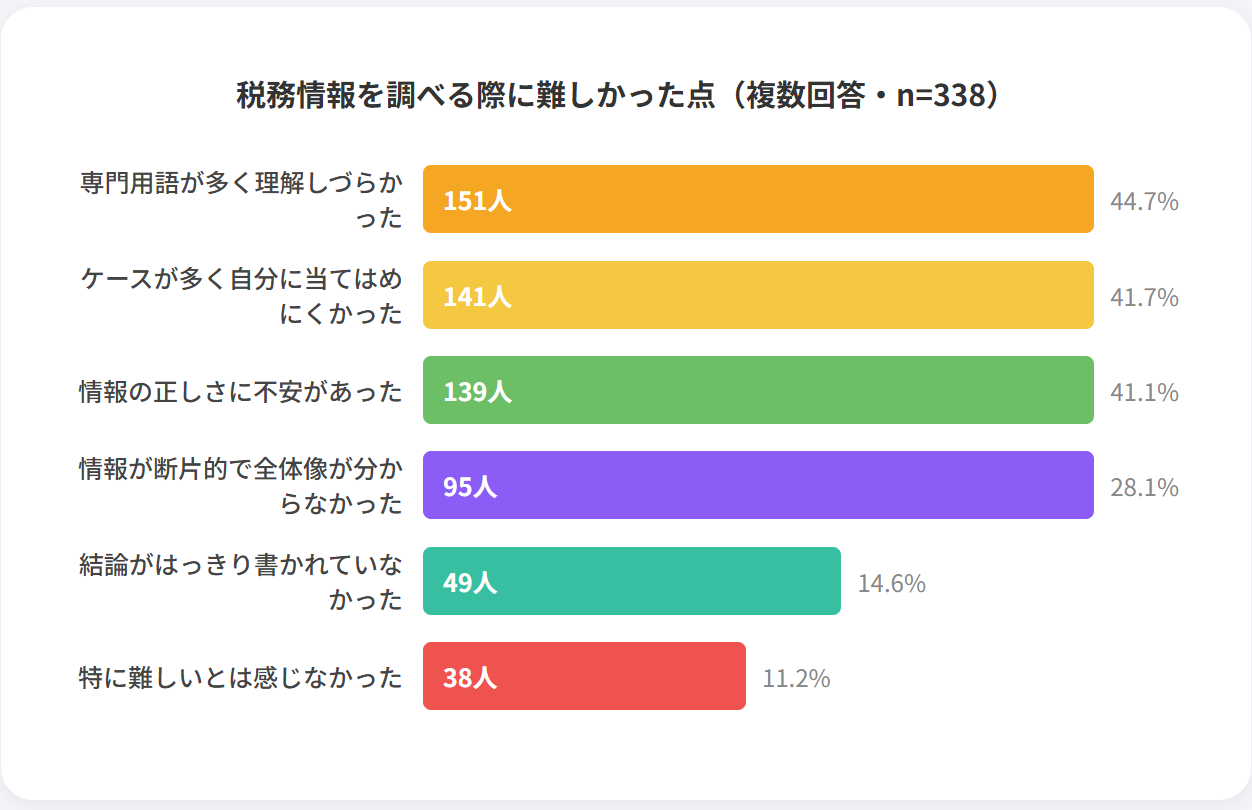
What Felt Difficult (multiple answers) | Responses | Percentage |
|---|---|---|
Too much technical jargon, hard to understand | 151 | 44.67% |
Too many possible cases, hard to apply to their own situation | 141 | 41.72% |
Uncertain whether the information was accurate | 139 | 41.12% |
Information was fragmented, couldn’t see the big picture | 95 | 28.11% |
Conclusions weren’t clearly stated | 49 | 14.56% |
Didn’t find it particularly difficult | 38 | 11.24% |
Asked about the difficulties they encountered while researching the topic, “too much technical jargon” was the most common answer, at 44.67%. Crypto tax matters mix accounting terms like the moving average method and the total average method with technical terms rooted in the underlying technology, such as staking and hard forks. The survey reveals a serious problem: this terminology creates a barrier that keeps holders from properly absorbing the content of explainer articles even when they read them.
Over 40% also cited “uncertainty about whether information is accurate” and “difficulty applying it to their own case.” Information found online doesn’t necessarily reflect the latest legal amendments or a holder’s specific trading environment — such as using multiple exchanges or engaging with DeFi. Uncertainty about the accuracy of information, in particular, is a major source of psychological stress for holders, who ultimately bear full responsibility for their own filing. The data suggests that securing reliable sources of information is a bigger challenge than simply acquiring knowledge.
37.87% Are Eager for a Third Party to Check Their Work
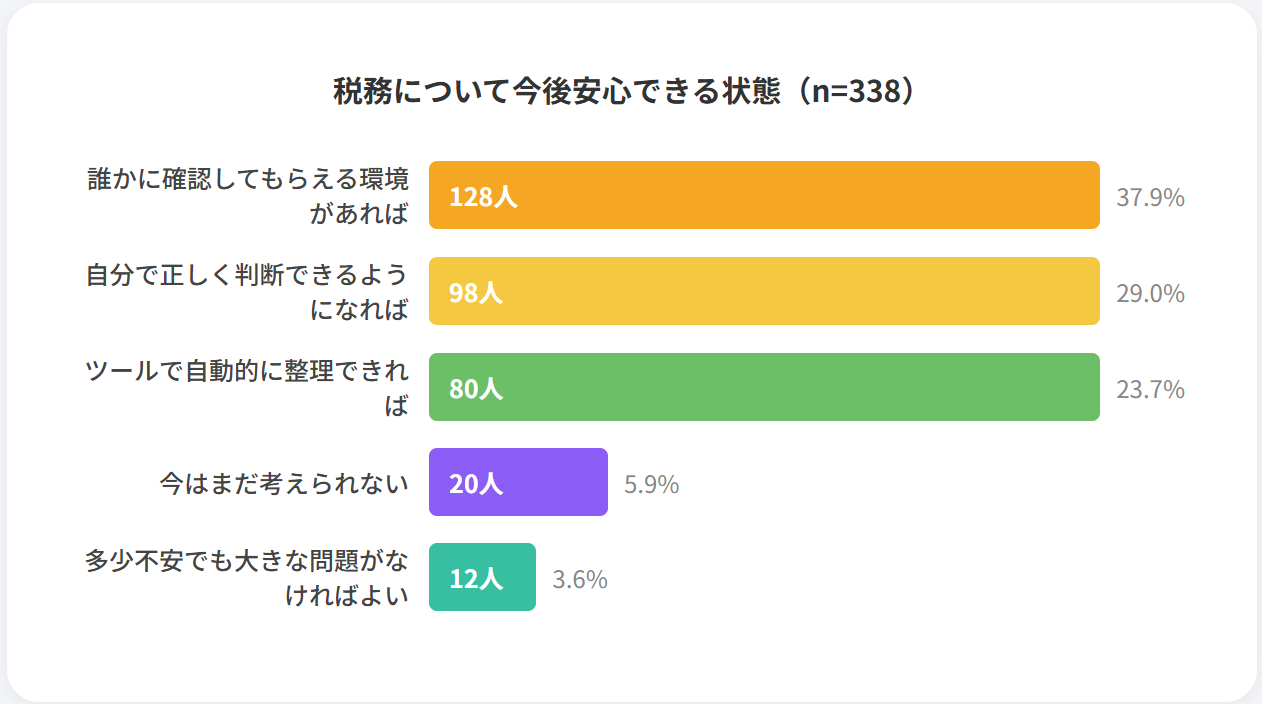
What Would Make Them Feel at Ease | Responses | Percentage |
|---|---|---|
Having an environment where someone can check their work | 128 | 37.87% |
Being able to judge correctly on their own | 98 | 28.99% |
Having a tool that automatically organizes everything | 80 | 23.67% |
Can’t imagine feeling at ease right now | 20 | 5.92% |
It’s fine as long as there’s no major problem, even with some anxiety | 12 | 3.55% |
Asked what would need to be true for them to feel at ease in the future, 37.87% said “an environment where someone can check their work” — the top answer. This shows that many holders feel they’ve hit the limits of what they can handle alone and want a place where professionals such as tax accountants, or a support service, can effectively “grade their homework.” Because the risk of getting it wrong on crypto taxes is significant, the data reflects an earnest desire among holders for someone else to provide that final safety net.
At the same time, 28.99% said they want to “be able to judge correctly on their own,” reflecting a desire among some to become self-sufficient. About 24% also hope that “automatic organization by a tool” will solve their problem, suggesting they believe reducing manual errors and workload translates directly into peace of mind. The conclusion is that what most holders are looking for isn’t simply more information — it’s a system that reduces the practical burden while objectively guaranteeing the accuracy of their filing.
Young Holders Trust Social Media, Seniors Favor Specialist Media
Information Source (multiple answers) | 20s | 30s | 40s | 50s | 60s and older |
|---|---|---|---|---|---|
Social media | 63.1% | 51.5% | 40.7% | 34.6% | 20.0% |
Crypto-specialist media | 31.0% | 33.7% | 36.0% | 40.4% | 45.0% |
News sites | 50.0% | 53.5% | 55.8% | 53.8% | 55.0% |
Content from tax accountants and other professionals | 17.9% | 20.8% | 24.4% | 25.0% | 30.0% |
Analyzing information-gathering methods by age shows that “social media” use stands out among holders in their 20s, at 63.1%, reflecting a research style that prioritizes time efficiency. Social media use then declines steadily with age, falling to just 20.0% among holders 60 and older. Senior holders instead tend to favor “crypto-specialist media” and “content from tax accountants,” painting a contrasting picture in which they prioritize accuracy and reliability over speed.
What stands out is that “news sites” maintain a usage rate above 50% across every single age group. Tax reforms and regulatory developments covered by mainstream news outlets are likely the topic of shared concern for holders across the board, functioning as a trusted “public benchmark.” That said, given how many respondents across all ages report finding the information difficult, it’s clear that every type of media needs to do more to translate complex rules into plain-language explanations and bridge the gap to individual cases.
Summary
This survey reveals an extremely serious reality: roughly 70% of crypto asset users face some kind of tax-related challenge. One particularly striking finding is that among high earners with household income over ¥10 million, the share who “clearly struggled” reaches around 30% — showing that growth in trading scale translates directly into greater tax risk. Because a holder’s income classification (generally miscellaneous income) and choice of calculation method (moving average or total average) significantly affect the amount owed, the structure is such that access to expert knowledge increasingly determines success or failure as a holder’s assets grow.
In addition, the timing of these struggles is concentrated within the first year after a holder starts trading, meaning that “acquiring foundational knowledge” before their first final tax return is the biggest obstacle. The image of holders overwhelmed by an abundance of information and unable to find the answer that applies to their own situation symbolizes just how fragmented information around crypto taxes currently is. Complex transactions such as DeFi and NFTs, in particular, fall into territory that traditional accounting knowledge alone can’t fully cover, which makes it unsurprising that holders cite “difficult technical terminology” as their single biggest challenge.
The fact that so many holders are longing for “an environment where someone can check their work” as a solution offers an important signal for how this market should develop going forward. There are limits to what self-directed research and tools alone can accomplish, and it’s clear that a mechanism that objectively guarantees the accuracy of a final filing is what would truly bring holders peace of mind. Japan’s crypto tax rules remain in a transitional period, and further changes and added complexity are likely ahead. Holders are increasingly being asked to practice “strategic tax management” — securing reliable sources of information early and, where necessary, combining the help of professionals such as tax accountants with high-precision calculation tools.
Survey Overview
Survey date: February 24, 2026
Survey method: Internet survey
Survey population: Men and women residing in Japan who are currently investing, or have previously invested, in crypto assets
Valid responses: 338
Conducted by: Clabo Inc.
Survey Questions
- Have you ever used crypto assets (virtual currency)?
- Have you ever struggled or run into trouble with crypto asset taxes or filing a final tax return?
- When you first ran into trouble, how long had it been since you started using crypto assets?
- What was the first thing about crypto asset taxes that you didn’t understand? Please choose the closest answer.
- Looking back, what would you say was the closest cause of your tax-related struggles?
- What did you actually do when you struggled or felt anxious about tax matters? Please select all that apply.
- Where did you mainly get information about crypto asset taxes or filing a final tax return?
- When researching tax information, what did you find particularly difficult? Please select all that apply.
- Looking back on your crypto tax troubles, what do you wish you had known beforehand? Please choose the closest answer.
- Going forward, what would need to be true for you to feel at ease about crypto asset taxes?
This article is for informational purposes only and does not constitute financial or investment advice. Please consult a qualified professional before making investment decisions.


