


The “¥200,000 rule” is one of the unavoidable realities of crypto investing in Japan — but how many investors can actually explain it correctly?
Clabo's in-house survey reveals a striking gap in tax knowledge depending on an investor's trading style.
The survey found that only about one-fifth of respondents correctly understand the rule, with short-term traders in particular falling short of accurate understanding.
Long-term holders, by contrast, showed a higher level of understanding than other styles — likely reflecting their greater focus on exit strategy.
Based on responses from 317 investors, this article takes a detailed look at exactly where investors get tripped up and what actions they take when they're unsure how to proceed.
For readers outside Japan: the “¥200,000 rule” refers to a threshold under which salaried employees with a single employer are generally not required to file a final tax return (kakutei shinkoku, or annual tax filing) if their miscellaneous income — including crypto gains — totals ¥200,000 or less (roughly $1,300) in a given year. As of July 2026, under current law, gains from selling crypto assets (also known as virtual currencies) are treated as miscellaneous income and taxed under aggregate (progressive) taxation, and losses can only be offset against other miscellaneous income — not against salary or other income categories. On July 15, 2026, an amended Financial Instruments and Exchange Act (FIEA) was passed by the House of Councillors, which will reclassify crypto assets as financial instruments under the FIEA; a flat 20% separate self-assessment tax rate is expected to apply from the fiscal year following the amended law's enforcement (projected January 2028).
Long-Term Holders Score 33% Understanding, Far Ahead of Short-Term Traders
Overall Understanding of the ¥200,000 Rule Stays at Just Around 20%
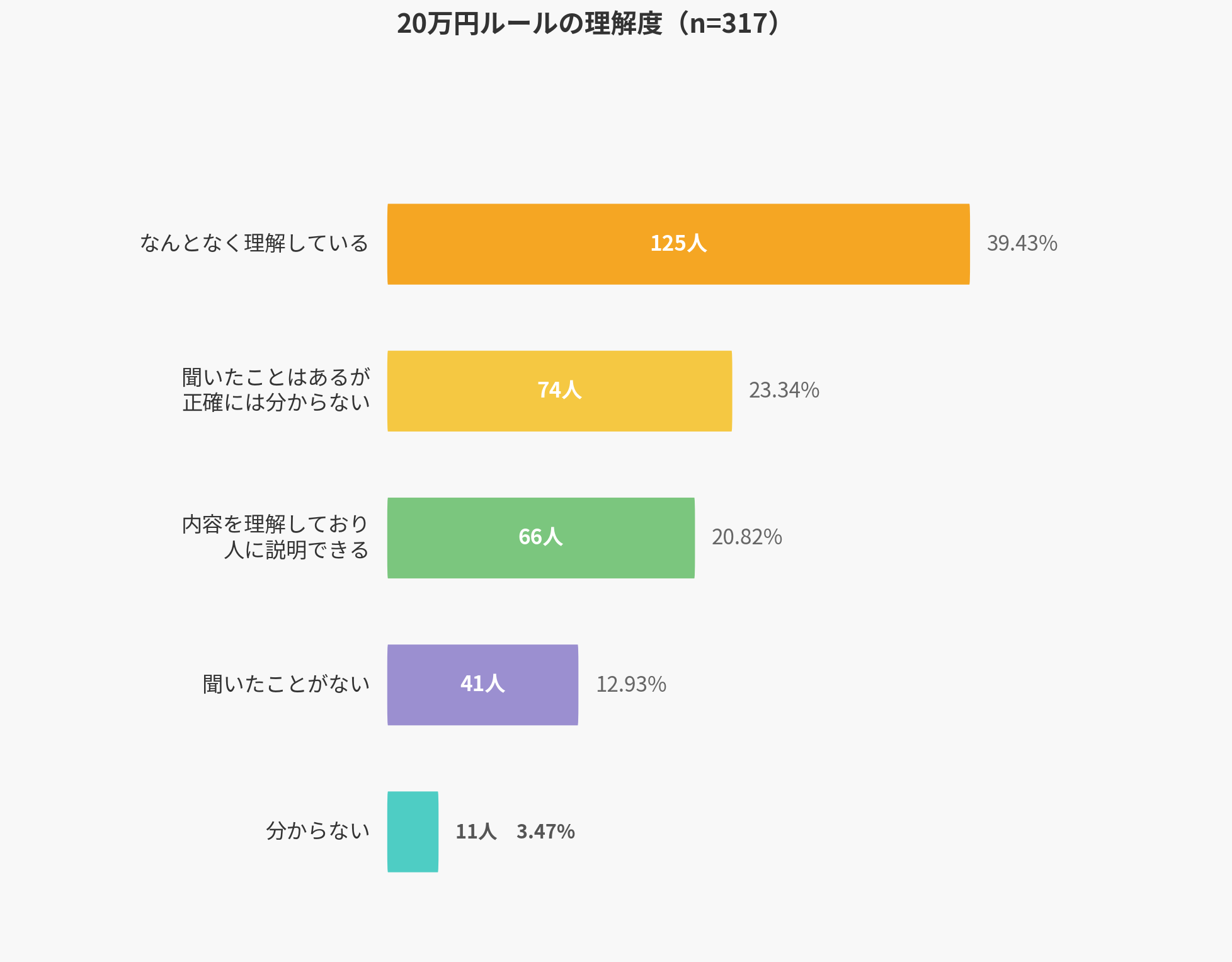
Response | Respondents | Share |
|---|---|---|
Have a vague understanding | 125 | 39.43% |
Heard of it but don't know the details | 74 | 23.34% |
Understand it well enough to explain to others | 66 | 20.82% |
Never heard of it | 41 | 12.93% |
Not sure | 11 | 3.47% |
The survey on understanding of the ¥200,000 rule for crypto taxes found that only 20.82% of respondents answered “I understand it well enough to explain to others.”
In other words, only one in five investors has accurate knowledge of the rule.
About 40% of investors answered that they have “a vague understanding,” but this in practice relies on an imprecise grasp of the rule.
Paying taxes is a legal obligation, yet the survey highlights that accurate knowledge has not taken root among many investors.
Meanwhile, combining “heard of it but don't know the details” and “never heard of it” accounts for more than 30% of respondents.
This is knowledge that's essential for continuing to invest, yet it remains a murky area for many.
Long-Term Holders Lead the Pack, With 33% Understanding the Rule Accurately
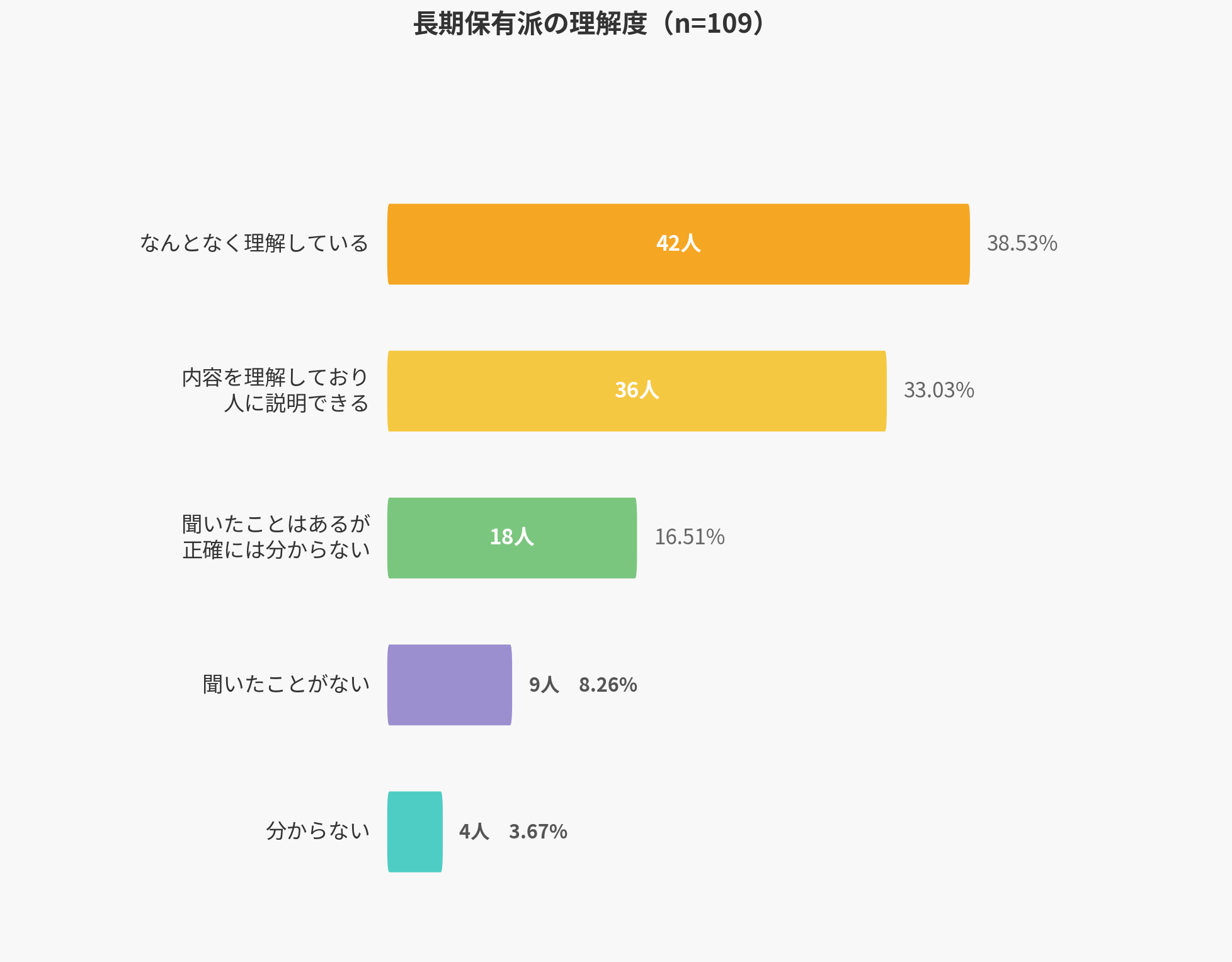
Response | Respondents | Share |
|---|---|---|
Understand it well enough to explain to others | 36 | 33.03% |
Have a vague understanding | 42 | 38.53% |
Heard of it but don't know the details | 18 | 16.51% |
Never heard of it | 9 | 8.26% |
Not sure | 4 | 3.67% |
Breaking down understanding of the ¥200,000 rule by investment style, the survey found that investors who primarily hold long-term have the highest rate of accurate understanding.
The share who answered “I understand it well enough to explain to others” reached 33.03%, more than 10 points above the overall average.
Since a single profit-taking event tends to generate larger gains for long-term holders, many likely research the tax implications carefully in advance.
This appears to reflect a strong awareness of tax rules as part of their exit strategy.
Including those who have “a vague understanding,” more than 70% of long-term holders have some knowledge of the rule — a figure that stands out compared to other styles.
This group can be described as having an unusually strong defensive awareness of tax risk.
Short-Term Traders Fall Short, With Just 18% Understanding Accurately
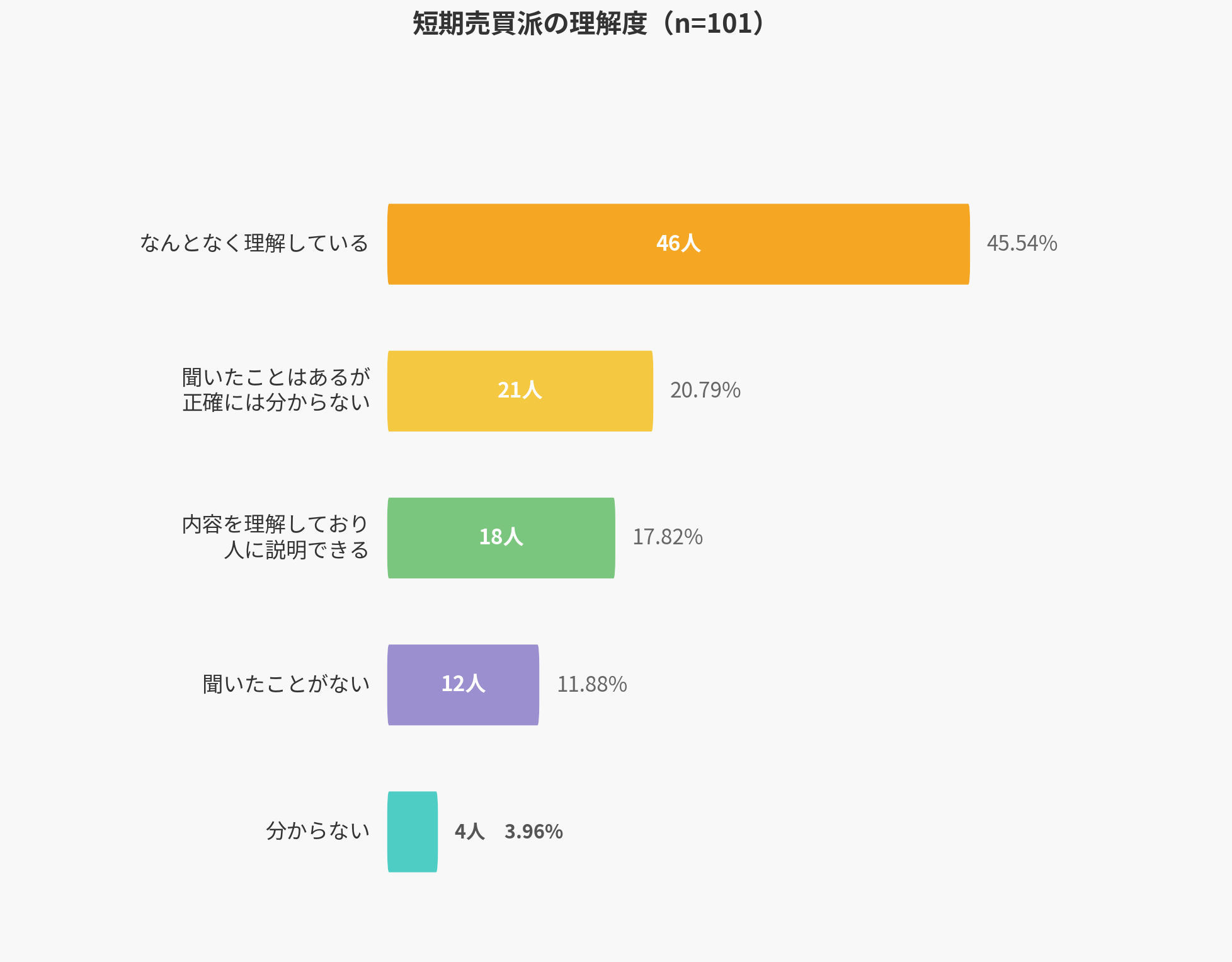
Response | Respondents | Share |
|---|---|---|
Have a vague understanding | 46 | 45.54% |
Heard of it but don't know the details | 21 | 20.79% |
Understand it well enough to explain to others | 18 | 17.82% |
Never heard of it | 12 | 11.88% |
Not sure | 4 | 3.96% |
Among short-term traders who trade frequently, the rate of accurate understanding was just 17.82% — roughly half that of long-term holders, a surprising result.
Despite having the most trading opportunities, this group shows the least penetration of accurate rule knowledge.
The “vague understanding” group is the largest of any style at 45.54%, but many clearly haven't reached a detailed level of knowledge.
Because these investors focus so heavily on day-to-day price movements, grasping the precise calculation methods that underpin tax filing tends to get pushed aside.
The group that has “heard of it but doesn't know the details” also exceeds 20%, suggesting a high likelihood of latent tax risk.
For a trading style built around frequent profit-taking, misunderstanding the rule could prove to be a critical flaw.
Complex Calculations and Unclear Boundaries on Who the Rule Applies To
Not Knowing How to Calculate Profit Is the Top Difficulty, Cited by 40%
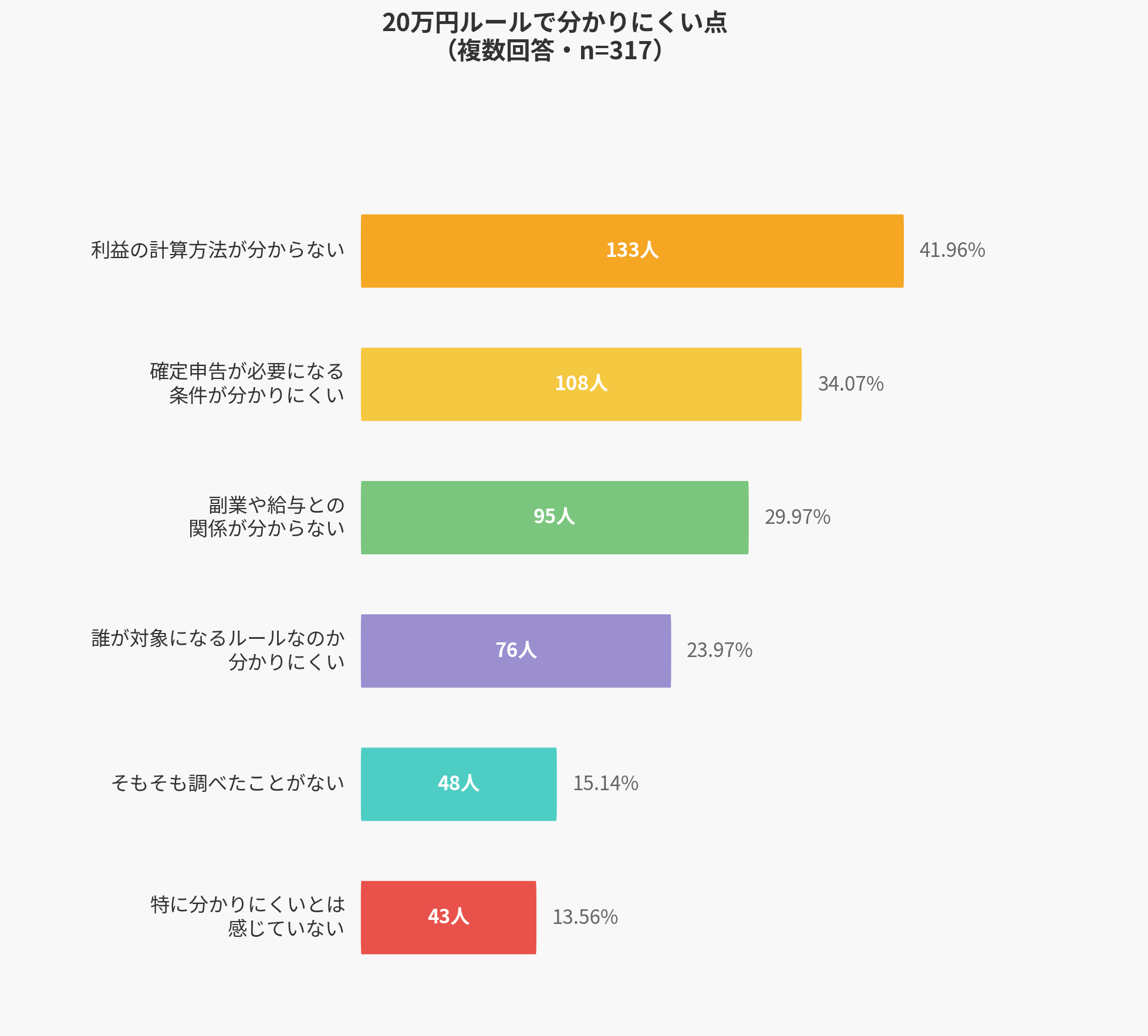
Response | Respondents | Share |
|---|---|---|
Don't know how to calculate profit | 133 | 41.96% |
Unclear when a tax return is required | 108 | 34.07% |
Unclear how it relates to side income or salary | 95 | 29.97% |
Unclear who the rule applies to | 76 | 23.97% |
Never looked into it | 48 | 15.14% |
Don't find it particularly confusing | 43 | 13.56% |
Asked specifically what makes the ¥200,000 rule confusing, “how to calculate profit” topped the list at 41.96%.
The hurdle appears to be that calculations grow complex not just from simple sales, but also from crypto-to-crypto swaps and using crypto for payments.
More than 30% of investors also find the conditions that trigger a tax filing requirement difficult to grasp.
Even when investors know the ¥200,000 figure, the precise definition of what income it covers doesn't appear to have fully sunk in.
Questions also persist around finer details of the system, such as what other income besides salary must be added together.
The survey shows that many investors worry that a surface-level understanding of the system alone won't be enough when it actually comes time to file.
Short-Term Traders Struggle Most With Calculation Complexity
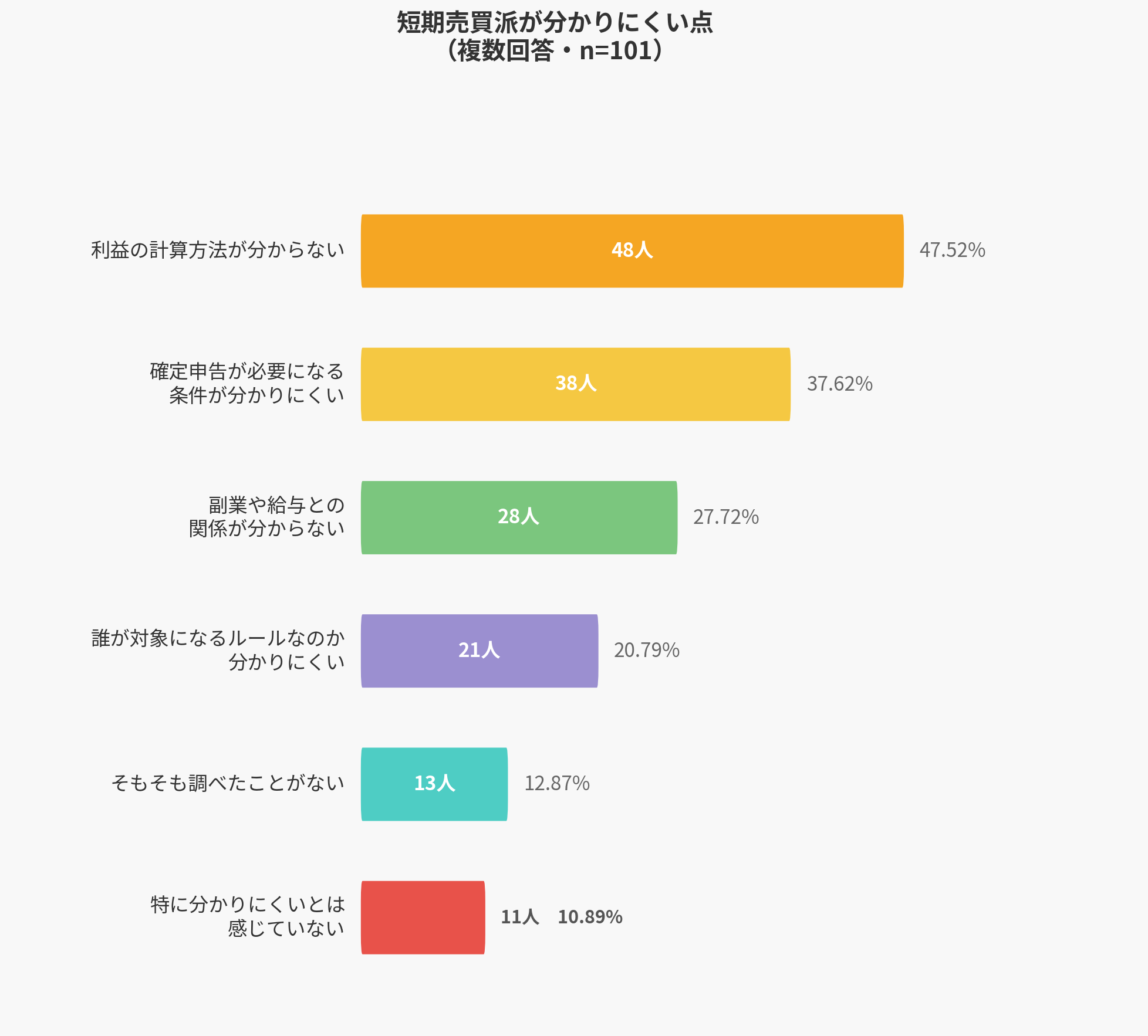
Response (primarily short-term traders) | Respondents | Share |
|---|---|---|
Don't know how to calculate profit | 48 | 47.52% |
Unclear when a tax return is required | 38 | 37.62% |
Unclear how it relates to side income or salary | 28 | 27.72% |
Unclear who the rule applies to | 21 | 20.79% |
Never looked into it | 13 | 12.87% |
Don't find it particularly confusing | 11 | 10.89% |
Narrowing the focus to investors who primarily trade short-term, nearly half — 47.52% — cited “how to calculate profit” as a challenge.
Given how frequently this group trades, calculating gains and losses and average acquisition cost for every transaction appears to be a heavy burden.
On the conditions for filing a tax return as well, 37.62% — above the overall average — said they find it confusing.
Because these investors take profits frequently, they naturally have to stay acutely aware of whether they've crossed the threshold.
Meanwhile, only about 10% said they don't find it particularly confusing.
Even short-term traders who engage with the market daily clearly haven't resolved the complexity on the tax side.
Long-Term Holders Tend to Struggle With Who the Rule Applies To
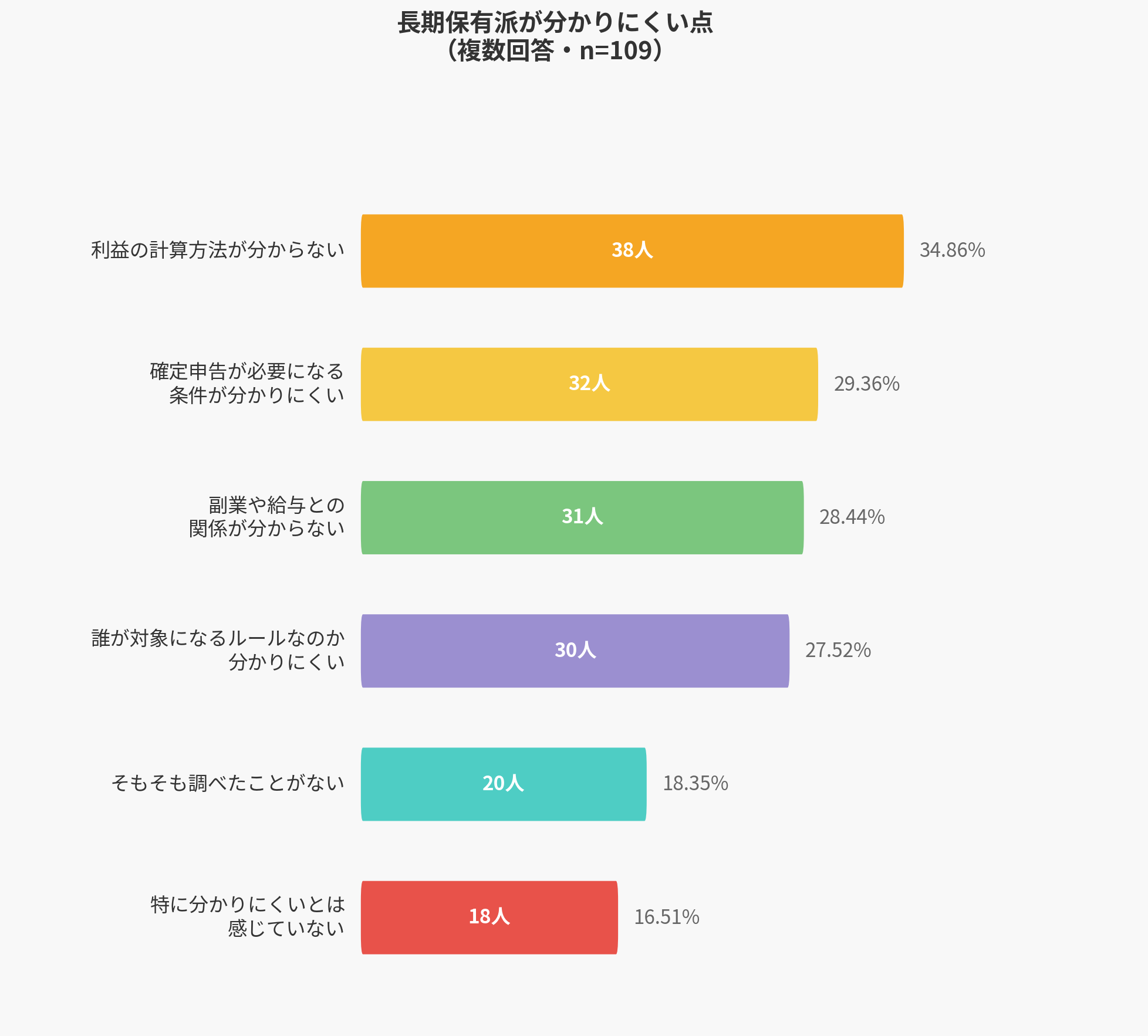
Response (primarily long-term holders) | Respondents | Share |
|---|---|---|
Don't know how to calculate profit | 38 | 34.86% |
Unclear when a tax return is required | 32 | 29.36% |
Unclear how it relates to side income or salary | 31 | 28.44% |
Unclear who the rule applies to | 30 | 27.52% |
Never looked into it | 20 | 18.35% |
Don't find it particularly confusing | 18 | 16.51% |
Among long-term holders too, “calculation method” is the most common answer, but what stands out is that the fundamental question of “who does this apply to” reaches 27.52%.
That's higher than among short-term traders, suggesting that precisely because they take profits less often, many long-term holders get stuck right at the starting point of wondering whether the rule even applies to them.
About 18% also answered that they've “never looked into it,” a higher share than other styles.
While committed to HODLing (long-term holding), these investors tend to be less conscious of tax obligations, which leaves their knowledge prone to falling out of date.
However, when the time finally comes to realize gains built up over several years, there's a real risk of a substantial tax bill.
Even for long-term investors, the survey suggests it's essential to understand the rules early, with an eye toward exit strategy.
About 40% of Those Who've Been Unsure Resolve It by Using a Tool
One in Three Investors Has Been Unsure Whether the Rule Applies to Them
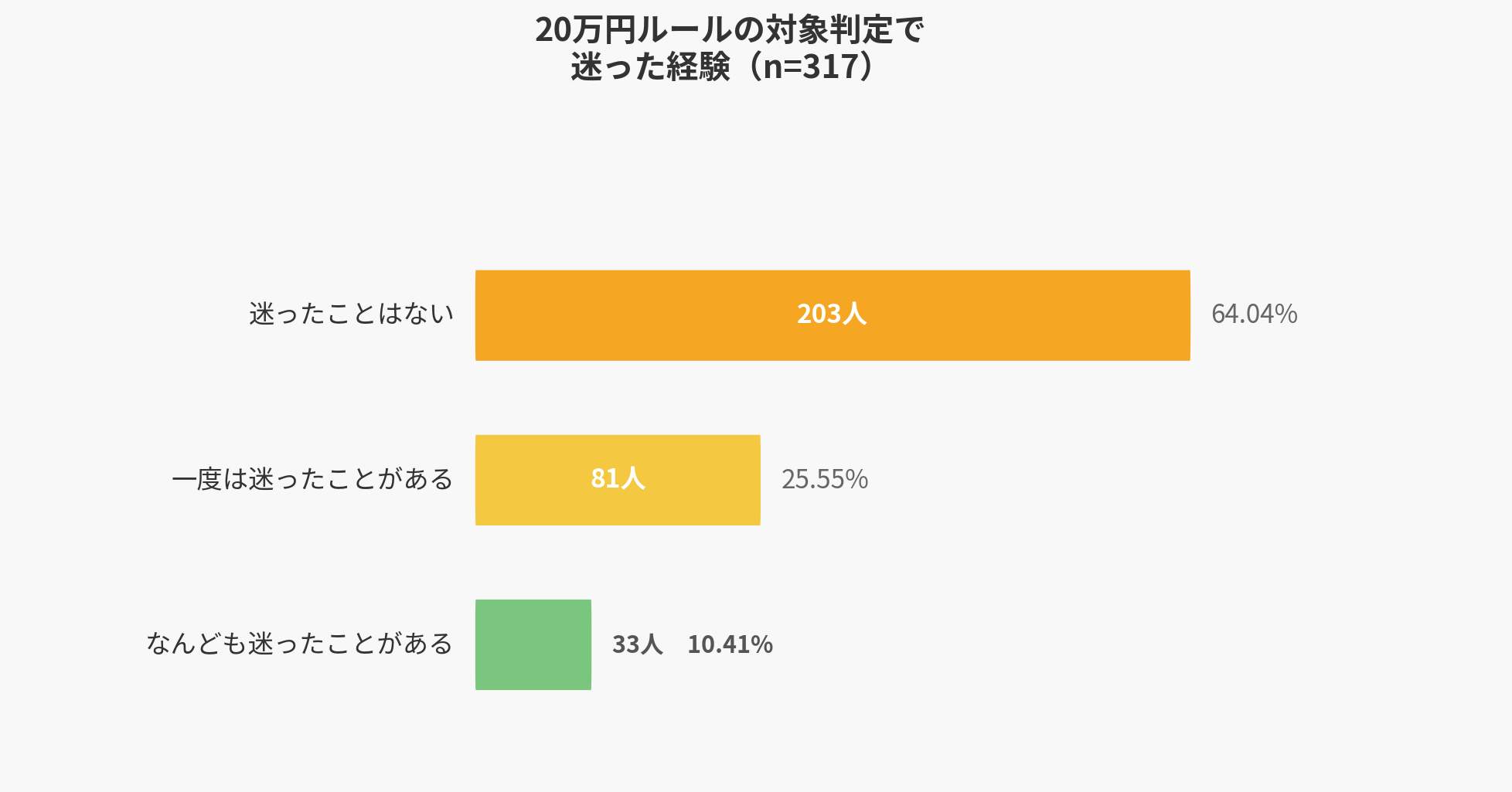
Response | Respondents | Share |
|---|---|---|
Have been unsure once | 81 | 25.55% |
Have been unsure multiple times | 33 | 10.41% |
Have never been unsure | 203 | 64.04% |
The survey found that 35.96% of investors have at some point been unsure whether they're subject to the ¥200,000 rule.
Of those, about 10% say they've felt unsure repeatedly, illustrating that judging whether the rule applies is far from straightforward.
Many crypto users feel anxious when trying to reconcile their profit levels against their overall income situation.
In a highly volatile market, accurately tracking gains and losses is difficult, which likely leaves many investors unable to judge their status with confidence.
On the other hand, more than 60% of users answered that they've never been unsure — but this figure includes those who have never looked into the rule in the first place.
The underlying picture suggests that an even larger share of investors could potentially be facing this judgment call.
When Unsure, Using a Calculation Tool Is the Most Common Response
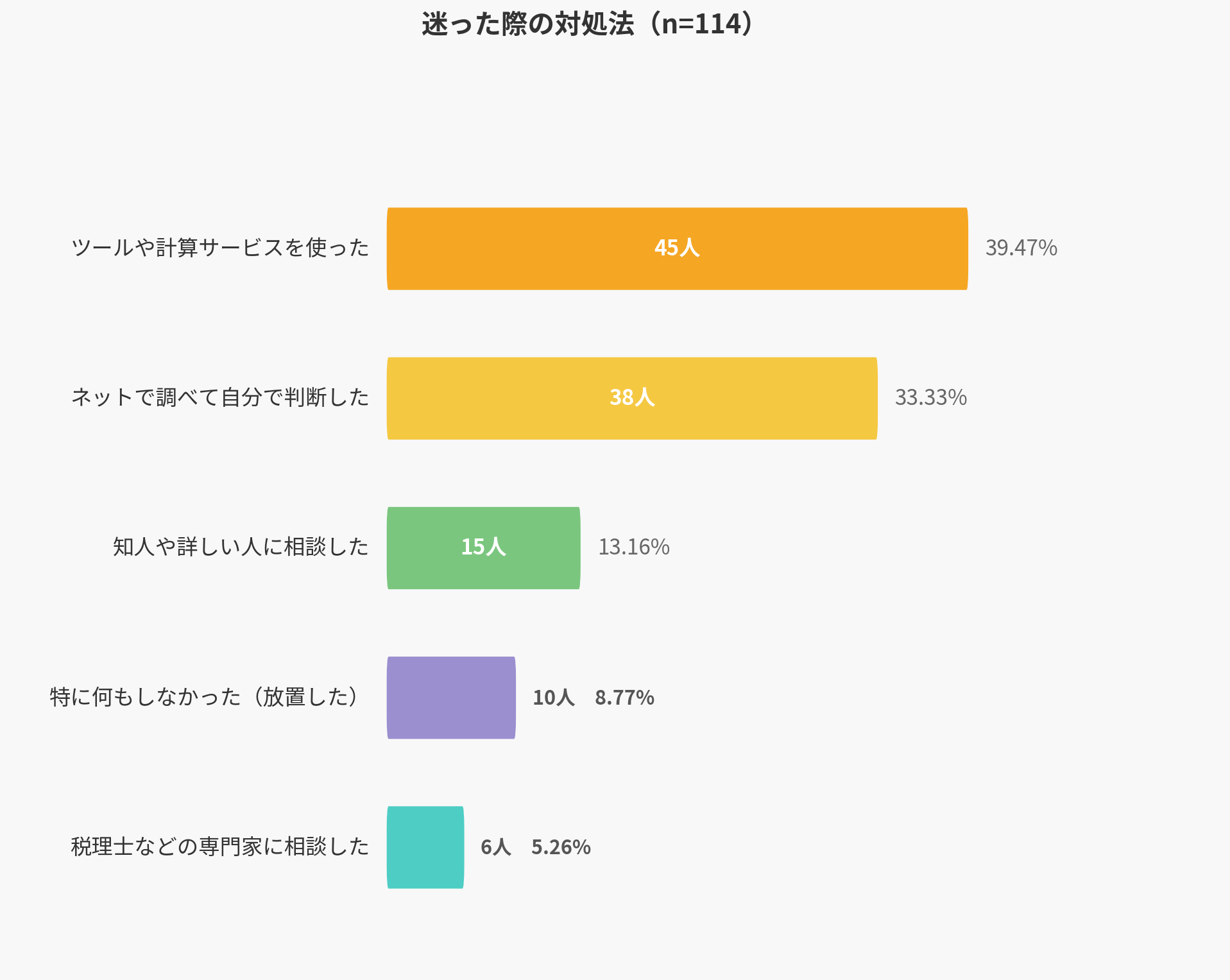
Response | Respondents | Share |
|---|---|---|
Used a tool or calculation service | 45 | 39.47% |
Researched online and decided for myself | 38 | 33.33% |
Consulted a knowledgeable friend or acquaintance | 15 | 13.16% |
Did nothing in particular (left it unresolved) | 10 | 8.77% |
Consulted a professional such as a tax accountant | 6 | 5.26% |
As a concrete response when unsure, 39.47% turned to a “tool or calculation service.”
There's a strong tendency to automate the complex calculation of average acquisition cost and aggregate wide-ranging transaction histories in order to arrive at an objective figure.
The next most common response, at over 30%, is investors who “researched online and decided for myself.”
While the reliability of information needs to be carefully assessed, the reality is that many investors are making decisions based on information found on the web.
Consulting a professional, meanwhile, accounts for only about 5%, suggesting the barrier to using a tax accountant remains high for individual investors.
It appears that easily accessible digital tools are increasingly becoming the standard approach to crypto tax matters.
Short-Term Traders Lean Heavily on Tools, Long-Term Holders Research Independently
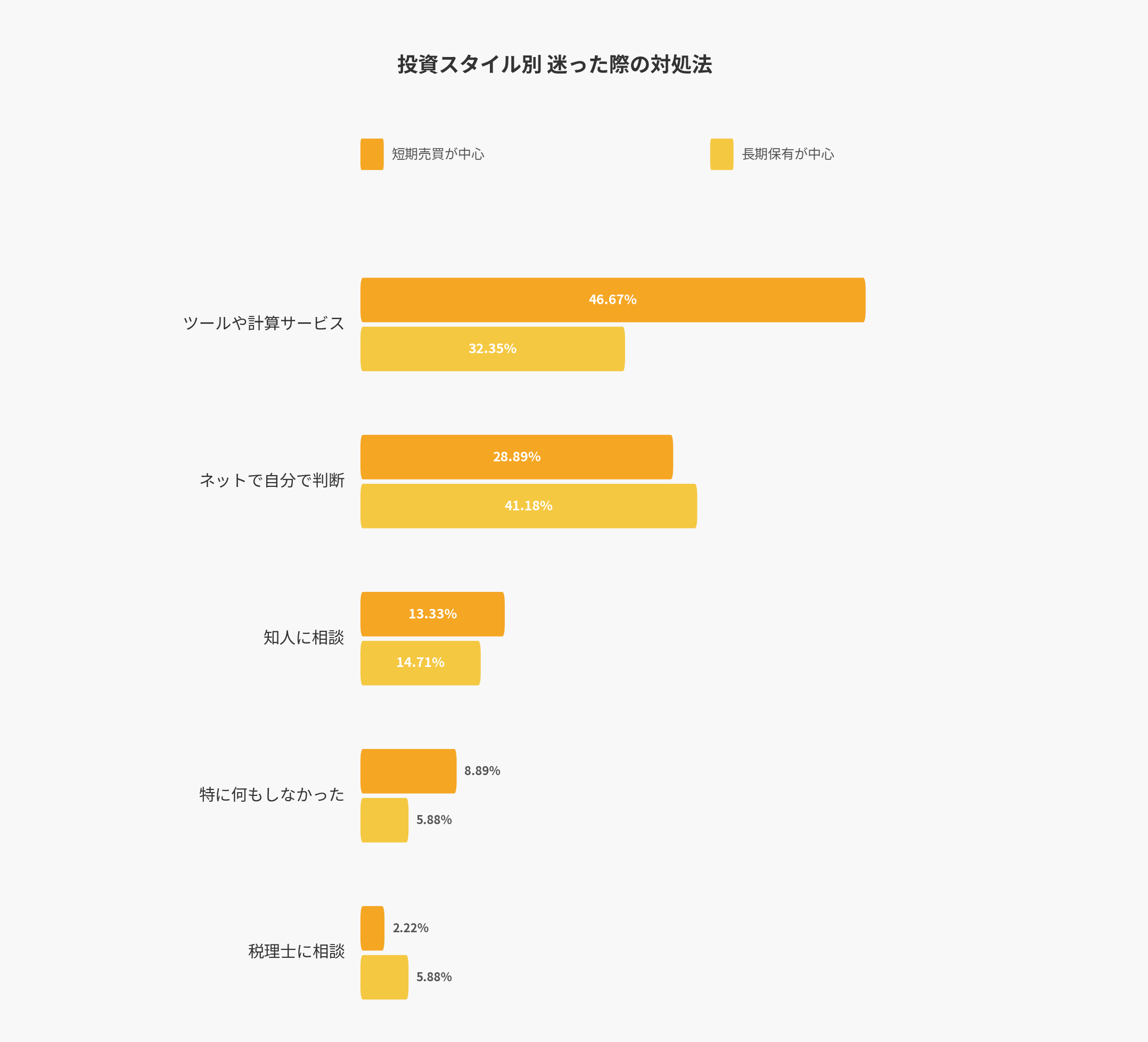
Response | Primarily short-term traders | Primarily long-term holders |
|---|---|---|
Used a tool or calculation service | 21 (46.67%) | 11 (32.35%) |
Researched online and decided for myself | 13 (28.89%) | 14 (41.18%) |
Consulted a knowledgeable friend or acquaintance | 6 (13.33%) | 5 (14.71%) |
Did nothing in particular (left it unresolved) | 4 (8.89%) | 2 (5.88%) |
Consulted a professional such as a tax accountant | 1 (2.22%) | 2 (5.88%) |
Comparing responses by style, short-term traders show a very high tool-usage rate of 46.67%.
Processing enormous volumes of transaction data by hand simply isn't realistic, which naturally drives up reliance on calculation services.
Long-term holders, by contrast, most commonly “researched online and decided for myself” at 41.18%, surpassing tool usage.
With a limited number of transactions, simply checking the basic rules online tends to be enough for them to grasp their own situation independently.
The fact that about 9% of short-term traders “did nothing in particular” is a cause for tax-related concern.
The more actively an investor trades, the higher the risk of unintentionally omitting income from a filing, which calls for more rigorous record-keeping.
Conclusion
This survey reveals that only about 20% of crypto investors accurately understand the ¥200,000 rule.
A clear gap emerged between styles: long-term holders showed a high understanding rate of 33%, compared to just 18% among short-term traders.
“How to calculate profit” is the biggest hurdle overall, and the data shows that the more frequently a short-term trader trades, the more they struggle with the complexity of the calculations.
About 40% turn to a calculation tool when unsure, which also suggests that managing this manually has reached its limits for many investors.
Regardless of investment style, understanding the rules early with an eye toward exit strategy is essential.
As this data shows, having a clear personal standard for judgment is the first step toward avoiding future tax risk and achieving sustainable investment results.
Survey Overview
Survey date: February 24, 2026
Survey method: Internet survey
Survey population: Men and women residing in Japan who are currently investing in, or have previously invested in, crypto assets
Valid responses: 317
Conducted by: Clabo Inc.
Survey Questions
- Have you ever used crypto assets?
- Which of the following best describes your current understanding of the “¥200,000 rule” regarding crypto taxes?
- What did you find confusing about the “¥200,000 rule”? Please select all that apply.
- Have you ever been unsure whether you're subject to the ¥200,000 rule?
- When you were unsure, how did you ultimately judge or address the situation?
- Which of the following best describes your crypto usage style?
This article is for informational purposes only and does not constitute financial or investment advice. Please consult a qualified professional before making investment decisions.


