


As the crypto assets (also known as virtual currencies) market has grown, one of the biggest hurdles many holders now face is taxation.
Clabo's latest original survey found that 50.5% of crypto-experienced respondents have used a licensed tax accountant (zeirishi) — a professional certified to prepare tax filings and represent taxpayers before the tax authorities — at some point, with most of them considering professional help within the first year of investing. The question of whether to handle tax filing alone or bring in a professional is a shared challenge regardless of investment size or trading style.
In this article, we use our proprietary survey data to break down the decisive reasons holders turned to tax accountants, as well as the anxieties behind their hesitation to do so.
Note on the current tax framework (as of July 2026): Under Japanese law in effect as of July 2026, gains from selling crypto assets are treated as miscellaneous income and taxed under the aggregate (progressive) taxation system. On July 15, 2026, an amended Financial Instruments and Exchange Act (FIEA) was passed by the House of Councillors, reclassifying crypto assets as financial instruments under the FIEA; a flat 20% separate self-assessment tax rate is expected to apply starting the year after the amended law takes effect (expected around January 2028). Holders should also note that losses on crypto assets can only be offset against other miscellaneous income, not against salary or other income categories.
Nearly Half Have Used a Tax Accountant: A Split Between Annual Clients and One-Off Users
Ongoing Engagements Stay Under 20%: Over Half Have Relied on a Tax Accountant at Least Once
Response | Responses | Share |
|---|---|---|
Use one every year | 54 | 17.7% |
Have used one at least once in the past | 100 | 32.79% |
Have never used one | 134 | 43.93% |
Considered it but didn't follow through | 17 | 5.57% |
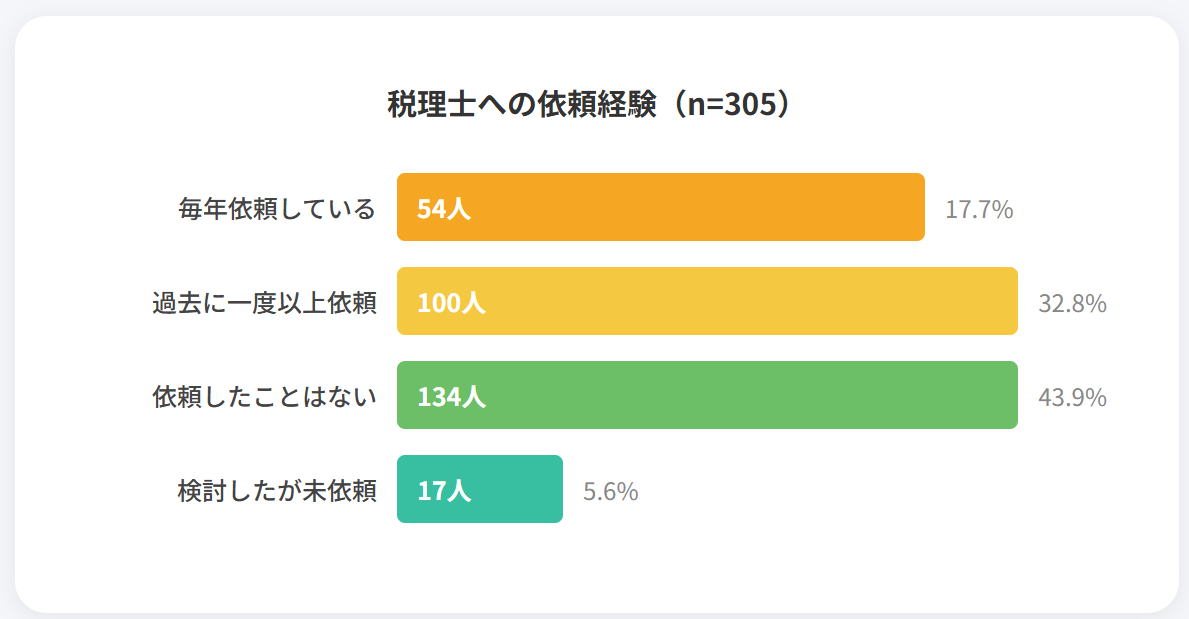
Asked how much they rely on tax accountants for their crypto asset final tax returns, respondents who had used one at least once totaled 50.5%. While only 17.7% of holders use a tax accountant every year, a meaningful share turn to a professional on a spot basis instead.
Calculating gains and losses on crypto assets has grown more complex every year, and for users of overseas exchanges (order-book exchanges) or DeFi (Decentralized Finance) in particular, doing the math alone is often difficult. Against this backdrop, it appears increasingly common for holders to draw on professional expertise as needed.
At the same time, around 44% of respondents have never used a tax accountant, underscoring a growing polarization. As tax rules continue to develop, holders appear to be looking for clearer criteria for deciding whether to handle filing themselves or hand it off to a professional.
The Larger the Investment, the Higher the Reliance: Nearly 70% of Holders With ¥500,000+ Have Used a Tax Accountant
Investment size | Every year | Used in the past | Never used | Considered but didn't use | Prefer not to answer |
|---|---|---|---|---|---|
Under ¥10,000 | 12.9% | 19.4% | 58.1% | 9.6% | 0.0% |
¥10,000–under ¥100,000 | 13.1% | 29.5% | 50.8% | 6.6% | 0.0% |
¥100,000–under ¥500,000 | 23.9% | 43.5% | 30.4% | 2.2% | 0.0% |
¥500,000 or more | 35.7% | 35.7% | 21.4% | 7.2% | 0.0% |
Prefer not to answer | 0.0% | 50.0% | 50.0% | 0.0% | 0.0% |
*Cross-tabulation of Q6 ("Investment size") and Q2 ("Experience using a tax accountant") (n=154; respondents who had used or considered using a tax accountant) |
Looking at the relationship between investment size and how holders rely on tax accountants, the share who use one every year rises noticeably as portfolio size increases. Among holders with ¥500,000 or more invested, those who use a tax accountant every year plus those who have used one in the past add up to over 70%, showing that awareness of tax risk grows in step with asset size.
By contrast, among holders with under ¥100,000 invested, more than half have never used a tax accountant, suggesting that at smaller investment sizes, cost concerns push many holders toward self-filing. Those more likely to owe a larger tax bill tend to secure a professional early on — even at a cost — to avoid the risk of a later tax audit or calculation errors.
This reflects a clear-eyed understanding among holders that under Japan's progressive tax rate structure applied to crypto gains, the cost of a mistake grows along with the profit. Building a management system with an eventual tax accountant engagement in mind — even from the early stages of building a portfolio — is key to sustainable investing.
Active Traders Want to Avoid the Hassle: Trading Frequency Shapes the Decision to Hire a Pro
Trading style | Every year | Used in the past | Never used | Considered but didn't use | Prefer not to answer |
|---|---|---|---|---|---|
Mainly long-term holding | 12.5% | 26.8% | 53.6% | 7.1% | 0.0% |
Mainly short-term trading | 22.1% | 40.0% | 33.7% | 4.2% | 0.0% |
Both long- and short-term | 21.7% | 36.2% | 37.7% | 4.4% | 0.0% |
Low trading frequency | 12.5% | 12.5% | 62.5% | 12.5% | 0.0% |
Prefer not to answer | 0.0% | 38.5% | 53.8% | 7.7% | 0.0% |
*Cross-tabulation of Q7 ("Trading style") and Q2 ("Experience using a tax accountant") (n=305) |
Breaking results down by trading style, holders who trade frequently short-term, or who combine long- and short-term trading, show higher rates of using a tax accountant. For users focused on short-term trading, the sheer number of annual transactions tends to balloon, and the annual transaction report provided by an exchange alone is often not enough to complete an accurate gain/loss calculation.
By contrast, holders who mainly HODL (long-term holding) have fewer opportunities to sell, and more than half of this group report never having used a tax accountant — suggesting their filing needs stay within a range they can handle on their own. Because the volume of transaction history directly drives how much work a filing takes, the data highlights that many holders choose a tax accountant primarily to save time.
This is especially true when transaction types diversify — NFT trading, staking rewards, and the like — since each requires a sophisticated tax judgment call. For many holders, the moment they feel their trading activity has become "complicated" appears to be the critical turning point at which they start considering a tax accountant.
Prioritizing Time Efficiency: Holders Who Outsource "Complex Calculations" to Professionals
Over 60% Prioritize Efficiency: Administrative Burden From Complex Trading Is the Biggest Hurdle
Reason (multiple answers allowed) | Responses | Share |
|---|---|---|
Wanted to save time and effort | 93 | 60.39% |
Felt trading activity was too complex | 76 | 49.35% |
Wanted to avoid tax risk | 64 | 41.56% |
Lacked confidence in the accuracy of filing | 43 | 27.92% |
Recommended by others or by information sources | 33 | 21.43% |
None of the above | 5 | 3.25% |
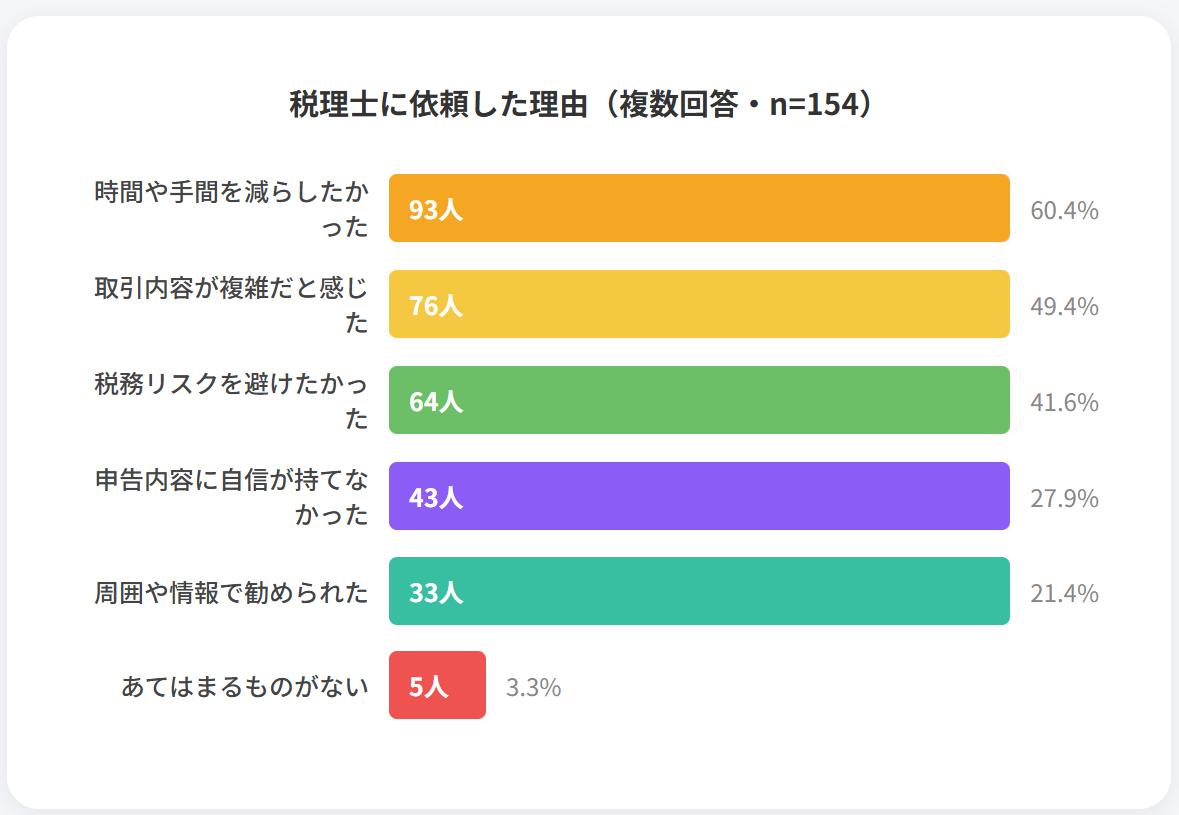
Asked their main reason for deciding to use a tax accountant, holders most often cited "wanted to save time and effort" at 60.4%. Calculating gains and losses on crypto assets becomes exponentially more costly to do accurately as transfers between exchanges and trades across a wide range of tokens pile up. Many holders, factoring in their own hourly value and opportunity cost, clearly prioritize "time performance" (tapa) — outsourcing tedious administrative work to a professional so they can focus on core activities like investment decisions.
The next most common answer was "felt trading activity was too complex" at 49.4%. For holders engaged in advanced transactions where interpretation under current tax rules is unsettled — DeFi staking, secondary NFT sales, and the like — calculation difficulty is a major trigger for hiring a professional. Around 40% also cited "wanting to avoid tax risk," reflecting that many are paying for the credibility of a tax accountant's signature as a defense against penalties such as a later tax audit or an underreporting penalty.
For holders, a tax accountant's fee is settling in as more than just an expense — it functions as a "necessary cost" that hedges against future additional tax assessments while freeing up their own valuable time.
Households Earning ¥10 Million or More Lean Toward Risk Aversion: Higher Earners Value the "Peace of Mind" a Professional Provides
Household income | Saving time/effort | Complex trading | Avoiding tax risk | Uncertain about accuracy | Recommended by others |
|---|---|---|---|---|---|
Under ¥4 million | 56.1% | 51.2% | 34.1% | 22.0% | 14.6% |
¥4 million–under ¥10 million | 60.5% | 47.7% | 40.7% | 29.1% | 22.1% |
¥10 million or more | 69.2% | 50.0% | 57.7% | 34.6% | 30.8% |
Prefer not to answer | 42.9% | 71.4% | 57.1% | 28.6% | 28.6% |
*Cross-tabulation of household income and reasons for using a tax accountant (Q3) (n=154) |
Breaking down reasons by household income, the share citing "wanting to avoid tax risk" rises with income, reaching about 58% among households earning ¥10 million or more. For high earners, the social and financial fallout from a discovered filing omission can be severe, driving a strong motivation to complete their return through a more solid process. The same group also shows a high figure for "wanting to save time and effort" (69.2%), likely reflecting their status as busy professionals.
By contrast, among households earning under ¥4 million, "felt trading activity was too complex" (51.2%) ranks second after time and effort, showing a clear pattern of turning to a professional once they hit the limits of self-filing. That roughly half of respondents across income levels cite trading complexity as a reason points to how technically and practically demanding the crypto asset market is overall. Meanwhile, higher earners also show a notably high figure for "recommended by others or by information sources" (30.8%), suggesting that word of mouth and professional referrals within affluent communities are also a meaningful trigger.
These results vividly illustrate a maturing pattern in asset management: as portfolio size and income grow, holders place increasing value on the "seal of approval" a professional provides.
Younger Holders Are Heavily Influenced by Social Media: Under-30s Decide to Hire Based on Outside Information
Age group | Saving time/effort | Complex trading | Avoiding tax risk | Uncertain about accuracy | Recommended by others |
|---|---|---|---|---|---|
20s or younger | 62.5% | 43.8% | 25.0% | 25.0% | 43.8% |
30s | 66.7% | 47.1% | 43.1% | 29.4% | 25.5% |
40s | 51.0% | 56.9% | 43.1% | 25.5% | 15.7% |
50s or older | 65.7% | 45.7% | 42.9% | 31.4% | 11.4% |
*Cross-tabulation of age group and reasons for using a tax accountant (Q3) (n=154) |
By age group, the under-30 bracket reported "recommended by others or by information sources" at 43.8% — far higher than any other age group. Younger holders, who are exposed daily to social media and crypto-focused outlets, are well positioned to absorb messages about the importance of tracking gains and losses and the benefits of using a tax accountant from influencers and online content. For them, hiring a tax accountant appears to be validated not just by their own judgment but by an accumulation of outside recommendations and information, reinforcing it as the "right choice."
By contrast, among the 40-and-older middle bracket, "felt trading activity was too complex" (56.9%) is the leading motivator, with a practical breaking point increasingly serving as the deciding factor. In their 30s, both "time and effort" (66.7%) and "tax risk" (43.1%) score high, reflecting a group in the prime of their careers seeking both efficiency and peace of mind about the future. While the specific trigger varies by age, all age groups share a strong appreciation for the value of the time resource.
Younger holders attuned to the flow of information, and middle-aged and older holders facing practical hurdles: the survey makes clear that the "resource" of a tax accountant is being put to effective use in both contexts, each in its own way.
Self-Filing Is the Single Most Common Choice at 30%: Cost and "Not Knowing How to Find a Pro" Are the Barriers
Doubts About Cost-Effectiveness Persist; 1 in 5 Give Up Simply Because They Don't Know How to Ask
Reason (multiple answers allowed) | Responses | Share |
|---|---|---|
Thought they could handle it themselves | 47 | 31.13% |
Felt the cost was too high | 43 | 28.48% |
None of the above | 38 | 25.17% |
Didn't know how to go about hiring one | 34 | 22.52% |
Felt their trading activity was simple | 32 | 21.19% |
Didn't know which tax accountant to choose | 25 | 16.56% |
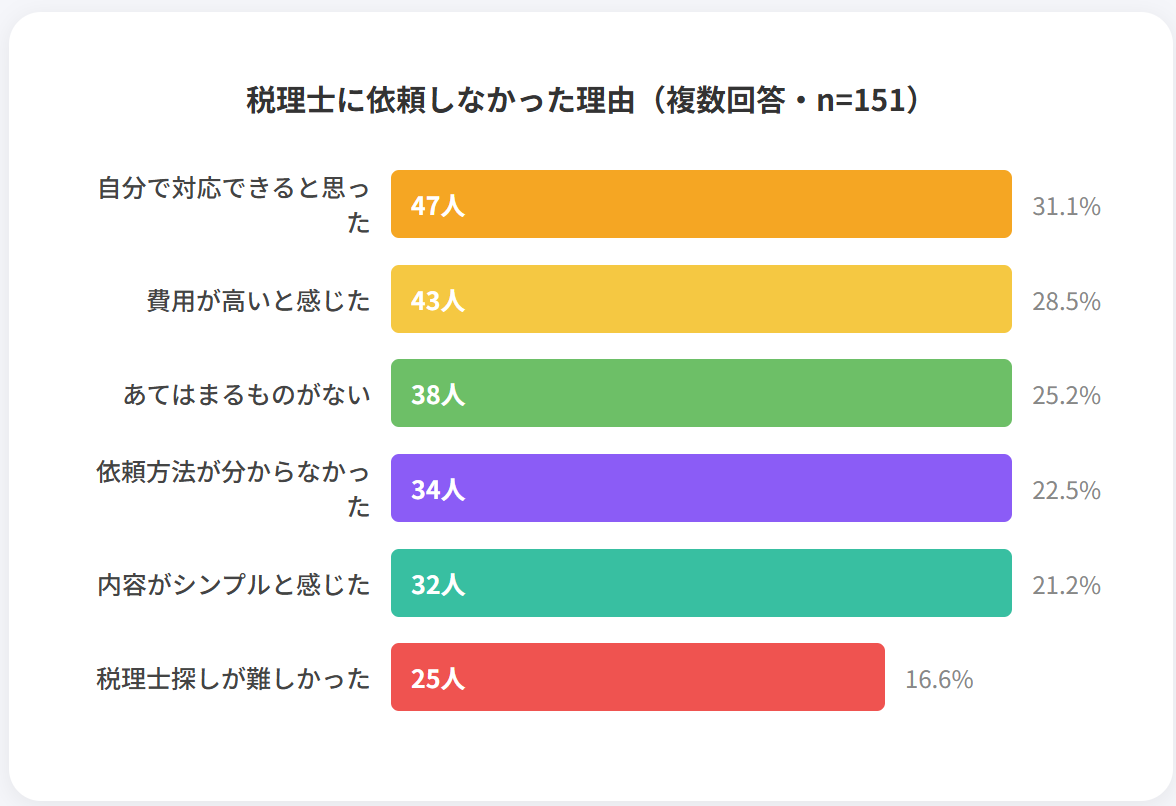
Asked why they had not used a tax accountant, respondents most often said "thought they could handle it themselves," at 31.1%. Crypto-asset-specific gain/loss calculation tools have become more widespread recently, making it relatively easy to complete calculations via API integration and similar features. A meaningful share of holders whose trading is limited to domestic exchanges, or to spot trading only, appear to conclude they don't need to pay for outside help.
At the same time, 28.5% felt "the cost was too high," highlighting that holders are weighing the price of expert knowledge against their own investment returns with a critical eye. Especially notable is the group tripped up before literacy even comes into play — 22.5% "didn't know how to go about hiring one" and 16.6% "didn't know which tax accountant to choose." Tax accountants well-versed in crypto assets remain scarce, and a structural issue — holders unable to reach the right point of contact — appears to be a major factor behind the non-use group.
While self-filing saves money, it also means bearing full responsibility for keeping up with the latest tax reforms and for any calculation omissions. Whether the "I can do it myself" judgment is grounded in an objective risk assessment is likely to be a critical fork in the road for future tax risk.
Households Under ¥4 Million Prioritize Cost: Lower-Income Holders Feel the "Fee Wall" Most Acutely
Household income | Self-filed | Cost too high | Unclear how to hire | Difficulty finding one | Trading is simple |
|---|---|---|---|---|---|
Under ¥4 million | 23.4% | 34.4% | 23.4% | 12.5% | 14.1% |
¥4 million–under ¥10 million | 37.7% | 24.6% | 21.3% | 16.4% | 26.2% |
¥10 million or more | 33.3% | 22.2% | 22.2% | 33.3% | 22.2% |
Prefer not to answer | 40.0% | 20.0% | 30.0% | 20.0% | 30.0% |
*Cross-tabulation of household income and reasons for not using a tax accountant (Q4) (n=151) |
By household income, "felt the cost was too high" was the top answer at 34.4% among those earning under ¥4 million, well above every other income bracket. Because tax accountant fees for crypto assets can range from tens of thousands to several hundred thousand yen depending on transaction volume and complexity, this appears to weigh heavily on holders with limited principal or annual gains. Among those earning ¥4 million to under ¥10 million, "can handle it myself" topped the list at 37.7%, suggesting this group is balancing its own capability against cost.
Interestingly, more than 20% of high earners — those with household income of ¥10 million or more — also said "the cost was too high," showing that even affluent holders don't automatically outsource. This group also reported "didn't know which tax accountant to choose" at 33.3%, nearly double any other income bracket, suggesting that supply may not be keeping pace with demand for a carefully selected, highly specialized tax accountant. As portfolio size grows, holders appear to seek not just basic bookkeeping support but a partner with deep expertise specific to crypto assets.
In short, the reasons behind non-use aren't purely a reluctance to pay — a genuine struggle to find someone worth paying is also mixed in.
Women Are More Likely to Be Stuck on "How to Hire": Nearly 30% Struggle With the First Step
Gender | Self-filed | Cost too high | Unclear how to hire | Difficulty finding one | Trading is simple |
|---|---|---|---|---|---|
Male | 32.7% | 29.8% | 19.2% | 17.3% | 21.2% |
Female | 27.7% | 25.5% | 29.8% | 14.9% | 21.3% |
*Cross-tabulation of gender and reasons for not using a tax accountant (Q4) (n=151) |
By gender, women reported "didn't know how to go about hiring one" at 29.8% — roughly 10 points higher than men. While male holders more often cite confidence in "handling it myself" or "cost" as their reasons, female holders are more often held back by uncertainty over the process itself — where to go and how to make contact. This may reflect an ongoing shortage of information explaining the "first step" for beginners and certain groups in the highly specialized field of crypto tax.
Even for "can handle it myself," men exceed 30% while women stay in the 20% range, suggesting that women may feel uneasy about self-filing yet hold back simply because they don't know how to hire someone. As the crypto asset base widens, raising awareness of accessible tax consultation resources — regardless of gender or investment experience — has emerged as an industry-wide challenge.
Hiring a professional is not just about outsourcing the paperwork — it's also a way of "buying peace of mind" for one's investing activity. Addressing the needs of holders who miss out on support they should be able to access, simply because the process is opaque, is essential to the healthy development of the investment market.
The First Year Is the Turning Point: Even Small-Scale Investors Consider a Professional 40% of the Time
Over Half Start Thinking About a Pro Within a Year: The "Tax Wall" Hits Early
Response | Responses | Share |
|---|---|---|
Under 6 months | 23 | 14.94% |
6 months to under 1 year | 63 | 40.91% |
1 year to under 3 years | 49 | 31.82% |
3 years or more | 19 | 12.34% |
Don't remember | 0 | 0% |
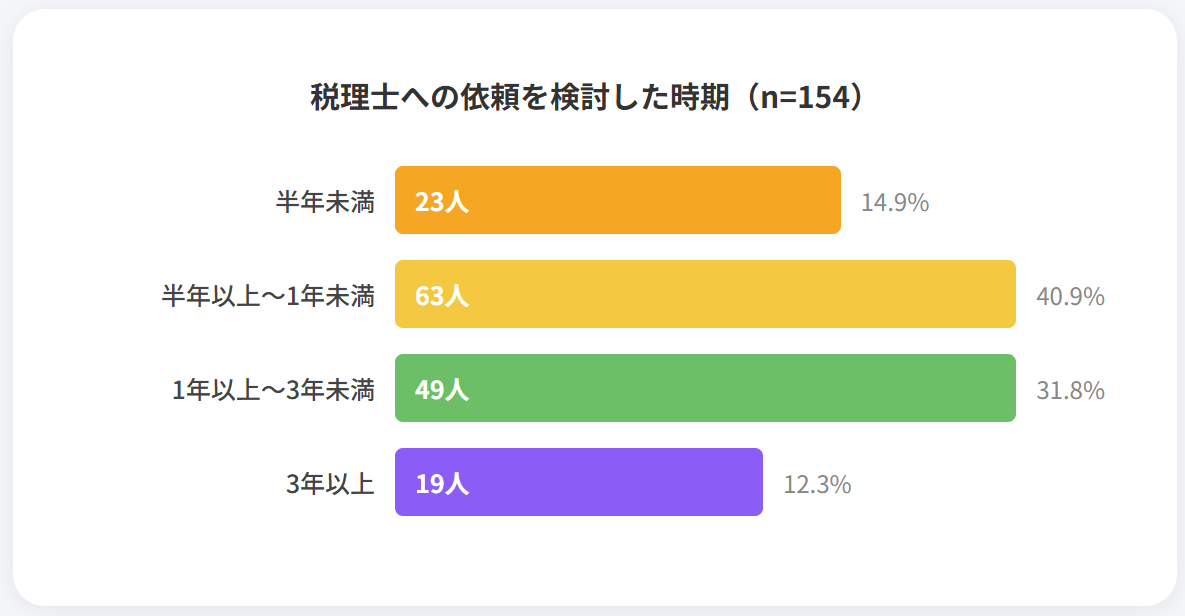
Asked how long after starting to invest in crypto assets they considered using a tax accountant, respondents who did so within their first year of investing added up to about 56%. In particular, "6 months to under 1 year" accounted for over 40%, suggesting that many holders hit the limits of self-calculation around the time of their first tax filing season. Unlike other financial products, crypto assets demand rigorous record-keeping from the start — carrying acquisition costs forward across calendar years, consolidating transaction history across multiple exchange service providers, and more.
These results tell us that many holders confront tax challenges while their investing experience is still shallow. Considering professional support early on is a reasonable choice, given it helps prevent calculation errors from piling up over time. Holders with an eye on long-term asset building appear to place particular weight on establishing an accurate gain/loss calculation framework during the early phase of investing.
Meanwhile, only just over 10% of holders wait 3 years or more before considering a tax accountant, indicating that either a self-management approach becomes established with experience, or holders who don't use one early on tend to keep managing things on their own.
Even Under ¥100,000, 40% Consider Hiring a Pro: Small-Scale Holders Can't Ignore Filing Complexity Either
Investment size | Under 6 months | 6 months–under 1 year | 1 year–under 3 years | 3 years or more | Don't remember |
|---|---|---|---|---|---|
Under ¥10,000 | 9.7% | 35.5% | 41.9% | 12.9% | 0.0% |
¥10,000–under ¥100,000 | 14.8% | 39.3% | 36.1% | 9.8% | 0.0% |
¥100,000–under ¥500,000 | 17.4% | 45.7% | 23.9% | 13.0% | 0.0% |
¥500,000 or more | 21.4% | 42.9% | 14.3% | 21.4% | 0.0% |
Prefer not to answer | 50.0% | 50.0% | 0.0% | 0.0% | 0.0% |
*Cross-tabulation of investment size (Q6) and timing of consideration (Q5) (n=154) |
Looking at timing by investment size, even among holders with under ¥100,000 invested, about 40% considered using a tax accountant within their first year. Regardless of the size of the investment, the amount of calculation work scales with the variety and frequency of trades, meaning administrative burden is a hurdle even small-scale holders can't ignore. Among the mid-size bracket of ¥100,000 to under ¥500,000, consideration within 6 months to a year was highest at 45.7%, suggesting holders start seriously weighing professional help once modest gains begin to appear.
By contrast, among the large-scale bracket of ¥500,000 or more, early consideration within "under 6 months" (21.4%) is the highest across all categories, and "3 years or more" (21.4%) is also notably high. This points to a split between a cautious group wary of tax risk from the start, and a group whose gains grew over several years before they belatedly sought professional support. Holders with greater financial resources appear more attuned to building a "defensive" structure before their tax liability grows large.
Regardless of portfolio size, anxiety about the calculation rules specific to crypto assets is a shared experience, and the need for professional help is especially pronounced around the moment a sale locks in a realized gain.
Salaried Employees Decide Early: Busy Working-Age Holders Are More Likely to Outsource Within a Year
Occupation | Under 6 months | 6 months–under 1 year | 1 year–under 3 years | 3 years or more | Don't remember |
|---|---|---|---|---|---|
Public servant / salaried employee | 15.1% | 41.5% | 33.0% | 10.4% | 0.0% |
Self-employed / freelance | 13.0% | 34.8% | 34.8% | 17.4% | 0.0% |
Other (homemaker, student, etc.) | 16.0% | 44.0% | 24.0% | 16.0% | 0.0% |
*Cross-tabulation of occupation and timing of consideration (Q5) (n=154) |
Comparing timing by occupation, about 56% of salaried employees and public servants considered using a tax accountant within their first year. For working-age holders with a full-time job, doing complex gain/loss calculations using limited off-hours and evenings is a significant physical burden, which tends to push them toward professional help early. The employee-specific rule that a final tax return becomes mandatory once non-salary income exceeds ¥200,000 likely also nudges this group to think about a professional sooner rather than later.
Among the self-employed and freelance group, 17.4% consider a tax accountant only after 3 or more years — higher than any other group — suggesting that because they're already accustomed to filing final tax returns, they tend to try handling it themselves first. That they still eventually consider a professional, though, indicates they've run into a complexity specific to crypto assets that operates on a different level from filing business income.
Regardless of occupation, the first year after starting to invest appears to function as a critical trial period during which holders judge whether they can manage on their own. In particular, when preparing their final tax return after year-end profit-taking sales, many users rediscover just how necessary a tax accountant can be.
Anxiety About Expertise Runs Deep: Over 30% Are Eager to Connect With the "Right" Tax Accountant
Lack of Confidence in Understanding the Rules Tops the List; Nearly 40% Fear Being Flagged Later
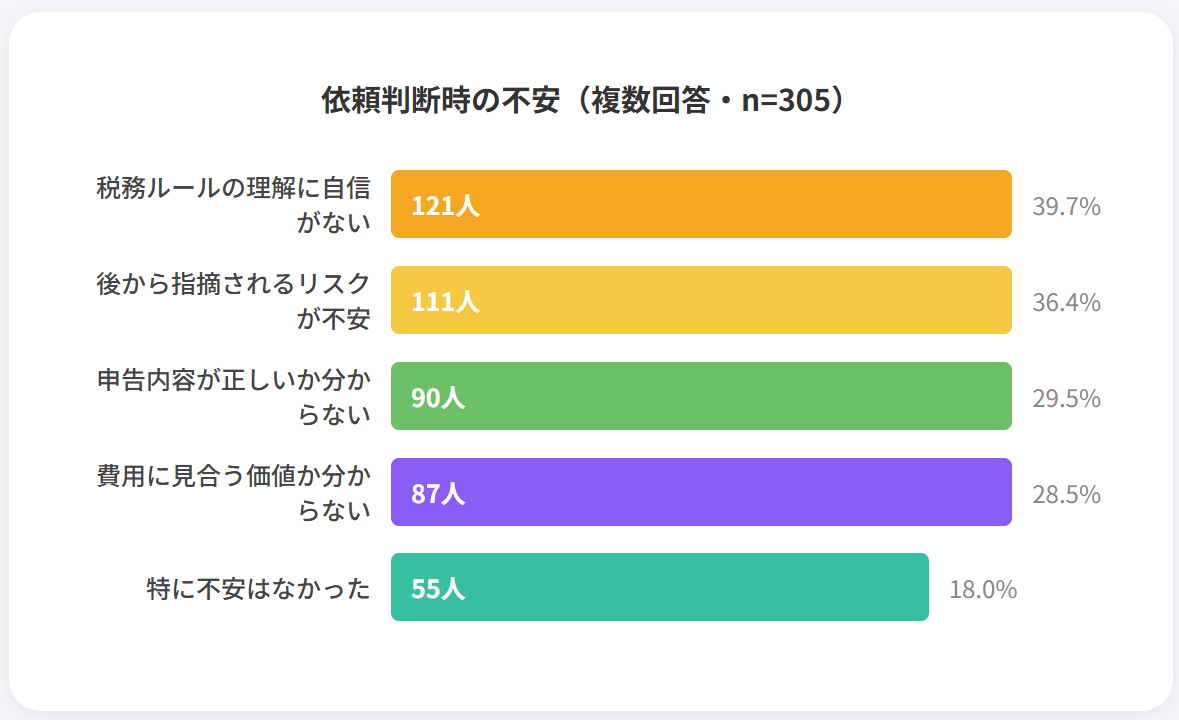
Reason (multiple answers allowed) | Responses | Share |
|---|---|---|
Lacked confidence in understanding the tax rules | 121 | 39.67% |
Worried about the risk of being flagged later | 111 | 36.39% |
Couldn't tell if their filing was accurate | 90 | 29.51% |
Couldn't tell if the cost was worth the value | 87 | 28.52% |
Had no particular concerns | 55 | 18.03% |
Asked what anxieties they felt when deciding whether to use a tax accountant for their final tax return, respondents most often cited "lacked confidence in understanding the tax rules" at 39.7%. Japan's tax treatment of crypto assets involves numerous points open to interpretation without specialist knowledge — that it falls under aggregate (comprehensive) taxation rather than separate self-assessment taxation, how to determine acquisition cost for mining or staking rewards, and more. This regulatory complexity creates a psychological burden of "not knowing the right answer" for holders, and it's the single biggest factor that makes them think of hiring a tax accountant.
Another 36.4% worried about "the risk of being flagged later," underscoring a very high level of vigilance about the real consequences of a filing omission, such as additional tax penalties or late-payment interest. For many holders, a tax accountant's fee isn't simply the price of clerical outsourcing — it's expected to function as a "shield" against the tax authorities. Meanwhile, about 28% were unsure whether the cost is worth the value, and making visible the peace of mind and tangible benefit gained for the money spent remains a challenge for the industry as a whole.
A defensive instinct to minimize risk, and a sharp eye on cost-effectiveness — caught between the two, holders appear to face the "should I hire one or not" decision again and again.
Information on "How to Find One" Tops Requests; Holders Also Want Concrete Examples for Deciding
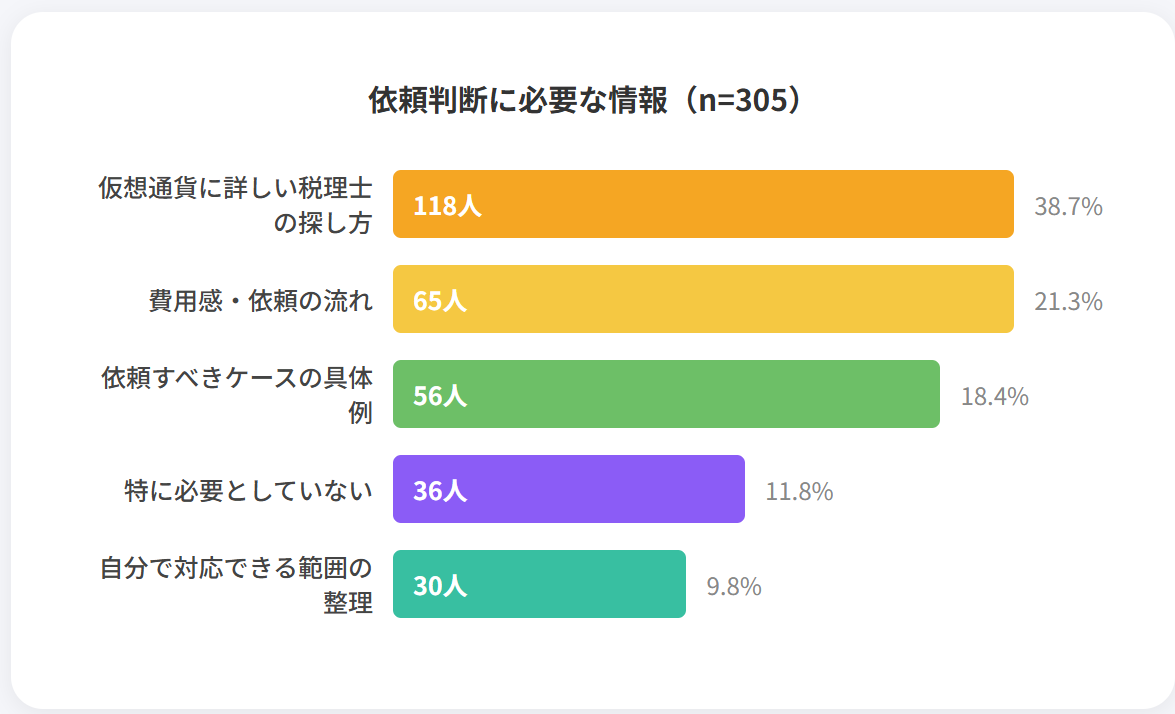
Response | Responses | Share |
|---|---|---|
How to find a tax accountant experienced with crypto | 118 | 38.69% |
Information on typical cost and the process of hiring | 65 | 21.31% |
Concrete examples of when to use a tax accountant | 56 | 18.36% |
Don't feel the need for this information | 36 | 11.8% |
A clear breakdown of what can be handled on one's own | 30 | 9.84% |
Asked what information would make it easier to decide whether to hire a tax accountant, 38.7% of holders cited "how to find one experienced with crypto." A nearby tax accountant's office doesn't necessarily handle crypto assets, and many holders appear to struggle with matching to a specialist who has the literacy needed for these unusual calculations. This suggests that a lack of information is causing a mismatch between users who want professional support and the specialists who could provide it.
Next came "typical cost and process" (21.3%) and "concrete examples of when to hire" (18.4%), reflecting demand for more transparency around both the "criteria" and the "cost" of using a tax accountant. Holders need guidelines that let them objectively judge whether their own trading size and activity have reached a level that warrants professional help, or still fall within a range they can manage on their own.
What holders want most isn't a generic explanation of the system, but a concrete route to the right specialist for their situation. As more information addressing this need becomes available, the environment for more users to manage their crypto taxes appropriately should continue to improve.
Holders 50 and Older Value a Tax Accountant's Expertise Most: Senior Holders Want Reliable Execution
Analyzing requests by age group, over 40% of holders aged 40 and older asked for "how to find an experienced tax accountant," a notably high level. Among the 50-and-older senior bracket in particular, "a clear breakdown of what can be handled on my own" (5.7%) was strikingly rare compared with younger holders, suggesting they operate on the assumption of leaving things to a professional from the outset. The stronger a generation's sense that mistakes in asset management are unacceptable, the more strongly it seeks a connection with a trustworthy specialist.
By contrast, the under-30 group scored higher than other ages on "concrete examples of when to hire" (25.0%), hinting at a desire to first gauge whether they can handle it themselves. While "how to find one" remains the top answer across all age groups, a subtle nuance emerges: middle-aged and senior holders place more weight on "certainty," while younger holders place more weight on "decision-making material."
For every generation, a clear "access route to a specialist" for properly handling this new asset class of crypto assets has become essential infrastructure for continuing to invest.
Summary
This survey found that roughly half of crypto asset holders have used a tax accountant for their final tax return at some point. Notably, many holders consider professional help early — within the first year of investing — showing that the complex gain/loss calculations specific to crypto assets are an extremely high barrier for users who are still new to the market.
The value holders seek from a tax accountant goes beyond simply outsourcing paperwork. For busy working-age holders with a full-time job, it's about "creating time"; for high earners and large-scale holders, it strongly reflects "hedging risk" against a future tax audit or penalty. At the same time, a certain share of holders still choose to self-file, and behind that choice lies not just cost but also an access problem — being unable to find a specialist to consult in the first place.
Japan's crypto tax rules remain complex, and as trading styles diversify, it becomes harder for any individual to keep track of every rule accurately on their own. Securing a trusted tax accountant as a partner is a highly effective strategy for relieving unnecessary anxiety and sustaining healthy investing activity. Objectively assessing the calculation complexity and risk they personally face, and bringing in a specialist's expertise at the right time, is what crypto asset holders will increasingly need going forward.
Survey Overview
Survey date: February 24, 2026
Survey method: Internet survey
Survey population: Men and women residing in Japan who currently invest, or have previously invested, in crypto assets
Valid responses: 305
Conducted by: Clabo Inc.
Survey Questions
- Have you ever used virtual currency (crypto assets)?
- Have you ever hired a tax accountant regarding virtual currency taxes or your final tax return?
- What was your main reason for deciding to hire a tax accountant? (Select all that apply)
- What was your main reason for not hiring a tax accountant? (Select all that apply)
- At the time you considered or decided on hiring a tax accountant, how long had you been investing in virtual currency?
- At the time you considered or decided on hiring a tax accountant, which best describes your investment size?
- Which best describes your virtual currency trading style?
- Where did you mainly get information about virtual currency taxes and final tax returns?
- What concerns did you have when deciding whether to hire a tax accountant for your virtual currency final tax return? (Select all that apply)
- Going forward, what information or support would make it easier for you to decide whether to hire a tax accountant for your virtual currency final tax return?
This article is for informational purposes only and does not constitute financial or investment advice. Please consult a qualified professional before making investment decisions.


