


As the market for crypto assets (also known as virtual currencies) continues to expand, tax filing has become an unavoidable challenge for holders in Japan. Unlike stock investing, where a specified account (tokutei kouza) with automatic withholding can simplify the process, no equivalent system exists for crypto assets. As a result, a significant number of holders feel they have reached the limits of what they can manage on their own when it comes to calculating gains and losses and understanding the applicable rules.
This survey analyzed 335 people who currently hold crypto assets, examining their level of confidence in filing tax returns, the specific concerns they face, and the measures they are currently taking. The results showed that 54.0% of respondents overall answered that they either "lack confidence" or "cannot judge" when it comes to filing, and revealed clear gaps in tax literacy depending on income level and age group.
The survey also highlighted a precarious situation in which many holders harbor doubts about the "accuracy of information" yet still rely primarily on social media and news sites as their main sources of information. Drawing on the raw voices captured in the survey, this article examines, from a professional perspective, the barriers crypto asset holders face and the kind of support needed to overcome them.
Note: As of July 2026, under Japan’s current tax law, gains from selling crypto assets are treated as miscellaneous income and taxed under the aggregate (progressive) taxation system. On July 15, 2026, an amended Financial Instruments and Exchange Act was passed by the House of Councillors, which will reclassify crypto assets as financial instruments under the FIEA. Under the amended law, a flat 20% separate self-assessment tax rate is expected to apply starting from the year after the revised law takes effect — currently projected for January 2028.
Over Half of Holders Lack Confidence in Filing Tax Returns
Just Over 40% Feel Confident About Filing
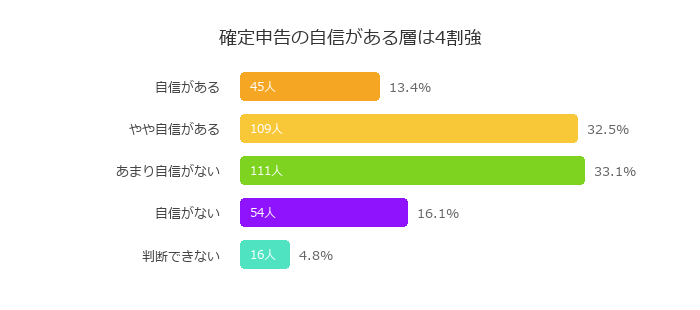
Confidence Level | Number of Responses | Percentage |
|---|---|---|
Confident | 45 | 13.43% |
Somewhat confident | 109 | 32.54% |
Not very confident | 111 | 33.13% |
Not confident | 54 | 16.12% |
Cannot judge because I don’t know | 16 | 4.78% |
When crypto asset holders were surveyed about their confidence in filing tax returns, only 45.97% answered positively, combining "confident" and "somewhat confident." Meanwhile, the negative group, combining "not very confident" and "not confident," reached 49.25%, and when the "cannot judge" group is included, 54.03% of all respondents feel some degree of unease about filing. This suggests that even as crypto asset trading becomes more mainstream, the hurdle of tax filing remains high.
The fact that only 13.43% can flatly say they are "confident" is particularly telling of how the complexity of the system weighs on holders psychologically. Annual transaction reports from exchanges alone are not enough to complete a filing, and the burden of calculating gains using the moving average method or the total average method appears to be a major factor dragging down self-assessed confidence.
Because incorrect calculations can trigger penalties such as the additional tax for underreporting, this lack of confidence is not a problem that can be overlooked.
Among Those Earning Over ¥10 Million, 60% Feel Confident
Household Income | Confident (Total) | Not Confident (Total, incl. "cannot judge") |
|---|---|---|
Under ¥4 million | 38.5% | 61.5% |
¥4 million to under ¥10 million | 44.2% | 55.8% |
¥10 million or more | 62.1% | 37.9% |
A cross-tabulation of confidence by household income revealed a clear correlation: the higher the income level, the higher the confidence in filing. Among those with household income of ¥10 million (approx. $67,000 at ¥150/$1, for reference only) or more, 62.1% answered they were "confident (or somewhat confident)," a gap of roughly 23 percentage points compared with 38.5% among those earning under ¥4 million (approx. $27,000).
Higher-income holders often manage a wider range of assets beyond crypto, including stocks and real estate, giving them more frequent exposure to tax matters and a corresponding sense of confidence. Their greater financial flexibility also makes it easier to access professionals such as tax accountants, allowing them to supplement their knowledge accurately — another factor behind the literacy gap.
By contrast, the fact that over 60% of those earning under ¥4 million report a "lack of confidence" illustrates how holders with smaller portfolios tend to feel they have reached the limits of self-taught filing. Crypto assets are, in principle, classified as miscellaneous income, which comes with special rules — most notably, losses can only be offset against other miscellaneous income and cannot be offset against other income categories such as employment income. Because of this, acquiring accurate knowledge is essential regardless of income bracket.
For Working-Age Holders in Their 30s and 40s, Time Pressure and Complex Trades Are the Barrier
Age Group | Confident (Total) | Not Confident (Total, incl. "cannot judge") |
|---|---|---|
In their 20s | 51.2% | 48.8% |
In their 30s | 42.1% | 57.9% |
In their 40s | 41.5% | 58.5% |
In their 50s | 48.4% | 51.6% |
60s and older | 55.2% | 44.8% |
Breaking the results down by age, the shares answering "not confident (including ‘cannot judge’)" were notably high among those in their 30s and 40s, at 57.9% and 58.5% respectively — the highest of any age group.
This generation is typically at a busy stage of life balancing work and childcare, leaving limited time for the complicated task of calculating gains and losses. They also tend to use multiple exchanges and diversify across tokens, which further complicates their filings. Accurate filing requires consolidating a complete transaction history, and the sheer volume of work involved directly translates into a "lack of confidence."
By contrast, among those aged 60 and older, 55.2% reported being "confident," a majority that suggests this group approaches tax procedures more calmly than working-age respondents. Their accumulated investment experience, along with the extra time that comes with retirement, likely contributes to a more accurate grasp of their own transactions and greater confidence overall.
For younger and mid-career holders, using automated calculation tools and knowing how to filter through available information will be key to reducing the stress of tax filing.
Over 40% Cite the Complexity of Tax Rules as a Major Struggle
Complex Calculations and Rules Create a Psychological Barrier for Holders
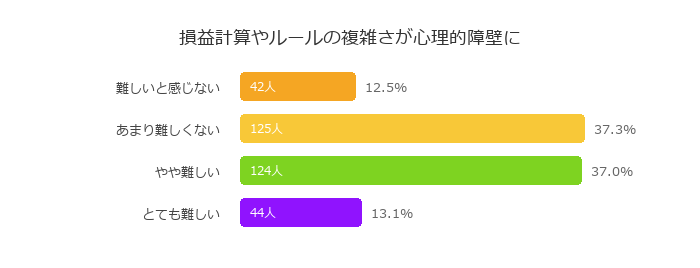
Perceived Difficulty | Number of Responses | Percentage |
|---|---|---|
Not difficult at all | 42 | 12.54% |
Not very difficult | 125 | 37.31% |
Somewhat difficult | 124 | 37.01% |
Very difficult | 44 | 13.13% |
Asked whether they find filing difficult, 50.14% answered positively, combining "somewhat difficult" and "very difficult," meaning roughly half of holders feel some degree of difficulty. Among them, 13.13% went as far as answering "very difficult," underscoring how burdensome crypto-specific calculation rules can be.
At the same time, roughly half of respondents said they do not find it difficult, which is likely due in large part to simpler trading patterns and the growing availability of calculation tools.
Because crypto assets lack an equivalent to the specified account (tokutei kouza) with automatic withholding used for stocks, holders must, in principle, manage their entire transaction history themselves. This becomes especially complicated when using multiple Crypto Asset Exchange Service Providers or combining domestic exchanges with overseas ones, making the calculation of acquisition cost extremely burdensome. These structural gaps, combined with the opacity of the calculation process, are likely the main reasons holders come away with such a strong impression of "difficulty."
41% Admit They’ve Reached the Limits of Their Understanding of the System
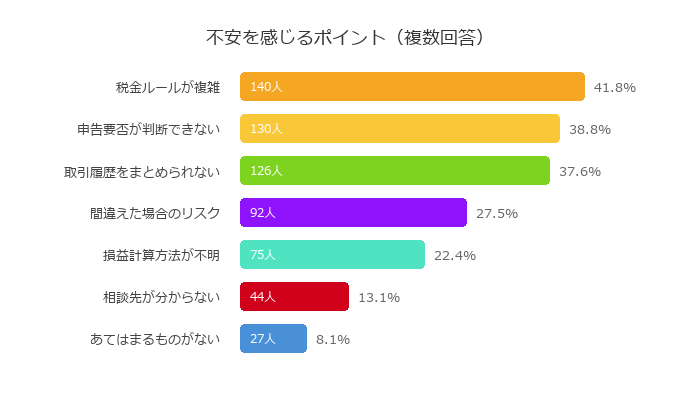
Sources of Concern (multiple answers allowed) | Number of Responses | Percentage |
|---|---|---|
Tax rules feel complex | 140 | 41.79% |
Cannot determine whether filing is required | 130 | 38.81% |
Unable to consolidate transaction history | 126 | 37.61% |
Worried about the risk of making a mistake | 92 | 27.46% |
Do not know how to calculate gains and losses | 75 | 22.39% |
Do not know where to seek advice | 44 | 13.13% |
None of the above apply | 27 | 8.06% |
Among specific concerns, "complexity of the rules" ranked highest at 41.79%, followed by "uncertainty over whether filing is required" at 38.81%. Crypto assets are classified as "miscellaneous income" under the Income Tax Act, but because they are subject to aggregate taxation rather than separate self-assessment taxation, the applicable tax rate fluctuates depending on a person’s other income — another factor that hampers understanding. In addition, 37.61% cited the practical challenge of "not having consolidated their transaction history," with poor record-keeping compounding their anxiety.
Furthermore, the fact that 27.46% of holders fear "the risk of making a mistake" reflects both a strong compliance mindset and a genuine hunger for accurate information.
Tax audits related to crypto assets have been intensifying in recent years, and the penalties (additional taxes) for failing to file or underreporting are far from light. It’s clear that the state of simply "not knowing what is correct" is itself being perceived as the biggest risk in crypto investment activity.
47.2% Doubt the Accuracy of the Information They Find
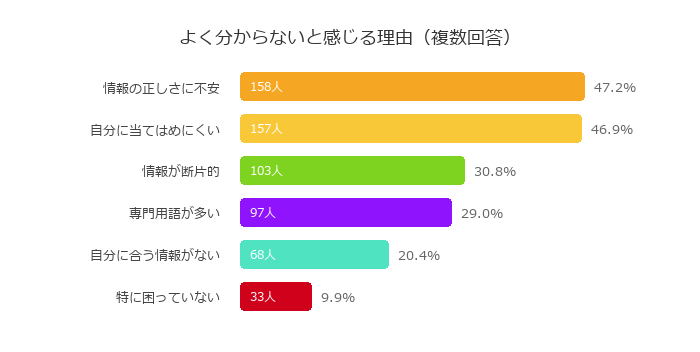
Reasons Information Feels Unclear (multiple answers allowed) | Number of Responses | Percentage |
|---|---|---|
Uncertain about the accuracy of information | 158 | 47.16% |
Too many case-by-case explanations, hard to apply to my situation | 157 | 46.87% |
Information is fragmented, hard to grasp the full picture | 103 | 30.75% |
Too much technical jargon, hard to understand | 97 | 28.96% |
Cannot find information that matches my situation | 68 | 20.36% |
Not particularly troubled | 33 | 9.85% |
As for why researching the topic doesn’t resolve their confusion, roughly half of respondents, 47.16%, pointed to "the reliability of information," while 46.87% cited the difficulty of "applying it to their own situation."
While an enormous amount of information is available online, there is little coverage addressing individual cases such as NFT transfers or DeFi rewards, making it difficult for holders to sort through what applies to them. The frustration of piecing together fragmented information without ever seeing the full picture suggests a lack of systematic guidance.
In addition, 28.96% see "technical jargon" as a barrier, pointing to a reality in which beginners get stuck right at the entry point of tax knowledge.
Guidance from the Financial Services Agency (FSA) and National Tax Agency (NTA) on crypto-related taxation is updated fairly frequently, and the cost of continually keeping up with the latest information is far from trivial. What the market urgently needs is a way to resolve this information asymmetry and let individual holders quickly determine "what applies to my case."
Increasingly Complex Trading Adds to the Filing Burden
High Trade Volume and the Special Tax Treatment of DeFi and NFTs Are a Source of Trouble
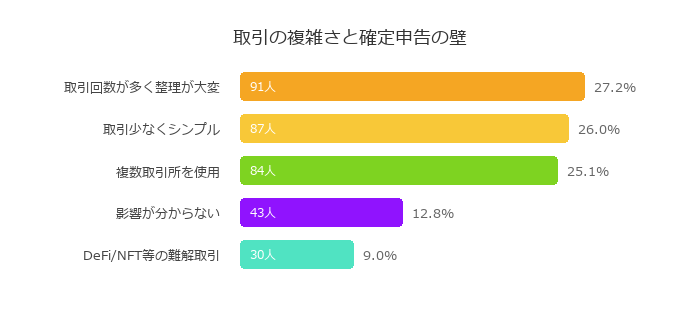
Type of Trading Activity | Number of Responses | Percentage |
|---|---|---|
High trade frequency makes organizing difficult | 91 | 27.16% |
Low trade frequency and simple content | 87 | 25.97% |
Low trade frequency but uses multiple exchanges | 84 | 25.07% |
Unsure how my trading activity affects my filing | 43 | 12.84% |
Includes DeFi, NFTs, or other trades with unclear tax treatment | 30 | 8.96% |
Looking at how respondents assessed their own trading activity from a tax-filing standpoint, 27.16% cited "difficulty organizing records due to a high number of trades" as their biggest challenge. Combined with the 8.96% who included "complex trades such as DeFi or NFTs," 36.12% of holders face a high workload burden, whether physical or in terms of knowledge required. Because crypto assets can be traded frequently in small amounts, it’s not unusual for a single year’s transaction history to run into the thousands of lines — a scale that makes manual calculation effectively impossible.
Additionally, 25.07% "use multiple exchanges," and tracking asset movements across exchanges raises the risk of underreporting. A further 12.84% answered that they "don’t know how their own trading affects their filing," highlighting a lack of basic understanding of taxable events (such as selling, exchanging, or making payments). Under Japan’s distinctive tax rules, where even crypto-to-crypto exchanges are taxable events, this gap in awareness carries the risk of unintentional underreporting.
33.4% Have Adopted Gain/Loss Calculation Tools
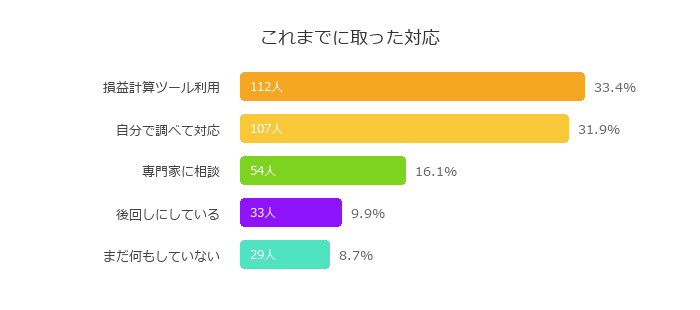
Measures Taken So Far | Number of Responses | Percentage |
|---|---|---|
Used a gain/loss calculation tool or software | 112 | 33.43% |
Handled it by researching on my own | 107 | 31.94% |
Consulted a professional such as a tax accountant | 54 | 16.12% |
Postponing it until it becomes necessary | 33 | 9.85% |
Haven’t done anything yet | 29 | 8.66% |
In terms of concrete action taken toward filing, 33.43% have adopted a "gain/loss calculation tool or software," making digital efficiency the most common approach. Close behind, 31.94% "handled it by researching on their own," reflecting a segment of holders who prefer to complete the process independently rather than rely on outside services. However, because crypto asset calculations require the strict application of methods such as the moving average method, manual calculation is prone to human error, making this an area where using a tool is generally recommended.
Notably, roughly 18.5% of respondents overall are either "putting it off" or have "done nothing yet." Because crypto asset gains are combined with other income as "miscellaneous income," a filing obligation arises once annual gains exceed ¥200,000 (approx. $1,300 at ¥150/$1, for reference only), and the risk of scrambling through a mountain of transaction history right before the deadline is extremely high. Organizing one’s transaction history early is essential not only for estimating the tax owed but also for tax-saving measures such as realizing unrealized losses, and neglecting it can translate directly into financial losses down the road.
News Sites Are the Dominant Information Source, Used by 51.9%, But Reliance on Social Media Is Also Notable
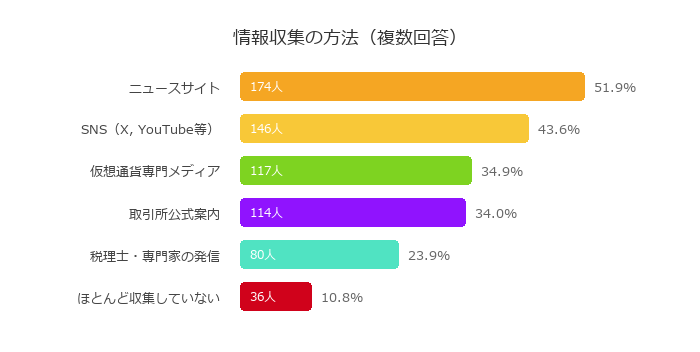
Information-Gathering Methods (multiple answers allowed) | Number of Responses | Percentage |
|---|---|---|
News sites | 174 | 51.94% |
Social media (X, YouTube, TikTok, etc.) | 146 | 43.58% |
Specialist crypto media | 117 | 34.93% |
Guidance from exchanges or official services | 114 | 34.03% |
Content from tax accountants or accounting professionals | 80 | 23.88% |
Barely gather information at all | 36 | 10.75% |
Asked about their everyday sources of information, "news sites" ranked highest at 51.94%, followed closely by "social media" at 43.58%.
While fast-moving media are favored, sources more likely to guarantee accuracy — "guidance from exchanges" and "content from professionals" — trail at only 34.03% and 23.88% respectively. Because information shared on social media by an unspecified range of people can include misunderstandings or content based on outdated tax rules, an over-reliance on such sources carries the risk of leading to incorrect filings.
When gathering information, it’s important to check primary sources such as guidance from the National Tax Agency (NTA) and official explanations provided by the Japan Virtual and Crypto Assets Exchange Association (JVCEA).
Cross-checking convenient sources like social media and general news against expert-supervised articles and announcements from public authorities is a practical safeguard for protecting one’s own assets.
39.43% Are Eager for an Expert to Check Their Filing
Holders Seek Objective Assurance
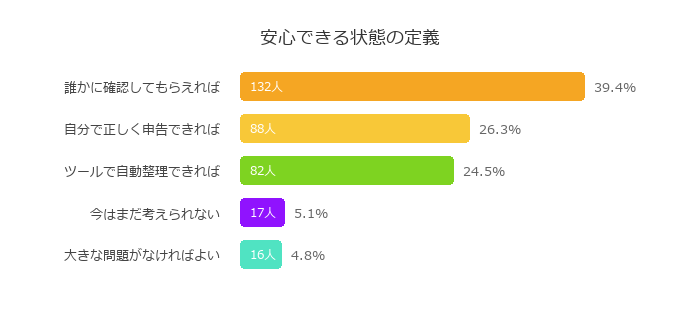
What Would Provide Peace of Mind | Number of Responses | Percentage |
|---|---|---|
Having someone check my filing | 132 | 39.43% |
Knowing I can file correctly myself | 88 | 26.27% |
Having a tool automatically organize everything | 82 | 24.48% |
Can’t think about it yet | 17 | 5.07% |
Fine with some uncertainty as long as there’s no major issue | 16 | 4.78% |
Asked what would make them feel "at ease" about filing, the largest group, 39.43%, said "having someone check it for me." This reflects the reality that many holders feel they’ve reached the limits of what they can file on their own and strongly want a third party (an expert) to provide an objective "correct answer." Because interpretations of crypto tax rules can sometimes differ, the psychological hurdle of proceeding on one’s own judgment appears to be driving demand for outside verification.
In addition, 24.48% cited "automatic organization by a tool," pointing to a persistent desire to eliminate human error. Meanwhile, the 26.27% who answered "being able to file correctly myself" show that a certain segment aims to independently build up their own literacy. In any case, what crypto asset holders are ultimately seeking is a "reliable method" that eliminates ambiguous judgment calls and reduces the risk of being flagged by tax authorities as close to zero as possible.
47.8% Want a “Check Method” to Determine Whether They Need to File
Support Desired (multiple answers allowed) | Number of Responses | Percentage |
|---|---|---|
A check method to see if I need to file | 160 | 47.76% |
Concrete examples by type of trade | 135 | 40.30% |
An easy-to-understand explanation of the overall process | 111 | 33.13% |
Comparison information on tools and services | 110 | 32.84% |
Opportunities to consult a professional | 65 | 19.40% |
Don’t particularly need anything | 27 | 8.06% |
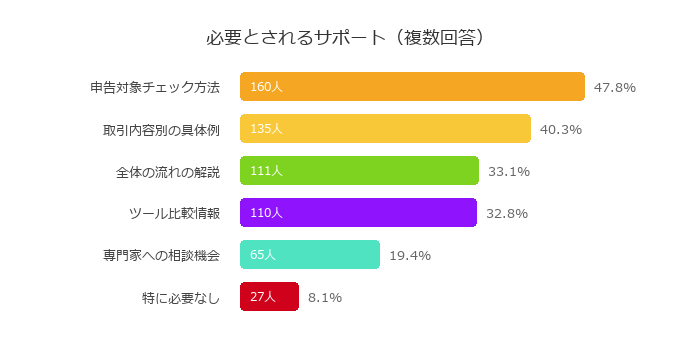
Among the types of support holders hope to see in the future, "a check method to see if I need to file" received the strongest support, reaching nearly half of respondents at 47.76%. A filing obligation for crypto assets arises once income exceeds ¥200,000, but many holders appear unable to determine whether their own situation meets that threshold — for example, what counts as deductible expenses or when a gain is considered realized. There was also strong demand, at 40.30%, for "concrete examples by type of trade," showing a preference for practical, hands-on guidelines over abstract explanations.
Demand was also high for "an explanation of the overall process" (33.13%) and "comparison information on tools" (32.84%), pointing to a need for information that covers filing preparation from start to finish. The 19.40% who want "opportunities to consult a professional" align with the earlier finding that "having someone check it" provides peace of mind. Rather than expecting individuals to overcome a complex tax system through effort alone, there is an urgent need to expand convenient support systems, such as simple eligibility-check tools and concrete case studies.
Holders Earning Under ¥4 Million Prioritize “Automatic Organization”
Household Income | Having Someone Check | My Own Effort | Automatic Tool Organization | Other (incl. no answer) |
|---|---|---|---|---|
Under ¥4 million | 34.6% | 23.1% | 34.6% | 7.7% |
¥4 million to under ¥10 million | 41.3% | 24.5% | 24.1% | 10.1% |
¥10 million or more | 41.4% | 36.2% | 15.5% | 6.9% |
Analyzing "what provides peace of mind" by household income, holders earning under ¥4 million placed notably more emphasis on "automatic tool organization," at 34.6% — clearly higher than other income brackets. This group likely prefers to complete filing independently and efficiently using low-cost or free tools rather than paying for a tax accountant’s review, which can come with a high fee. This may reflect a rational economic calculation: avoiding filing costs that would be disproportionately high relative to their income.
By contrast, among those earning ¥10 million or more, "filing correctly through my own effort" scored high at 36.2%, showing a strong motivation to build literacy on their own. Overall, demand for "having someone check it" remains stable at around 40% across income brackets, but a clear pattern emerges in which lower-income holders lean toward tool-based automation while higher-income holders lean toward acquiring knowledge and seeking outside verification. Meeting this diversity of needs — by offering appropriate support tools and information tailored to holders’ asset scale — will contribute to the healthy development of the crypto asset market as a whole.
Conclusion
This survey found that a majority of crypto asset holders feel they "lack confidence" when it comes to filing tax returns, and that this stems from a deep-rooted combination of complex tax rules and burdensome calculations. The fact that only 13.43% can flatly say they are "confident" symbolizes a difficulty in understanding the system that cannot be resolved through individual effort alone. Concerns such as "tax rules feel complex" (41.79%) and "cannot determine whether filing is required" (38.81%) very likely represent a psychological barrier standing in the way of the market’s healthy development.
At the same time, the survey confirmed a more proactive side: 33.43% of holders have already adopted gain/loss calculation tools or software as they search for a more efficient way to handle their taxes. In principle, calculating crypto asset gains and losses requires accurately aggregating the entire transaction history using either the moving average method or the total average method. For the 27.16% who feel that "a high number of trades makes organizing difficult," using digital tools to eliminate human error is an extremely effective safeguard against the risk of underreporting or failing to file.
Going forward, enabling holders to continue trading with "peace of mind" will require expanding support such as the "expert check" that 39.43% want and the "check method to determine filing eligibility" that 47.76% are asking for. Given that 47.16% of respondents feel uncertain about the accuracy of the information they find, holders need the literacy to reference primary sources from public authorities and specialist media rather than relying on fragmented information from social media. Filing a tax return is not merely an obligation — it is an important process for accurately understanding one’s own asset position and building a sustainable investment strategy. Organizing transaction history early and making use of appropriate support may well be what ultimately helps holders avoid future tax trouble and maximize their investment returns.
This article is for general informational purposes only and does not constitute tax advice. For guidance on your specific situation, please consult a qualified tax accountant or other professional.
Survey Overview
Survey date: February 24, 2026
Survey method: Internet survey
Survey subjects: Men and women residing in Japan (people currently investing in crypto assets or with past investment experience)
Valid responses: 335
Conducted by: Clabo, Inc.
Survey Questions
- Have you ever used crypto assets (virtual currency)?
- Regarding filing a final tax return for crypto assets, which option is closest to your current level of confidence?
- When you think about filing a final tax return for crypto assets, which option is closest to how difficult it feels?
- Regarding your crypto asset trading activity, which option is closest from a tax-filing perspective?
- Regarding filing a final tax return for crypto assets, which points, if any, do you feel particularly concerned about?
- Regarding filing a final tax return for crypto assets, which measures, if any, have you taken so far?
- Regarding filing a final tax return for crypto assets, how do you usually gather information?
- Regarding filing a final tax return for crypto assets, which reasons, if any, make the information feel "unclear" even after researching it?
- Regarding filing a final tax return for crypto assets, which forms of support, if any, would be helpful going forward?
- Regarding filing a final tax return for crypto assets, what would need to happen for you to feel "at ease"?


