


Investors who lack confidence in filing their tax returns tend to prioritize convenience over accuracy, relying heavily on social media and YouTube rather than official information, a survey has found.
Among 335 people with experience investing in crypto assets (also known as virtual currencies), 47.3% of those who said they lack confidence in tax filing cited social media as their primary source of information, while only 30.3% referred to official sources.
This article uses the survey data to break down the decisive difference in information-gathering styles between confident and unconfident investors, and to identify the true source of the anxiety many investors feel.
It offers hints for resolving the common worry that "what I've researched doesn't seem to apply to my own case," so that investors can file with confidence.
47.3% of Low-Confidence Investors Rely on Social Media; Only 30.3% Reference Official Sources
Lack of Understanding of the System Is a Serious Barrier
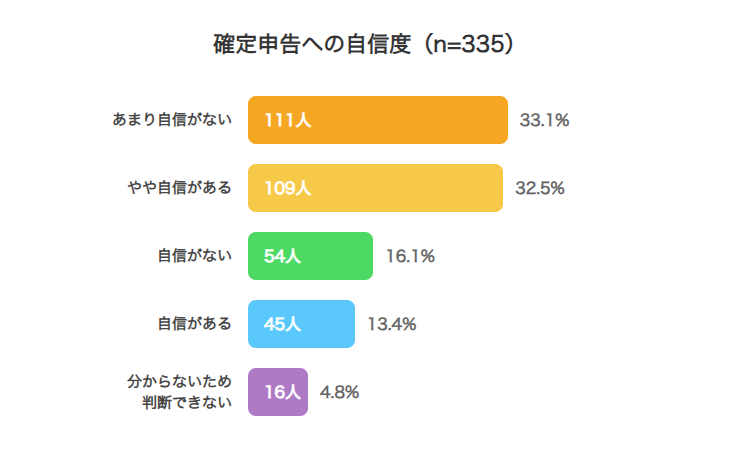
Response | Respondents | Share |
|---|---|---|
Not very confident | 111 | 33.1% |
Somewhat confident | 109 | 32.5% |
Not confident | 54 | 16.1% |
Confident | 45 | 13.4% |
Unable to judge | 16 | 4.8% |
Investors who answered "confident" or "somewhat confident" about filing taxes on crypto assets accounted for only 45.9% combined.
This reveals that more than half of investors continue to trade while harboring some degree of anxiety about their own filing practices.
Notably, those in the "not confident" camp reached 49.2% in total, meaning roughly one in two respondents recognizes a gap in their own knowledge.
Because crypto assets are classified as miscellaneous income for tax purposes, the complexity of the calculation method appears to be a major factor raising the psychological barrier.
A certain number of respondents also said they are simply unable to judge, suggesting some may not have had sufficient opportunity to engage with the system itself.
For investors to keep building assets in a sustainable way, boosting tax literacy — not just trading skill — is becoming an urgent priority.
Only 30.3% Refer to Official Sources
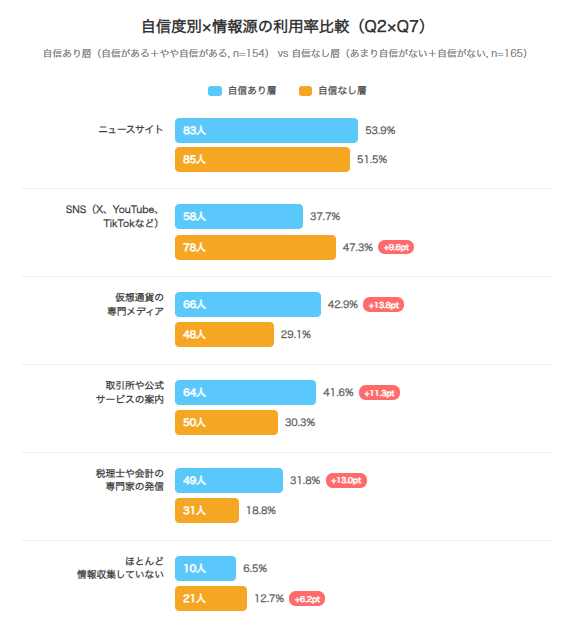
Information Source | Low-Confidence Group (n=165) | Share | Confident Group (n=154) | Share |
|---|---|---|---|---|
News sites | 85 | 51.5% | 83 | 53.9% |
Social media (X, YouTube, TikTok, etc.) | 78 | 47.3% | 58 | 37.7% |
Guidance from exchanges or official services | 50 | 30.3% | 64 | 41.6% |
Specialized crypto media | 48 | 29.1% | 66 | 42.9% |
Posts by tax accountants or accounting professionals | 31 | 18.8% | 49 | 31.8% |
Barely gathers information at all | 21 | 12.7% | 10 | 6.5% |
Analyzing the relationship between confidence in tax filing and information sources reveals a decisive structural gap in information quality.
Among the low-confidence group, 47.3% cite social media as their main source, a notably high figure that points to reliance on easily accessible information.
Meanwhile, only 30.3% refer to the more reliable "guidance from official services," a wide gap compared with the confident group (41.6%).
The less confident an investor is, the more they appear to prioritize ease of understanding over accurate primary sources, which increases the risk of encountering inaccurate information.
Ironically, staying distant from accurate official information may itself be a root cause preventing these investors from building confidence.
Rather than being swayed by uncertain secondary information, developing the habit of accessing official standards and expert knowledge is arguably the surest path to resolving filing-related anxiety.
64.2% of Investors in Their 20s Use Social Media
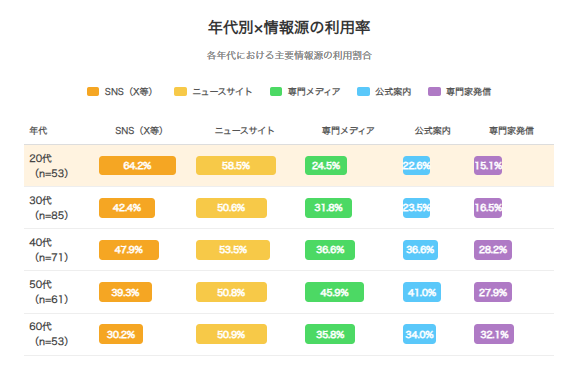
Age Bracket | Social Media (X, etc.) | News Sites | Specialized Media | Official Guidance | Expert Commentary |
|---|---|---|---|---|---|
In their 20s (n=53) | 34 (64.2%) | 31 (58.5%) | 13 (24.5%) | 12 (22.6%) | 8 (15.1%) |
In their 30s (n=85) | 36 (42.4%) | 43 (50.6%) | 27 (31.8%) | 20 (23.5%) | 14 (16.5%) |
In their 40s (n=71) | 34 (47.9%) | 38 (53.5%) | 26 (36.6%) | 26 (36.6%) | 20 (28.2%) |
In their 50s (n=61) | 24 (39.3%) | 31 (50.8%) | 28 (45.9%) | 25 (41.0%) | 17 (27.9%) |
In their 60s (n=53) | 16 (30.2%) | 27 (50.9%) | 19 (35.8%) | 18 (34.0%) | 17 (32.1%) |
The age-group analysis reveals that younger investors face greater vulnerability regarding the credibility of the information they rely on.
Among investors in their 20s, 64.2% get information from social media — by far the highest figure across all age groups.
At the same time, only 22.6% refer to official guidance, the lowest share of any age group, suggesting a pattern of relying on less reliable information sources has taken hold.
While younger investors tend to prioritize trend-driven information, over-reliance on social media is risky for the practical work of filing taxes, which carries legal obligations.
Notably, only 15.1% of those in their 20s check expert commentary, leaving them especially vulnerable to misinterpretation or misinformation.
In the pursuit of convenience, the defensive perspective of tax-audit risk appears to be overlooked — a point that should not be ignored.
41.2% of Low-Confidence Investors Struggle to Judge Whether Filing Is Required
Understanding the Rules and Making the Right Judgment Are the Top Priorities
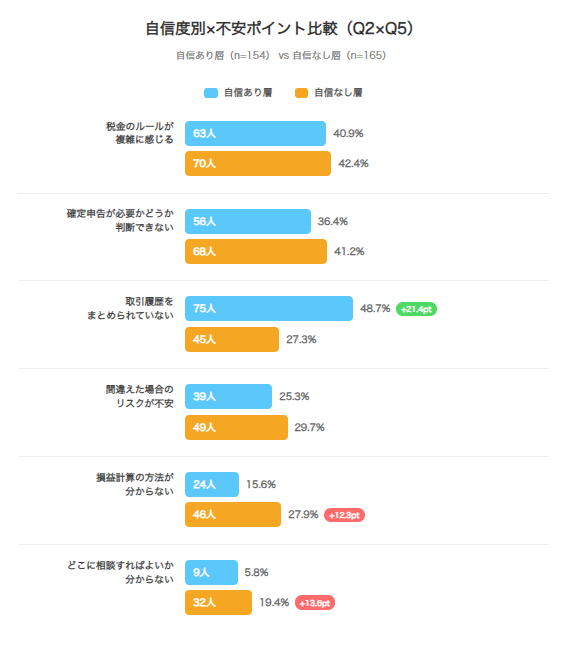
Point of Concern | Low-Confidence Group (n=165) | Share | Confident Group (n=154) | Share |
|---|---|---|---|---|
The tax rules feel complex | 70 | 42.4% | 63 | 40.9% |
Cannot judge whether filing is required | 68 | 41.2% | 56 | 36.4% |
Worried about the risk of making a mistake | 49 | 29.7% | 39 | 25.3% |
Don't know how to calculate gains and losses | 46 | 27.9% | 24 | 15.6% |
Haven't organized transaction history | 45 | 27.3% | 75 | 48.7% |
Don't know where to consult | 32 | 19.4% | 9 | 5.8% |
Investors who answered "confident" or "somewhat confident" about filing taxes on crypto assets accounted for only 45.9% combined.
This reveals that more than half of investors continue to trade while harboring some degree of anxiety about their own filing practices.
Notably, those in the "not confident" camp reached 49.2% in total, meaning roughly one in two respondents recognizes a gap in their own knowledge.
Because crypto assets are classified as miscellaneous income for tax purposes, the complexity of the calculation method appears to be a major factor raising the psychological barrier.
A certain number of respondents also said they are "unable to judge," suggesting some may not have had sufficient opportunity to engage with the system itself.
For investors to keep building assets in a sustainable way, boosting tax literacy — not just trading skill — is becoming an urgent priority.
Even Among Confident Investors, 48.7% Struggle to Organize Their Records
Information Source | Low-Confidence Group (n=165) | Share | Confident Group (n=154) | Share |
|---|---|---|---|---|
News sites | 85 | 51.5% | 83 | 53.9% |
Social media (X, YouTube, TikTok, etc.) | 78 | 47.3% | 58 | 37.7% |
Guidance from exchanges or official services | 50 | 30.3% | 64 | 41.6% |
Specialized crypto media | 48 | 29.1% | 66 | 42.9% |
Posts by tax accountants or accounting professionals | 31 | 18.8% | 49 | 31.8% |
Barely gathers information at all | 21 | 12.7% | 10 | 6.5% |
Cross-analyzing the relationship between confidence in tax filing and information sources reveals a decisive structural gap in information quality.
Among the low-confidence group, 47.3% cite social media as their main source, a notably high figure that points to reliance on easily accessible information.
Meanwhile, only 30.3% refer to the more reliable official service guidance, a wide gap compared with the confident group (41.6%).
The less confident an investor is, the more they appear to prioritize ease of understanding over accurate primary information, which increases the risk of encountering inaccurate information.
Ironically, staying distant from accurate official information may itself be a root cause preventing these investors from building confidence.
Rather than being swayed by uncertain secondary information, developing the habit of accessing official standards and expert knowledge is arguably the surest path to resolving filing-related anxiety.
The True Source of Anxiety Is the Judgment Standard: 41.2% Struggle to Determine Whether Filing Is Required
Investors Are Stuck Before They Even Reach the Practical Work
Point of Concern | Low-Confidence Group (n=165) | Share | Confident Group (n=154) | Share |
|---|---|---|---|---|
The tax rules feel complex | 70 | 42.4% | 63 | 40.9% |
Cannot judge whether filing is required | 68 | 41.2% | 56 | 36.4% |
Worried about the risk of making a mistake | 49 | 29.7% | 39 | 25.3% |
Don't know how to calculate gains and losses | 46 | 27.9% | 24 | 15.6% |
Haven't organized transaction history | 45 | 27.3% | 75 | 48.7% |
Don't know where to consult | 32 | 19.4% | 9 | 5.8% |
For investors lacking confidence, the anxiety is concentrated in the "judgment" stage before the work even begins.
41.2% of the low-confidence group are troubled by whether filing is required, finding the complexity of the rules to be a barrier.
Not being able to apply a clear standard to their own situation is the single biggest obstacle preventing them from filing.
The clearest gap with the confident group appears in their understanding of calculation methods.
27.9% of the low-confidence group struggle with how to calculate figures, showing that skill level is what separates confidence from doubt.
A high proportion also don't know where to consult, and this sense of isolation further amplifies their anxiety.
Acquiring knowledge from accurate sources and securing a place to consult are the keys to moving practical work forward.
Since an early misjudgment can lead directly to tax risk, a careful approach based on official information is essential.
Having solid grounds to stand on is the first step toward continuing to invest with confidence.
Even Confident Investors Struggle to Organize Their Records
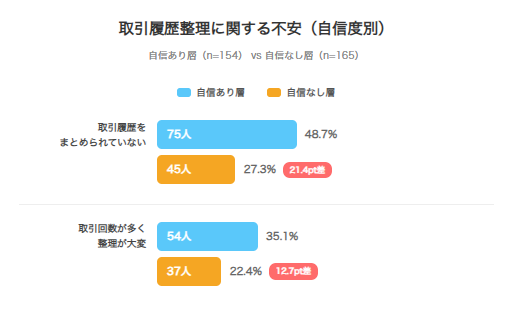
Current State of Transactions | Low-Confidence Group (n=165) | Share | Confident Group (n=154) | Share |
|---|---|---|---|---|
Haven't organized transaction history | 45 | 27.3% | 75 | 48.7% |
Too many transactions to organize easily | 37 | 22.4% | 54 | 35.1% |
Organizing transaction history is a shared challenge for all investors, regardless of confidence level.
48.7% of the confident group see record-keeping as a concern, a figure far exceeding that of the low-confidence group.
This suggests that investors with more knowledge have actually begun the work and are confronting the wall of massive data aggregation.
While 35.1% of the confident group find the sheer number of transactions burdensome, only 22.4% of the low-confidence group feel the same.
The low-confidence group tends to be stuck due to unclear rules, while the confident group is more concerned about management costs.
It's clear that the nature of the concerns investors face shifts significantly depending on their investment stage.
Reducing this burden will require further advances in data integration and automated calculation tools.
Introducing more efficient management methods would allow investors to focus their resources on their core investment activities.
Building an environment where technology solves this practical work is the foundation for staying engaged in the market.
Households Earning Over ¥10 Million Are Especially Wary of Risk
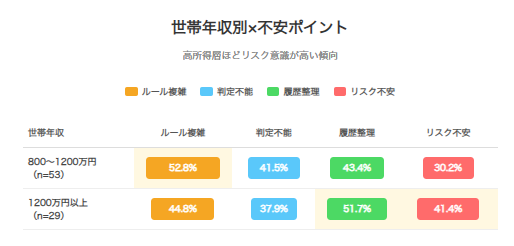
Household Income | Rules Feel Complex | Unable to Judge | Record Organization | Risk Concerns |
|---|---|---|---|---|
¥8M–¥12M (n=53) | 52.8% | 41.5% | 43.4% | 30.2% |
¥12M and above (n=29) | 44.8% | 37.9% | 51.7% | 41.4% |
As income levels rise, concern about tax rules and risk awareness both tend to strengthen.
In the ¥8 million–¥12 million household income band (roughly USD 53,000–80,000, at an approximate reference rate of ¥150/USD), 52.8% expressed concern about the rules — the highest of any income bracket.
Among those earning ¥12 million (roughly USD 80,000) or more, risk-related anxiety reaches 41.4%, about double that of lower-income brackets.
Concern about organizing records is also notably high in the ¥12 million-plus bracket, at 51.7%.
The more funds an investor manages across diverse strategies, the more limited a self-managed, DIY approach to tracking becomes.
This likely reflects a protective instinct that grows stronger as investors seek more precise handling of larger portfolios.
High-income investors and those with large positions need specialized individual support and advanced management tools.
Filing accurately is directly tied to protecting one's own assets and maximizing investment performance.
Expanding appropriate support systems is likely to contribute to greater trust across the market as a whole.
Judging the Accuracy of Information Is the Biggest Barrier: 47.2% Are Unsure Whether Information Is Correct
Lack of Trust Gets in the Way of Understanding
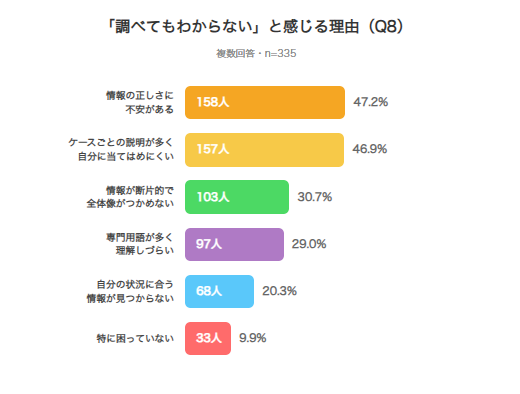
Reason | Respondents (n=335) | Share |
|---|---|---|
Uncertain whether the information is accurate | 158 | 47.2% |
Too many case-by-case explanations, hard to apply to my own situation | 157 | 46.9% |
Information is fragmented, hard to grasp the full picture | 103 | 30.7% |
Too much jargon, hard to understand | 97 | 29.0% |
Can't find information that matches my own situation | 68 | 20.3% |
Not particularly troubled | 33 | 9.9% |
Even after gathering information about tax filing, many investors don't come away feeling reassured — and behind this lies a distrust of "information quality."
The survey found that the most common reason was "uncertain whether the information is accurate," cited by 47.2% of respondents.
While an enormous volume of explanations exists online, judging their credibility has become a major burden for investors.
Crypto asset taxation is complex, and outdated information or misinterpretations are, in reality, common on social media and personal blogs.
Investors with larger gains tend to be especially cautious about which information to trust, fearing penalties from an incorrect filing.
The more information one gathers, the more one can fall into the paradox of not knowing which answer is "correct."
Ultimately, what investors want isn't the "quantity" of information but its "reliability."
Rather than relying on uncertain secondary sources, they should refer to well-supported information such as National Tax Agency (NTA) guidance or the advice of tax professionals.
Securing a reliable source of information is arguably the shortest path to resolving the uncertainty around filing.
46.9% Say the Information "Doesn't Apply to Them"
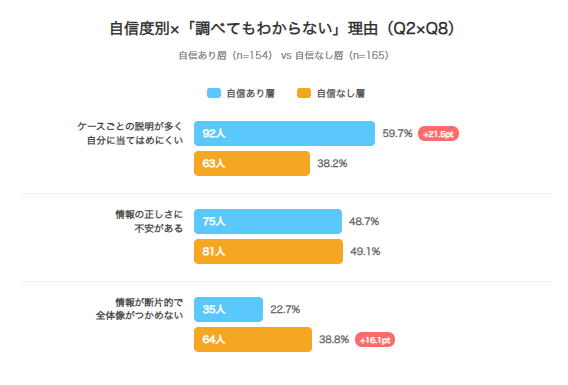
Reason (by Confidence Level) | Confident Group (n=154) | Share | Low-Confidence Group (n=165) | Share |
|---|---|---|---|---|
Too many case-by-case explanations, hard to apply to my own situation | 92 | 59.7% | 63 | 38.2% |
Uncertain whether the information is accurate | 75 | 48.7% | 81 | 49.1% |
Information is fragmented, hard to grasp the full picture | 35 | 22.7% | 64 | 38.8% |
The difficulty of applying general information to individual cases is another major factor troubling investors.
Overall, 46.9% cited "too many case-by-case explanations, hard to apply to my own situation" as a barrier.
This figure is especially high — 59.7% — among the confident group, a clear sign that the deeper investors get into practical work, the more they struggle with how to apply the rules to their own individual case.
As new forms of trading such as DeFi and NFT (Non-Fungible Token) transactions increase, general explanatory articles alone are increasingly unable to cover every scenario.
Precisely because confident investors are engaged in detailed calculations, they struggle with how to apply existing rules to their own trades.
Meanwhile, the low-confidence group cites fragmented information (38.8%) as a challenge, struggling instead to grasp even the basic overall picture.
Uniform information alone cannot cover the full diversity of investment styles.
Demand is likely to keep growing for calculation tools that can accurately reflect individual transaction histories, as well as environments that allow for individual consultation.
Building a system that helps each investor find "the right answer for them" is essential to raising the overall filing rate across the market.
Beginners Struggle Most at the Information Entry Point
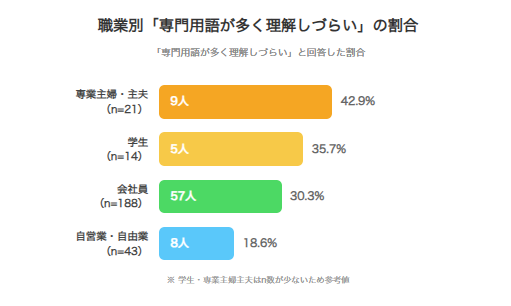
By Occupation (Barrier of Technical Jargon) | Respondents | Share |
|---|---|---|
Company employees (n=188) | 57 | 30.3% |
Self-employed / freelance (n=43) | 8 | 18.6% |
Full-time homemakers (n=21) | 9 | 42.9% |
Students (n=14) | 5 | 35.7% |
The difficulty of the information itself — particularly the barrier of technical jargon — has also emerged as a notable challenge.
Overall, 29.0% of investors said they cannot fully absorb information because "there is too much jargon, making it hard to understand."
This figure is especially high among full-time homemakers, at 42.9%, showing that the difficulty of accessing information varies significantly by occupation.
Self-employed and freelance workers, who are typically already familiar with filing tax returns, report a low figure of 18.6%, but for those unfamiliar with the process, the terminology itself is a source of pain.
Tax terms such as "moving average method" and "total average method" act as the first filter blocking comprehension.
Providing beginner-friendly, simplified explanations and intuitive tools is essential to widening access.
Balancing "ease of understanding" with "accuracy" of information is a major challenge for media outlets and service providers alike.
Rather than eliminating technical terms altogether, an approach that carefully explains them using diagrams and concrete examples is what readers need.
Lowering the entry barrier should help more investors gain access to accurate tax knowledge.
Strong Demand for Expert "Sign-off": 46.1% Want Third-Party Confirmation
The Psychology of Investors Who Can't Feel Certain
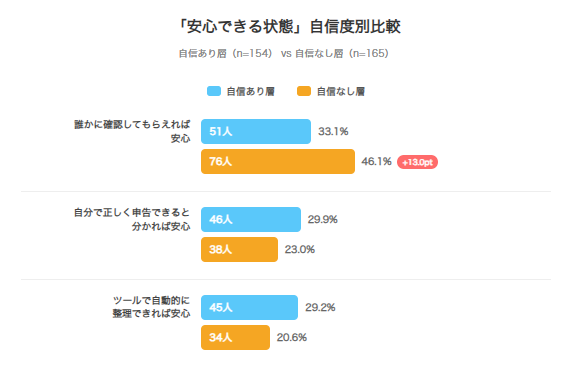
What Would Provide Reassurance | Low-Confidence Group (n=165) | Share | Confident Group (n=154) | Share |
|---|---|---|---|---|
Reassured if someone else could check it | 76 | 46.1% | 51 | 33.1% |
Reassured if I knew I could file correctly myself | 38 | 23.0% | 46 | 29.9% |
Reassured if a tool could organize things automatically | 34 | 20.6% | 45 | 29.2% |
What investors ultimately want when filing their taxes is third-party "validation of correctness."
46.1% of the low-confidence group answered "reassured if someone else could check it," the highest figure of any item across the survey.
Even after gathering information online, an underlying anxiety about whether their own case is legally correct is clearly visible.
Meanwhile, even in the confident group, 33.1% seek confirmation from others, showing that fear of making a mistake remains strong regardless of knowledge level.
An orientation toward resolving things independently reaches 29.9% in the confident group, exceeding the low-confidence group (23.0%).
Regardless of knowledge level, a shared psychological need is to entrust the final "answer-checking" to an outside party.
What media and service providers should offer is not simply a list of information, but "two-way support."
Mechanisms that address practical anxieties — such as individual consultations or bridges to tax accountants — help build a sense of security.
Preventing isolation and creating an environment where investors can file with confidence is essential to the sustained maturation of the market.
A Temperature Gap in Expectations for Tools
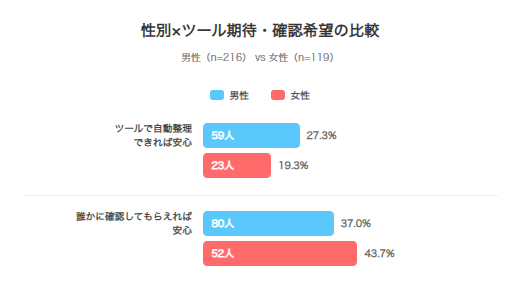
By Gender (Expectations for Tools) | Male (n=216) | Share | Female (n=119) | Share |
|---|---|---|---|---|
Reassured if a tool could organize things automatically | 59 | 27.3% | 23 | 19.3% |
Reassured if someone else could check it | 80 | 37.0% | 52 | 43.7% |
Expectations for automation tools clearly differ depending on investors' confidence level and other attributes.
"Reassured if a tool could organize things automatically" reached 29.2% among the confident group.
Among the low-confidence group, by contrast, it stood at only 20.6%, showing a preference for consulting a "person" over a technical solution.
By gender, 27.3% of men support using tools, compared with only 19.3% of women.
43.7% of women want "someone to check it," placing greater weight on face-to-face or interactive reassurance.
The needs of investors seeking efficiency and those seeking guaranteed oversight are clearly polarized.
Technical solutions are important, but they may not be sufficient on their own to provide psychological reassurance.
Going forward, hybrid support that combines the convenience of automated calculation with expert oversight will likely be needed.
Building a multifaceted support system tailored to each individual's literacy and preferences remains a challenge for the industry.
30.6% of Investors in Their 30s Are Concerned About Risk
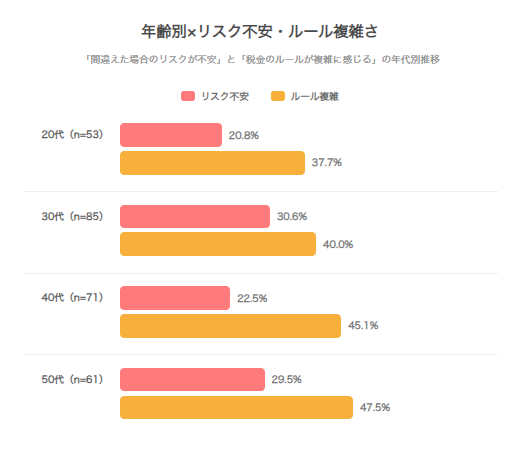
Age (Risk of Making a Mistake) | In Their 20s (n=53) | In Their 30s (n=85) | In Their 40s (n=71) | In Their 50s (n=61) |
|---|---|---|---|---|
Worried about the risk of making a mistake | 20.8% | 30.6% | 22.5% | 29.5% |
The tax rules feel complex | 37.7% | 40.0% | 45.1% | 47.5% |
Wariness about the tax risk of filing errors tends to run especially high among investors in their 30s and 50s.
30.6% of investors in their 30s cite concern about "the risk of making a mistake," reflecting the caution typical of the asset-building phase of life.
From their 40s onward, over 40% cite "the complexity of the rules" as a concern, showing that the barrier of understanding the system becomes more pronounced.
Investors in their 20s, the youngest group, show the lowest risk concern at 20.8%, suggesting a weaker sense of alarm about potential scrutiny from tax authorities.
This correlates with the social-media dependency noted earlier, pointing to a lack of attention to information accuracy.
Because the nature of concerns differs by generation, targeted awareness efforts tailored to each age group are needed.
While the desire to "file correctly" is shared across all generations, the barriers preventing it vary widely.
After helping investors correctly recognize the risks, concrete means of avoiding them should be presented.
Strengthened public-private information provision is needed so that all investors can achieve legal transparency.
Summary
This survey reveals that investor confidence in filing taxes on crypto assets is closely tied to the quality of the information sources they rely on.
In particular, 47.3% of investors who lack confidence in tax filing rely primarily on social media, and this dependence on easily accessible secondary information appears — ironically — to be amplifying their vague sense of anxiety rather than resolving it.
Confident investors, by contrast, reference official guidance and expert knowledge at a rate of 41.6% or higher, making it clear that the habit of engaging with accurate primary information is linked to confidence in filing.
The fact that the top reason investors fail to resolve their questions even after researching is "uncertainty about whether the information is correct" (47.2%) symbolizes a broader credibility challenge facing the market as a whole.
Investors who lack confidence tend to get stuck at the initial stage — figuring out how to calculate gains and losses or whether filing is even required — and carry an earnest need to have someone confirm their approach.
By contrast, confident investors face the practical challenge of organizing complex transaction histories, showing that the nature of investors' concerns changes clearly depending on their investment stage.
Ultimately, dispelling anxiety about tax filing requires more than fragmented social-media information — it requires the process of applying reliable official sources and expert opinions to one's own individual transactions.
Operating on the basis of "this is what's officially established," rather than "someone said so," is the only way to avoid future tax risk and continue investing with peace of mind.
Going forward, alongside individual investors' efforts to raise their own literacy, the industry as a whole needs to build an environment where everyone can easily access expert knowledge and accurate calculation tools.
Note on the current tax framework (as of July 2026): Under Japan's current rules, gains from selling crypto assets are taxed as miscellaneous income under aggregate (progressive) taxation, and losses can be offset only against other miscellaneous income — not against employment income or other income categories. On July 15, 2026, revisions to the Financial Instruments and Exchange Act (FIEA) passed the House of Councillors, reclassifying crypto assets as financial instruments under the FIEA; a flat 20% separate self-assessment tax rate is expected to take effect starting the year after the revised law is enforced (projected January 2028).
Survey Overview
Survey date: February 24, 2026
Survey method: Internet survey
Survey target: Men and women residing in Japan (those currently investing in crypto assets, or who have invested in the past)
Valid responses: 335
Conducted by: Clabo Inc.
Survey Questions
- Have you ever used crypto assets (virtual currencies)?
- Please indicate which best describes your current level of confidence regarding tax filing for crypto assets.
- Please indicate which points, if any, apply to specific concerns you have about tax filing for crypto assets.
- How do you typically gather information about tax filing for crypto assets?
- Please indicate which reasons, if any, apply to why you feel you "don't fully understand" tax filing for crypto assets, even after researching it.
This article is for informational purposes only and does not constitute financial or investment advice. Please consult a qualified professional before making investment decisions.


